Fleabane

P80513Erigeron karvinskianus

Is it really supposed to be the bane of fleas? If so, why? I learned it as Santa Barbara daisy. Is it native there, or was a particular variety of it named for Santa Barbara? Is it a weed? Is it native? Is it a native of somewhere else in California that merely naturalized here? There are so many questions about this simple little flower that is growing wild under a cyclone fence at the backside of a motorcourt at work.

Whether it really is native or not, or whether it is a straight species or a selected variety of one, fleabane happens to do well in drought tolerant landscapes composed of native plants. It naturally spreads out to form shallow but wide mounds. If it gets cut back in its off season, it comes right back. Although it dies after only a few years, lower stems typically form roots and grow into new plants before the original one dies, essentially replacing itself before anyone notices.

If it is a weed, it is polite about it. Stray plants that appear where they are not wanted are easy to get rid of, and do not regenerate too aggressively to be managed. Those that happen to appear in out of the way situation can be left to bloom without much concern of profuse seed dispersion. Weed or not, it is preferred to other nastier weeds that it might prevent from growing simply by occupying the space.

It happens to grow in my planter box downtown. ( https://tonytomeo.wordpress.com/2017/11/04/my-tiny-downtown-garden/ https://tonytomeo.wordpress.com/2018/01/06/six-on-saturday-my-downtown-planter-box-again-and-up-close-this-time/ ) I certainly did not plant it. It was there long before my time, and remain, even if merely in a minor degree, just in case the person who planted it years ago ever stops by to check in on it.

San Francisco Iris II – the Expected Sequel

P80512KIt is not as if the previous article about it was inadequate. https://tonytomeo.wordpress.com/2018/05/05/san-francisco-iris/ I really did not want to get into the habit of writing so many sequels. However, something happened to necessitate this update.

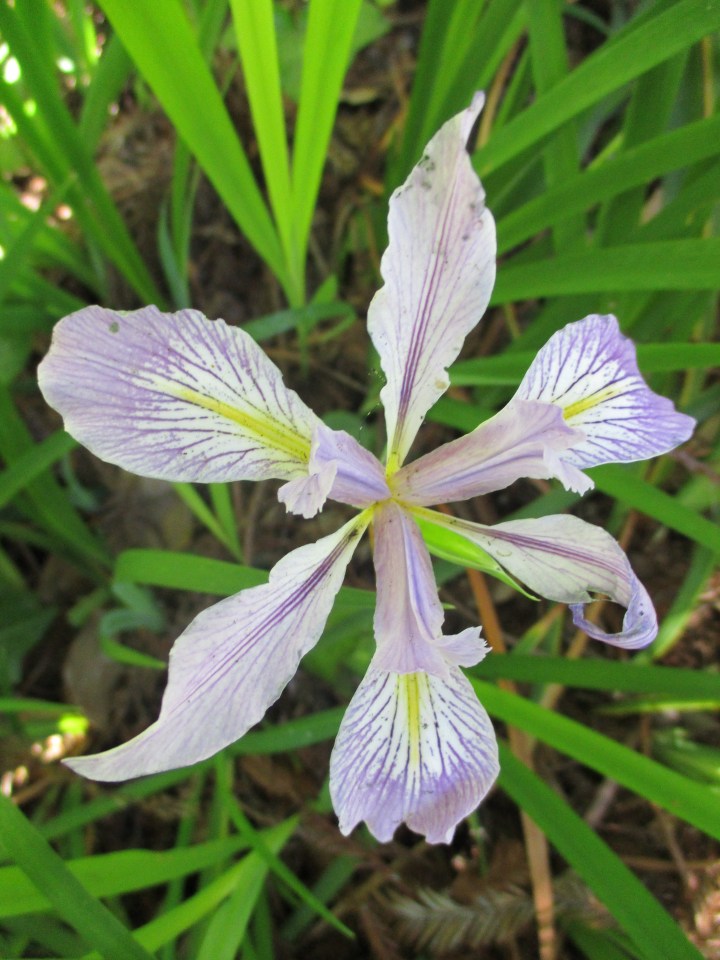
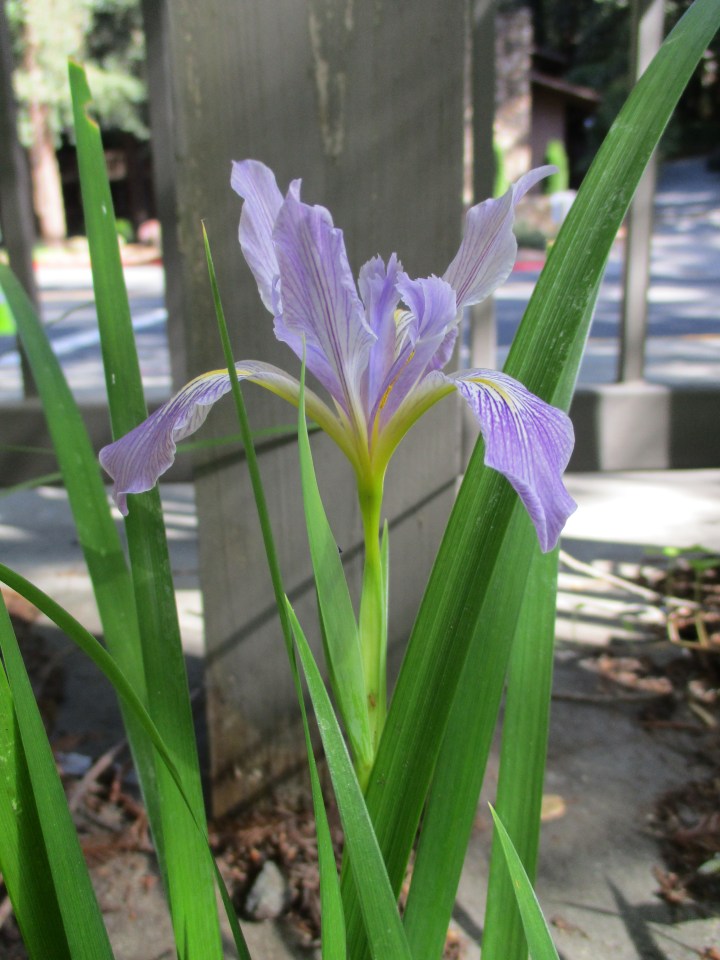
I found what seems to be a REAL San Francisco Iris, right here in the Santa Cruz Mountains. Except for being somewhat etiolated from the shade of the surrounding redwoods, it looks very similar to the San Francisco iris I picked on the Montara Peaks when I was in high school! This one happens to be a bit lighter blue than most, but is certainly well within the color range of the flowers that I remember. Most were probably a bit darker blue, but many were lighter, and some were very pale blue.

It is impossible to know if it was planted in this spot that had been landscaped in the distant past, or merely grew wild. It is right down the road from the more colorful cultivars that I got pictures of earlier. It only recently bloomed on rather grassy foliage that was easy to miss.

I know it does not look like much, but I prefer it to the fancier garden cultivars of the same specie, Iris douglasiana. (It is not the ‘San Francisco’ cultivar of bearded iris.) It is what I am familiar with, and exemplifies the species. Besides Montara, I remember it from San Bruno Mountain, Angel Island and Alcatraz. I might have seen it in the Oakland Hills and on Point Reyes too, but I am not certain if they really were the same.

The bearded iris from my great grandmother’s garden will always be my favorite. https://tonytomeo.wordpress.com/2017/09/10/roots/ However, these San Francisco iris and I have too much history together to ignore.P80512K+

Six on Saturday: Tree Ring Circus


When a tree falls in a forest and there is no one around to hear, it makes a big noise, as well as a mess, and it leaves some if its root in the ground. If a redwood tree falls in a forest, and there is no one around to hear, it is probably better that way. It wold be dangerous to be too close to a redwood when it comes down! They are so big and tall, and are typically so crowded amongst other trees, that they bring down tons of debris with them.

Falling redwoods are rare. They live for centuries or thousands of years. Yet, sooner or later it happens. In more modern history, after the ecology of the redwood groves was disrupted by extensive harvesting, redwoods sometimes get killed by forest fires. (Redwoods are some of the few trees in California that survive forest fires by being fire retardant, but can be killed if enough of the more combustible trees around them burn hotly enough. Extensive harvesting allowed more of the other combustible trees to mix into redwood forests than would normally be there.)

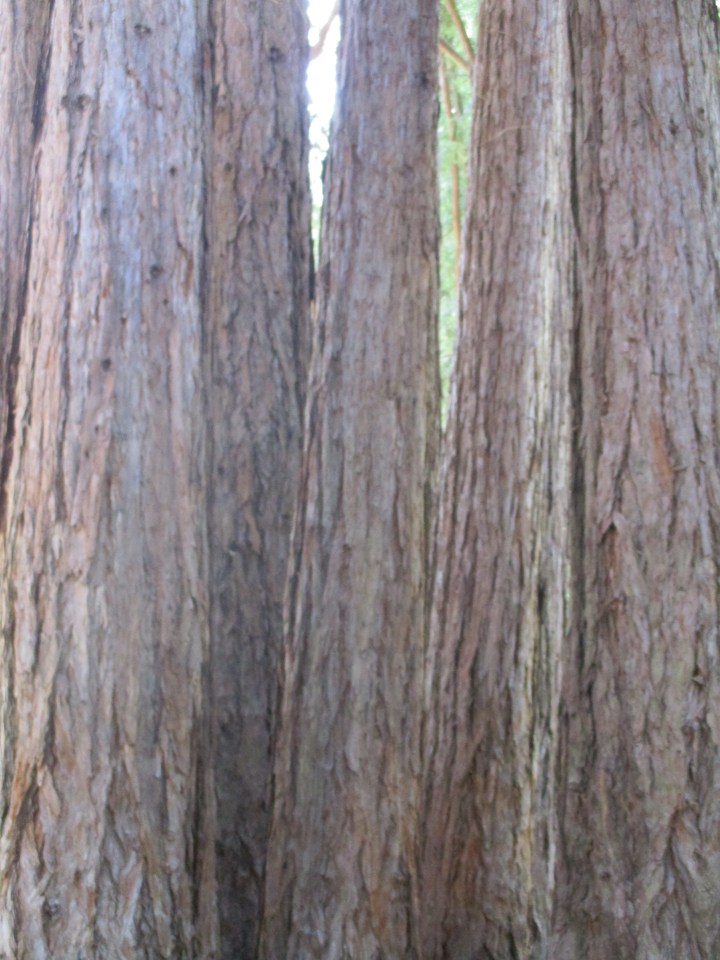
The one thing that redwoods do even less frequently than fall is die. Even after they fall, burn to ‘death’ or get cut down, they regenerate from their stump or roots. Sometimes, several or many genetically identical new trees that are all attached to the same root system develop around a dying parent before it falls. They sometimes do so after a parent burns or gets cut down. Eventually, the original tree decays, leaving a circle of new trees around where it once was. Outsiders often refer to them as ‘fairy rings’. To us, they are just tree circles or rings. Larger and more impressive circles might be known as ‘chapels’ or better yet, ‘cathedrals’.

They are impressive features in the forests. When the area nearby gets landscaped, they are typically ignored because they are so excellent that they can not be improved. There are not many plants that live in the debris of redwoods anyway.

1. This is a nice small but crowded chapel where I work.P80512
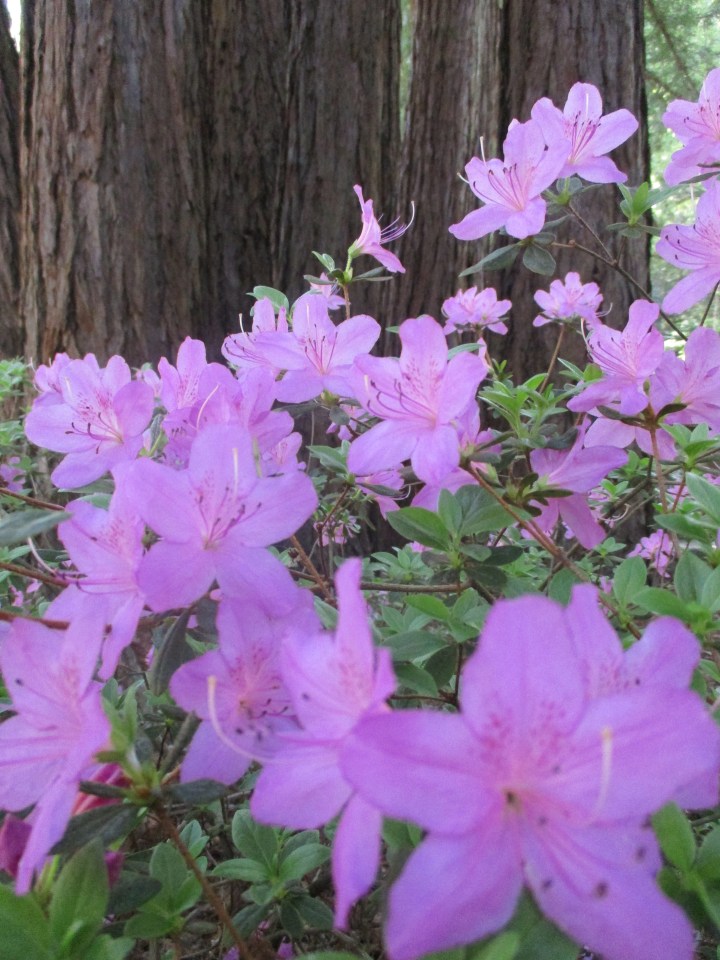
2. How does such a chapel get landscaped? It doesn’t. Ours happens to have a nice patch of azaleas nearby. This picture was taken earlier. Bloom finished a while ago.P80512+
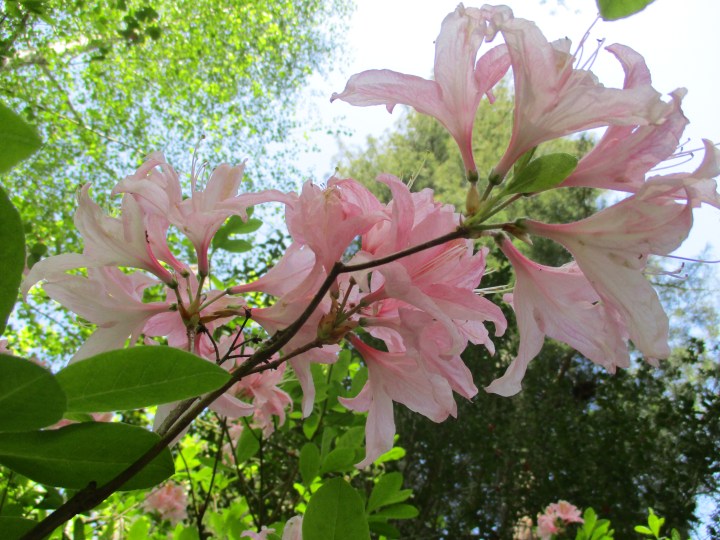
3. These azaleas are just so excellent that I had to get a better picture to show them off.P80512++
4. Forget-me-not happens to be one of those few plants that does not mind light redwood litter, so we often let it grow and bloom if it shows up in a good spot.P80512+++
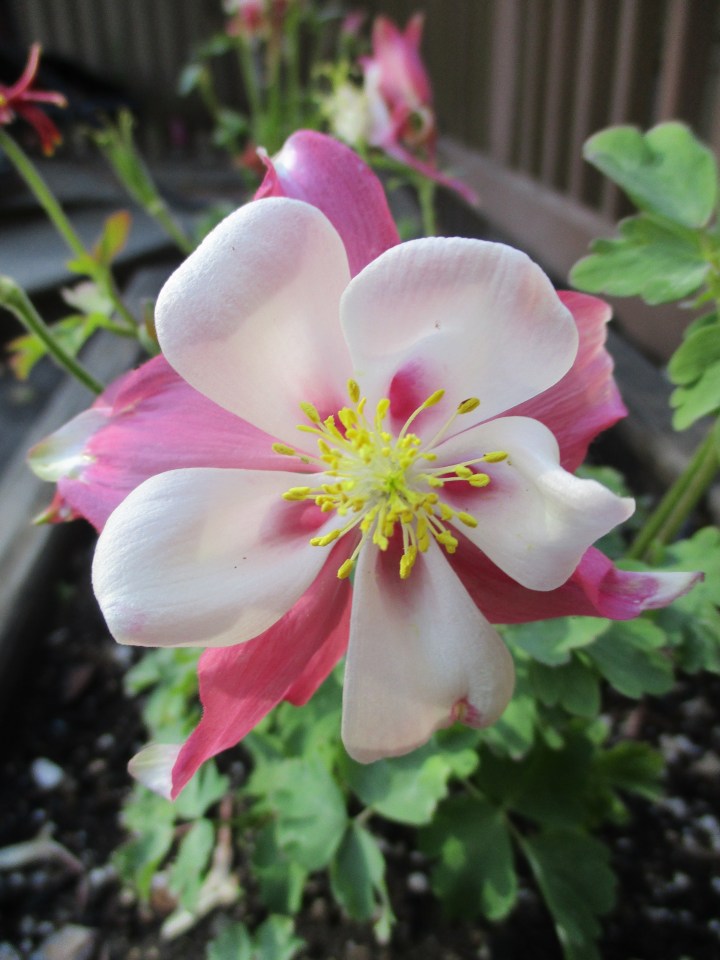
5. Columbine just seems to look good with redwoods for some reason, but it dislikes the litter. This columbine is in a nearby planter that does not get much litter.P80512++++
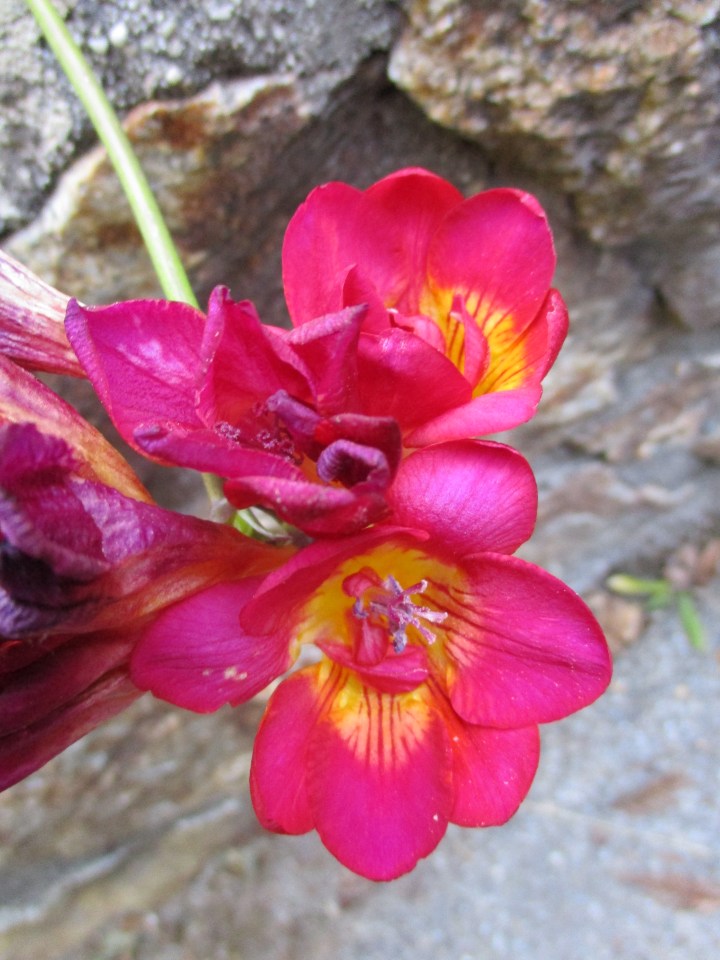
6. I can not explain the red freesias that bloom earlier in spring. There are yellow and purple ones too. No one knows where they came from, but they do not seem to be bothered by a bit of redwood litter.P80512+++++This is the link for Six on Saturday, for anyone else who would like to participate:

https://thepropagatorblog.wordpress.com/2017/09/18/six-on-saturday-a-participant-guide/

Deciduous Rhododendrons

P80509They are not a myth. They are quite real. So are the related and similar deciduous azaleas. There are certainly not as popular or as diverse as the familiar evergreen cultivars, but they have their place.

Like the popular evergreen cultivars, deciduous rhododendrons and azaleas have been extensively bred so that they are more spectacular than their ancestors in the wild. They lack the purples and blues of the evergreens, but they compensate with bright oranges and yellows that are uncommon among the evergreen cultivars, as well as reds, pinks and whites. Some of their colors are bright and fiery, while some are more relaxed. Compared to evergreen rhododendrons, the flowers of the deciduous rhododendrons are smaller, thinner, and suspended in smaller trusses. However, these smaller trusses are often significantly more abundant, and are flashier as they bloom before new foliage develops in spring.

Deciduous rhododendrons and azaleas are not grown for the foliar color in autumn, but where autumn weather is cold enough, their foliage can color somewhat well. It is mostly clear yellow, but can sometimes turn orange before falling away cleanly, leaving neatly bare stems through winter.

What deciduous rhododendrons and azaleas excel at that their evergreen counterparts can not compete with is their fragrance. Many are moderately fragrant. Some are VERY fragrant. It is rare that such showy flowers are also so fragrant. (Most flowers rely on one technique or another to attract pollinators.)

Now that the evergreen rhododendrons are blooming, our few deciduous rhododendrons are just about finishing. Visitors often ask about the fragrance, since they do not expect fragrance from rhododendron or azalea flowers, even though they can see little else blooming in same area. These flowers are so popular that we would like to plant more near windows of meeting rooms.P80509+(The article from my weekly gardening column that is typically posted on Thursday was posted yesterday, which is why this article, which is more appropriate for Wednesday is posted today.)

Sport

P80506Not just any sport; a witch’s broom sport! Remember the quidditch tournament of the first Harry Potter Movie? Well, it has nothing to do with that. You should not be watching such movies anyway.

This sort of ‘sport’ is merely a genetic variant growth. This particular sport happens to be known as a ‘witch’s broom’.

There is quite a variety of other sports.

Sometimes, a plant is going along minding its own business, when all of a sudden, it produces a stem with variegated leaves. Unlike the plain green leaves on the rest of the plant, the leaves on the sport are outfitted with white margins. In the wild, such a sport would probably not last long. Since it has less chlorophyll than the unvariegated foliage, it would grow slower, so would eventually be overwhelmed and shaded out by the more vigorous greener foliage. However, if someone happens to find this variegated sport, and determines that the variegation might be an attribute, it can be propagated as a new variegated cultivar of the species.

Sometimes, a plant is going along minding its own business, when all of a sudden, it produces a stem with bronzed foliage, or gold foliage, or leaves that are shaped differently from those on the rest of the plant. Perhaps new stems are more pendulous than they normally are. Sometimes, growth is more compact. It might even be rather stunted and disfigured, branching into a tuft of densely arranged twiggy stems known as a ‘witch’s broom’.

Such growth does not look like a witch’s broom for very long. As it grows, it develops into a densely shrubby mass that eventually gets too heavy to be supported. If the dense growth is appealing, it can be propagated as a new cultivar, like the dwarf Alberta spruce was reproduced from a witch’s broom sport of the common white spruce, or the pencil point juniper was reproduced from a witch’s broom sport of the common juniper (Juniperus communis ‘Compressa’).

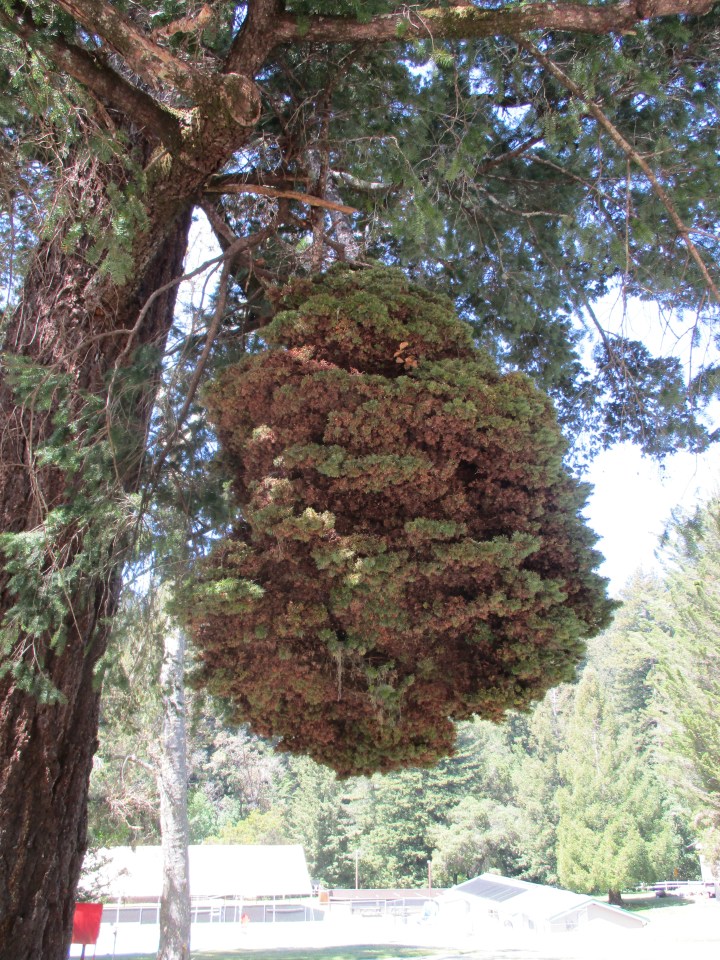
This massive witch’s broom happens to be on a Douglas fir. It has been here for decades. It sure is ugly, but also interesting. It could be interesting enough to be reproduced.

San Francisco iris

P80505KThere really is a bearded iris that happens to be named ‘San Francisco’. It is related to ‘Los Angeles’, but not ‘San Jose’. (I really want to find a copy of ‘San Jose’ for my own garden!) Both ‘San Francisco’ and ‘Los Angeles’ are white with a slight blue highlight, and an even slighter reddish edge that is easy to miss. I can not remember which one of the two is whiter than the other, but the whiter one may lack the reddish edge altogether.

The San Francisco iris I remember is something completely different. It is a native west coast iris, Iris douglasiana (or douglasii or any other variation of ‘douglas‘ that any particular botanist happen to prefer) that happens to be endemic to the coastal region of San Mateo County south of San Francisco, and was probably endemic to San Francisco County as well. It would be difficult to identify the entire range, because San Francisco iris is merely a variety, rather than a species. The species has a much larger range. Some might say that the same species in Sonoma or Monterey Counties is also San Francisco iris, just because it happens to bloom with a similar color range.

Well, then there is the issue of the color range. Most varieties of other specie are a particular color. Those that have a range of color at least exhibit a distinct color range that is somehow special and different from everything else. The San Francisco iris does not. It is always blue, but might be any shade or hue between very pale blue and rather dark new denim blue. Not only is that a broad range of color, but it is not very distinctive from the same species hundreds of miles away.

So why do we know it as ‘San Francisco iris’? I really do not know. Perhaps it is just something for us to brag about.

Over the years, west coast iris has been bred to bloom with larger flowers with more of a color range. I am sorry that I did not get more pictures while they were blooming. Besides the more common shades and hues of simple blue, they can bloom in various shades and hues of purple, violet, yellow, gold and white. They are still as undemanding as their ancestors are, and once established, do not need much attention at all.P80505K+

Six on Saturday: Azaleas


There is just too much blooming this time of year to fit it all into one Saturday. These azaleas were blooming quite some time ago, and these pictures are at least a week old. Some might be almost two weeks old. I just could not use them last week because there were still camellias to show off.

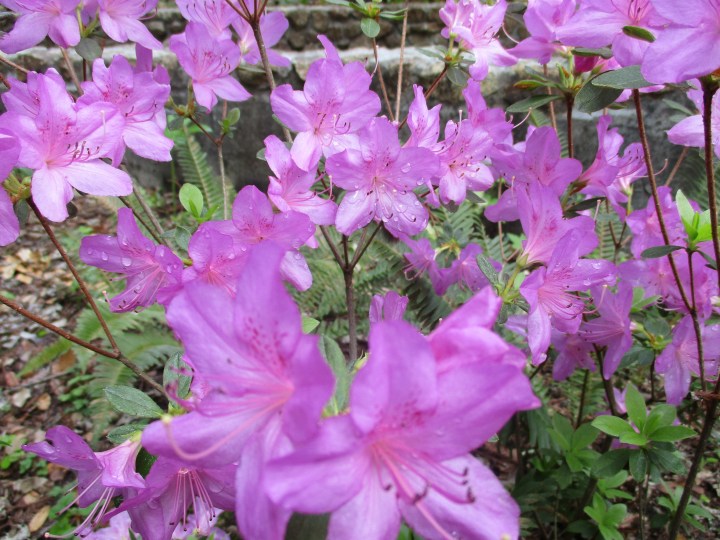
1. What this one lacks in profusion, it compensates for with large flower size. We used to grow one that looked like this but perhaps with slightly richer color. It was known as ‘Phoenicia’. It was a bit too garish for my taste.P80505
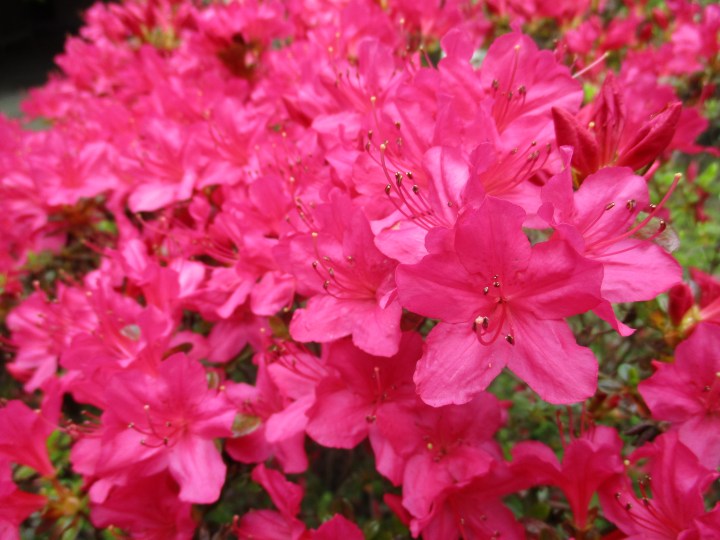
2. These flowers are smaller, but seriously more profuse. In fact, they are so profuse that, like #4, #5 and #6, the foliage is barely visible behind so many flowers. It is garish too, but I rather like this particular flavor of color.P80505+
3. Okay, so they are not as profuse, but they are such an excellently bright red. It looks like ‘Ward’s Ruby’ to be, but I can not be certain. All these azaleas look so different in this landscape than in production on the farm.P80505++
4. Not much foliage could be seen through these glowing flowers. They are more profuse than they look. They just do not seem so profuse because they are not dense. I do not know which cultivar to compare this one to.P80505+++
5. ‘Coral Bells’ has very profuse and very densely arranged tiny flowers. They form a layer over the exterior of the plant. Although I would say that these are more pink than coral, this cultivar is unmistakably ‘Coral Bells’.P80505++++
6. ‘Fielders White’ is the best that I saved for last. They are perfectly white medium sized flowers that are profuse enough to almost obscure the foliage, but not so profuse that the perfect form of the flowers is obscured.P80505+++++
This is the link for Six on Saturday, for anyone else who would like to participate:

https://thepropagatorblog.wordpress.com/2017/09/18/six-on-saturday-a-participant-guide/

May 2

P80502When I started writing this blog eight months ago, I reserved the right to occasionally write about topics that were irrelevant to horticulture and gardening. I designated the category of ‘elaborations’ for posts that were not from my weekly gardening column; but so far, I have tried to post articles within this category that were at least remotely relevant to horticulture, even if only to discuss a single tree, or merely a single ginkgo leaf that somehow appeared in Felton Covered Bridge Park.

Today is May 2. My post for today is only relevant to horticulture in that it explains the importance of the ‘Memorial Tree’ in Felton Covered Bridge Park.

Steven Michael Ralls passed away a year ago, on May 2, 2017

Jeffrey Dale Scofield passed away two years prior to that, on May 2, 2015

They were two of my most intimate friends. I wrote both obituaries. The obituaries are posted below, and are irrelevant to horticulture.

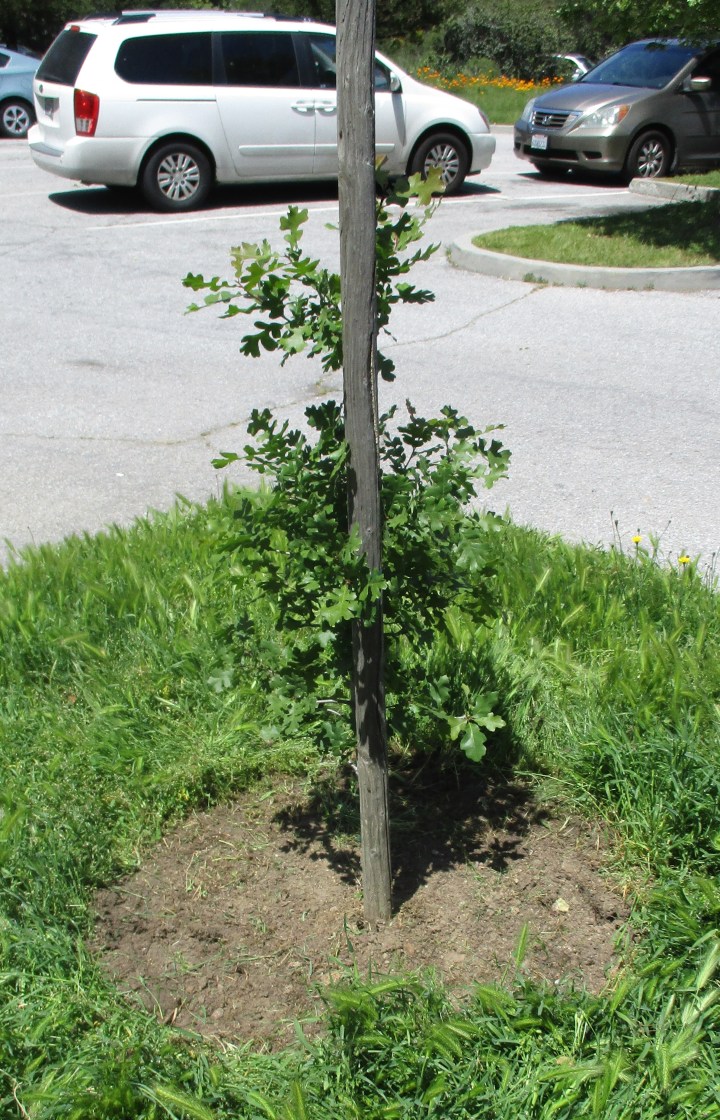
The small valley oak ‘Memorial Tree’ that was planted in Felton Covered Bridge Park was originally designated as the ‘Scofield Tree’. However, a few more prominent friends of our Community passed away afterward; and the Park could not accommodate more memorial trees. Finally, when we could not find an appropriate situation for a memorial tree for Steven, the ‘Scofield Tree’ was designated simply as the ‘Memorial Tree’. These are a few brief articles about it.

https://tonytomeo.wordpress.com/2017/10/06/small-tree-in-a-big-park/

https://tonytomeo.wordpress.com/2017/12/24/scofield-tree-update/

https://tonytomeo.wordpress.com/2018/03/31/scofield-tree-update-spring-2018/

https://tonytomeo.wordpress.com/2018/04/15/memorial-tree-update-to-the-updated-update-etc-the-sequel-to-all-those-other-sequels/

These are two articles about some of our adventures with Steven, and a third about the ginkgo leaf that appeared in Felton Covered Bridge Park on Steven’s birthday last December 13:

https://tonytomeo.wordpress.com/2017/11/19/oklahoma/

https://tonytomeo.wordpress.com/2017/12/13/birthday/

https://tonytomeo.wordpress.com/2018/01/21/okie-mowers/

P80502+
Jeffrey Dale Scofield of Felton passed away peacefully from complications associated with cancer on May 2, 2015, in Santa Cruz, only a short distance from where he was born on June 9, 1959. Except for when he traveled for work in other regions, he lived his entire life in the San Lorenzo Valley.

After harvesting timber earlier in his career, Jeffrey Scofield became well known professionally for setting “miles of tiles” and stone. More recently, he harvested firewood. He was a champion of both baseball and arm wrestling.

Mr. Scofield is survived by his sister Valerie of Las Vegas, nephew Rodney of Bethel Island, niece Christa, nephew Charles of Reno, and many lifelong friends of the San Lorenzo Valley. Ashes will be scattered privately.

P80502++Steven Michael Ralls of Felton succumbed to complications associated with a variety of chronic medical conditions, and passed away in Aptos on May 2, 2017, at the age of 46. Steven was born on December 13, 1970 in Fort Leonard Wood, Missouri, and then spent most of his childhood in Norman, Oklahoma. He came with his family to Berkeley, California in 1987, and then lived in Hayward, before settling in Felton in 1999. His recent relocation to Aptos was considered to be only temporary, as he would have preferred to return home to Felton.
Prior to the onset of debilitating medical conditions, Steven had a distinguished career in specialized woodworking and finish carpentry. His work can be found in some of the more luxuriously outfitted homes and offices of the San Francisco and Monterey Bay Areas. Steven was also remarkably proficient with the restoration of old homes, cabinetry and furniture.
Later in life, Steven devoted more attention to art, particularly drawing and guitar music. His talent with the guitar was exceeded only by his exquisite voice that accompanied it.
Steven Ralls is survived by his son Michael Forrest Ralls of Oakland, California, wife Gayle Schermerhorn of Murphys, California, brother Jonathan Ralls of Hayward, California, sister Tammy Roberts of Wichita, Kansas, sister Brandi Ralls Sullivan of Lakewood, Washington, brother Brent Patty of Saginaw, Texas, mother Virginia Bates of Newalla, Oklahoma, father Michael Ralls of Olathe, Kansas, and many old friends of the San Lorenzo Valley.

Pine

P80429Redwood Glen was the ‘camp’ that we all went to in the sixth grade. It was probably our equivalent of what is now known as ‘nature camp’. For most of us, our experience at Redwood Glen was the longest time we had ever been away from our homes and families. We arrived on Monday morning, and returned home on Friday afternoon. It was something that we looked forward to with great anticipation for the few years prior.

While there, we studied nature in a variety of ways. We found animal tracks and made plaster casts of them. We went hiking through a variety of ecosystems, and went on a night hike. We searched for fossils; and I found and still have the most complete fossil of half of a fish. We studied ecology and native flora and fauna. We identified redwoods, Douglas firs, ponderosa pines, bays, live oaks, bigleaf maples and box elders. We collected a few edible herbaceous plants and made our own salads with them. The three leaves that I collected to distinguish leaves with pinnate, palmate and parallel veins was a project in one of our botanical workshops. I described it yesterday at: https://tonytomeo.wordpress.com/2018/04/28/pinnate-leaves/

For my class, that was back in November of 1978. In 1995, when I went to grow rhododendrons nearby, I became a neighbor to Redwood Glen. I always knew where it was, but never had any excuse to stop by; until now. Some of my colleagues who manage the facilities and landscapes at a nearby conference center toured the site. I was right there with them.

Some of the buildings were new since 1978. Some had been renovated. The big dining room had not changed. What was most excellent about touring the facility was finding the same old cabin I stayed in back in 1978. I think that it was simply designated as Cabin 4 back then, but is now known as ‘PINE’.

Except for a modern roof and windows, Pine looks just like it did when I was there three decades ago. The middle front door was for the counselors who stayed in their own tiny room between the two wings to the left and right. I stayed in the wing on the right. My bunk was the lower of the two just inside the front door to the right. I so wanted to see the interior of Pine, but the door was locked.

I rarely want to see places that I remember so fondly. I prefer to remember them as they were rather than find that they had been renovated disgracefully, or demolished and replaced with something new. I sort of expected to find something new here. What an excellent surprise!P80429+

Pinnate Leaves

P80428K.JPGThat refers to the pattern of the veins in the leaves. Long before studying horticulture and botany at Cal Poly, my classmates and I learned a bit about horticulture within the contexts of studying ‘nature’. While in the sixth grade, we all went to camp for a week. One of the many projects we did during that time was collecting a few leaves to represent three different vein patterns, and mounting them under clear plastic on a cardboard plaque. The three different patters were, ‘pinnate’, ‘palmate’, and ‘parallel’. I do not remember if we all used the same leaves, but for my plaque, I got a blue gum eucalyptus leaf to represent pinnate veins. Palmate veins were represented by English ivy. Parallel veins were represented by English plantain.

These two blue gum trees are the same trees that provided the leaf with pinnate veins for my plaque. This is not a good picture. There really are two trees here. The picture below is even worse, but shows that there really are two separate trees. They probably flanked a driveway to the old house outside of the picture to the right. They are not very healthy right now, and do not seem to be much bigger than they were back in November of 1978, when my sixth grade class was here at camp with them.

This camp happens to be right down the road from the farm. We are neighbors. It is gratifying to see that so much of the camp is just as it was four decades ago. The English ivy that was so common back than is completely gone now, probably because it is so invasive. The lawn around the blue gum eucalyptus used to be much weedier, and provided the English plantain leaves for my plaque.P80428K+