 Before I continue, I should mention that I have worked for some of the BEST horticultural professionals in the entire Universe! Seriously! I have worked for the single most excellent nurseryman EVER, and not one, but a FEW of the most excellent arborists EVER! YES, I am bragging! I can write about some of them another time.
I have also worked for some of the worst, including those who were involved with the maintenance of landscapes associated with various residential sites that were in the process of being renovated or demolished and redeveloped at the old Fort Ord. They engaged in more unethical activity at Fort Ord than I can write about in just a few articles. For now, I will just rant about one such incident.
Back in about 2007 or 2008, I was asked to go out to investigated a distressed ‘Marina’ madrone on Abrams Drive. The subject was easy to find because is was the only nearly dead tree within a remarkably uniform row of very healthy ‘Marina’ madrones. It had been too severely ravaged by a severe infestation of aphid to be salvaged. I prescribed removal and replacement with a new specimen of the same cultivar.
I was annoyed that the removal of this single tree would ruin the otherwise perfect uniformity and spacing of the row of trees that had been so well maintained for many years. I was even more annoyed that the people whom I worked with had not noticed that the tree was distressed before it succumbed to the aphid infestation. Aphid is not normally much of a problem for ‘Marina’ madron. It was obvious that the subject had been deteriorating for a few years before it finally succumbed, and would have exhibited very obvious symptoms of distress for at least the previous few months. Someone should have noticed a problem during that time. That is part of what the clients had been paying us significant amounts of money to do.
All that I could do was write my report to recommend removal of the subject so that the client could justify the expense.
The following week, on my way down Abrams Drive to investigate another problem, I noticed that the subject had not yet been removed. However, one of the trees next to it was missing. I stopped to investigate and found a stump with fresh sawdust. I called the project manager, but before I could ask about the missing tree, was informed that the subject had been removed. Well, one can guess what happened. The ‘tree crew’ removed the wrong specimen!
My report was very specific about the location of the subject, and cited the subject’s identification number. Now, even without that information, it should have been EXTREMELY obvious which tree needed to be removed. As I said earlier, I had no problem identifying it as the only nearly dead tree within a very uniform group of very healthy trees. Someone on the crew who removed it, or the project manager who was supposed to ‘manage’ the project, or ANYONE involved with this removal should have noticed that the wrong tree was getting cut down. Even if no one bothered to notice the dead tree that really needed to be cut down, someone . . . ANYONE of the so called ‘horticultural professionals’ should have wondered why such a remarkably healthy tree was being cut down.
So, the ‘tree crew’ returned and cut down the original subject, and actually did so with their second attempt.
Then the two trees needed to be replaced. It sounds simple enough. The problem was that these particular ‘professionals’ knew of only a few trees, and ‘Marina’ madrone was not one of them. They replaced the removed trees with the ubiquitous crape myrtle, which completely ruined the conformity of the otherwise uniform row of ‘Marina’ madrone.
The client was billed for it all.
They payed for the removal and replacement of a tree that they had already payed a significant amount of money for, to be maintained properly so that this sort of thing would not happen.
They payed for the removal and replacement of a tree for no justifiable reason . . . just because NO ONE involved could identify the difference between a healthy tree and a nearly dead tree.
In the end, the client payed a lot of money to get their formerly exemplary trees replaced with the wrong trees.
Krispy Kritter
 This really is the best climate here. Winters are just cool enough for many plants that require a bit of a chill, but not unpleasantly cold. Summers are just warm enough for most plants that need warmth, but the weather does not stay too unpleasantly hot for too long. Warm weather here typically lasts no more than a week, and is accompanied by light evening breezes and cooler nights. Minimal humidity typically makes the worst of the heat a bit more tolerable.
While much of North America and parts of Europe were experiencing abnormally and uncomfortably warm weather earlier in summer, our weather somehow stayed relatively mild. For a while, it was significantly warmer in Portland than here. It certainly was nothing to complain about. Vegetable plants that crave warmth were not too inhibited by the mild weather. Flowers that typically deteriorate in warm and arid summer weather lasted a bit longer than expected.
Then the weather changed. It did not get too unseasonable warm. In fact, the weather merely did what is typical for this time of year. The problem was that it happened so suddenly. The weather went from pleasantly mild and somewhat humid, to more seasonably warm and arid overnight. Flowers faded and warm season annuals wanted for more water.
The worst of it was that exposed foliage of some plants got roasted. English laurel and rhododendron were particularly susceptible Because we had no way of anticipating the sudden change of weather, we had just shorn a large hedge of English laurel, just in time for the warm weather to cook the freshly exposed inner foliage.
At about the same time, new plants were being installed into a small newly landscaped area. The transition from the cool and comfortable nursery on the coast to the warm and arid landscape where they were surrounded by black groundcloth (prior to the installation of chips) was too much of a shock for some of them. We could not water them enough to prevent some of the foliage from desiccating.
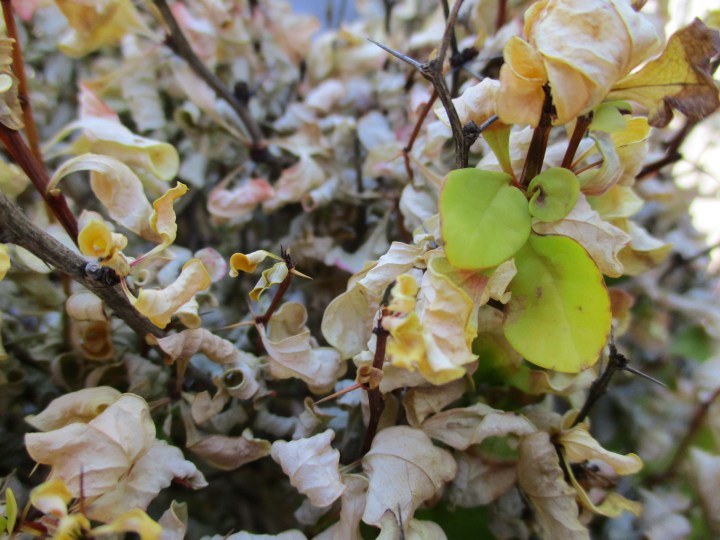
This crispy barberry is fortunately not as dead as it seems to be. Only the outer foliage is roasted. The stems and buds do not seem to be damaged. It will probably foliate again before defoliating in autumn. Even if it induces premature dormancy, it should recover as next winter ends.
Nonetheless, such damage on new plants is disconcerting.
Garden Bloggers’ Bloom Day July 15 – Summer Weather Has Arrived
While so many of us in the Northern Hemisphere were contending with unusually warm weather, our weather here had been unusually mild. The weather only recently became warm for the past two weeks or so. It did not get unusually hot here like it did in so many other regions, but the warmth developed suddenly enough to damage many of the flowers that were blooming at the time. This included many of the new perennials that we happened to be installing at the time. Consequently, there were not nearly as many flowers to get pictures of as there had been in May, and some of the flowers in these pictures show damage from the sudden change in the weather. I am sorry that I neglected to participate in Bloom Day in June.
These pictures were taken at work, on the Santa Cruz County side of the Santa Cruz Mountains above Los Gatos, closer to Felton. The climate is more coastal than the chaparral climate of the Santa Clara Valley, although both are within USDA Zone 9.
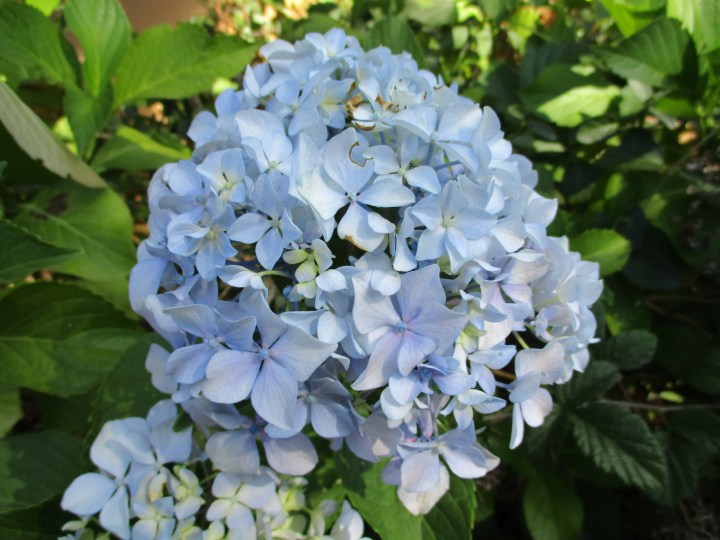
Carpet Roses are the lowliest of all roses, but they happen to be more functional for more landscape applications than other roses are. These got pruned back to a few canes over winter, and will get trimmed for confinement about now, but really do not need any more work than that. They bloom profusely in a few phases. They are only looking tired now because of the weather.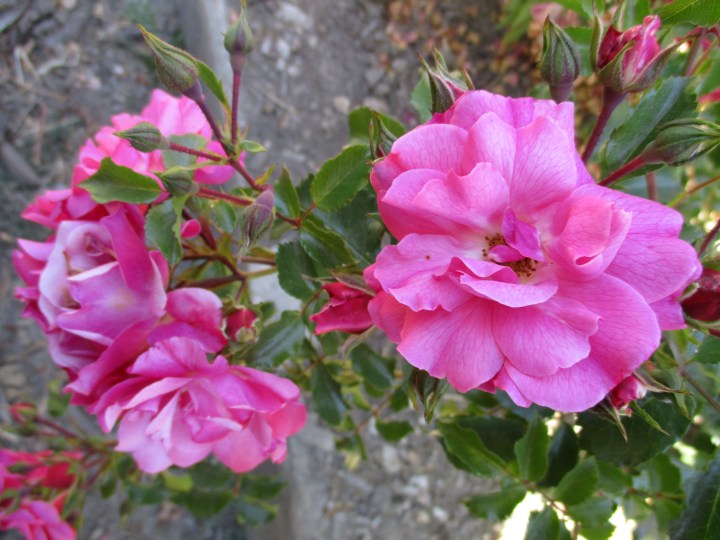 Hydrangea are finishing in most other areas here. These are odd ones. They are more exposed to harsh weather conditions than others, but are somehow lasting later than those that are more sheltered. They are blue instead of pink, but are not in what would be considered acidic conditions within redwood forests. Nor were they fertilized to be blue. No one is complaining.
 Yarrow was planted just before the weather changed. Once established, it does remarkably well in the endemic soil and climate.
 Yarrow unfortunately got roasted by the sudden warmth. These yellow (or ‘golden’) flowers are getting quite crispy already.
 Coneflower was likewise planted just before the weather changed, and likewise got roasted. These happen to be some of the best at the moment.
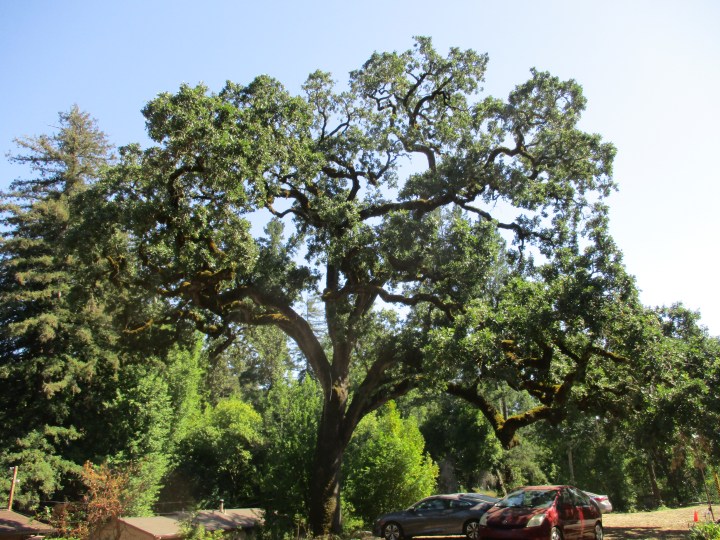
 Valley Oak probably qualifies as appropriate for Bloom Day because it really is blooming right now. You just can not see it. The dust is everywhere. I really like this grand and sculptural tree. The valley oak happens to be the biggest oak in North America, and it also happens to live here, on the outskirts of groves of coastal redwoods, which are the tallest trees in the World.
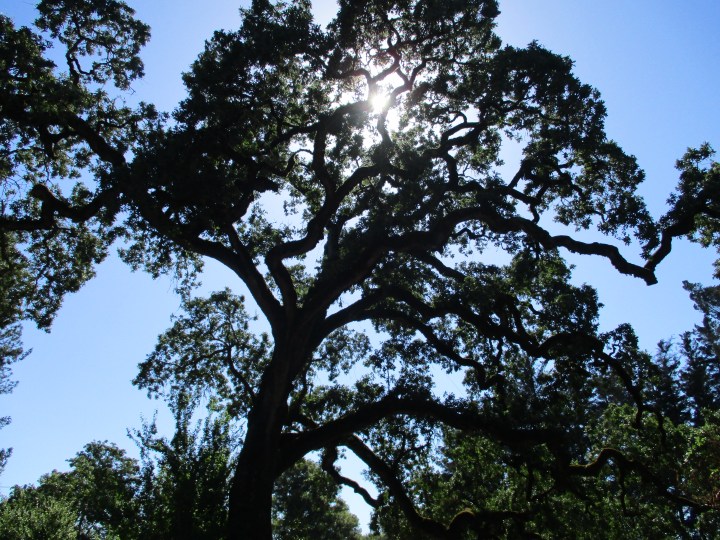 Valley Oak is so excellent that I had to get another picture of it from another angle. The first picture was looking about south toward the midday sun. This is looking almost to the east, perpendicularly to the other picture. The cars in the foreground are much closer than they seem to be. The trunk of the tree is significantly wider than it seems to be in relation to the cars.
 Garden Bloggers all over America and in other countries can share what is blooming in their gardens on the fifteenth of each month on “Garden Bloggers’ Bloom Day”, hosted by Carol Micheal’s May Dreams Garden at http://www.maydreamsgardens.com
Nature Is Messy
 This sort of weather pattern does not happen very often. Late spring is normally pleasantly warm, and the weather gets progressively warmer through summer, which typically includes a few unpleasantly warm days. It rarely gets too hot here, and when it does, it does not last for more than a few days, and tends to cool off at least somewhat at night. The air is normally arid. Humidity is uncommon in a chaparral climate.
While so many in the Northern Hemisphere were experiencing unseasonable warmth, the weather here was unusually mild. When the weather became warm, it did so suddenly. There was nothing unusual about the warmth. It was well withing the normal range for this time of year. The suddenness of the change was what made it unusual.
Humidity complicated matters. Again there is nothing too strange about humidity. Although rare, it does sometimes happen. The problem was that it happened at the same time that the weather suddenly changed from pleasantly mild to somewhat warm.
This combination of the weather changing so suddenly from mild and arid to warm and humid caused an outbreak of spontaneous limb failure. It was very evident in Felton Covered Bridge Park, where several trees that experienced it could be observed in the same place.
The most recent victim was the biggest old California sycamore in the area. Half of the top of the canopy broke away and got hung up on an adjacent trunk, but started a cascade of other limbs that broke off more major limbs all the way to the ground. A large cavity that contained a very established beehive was exposed. A car parked below was clobbered (but somehow sustained only minimal damage!). The remaining trunks and limbs of the old sycamore are now even more scarred and disfigured than they were before this happened. The biggest gash is about fifteen feet long! What a mess!
Spontaneous limb failure is technically very damaging to the trees who experience it, but not all of them see it that way. Many of the riparian trees that are so inordinately susceptible to it might use it to their advantage. Fractured limbs that remain attached to the original tree while they sag onto the ground can develop roots where they touch the soil, and develop into new trees. These new trees are more stable at first, but eventually develop structural inadequacies like their parents did, and repeat the process. Willows excel at this technique. Cottonwoods and box elders do it too. Sycamore do it only rarely, but sometimes destabilize and fall over so that some of their limbs can grow into new trees as the original trunks decay. It may not be the sort of behavior that we want in our home gardens or parks, but as far as the trees are concerned, it works.
Six on Saturday: Redwoods
Both coastal and giant redwoods, are the most excellent trees. The giant redwoods are endemic to isolated colonies in the Sierra Nevada. The coastal redwoods are endemic to the coastal region from the Oregon Border to San Luis Obispo County, which happens to include this region.
Coastal redwoods are so awesome that even the dead stumps from trees harvested a century ago are awesome. Most of the stumps in this region have been charred by forest fires. Yet, even after a century, they are still quite solid. They decay very slowly, which is why their timber is such a popular and important building material. Because the stumps are so big and would be difficult to get rid of, not many of us even try.
1. Compared to some of the tacky garden art that some people pay significant money for, this old redwood stump is strikingly sculptural. It stands so proudly out on this knoll on the edge of a small creek just above where it flows into Bean Creek. It is difficult to see in this picture, but a landscaper tried to obscure this stump with potato vine. Only a bit of twiggy growth can be seen at the top of the stump. The rest of the vine is now overwhelming the adjacent dogwood above. The trunk of the dogwood is to the right. Coastal redwood forests are innately shady. The potato vine is not very happy there. Even if it were happy, and were able to obscure the stump, would it really be an improvement? 2. These two bigger stumps are just a short distance uphill and across the small creek. Old stumps are more often single, but surrounded by multiple trunks that emerged from the roots. Because almost all of the trees here had been harvested about a century ago, there are now many more secondary trunks per area than there would naturally be. It is not much of a problem yet, but these trunks will likely become more crowded as they mature.
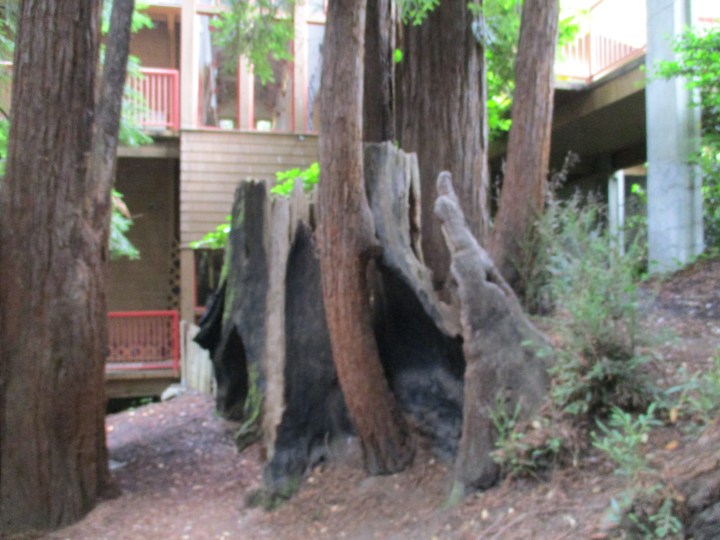
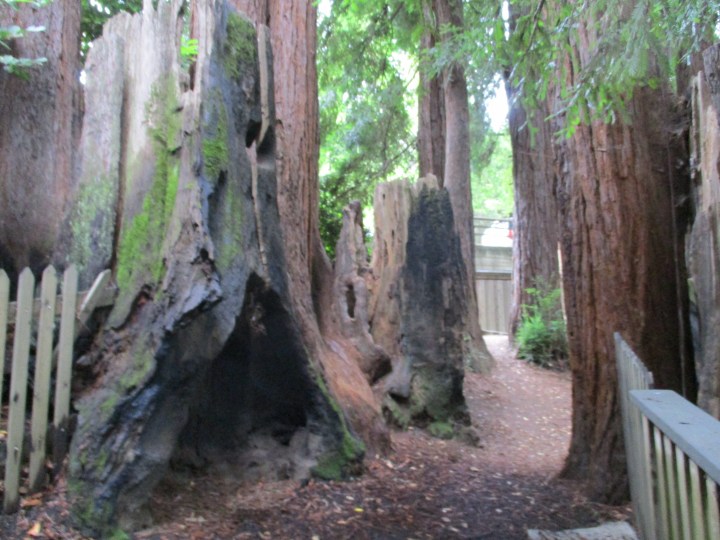 3. These are the same two stumps from the other side. This trunk coming up from within is likely from the same original root system. All trunks that develop from the same root system are genetically identical, so they look very similar from a distance. Some genetically identical groves can be quite broad, and include many trunks.
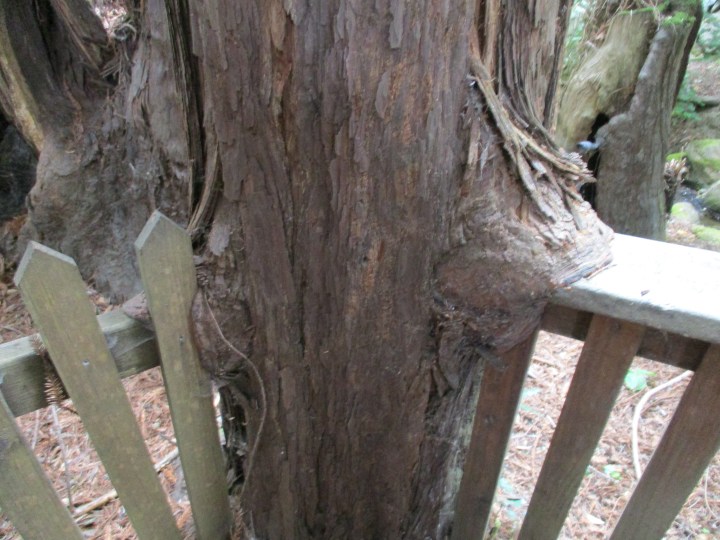
 4. This small coastal redwood trunk is not happy about the fence that is nailed to it.
 5. This is more what you expect coastal redwoods to look like. It is impossible to determine from this picture if these trunks are genetically identical secondary trees that emerged from the same root system, but their proximity to each other suggests that they likely are.
 6. This epiphyllum is the flower that I promised to those who expressed a concern than my Six on Saturday lacked adequate bloom. I shared a picture of this same epiphyllum earlier, but it has continued to bloom.
This is the link for Six on Saturday, for anyone else who would like to participate:
https://thepropagatorblog.wordpress.com/2017/09/18/six-on-saturday-a-participant-guide/
Horridculture – Rose Colored Glasses
This article reminded me of a sore subject from back in about 1986 that continues today: https://wordpress.com/read/blogs/7890212/posts/4888 You should probably take a look at it before you continue.
Back when my colleague and I were roommates in the dorms at Cal Poly in San Luis Obispo, we noticed how badly the photographs in bare root catalogs had been modified to enhance color. Years before modern digital editing, colored film was cut out to any desired shape and placed over a photograph to produce a new photograph with enhanced color. We looked at pictures of flowering crabapples with canopies that were entirely bright pink, including the stems, leaves and everything associated with the canopy of the tree. We could easily see the outline of the bright pink film that had been placed over the original photograph. It was done with blue fescue, hydrangeas, azaleas, callas and really just about anything that could benefit from a bit of enhanced color.
It certainly did not dissuade us from our interest in the plants that had been photographically enhanced. We liked them anyway. The poor quality of the enhancements that would be laughable by modern standards seemed to be more acceptable back then; like the idealistic pictures of the food available from popular fast food establishments. I mean, we all know that the food does not look like ‘that’ but it probably tastes like ‘that’ looks.
Three decades later, modern technology of digital editing of photographs (if they are still known as ‘photographs’) has improved the technique of color enhancement significantly. Most pictures in catalogs are now enhanced to some degree, not to be deceptive, but to eliminate minor glitches that might distract from the rest of the image, and perhaps to enhance color that is slightly compromised by the exposure at the time the picture was taken.
But of course, there are some images that are blatantly inaccurate and deceptive.
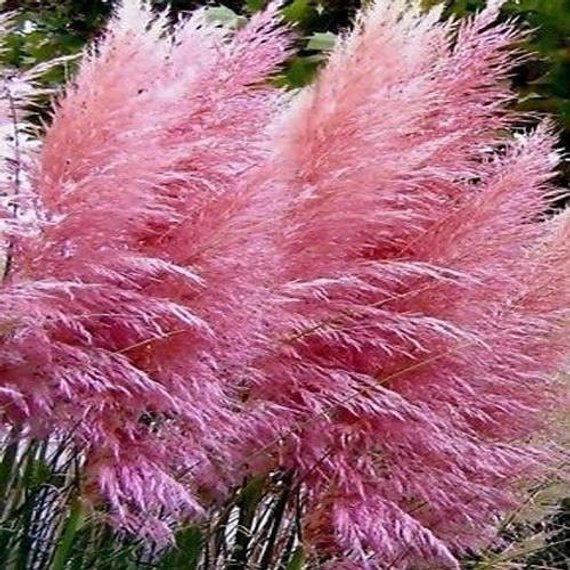
My colleague down south tells me that pink pampas grass can be about as peachy pink as cantaloupe is. It could possibly be more pink in other regions. I have never seen it more than simple pinkish tan here. I know of no one who has confirmed that it can be as bright cotton-candy pink as it is in the picture above. Is it inaccurate and deceptive? I do not know. I do not really care. If I wanted pink pampas grass, I would purchase it anyway, and just try to not be too disappointed when it blooms tan.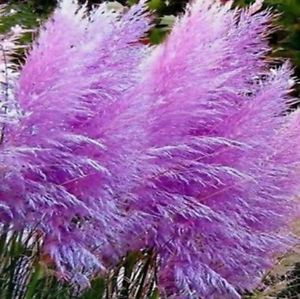 This picture above is certainly interesting as well. It is such an appealing color. What is more interesting it that it is the exact same picture as the picture on top, but is merely a different color. I have never heard of a pampas grass doing that! It must be quite common though. Online, there are a few pictures of other pampas grass doing the exact same thing. These two below, for example, are the exact same picture in two different colors, and with slightly different proportional modification.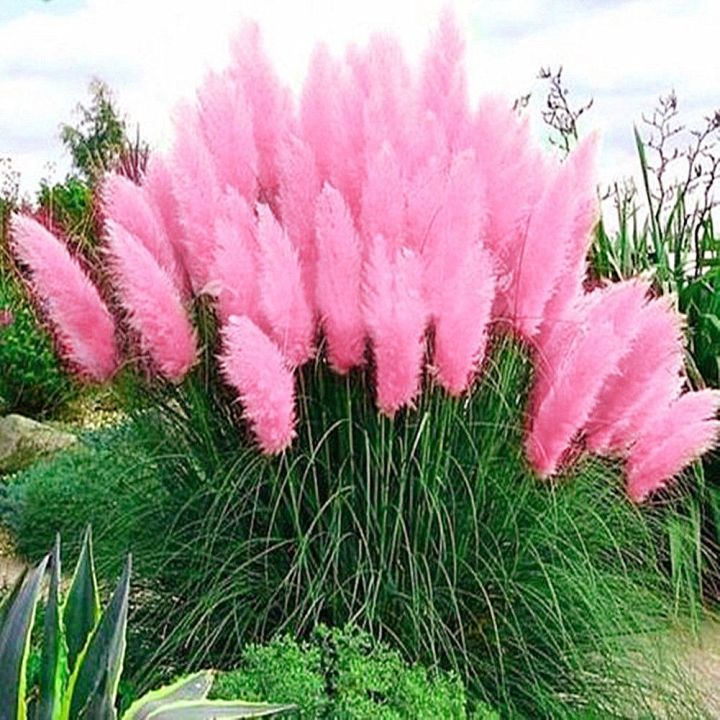
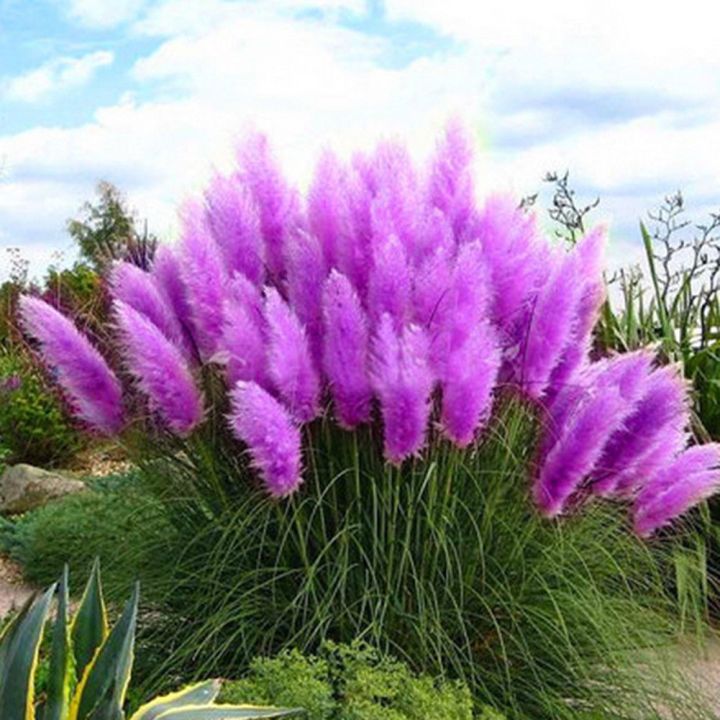 As amusing as these pictures are, they are not as downright KRAZY as the rainbow rose in the article that I posted a link to above is. It is certainly worth taking a look at.
Palm Treevia
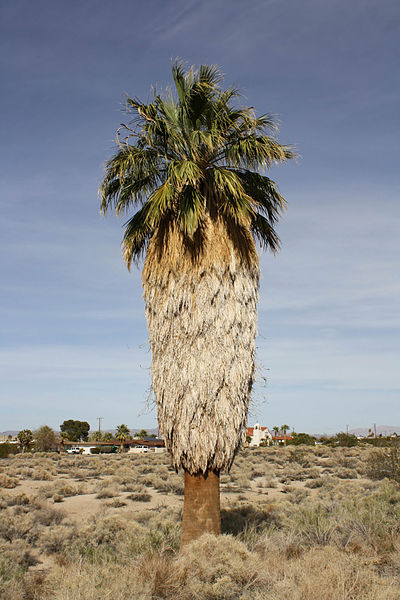
This is a quick trivia question.
Which of these three states has the most native genera of palm?
1. California
2. Hawaii
3. Oklahoma
4. None of the above

This is not a trick question. Notice that it asks about genera rather than species.
1. California is home to many exotic specie and genera of palm; but only ONE is native. The California fan palm, Washingtonia filifera, which is also known as the desert fan palm, lives in isolated groves out in the Mojave Desert. https://tonytomeo.wordpress.com/2018/06/30/oasis/ Because it prefers hot and arid desert climates, and does not like to be watered too generously through summer, it is now a very unpopular palm for landscapes.
2. Hawaii, is populated by many more exotic species and genera of palm than California is, but only species of the ONE genera of Pritchardia are native. Many of the exotic genera were imported by ancient Polynesians to produce food. Others were imported later for landscaping.
3. Oklahoma is the sort of place where only a few of the toughest of exotic palms can survive outside. Yet, McCurtain County, in the very southeastern corner of Oklahoma, is home to ONE very rare but nonetheless native variety of dwarf palmetto, Sabal minor.
4. ‘None of the above’ is the correct answer to the question because none of the other choices above have any more native genera than any of the others.
So, although Hawaii really does have more native species of palm, it has no more native genera than California or even Oklahoma. Each of these three states has exactly ONE native genus of palm.
I am sorry that I have no good pictures of any of these palms. All three of these pictures were obtained online. I have experience with neither the dwarf palmetto of Oklahoma, nor any of the species of Pritchardia of Hawaii. However, the California fan palm happens to be my all time favorite palm, even though it is not very happy here. It is such a stately palm, and those grown from the same seed batches are uniform enough for formal plantings. They are the palms that flank the famous Palm Driveway of the Winchester House in San Jose, as they were popular for flanking driveways and roadways in California and Arizona during the Victorian period. I did happen to see California fan palm in the wild outside of Palm Springs while in school in the late 1980s and can tell you that they are spectacular in their native habitat.

Note: The elderly and deteriorating California fan palms that flanked the Palm Drive of the Winchester House have been replaced with palms that are hybrids of California fan palm, Washingtonia filifera, and Mexican fan palm, Washingtonia robusta. They are more tolerant to the irrigation of the landscape around them.
More Spontaneous Limb Failure

 (This was copied and modified from the Facebook page of Felton League.)
Warm and humid weather is an uncomfortable change for an otherwise mild summer. It also causes spontaneous limb failure among trees, particular those in riparian areas or irrigated landscapes. What sounded like muffled firecrackers was the (slow but steady) fracturing of another cottonwood limb in Felton Covered Bridge Park. (Another incident of spontaneous limb failure was mentioned a few days ago.) (https://tonytomeo.wordpress.com/2018/07/01/spontaneous-limb-failure/) This one was over the picnic area adjacent to the playground. The fallen portion of the limb was less than a foot in diameter, although it was slighter wider than a foot wide where the fracture originated. It fell onto the middle of a group of picnic tables, with the fractured proximal end remaining suspended and attached to the originating tree. Because it remained attached and fractured slowly, the limb did not fall with enough inertia to damage the picnic tables. It was removed very efficiently. (continued)
Cottonwood, sweetgum, coast live oak, valley oak, Chinese elm, California bay, California sycamore, willow and various eucalypti are particularly susceptible to spontaneous limb failure. The oaks and eucalypti are particularly dangerous. Oak limbs are extremely heavy, and tend to break away cleanly and suddenly rather than fall slowly while still attached. Eucalypti limbs likewise break away cleanly, and then fall from great heights without many lower limbs to slow them down. As they start to fracture, Chinese elm and willow limbs might stay attached to the main trunks or the larger limbs from which they originate, which might slow them down somewhat.
Sadly, spontaneous limb failure does more than damage whatever the falling limbs land on. It can also disfigure the affected trees so severely that they must be removed rather than salvaged.
Six on Saturday: Finally Flowers
After posting so many inter pictures of soil, stone, road signs, plumbing, empty wine barrels and mockery of French culture, I suppose I should share some pictures of actual flowers for a change. I mean, this is about gardening after all. Unfortunately though, I do not work with many flowers. The landscapes are designed to be compatible with the surrounding forests, so flowers are minimal. I already shared pictures of most of the best. Some of these are from gardens that I do not work with. I just thought that they were pretty.
1. Avens finished blooming more than a week ago. I just really liked this picture because it is such a nice swirly orange color. Until I found these, I had not seen avens in many years, and did not expect to see it anytime soon. Since featuring it in the gardening column, I have found that others in other regions are quite familiar with it, and this it more popular than I would have guessed. http://www.canyon-news.com/ph-has-ups-and-downs/80473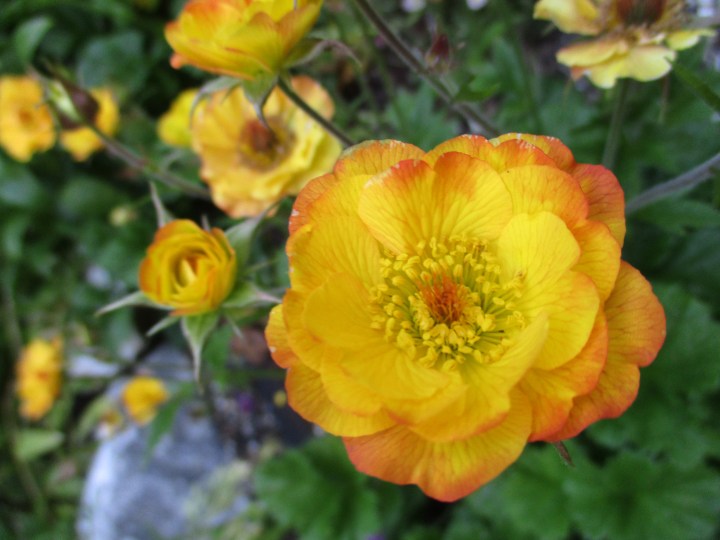
2. Lobelia is one of the more common warm season annuals. This is not from one of the landscapes that I work with, but looked good enough in a planter box in town for me to get a picture of it. I do not know what variety it is. There are many varieties nowadays that I am not familiar with anyway. Back in the 1980s, bright blue lobelia was popular alternated with white alyssum. I thought it looked rather silly at the time, but would not mind seeing it now. It was such an 80s look.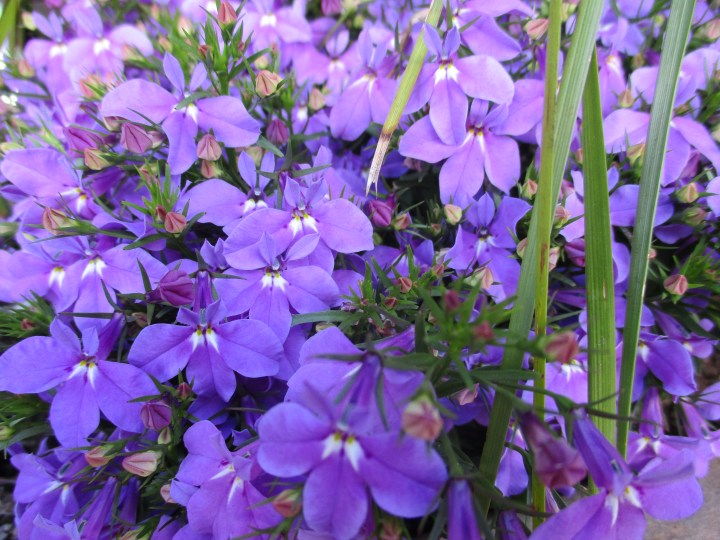
3. Pelargonium was in the same planter box as the lobelia. I know neither the species nor the cultivar. Again, it was just too pretty to pass up without getting a picture. It is more diminutive than the sorts of pelargoniums that I am familiar with. The plants are very compact. The variegated leaves and flowers are quite small.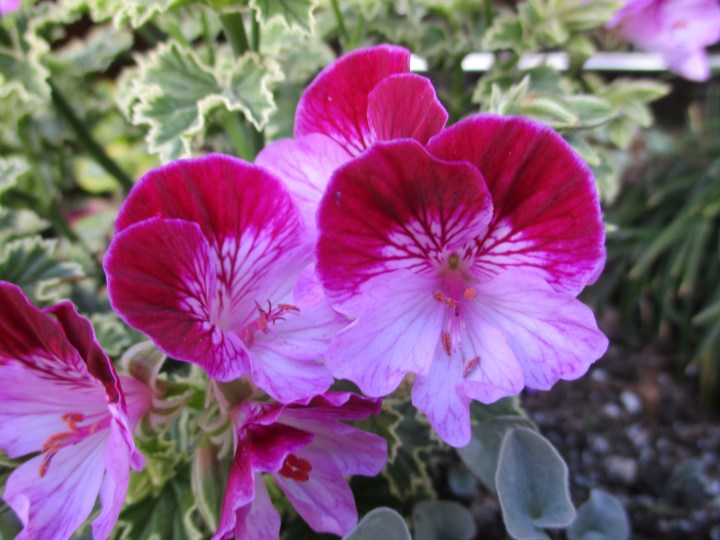
4. Zonal Geranium happens to be one of my favorite perennials because it was one of my first. Although I grew my first for only a short while when I was very young, I still grow one that I found in a trash pile when I was in junior high school, and another that I found naturalized in a creek near San Martin shortly after I graduated from college. I bring pieces of them everywhere I go. Both are the big and weedy types that are probably very closely related to the straight species. The first one is the very common bright pink with leaves that lack halos. The second is the very common bright orange red with only slight halos on the leaves. Getting back to this remarkably bright red zonal geranium; it is not one of mine. The leaves have only very light halos. The growth seems to be almost as vigorous and weedy as my bright orange red one, but not quite. It is more tame, and more prolific with bloom. The bright red color is prettier too.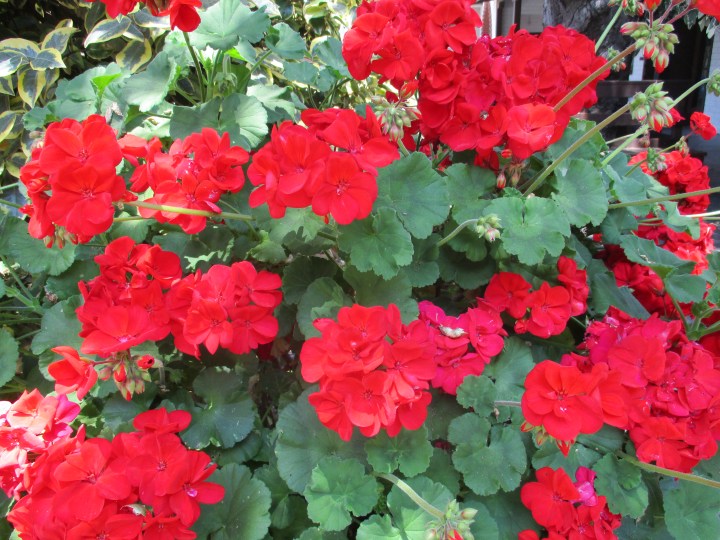
5. Lithodora looks prettier close up that it really looks in the landscape. It was planted into one of the newer small landscapes, but is not growing very well. I found the name to be amusing because it seems to mean that it smells like a rock. However, someone recently explained to me that the name means that it adores rocks, since it naturally grows in soil that is too rocky for other plants.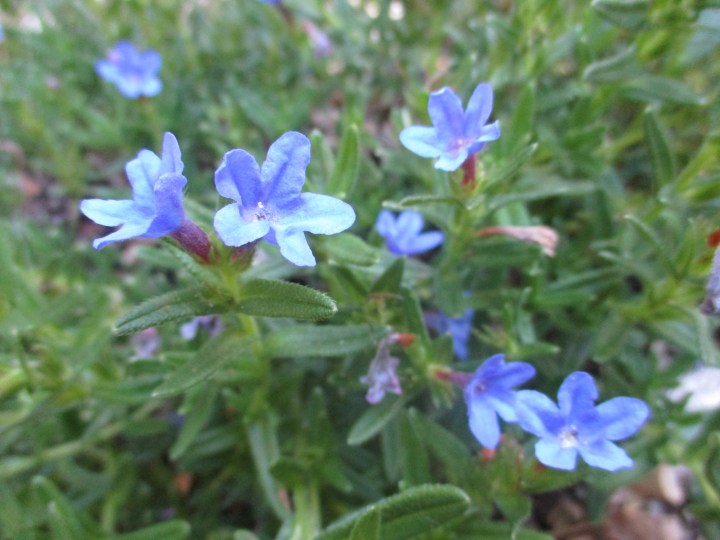
6. White Hydrangea is a nonconformist among all the hydrangeas that I fertilized to be either pink or blue. So far, the pink ones are still pink, and the blue ones are still blue. The few white ones are always white. http://www.canyon-news.com/ph-has-ups-and-downs/80473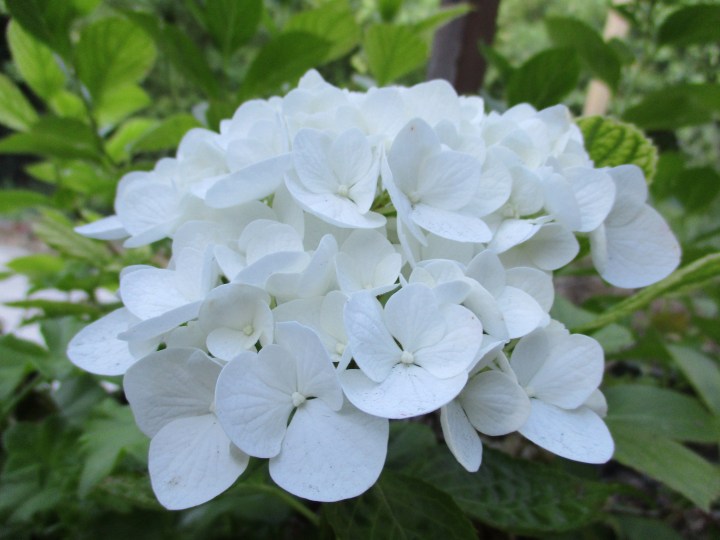
This is the link for Six on Saturday, for anyone else who would like to participate:
https://thepropagatorblog.wordpress.com/2017/09/18/six-on-saturday-a-participant-guide/
Horridculture – Mutants
 Mutants are the source of many of our favorite cultivars of otherwise simpler specie. Many cultivars of plants with compact, pendulous or fastigiate (strictly vertical) growth, or variegated, bronzed, golden or otherwise abnormally colored foliage, were derived from ‘sports’, which are mutant stems that appear on otherwise normal plants. Thornless blackberries were sports of thorny cultivars. Fruitless mulberry is a sport of white mulberry. There is no shortage of mutants.
https://tonytomeo.wordpress.com/2018/05/07/cultivars-are-the-real-cloned-mutants/
https://tonytomeo.wordpress.com/2018/05/06/sport/
By nature, mutants are genetically unstable. A few can easily mutate back to their original and more genetically stable characteristics. Variegated plants are notorious for developing simple green unvariegated foliage. Because it has more chlorophyll, the unvariegated foliage grows faster, and has the potential to eventually overwhelm and replace the variegated foliage. That is why green sports should get pruned out of variegated plants.
‘President Roosevelt’ is the most popular of the few variegated rhododendrons. In nursery production, it gets pruned somewhat regularly to remove green sports. Variegated specimens are rare in landscapes because almost all revert to unvariegated foliage within only a few years.
‘Yellow Wave’ is a cultivar of New Zealand flax with pendulous yellow striped foliage. It can be seen in front of the upright greener foliage in the background. These are not two separate plants stuck together. The more vigorous green foliage is a reverting sport that should have been removed by the ‘gardener’ who is supposed to be ‘maintaining’ this landscape. The green sport is now so developed that it can not be removed without damaging the rest of the ‘Yellow Wave’ growth. It will undoubtedly be left to overwhelm and replace it. Fortunately, the upright green foliage is about as appealing as the ‘Yellow Wave’, so no one will notice the inadequacy of the maintenance. No one ever does.

