Six on Saturday: Williamsburg II

Woodland Gnome of Our Forest Garden awesomely sent me six seedlings of Ilex opaca, American holly from Williamsburg! I had been wanting to get more acquainted with this species since encountering it in school in about 1986, but never justified doing so before. It is unavailable from nurseries here anyway. As with beautyberry, esperanza, poinciana, red elderberry and several other species that I want to get acquainted with, I specifically wanted their wild form, as it grows from seed, rather than cultivars. This is exactly what these seedlings are. I am already very pleased with them, and we are barely acquainted.

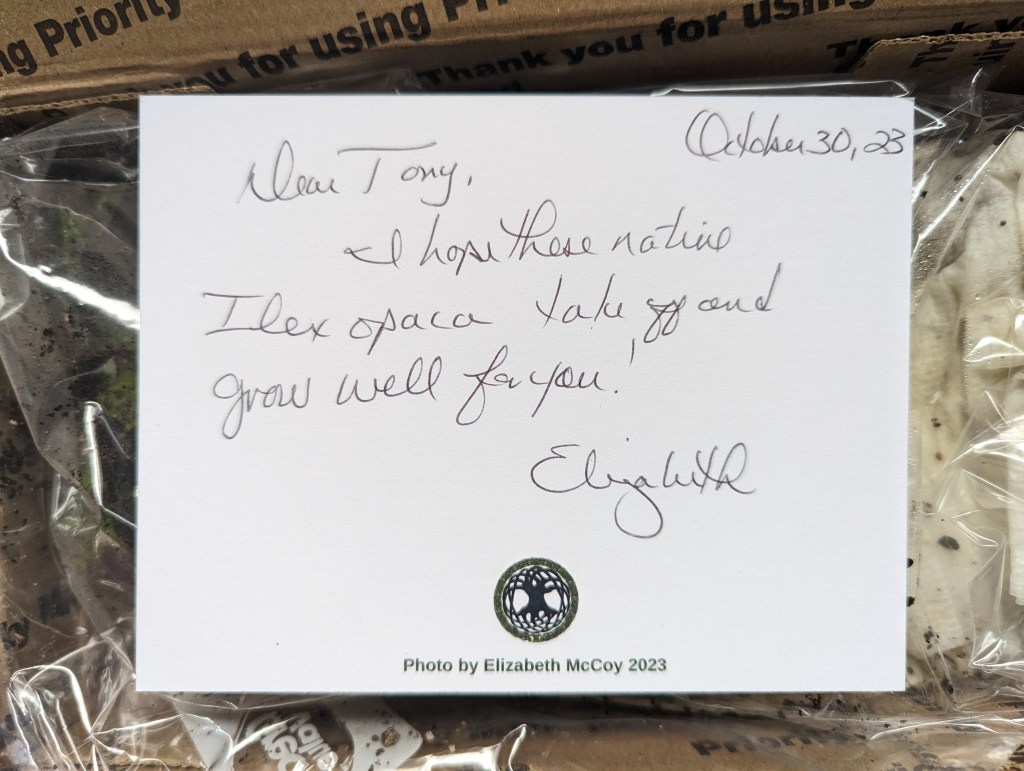
1. Cards and letters written by hand with ink on paper and sent by mail have become an old fashioned courtesy. It is gratifying to know that some still express such graciousness.
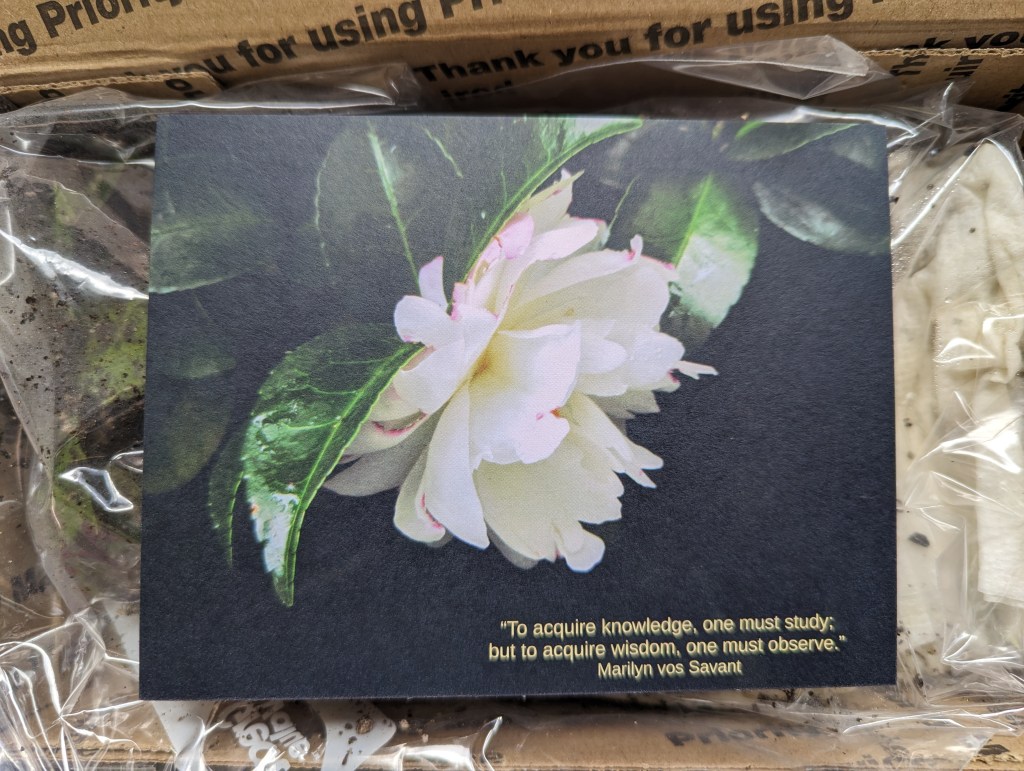
2. Camellia sasanqua, sasanqua camellia is the illustration for the other side of the card. It very likely bloomed where the contents of the parcel originated from in Williamsburg.
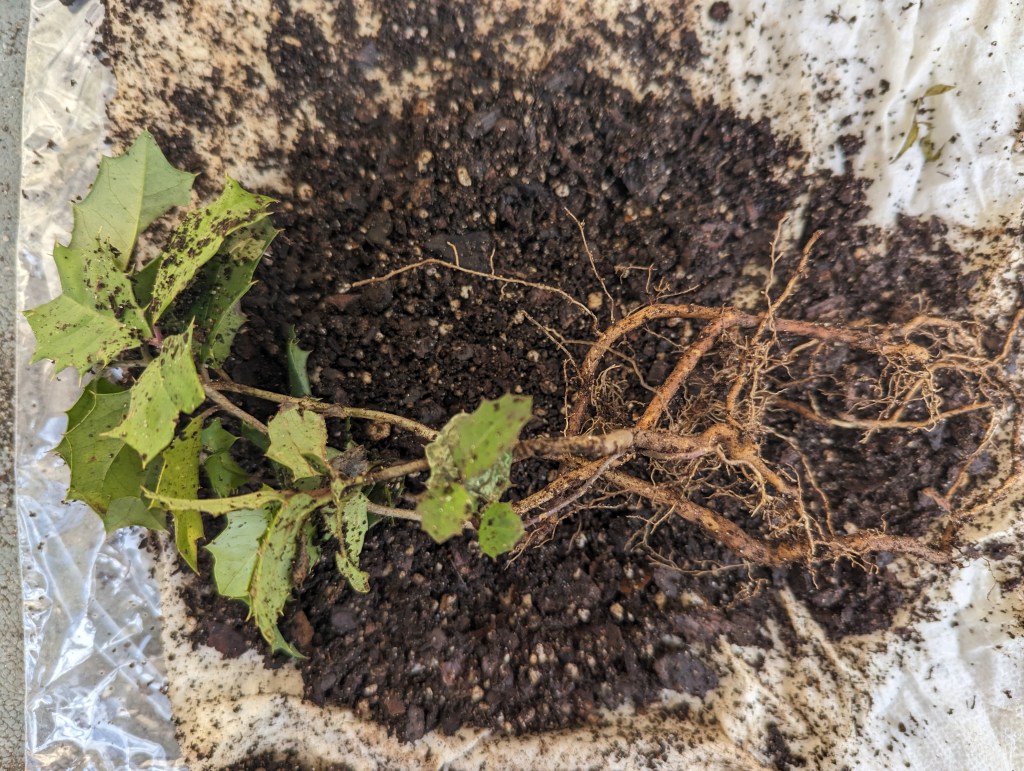
3. Ilex opaca, American holly was the contents of the parcel. There are six seedlings. For me, this is a remarkable acquisition, like beautyberry, red elderberry and Louisiana iris.
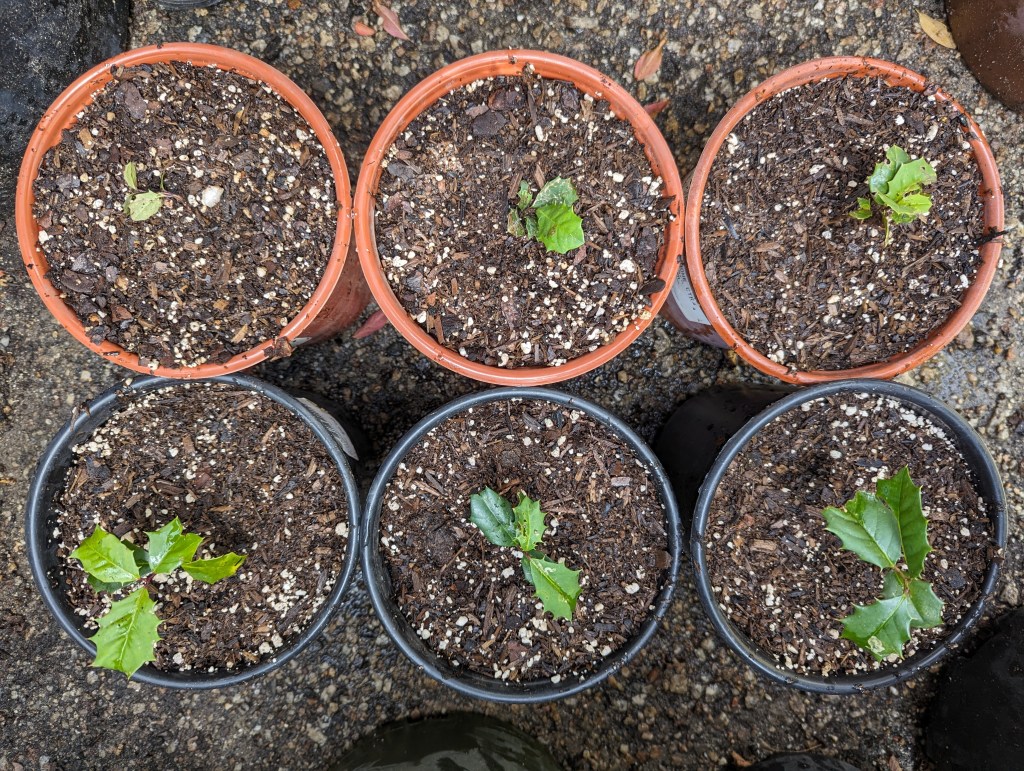
4. Ilex opaca, American holly seedlings were canned and happy shortly after arrival here two weeks ago. They can now disperse roots through winter to sustain growth next year.
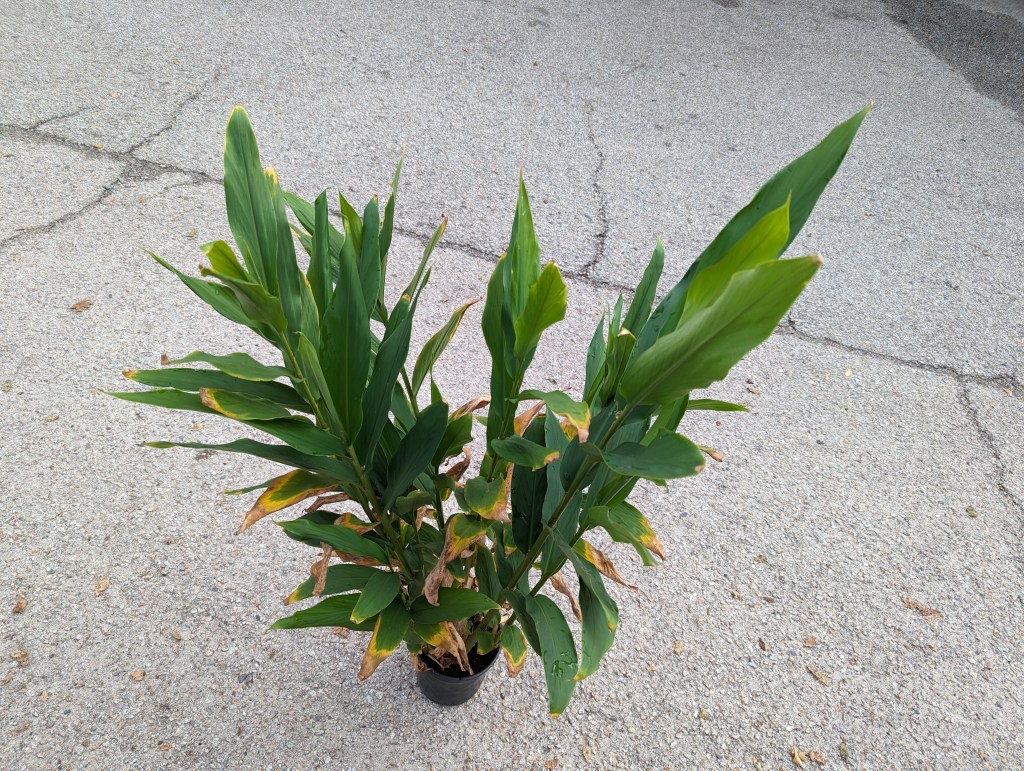
5. Hedychium coronarium, white butterfly ginger came from the same source two years ago. Some was planted at the Chapel. This remaining specimen is higher than three feet. It really wants to be in the ground. The mild warmth last summer likely inhibited bloom.
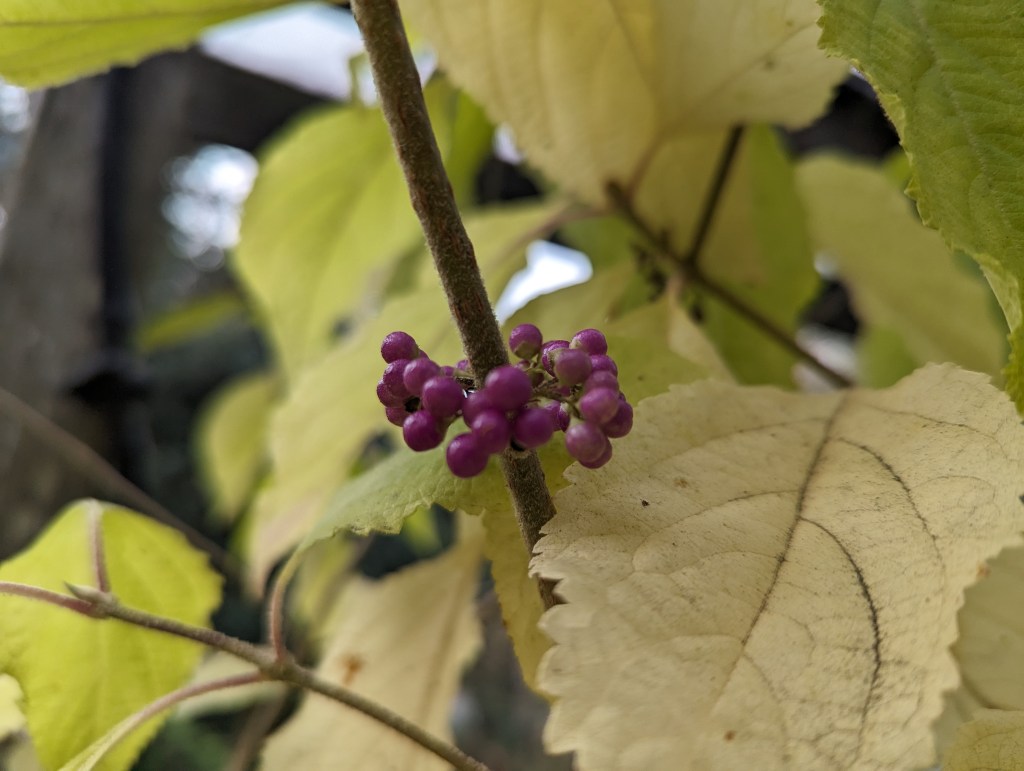
6. Callicarpa americana, American beautyberry was an even more excellent acquisition two years ago. The mild warmth last summer likely inhibited the ripening of the berries. Larger clusters of berries are still green. This yellow foliage will likely be gone after rain.
This is the link for Six on Saturday, for anyone else who would like to participate: https://thepropagatorblog.wordpress.com/2017/09/18/six-on-saturday-a-participant-guide/

Candelabra Tree

Candelabra tree is a big and strikingly weird succulent.

The weirdly sculptural succulent stems of candelabra tree, Euphorbia ingens, dark green but devoid of any real foliage, are striking in the right situation.  These stems resemble those of unrelated cactus, with longitudinal ridges topped with spines. Although botanically interesting, the minute greenish yellow flowers that bloom in autumn and winter on the ridges of the upper portions of the upper segments are not much to look at. Deep red seed capsules that turn purple as they ripen sometimes develop in milder climates after the flowers are gone, but are almost never seen locally.

Good exposure is preferred. Candelabra tree are better structured and more prominent standing alone away from other larger trees and shrubs. Cool winters and occasional frosts limit their height to not much more than fifteen feet; and unusually cold frost can actually kill big specimens back severely. However, in sheltered areas and milder climates, candelabra tree can get twice as tall. Soil should drain very well and get dry between watering. Regular watering can cause rot, particularly in dense or rich soil.

The main problem with candelabra tree is the remarkably caustic latex sap, which can be dangerous to children, chewing dogs or even those who need to prune the stems. Fortunately, candelabra tree needs very little attention, and only needs to be pruned where the stems get in the way or start to lean against fences or roofs. The caustic sap prevents insect problems.

Wise Old Owl (2011)

There is more to cut flowers than flowers.

(This is an old article from 2011, so much of the information within is no longer relevant.)

The sixteen acres of gardens of Filoli are spectacular and horticulturally compelling throughout the year. However, the weather through winter, although more pleasant than other places in the world, is not always quite so compelling or conducive to garden tours. At Filoli though, this is not a problem. More than six hundred volunteers and the Filoli staff merely bring the outdoors indoors, by selecting materials from the garden to adorn the interior of the 36,000 square foot Filoli residence for ‘The Wise Old Owl’, the annual fund raising Holiday Traditions Boutique.

While perusing The Wise Old Owl merchandise, guests can enjoy how so much more than flowers can be brought in from the garden to deck out the home. Bare stems, gnarly limbs, evergreen foliage, pine cones, bark and all sorts of bits and pieces of the autumn and winter garden demonstrate the potential for alternatives to traditional cut flowers that we may not even recognize as useful materials in our own gardens. Of course, there will be no shortage of the less abundant flowers that bloom through the season and decoration that are not out of the garden, as well as live music to enhance the display. Regardless of horticultural interest or boutique merchandise, the grand residence at Filoli is worth visiting even on the least eventful day of the year.

There are too many events within the Event to describe here. Guests can visit http://www.filoli.org to plan ahead and make reservations for buffet lunches and evening bistro dining, as well as an elegant Saturday Evening Dinner Party with dancing in the Ballroom. Children six to twelve years of age can enjoy a Children’s Tea on the finale of The Wise Old Owl on December 3.

The Wise Old Owl begins in only a few days on November 25, and continues through December 3. The hours of operation and admission are variable relative to the various events throughout the main Event. Reservations for specific events can be arranged and more information can be found online

Tickets can be purchased online, by fax or by telephoning Filoli weekdays between 9:00 a.m. and 4:00 p.m. At 650 – 364 8300 X 508. Order forms for fax transactions can be downloaded from the website and sent to 650 – 503 2090. Admission is limited; and tickets get exhausted somewhat early. Tickets are neither refundable nor exchangeable. Filoli is located at 86 Canada Road in Woodside (94062).

Horridculture – New Lawn for Old Trees

These mature oaks can not adapt to the irrigation that the new lawn requires.

Californian climates are impressively diverse. However, most climates here are chaparral or desert climates, or similar to such climates. That means that almost all rain occurs during the rainy winter season, and that almost no rain occurs during the dry summer season. Vegetation that is native to California is very familiar with the climates here. Therefore, it does not expect rain during summer. This should be obvious.

Some native species can adapt to irrigation during summer. Some may grow faster than they normally would without irrigation, but compromise their natural life span in the process. This is acceptable within some landscapes. Many riparian species are not bothered by irrigation.

However, some species adapt less efficiently. Some do not adapt at all. Some that can adapt while young can not do so while mature. Oaks are a common example of this.

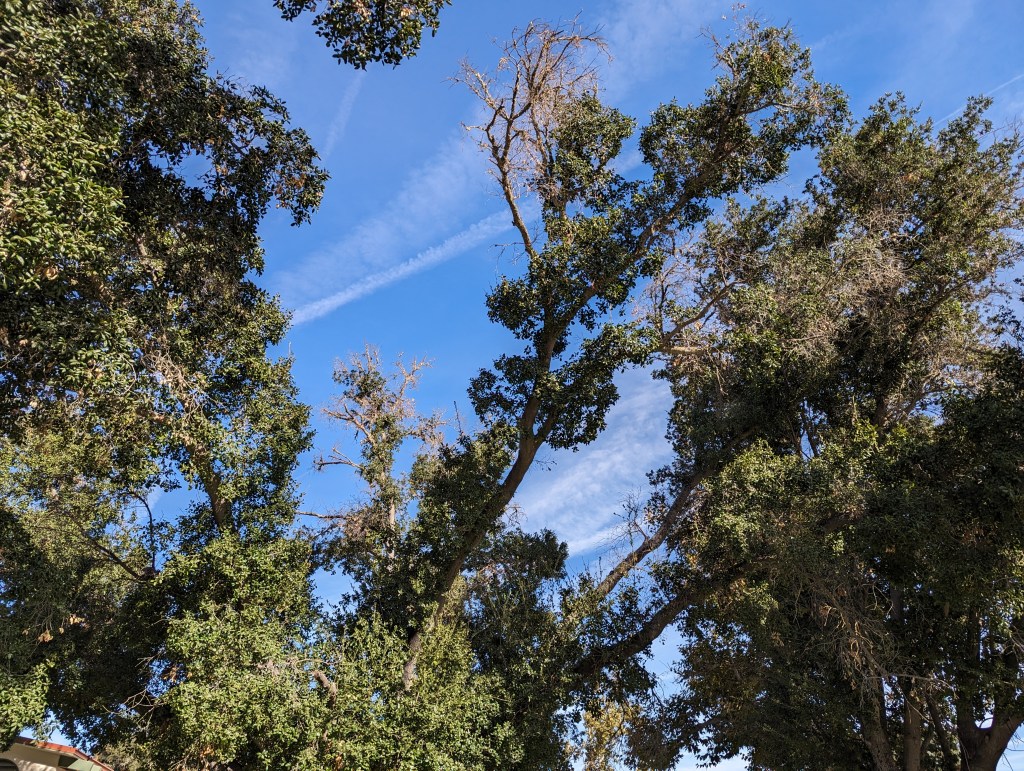
These coast live oaks with a few blue oaks were installed as shade trees within a formerly minimalistic landscape that did not include turf. They were happy with annual rainfall for half a century or so. Then, this generously irrigated lawn was installed around them. They can not adapt to the frequent irritation that the lawn requires. Their roots are succumbing to decay, so will eventually be unable to sustain their foliar canopies. As they deteriorate, decay may eventually compromise their structural integrity and stability. Dieback is already evident within their upper canopies, with lower watersprouts attempting to compensate.

I suspect that the trees will be removed before they deteriorate enough to become hazardous. I also suspect that new trees will systematically replace them prior to their systematic removal. Their eventual demise is likely an acceptable loss, and perhaps expected. Turf with adapted shade trees is likely more important within this particular situation than preservation of these middle aged oaks.

Dieback is evident within the upper canopy. Watersprouts are evident with the lower canopy.

Rest Stop

Quercus douglasii, blue oak

Rhody, Carson and I took Highway 101 for most of our recent trip from here to the Los Angeles region. We typically drive on more of a variety of highways between here and there, but for this trip, I wanted to drive on Highway 101, as was more typical when I was in college in the late 1980s.

Rhody enjoys rest stops, perhaps as much as our destinations. Because the rest stops near Gaviota remain defunct, only the Camp Roberts Southbound Rest Area was in service on our route. We stopped there, of course.

The old facilities that I remember were replaced years ago. I would prefer the old original buildings. I can not imagine why replacement was necessary. Nor can I understand why the more elaborate associated landscape was necessary. This new landscape, with its cliche crape myrtles, carpet roses and a bit of lawn, is irrigated so generously that the old coast live oaks are deteriorating and succumbing to rot. Most are now surrounded by irrigated lawn, after surviving with only annual rainfall for half a century or so. Like so much about California, not much of the familiar remains.

However, besides the deteriorating mature coast live oaks and a few seemingly younger California sycamores that are also within the landscaped areas, a few familiar native oaks remain beyond the landscaped area. Some seem to be older than those within the landscaped area, and if so, were there prior to the development of the rest stop. Most are coast live oaks, and a few are blue oaks.

I met the blue oak in the picture above in 1985. Although it has not grown much since then, the disproportionately large cavity within its trunk has. I am impressed that the trunk can still suspend the healthy foliar canopy above.

Alocasia or Colocasia?

Alocasia odora

‘A’ or ‘co’? What is the better prefix for ‘locasia’? There are certainly differences between the two, but information regarding such differences and characteristics is confusing and potentially misleading. It is amazing how much less information is available now that so much more information is so much more available than it has ever been before.

Alocasia generally develops big leaves that point upward. Colocasia generally develops big leaves that point downward. Alocasia prefers a bit of partial shade. Colocasia prefers more direct sunshine. Alocasia generally has more colorful leaves. Colocasia generally has bigger leaves. Of course, these are generalizations, and some species of each of these two genera seem to be species of the other genus.

Colocasia gigantea supposedly develops the biggest leaves and can get twenty feet tall. Alocasia macrorrhiza supposedly is the biggest of its genus and can get fifteen feet tall. It is difficult to know what to believe.

One the edge of a pond at work, we would like to grow whichever of these massive perennials develops the biggest leaves. If we grow Alocasia, we can put it in a partially shaded situation. If we grow Colocasia, we can put it in a sunnier situation nearby. If we grow Alocasia, we can put it a short distance from the edge of the pond. If we grow Colocasia, we can put it right at the edge of the pond. We only need to know which cultivar of which species of which genus we should grow.

I am inclined to grow Colocasia gigantea. We have a few months to decide, since we do not want to plant it during autumn or winter. We recently acquired this Alocasia odora. Also, another similar but unidentified perennial that seems to be a Colocasia must be relocated from another disproportionately compact landscape.

Six on Saturday: Los Angeles to Los Gatos II

Ilex opaca, American holly would have been a better topic for Six on Saturday this week. Woodland Gnome of Our Forest Garden sent me six seedlings from Williamsburg! They are now happily canned. I will share their pictures next week. For now, these are a few of the many goodies that I brought from Southern California. I sadly needed to go there for a memorial for an old college friend.

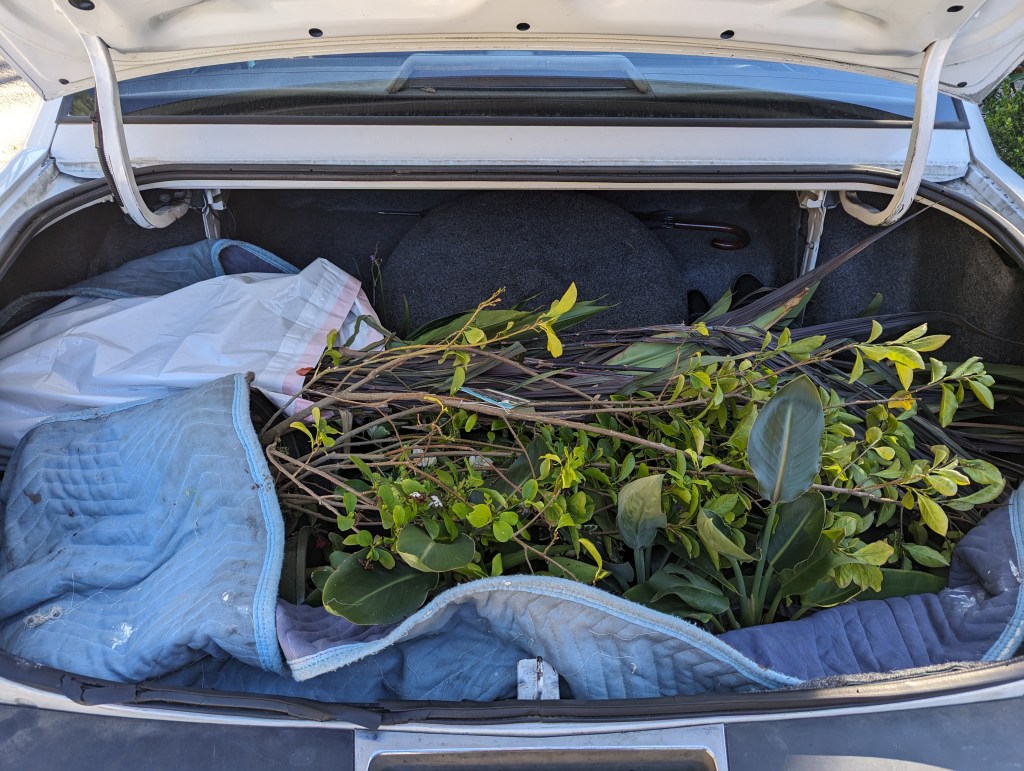
1. Carson is a 1994 Buick Roadmaster touring sedan, not a pickup. He diligently brought all this from Southern California anyway. It includes so much more than these six below.

2. Pimenta dioica, allspice is apparently quite rare. Brent had me trim his so that I could process these scraps as cuttings. However, it is dioecious, so requires a mate to set fruit.

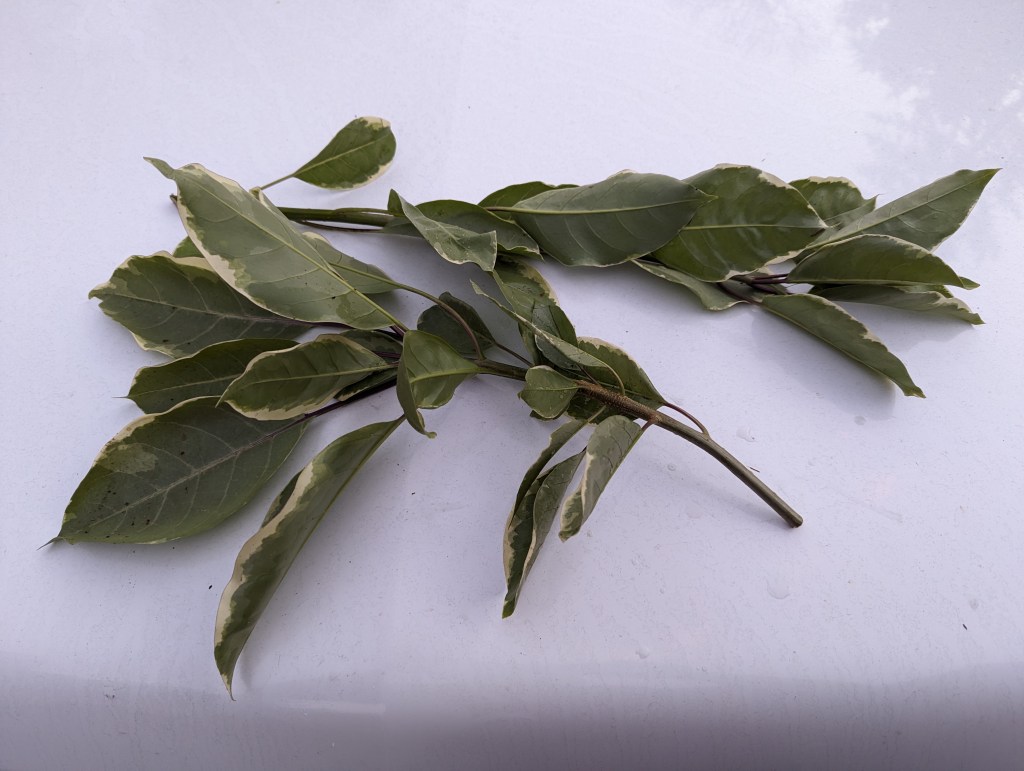
3. Solandra maxima ‘Variegata’, variegated cup of gold vine was acquired in accordance with one of our collegiate traditions; theft. I processed these two scraps into six cuttings. Incidentally, I was uninvolved with its initial acquisition. I will merely grow the cuttings.

4. Nephrolepis exaltata ‘Variegata’, variegated Boston fern or tiger fern is a smaller copy of the mature specimen that provided picture #4 of my Six on Saturday of last Saturday.

5. Hedychium coronarium ‘Variegatum’, variegated white butterfly ginger should bloom with white flowers comparable to those of white butterfly ginger from Woodland Gnome of Our Forest Garden. However, I suspect that it is actually ‘Tahitian Flame’ with peachy bloom. To its right, Alpinia galanga, galangal is a culinary ginger with mundane bloom.

6. Canna of an unidentified cultivar is likely the most important of all these acquisitions. It was acquired by the same means as the variegated cup of gold vine #3, but worse. It is from the Baptist Church that hosted the repast for the memorial of our deceased friend.

This is the link for Six on Saturday, for anyone else who would like to participate: https://thepropagatorblog.wordpress.com/2017/09/18/six-on-saturday-a-participant-guide/

Fireplace Season

Firewood must be seasoned by now. Fresh wood will be seasoned for next year.

There are several reasons why fireplaces are not nearly as commonly used as they once were. Modern building regulations have prevented construction of newer fireplaces (except pellet stoves). Many fireplaces that were ruined by the Loma Prieta Earthquake were never replaced; partly because there are other more efficient sources of heat, and partly because of the concern of air quality. The fuel that was once relatively easy to obtain from orchards that were getting removed to relinquish their land for urban development has been exhausted.

Regardless, those of us who use fireplaces need to be certain that they do not become overwhelmed by trees or climbing vines. Cypress, cedars, pines and some fan palms are remarkably combustible and hazardous when they get too close to chimneys, particularly if the roofs below are covered with old fashioned cedar shingles.

All trees and vines should be pruned away from chimneys so that they are out of reach of sparks and heat. The more combustible trees should get more clearance than deciduous trees (that are bare through winter) need. Nearby Monterey pines, Cypress and any trees that tend to accumulate debris should be groomed of debris, even if their limbs are already pruned back for sufficient clearance.

Trees should also be pruned for clearance from roofs and gutters; and any accumulated debris should be removed. Even before the weight becomes sufficient to cause damage, the motion of limbs in the wind is abrasive to roofs. Older roofs, particularly cedar shingles, will deteriorate under any accumulation of organic debris, particularly as it gets wet from rain.

Horridculture – Diet

Dinnerplate dahlias should be about ten inches wide.

Mail order scams are a topic that I have been avoiding. I do not want to consider that some of a few items that I purchase by mail order may not be what they were sold as; and, if so, I will not know until they grow, bloom or produce fruit. Furthermore, I want to believe that if such items are not what they were sold as, that the situation is merely accidental.

This was no accident.

It began with the purchase of thirty rhizomes of ‘Red King Humbert’ canna last year. They were the cheap sort that become available after their primary season. I did not expect them to be of exemplary quality. Nor did I expect them to bloom. I only wanted them to grow a bit during the remainder of their season so that their rhizomes could survive winter dormancy to grow and bloom for the following season, which would have been last spring.

They grew as expected, but seemed to be virused. I tried to believe that the supplier would not send me virused stock, and that the striations of their foliage were normal. However, as growth resumed last spring, the foliage was very obviously virused.

Also, as they grew, they were very obviously not ‘Red King Humbert’. They grew only about two feet tall, and bloomed with scrawny orange flowers. ‘Red King Humbert’ gets about six feet tall, with big and billowy orangish red bloom.

The supplier gave me a credit for the expenditure, to spend on more of their products, I should have requested a simple refund. Instead, with the credit and a slight bit more for the difference in price, I purchased two dozen rhizomes of assorted dinnerplate dahlias.

As with the canna, I did not expect exemplary performance from these dahlias so late in the season. I only wanted them to survive and grow enough to store enough resources to survive their winter dormancy, to grow and bloom for the next season.

Most were completely necrotic and mummified upon arrival. Because this was after my experience with the canna, the supplier agreed to refund what I spent, but then only refunded a random amount of a dollar and a few cents. When I asked about the refund, I was informed that it was comparable to the cost of the one rhizome that I sent a picture of, as if I was expected to send a picture of every rhizome that I wanted a refund for. I explained that almost all of the rhizomes were comparable the the one that I sent a picture of, but received no more response.

I still have heard nothing about it. I decided to be satisfied with the few rhizomes that survived, and just accept the loss. The time that I had already wasted on pursuing a refund was worth more than any refund that I would have gotten.

So, . . . a few of the dinnerplate dahlia rhizomes survived and generated a bit of growth to partially recharge their resources prior to their next dormancy. Two actually bloomed. Apparently, these are very special dinnerplate dahlias. Instead of producing blooms that are about ten inches wide, the largest bloom is less than three inches wide. I have never seen such a dinky dinnerplate.

Unhappy Fishtail Palm

Now that the foliar color has improved, the foliar density is deteriorating.

Fishtail palm is never completely happy here. It is not much happier in Southern California. Even the happiest are discolored to a minor degree. Many are more significantly discolored. Some are so very discolored that they are visually unappealing.

No one seems to know why. I suspect that they would prefer more humidity. Perhaps they prefer more humid warmth. They may dislike the pH of the soil.

Furthermore, fishtail palms are monocarpic. Each trunk dies after bloom. Clumping sorts develop new trunks prior to the demise of a blooming trunk. Those that do not develop replacement trunks die completely.

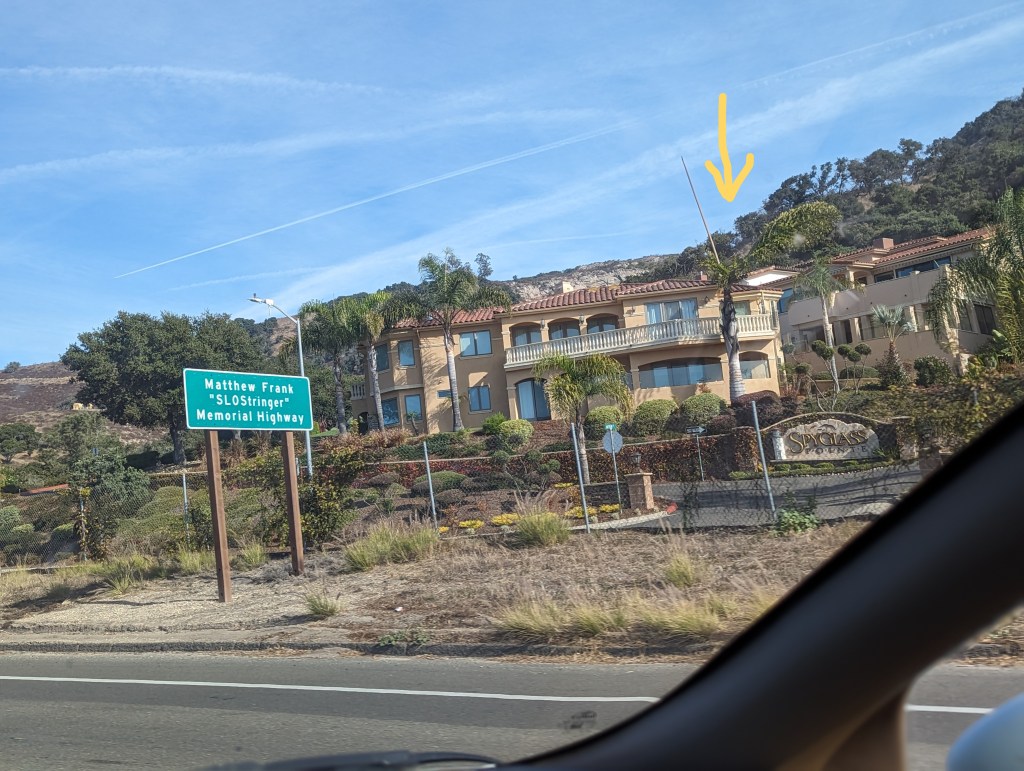
The illustration above is obviously not of exemplary quality. I took it from the car while driving. This was on northbound Highway 101, at the northern extremity of Pismo Beach. The palm to the upper left of the sign for Spyglass Pointe, with the yellow arrow pointing at it from above, is a fishtail palm. Until recently, it had been famously chlorotic.

Colleagues who drove through Pismo Beach typically asked me about this palm after seeing how chlorotic it typically had been. This it he least chlorotic that I have ever seen it. However, it may be naturally deteriorating after its primary bloom. Although I have not observed any bloom, I can see that new leaves are not developing on the same rate that They had in the past. This picture shows it with only a single open leaf, with another foliar spike extending from the terminal bud.

This particular fishtail palm is not very old. I can remember when the associated residential buildings were constructed less than two decades ago. landscapes and associated trees were added shortly afterward. Since then, the fishtail palm had been unhappy. This likely why fishtail palm is not more commonly available here than it is.