Horridculture – Rats!

Darla would not have allowed this!

Darla would be very disappointed. Rodents were not a problem while she was here. Since her retirement, they have proliferated. I do not mind if they get into the compost or even the trash. The problem is that they now inhabit portions of the shop buildings and the nursery where we grow a few items for the landscapes.

They are rudely bold about their infestation too. They know that I can not catch them like Darla would, so they are in no hurry to evade me if I encounter them while working late. They ruined a bag of seed for erosion control vegetation. Although the top of the bag was wide open, they chewed through the bag so that the contents spilled out onto the floor.

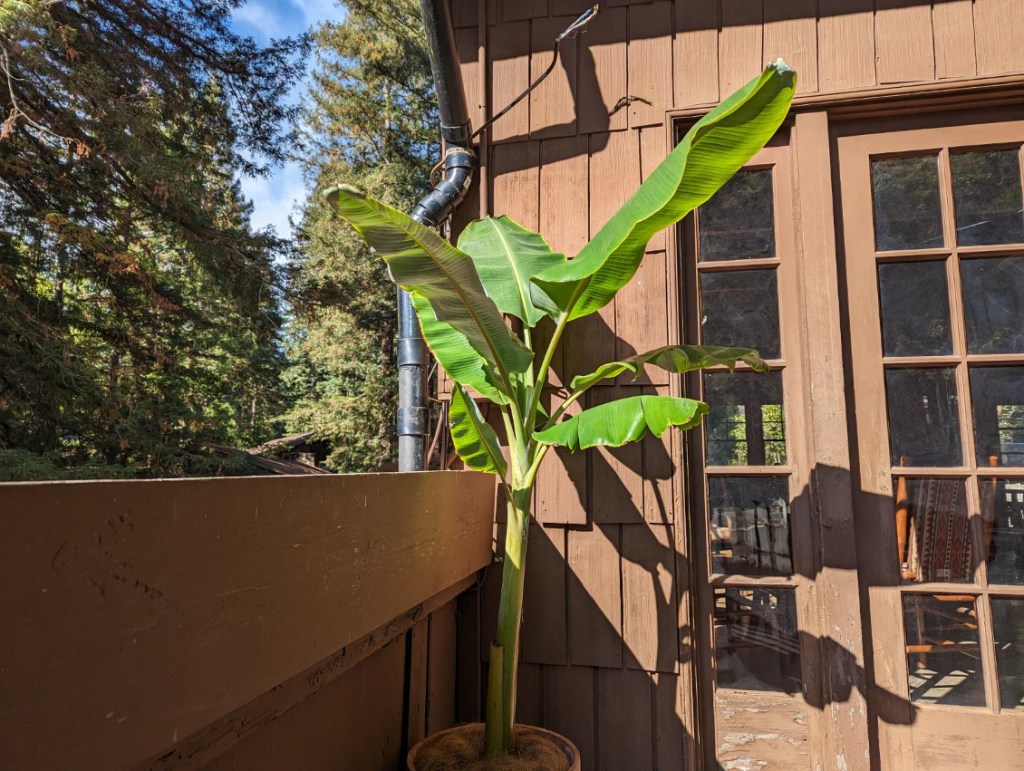
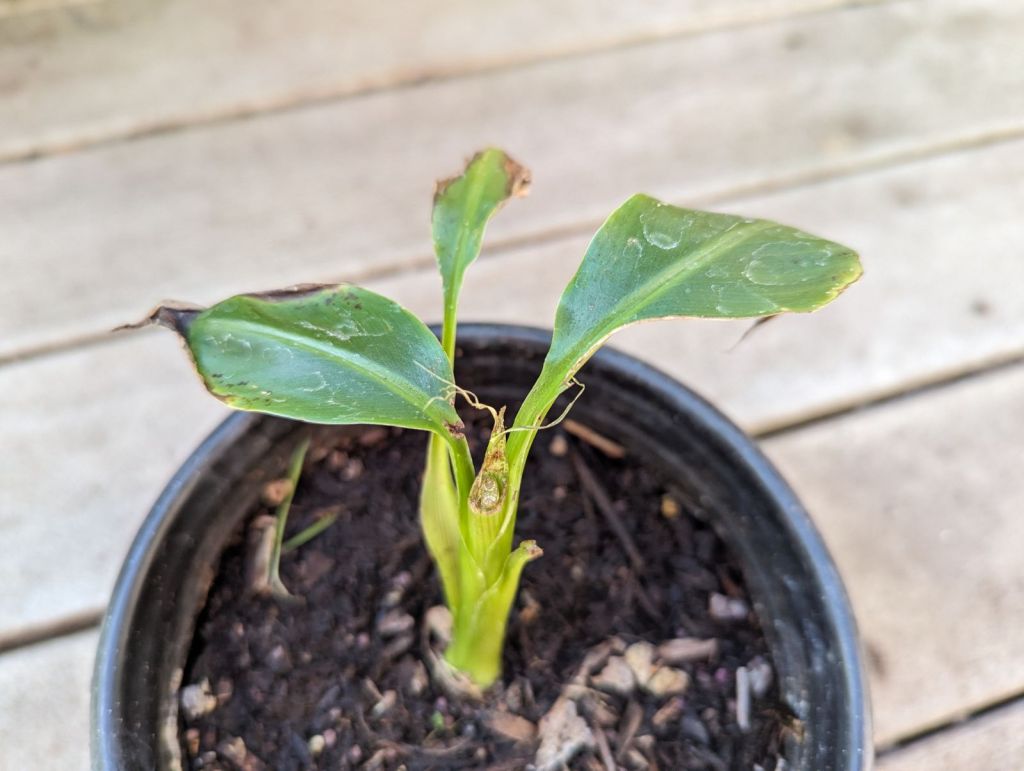
Worst of all, they chewed the tops of a few of the more unusual items within the nursery. They ruined a few of the Heliconia that I brought from Brent’s garden, and then chewed the tops off of two young banana trees. All affected specimens should recover, but I am very annoyed by the damage nonetheless. I do not put so much effort into growing such vegetation just to feed rude rodents! Besides, the banana trees are of an uncommon cultivar. I am concerned about others that are quite rare.

Rats would not be such a problem if only they were not so rude. There is plenty of vegetation, including blackberries, for them to eat within surrounding forested areas. They insist on coming inside to damage important vegetation instead. That is why I do not feel at all guilty about putting traps out.

Ultimately, I should be more diligent about hiring a feral kitty to dissuade rodent infestation. I have not yet heard back from the agency that procures employment for such feral kitties.

What Is This?! III

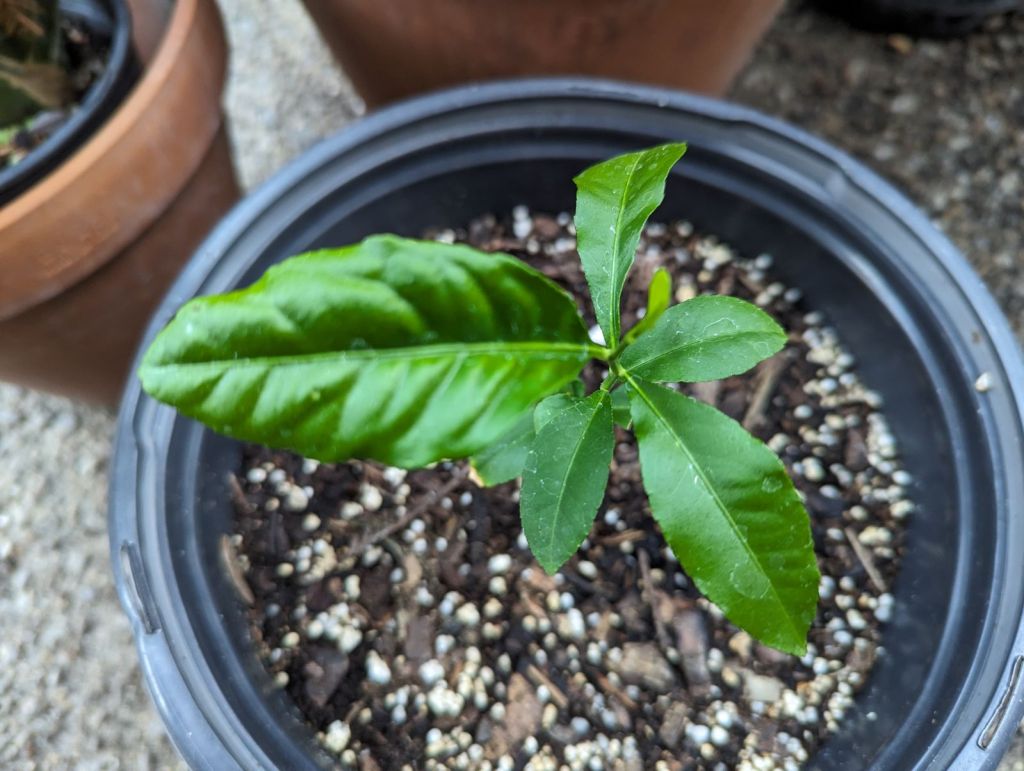
Could it be lychee?

Prior to the identification of Hibbertia scandens last week, another mystery arrived. I probably should have mentioned it earlier, but as with the previous mystery, I thought that I would have identified it before I felt compelled to mention it here. Unlike the previous mystery though, I did not recognize it as something that I had encountered in the past.

Someone with whom I work, who is not so horticulturally oriented, brought it from one of the homes that he was working at. It had been left by a former tenant. Initially, I thought that it was merely a can of otherwise unused media in which a common bay laurel seed had germinated. However, it is not a bay laurel seedling. Also, contrary to how it appears in the picture, it is remarkably centered within the can, as if intentionally plugged there.

Initially, I thought that it resembled coffee, Coffea arabica. However, coffee exhibits opposite leaf arrangement, and these leaves are alternately arranged. Besides, viable unroasted coffee seed is not exactly common. Now, I sort of suspect that it could be lychee, Litchi chinensis. Although uncommon, seeded lychee fruit are not as rare as unroasted coffee. Although their leaves are so closely paired among mature specimens that they seem to be oppositely arranged, they are technically alternately arranged, and more obviously so among juvenile growth. If this is lychee, it will not produce identifying bloom for a few years.

Realistically, immediate identification of this seedling is unimportant. I could have put less effort into discarding it than I put into writing about it. Therefore, I will merely give it what it needs until it grows enough for identification. I will not mind discarding it if I identify it as something that is useless. Otherwise, I can find it a home.

Prickly Pear

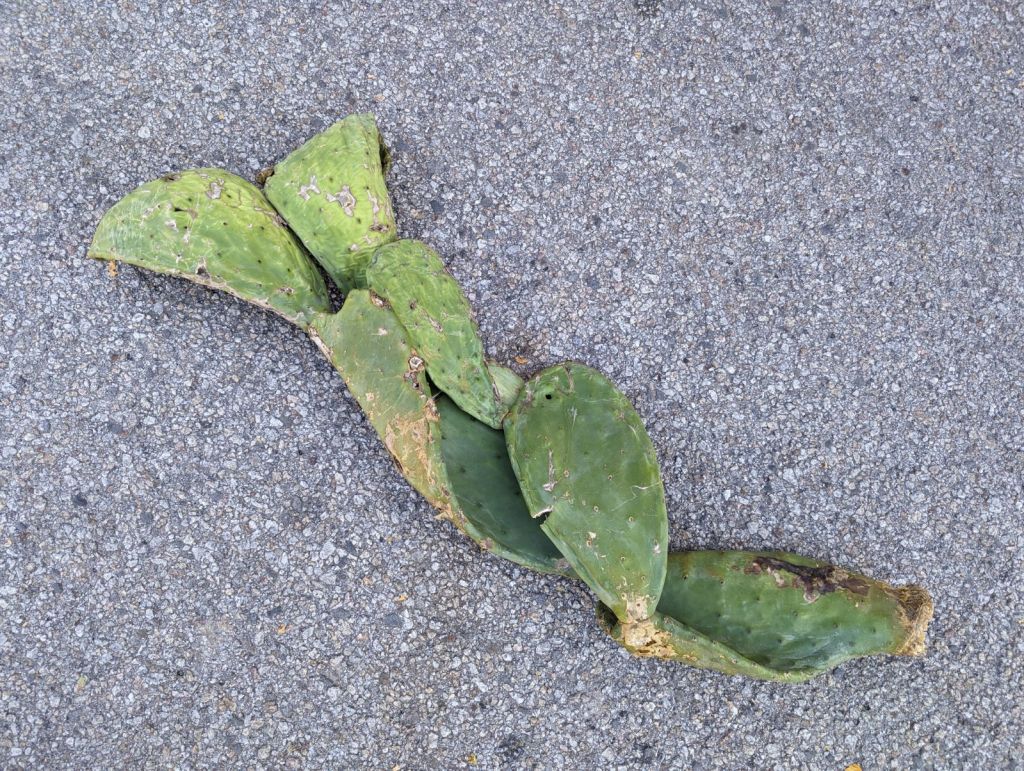
I can make good use of this bit of greenwaste.

It is certainly no pear, and its particular cultivar is not overly prickly. Nonetheless, it is commonly known as ‘prickly pear’. It is also known as ‘Indian fig’, but is neither a fig, nor from India. The Mexican Spanish name for its fruit is ‘tuna’, but in American English, that seems fishy.

However, within its proper linguistic context, ‘tuna’ would be the least misleading of the common names of the fruit of ‘nopal’. ‘Nopal’ is the common name of various species of Opuntia, many of which are popularly grown as vegetables. ‘Nopales’ are plural. ‘Nopalitos’ are sliced or otherwise processed as small bits for culinary application.

Anyway, this shabby bit of nopal appeared within our big greenwaste pile at work. I find it annoying when neighbors exploit our greenwaste pile for disposal of greenwaste that is obviously not from our landscapes, as if I will not notice. Such debris often includes dirt and other crud or even trash that can not be chipped, and is almost never staged to facilitate efficient chipping.

This was quite a find though. It can be cut into six separate pieces to be plugged in between the five Arizona cypress that I installed as an informal hedge along the outer road. I would not have considered doing so if this had not appeared unwanted on our greenwaste pile. Nopal that I plugged a bit farther out, closer to the road, were shredded by weed whackers on a few occasions until they ultimately succumbed.

I already grow one unidentified cultivar of nopal for its eventual production of rich red tuna. I have no idea what this new acquisition is either, and it could be the same as what is already here, but I sort of hope that it produces yellow or gold tuna with milder flavor.

Six on Saturday: Best or Worst for Last

Indian summer is now doing what it does every few years or so. It was more than ninety degrees for a second day here yesterday, and was even warmer in the Santa Clara Valley. As typical, it happened after cooling weather already started to feel like autumn. It is not a good time to relocate vegetation, which I started to do while the weather was still cool. Also, I must briefly increase irrigation. Not all of these Six are relevant to the weather or any particular theme. Actually, half are irrelevant. The last is open to interpretation. It is not a good picture, but is likely the best.

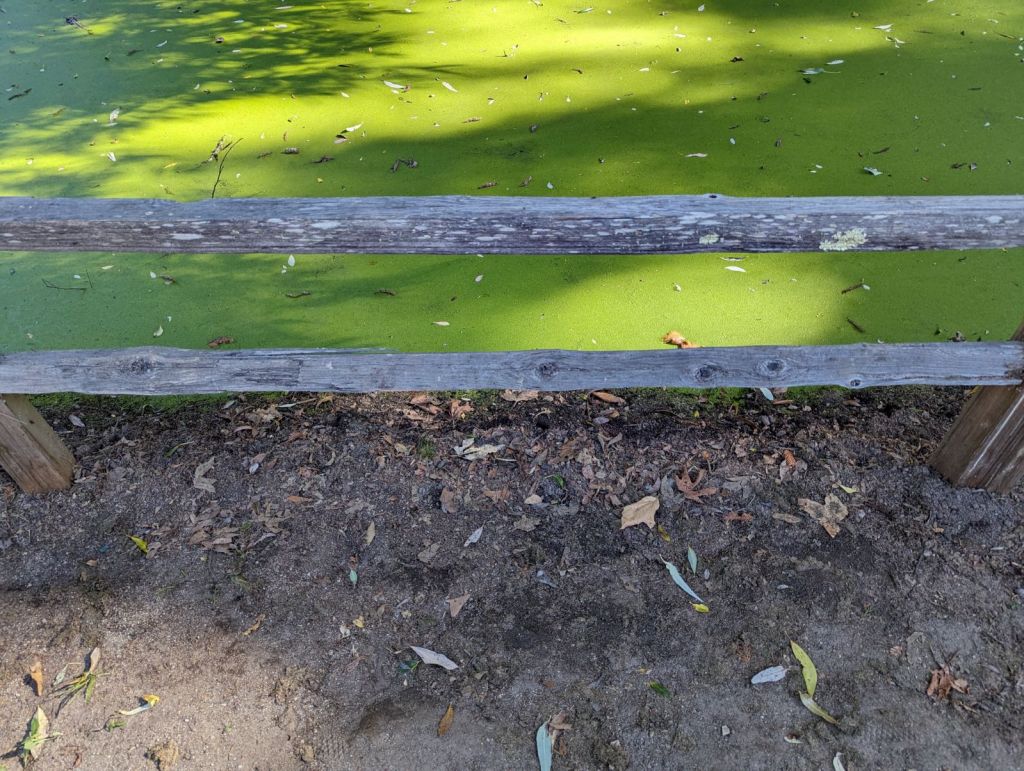
1. Water from the spigot occasionally gets slightly colorful here. Water from the streams and creek is clearer. It is a consequence of hydrant flushing. It is harmless for irrigation.

2. Unidentified ferns needed to be removed from where an old fence was replaced. I can not simply discard them. I buried them elsewhere so that they can regenerate next year.

3. Unidentified spirea was also in the way. Of course, although I do not expect much of it to survive, I relocated it also. I typically cut this spirea back to the ground during winter.

4. Marah macrocarpa, wild cucumber develops huge tubers that can weigh more than I do. This one is merely about a foot and a half long, so is relatively small, but now what?!

5. Portulaca grandiflora, moss rose is not mine, is not here, and did not give me a good picture. Nevertheless, I feel obligated to share at least some summery floral color today.

6. Rhody did not cooperate for this picture either. I can not explain how he so efficiently hid behind only one yawn. As bad as this picture is, it just might be the best of these Six.

This is the link for Six on Saturday, for anyone else who would like to participate: https://thepropagatorblog.wordpress.com/2017/09/18/six-on-saturday-a-participant-guide/

Out of Tune Trumpet

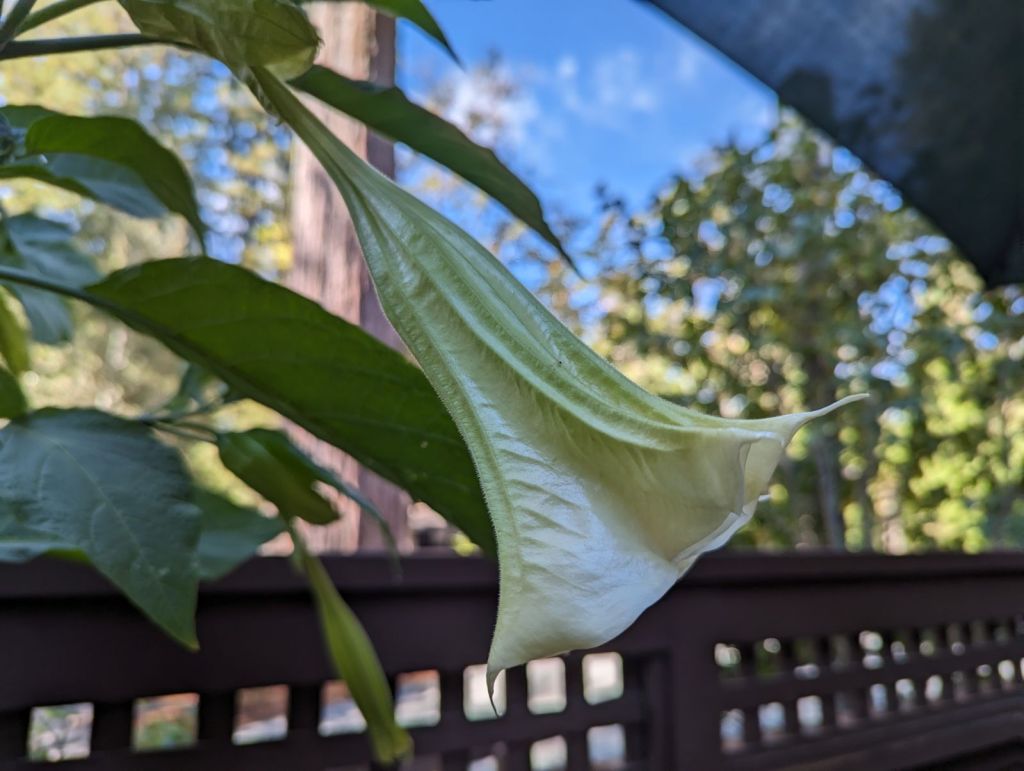
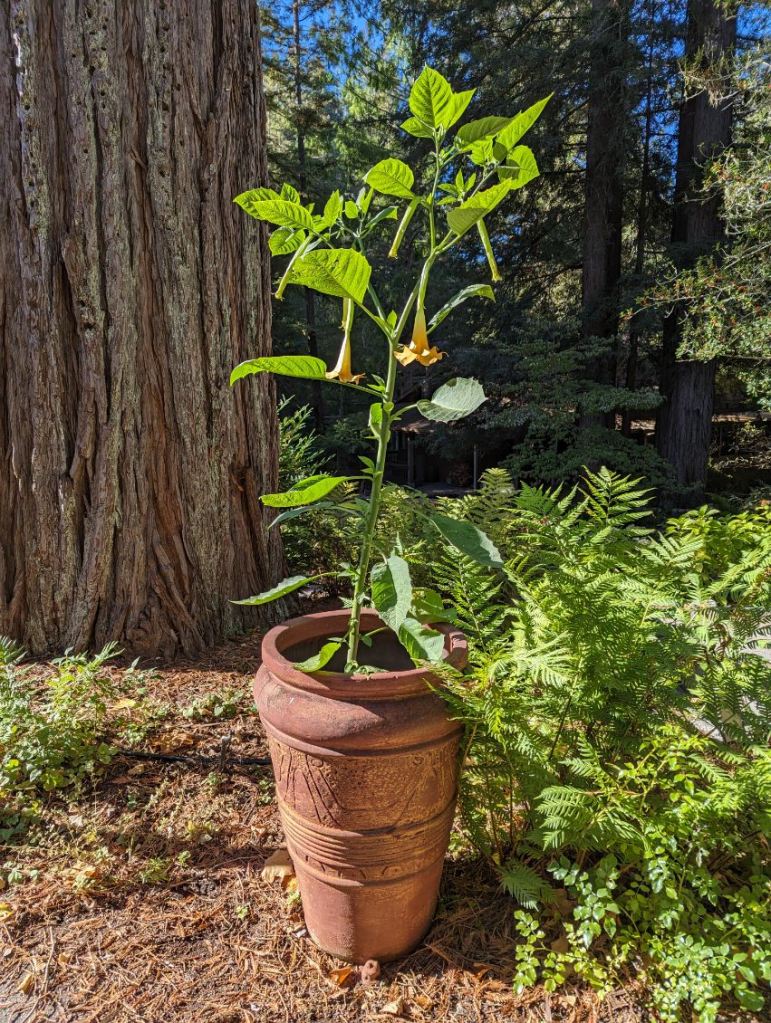
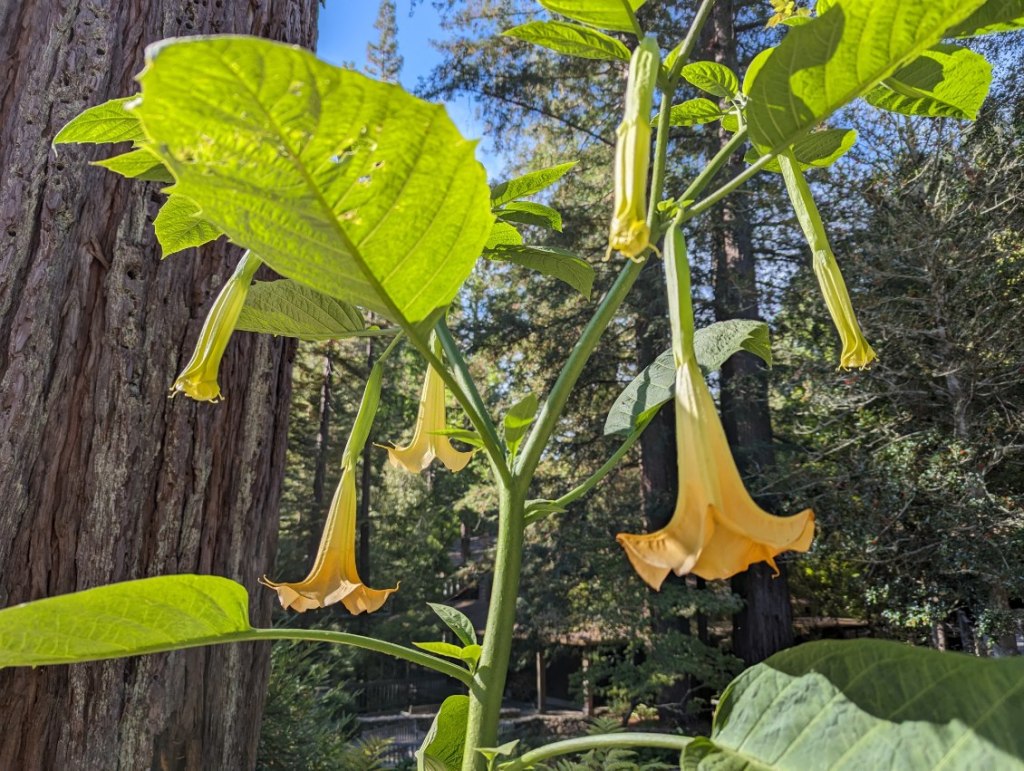
Brugmansia X cubensis ‘Charles Grimaldi’

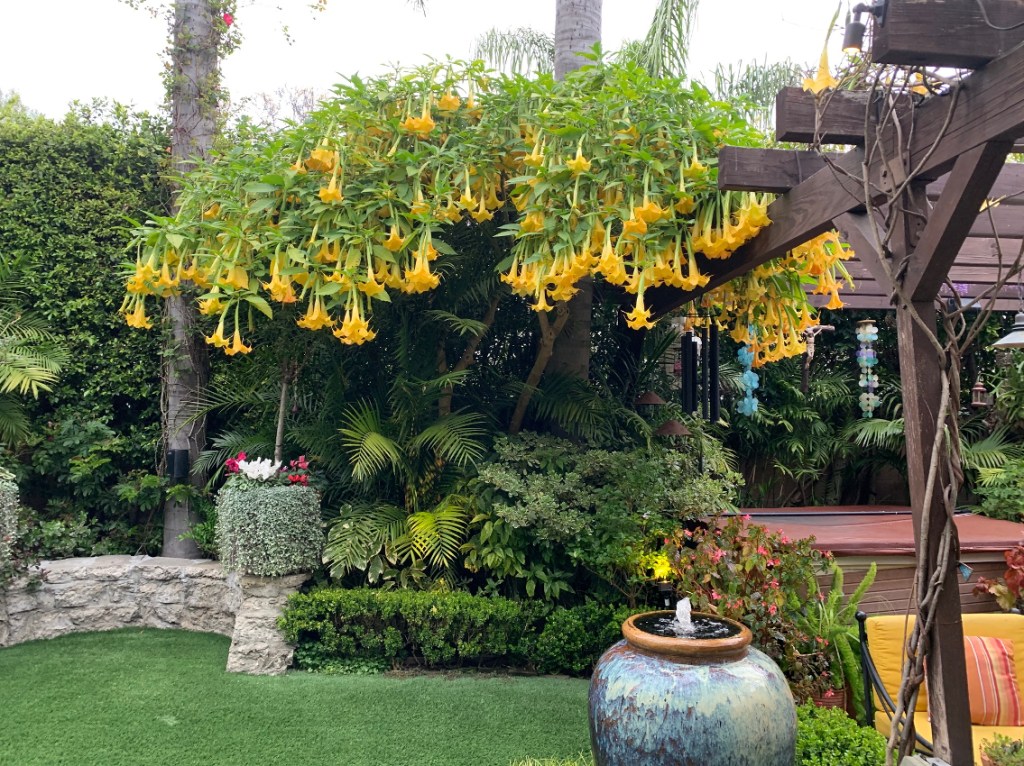
Summer was mild. Vegetation that enjoys warmth grew relatively slowly through much of it. Then, toward late summer, and without increased warmth, some vegetation seemed to accelerate growth unexpectedly. Banana and heliconia pups grew like they should have earlier in summer. Angel’s trumpet cuttings began to get somewhat weedy. Some that did not bloom earlier began to bloom now!

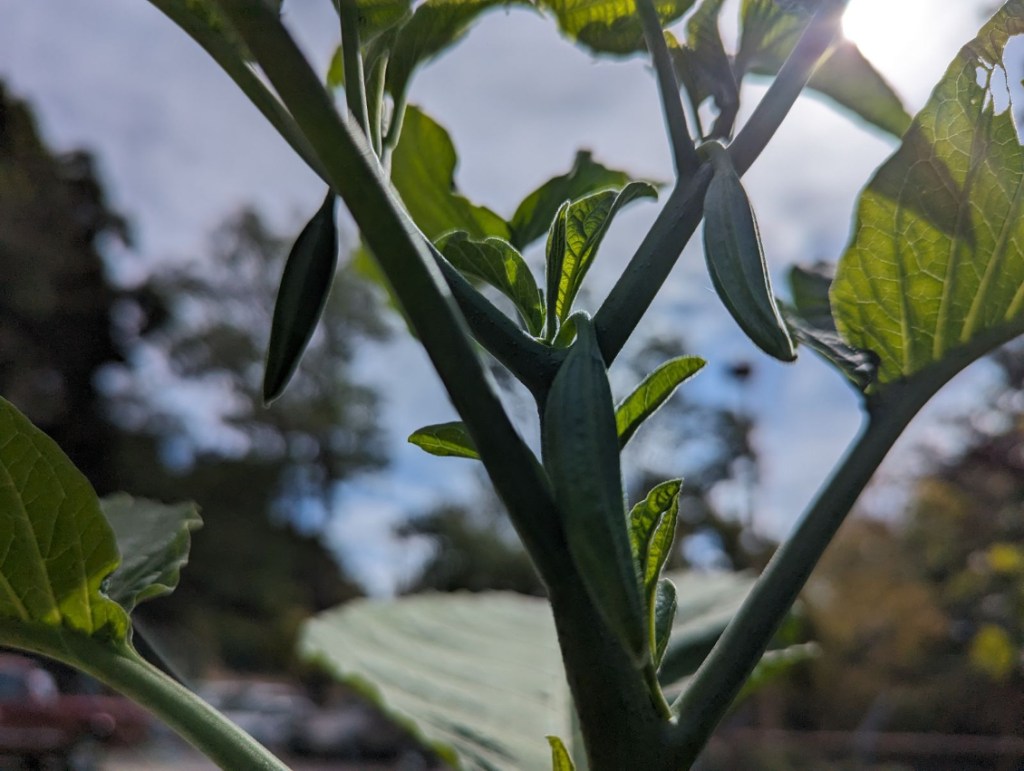
Brugmansia X cubensis ‘Charles Grimaldi’ is likely the most popular angel’s trumpet. It is the most vigorous, and may be the most fragrant. One cutting that survived the unusually cool frost last winter grew from its roots to more than six feet tall since then. Now that it is time for it to decelerate growth, it is blooming! Such performance is impressive, but not in tune with the seasons. It can not continue for long, before disruption by increasingly cool autumn weather. Unusually vigorous growth that continues to bloom unusually late could be unusually vulnerable to frost next winter.

This is not the only angel’s trumpet that is out of tune with its seasons. A similarly mature specimen of an unidentified cultivar with single white flowers is about to bloom also. Two older specimens of other unidentified cultivars are growing about as vigorously, although without bloom. One blooms with double white flowers. The other blooms with single pale orange flowers.

About nine copies of each of both cultivars that bloom with white flowers are growing like weeds in #1 cans, with more than a dozen more small cuttings of the cultivar that blooms with double flowers in cells. Only the original matured specimen that blooms with double white flowers actually inhabits a landscape, and is incidentally about to bloom, but is not here with these in the nursery. More will go to landscapes after winter, where their bloom can be enjoyed.

What Is This?! II – Hibbertia scandens (sequel from last Saturday)

Hibbertia scandens, Guinea flower

Obviously, it is not cup of gold vine, Carolina jessamine, yellow jasmine, yellow trumpet vine, yellow orchid vine, yellow black eyed Susan vine or any of the vines with yellow flowers that Google suggested as its identity. It is more than obviously not lotus, which incidentally blooms with orange flowers rather than yellow, but was somehow, according to Google, a candidate for vines with yellow flowers. It is amazing what can and can not be found on Google.

Brent recognized this vine just like I did, but also like me, could not remember its identity. We had not seen much of it in many years, but could remember that it was somewhat common in coastal regions while we were in school during the late 1980s. It lived at a doughnut shop that we sometimes went to in Morro Bay, and seemed to smell as if a tom cat had marked his territory on it. I can remember it within old gardens of Carmel and Monterey, as well as Santa Cruz, where I found these cuttings. I also remember encountering it while inspecting median landscapes of some of the major roads of Morgan Hill in the late 2000s, and that it did not perform as well within the somewhat inland climate there. Brent observed that specimens in Santa Monica and Beverly Hills seemed to express the same preference for the more coastal climate of Santa Monica.

Now that I got it, I have no idea of what to do with it. I suppose that, without mentioning the faint but potentially slightly objectionable floral fragrance, I can convince neighbors that they want it in their gardens. Some of our landscapes are big enough for it to be pretty at a distance. At least I know what it is, Guinea flower, Hibbertia scandens.

Six on Saturday: Autumn in the Redwoods

Autumn is not much to brag about here. Not only is the change of the weather mild, but foliar color is limited beyond synthetic landscapes. Redwoods are only a bit messier now because they did not shed as much as typical while summer weather remained atypically mild. Fireplaces at work get a bit more use, but only for ambience. A few autumn flowers bloom between summer flowers and winter flowers.

1. Sequoia sempervirens, coastal redwood is evergreen. Its foliage does not turn colorful for autumn. It certainly sheds though. It sheds mostly while the weather is warmest and driest through summer. However, without such weather, it sheds more as summer ends.

2. Firewood is too mixed for identification of all species that might be involved with this picture. It comes from the various trees that must be removed and pruned here. Because fires at work are more for ambience than heat, the quality of such wood is unimportant.

3. Anemone hupehensis var. japonica, Japanese anemone exhibits why I find ‘Honorine Jobert’ to be so appealing. This is the only anemone here, and it is ghastly pallid, neither pure white nor pinkish. It actually seems to be slightly grayish. Ick! I learned this species as simply Anemone japonica, but now learn that it is supposedly Eriocapitella japonica.

4. Chrysanthemum X morifolium, is more discolored than anemone, but is instead quite pretty. It was likely white when left here after a wedding. It now lives in a garden nearby.

5. Tagetes patula, marigold is as customary for autumn as chrysanthemum is. Its bright yellow and orange are splendid. This one though looks too much like Ronald McDonald.

6. Tagetes patula, marigold should look more like these. Brownish red is traditional too. Marigold is the official flower of Dia de los Muertos of the first and second of November.

This is the link for Six on Saturday, for anyone else who would like to participate: https://thepropagatorblog.wordpress.com/2017/09/18/six-on-saturday-a-participant-guide/

Horridculture – Inappropriateness

Vines and annuals are not shrubbery and ground cover.

Vegetation within a planned landscape should serve a purpose. The form of such vegetation should be appropriate to such purpose. Trees provide shade. Shrubbery defines space and obscures undesirable scenery. Vines climb fences and other infrastructure. Annual bedding plants provide more seasonal color than most other vegetation. Turf grows into useful lawns. It is helpful to plan accordingly for a landscape.

Turf can not do much more than become useful lawn. It can not provide shade, obscure undesirable scenery, climb fences or provide more seasonal color than green. Nor can trees, shrubbery or vines become useful lawn. Again, each form of vegetation should be appropriate to its particular application.

Trellised rocktrumpet is not shrubbery. Rose periwinkle is not permanent ground cover.

There is so much other vegetation that would have been appropriate to this particular situation. Star jasmine, trailing lantana, trailing rosemary or even the dreaded English ivy would have been better and more permanent ground cover. Dwarf oleander, barberry, arborvitae or even dwarf New Zealand tea tree would have been better shrubbery.

Rose periwinkle is an annual bedding plant. Although it is somewhat pretty now, it will not likely survive through winter. Even if it does, it will not migrate far enough to reliably function as a ground cover.

Trellised rocktrumpet is a small but vigorous vine that will always be reliant on trellises for support. As its cheap trellises decay and deteriorate, it will eventually develop into shabby mounds of tangled vine stems, but will never be able to support itself as high as the new trellises are now. It can reach out to cover some of the ground that will be vacated by the rose periwinkle, but can not reliably function as a ground cover for this much area. It will bloom less if shorn for neatness.

V8

The vertical post demonstrates how much the tree trunk leans.

A few tree species should’ve had a V8. That includes more than a few individual trees. It applies to enough individuals of a species to indicate that the need is almost typical of the particular species.

The need for a V8 is derived from old advertisements for the V8 beverage that depicted those who were deficient in adequate consumption of V8 as leaning prominently. V8 is a juice beverage that is composed of juices of eight vegetables; tomatoes, carrots, celery, beets, parsley, lettuce, watercress and spinach. Hence, V8. It balances a diet so that those who consume it stand upright rather than lean.

In horticultural slang, the need for a V8 refers to a leaning trunk.

Any tree of any species has potential to develop a leaning trunk, and consequently appear to be in need of a V8. Some species innately develop leaning trunks though. No one seems to know why, but specimens of such species with vertical trunks are oddly uncommon or perhaps rare.

For example, so many ginkgo trees lean at such similar angles that, among some groups, their distinctive lean seems to be a normal characteristic of the species. It is variable though. Many individual trees that are isolated from others are quite vertical. So are some groups of street trees. However, many or most specimens of other groups of street trees lean at very similar angles, although in random directions.

Italian stone pines are more likely to lean, also at relatively similar angles, and also in random directions. Locally, vertical trunks are rare among this species. However, within their native range, vertical trunks are typical.

Argyle apple (eucalyptus) is almost comparable to Italian stone pine in regard to its typical need for a v8. I have seen a few with vertical trunks. I was determined for ours to be among them. I bound the trunk to keep it straight as it grew. I installed it with the trunk as vertical as the sign post next to it. When wind caused it to lean slightly while it was smaller than it is now, I pushed it back into position. Actually, I might have done that a few time. However, as it matured, it became more difficult to push back into position. Eventually, it refused to budge from its leaning position. Now, like most of the species, this specimen also seems to be in need of a V8.

After the base of the trunk insisted on leaning, the upper portion of the trunk assumed vertical posture.

What Is This?!

I have no idea what it is, but I intend to grow it.

It is an evergreen vine that seems to sprawl over other vegetation rather than actually climb it. It lacks tendrils or other means with which to hold onto its support. It does not even seem to wrap around its support. Nor does it seem to get very high above the ground. It just sort of sprawls.

Its glossy leaves are rather simple, just like in the picture here.

Its bright yellow and staminate flowers, if I remember correctly, seem to resemble those of Saint John’s wort, but are a bit wider.

This vine, again if I remember correctly, seemed to be more popular years ago. I do not notice it much anymore. I can not remember when I last saw it in a nursery, or if I ever saw it a nursery. The few specimens that I am aware of inhabit old landscapes that have not been renovated in decades. I got these bits from where they were regenerating after their earlier removal from an old landscape.

Now that I have these bits, I intend to grow them, in order to get familiar with the species. I hope that I can eventually identify it. It should not be so difficult for something that had formerly been popular, or at least common enough for me to recognize it as something that had formerly been familiar.

I do not often encounter a species that I can not identify, and I even more rarely admit to it. If I do not recognize a species, I can typically recognize the genus, or at least the family, and then key it out. For this seemingly simple vine, I can not identify its family. I asked Brent, which I almost never do. He recognized it about like I did, but also could not remember its name.