Horridculture – Jumpin’ Juniper!

P00422-1
This is the backside of some of the better junipers!

Junipers have a bad reputation. They earned it at a time when they were too common. Too many were installed into situations that they were not appropriate for. As they grew, they were unpleasant to handle. If not handled enough, they became overgrown and shabby. Once that happened, there were nearly impossible to prune back into confinement without being ruined.

I was never one to completely subscribe to that bad reputation. There were just too many junipers that I really liked, particularly the Hollywood juniper and the Hetz blue juniper. There were a few that I disliked, and I still loath the common tam juniper, but they were in the minority, and happen to be the same sort that are becoming more scarce.

For landscape situations that they happen to conform to, there really is no reason for junipers to be any less appropriate than any other genus is. They are happy with local climates and soil types. Once established, they do not need much water at all, and many need no supplemental irrigation. They last for a very long time. Best of all, they need only minimal maintenance.

However, even some of the best junipers are not perfect. I know. I just needed to work with some that were installed in 1980, and, except for getting pruned back around the edges, were completely ignored. After days of trying to tame them, I can not longer deny that some of what I have not wanted to believe about them is very true.

Besides all the trash and road debris that had been dumped into them during the past four decades, they were thickly infested with Himalayan blackberry. Removing the bramble was not only wickedly unpleasant, but it exposed bare spots where juniper foliage had been shaded out. Removal of a few junipers that had been overwhelmed and died left even more bare spots.

Well, I could not just leave all the dead twiggy growth under the bars spots, so tried to remove some of that too. That only exposed more of what what under and behind it, and caused the well foliated stems above to sag into the whole mess. In the end, the junipers are an unsightly mess, and I know that they will stay that way for a very long time.

P00422-2
Removal of all the bramble and dead junipers exposes a lot of bare branches.

Tradition

P00419
Lunaria annua is known more for coin shaped seed pods than bloom.

Money plant, Lunaria annua, which some may know as ‘honesty’, is honestly not a wildflower here. It is neither native nor naturalized. Yet, it seems to grow wild on roadsides, in drainage ditches, and around the perimeters of some of the landscapes. It certainly produces enough seed to naturalize. It just would not have done so in this climate without a bit of intervention.

Many years ago, someone who maintained the landscapes here started sowing seed for money plant. I do not know if he was the first to sow the seed, or if he collected it from plants that someone else grew. He collected seed annually to disperse randomly by simply tossing it out wherever he though it might happily grow into more money plant.

Since money plant wants a bit more water than it gets from annual rainfall here, it was happiest where it is most often seen now, in roadside drainage ditches and on the perimeters of irrigated landscapes. It somehow competes effectively with other seemingly more aggressive vegetation. In the more favorable situations, it self sows, but can not perpetuate indefinitely.

The horticulturist who dispersed the seed for so many years retired a few years ago. Consequently, there has been a bit less money plant annually since then. It certainly tries to naturalize, but was rather scarce last year.

We could not allow it to go extinct just yet. We collected some of the seed from the plants that bloomed last year. I dispersed a few where I thought they would be happy without being obtrusive in the landscapes. I gave most of the seed to a neighbor who happens to enjoy tossing random seed into random (but hopefully suitable) spots where wildflowers would be nice.

It is such a delightful tradition that is worth continuing.

When It Rains, It Pours

P00418K-1
Mudslide!

The only reason we developed a small vegetable garden here this year is that we have been unable to go to work for about a month. Without my second most time consuming employment, I had time to clear a small unused space (which was not nearly as simple as that sounds) and sow seed for vegetables. It was a late start a month ago, but not too late.

In fact, there was still time to do it before the last storm to go through. I know that sounds trivial, but as a Californian who is accustomed to gardening in a chaparral climate, and sometimes where there is no water available, planting prior to a storm ‘seems’ to be rather important. I know it is not. Water is available here. Otherwise, I would not grow vegetables.

Not only was there a storm, but there was a second storm later! Of course, it is not really that simple. The first light duty storm was nice, and soaked things sufficiently. Then the weather stayed strangely cool for this time of year. Nothing germinated. Then the second storm was brief but torrential enough to erode all of the recently sown seed right out of the new garden!

It was too comical for me to be too annoyed by it. I only needed to see what survived the erosion so that I could replace what did not. I almost replaced everything anyway, just because I was that certain that nothing survived.

Well, as it turned out, not much was missing! The garden got a slow start, and was delayed again by cool weather, but somehow seems to be recovering nicely. Even some of the very old seed that I did not expect to be viable has germinated.

P00418K-2
A late batch of radish somehow survived.

Now, I must go work in the garden.

P00418K-3

P00418K-4
Late but ready to go.

Six on Saturday: Moving Day

A neighbor family relocated to a new home a short distance away. The former home needs such major repair that it may instead be demolished and replaced. For now, it remains abandoned. I collected a few plants from the abandoned garden so that some could be relocated to the new home. So far, only two Philodendron selloum and one Mexican fan palm went. The rest remain here, and may actually go to other homes.

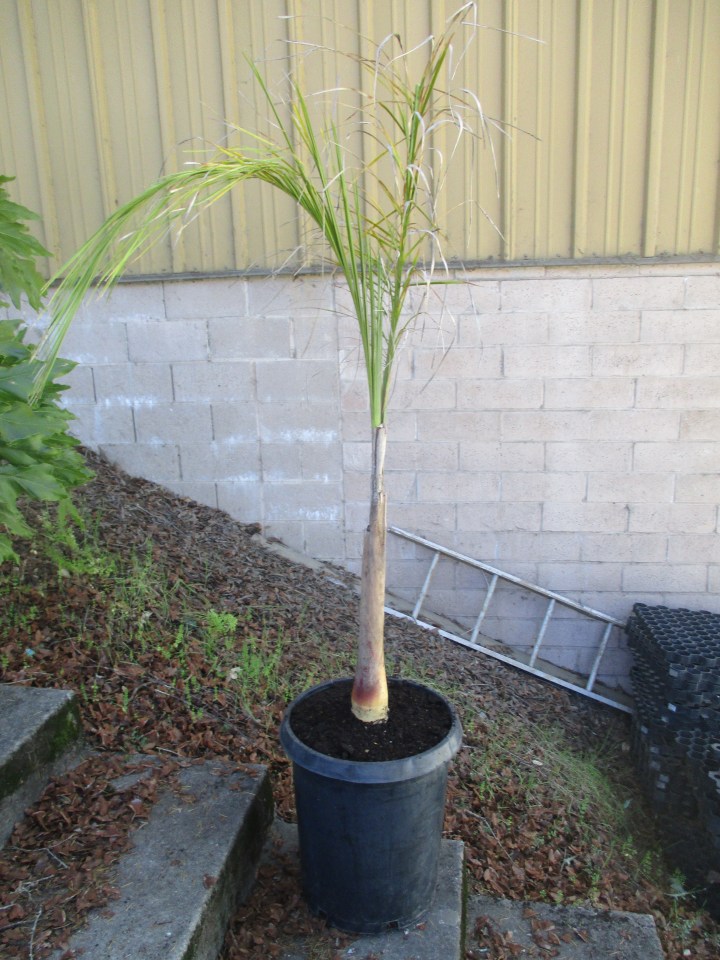
1. In all my career, I have never seen a trunk of a palm shrivel from desiccation like this. All of the now absent roots were desiccated also. I seriously doubt that this queen palm will survive.P00418-1

2. It got canned anyway. Without significant roots, it certainly did not need all this medium. It only got a #15 can so that the shriveled trunk could be buried, sort of like a weird palm cutting.P00418-2

3. This lemon tree was almost left behind because it is so mutilated. It looks a bit suspicious too, sort of like shaddock understock of a formerly grafted tree. Actually, it is ‘Ponderosa’ lemon.P00418-3

4. The smaller of two Mexican fan palms got canned into a #5 can until it starts to produce new roots and foliage. Actually, only the queen palm and the big Mexican fan palm got larger cans.P00418-4

5. This bigger Mexican fan palm got a squat #20 can because the trunk is wider than a #5 can. There are not very many roots in there yet. It got left here to divert traffic around the garden.P00418-5

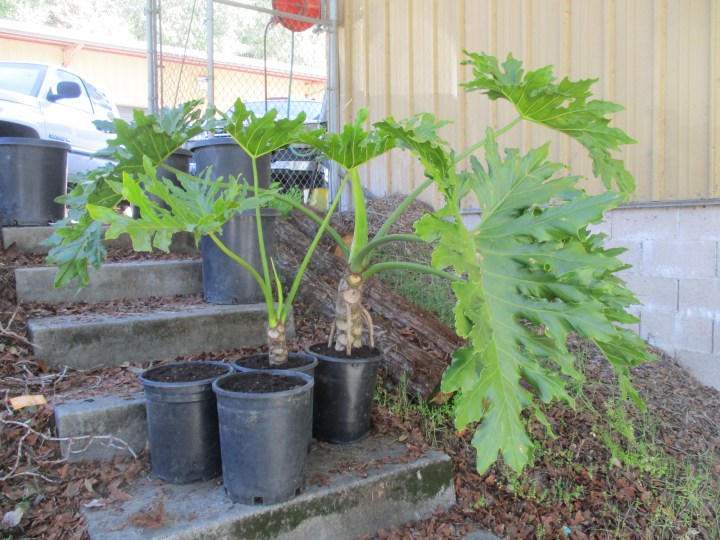
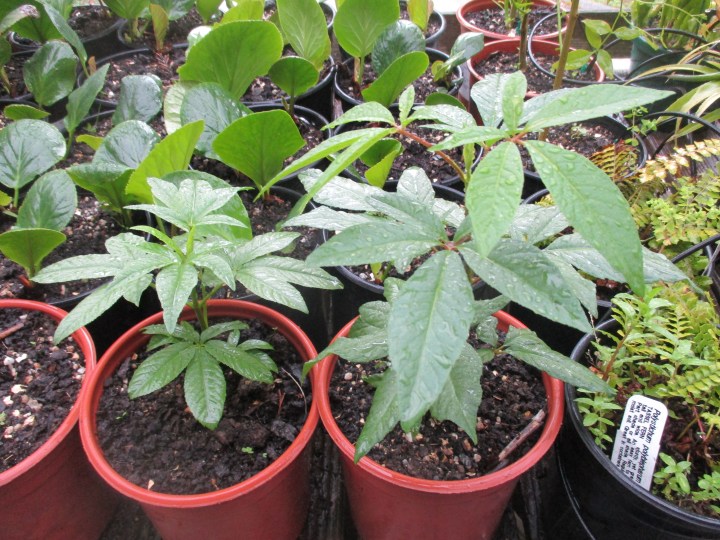
6. These three Philodendron selloum were all I originally wanted to salvage. One lacks foliage for now. The other can that seems to be empty contains bare tubers of an unidentified heliconia.P00418-6

This is the link for Six on Saturday, for anyone else who would like to participate:

https://thepropagatorblog.wordpress.com/2017/09/18/six-on-saturday-a-participant-guide/

Horridculture – Slim Waists

P00415
If I put a spider plant in the pot on the right, I may never get it out.

Clay pots have been around for a very long time. It is impossible to know for how long exactly. It is logical to say that they have been around long enough to evolve into the perfect shape for their function. Although the dimensions and proportions are variable, the basic design characteristics of the simplest and best engineered clay pots can not be improved on.

Clay pots are circular from above and below for a few reasons. Such a shape is easily formed on a potters’ wheel. It is more structurally sound than a form with flat sides and more corners. The space within is evenly distributed around the vertical center, without more remote corners. Although roots will circle within, there are not so many corners for them to congregate in.

Drainage holes are at the bottoms because that is where water drains to.

Thick rims around the top edges of common clay pots enhance durability where it is most necessary, and also prevent pots of the same size from becoming wedged into each other when stacked. The weight of stacked pots rests firmly and vertically on such rims, rather than being diverted laterally to break wedged pots to pieces.

It would not be possible to stack clay pots if they were not tapered to be wider on top. Of course, they are tapered for a few reasons, just like they are circular and outfitted with rims for a few reasons. Tapered form fits the natural dispersion of the roots of most plants better. More importantly, tapered form facilitates the removal of firm root systems with minimal disruption.

So, after perhaps thousands of years of evolution to achieve the perfect form, who thought it was a good idea to taper pots inward at the top? The lack of a rim is not so important if pots are not so numerous that efficient stacking is a concern. Such pots can not be staked anyway. They do not get reused as much as common clay pots either, so do not need to be so durable.

However, that upper inward taper is a serious problem for plants that mature and develop firm root systems within. Such mature plants can only be removed from such pots only by tearing their root systems apart, or by breaking the pots apart. Such form is only practical for big pots that contain multiple small plants that, individually, do not get big enough to fill the pots.

For example, big urns of bedding plants or mixed perennials function more as planters than as pots. Bedding plants get removed and replaced seasonally, and even if the don’t, they can not get big enough to develop a solid root system that is wider than the inwardly tapered top of a big urn. Likewise, most perennials get removed from such big pots before they get stuck within.

Palms, agaves, yuccas and other more substantial perennials must not be allowed to live within an inwardly tapered urn long enough to develop a firm root system that can not be removed.

Gopher It!

P00412
Honey badger don’t care. Neither does the gopher who did this.

Deer do not eat all plants. There are a few that are toxic to them. There are more that deer simply dislike. With a minimal bit of research, it is not difficult to find a few lists of plant species that deer are supposed to avoid. The problem with such lists though, is that deer do not read them. Only toxic plants are reliably safe from deer.

It would not be so bad if only deer were a bit more cooperative. They would be welcome in gardens if they ate only weeds that no one wants anyway. We all know that they can eat weeds, they just choose not to do so while they are in our gardens.

For that matter, gophers would not be such a problem if they ate only weeds, and aerated only soil that needs it. Instead, they seem to target the most important plants they can find, and excavate primarily in lawns. There is no effort to cooperate.

For as long as people have been growing vegetation, whether as agricultural commodities or in landscapes, people have been competing with wildlife of one form or another, or several others. Wildlife is no more cooperative now than it was many thousands of years ago. Some animals are even less cooperative than their ancestors were. Some are downright defiant!

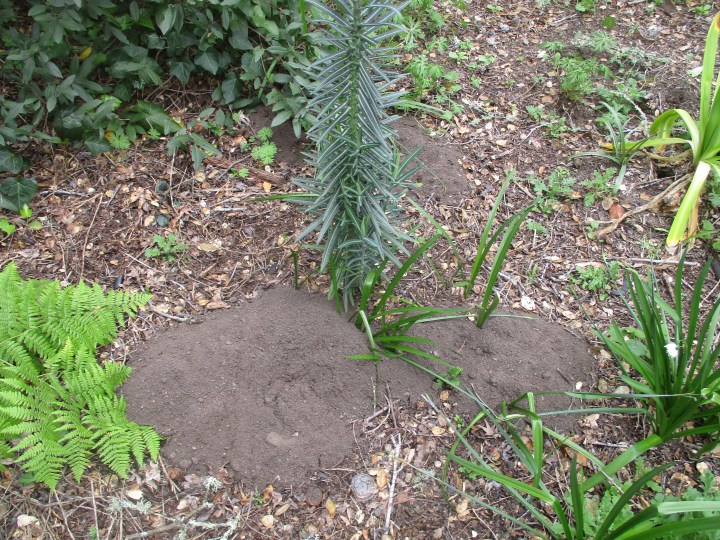
Gophers have been known to push traps out from their tunnels, without springing the traps. Some will emerge from their subterranean tunnels to step over the tops of root cages that are designed to exclude them, just to get to the roots within. The gopher associated with the excavation seen in the picture above was not so defiant, but was certainly undeterred.

The foliage at the center of the picture is gopher purge. Although not planted here intentionally, it used to be planted around vegetable gardens to deter gophers. It has a caustic sap that is very irritating to gophers if they try to excavate through the roots. However, the picture clearly shows excavation to the left, to the right, and behind the gopher purge.

Six on Saturday: TWIGS!


The Belmont Rooster posted pictures of red mulberry that really got my attention back on February 15. The trees are native on his farm, but not here. I only remember them as decoy trees that provided berries to distract birds from other fruit as it ripened in the orchards. Of course, those that I remember were planted. I neglected to get seed or cuttings from them while in Oklahoma. I have been craving them since.

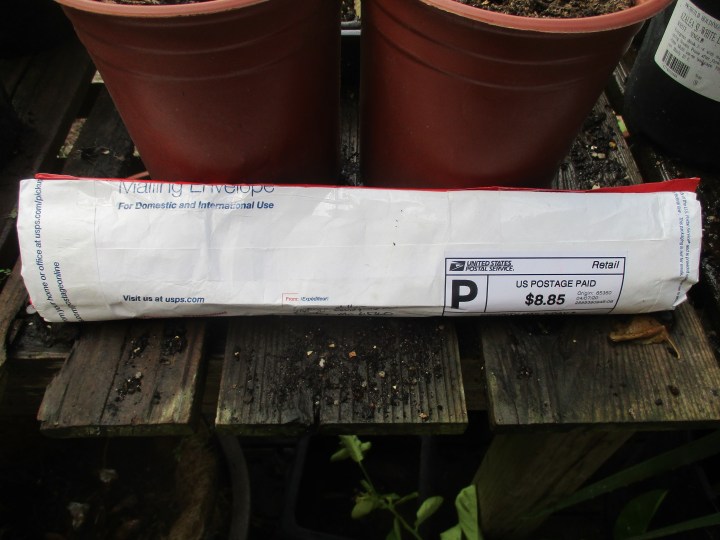
1. $8.85! The Belmont Rooster spent some major funds to get this package to me. It must be important. I already know it is very important to me! I have been wanting this for seven years. P00411-1

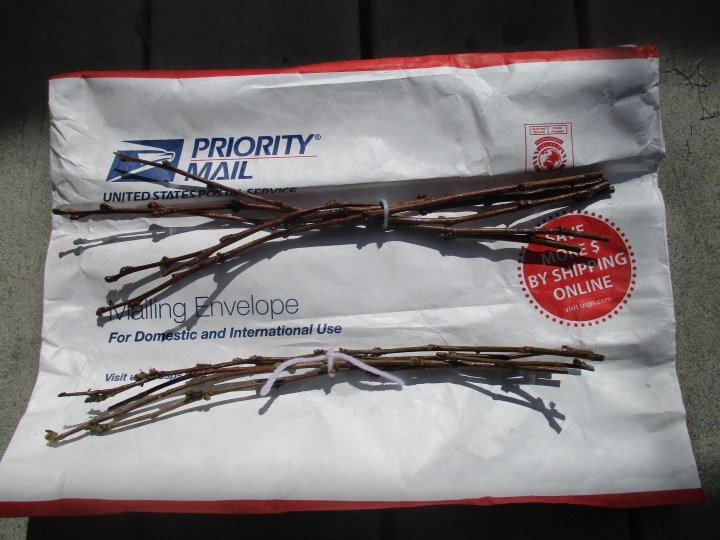
2. TWIGS! I got two bundles of twigs! These are not just any twigs though. They are from red mulberry, Morus rubra. One bundle is from a female tree. The other is from a male pollinator.P00411-2

3. Cuttings were processed from the twigs. There are a dozen female cuttings, and sixteen male cuttings. These are male. I was informed earlier that the female twigs were starting to foliate.P00411-3

4. Plugged cuttings are not much to look at. Rooting hormone was applied, but is not visible on the bottom ends. Only a few popping buds are barely visible in the female cuttings to the right.P00411-4

5. White mulberry was the only mulberry that I was growing here. I got the cuttings for it from a client’s tree. I do not know what cultivar it is. I have not been very impressed with it so far.P00411-5

6. The Belmont Rooster sent these cuttings from Missouri, just to the left of the center of this picture. All of Missouri is within the native range of red mulberry, which is designated by green.P00411-6

This is the link for Six on Saturday, for anyone else who would like to participate:

https://thepropagatorblog.wordpress.com/2017/09/18/six-on-saturday-a-participant-guide/


Horridculture – Going To Pot

P00408-1
Would these hanging potted plants even be noticeable if they were not circled?

Container gardening is overrated. Perhaps not so much now as it had been while it was more of a fad a decade or so ago, but it is still overrated nonetheless. Most plants are happier in the ground than they are in confinement. They want to disperse their roots freely to where the goodies are, and not contend with the unnatural temperature fluctuations of contained medium.

There are only a few exceptions for which containment of potted plants is an advantage. Houseplants are the most obvious exceptions. Also, plants that are sensitive to frost can be relocated to sheltered situations for winter if contained. Potted orchids and other flashy bloomers can be prominently displayed while blooming, and then returned to utilitarian locations as they finish.

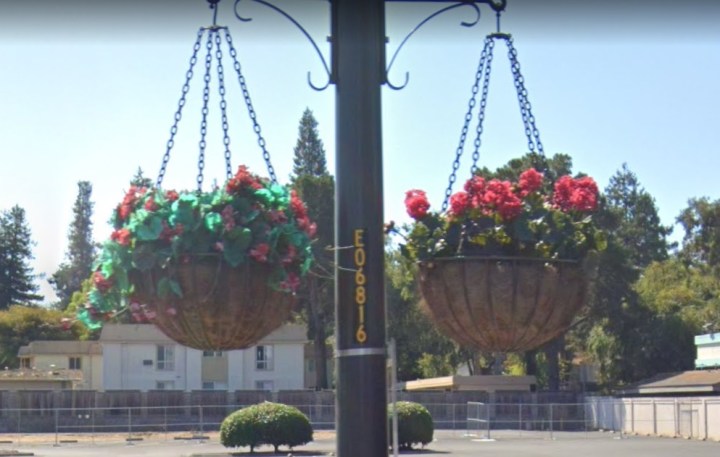
The justification for the hanging potted plants in the picture above escapes me. Does anyone besides me even notice that they are there? They are hung too high for anyone on the sidewalk to appreciate them, or actually see the flowers that are visible from above. Those on the opposite sidewalk can see them, but only at a great distance across all those lanes of El Camino Real.

Those in cars on the road see less of them than pedestrians. Even those who happen to look up while riding past in convertibles with the tops down will see only the undersides, and only at significant speed. These potted plants would be in the way of the sidewalks if they were lowered to be more visible. No matter where they are, they are not proportionate to the broad road.

Maintenance of the flowers in these many hanging pots was quite a bit of work. The annual flowers needed to be replaced a few times a year, or more if ruined by the weather. Without automated irrigation, someone needed to manually water them, which left puddles on the sidewalks that were more noticeable than the highly hung pots above.

As if all these hanging pots were not already tacky enough, the flowers within were eventually replaced with . . . fake flowers, as seen in the picture below.

P00408-2
Just when it could not get any tackier; they are fake!

Springtime On Time

P00405
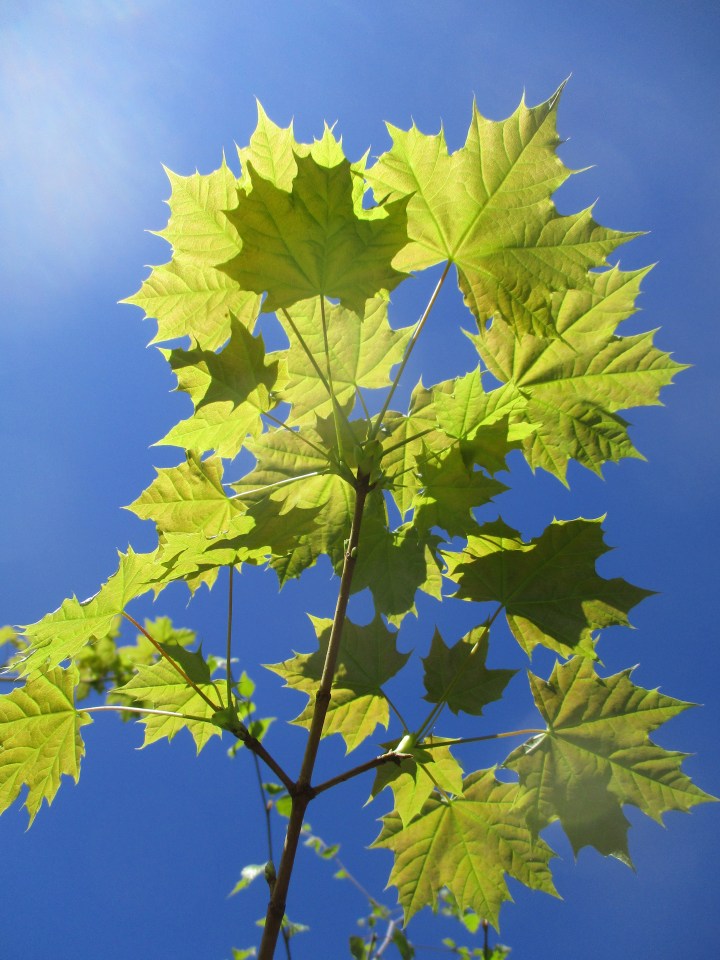
According to these maples, spring is right on time.

Seasons in the Santa Clara Valley are not very distinct. They are not much more distinct in the Santa Cruz Mountains above. Hot weather in summer does not last for more than a few days, and usually cools off somewhat at night. Winter is never very cold, with light snow rarely falling only on the tops of the highest peaks.

Some believe that summer is our only season, with a few days of ‘not summer’. I would say that it is more like springtime all the time, with a few warm days, a few cool days, and a few rainy days. In many ways, it is great for gardening. However, it can be limiting for species that prefer more warmth in summer, or a good chill in winter. It can also be rather boring.

The vast orchards that formerly occupied the Santa Clara Valley were fortunately satisfied with the mild climate here, and actually enjoyed it. They got just enough chill and just enough warmth, but just as importantly, they appreciated the aridity. Late rain and humidity can ruin the same sorts of fruits in other climates.

Even without much distinction between seasons, springtime in the Santa Clara Valley was spectacular before the orchards were exterminated. A long time ago, tourists came to see it like the fall color of New England. Many or most tourists witnessed it while the weather where they came from was more like late winter. Natives considered the timing to be right on schedule.

However, the schedule did not coincide with what we learned about seasons in kindergarten. We cut out colored leaves from construction paper in autumn, even though there was not much fall color. We cut out snowflakes from white paper in winter, even though most of us had never seen snow. By the time we started cutting out flowers, most spring bloom was already done.

Norway maples always seemed to know what time of year it was. Schwedler maple, which is a darkly bronzed cultivar of Norway maple, was a common street tree in the Santa Clara Valley back then, particularly in tract neighborhoods that were build in the middle of the 1950s. Some disliked how it stayed bare and seemed to be dead after other trees bloomed and foliated.

To some of us, the reddish new growth of the Schwedler maples was what let us know that it really was springtime. Of course, we were done with all our spring planting by then, as allowed by the local climates. Also, the bloomed out orchards were already foliating. The maples just let us know that winter was completely finished and would not be back for several months.

Five young feral Norway maples at work are doing that splendidly right now. They lack the bolder color of the Schwedler maples, but they make the same statement. The bloom of the flowering cherries is exquisite, but not as convincing as the foliation of the maples.

Two at Two

P00404K-1
This species of Rhus remains unidentified.

Apologies for the delay of posting something for noon as I typically do.

These are just two pictures of two species that were not interesting enough for my Six on Saturday post this morning. Now that it is past one as I write this, it will be scheduled to post at two, hence Two at Two.

Most of what we propagate or recycle here has some potential to be used in the landscapes. Sometimes, we salvage something just because it it too appealing to waste, even if there is no plan for what will be done with it later. For example, we now have five nicely canned but otherwise useless Norway maples, just because they needed to be removed from a landscape.

I canned the four specimens of unidentified Rhus in the picture above because I thought I knew what they are, and that I wanted to plant them somewhere. Now that I realize that I have no idea what they are, and that the one thing I know about them is that they are invasive, I really do not know what to do with them. For now, they will stay canned right here where they are.

The buckeye in the picture below were grown just because the huge seed were too compelling to discard. Although I know what species they are, I also know that they are not very popular. Actually, because they defoliate and seem to be dead through summer, they are rather unpopular. They will likely just get planted in a bare spot on the bank of Zayante Creek right outside.

That is part of the problem of enjoying our work a bit too much. We take horticulture a bit too seriously, and feel compelled to find homes for all the unwanted flora that we can salvage.

P00404K-2
Buckeye will not be easy to find a home for.