Horridculture – Skipping Ahead

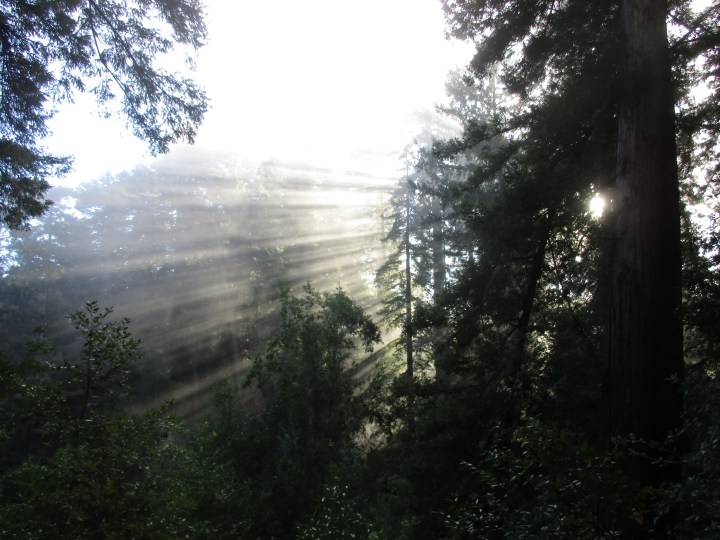
January 17 is as far as I have gotten with the backlog of articles from blogs that I follow. I am now two and a half weeks behind schedule. Articles are old news by the time I see them. I have been trying to catch up for weeks or maybe months, but have instead been getting farther behind. The video above is from the article I posted back then. There has been no rain since then.

The video also looks like what I feel I am doing to that backlog of article while I skip ahead to current articles beginning with February 5. Flushing them like this seems so negligent. I feel so obligated to read the articles of blogs that I follow. That is why I follow them. However, if I do not flush the backlog, articles that are current now will also be old news by the time I get them.

I have been reading some of these blogs so regularly that those who write them sometimes include notes to me within the contexts of their articles. Sometimes they comment on something that they think I would be particularly interested in. Sometimes they ask questions that they think I might know the answers to, or just ask for a bit of advice. Flushing all that is just wrong.

I have no choice. I have no time for it all. I write my brief gardening articles for more small newspapers than I can keep track of. I still work at a part-time and temporary job that involves maintenance of landscapes and small scale arboriculture because I can not bear to leave! I intend to eventually return to work at nursery production, but have been too overworked to do so.

Meanwhile, former clients and clients of former clients continue to contact me in need of services that I can no longer provide. I can find no one to refer them to for comparable services. All of the best arborists and horticulturists are retired, deceased or too busy (compensating for the lack of those of us who are retired or deceased) to accommodate more work. It is saddening.

On top of all that, I am supposed to be canning cedar trees and plugging sycamore cuttings for street trees in Los Angeles a few years from now . . . and maybe working in the garden?!?!

SODS?

P00202
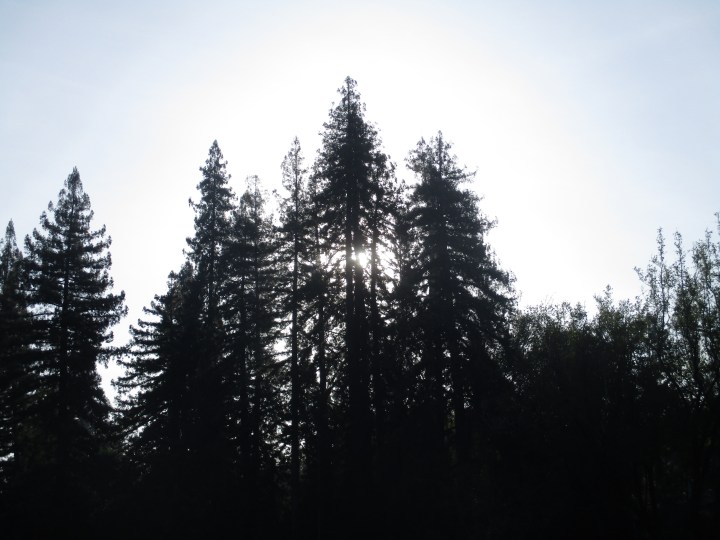
Flagging (sudden necrosis of distal foliage) used to indicate the beginning of a sudden end.

Phytophthora ramorum is the pathogen that initiates Sudden Oak Death Syndrome, which is known simply as SODS. Monarthrum scutellare, which are known as ambrosia beetles, and are the secondary pathogen associated with the syndrome, infest and kill tanoak and coast live oak that are infested with Phytophthora ramorum, about as quickly as symptoms are observable.

Hypoxylon thouarsianum is a tertiary but merely opportunistic pathogen associated with the syndrome. By the time it gets established within galleries excavated by the ambrosia beetles, the affected trees are almost completely necrotic. That first ‘S’ in SODS is there for a reason. It is an efficient process. Death occurs too suddenly for affected trees to drop any of their leaves!

Each of these three pathogens causes distinct symptoms. Phytophthora ramorum causes trees to bleed black tar-like fluid, and causes tanoak to exhibit foliar flagging as seen in the picture above. Monarthrum scutellare expels finely textured frass from the galleries it excavates into infected trees. Hypoxylon thouarsianum produces distinct small and black fruiting structures.

In the past several years though, Sudden Oak Death Syndrome has often been a bit less than sudden. There are a few tanoaks here that have exhibited foliar flagging for a few consecutive years, without any bleeding from the trunk or infestation by ambrosia beetle. Some coast live oaks have exhibited minor bleeding, but likewise have not become infested by ambrosia beetle.

It is as if the ambrosia beetle is no longer proliferating as it had been. It actually seems to be rather scarce. Trees that were expected to succumb suddenly to ambrosia beetle infestation are succumbing slower to infestation of only Phytophthora ramorum. The process is variable, so might have potential to kill some trees rather suddenly, but may take a few years to kill others.

Could some possibly survive?

Vegetation Exploitation

P00201K
If a tree falls in a forest, . . . it might get recycled.

Exploitation of the vegetation here involves so much more than collecting seed from old bloom, dividing overgrown perennials, or processing cuttings from pruning scraps. It goes beyond the reassignment of lauristinus, canna, African iris, deodar cedar and perhaps others that I wrote about earlier. Flowers, fruits, vegetables and herbs are mundanely obvious assets.

The landscapes and forests here do so much more than beautify and provide shade. When a tree falls in a forest (and makes a sound even if no one is there to hear it), it might get processed into firewood or lumber. Some of the foliage that falls in landscaped areas goes to the compost piles. Even debris that gets removed from here gets recycled as greenwaste somewhere else.

Of course, we can not recycle, reuse, repurpose or otherwise make use of everything that falls out of the forests and landscapes. There is simply too much of it. That is how the ecosystems of the forests recycle naturally. Exotic plants in the landscapes do not know that they are exotic, and try to behave as they would within their respective ecosystems. Nature is innately messy.

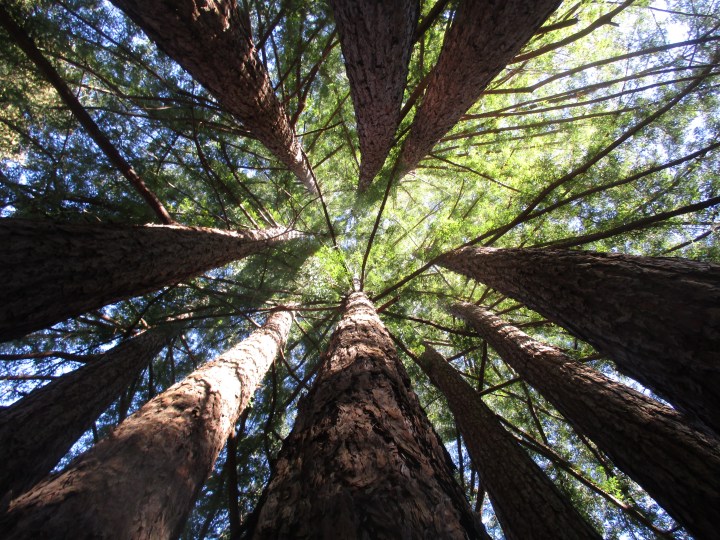
Trees that fall across hiking trails merely get cleared from the trails, and left to decompose out in the forests. Even potentially useful firs, pines and redwoods can not be extracted feasibly. Their big trunks might remain where they fell, with only a section cut out where a trail goes through. The forests do not mind. Their ecosystems know how to make use of such biomass too.

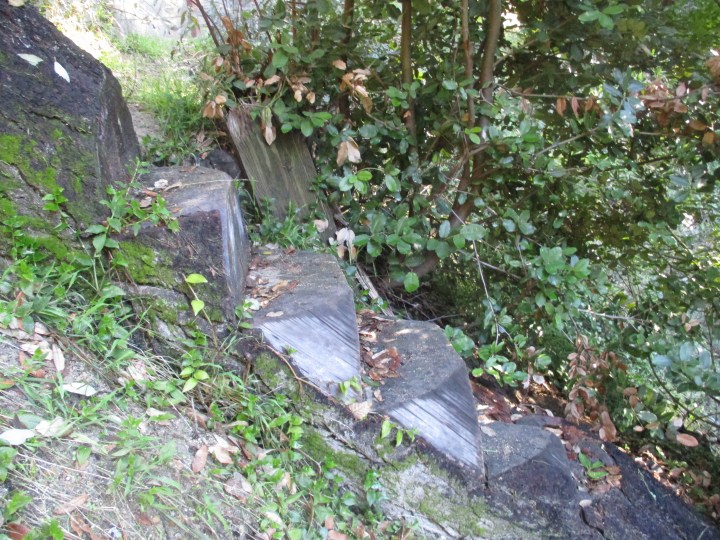
This fallen fir tree happened to land squarely on top of a few steps in a trail that is cut into a steep hillside. As you can see, it was not exactly cleared completely from the trail, but instead replaced the steps that it destroyed.

Six on Saturday: Sow The Seed Of Doubt


There is serious doubt about the practicality of collecting seed that there is no use for. We have no time to sow any of it properly. Some gets tossed unceremoniously where it would be nice if just a bit of it grows and blooms next year. Such folly is better than the guilt of simply discarding all that seed, even if we get more of something we do not want.

1. Echinacea purpurea – coneflower – Deadheading left me with all these dead heads of seed. I have no use for all this seed; but a neighbor is happy to scatter it where some might grow.P91228-1

2. Lychnis coronaria – campion – This is all the seed I got, in a small pill can. Most was left in the landscapes to disperse where already established. This bit of seed goes to new territory.P91228-2

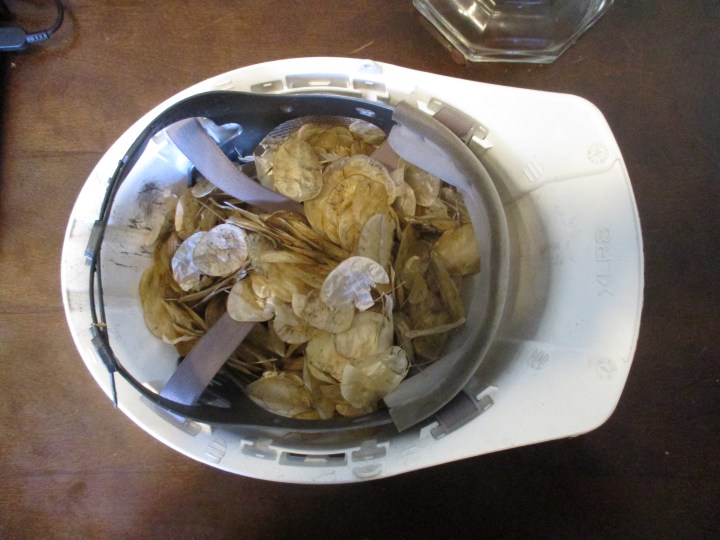
3. Lunaria annua – honesty – This is just one of several hard hat fulls. Seed already sifted down, leaving empty frass on top. I lack an article to link to, so linked to someone else’s article.P91228-3

4. Aesculus californica – California buckeye – This is what is starting to grow from four big seeds that I could not bear to discard earlier. Now there will be four baby trees without a plan.P91228-4

5. Pelargonium X hortorum – zonal geranium – Not all of this folly is from seed. Scrap from pruning geraniums got processed into more cuttings than we will plug. These are the last few.P91228-5

6. Rhus lanceolata? – prairie sumac? – There is even more folly in canning feral seedlings of this unidentified sumac. It is about as sensible as canning the four sweetgum to the upper right.P91228-6

This is the link for Six on Saturday, for anyone else who would like to participate:

https://thepropagatorblog.wordpress.com/2017/09/18/six-on-saturday-a-participant-guide/

Horridculture – Memorials

P00129
Where are the cedars?

Memorial trees should be remembered . . . right? I mean, they are planted to remind us of . . . something, or . . . someone. They are typically trees that will be around for a long time, because that is how important memories should be. Redwoods and oaks work nicely. Most get outfitted with plaques to remind everyone what the trees are there to remind us of.

The old original Sunnyvale City Hall was landscaped with several memorial trees. The most prominent were redwoods and cedars that were mostly planted as memorials for local veterans of various wars. They accumulated over several decades and a few wars. City Hall seemed like a good place for them, where they could live for a long time without bother.

However, City Hall was demolished in the late 1970s, and replaced with a big mall. The larger redwood and cedar memorial trees were salvaged as the mall was build around them. Most survived in a courtyard within the mall until the mall was partly demolished less than a quarter of a century later.

All the cedar memorial trees died in captivity within the courtyard. One redwood that was not a memorial was added to the group where one of the cedars had been.

Prior to the demolition of the courtyard, I needed to inspect the surviving redwood to prescribe procedures for safe removal of surface pavement, and subsequent protection of exposed roots. The surviving trees were in remarkably good health. I was not very worried about them. What bothered me though, was the complete disregard for their historical significance.

The plaques associated with these memorial trees were a mess. It was as if they all had been collected from their respective trees, mixed up, and replaced randomly. Plaques from the absent cedars were assigned to some of the surviving redwoods. The oldest and grandest memorial redwood was labeled as the redwood that was added last, after the mall was built, and therefore of no historical significance. The smallest and youngest redwood that really was added after the mall was built was labeled as one of the more historically significant memorial trees.

I believe that all the trees that were there during my inspection are still quite healthy within a small park space that was built around them. I have no idea if they are outfitted with plaques. If they are, I can not help but doubt the accuracy of those plaques.

How To Train Your Dragon

P00126
Oh, the SHAME!

Dragon fruit became a fad on the West Coast of California several years ago. They were probably always around, but had previously been rare. When they inexplicably became more popular and common, they did so down south first. Their popularity migrated to the Santa Clara Valley a few years later. It probably will not go much farther though, since they are sensitive to frost.

It is not a bad fad, at least relative to most others. Dragon fruit, which is also known as pitaya, happens to be very easy to grow and propagate from cuttings. Locally, it needs protection from frost, but no more than other popular tropical plants. It recovers from minor frost damage quite efficiently. Pruning scraps can be rooted and grown as more plants for friends and neighbors.

Of course, I dislike fads. I am not impressed by the fruit, which might lack flavor here where the weather does not stay very warm for very long through summer. The coarsely textured and floppy plants get big and awkward. They are typically trained up onto posts from which their many long stems hang downward. An exemplary specimen looks like Sigmund the Sea Monster.

This is a fad that I dislike enough to try. I want to see what all the fuss is about. These are my first two cuttings. The upper cutting produces red fruit. The lower cutting that is marked with a line to show how deeply it should be stuck into rooting medium produces white fruit. I will know where to release them into the landscape by the time they develop roots and start to grow.

This is so shameful that I probably should not be writing about it. Oh well. Perhaps in a few months, I will write about how these cuttings will be progressing.

Wild Strawberry?

P00125K
Wild strawberries are worth salvaging.

Under a bank of carpet roses that I am none too keen on, this grubby ground cover competes with more aggressive weeds. To me, it looks like common mock strawberry, Potentilla indica. I never gave it much though. It seemed to me that whoever had installed cheap and common carpet roses on that bank would have employed a comparably cheap and common ground cover.

The ground cover was more prolific in open spots that were too narrow for more of the roses, and from there, seemed to have migrated under the roses as a second layer of ground cover. It would not have been installed underneath intentionally. It did not occur to me that it may have grown from seed like so many other weeds there, or migrated in from the surrounding forest.

The white flowers did catch my attention though. I was not aware of a mock strawberry that bloomed with white flowers. I really was not concerned enough about it to investigate. This part of the landscape will be getting renovated soon anyway. The roses will be relocated to where they can not extend their thorny canes into an adjacent walkway. Agapanthus will replace them.

Now that I am seeing more of these odd strawberries, I am wondering if this low ground cover that I formerly had no regard for is actually the native wild strawberry, Fragaria californica. Not only should mock strawberry bloom with yellow flowers, but it should also produce more spherical berries. Now I will need to identify it before I either dispose of it, or merely relocate it.

I prefer to not salvage exotic species that exhibit potential to naturalize from landscaped areas into surrounding forests. If this ground cover is wild strawberry, it migrated from surrounding forests into a particular casually landscaped area.

Six on Saturday: Poison Ivy


Poison ivy is not native here. Neither is English ivy. However, English ivy, Hedera helix, is an aggressively naturalized exotic species. Even after it had been designated as a voracious weed in the region, it was installed in some of the landscapes here many years ago. It is so common here now that we know it simply as the standard ‘ivy’. Algerian ivy was planted too, but it is not quite so aggressive.

1. English ivy grew up and over this abandoned building, and accelerated the deterioration of the old roof. It would be pointless to remove it now. The building will eventually be demolished.P00125-1

2. This building is not abandoned. No ivy was on this roof just a few days earlier. All this ivy did not grow up and over the building this aggressively since then, but fell from above. Surprise!P00125-2

3. The yellow pointer shows where the dead redwood trunk that supported all the ivy broke and dropped the whole mess onto the roof at the bottom of the picture. It is about thirty feet up!P00125-3

4. What a mess! This close up of the same broken dead redwood trunk shows another dead redwood trunk to the right, and a viable trunk with another dense ivy thicket in the background.P00125-4

5. Surprisingly, this is the worst of the damage. It was likely impaled by the rotten redwood trunk. The ivy likely stayed connected to the rest of the thicket long enough to slow the descent.P00125-5

6. Even after getting Ginsu with saws and shears, and getting bounce-house with debris, the pulpy redwood trunk and ivy was still a full load. That was a lot of weight to land on an old roof!P00125-6

This is the link for Six on Saturday, for anyone else who would like to participate:

https://thepropagatorblog.wordpress.com/2017/09/18/six-on-saturday-a-participant-guide/

Horridculture – Dried Plums?

00115
Dried prunes are experiencing something of an identity crisis.

Nomenclature used to be more predictably standardized than it is now. When I write about how it works, I compare it to the names of cars. For example, ‘General Motors’ is just a family. ‘Buick’ is a genus. ‘Electra’ is a species. ‘Limited’ is a variety. Well, my Sebring was labeled as a Chyrsler but made by Mercedes Benz. Modern horticultural nomenclature is no more accurate.

With all the promiscuity going on nowadays, it is impossible to know who the parent of some of our favorite plants are. Many are interspecific hybrids. Some are intergeneric hybrids. Some are so complicated that their species names are merely omitted; and no one seems to notice! That is like driving a Mercury LS without knowing or caring if it is a Grand Marquis or a Lynx.

So, now we can grow such aberrations of traditional stone fruit as as aprium, apriplum, pluot, plumcot, nectaplum, pluerry and peacotum. The first half of the names supposedly indicate who the promiscuous maternal parent is. The second half refers to the male pollinator. Parents who contributed fewer letters to the name were supposedly already hybridized prior to breeding.

For example, an apricot pollinated by a plum creates an aprium; and an aprium pollinated by a plum creates an apriplum. The apriplum gets an extra letter from plum ancestry because it is %75 plum and %25 apricot. A plum pollinated by an apricot creates a pluot; and a plum pollinated by a pluot creates a plumcot. There are, of course, many other complicating combinations.

Sure, the resulting fruit is very good; but is it any better than what it was bred from? If everyone could have tasted the simple, traditional and exemplary stone fruits that formerly grew in the vast orchards of the Santa Clara Valley, there would be no need for all this hooey. Besides, why is there all this interest in creating new and weird fruit while eliminating some of the old?

Prunes and plums, as I explained earlier, are two distinct types of fruits. Japanese plums are the richly flavored and typically more brightly colored fruits that were more popular in home gardens than in orchards, since they are not easy to transport. European prunes are the sweeter but mildly flavored freestone fruits that grew in orchards, generally for drying and canning.

Apparently, the name of ‘prunes’ was not appealing enough . . . or was actually considered to be unappealing. Almost twenty years ago, prunes were consequently reclassified as plums. Dried prunes are now known as dried plums, as if they are dried versions of the classic ‘Santa Rosa’ plums that so many of us grow in our home gardens. Some of them just might be! Who knows?!

Plum juice could be extracted from Japanese plums, which actually make excellently rich juice, but is more likely from fresh (not dried) French or Italian prunes. However, there is still such a beverage that is known as prune juice. It is extracted from, of all things, rehydrated dried plums . . . or dried prunes. These unfortunate fruits get dehydrated, rehydrated, and then juiced!

The juice of rehydraded dehydrated plums or prunes might be the only remaining application of the word ‘prune’. At least it is useful for that; in the sense that it designates the source of the juice as rehydrated dehydrated fruit of some sort, rather than fresh fruit of some sort. Whether such fruit is a plum or what was formerly known as a prune remains something of a mystery.

Corm-ucopia

P00119
Is this part of the secret to their success?

Montbretia showed up here several years ago. Of course, it did not take long for it to get very established. It is too shady for bloom, but not shady enough to inhibit vegetative proliferation. Those nasty stolons get everywhere, and grow into corms. They are so aggressive that they exclude English ivy! Seriously, they are the only species we know that can crowd out English ivy!

Some consider Montbretia to be the the genus name. Some consider it to be a common name for the genus of Crocosmia, or for a particular intergeneric hybrid. What is now so aggressively naturalized here might be Crocosmia paniculata. I really do not know. The few rare and sporadic blooms look like what I am familiar with in other landscapes, with branched inflorescences.

Now, I am aware of how aggressive their stolons are, and that their stolons swell into corms when they get to where they are going. I also know the physiology of simple corms, and that new replacement corms develop on top of old deteriorating corms. They might extend a few more stolons in the process, or put out a litter of cormels off to the side, but their technique is limited.

Well, it should be.

The technique demonstrated by this picture is weird. It seems to show a series of corms from the last twelve years. That makes sense if one corm replaces a previous corm annually. Longer accumulations can be found in older colonies. However, montbretia infested this landscape less than a decade ago, and took a few more years to disperse where these corms were unearthed.

Furthermore, after a decade, the oldest corms should be rotten and decomposed. Except for the stunted four year old corm, those that developed in the last six years seem to be suspiciously fresh.