Rain Shadow

P91222Hollywood is famous as the Cinema Capital of the World. Niles was its predecessor. Both are within regions of remarkably diverse scenery that is so important to cinema. Mountains, deserts, chaparrals, forests, lakes and big cities are conveniently nearby. There are not many places in the World with such a thorough mix of geography and climate. California really does have it all.

It is a challenge for gardening though. The stone fruits that grow so naturally in the Santa Clara Valley are not quite as productive just a few miles to the South in the Santa Cruz Mountains. The pears and apples that do so well in the Santa Cruz Mountains are not quite as happy in the Santa Clara Valley. Species that want a good chill in winter do not want to be in Los Angeles.

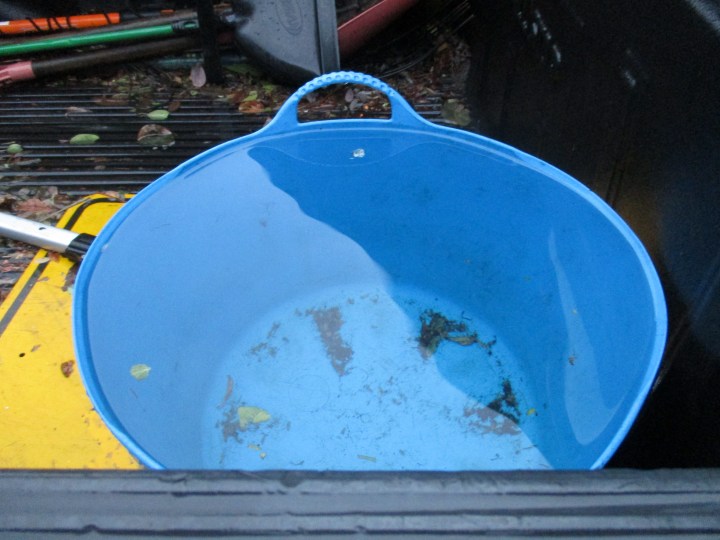
On the coastal side of the Santa Cruz Mountains, just outside of Felton, a few days of rain filled the bin in the picture above. The rain continued just as long throughout the area, including the inland side of the Santa Cruz Mountains and the adjacent Santa Clara Valley. Although the duration of the rain was approximately the same, the volume of precipitation was very different.

The water in the bin is more than a foot deep. That is about the average annual rainfall for my former neighborhood at about this same elevation, but on the opposite and inland side of the Santa Cruz Mountains. Storms must drop much of their moisture to get up and over, but are then able to retain much of the remaining moisture as they drop in elevation on the other side.

The drier inland side of the Santa Cruz Mountains, and adjacent portion of the Santa Clara Valley are in what is known as a ‘rain shadow’.

Growing Problem

P91221KRecycling plant material is practical and gratifying. We do quite a bit of it here. Back in September, I briefly wrote about recycling laurustinus that was removed from an area that was about to be landscaped, and relocated to other sites where it can grow into functional informal hedges. We were able to use something that was a problem in one location as an asset somewhere else.

We will be doing more of this sort of recycling now that the rainy season has started. Right now, the plants that need to be removed are as dormant as they get, so do not mind getting dug as much as they would have while they were still active. Rain helps settle them in at their new locations. A few get canned and stocked into the nursery, to be planted into new landscapes later.

Some of what gets recycled was intentionally installed in the past, but for one reason or another, became inappropriate for a particular site. For example, I will soon be relocating agapanthus that performed well for many years, but eventually became too shaded by growing trees nearby. Forsythia that has already been relocated was too big and awkward for its confined space.

Many plants that get recycled were not intentionally planted, but happened to grow wild in situations where they can not stay. Some are native. Some are descendents of desirable exotics. The laurustinus that I mentioned above are such an example. Just yesterday, I relocated a few naturalized but superfluous birches from an established landscape to an unlandscaped area.

We certainly do not recycle everything that can be recycled. Many plants, both native and naturalized exotic, are just too problematic. Fleabane that I wrote about yesterday is marginal.

Sweetgum happens to be one of those trees that we probably should not recycle. They are splendidly colorful in autumn, and particularly spectacular amongst the deep green redwoods. The problems are that the now overgrown trees here are developing serious structural deficiency, and producing an overwhelming abundance of messy and potentially hazardous maces (fruits).

Nonetheless, I found and canned these four rooted sweetgum watersprouts. They were growing from roots of one of several big and very problematic sweetgums that got removed last year. If they get planted here, they and their associated problems will be located outside of refined landscapes. In the future, thy can drop maces and limbs in the forest without bothering anyone.

Horridculture – That Blows!

P91218-1Blowers put the ‘blow’ in ‘mow, blow and go’. They really blow! The only power tool used by so-called ‘gardeners’ that is more detestable to the rest of us is the power hedge shears, and that claim is contestable. Some consider blowers to be worse because they are so obnoxiously noisy, and generate so much dust. Some municipalities have outlawed the use of the noisiest sorts.

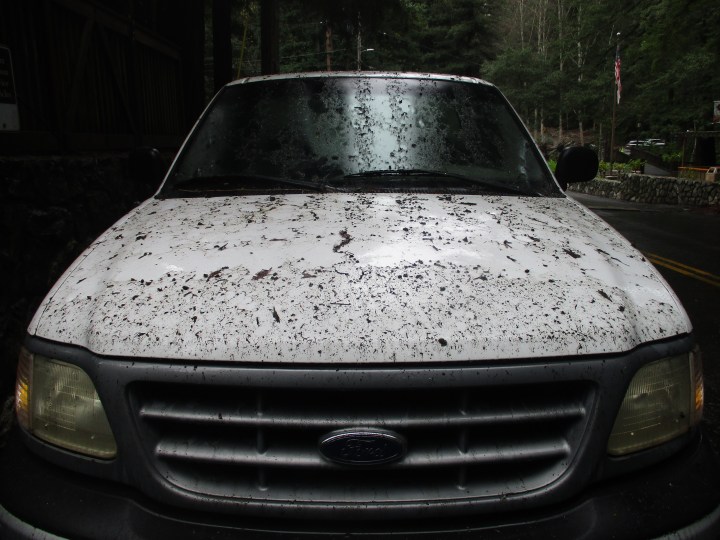
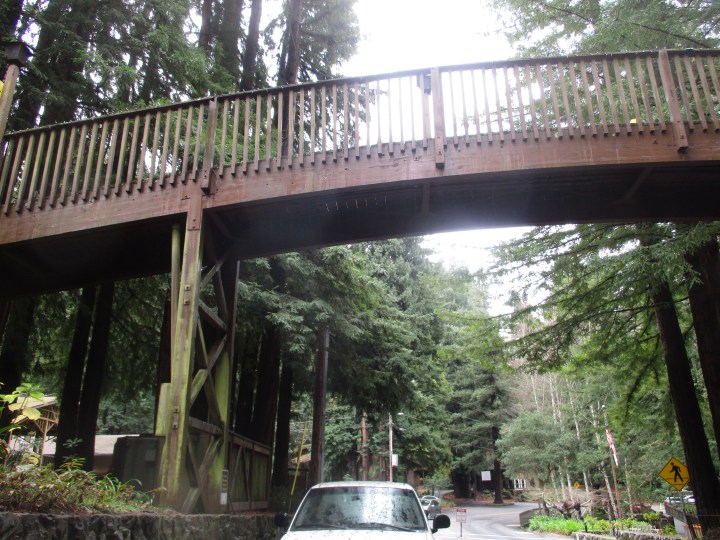
The mess on the hood and windshield in the picture above was not actually caused by blowers. The picture below shows the bridge that was power washed above. Oops. I should have been suspicious that no one wanted that parking space. Anyway, this picture was just too funny to not share; . . . and I happen to lack pictures of the sorts of dusty messes that blowers can stir up.

Where I lived in town, the so-called ‘gardeners’ who ‘maintained’ the apartment buildings on either side used blowers. There is a noise ordinance there, but we never bothered to enforce it. We did not want to interfere with what needed to be done. There was a lot of pavement, and we wanted it to be kept clean. We could not expect it all to be quietly swept like I swept mine.

To the north, the blowers were either off or on full-throttle. There was nothing in between. The cars in the carport collected all the dust that was stirred up. If the door to the washroom was left open, debris got blown in, and the pilot light for the only water heater in the building got blown out. Most of the debris got blown to the southeast corner, and under a fence into my yard.

The same happened to the south, but the water heater was less exposed, and there was much more debris. The largest valley oak around lived there, and dropped leaves for several months. I replaced the kickboard at the base of the fence in their northeast corner a few times, but it was just as regularly kicked out and removed so that debris could continue to be blown under!

In other neighborhoods, so-called ‘gardeners’ are notorious for blowing debris out into roads, where it gets dispersed by traffic. Even if they do not blow it away just to become a problem somewhere else, they are likely to blow too much of it into shrubbery, along with any mixed litter. It accumulates faster than it decomposes to benefit the soil and roots below. What a mess!P91218-2

Deck the Halls

P91215-1English holly is politely naturalized here. This means that, although naturalized, it is not aggressively invasive, and does not seem to be too detrimental to the ecosystem. It is only annoying to see out in forests, far from the landscapes that the seed escaped from, and wonder if it has potential to significantly compete with native vegetation. It would be better if it were not there.

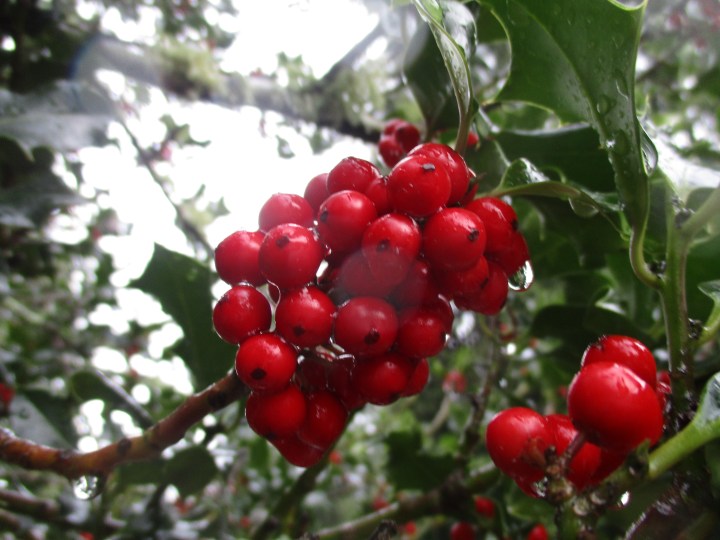
At least it is pretty. In refined landscapes, it happens to be one of my favorites for distinctively glossy and prickly foliage. There is nothing else like it. Variegated cultivars are just as striking, with a bit of color for situations where there is already plenty of rich dark green. Female plants produce a few bright red berries. Older or distressed plants might produce more than others.

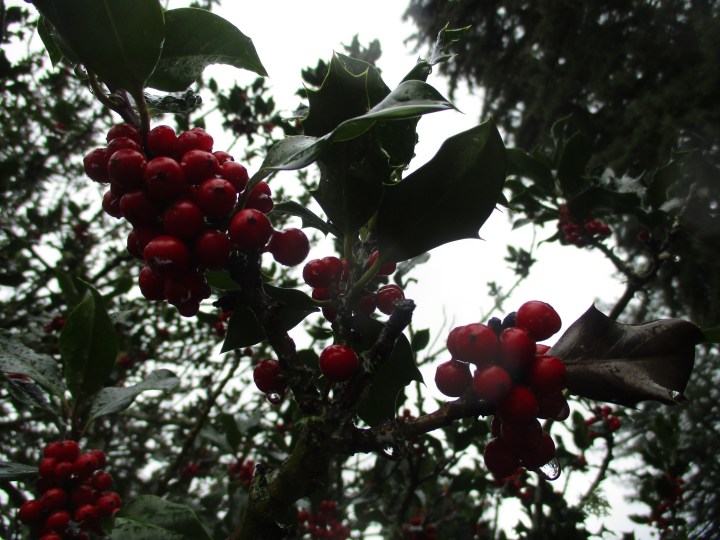
So, I have mixed feelings about this overgrown English holly tree that I must eventually cut down. In the picture above, it is evident that it is not the prettiest. It is a sparsely foliated thicket of tangled inner stems on an uninterestingly straight and bare trunk. It occupies a prominent position where there should be something of a friendlier disposition. It doesn’t contribute much.

However, it does produce an abundance of delightfully bright red berries. I got these pictures while collecting berries to decorate the buffets and tables of the big dining room across the road.

If it were in my garden, I would probably pollard it back to the bare trunk or perhaps just a short stump, and allow it to regenerate with fresh new foliage. Such a procedure would eliminate the tangled thicket of bare interior stems, but would unfortunately inhibit berry production for at least a few years while new growth matures. I just do not want to give up on it completely.P91215-2P91215-3

Spruced Up

P91214KSpruce happen to very compatible with the landscape style here. They fit in nicely with surrounding redwoods, but are more proportionate to sunny spots of some of the refined landscapes. We intend to add a few into some of the landscapes as they get renovated. They will stay branched to the ground, like big dense shrubbery, with the personality of distinguished forest trees.

Several dwarf Alberta spruce, which is a very compact cultivar of white spruce, have been incorporated into landscapes that were renovated during the past few years. They really are dinky though, and stay smaller than most shrubbery. Some of the very compact cultivars of blue spruce that we would like to add next will eventually get significantly bigger, but do not grow fast.

A few spruce that grow more like tree rather than shrubbery would be really excellent. The taller blue spruce with more open branch structure are no longer available from local nurseries, but could be ordered. I particularly want to try any of the white, black, red, Engelmann or Sitka spruce that are endemic to North America, although I know some might not be happy here.

Sitka spruce just happened to become available. A colleague brought these eight seedlings back from the coast up near the Oregon border, and will probably get a few more. They are prolific there, and get pulled like many other weeds. At the rate they are growing, they could get planted into a landscape even before we get any blue spruce! I am already very pleased with them.

For a while, I grew each of the six North American spruce, but only in cans. Since these Sitka spruce arrived, I have been wanting to get the other five. White spruce is ‘sort of’ here. Blue spruce will arrive soon enough.

Six on Saturday: Nursery Work


This is more like what I should be doing. My part time job here was supposed to be temporary, just until I went back to work growing things. It is not easy to leave. Actually, it is downright difficult. Well, that is another story. Yesterday, Friday, I got to pretend I was back at work, dividing perennials and plugging cuttings. It all came from what already lives in the landscapes.

These seasonal tasks had been delayed until the rainy season started.

1. African iris, Dietes bicolor, got plucked around the edges where it was getting too close to a walkway. These plucked and groomed scraps will be plugged directly where more are desired.P91214-1

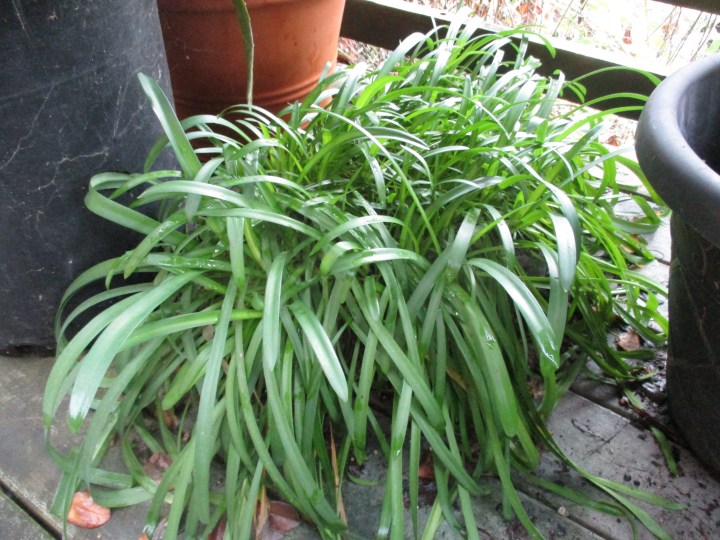
2. Lily-of-the-Nile, Agapanthus africanus, got pulled a long time ago, and just left here on the floor. It can get split into many individual pups, but will more likely be planted as a full clump.P91214-2

3. Pigsqueak, Bergenia crassifolia, got pulled where it was creeping over a stone wall. Most was plugged back behind where it came from. Sixteen groups of three pups were canned for later.P91214-3

4. Boston ivy, Parthenocissus tricuspidata, provided this mess when it was relieved of its stakes and groomed. It grew so fast in the first year, that there is concern about planting more of it.P91214-4

5. 100 cuttings is too many! There are only a few concrete structures that it can climb onto. It probably would have been more practical to plug a few cuttings directly into only a few cans.P91214-5

6. Cuttings would have fit better into cans too. These cuttings are plugged diagonally, leaning back toward the top of the picture, with the front row leaning toward the bottom of the picture.P91214-6

This is the link for Six on Saturday, for anyone else who would like to participate:

https://thepropagatorblog.wordpress.com/2017/09/18/six-on-saturday-a-participant-guide/

Horridculture – Bad Guys

P91211Roots hold up trees. That is part of their job. They grow along with the trees they support, and disperse as necessary to maintain stability. Trees grown within the confinement of cans (pots) or boxes, and then installed into a landscape, are typically staked temporarily until their roots adequately disperse and stabilize. Once unnecessary, stakes and bindings must be removed.

Mature palms that get relocated are supported temporarily by guy wires. They are just too big to be supported by stakes. Because palm trunks to not grow any wider as at they grow taller, they are not damaged by the sorts of bindings that would damage the fattening trunks of other trees. Like stakes on other trees, guy wires must be removed as they become unnecessary.

Although they can be appropriate in unusual circumstances in which stakes would not be practical, guy wires are rarely used on trees that are not palms. Mature trees that get relocated can be guyed if too big to be supported by stakes. Because trunks and limbs of such trees expand (circumference), it is more important for guy wires to be remove when they become obsolete.

As useful as guy wires can be, they are more often used improperly or inappropriately. Firstly, those who install them rarely do so correctly, with the wires or cables as straight as possible between each end. Cabled anchors are usually pounded into the ground perpendicularly to the direction of the cable, so that the cable merely slices through the soil when tension is applied.

Once installed, cables are very often left in place long enough to constrict the growing trunks or limbs that they are attached to. Cables that apply too much tension or limit the motion of the trees they support (in the breeze) for too long will actually inhibit root dispersion. Trees will only become as stable as they need to be. Besides all this, lingering cables are just plain unsightly.

The cabled trees in these pictures demonstrate another set of problems that should be corrected by simple and necessary pruning, and comparably necessary adjustment of the automated irrigation. Guy wires should most certainly not be necessary for such mature trees of this species, and will interfere with necessary root dispersion without remedying the primary problems.

Firstly, the trees are too low and dense. Even if stability were not a concern, they should be pruned for a bit more clearance above the patio to the right of the picture, and perhaps allow a bit more sunlight to the plants below, even if only temporarily. More importantly, pruning would temporarily decrease weight and wind resistance of the canopies while roots adapt accordingly.

Secondly, the landscape is getting irrigated too much, even for the ferns in the background. This maintains soil saturation so that stabilizing roots can not disperse into deeper strata. Roots that might have extended deeper earlier will drown and rot. Until this happens, excessive irrigation promotes heavy superfluous growth that the compromised root system can not support.

Automated irrigation should be disabled for winter, and operated only manually and minimally if the weather stays dry long enough for the ferns to get drier than they are comfortable with. It can be adjusted accordingly when reactivated in spring. Even before that happens, and roots disperse, the guy wires can be removed as soon as these trees get pruned as they should be.P91211+

Curb Mongrel

P91208Fruit trees, with few exceptions, have been extensively bred to produce the quality of fruit that we expect from them. Some are consequently genetically unstable, or at least less genetically stable than their wild ancestors were. Even if they never mutate or try to revert to a more stable state, they are very unlikely to produce seed that can develop into genetically similar trees.
In other words, they are not ‘true-to-type’. Their seed might grow into trees that produce fruit that resembles that of one of their ancestors, or of a pollinating parent tree. It is impossible to predict what fruit will be like until it actually develops.

That may take a while. Some seed grown fruit trees start out with juvenile growth, and take a few years to mature enough to bloom and produce fruit. Some types of avocado trees grow tall and lanky for a few years before they bloom. Most citrus are fruitless and wickedly thorny through their juvenile phase.

Grafted fruit trees or those grown from cuttings are true-to-type because they are genetically identical clones of their single parents. Cuttings and scions (for grafting) are made from adult growth, so do not need to mature through a juvenile phase.

The unpredictability of genetic variability is the main reason fruit trees are not often grown intentionally from seed. Juvenility might be the second main reason. However, neither of these two reasons prevents curb mongrels from growing wherever their seed lands, which is often next to sidewalks and curbs where cores and pits get discarded.

Curb mongrels generally get removed and disposed of, just like any other weed. It would be more practical to plant a known cultivar of fruit into a situation where such a tree is actually desired. Every once in a while, a curb mongrel appears where it is allowed to stay, and eventually produces fruit that justifies its preservation.

Well, that was not what happened with this curb mongrel apple tree that appeared adjacent to a patio used for outdoor dining. It was not compatible with the landscape, so got removed before it was able to produce any fruit. It looks like it was grafted, but only because someone tried to cut it down without removing the stump two years ago.

The problem now is that it came up with enough roots to survive relocation. It is not so easy to dispose of a tree with such potential, even though there is no way to know what its potential is until it fruits. It will get planted into a private garden and pruned back accordingly. If we had planned for it to be relocated, the process would have been delayed until it was defoliated.

If the fruit is of inferior quality, the tree can be removed and discarded. At least we tried. Alternatively, a desirable cultivar can be grafted onto it. In a home garden, no one needs to know that it is not a known understock (rootstock) cultivar. The foliage resembles that of ‘Red Delicious’, which makes sense for seed that likely originated from a commonly discarded core.

Reassignment

P91207K

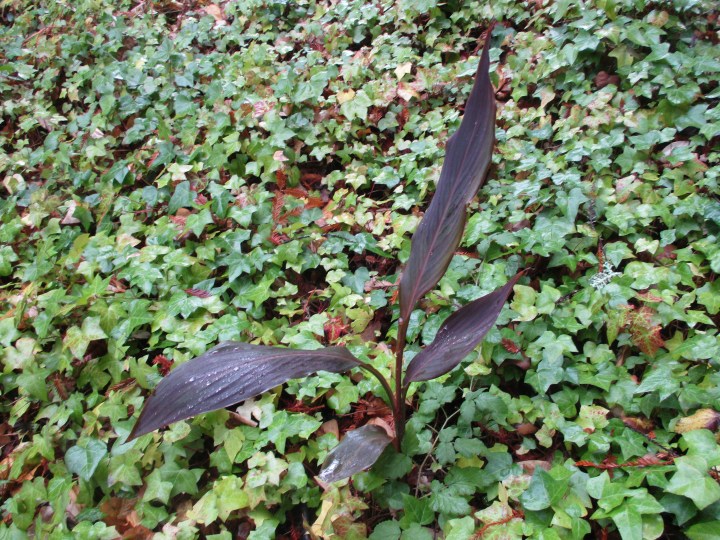
There is quite a bit of open space in some parts of the landscapes. It is not as if the landscapes are lacking much. There just happens to be a few spots where a bit more could be added. This expanse of healthy English ivy was already appealing, but lacked interest.

There is also quite a bit of spare plants out and about in the landscapes. It is not as if there is anything wrong with spare plants. There just happens to be too many of them. These cannas got overgrown and crowded within their original colony in another landscape, so needed to be divided and thinned out.

We are not a so-called ‘landscape’ company, which profits from the removal of some plants, and the installation of others. There is no incentive to dispose of as much vegetation as we could bill a client for. Nor is there any incentive to install as many new and expensive plants as we could fit into any available space. It is not a ‘business’.

To the contrary, it is in our own best interest to exploit resources that are already available to us. For example, when we thinned out these crowded cannas from one situation, we reassigned them to other situations where they could grow and become assets to their new landscapes. Also, viburnums that were removed from one site were reassigned as hedges in other situations.

We will be doing more of this sort of reassignment now that the weather is cooler and rainier, and the plants that will get relocated are dormant. Carpet roses that must be removed from the boundary of a playground because they are too thorny will be relocated to a broad roadside, where they can grow wild. They will be replaced with lily-of-the-Nile that is crowded elsewhere.

Six on Saturday: Pet Rock Amongst Redwoods


Macabee Gopher Trap was invented in Los Gatos. So was the Bean Pesticide Sprayer. Both were very useful in the vast orchards that formerly occupied the Santa Clara Valley. Another one of the more famous invention that originated in Los Gatos was not so practical. Actually, it was weirdly impractical. What was weirder was that it became such a craze in 1975 and early 1976.

It was the Pet Rock.

1. Pigeons don’t lay eggs in December. They certainly don’t lay such big eggs, or leave them without a few twigs to keep the from rolling away. Now that I think of it, pigeons don’t live here.P91207-1

2. Oh, it is just a rock, painted by someone named Madeline. Perhaps, it is a Pet Rock named Madeline. It seems to be of impeccable breeding. Form, color and temperament are exemplary.P91207-2

3. Perhaps it was painted by someone named Joy, or it is named Joy. Well, whatever or whoever it is, it seems to be very important. It was put back in the hanging basket of zonal geranium.P91207-3

4. That’s the hanging basket with the zonal geranium in it, right there, second from the left. It is not exactly a good place for a Pet Rock to nest. Notice the plaque over the rail right below it.P91207-4

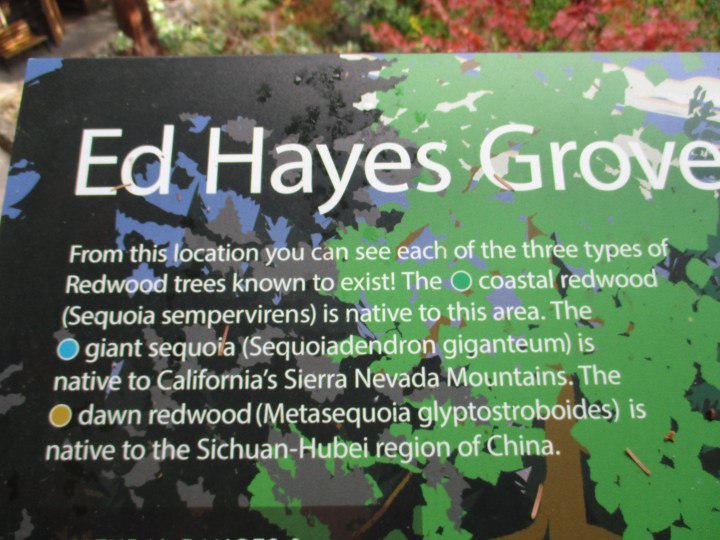
5. The plaque identifies all three species of redwood in the landscape. The green, blue and brown dots next to the names correspond to a diagram showing where each is within the landscape.P91207-5

6. The defoliated dawn redwood is to the left. The small giant redwood is to the right. Those in between and in the background are the native coastal redwoods, which grow wild in the region.P91207-6

This is the link for Six on Saturday, for anyone else who would like to participate:

https://thepropagatorblog.wordpress.com/2017/09/18/six-on-saturday-a-participant-guide/