Horridculture – Opposite Poles

P90904This is not about North and South. It is about a utility pole and a pole that remained from a redwood tree that was too close to it. One is there to support a variety of cables and a streetlamp. The other just wanted to grow into a redwood tree to join the rest of the forest. One has been deceased for many years or decades. The other was alive just recently, but is now only a stump.

The picture above shows how many cables the utility pole supports, as well as the streetlamp. When I did my internship in 1988, the arborists whom I worked with knew what each of the various cables were for; high voltage, lower voltage, cable television, telephone and whatever else was up there. Fiber optic cables have since simplified the telephone and television cables.

The picture above also shows how the unfortunate redwood tree needed to be cut back for clearance from the electrical cables. I was mortified to see this so prominently visible on the edge of a main road, because I should have noticed the problem earlier and just cut the tree down. Not too long ago I was pruning many other redwood trees for clearance from other streetlamps.

Those who pruned it instead, along with any other trees that were encroaching into the electrical cables, were very efficient with establishing clearance, but not so proficient with aesthetics. Obviously, I could not leave this tree like this on the side of the road. Even if I did not care what it looked like, I did not want it to regenerate and immediately encroach back into the cables.

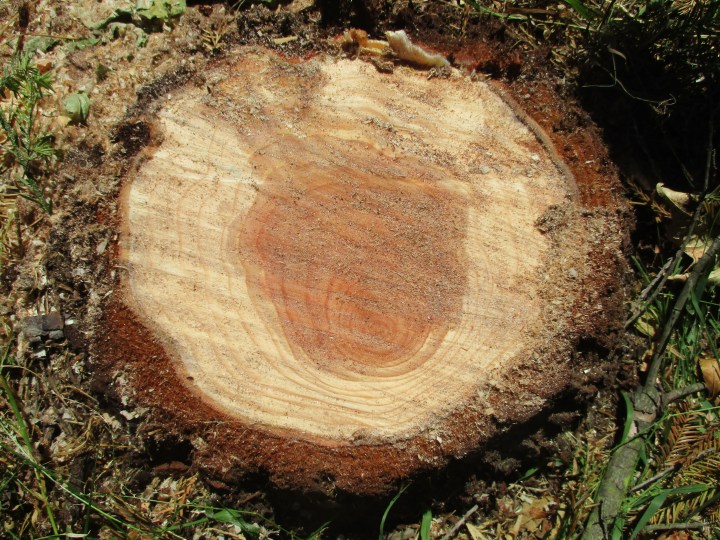
The picture below shows my corrective pruning. The stump is certainly not dead, and will try to regenerate, but will be easier to keep down. If kept down long enough, it may eventually die.

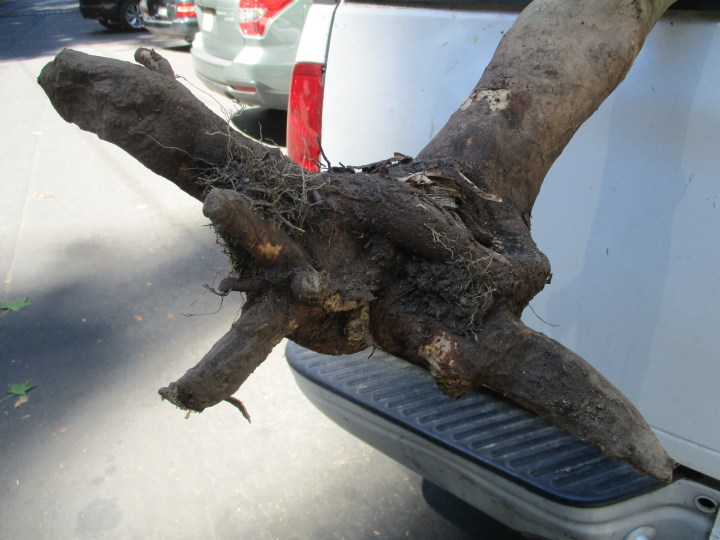
The second picture below shows the stripped trunk in two sections that are nearly eight feet long, and a short bottom section that is a bit more than two feet long. The two long sections are straight enough for gate posts (although there is another plan for them). It is a sad demise for the formerly healthy and sound redwood tree, but became necessary to keep the electricity on.P90904+P90904++

Props

P90901It has been almost a month since one of three small but sculptural and very prominent coast live oaks at work was destabilized by . . . well, children. They were climbing on it, as most good children should do. There were a few of them; and the tree is old and deteriorating. All three of the trees actually grew from the same rotten stump of a tree that was cut down decades ago.

I wrote about it at ‘Six on Saturday – Do Not Sit On Tree‘. The title will make more sense if you read about it.

To salvage the tree, I pruned off as much of the foliar canopy as possible. This eliminated some of the weight that the trunk needs to support, as well as decreased some of the resistance to wind, which exerts leverage against the compromised root system when wind blows. Sawhorses were placed under the trunk, and one of the others, to prevent them from sagging any lower.

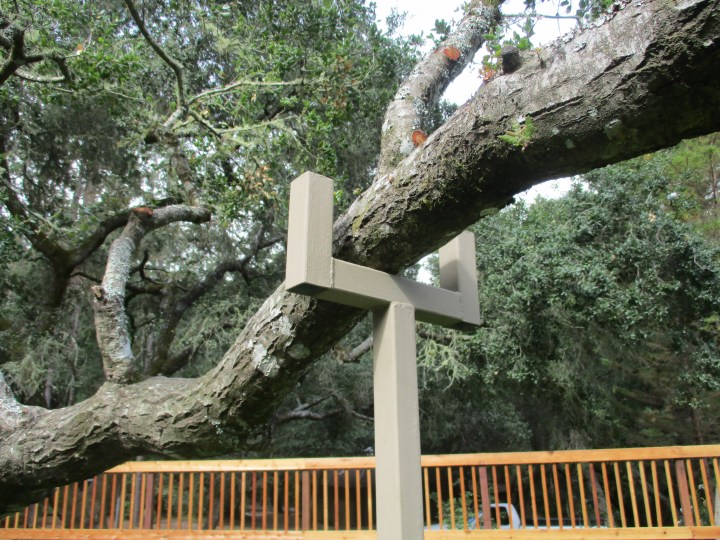
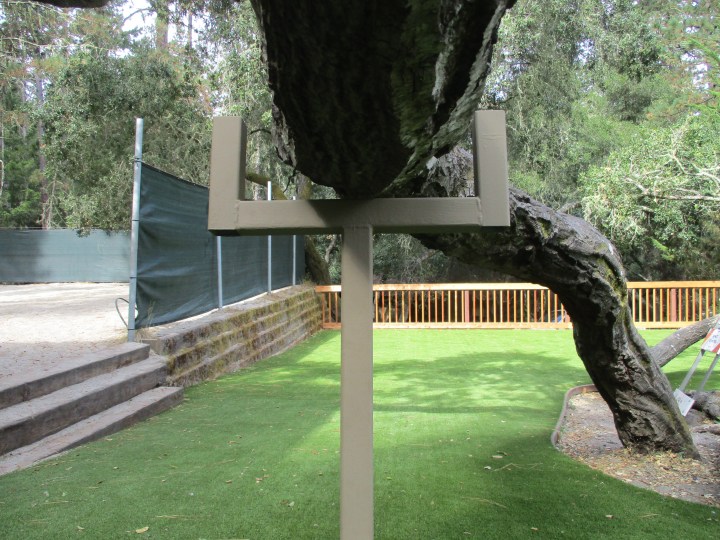
Props that were fabricated to be more permanent then the sawhorses were installed last week. They do not actually support or even touch the trunks, but are there to prevent the trunks from sagging any lower. If the trunks start to lean on the props, I will prune a bit more weight off. If that doesn’t work, the props can be moved a bit farther out, where the trunk are higher.

Hopefully, the old root system of the destabilized tree was not so severely damaged that it can not recover. If it does recover, and the trunk is not supported by the new prop, the tree will need to eventually regain stability. It will be a tediously slow process. Because the trees are already so mature and disfigured, the props will likely never be removed, regardless of recovery.

The first picture above show the destabilized tree outfitted with a new prop. The second picture below shows the other tree that was outfitted with a new prop just because it is so likely to become destabilized.

P90901+

Bad Pollard


P90831KJust about any other arborist will insist that any pollard is a bad pollard. I am not any other arborist. I have no issue with pollarding certain trees properly.

Pollarding is severe pruning that removes all growth that developed since the last pollarding procedure, leaving only a main trunk and a few main limbs. It is done while trees are dormant in winter, and must be repeated either annually or at least every few years, before the resulting growth develops into major limbs. Pruning must be very thorough and neat, leaving no stubs.

Most new growth develops from where older growth had been pruned away during the previous winter, with only a few adventitious stems possibly developing on the main limbs or trunks. Distended ‘knuckles’ develop where this growth repeatedly gets pruned away and regenerates. All subsequent pollard pruning must be done only on the outside of these knuckles, not below.

It may seem easier to cut entire knuckles off with fewer big cuts rather than cutting all the secondary growth off with so many more cuts. However, as new growth develops, the many small cuts on the distended knuckles will be compartmentalized (healed over) much more efficiently than fewer but larger wounds. Wounds that compartmentalize too slowly stay open to decay.

Once pollarded, a tree will always need to be pollarded, or at lease pruned regularly to compensate for compromised structural integrity. Secondary growth is innately vigorous and heavy, but weakly attached to the main limbs.

Pollarding is done to produce an abundance of lush foliage, to produce an abundance of twiggy growth, or to deprive a tree of bloom. Pollarded mulberry trees provide lush foliage to feed silkworms. Pollarded willow trees provide many uniform limber canes for basketry. Pollarded privets are unable to bloom and bother those who are allergic to their objectionably fine pollen.

Well, enough about pollarding.

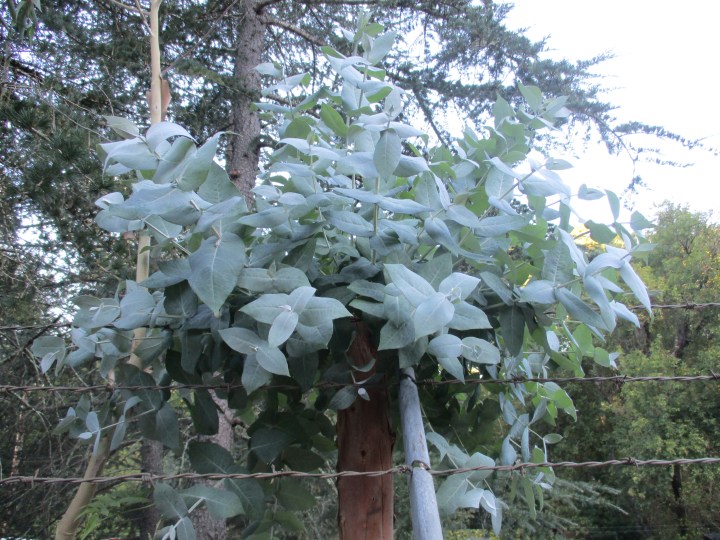
I pollarded a blue gum, Eucalyptus globulus, for the second time earlier this year. It was done dangerously late in the season, and at the same time that the roots of the tree were brutally damaged by relocation. (It is a canned tree that rooted into the ground.) The tree has no branches, but only a single ridiculously bare trunk with a silly new knuckle on top. Oh, the shame!

As you can see, the unfortunate tree has not grown much since then. It is now getting to be September, so the tree will not be growing much through autumn. As much as I would prefer to pollard this tree annually, I will likely not pollard it this winter, but instead let it grow for another year before pollarding it again. The blue juvenile foliage is exquisitely aromatic, but scarce.

For this picture, I could have moved the tree away from the fence that it is tied to for support, but the barbed wire somehow seems appropriate.

Six on Saturday: White Trash


This is getting close to the in-between time for annuals. Warm season annuals that bloomed through summer will soon be getting replaced with cool season annuals that will perform through winter. Of course, our seasons are neither as distinct nor as severe as they are elsewhere. Many annuals are actually perennial here. Some stay later than they should, just because they can.

Aging annuals and perennials can get somewhat trashy if they are not pruned back or replaced soon enough. Their replacements might not be very impressive until they get established and start to grow. So far, only a few violas have been installed here for autumn, and only because the petunias that were where they are now were getting tired prematurely. There will be more.

There is certainly much more color in the landscapes than what these pictures show. White just happens to be my favorite color.

1. Alyssum is supposed to be a cool season annual for spring or autumn. It does not like cold winter weather or warm summer weather. In our mild climate though, it does well in any season. In sunny spots, it self sows to replace itself before it gets old and deteriorates. This batch will eventually get removed, just so we can put something else here. It is prettier in sunnier spots.P90831

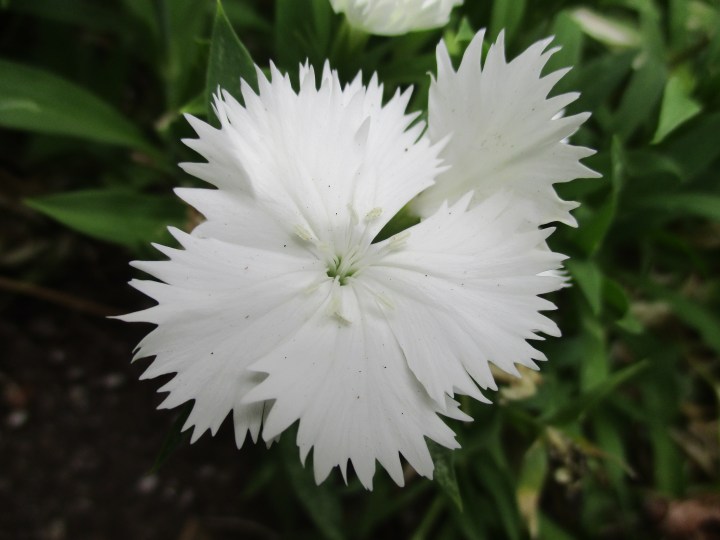
2. Dianthus, like alyssum, is supposed to be a cool season annual. It just does not succumb to the minor summer warmth here. Nor does it succumb to the mildly cool winter weather. It could grow as a short term perennial if we did not need to remove it to plants something else later. It also would perform better with better sun exposure. Here, bloom is not as full as it should be.P90831+

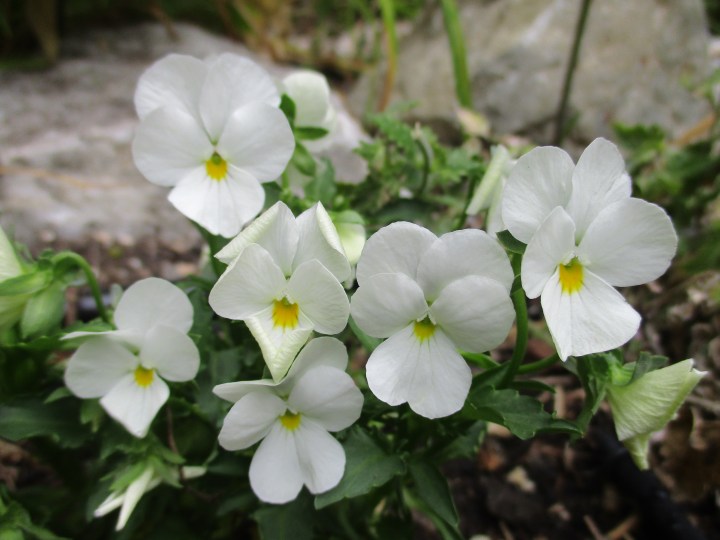
3. Viola is one of the cool season annuals that does not do well through summer here. Some survived from last spring, but they were not happy about it. A few of the many might survive and regenerate if we cut them back, but it is easier to plant something new. These white violas, as well as some comparable yellow ones, got planted early to replace prematurely fading petunias.P90831++

4. Petunia is a warm season annual that did well through most of the summer, but is now fading a bit early. Some have already been replaced with violas. Others probably should be. These are still mostly presentable, so can remain for now. If possible, it is better to not replace them with violas too early. Violas that grow too much before autumn can get floppy through winter.P90831+++

5. Phlox was not planted. A single plant grew in an already crowded bed of flashy annuals and perennials two springs ago. There were a few more last year, and even more this year. They all land in good situations, where they unobtrusively grow through spring, bloom in summer, and die back through autumn. They are warm season annuals, but are expected back next spring.P90831++++

6. Geranium, which are really pelargonium, are perennial here, rather than annual like they are in climates with cooler winters. They can be damaged or even killed by frost where they are more exposed, but this particular geranium is sheltered by an eave and trees. They will probably get cut back at the end of next winter, just to stimulate fresh new growth to replace the old.P90831+++++

This is the link for Six on Saturday, for anyone else who would like to participate:

https://thepropagatorblog.wordpress.com/2017/09/18/six-on-saturday-a-participant-guide/

Another One Bites The Dust

P90825If this looks familiar, it is because it is the second big camellia to be killed here in the same manner in not much more than two months. The damage is not fresh, likely because the gopher that caused it started chewing on the roots as soon as the other camellia was removed. The other camellia succumbed about two months after a similarly damaged cherry tree was removed.

We are now concerned for a remaining third camellia in the same spot, as well as others in the vicinity. There is also concern that the gopher may take interest in something else, such as the birches. We would typically find and destroy any gopher that causes such problems. The difficulty here is that the area is thoroughly covered with a dense layer of Algerian and English ivies.

All evidence of gopher excavation is obscured. Even if we could locate such excavation, it would be very difficult to cut through the thicket of ivy without collapsing the tunnels that we would need to put the traps into. It would be excellent to get rid of the ivy as well as the gopher, but that would be a major project for another time. As voracious as gophers are, they don’t eat ivy!

For now, we can only watch the adjacent camellia and other camellias in the vicinity for distress. Of course, by the time a problem is noticed, it will likely be too late to do much about it. We could only apply blood meal, and hope that it works as a repellent. These camellias get blood meal as fertilizer anyway, so would only need more applied off schedule and around the trunks.

The remains of the deceased camellia were removed from the site, and respectfully interred into the green waste recycle bin.

Fake Six on Saturday

P90824K‘Six on Saturday’ is a weekly tradition for many of us who enjoy sharing six horticulturally oriented pictures on Saturday. I just did it earlier this morning.

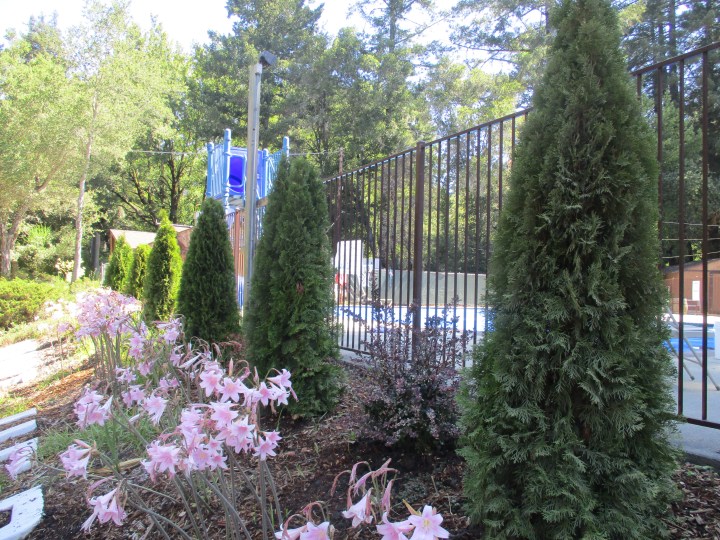
This is not ‘Six on Saturday’. It is just one picture of six arborvitae. What’s worse is that there is an indistinguishable seventh at the far end of the row. It blends into the sixth in this picture. There are seven barberry between them, with the seventh beyond the last arborvitae. This picture was taken more than a week ago, so most of the amaryllis are done blooming now.

This row of arborvitae and barberry was installed early last winter, after a grungy hedge of photinia was removed. It would have been nice to salvage the photinia, but they were such a mess that the process would have taken more than two years, and even then, would have been patchy.

These arborvitaes will not grow into a contiguous hedge like the photinia were, but already soften the otherwise uninviting visual impact of the plain and uniform fence behind. They will grow taller and broader, but will never get so big that they will be difficult to maintain. It should be easy enough to get behind them to prune away parts that get too close to the fence.

I happen to be pleased that we were able to incorporate this sort of formality into an otherwise completely informal landscape. The irregularity of the terrain, as well as the randomness of the big forest trees that were here before landscapes were installed, make such formality nearly impossible. Even if it were easier, formality is not exactly fashionable in landscape design.

Despite their imposed formality and exotic origins, both the arborvitae and the barberry are remarkably compatible with the native flora of the surrounding forest landscape.

Six on Saturday: The Shining


‘Shiners’ have nothing to do with Rudbeckia hirta, which is commonly known as ‘black eyed Susan’. (Why did rude Becky hurt Susan like that anyway?) Shiners are the wounds left from pruning significant limbs from their supporting limbs or main trunks. They shine most blatantly when fresh, and then fade in the weather.

The best shiners are those that will be compartmentalized (healed over) most efficiently. They should not be cut too deeply, or be left with stubs that interfere with compartmentalization. There is quite a bit of science to shiners.

1. This is a good example of a bad shiner. (I could have gotten a better picture of it, but thought that the sun shining from behind was appropriate to the topic.) This shiner was not made by pruning a limb away from a main trunk, but by pruning a main trunk away from a limb. The main trunk leans over so much that most of it needed to be removed to maintain minimal clearance over a driveway. The only two options were to prune it back the the limb on the left, or remove the entire tree. Because the shiner is wider than the remaining limb, which will become the main trunk, it will take several years to be compartmentalized. By that time, decay will have extended downward from the shiner into the main trunk below.P90824
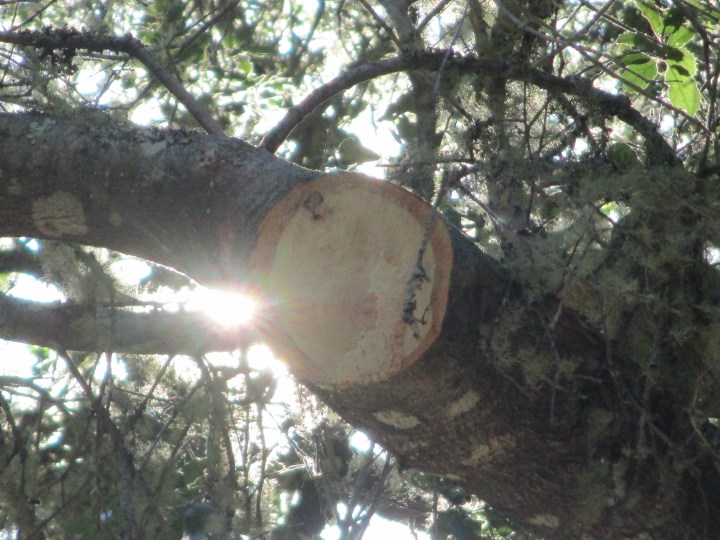
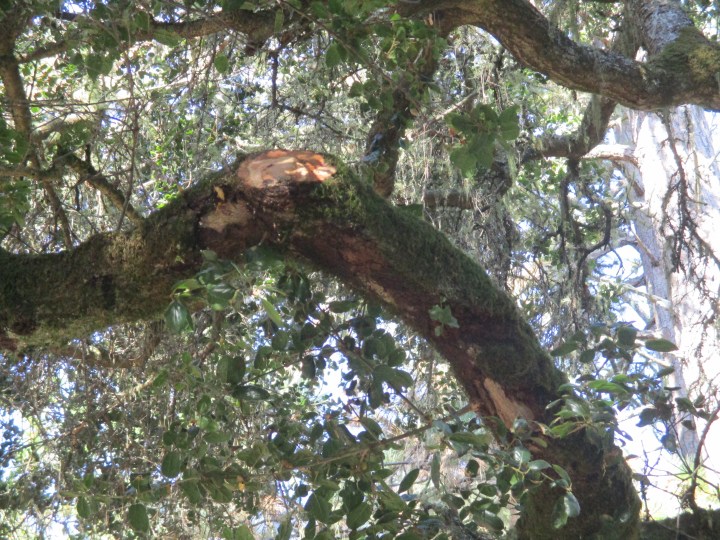
2. Removal of a limb that was battering the topsides of delivery trucks left the shiner above and left of the center of the picture. The scar to the lower left of the shiner, and another scar farther the lower right, closer to the lower right corner of the picture, were caused by a single altercation with one truck that drove off the edge of the driveway. Since it is not really encroaching into the driveway, or interfering with minimal clearance, this particular damaged limb remains.P90824+
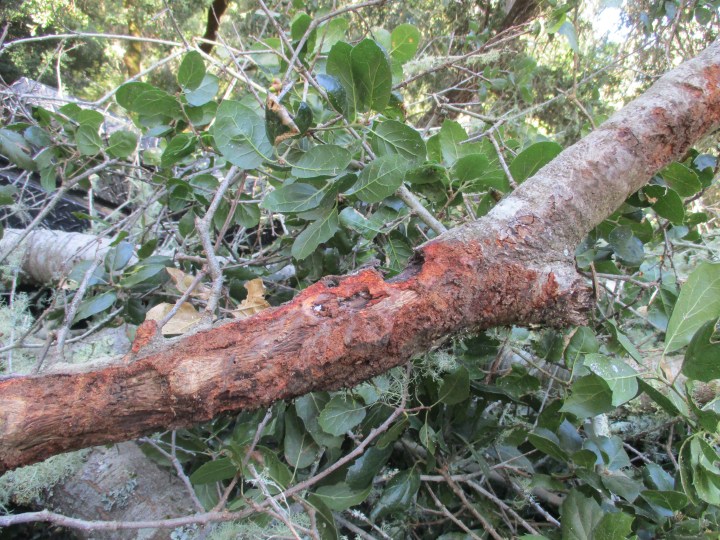
3. This is the thrashed limb that was removed from the limb in the #2 picture above. The freshest damage is still red. This limb had been up above minimal clearance for a few years before the supporting limb sagged with the weight of the growing canopy above. Damage to the trucks is more of a concern than the limbs, so it had to go.P90824++
4. This is another good example of a bad shiner. The main trunk to the right would not have been able to compartmentalize over the stub until it grew out past it, or the stub rotted and fell away. The stub was partly rotten, but also partly viable, with a small branch growing from it. The viable portion would have taken more time to rot away. The whole mess was cut away after this picture was taken; but the resulting shiner that I did not get pictures of has another problem. This picture shows how the stub wraps around the main trunk from behind. The bark compressed between the stub and the main trunk, which is known as ‘included bark’ or ‘bark inclusion’, will temporarily be in the way of compartmentalization of the shiner. Fortunately, the tree is young and vigorous enough to figure it all out.P90824+++
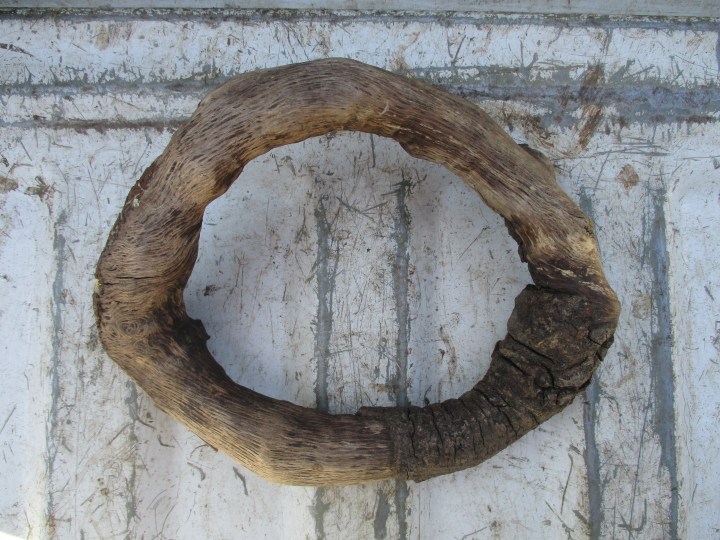
5. What looks like shark jaw bones without the teeth is the callus growth that once surrounded a well cut shiner. After the shiner was cut, and the tree started to compartmentalize over it, the tree died suddenly. As the trunk decayed, this dense callus growth that started to compartmentalize the shiner decayed slower. The uniformity of the callus growth shows how evenly the shiner was cut. I believe that the bottom of the shiner is to the left, but that could be backward. I can only say that the shiner is sideways in this picture.P90824++++
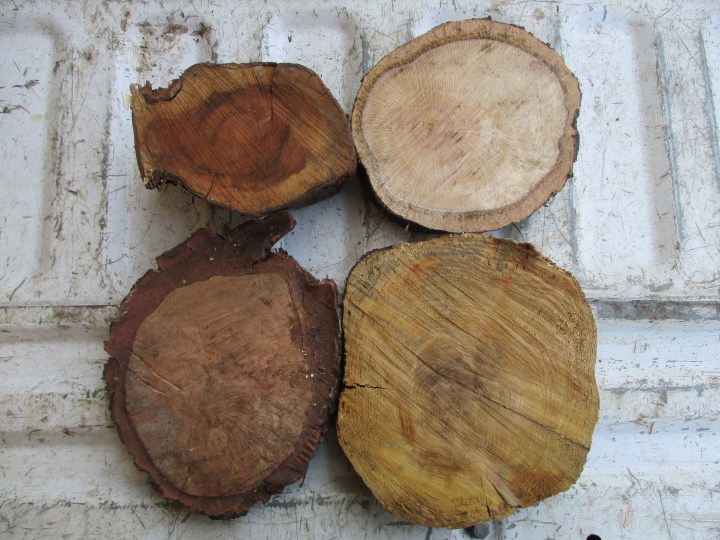
6. Coast live oak, Quercus agrifolia, is the only species in all five of the pictures above, and also provided the biscuits to the lower left and the upper right in this picture. ‘Biscuits’ are sometimes cut to adjust a shiner after the main part of a limb is pruned away, or perhaps to cut a stump slighter lower after a tree is cut down. I really do not remember why I saved the biscuit to the lower left, although I can remember the tree that it came from. The fresher one to the upper right is from the shiner in the first picture #1 above. I kept the Hollywood juniper biscuit to the upper left because I thought it would smell like the related Eastern red cedar (which is actually a juniper rather than a cedar) that cedar chests and closets are made with. The deteriorating biscuit to the lower right is from a very dead white fir that needed to be cut down. I kept it because I happen to be very fond of white firs, but so rarely see them here.P90824+++++
This is the link for Six on Saturday, for anyone else who would like to participate:

https://thepropagatorblog.wordpress.com/2017/09/18/six-on-saturday-a-participant-guide/

Horridculture – True Colors

P90821Bearded iris can bloom in almost any color. It is expected of them. There is not much they can do to surprise us.

Dahlias exhibit a remarkable range of both color and floral form. Only a few colors are beyond their range.

Roses, gladiolus, freesias, tulips, hyacinths, petunias, pansies, primroses and several of the most prolific bloomers are expected to provide many choices of color.

Other flowers are not so diverse. Forsythia blooms only in bright yellow, or perhaps a lighter hue of yellow. Mock orange blooms only in white, either single or double. Until recently, before purple was invented, the common species of lily-of-the-Nile were either blue or white. We tend to appreciate such flowers for their simplicity, and do not expect anything more from them.

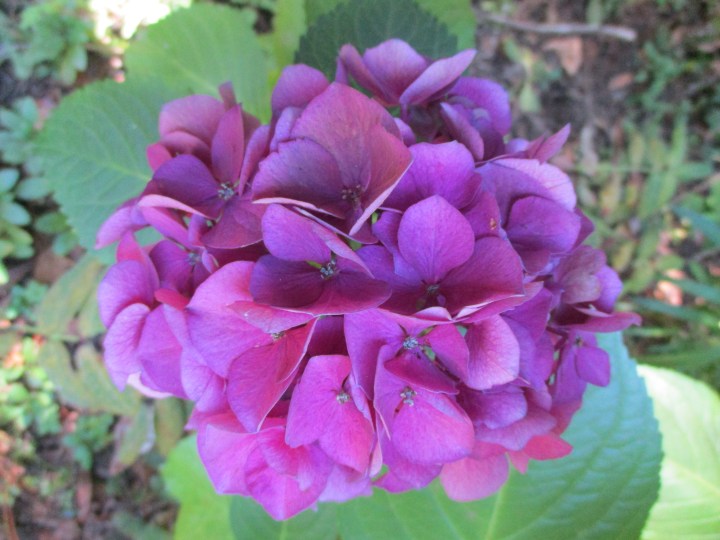
Decades ago, hydrangeas were either white or pink or blue. I say ‘either’ because what seems to be three choices is actually only two. White hydrangeas were always white. Pink or blue hydrangeas were the same, but were pink in alkaline soil, or blue in acidic soil. Blue hydrangeas planted into alkaline soil turned pink. Conversely, pink hydrangeas turned blue in acidic soil.

In the slightly alkaline soil of the Santa Clara Valley, pink hydrangeas were common. Blue hydrangeas were fertilized regularly with aluminum sulfate or some sort of acidifying fertilizer.

In the more acidic soil of the West Coast of Washington, pink hydrangeas would have been blue without lime.

Some more recently bred cultivars of hydrangea excel at either pink or blue. It does not take much to convince them to exhibit their preferred color in less than conducive conditions. These cultivars made it easier to grow blue hydrangeas in the Santa Clara Valley, or pink hydrangeas on the West Coast of Washington.

Then breeding got ridiculous. Hydrangeas were bred to bloom reliably in rich shades of purple, red, or dark blue, with minimal sensitivity to the pH of the soil. They are appealing to those who like these unnaturally rich colors; but to those of us who expect hydrangeas to bloom in white or traditionally soft hues of pink or blue, they are just too weird.

Can’t See The Tree For The Forest

P90818Big trees get big problems. Part of our job is to tend to these problems before they become dangerous. Many of these problems are somewhat easy to identify. A deteriorating ponderosa pine with browning foliage it difficult to ignore if it is tall enough to be seen above the rest of the forest more than a mile away.
There are a few problems that are not so easy to identify. Some are caused by the weather, without prior warning. Others are hidden in the forests. One might think that those in the forests would not concern us. However, our landscape and facilities are so intricately mixed with the forests.

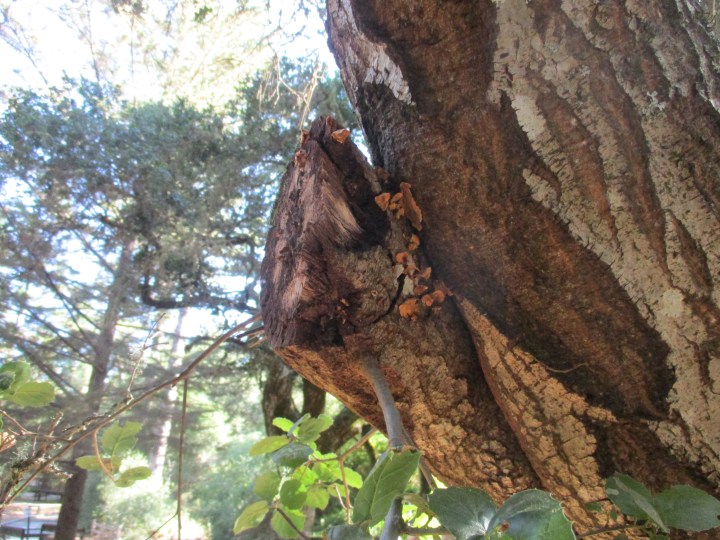
The shiner in the picture above was where a big broken limb needed to be cut from a big fir tree. It may not look big in the picture, but the limb was probably more than nine inches wide, and long enough to weigh a few hundred pounds. The lower right edge of the shiner is frayed because the limb broke right at the trunk, and was hanging vertically against the trunk.

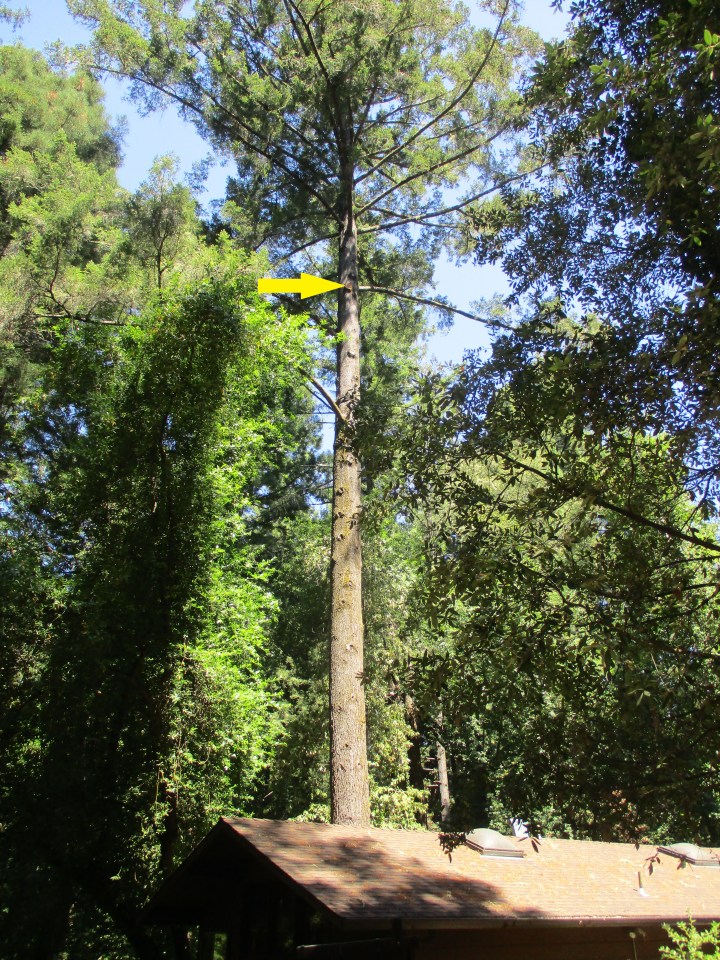
The yellow arrow in the picture below indicates where the shiner is located. The trunk of the tree is not as tapered as it seems to be in the picture. It only looks like this because it is so tall that the the upper portion is very far from the camera! Although this fir is a wild forest tree, it is only a few feet from the cabin below. The broken limb was dangling directly over the roof!

There was no way to predict that this limb would break. It did not seem to be any more structurally deficient than those that remain. Of course, once broken, it was removed faster than I could get a picture of it.P90818+

Fasciated Lily-of-the-Nile

P90817K

Floral fasciation is a rare developmental disfigurement of a bloom, supposedly caused by the fusion of two or more blooms. Many fasciated blooms really do look like two blooms stuck together, like double daisies. Alternatively, fasciation can cause distention of a single flower of many on a foral spike of foxglove.

Fasciation of lily-of-the-Nile bloom is typically expressed merely as a few stray florets on the otherwise bare stalk below the main floral truss. A smaller subordinate stalk may seem to be fused to the main stalk below the stray florets.

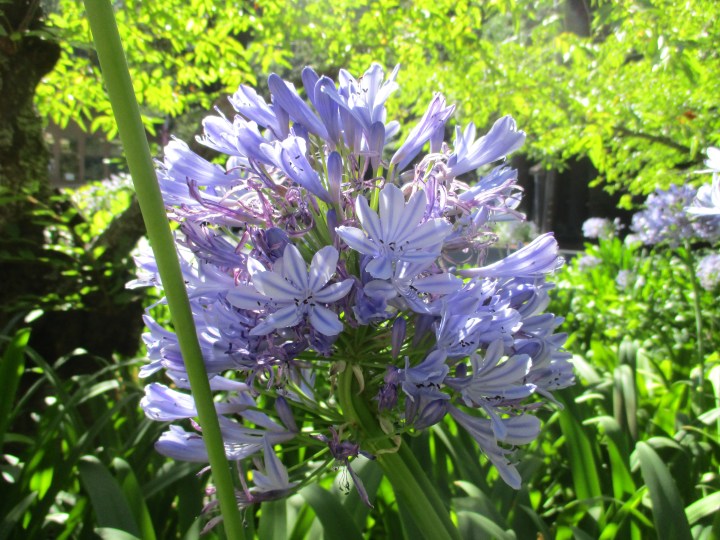
The specimen in the picture above is exceptional. It really does look like a double bloom, with one stacked on top of the other. The atypically short and stout stem looks like a tightly fused bundle of several smaller stems. Those who do not know better might find the more billowy and more colorful fasciated bloom to be more appealing than the normal bloom pictured below.

The first picture of my ‘Six on Saturday‘ post this morning shows that this is not the only fasciated bloom here. There is another similar fasciated bloom right next to it. This suggests that the fasciation is likely caused by a genetic mutation that was shared with each of two rhizomes that split from the original.

If the mutation is sufficiently stable, and not likely to soon revert, more copies could be propagated later by division. The rhizomes split after bloom; so if one split into two last year, the two that are here now could split into four next year. If genetically stable, all four should bloom with the same fasciation next year.

To monitor their genetic stability, I should probably relocate these two odd rhizomes, to separate them from the others for observation. I suspect that they will eventually revert anyway.

P90817++