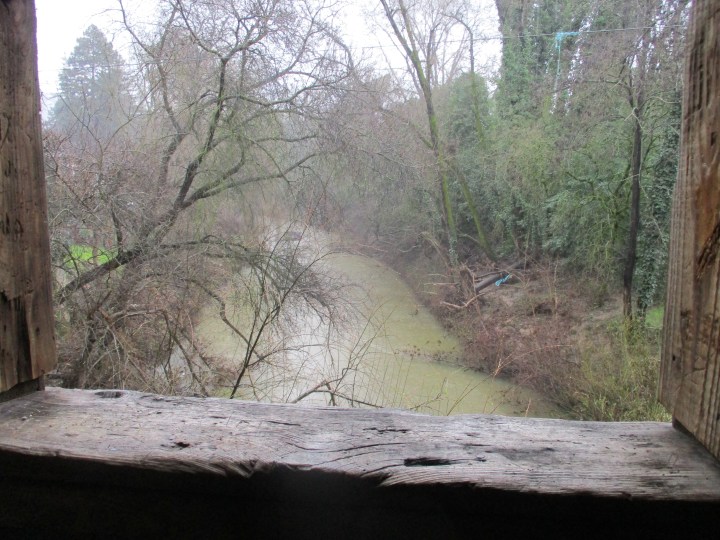
 It may not look like much, but before all the rain started, the San Lorenzo river was shallow enough here to walk across. The water was clear and barely flowing. It is impossible to guess how deep it is now. It looks like cafe au lait, and is certainly flowing better than it had been. The watershed is less than a hundred and fifty square miles, so all this water is not coming from very far away.
The first picture above, of the San Lorenzo River flowing south to Santa Cruz and the Monterey Bay, was taken from the western of the two windows on the south side of the Felton Covered Bridge. Experts believe this to be the best of the four windows. My Mother has an old black and white picture of my older sister, my younger brother and I looking out from this window when were just little tykes. There was a railroad bridge out there a long time ago. Only concrete foundations remain.
The second picture below, of the San Lorenzo River flowing from the Santa Cruz Mountains beyond, was taken from the western of the two windows on the north side of the Felton Covered Bridge. The San Lorenzo River flows south on this side too!
It has been raining rather well here. Boulder Creek, which is at the far north end of the San Lorenzo Valley, gets more rain than most places in California, and far more than the rain shadow region on the inland side of the Santa Cruz Mountains. Local rain does nothing for the water supply of the rest of California, but is a good indication that snow is falling in the Sierra Nevada, where most of the water for much of the rest of California is stored in the snowpack.
Greenhouse Envy
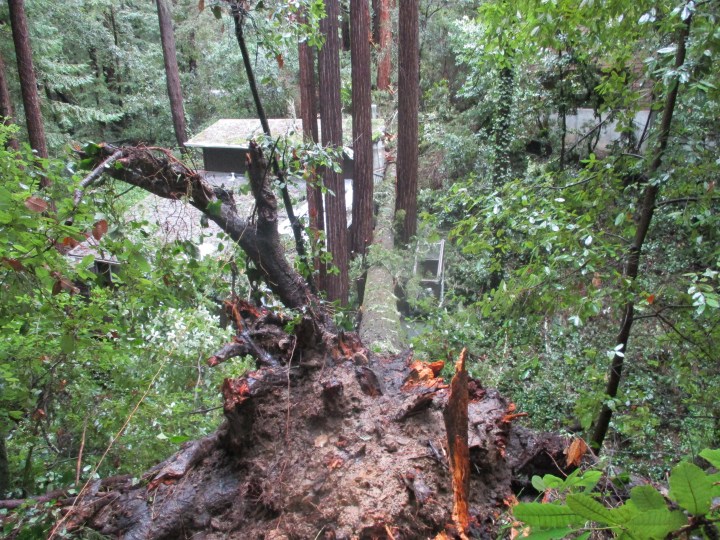 If there were lawns and fences in this neighborhood, the grass would likely seem to be greener on the other side of the fence. In this situation, the greenhouse probably seemed to be more comfortable than being left out in the storm. This tall Douglas fir tree dropped in to find out. It did not go well. What remains can be seen in the middle of the picture above, just to the right of the fallen fir, and in the close up of the picture below.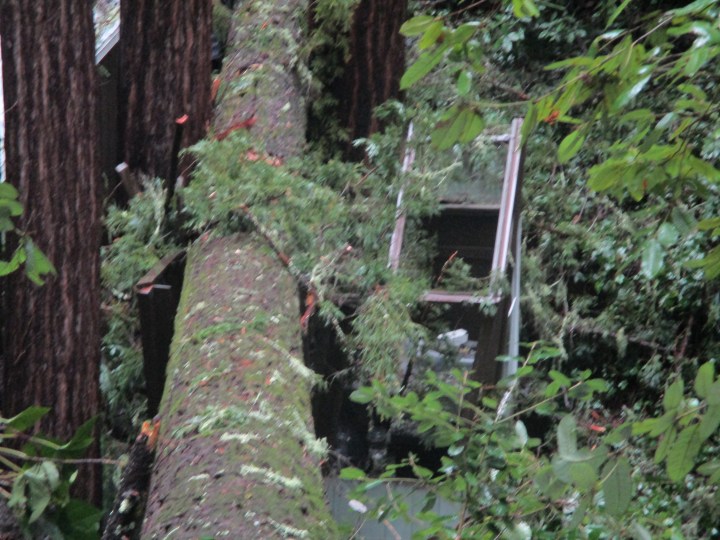
Miraculously, the two coastal redwood trees that caught and guided the fir to a direct hit on the greenhouse also prevented it from destroying the associated house. Well, at least the redwood on the left did. There would have been less damage if the fir had fallen farther to the right. Regardless, a deck was crushed, an eave was destroyed, but the rear wall of the home was barely nudged. Not even the windows there were broken!
Falling debris punched a few holes in the roof, but without structural damage. The patio of the big building to the right was littered with debris that was easily removed. After limbs are removed from the damaged house, much of the carcass of the fallen fir will remain on the forest floor. It decays efficiently here.
Incidentally, this fir was about to be removed. It had been identified as too risky for the neighborhood. Although they are not visible in the pictures, there are a few other homes in the neighborhood. The cabin that I stayed in for more than a week is just beyond where the top of the fir landed. The stovepipe that is visible in the background of the second of my ‘Six on Saturday – Cabin Fever’ pictures from January 5 is the same stove pipe that is visible on the roof of the home that was nearly destroyed by the fallen fir. https://tonytomeo.com/2019/01/05/six-on-saturday-cabin-fever/
(The stove pipe circled by the yellow oval just above the center of the picture above is the same stove pipe circled by the yellow oval just right of the middle of the upper margin of the picture below.)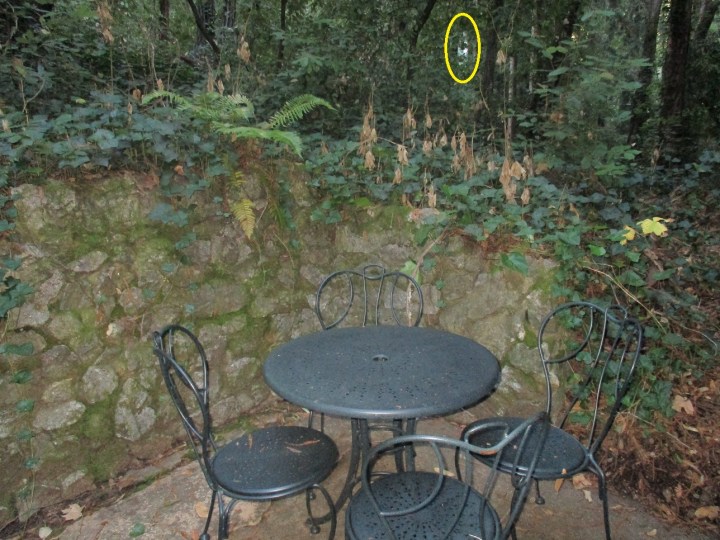
Six on Saturday: Untimely Death
One of the more unpleasant parts of my work is condemning elderly trees. Redwood and oaks in our region can live for centuries, but none last forever. It is sometimes my job to determine if some of the oldest of oaks have deteriorated to such an extent that they have become unsalvageably dangerous to those around them.
What is worse than that is that there are so many dangerously deteriorated oaks and other trees that collapse before they get removed, and many do so before anyone notices how dangerous they are. Some structural deficiencies and instabilities are concealed to the most thorough of arborists. That is what happened with this big coast live oak, Quercus agrifolia, with a five foot wide trunk, that fell behind Felton Presbyterian Church. I had known for some time that the healthy canopy was heavy and exposed to wind. What I did not know is that the root systems was insufficient to maintain stability when strong wind blew against the healthy canopy while the soil was saturated. The insufficiency of the root system became apparent not only because the tree destabilized, but also because the minimal root system became exposed by the destabilization. There was no evidence of decay or damage within the root system, which are what typically contributes to destabilization.
1. It is amazing that this tree stood for as long as it did with such minimal roots.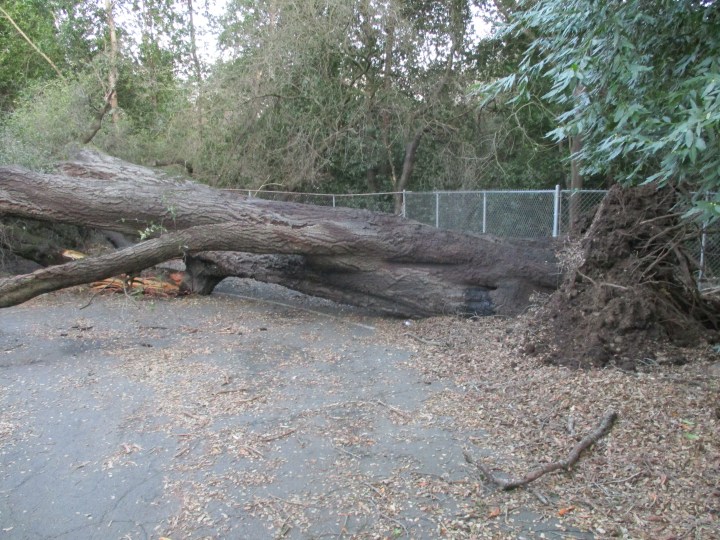
2. This is what those minimal roots supported for so long.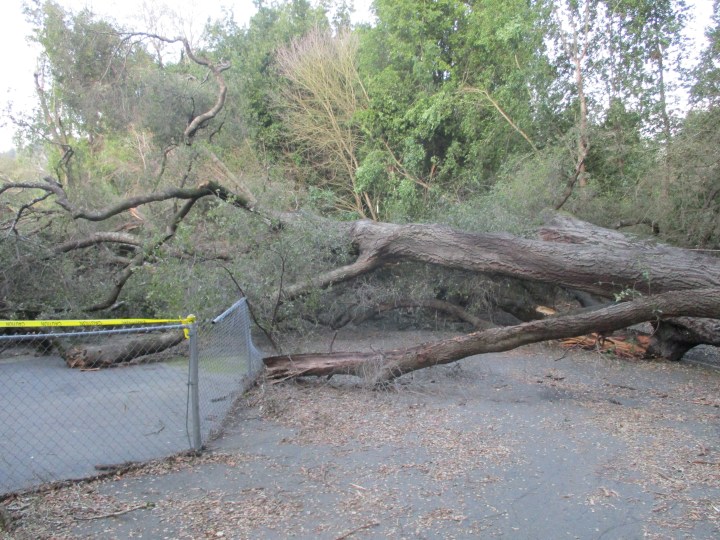
3. Healthy foliar growth on top of the canopy enhanced weight and wind resistance.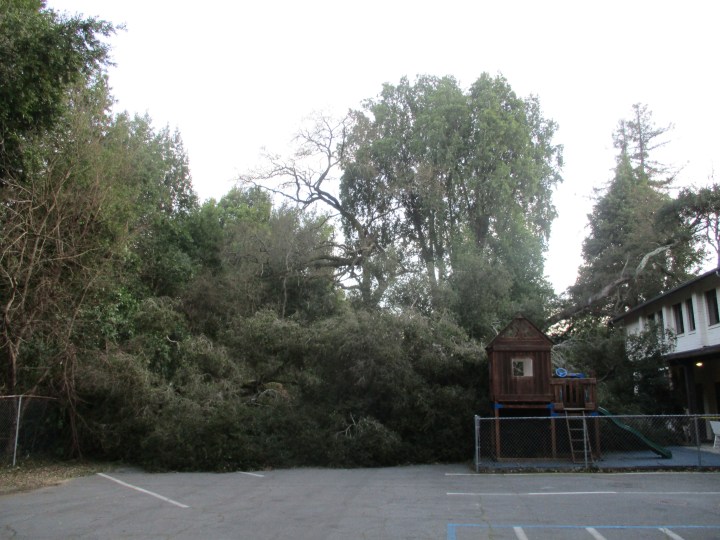
4. Damage was surprisingly minimal.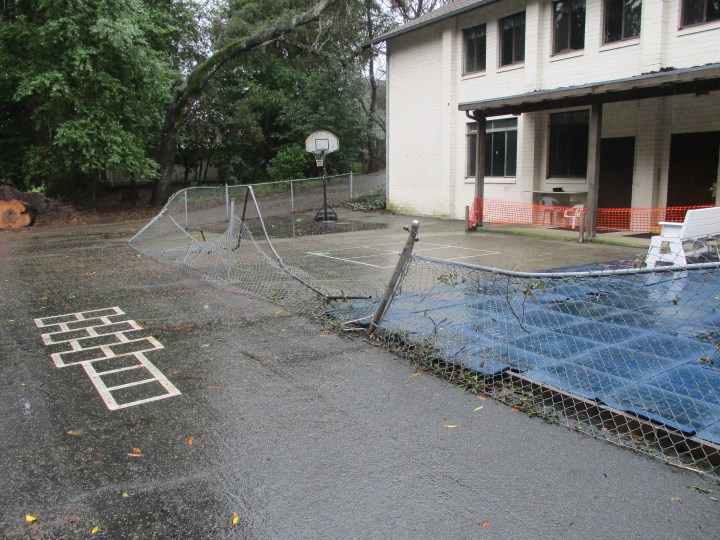
5. This decay within one of the main limbs was a structural deficiency that did not contribute to the destabilization.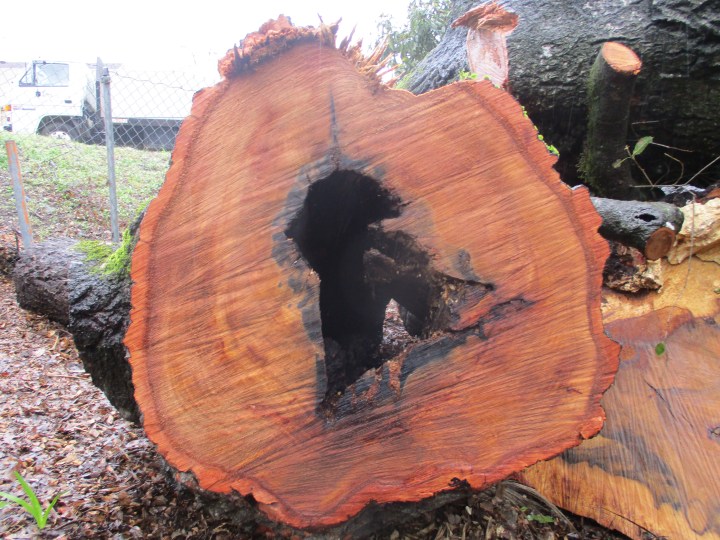
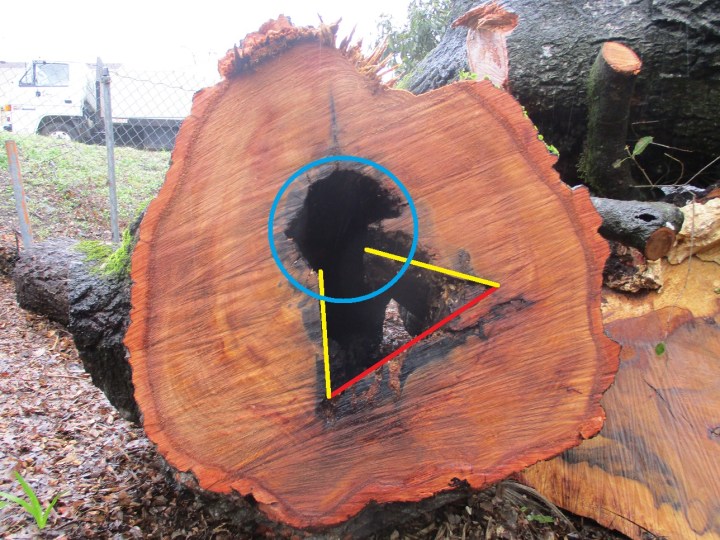
6. (above) This is the same picture as #5. The red line is at the cross section of where a limb broke or was cut away many years or decades ago. Although the straightness of the zone suggest that it was made by a pruning cut, it is unlikely that the tree was pruned up as high as this section of limb was located, particularly so long ago. As the tree compartmentalized the wound, decay spread inward toward the center from the wound, in a typical pattern that resembles a section of a pie chart, which is marked by the yellow lines. Once it reached the center, decay radiated outward from the center, in a typical circular patter, which is marked by the blue circle. As the center of the trunk rotted and deteriorated, the necrotic zone between it at the original wound continued to rot and deteriorate. By that time this cavity developed, the exterior of the wound had already been compartmentalized by viable wood that did not decay.
This is the link for Six on Saturday, for anyone else who would like to participate:
https://thepropagatorblog.wordpress.com/2017/09/18/six-on-saturday-a-participant-guide/
Horridculture – Disdain For Trees
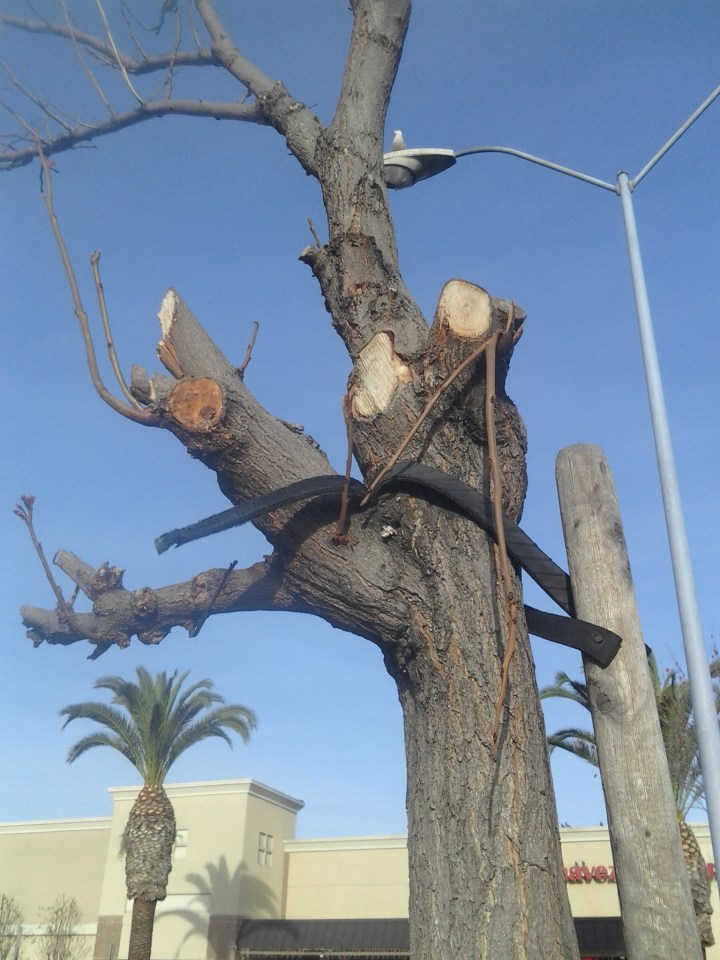 Okay, we get it; someone really hates trees. That’s fine. Trees are not for everyone. Just cut it down. Put it out of it’s misery. Take away the useless lodgepole stake and strap along with it. Maybe those Canary Island date palms that look like the home of SpongeBob SquarePants in the background will recover from their own form of abuse to compensate for the loss of this seemingly unwanted goldenrain tree.
Apparently, it is not that simple. This goes beyond a dislike of trees, or a mere desire to kill them. This tree seems to have been tortured by someone who enjoys it WAY too much. There were others that were similarly disfigured in this same parking lot in the north of San Jose. They were not pollarded. They were not pruned. There were mutilated, but kept alive for more of the same.
What is worse is that someone was paid for this torture. Property management hired a tree service to ‘prune’ these trees, likely for clearance from lamp poles and parked cars. Was the perpetrator inexperienced, insensitive, or as hateful as the severity of the disfigurement suggests? Well, lets analyze that.
There are plenty of inexperienced people who take jobs in occupations with which they are not familiar. However when the do so, they tend to learn at least the basics about it to avoid doing their work improperly. That obviously did not happen here.
Insensitivity or a lack of concern for the work is possible. However, even someone who does not care about such work is likely to get something about it correct, even if just circumstantially. Well, that did not happen either.
These trees are kept alive because they are more lucrative to the torturer that way. As disfigured as the trees are, they will regenerate new growth that will again need to be pruned for clearance later. Someone who put that much thought into what is being done could have just as easily put forth the effort to do ‘something’ properly in regard to pruning. That is obviously not part of the agenda. The perpetrator really is as disdainful of these trees as the disfigurement indicates.
Snow?
 What is this? It looks more like hail now. It was softer and squishier when it fell out of the sky only an hour or so before this picture was taken. There was a slight bit of snow up on Summit above Los Gatos. It will probably melt as quickly as the clouds clear to let the sunlight through. Snow sometimes appears on the higher peaks around the region, but is rare in lower elevations. Forty three years ago from today, on February 5 in 1976, snow fell in the Santa Clara Valley. It was about half an inch deep in some areas, an inch and a half in others, and was the last snow to fall there.
Metallic Roses
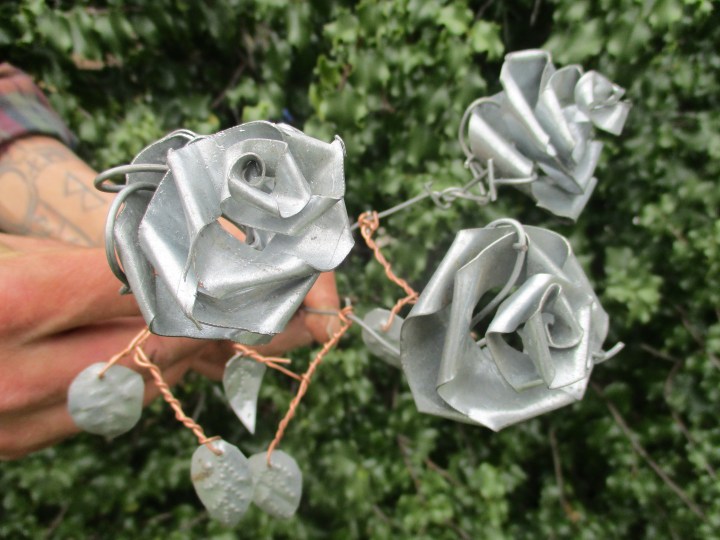 ‘Sterling Silver’ and ‘Stainless Steel’ are two hybrid tea roses that were quite popular decades ago. ‘Copper’ and ‘Aluminum’ are not. However, I did happen to write a bit about the aluminum roses in the picture above on the Facebook page of Felton League on January 28, and included a link to an older article that featured a picture of copper roses. They are not at all relevant to horticulture, but are interesting nonetheless.
Felton League is an informational forum for the distinguished small group of displaced or socially outcast people and their friends in Felton, California. That is how it is described on Facebook. Those who are more directly familiar with us know us as a community group that not only advocates for the local homeless, but also provides compelling insight into homeless culture, and confronts the trend of animosity and hostility for anyone perceived to be homeless.
This is the post on Felton League from January 28:
Some of us participate in the River Cleanups here and elsewhere in Santa Cruz County. Some regularly collect trash for disposal throughout the year. One takes trash collection a step further by creating these metallic roses from some of the collected debris. They were featured in this article about garden art that was published in local newspapers between San Francisco and Beverly Hills in the summer of 2017; https://tonytomeo.com/2018/07/12/be-tactful-with-garden-art/ . (Not all of the articles used this illustration. The link is for the article as it was posted last July, about a year after it was published.) The copper roses of the original article were made from copper pipe. The newer silvery roses are made from flashing found in the San Lorenzo River. The thorny stems are made from scraps of fencing material that resembles a fine gauge of hog wire, that was found closer to Zayante Creek. The leaves are wired on with random bits of copper wire. These roses are often sold to tourists and local merchants to finance the banquets hosted by ‘Let’s Have Soup’ in Felton Covered Bridge Park.
Not My Style
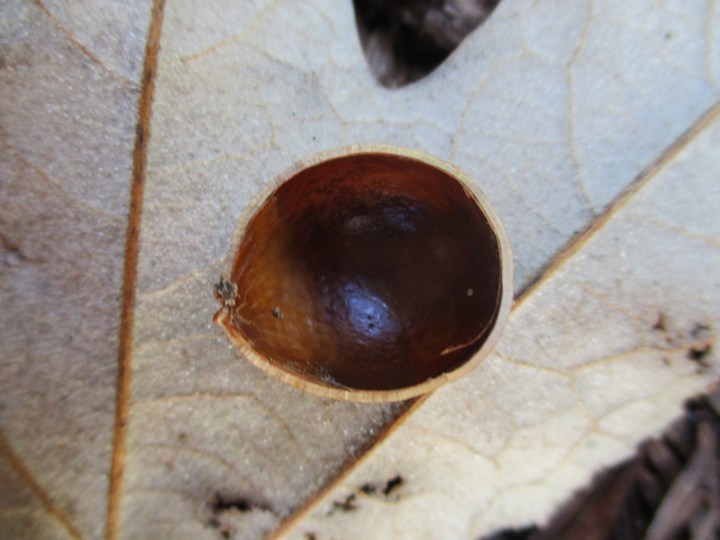 There is no shortage of artistic pictures online and within the context of gardening blogs. Some really are fascinating. I particularly like those that show the weather in far away and mythical lands like Colorado, Chicago, North Carolina, Australia, Oklahoma, New Zealand, Austin, and South Africa. Then there are the cats, dogs, hens, horses, pigs, and a few others that are not so entertaining. The close ups of flowers, fruits, leaves, mushrooms and any variety of odds and ends are amusing if they are not immediately recognizable. Yet, all these pictures are not my style. I am not the artistic sort.
I will try though. This shiny chestnut brown acorn half shell just looked like something that I should get a picture of. It was just laying there on the big sycamore leaf as if it were on display. The interior is even shinier and more richly colored than the exterior, although I did not turn it over to confirm. I am just guessing from my experience with other acorns.
The sycamore that provided the leaf is a California sycamore, Platanus racemosa.
I could not identify the species of the oak that provided the acorn. I am pretty certain that it is not from a coast live oak, valley oak, black oak or tanoak; respectively, Quercus agrifolia, Quercus lobata, Quercus kelogii or (Notho)Lithocarpus densiflorus. There are not many other options. I suspect that it could be from a canyon live oak or Shreve oak; respectively, Quercus chrysolepis or Quercus parvula ‘Shrevei’. Neither produces acorns that are typically as round as this one was.
Nor could I identify the species of squirrel, rat, raccoon, crow or whatever unknown animal dropped it.
Well, perhaps this is why I am not the artistic sort. I am instead the technical sort.
Six on Saturday: Right Here – Right Now
There are certainly more impressive flowers at work. I suppose I should have gotten pictures of them. Instead, I just took these six pictures within minimal proximity to a where I happened to be working on Wednesday. I thought they would be more interesting than they are. I wanted to get a picture of the laurustinus #4 because others have been posting pictures of the same as if it is something important. Flowering quince #6 is my favorite here, and the only one that was not planted into the landscape. It grew from the roots of an old specimen that was in front of an old home that was demolished to redevelop the site. Because of it’s resiliency, we want to pull up some of the layered stems (that rooted where they lay on the soil) to plant in elsewhere.
1. Garrya elliptica – silktassel bloomed with very pendulous light beige blooms quite some time ago. These lasted longer than others in partial shade, but are now turning tan and getting dry. Silktassel is native here.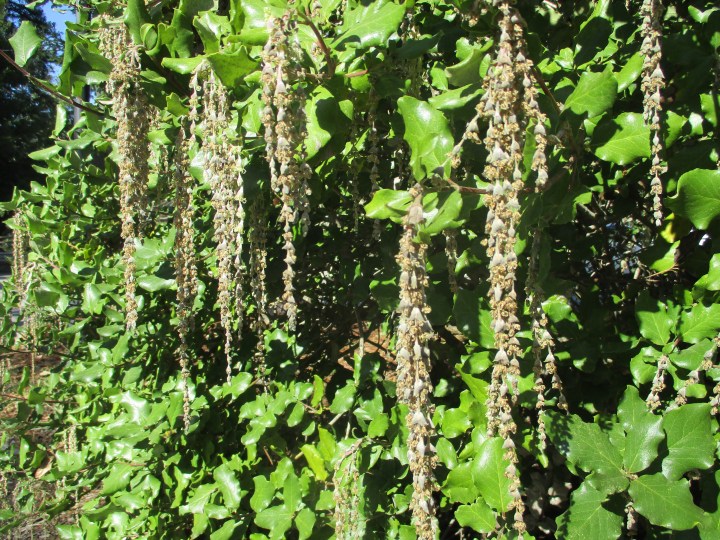
2. Rosmarinus officinalis ‘Prostratus’ – trailing rosemary seems to bloom continually. I do not remember it without bloom here. Bees, which are active in all but the coolest of weather, like how it always here for them.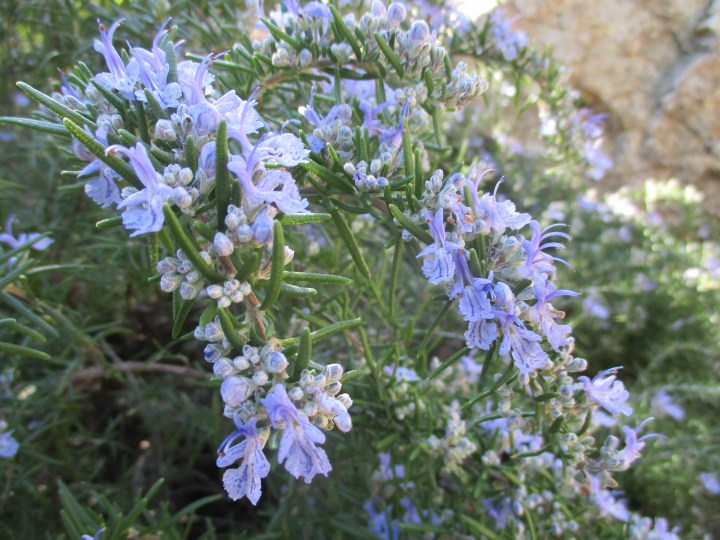
3. Arctostaphylos densiflora ‘Howard McMinn’ – Howard McMinn manzanita is a garden variety or cultivar of a species that is native not far north of here. I sort of think these waxy white flowers are too tiny to impress.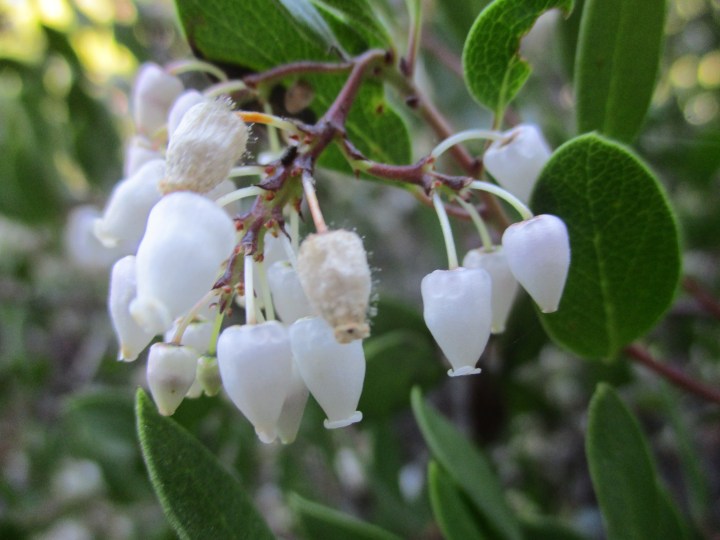
4. Vibrunum tinus ‘Spring Bouquet’ – laurustinus is actually blooming later here than where winters are colder. It naturalizes here. I suppose that those that grow from seed would not be of the same cultivar as the originals.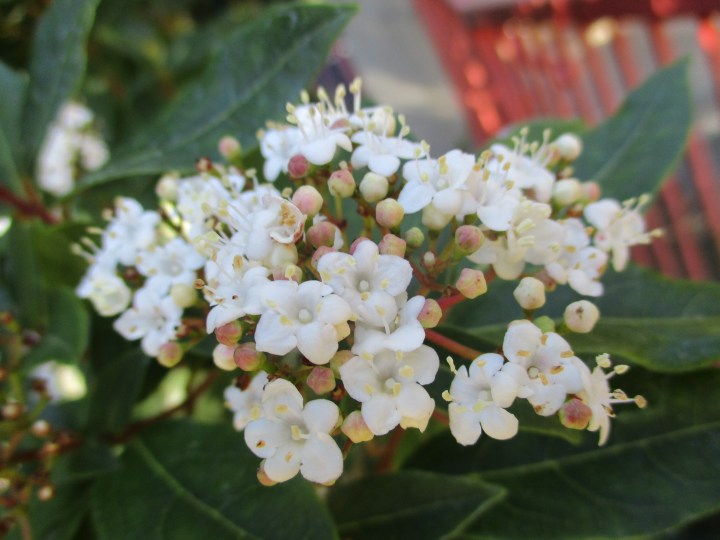
5. Prunus cerasifera – flowering plum is rather sparse here because of the partial shade of larger trees. I do not know what cultivar this one is. I am not even sure if it is Prunus cerasifera. It does not look familiar to me.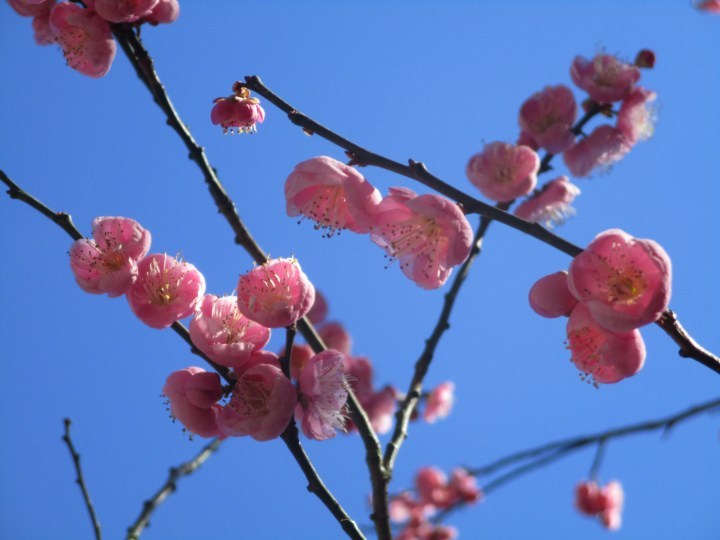
6. Chaenomeles speciosa – flowering quince is another one that I can not identify, although it seems to be the most common sort that I see about town.. I guessed the species, but will not even bother to guess a cultivar.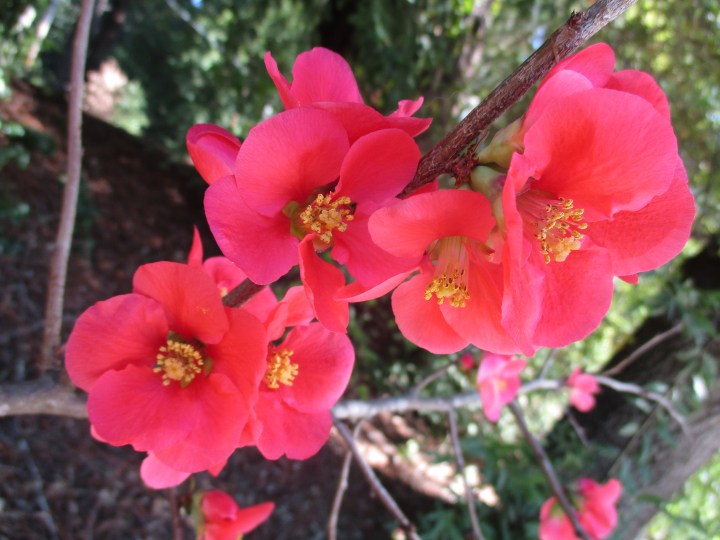
This is the link for Six on Saturday, for anyone else who would like to participate:
https://thepropagatorblog.wordpress.com/2017/09/18/six-on-saturday-a-participant-guide/
Horridculture – Slurry
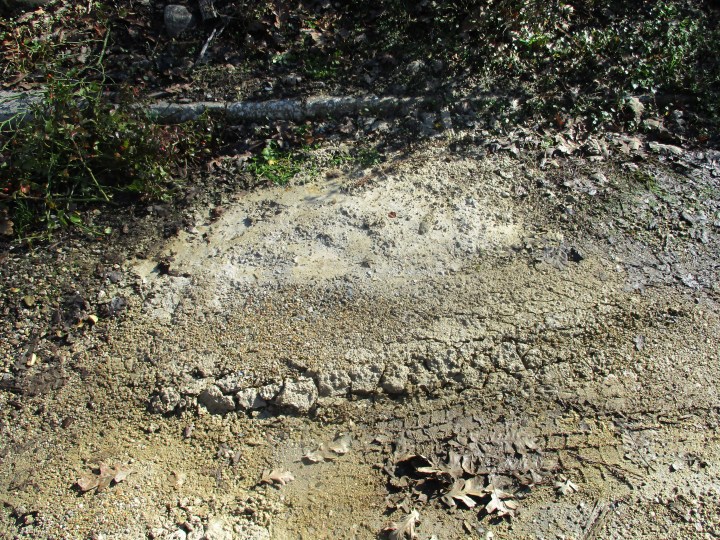 This is likely the worst illustration that I have ever used. It is sort of what it looks like; a mud puddle. What I mean by ‘sort of’ is that this is no ordinary mud. It is a now solidified slurry that was rinsed from a concrete delivery truck. Yes, solidified, right there next to an embankment covered with carpet roses. The curb near the top of the picture is where the embankment starts. The small pile of debris to the upper left is some of what I was pruning from the roses. There was another solidified puddle of slurry just a few yards away. They were just dumped there as if no one would notice.
What makes this even more infuriating is that there is a sign on the main gate into the site, as well as a few others throughout the site, explaining to everyone coming and going that they must wash mud or other crud from their vehicles before leaving the site, so that they leave nothing on the roadway outside. This refers mainly to mud on the tires, but really includes anything that makes a mess. There are washing stations within the site for those who must wash their tires before leaving. There is also a site for slurry such as this, that can not be rinsed into culverts that drain into the adjacent creeks. The management of the project did everything necessary to prevent this sort of thing from happening. Yet, here it is.
A smaller but more destructive puddle of slurry was dumped into my downtown planter box by tile setters working in an adjacent shop. https://tonytomeo.com/2017/11/04/my-tiny-downtown-garden/ That mess needed to be broken apart and removed, but could not be separated from the perennials that is flowed around before solidifying. All of the canna foliage, some nasturtiums and some of the aloes were destroyed.
The insensitivity is ridiculous. I could not imagine leaving debris from pruning roses where the new concrete was installed, as if no one would notice. Yet, such disregard for landscaped areas is quite common. That is why trees that are to be salvaged on a construction site need to be fenced. Even with fencing, they are very often damaged or ruined by those operating machinery. Wouldn’t that be comparable to an arborist cutting a tree down in the most efficient manner, even if it fell onto an adjacent house?
Gladiolus papilio (from the author of Tangly Cottage Gardening Journal)
 https://tonytomeo.com/2018/11/10/six-on-saturday-tangly-cottage-gardening-journal/
This link is to the original post to ‘Six on Saturday’ that was about the four dozen or so Gladiolus papilio bulbs that the author of Tangly Cottage Gardening Journal sent to me at the end of last October.
I tried to not get too eager about these new bulbs. I sort of watched their site shortly after planting them, just to make sure they were safe. Once they were planted, nothing else was done there. There was a bit of frost just to let them know what time of year it is. The rain has been soaking the ground for them.
More recently, I noticed that some of the spring bulbs, particularly narcissus, are blooming elsewhere. Daffodils with bigger flowers are just about to bloom. Even though I know that the summer bulbs bloom a season later, I also know that, their foliage starts to develop quite some time before bloom. They are not as fast as spring bulbs, so their foliage may appear months before ultimate bloom in summer. Again, I was trying to not get too excited.
Then on Friday, I needed to remove some licorice plant from the opposite end of the same big bed that the Gladiolus papilio is in. I did not go out of my way, but hey, while there, I went over to just make sure there were no problems where the the bulbs are at. I really did not expect to find these two shoots. They are emerging from bulbs at opposite ends of the row of the five groups of bulbs described in the earlier article. They look like small shoots of common gladiola, like those that emerge from the tiny cormlets that develop next to larger corms, which is exactly what I was expecting them to look like.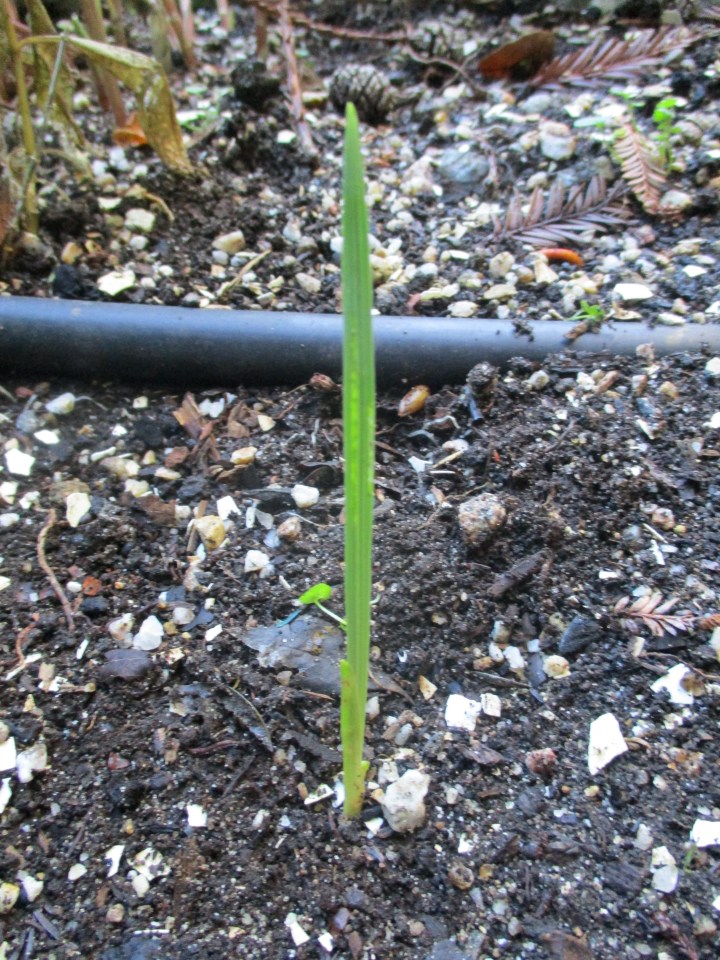
 Tony Tomeo