Horridculture – Fake Environmentalism

P90515Fake environmentalism is a HUGE topic, so for now, will be limited to fake environmentalism as justification for the eviction of homeless encampments.
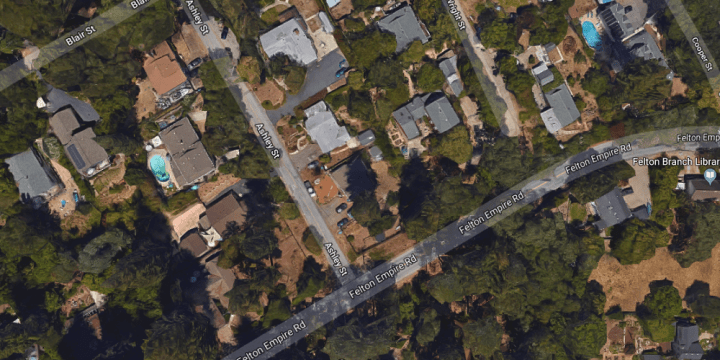
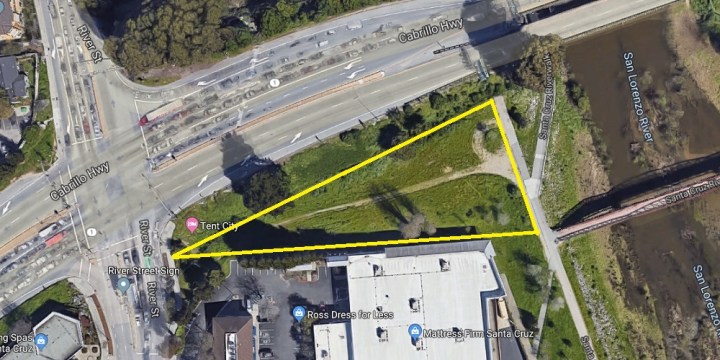
The yellow triangle in the picture above was the site of the Hero’s Camp, which was more commonly known as Ross Camp, and located behind Ross Dress For Less in Gateway Plaza in Santa Cruz. It is gone now. This satellite image was taken by Google Maps prior to the development of the Camp. I did not get pictures of the camp while inhabited, but you have likely seen enough other camps in the news to imagine what it looked like.
It really was as big as it looks, and really did exhibit all the problems that you hear about in the news, although not to such an exaggerated degree. Not everyone there used syringes to inject illicit narcotics. Not everyone there was an alcoholic. Not everyone was violent, from somewhere else, or a criminal. This is not about such issues anyway. It is about how the two hundred or so unhoused people who lived here affected the environment.
Was there trash? Of course there was. Was it more than what two hundred people who live in homes generate? No. Houseless people do not generate as much trash as the housed, simply because they lack resources to purchase the commodities from which so much trash is generated. The houseless certainly do not waste as much as the housed. Their trash just happens to be more visible for outsiders who do not know any better to see.
Furthermore, what is so typically described and perceived as trash is actually the belongings of those who live in such camps. Without closets, cabinets or furniture, our belongings would look about the same, except much more voluminous. When we take just some of the belongings that we don’t want or need and put them out in front of our homes, it is a garage sale, and likely amounts to much more than individual homeless people own.
The satellite image from Google Maps below shows the neighborhood where my grandparents lived in Felton, less than seven miles north of where the picture above was taken. Their old home is right in the middle of the picture. There were not so many other homes there when they arrived, just as World War II was ending. They lived a relatively modest lifestyle, on a small suburban parcel. They were not concerned about the environment.
Why should they have been? Even now, the people who live in homes here can generate as much trash as they want to, and no one will complain about it. They can fill their homes with their belongings, and put them neatly away in closets, cabinets and drawers. There are alcoholics in this neighborhood, as well as a few who are addicted to illicit narcotics. Some are criminals. Some are violent. Few are native. Again, this is off the main topic.
None of that is visible in this satellite image anyway. What it shows instead is how the lifestyles of those who live in homes are more detrimental to the environment than the lifestyles of those who lack homes. This picture is the same scale as the picture above, so you can see that only a few homes would fit into an area comparable to that in which about two hundred unhoused people lived. Only a few people live in each of these few homes.
What that means is that two hundred people like those who lived at the Hero’s Camp live dispersed over a much larger area, on land from which trees and vegetation needed to be removed. They all live in homes that are made of wood derived from trees that grew in forests. These homes are furnished with synthetic plaster, carpet, paint, glass, vinyl, metals and all sorts of materials that needed to be quarried, processed or manufactured.
It doesn’t end there. These homes consume energy for heating, lighting and whatever else that gas and electricity are used for. Cars driven by those who live in homes are also constructed from raw materials, and then need fuel to function. Water is consumed as if it were not a very limited resource. Much of it gets mixed with soaps and detergents before going back into the environment. Chlorine volatilizes from chlorinated swimming pools.
Then there are the landscapes and gardens, the parts of domestic lifestyles that we actually believe to be beneficial to the environment. They contain exotic (non-native) plants that compete with native species, and interfere with natural ecological processes. Irrigation of the landscapes stimulates redwoods and accelerated decay of oaks. Soil amendments, fertilizers and some of the pesticides change the chemistry of the soil and ground water.
Just compare these two pictures. As bad as the mess at Hero’s Camp was, the two hundred people who lived there were less detrimental to the environment and the local ecosystem than those who live in just a few of the homes visible in the picture below. Those who claim to be concerned about the environment should be more concerned about the ecologically detrimental lifestyles of those who live in homes than those who lack homes.P90515+

Fake New Lawn

P90512A new lawn is getting installed at work. Yes, installed. It will not be grown like lawns were decades ago. It will be unrolled and fastened into place, not like sod, but more like carpet. It will be synthetic artificial turf. After considerable deliberation, it was determined to be the most practical option for the particular application. The real turf that was there before succumbed to excessive traffic above and very sandy soil below.
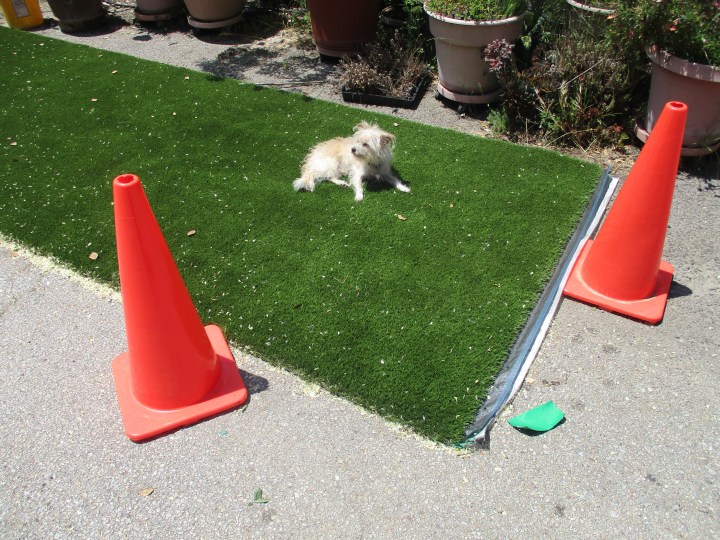
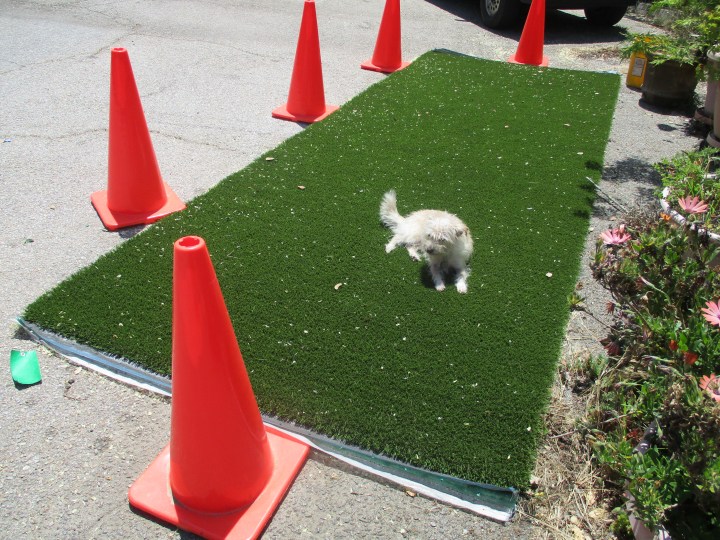
The contractor who will be installing this lawn sent a sample piece of it prior to the final installation. We actually do not know why we got a sample, since we already know what the particular artificial turf is like. There was some concern that it would get too warm in sunlight, but it arrived with no explanation. It was unrolled onto the asphalt driveway at our maintenance shops, and surrounded with cones to protect it from getting driven on.
Rhody wasted no time in trying it out. Obviously, he found it to be quite satisfactory. He rolls around on it and tried to dig into it like it is real grass. With all the fallen locust flowers and cottonwood fuzz, it even looks like a real lawn in need of raking. I certainly hope that it does not expect to be watered and mowed as well.
You might think that all horticulturists would automatically dislike artificial turf. Yet, I am not the only one who prefers it to real turf grass in some situations. You see, real turf takes so much effort that those of us who enjoy horticulture would rather put into other more interesting and productive chores. After all, lawn is the most demanding feature of most landscapes, but is also the most monotonous and boring. Many of the best get no use.P90512+

By the way, this article was intended for yesterday. The article that should have posted today got posted yesterday instead. I am sorry for the glitch of chronology.

The Seventh On Saturday

P90511KThis is the one that got away; or actually, the one that was never caught. It bloomed after I got the pictures for the ‘Six on Saturday’ post for this morning. It could be the same unopened bud in picture #3 of the Six on Saturday post, as it is now blooming. If not the same bud, it is on the same plant, and now looks even more like the common ‘Simplicity’ rose. It is not my favorite, but I did not select it.
That is how the recovery nursery works. It is where we bring salvageable plants that need to be removed from their landscapes. Some were in the way of other projects. Some were not the right plants for their particular situations. Some were even donated by neighbors who thought we might be able to utilize them somewhere in the landscapes.
Some of plants brought in are not there long. They might get groomed and then moved directly to a more appropriate situation. That happens more during winter, when we dig up dormant plants and relocate them while the weather is still cool and rainy. We did this with a big overgrown forsythia that was dug and divided into five or so new plants before getting relocated into a new landscape. It helps is we can delay relocation until winter.
There are many potentially salvageable plants that must be moved at a particular time, even if it is not while they are dormant. They get groomed and canned (potted), and can take their time to recover before we put them back into the landscapes. Unfortunately, many do not recover adequately. Some end up staying too long because we can not find homes for them. After several years, the roses will finally be going to a new home soon.

Six on Saturday: The Yard


This is no home garden. It is the yard outside the various shops of the Maintenance Department where I work part time. It contains some of the salvageable plant material that we try to recycle from some of the landscapes from which it must be removed. Over winter, some plants get dug and relocated directly, rather than come to the yard. Otherwise, plants come here to get canned (potted) to recover, and then find a home.

Because no one sees our yard, we need not maintain it like we maintain the rest of the landscapes. Consequently, it collects a few weeds. Also, because there are other shops in the same buildings, there are a few unexpected odds and ends left strewn about by other types of professionals, such as the electrician. Hence, #6.

1. You know, when I took this picture, I though that the annual grassy weeds somehow looked pretty in front of the wild cucumber vine on the cyclone fence. I’m not the artsy sort; so will not try to explain it.P90511

2. Mixed in with the wild cucumber vine, which incidentally makes not edible cucumbers, this potato vine blooms, but incidentally makes not potatoes. Of course, I never dug it up to confirm that claim.P90511+

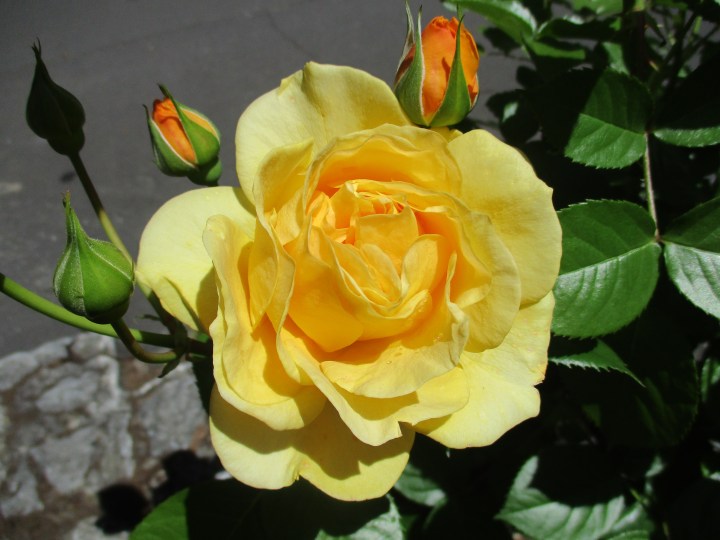
3. This rose, which might be ‘Simplicity’, has been here for a few years. No one remembers where it came from. It was supposed to get planted into a landscape while it was still dormant. Too late now.P90511++

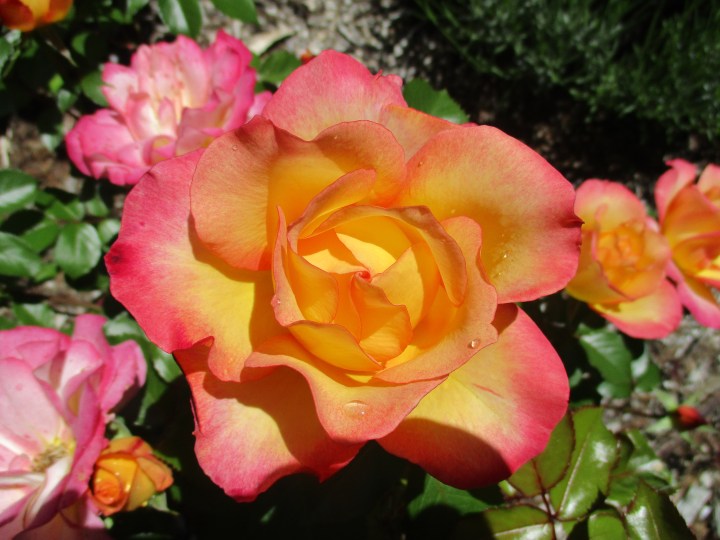
4. This rose might be ‘Medallion’, but it is hard to say for certain. It is not as big as it should be. It was supposed to get planted while dormant too. There actually is a landscape that can use both of them.P90511+++

5. Shasta daisy has been blooming for a while now. You would think that it would be easy to find a home for this one, but it is still in the yard. It is big enough to divide into more plants if still here this winter.P90511++++

6. Spring bulbs are done now.P90511+++++

This is the link for Six on Saturday, for anyone else who would like to participate:

https://thepropagatorblog.wordpress.com/2017/09/18/six-on-saturday-a-participant-guide/

Horridculture – Bad Pollarding And Coppicing

P90508Pollarding and coppicing are proper pruning techniques. If you think you are an arborist who believes otherwise, do not waste my time arguing about it. More than likely, you are neither as educated nor as experienced as I am with such matters, or you work exclusively with trees for which such procedures would be very inappropriate.
Well, yes, pollarding and coppicing are very inappropriate for the vast majority of trees and shrubs out there. Furthermore, even for those trees and shrubs that they are appropriate for, such procedures are very rarely done properly here in California. Most attempts at pollarding and coppicing are really horrid!
Take these blue elderberries and mock oranges for examples. They were mutilated last summer to improve the view of the historic Felton Covered Bridge. It sort of accomplished that objective, although the improved view of the Bridge was then cluttered with the disfigured and mostly bare trunks and limbs of the brutalized shrubbery below. Because they were chopped back too late in summer to grow much, they stayed that way until now.
So it is spring, and the shrubbery is growing from the tops of the mutilated but tall trunks and limbs, right back to obstructing the view of the Bridge. They will likely get chopped when they get to be too overwhelming, which again, will be in late summer, repeating the process. It would be better to just remove the shrubbery not only because it would be less work, but also because the shrubbery is so unsightly when it gets chopped!
OR; the shrubbery could get coppiced. Both blue elderberry and mock orange respond favorably to the procedure. If coppiced, or in other words, if pruned back to the ground annually each winter, they could regenerate fresh new growth each spring, but not get big enough to crowd the view of the Bridge by the following winter, when they get coppiced again. The elderberry would not bloom or fruit; but that is not important here anyway.
Coppicing takes advantage of the natural dormancy and regenerative processes of the plants. Starting over fresh each spring and growing uninterrupted through summer is more natural for them than trying to recover from getting brutalized while they are actively growing in summer. Since they start the process at ground level, they have room to grow without interruption. If cut back only as much as necessary, they have no room to grow.

Utilitarian Landscape

P90505I am no designer. I am merely a horticulturist. I grow things, and I know how things should be grown in landscape situations.

My colleague Brent Green is a landscape designer, as well as a horticulturist. He knows how things should be grown in landscape situations too, but more importantly, he knows how to assemble the landscapes that they grow in. He creates the sort of landscapes that most people think that all horticulturists strive for. (A few pictures of his home garden can be found in a former article, as well as another similar article that it links to: https://tonytomeo.com/2019/04/06/six-on-saturday-brents-garden/ .)

Brent and I have two completely different sets of standards for landscape design, to say the least. His ideal landscapes are very lush and inviting, with abundant color and fragrance. Mine are very simple and structured, with abundant fruits and vegetables. He strives to bring the ambiance of wild jungles into very urban settings. I try to instill formality and structure into the forests. Yet, we both agree that landscapes must be functional.

That means that landscapes must work for those using them, whatever they are using them for. Almost all of Brent’s clients use their landscapes as extensions of their homes, so want them to function as such.

I do not design landscapes, but I do happen to work in some. Most are in public spaces, and some are comparable to athletic fields. They function very differently from those in residential situations.

The unexpected way that these three small redwoods are functioning in this landscape was just too amusing to not get a picture of. I have no idea where all these wet suits came from, or why they are hung in this particularly prominent location, but it is the last thing I expected to encounter here.

The Other Rhodies

P90504KThere are countless species and cultivars of rhododendrons. Some have been in cultivation for centuries. Their big bold blooms are spectacular against a backdrop of their dark evergreen foliage. They prefer shelters spots, and some are happy to bloom in places that are too cool and too shaded for other flowers to bloom so well. They are so impressive that no one notices that they lack fragrance.

There is certainly a lot of variety among rhododendrons. Some are low mounding shrubs, while other can grow as small trees with open branch structure. Flowers can be white, pink, red, purple, blue or maybe even yellow or orange. Most flowers have some sort of pattern within the main color, but some are solid colors. Nonetheless, regardless of all the variety, we think that we can recognize a rhododendron when we see one.

Then there is Rhododendron occidentale, the Western azalea. The flowers are sort of recognizable as either big azalea flowers or lean rhododendron flowers, but are quite distinct from what we think of as familiar rhododendron flowers. The color range is very different too, with more white, marked with yellow, pink or orange. Even more surprising is that the bloom is quite sweetly fragrant!

Foliage is also very different from what is expected from a rhododendron. Not only is it deciduous, but if well exposed, it can actually develop soft yellow, orange or brownish red color in autumn. Individual leaves are rather narrow and papery.

We have only a few Rhododendron occidentale at work. They are not as tolerant of the partial shade from the redwoods as the more familiar rhododendrons are. However, they do happen to be blooming exceptionally well this year, while the bloom of the more familiar rhododendrons is less impressive than it has been in many years.

Six on Saturday: Rhody!!

P71014

This is not really about Rhody, the terrier whom I work for. I just threw that extra picture in because, if you know who Rhody is, you were expecting to see his picture after reading the title. The six pictures below are really just rhododendrons that were blooming last week.

Last year was the best bloom of rhododendrons and azaleas in many years here. Those who have known them for many years can not remember a more spectacular bloom, with so many of different cultivars of the rhododendrons blooming so profusely in the same season.

The bloom this year is unusually sparse. No one can explain it. They have good years and bad years, just like anything else in the garden. Fortunately, even in their bad years, the flowers that bloom are spectacular.

1. Of the six this week, this is my least favorite. It is a vary pale pink, but not pale enough to be white. There are not many florets on the trusses.P90504

2. I refer to this one as ‘Taurus’; but I really do not know what it is. ‘Taurus’ is very susceptible to thrip. This one sustains only minor damage from thrip, while a few others nearby are are seriously damaged.P90504+

3. This one may not look much better than #1, but the color is pinker, and the trusses are impressively big with more florets when it is in full bloom. It grows as a tree nearly twenty feet tall.P90504++

4. I refer to this one as ‘Anah Kruschke’, but like for #2 above and #5 below, I am not sure about its identity. ‘Anah Kruschke’ should not be damaged by thrip as badly as this one is. I think my colleague grew this one.P90504+++

5. Of the three here that I have names for, this is the one that is most certainly not what I like to think it is. ‘Helene Schiffner’, which happens to be one of my favorites, is not blushed with yellow.P90504++++

6. I believe that my esteemed colleague grew this one as well as #4. I remember delivering a significant order of rhododendrons here years ago, at about the same time this and #4 were installed.P90504+++++

This is the link for Six on Saturday, for anyone else who would like to participate:

https://thepropagatorblog.wordpress.com/2017/09/18/six-on-saturday-a-participant-guide/

Horridculture – Bad Seed

P80317+California poppies are like no other wildflower. They are so perfectly bright orange, and look almost synthetically uniform in profusion, as if painted onto coastal plains and hillsides. They may be a bit more yellowish in some regions, or a bit deeper orange in others, but they are always bright and strikingly uniform.
Genetic variation is naturally very rare. I can remember hiking with my Pa up to the (lesser known) Portola Monument in the hills behind Montara, and finding a few pale white poppies, and even fewer pale purple poppies. It was like finding four leaf clovers! Genetic variants among California poppies are not quite as rare as four leaf clovers are, but finding a few of both white and purple was really strange. I never found a pink one though.
Nowadays, poppies can bloom in all sorts of shades and hues or orange, yellow, red, pink and soft purple, as well as creamy white. Some bloom with fluffy double flowers. Of course, all this variety is not natural. California poppies were bred to do this.
The potential problem with such breeding is that California poppy is naturally very prolific with seed. Any of these weirdly bred varieties could escape into the wild and interbreed with wild poppies, causing them to be more variable, and interfere with the ecosystem.
The problem is not just with California poppies. Many plants get bred extensively enough to interfere with how they behave in the wild if they happen to escape cultivation.
Fortunately for California poppies, the weird new varieties do not really get very far in the wild. The are not true-to-type, so revert back to their original bright orange in just a few generations, even without outside influence. If pollinators do not recognize their unfamiliar color and form, they are less likely to get pollinated to continue to tamper with the ecology. In fact, wild California poppies still have the advantage in that regard.
This yellow California poppy with an orange center is a second generation seedling, and is already halfway between the original yellow variety, and the wild orange.

Redwoods Are So Tall . . .

P90428Redwoods are SO TALL!
How tall are they?
They are so tall that you can see for yourself if you look in this direction . . . from anywhere in North America.
They are so tall that if you need firewood, I can aim one in your direction as I cut it down.
They are so tall that while they drop foliar debris on the Ford and Chevrolet parked below, they also drop foliar debris on Mercury and Saturn in their respective orbits.
They are so tall that while other trees collect kites and Frisbees, they collect airplanes and satellites.
They are so tall that only a few of their seed survive. Most burn up in the atmosphere on their way down.
They are SO BIG too!
How big are they?
They are so big that some have tunnels cut through them so cars don’t run out of gasoline while driving around.
Okay enough of that for now.
Most of the biggest redwoods here were harvested, leaving only stumps to remind us of how big they were. The few trees that were big enough for harvest a century ago, but were not harvested when those around them were, probably exhibited some sort of defect that made their lumber undesirable.
The tree in this picture happens to be one of the few that is big enough now to suggest that it was likely big enough for harvest when those around it were harvested. The trunk is more that six feet wide. Yet, except for the severe lean, no obvious defects were observed. (The vertical edge of the doorway to the left was included in the picture for comparison with the lean of the tree.)
The tree started to lean only recently. If it had taken several years to develop this lean, the top several feet of the trunk would be curved upward, as it would have continued to grow vertically away from gravity while the trunk below it moved. If it moved suddenly but only once several years ago, there would be a kink near the top of the otherwise leaning trunk, from which, subsequent growth would be vertical.
This tree instead leans with a straight trunk from bottom to top, which means that it grew vertically, and then moved into this diagonal position too recently for new vertical growth to develop. Lateral branches are also diagonal, as they maintained their position perpendicular to the trunk. Although redwoods rarely destabilize, this one really seems as if it is about to fall.
Is this destabilization relative to some sort of deficiency that prevented the tree from getting harvested a century ago? I really should investigate.