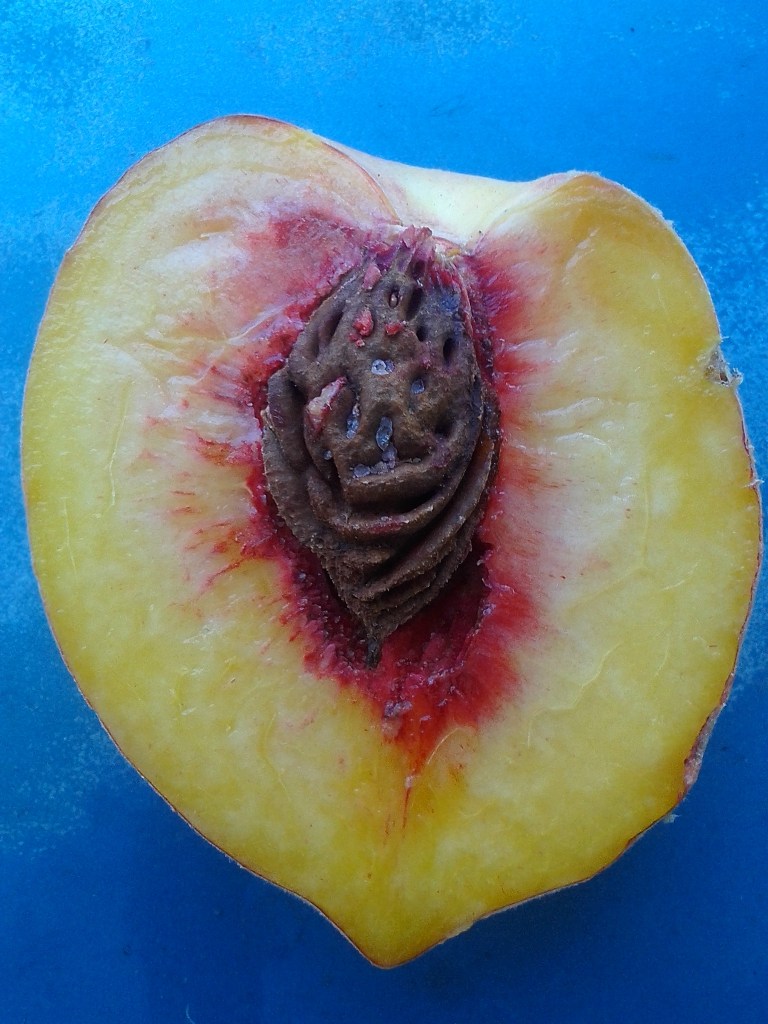
Of all the stone fruit trees like apricot, plum and cherry, none need more aggressive and specialized pruning while dormant in winter than peach, Prunus persica. The distinctively fuzzy fruit is so big and heavy that the weight of too much fruit tears limbs down. Pruning not only limits fruit production, but improves structural integrity, fruit weight distribution, fruit quality, and tree health. Mature trees should be kept less than ten feet tall, but often get twice as tall with much of the fruit out of reach.
If unpaved drainage ditches and collection ponds were more common locally, sweet flag, Acorus gramineus, might be also. It can provide a nicely neat border for such waterways, where the ground is too steep and damp for mowing. It can migrate into muddy situations and even into shallow water. Its dense network of fibrosus rhizomes helps to retain mud.
‘Variegatus’, with elegantly elongated and variegated leaves, is the most popular cultivar locally. It is rare in nurseries, but occasionally shared by friends and neighbors who grow it. Propagation by division is very easy. Single shoots or clumps of shoots grow if merely plugged into damp soil or mud. ‘Pusillus’ lacks variegation, and develops stouter leaves.
Sweet flag aggressively excludes other herbaceous vegetation, but does not migrate too rapidly. Plucking shoots and plugging them elsewhere accelerates migration. The dense foliage might get a foot deep. Individual leaves are very narrow, like grass. The mundane bloom is easy to ignore and is uncommon where the soil is not often saturated or muddy.
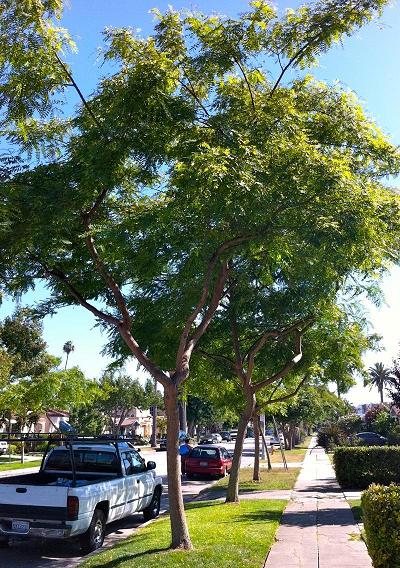
It may not get too tall, but with appropriate pruning, the tipu tree, Tipuana tipu, spreads a broad canopy high enough to be a good street tree. A mature tree is not much more than thirty feet tall and at least as broad. Roots are not too aggressive. A slight bit of mess is rarely but actually more likely to be a problem. The pale yellowish flowers that fall early in summer are followed by a few seeds. Not too long after the seeds stop falling, the deciduous foliage starts to fall. The soft green leaves are pinnately compound, with eleven to seventeen leaflets that are about an inch and a half long. Tipu tree is still uncommon, but really should be more popular than it is.
Ducks somehow find water. They eventually visit most home garden ponds that they can fit into. Duckweed, Lemna minor, is likely to come with them. It adheres to waterfowl and other wildlife for that purpose. It proliferates very efficiently, and almost typically becomes a nuisance. Eventually, proliferation in a healthy pond should stabilize to a tolerable rate.
Individual duckweed plants are tiny. Their oval leaves are typically less than a quarter of an inch long. Each floating leaf extends its single root less than three quarters of an inch into the water below. Plants produce no more than four rooted leaves before dividing into a few smaller plants to repeat the process. Bloom and subsequent seed are uncommon.
As a floating aquatic plant, prolific duckweed might obscure koi and submergent aquatic plants within garden ponds. However, it also helps stabilize healthy aquatic ecosystems. In fact, it is useful for bioremediation of agricultural and industrial applications. It absorbs detrimental substances from water, while producing fodder and biomass for composting.
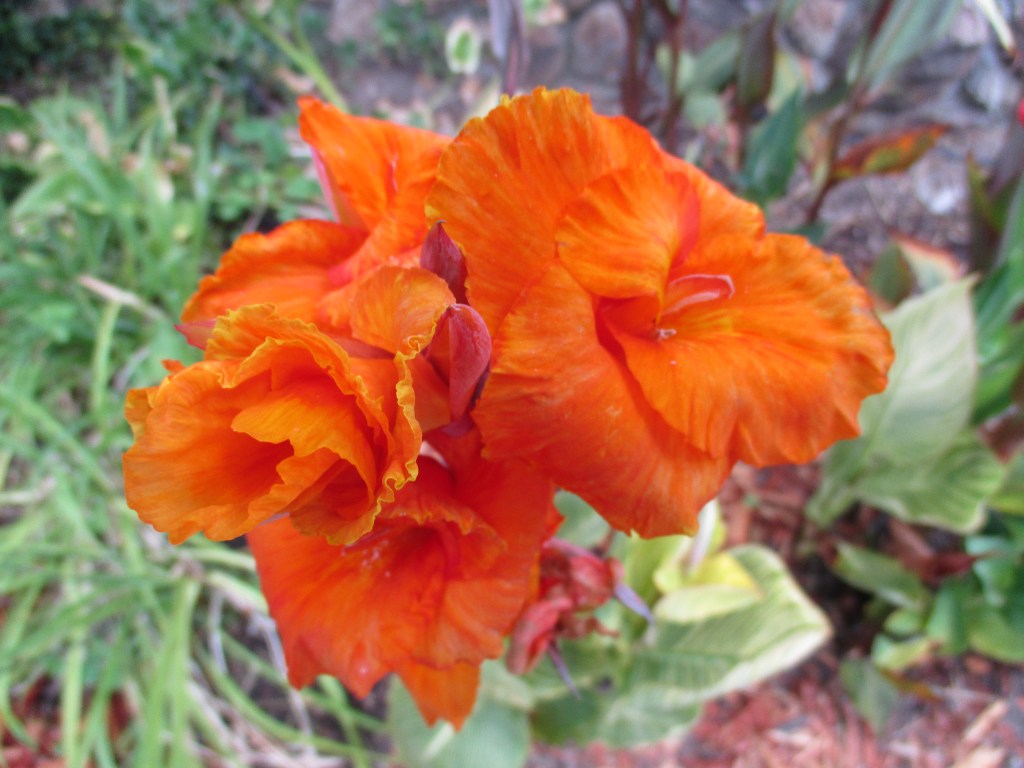
Although not directly toxic, canna has a unique reputation of lethality. Its spherical seeds are so hard that they were historically used as shot. Many victims are now pushing up daisies. Those who survived were pulling out cannas.
Old fashioned varieties that get up to six feet tall seem to be at least as popular as shorter modern varieties that get less than half as tall, probably because their bold foliage is as appealing as their colorful but awkwardly structured flowers. The big leaves can be cool green, rich reddish bronze or variegated. Red, orange, yellow, pink or rarely white flowers that bloom from summer to autumn are striking amongst the lush foliage, but are too perishable to be good cut flowers.
Stems that have finished blooming should be cut to the ground to promote more colorful new foliage and bloom. Mature colonies (of rhizomes) can be divided while dormant through winter if they get crowded enough to inhibit bloom every few years.
Canna bloom as well as foliage seem to be so tropical.
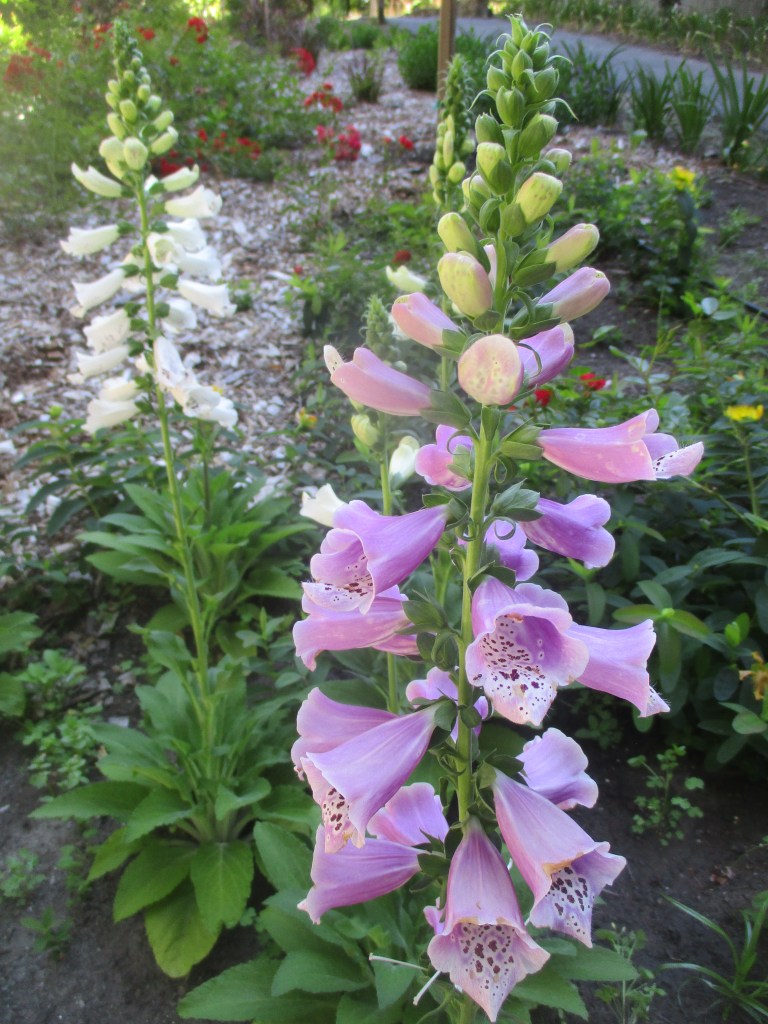
It is no coincidence that its generic name seems more pharmaceutical than horticultural. After all, the cardiac medication digitalis is an extract of foxglove, Digitalis purpurea. The plant is unfortunately very toxic. Because it naturalizes in several regions, it can be more hazardous than standardized medications. It can migrate undetected into home gardens.
Otherwise, foxglove is a delightful warm season annual with a rustic or woodsy style. It is actually a biennial that generates basal foliar rosettes during its first season, and blooms during its second season. Although technically monocarpic (so should die after bloom), it can produce a few short pups to bloom later. Seedlings can appear in random situations.
Plants from nurseries grew during a previous season, so are ready to bloom immediately for early summer. Their seedlings may grow through later summer and autumn, so might bloom for the following summer. Floral stalks generally stand between three and six feet tall. The tubular and somewhat pendant flowers are mostly pinkish purple, pink or white. A few modern varieties bloom yellow or apricot.
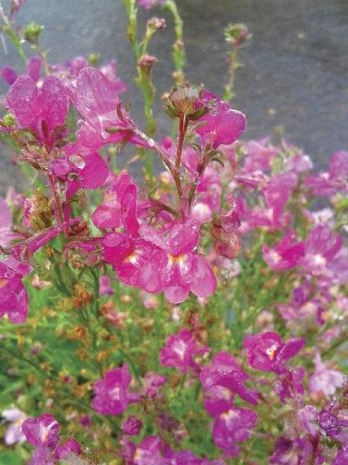
Toadflax really does look like baby snapdragon, which is its other common name. The tiny, half inch wide flowers are similarly bisymmetrical, and arranged in small trusses, although the diminutive leaves are distinctively narrow.
Common toadflax, Linaria maroccana, which is actually less common than the name implies, gets about one and a half to two feet tall and about half a foot wide. Two toned flowers bloom in summer in shades of pink, purplish pink, purple, blue, very pale yellow or red with yellow. ‘Northern Lights’ adds shades and bicolor combinations of yellow, orange and red to the mix. The more common ‘Fantasy Hybrids’ get only about half as tall and perhaps slightly wider, with earlier and slightly larger flowers in shades of yellow, blue, pink and bright pink, as well as white, mostly with slightly yellow throats.
Toadflax is a summer annual, but does not like to be too exposed to roasting heat and glare. If grown from seed, it should be sown as soon as possible after the last frost to get an early start.
The Nile River Valley is a region of extremes. It floods at times, but is hot and dry at other times. Lily of the Nile, Agapanthus orientalis, naturally survives it all. It can easily survive here. However, it survives arid heat by shedding a bit of foliage. Therefore, it is generally healthier here with at least occasional watering through the warmest weather of summer.
The almost spherical floral umbels of lily of the Nile explode into bloom like blue or white fireworks, just in time for Independence Day. They are about six to eight inches wide, on elegantly bare and slightly leaning stalks that stand about four feet tall. Individual flowers are only about an inch or two long. Flowers bloom only once annually, but last for weeks.
With or without bloom, the dense and evergreen foliage of lily of Nile is always lush. The soft and strap shaped leaves are about a foot and a half long, and flare outward from low basal rosettes. New foliage obscures deteriorated old foliage. Fleshy roots firmly secure plump rhizomes. Division relieves crowded rhizomes, and contains their slow migration.
The minute bright pink flowers of Mexican heather, Cuphea hyssopifolia, are less than a quarter inch long, but are enough to get the attention of the hummingbirds who really dig them. Flowers can rarely be more purplish or even more rarely white. The limber stems are well foliated with finely textured and narrow leaves that are not much more than half an inch long. Mature plants are typically lower but a bit wider than two feet. Overgrown plants can be pruned severely at the end of winter to regenerate over summer.
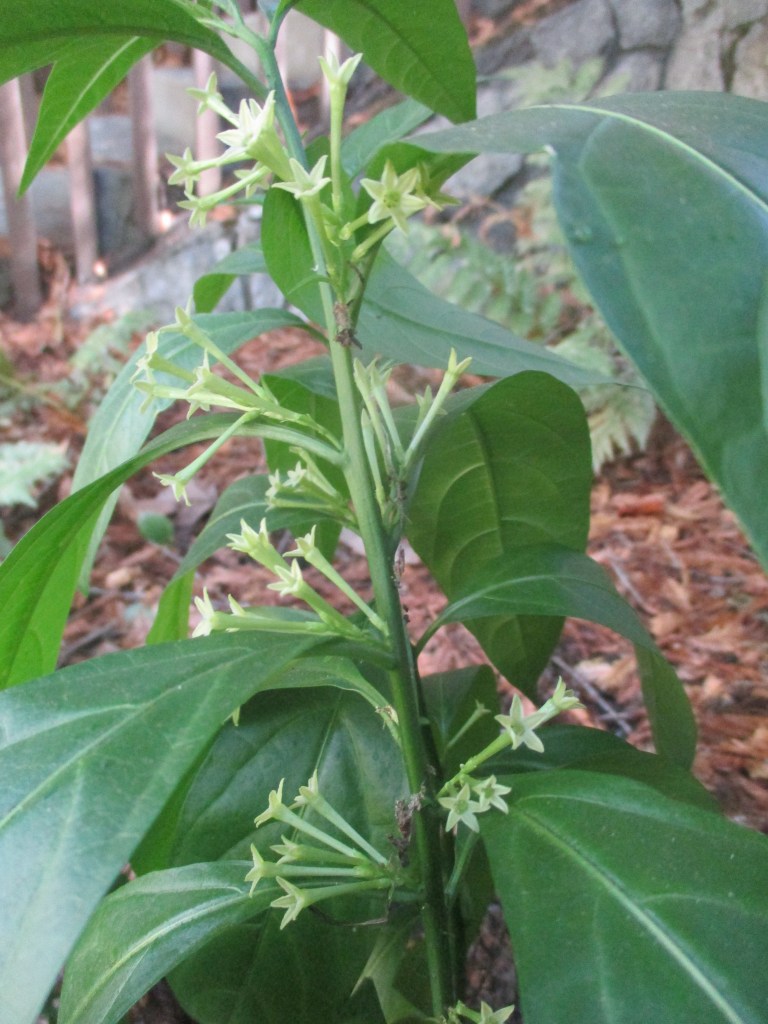
The warm nights between the dog days of summer are ideal for night blooming jasmine, Cestrum nocturnum. That is when it disperses its famously sweet fragrance to attract bat and moth pollinators. A bit of humidity, although unnecessary and locally rare, enhances the permeating nature of the fragrance. Some might find such fragrance to be excessive.
Otherwise, night blooming jasmine is quite modest. Those who experience the powerful fragrance at night may be unable to identify its source while visible during the day. Small floral trusses hold several small and narrowly tubular flowers that are about an inch long. Bloom is greenish white or pallid yellow. Simple evergreen leaves are a few inches long.
Therefore, night blooming jasmine works best in the background of more colorful bloom. It will not mind if other flowers get the credit for its fragrance. With regular watering, night blooming jasmine is happy in unseen areas between buildings, and under high windows that lack views. Aggressive pruning only in early spring promotes blooming new growth. Most plants stay shorter than ten feet. Rare white berries are toxic.





 Tony Tomeo