Echeveria

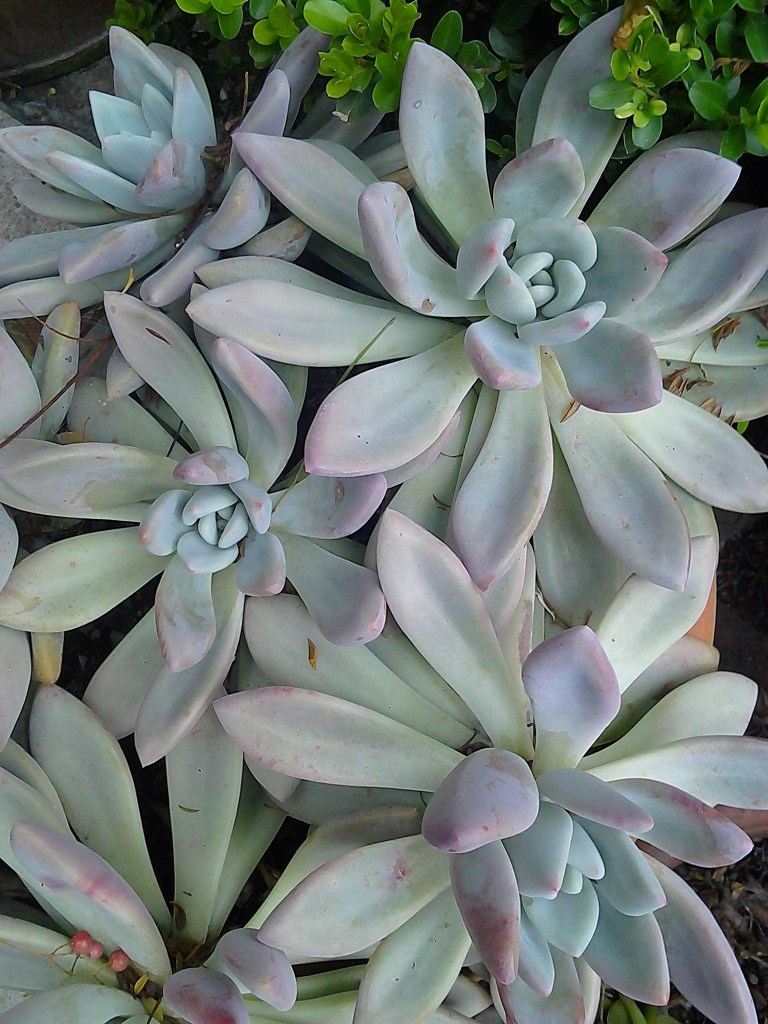
There are so many different personalities of Echeveria! This one only slightly resembles the more familiar ‘hen and chicks’ types.

Some but not all of of the many succulent plants known as ‘hen and chicks’ are varieties of Echeveria. Likewise, some but certainly not all Echeveria are known as ‘hen and chicks’. Echeveria are so variable that many do not seem to be related, although all have dense rosettes of succulent leaves. Some have very narrow leaves like miniature yuccas. Others have warty broad leaves. Foliage can be simple green, yellowish, bluish, gray, bronze, bronzy purple or variegated. The edges and tips of leaves of many varieties are blushed with red or purple that is more colorful in winter, or with complete sun exposure. Most Echeveria will tolerate light shade. Propagation is very easy from division of pups, stem cuttings and even leaf cuttings.
Ranunculus

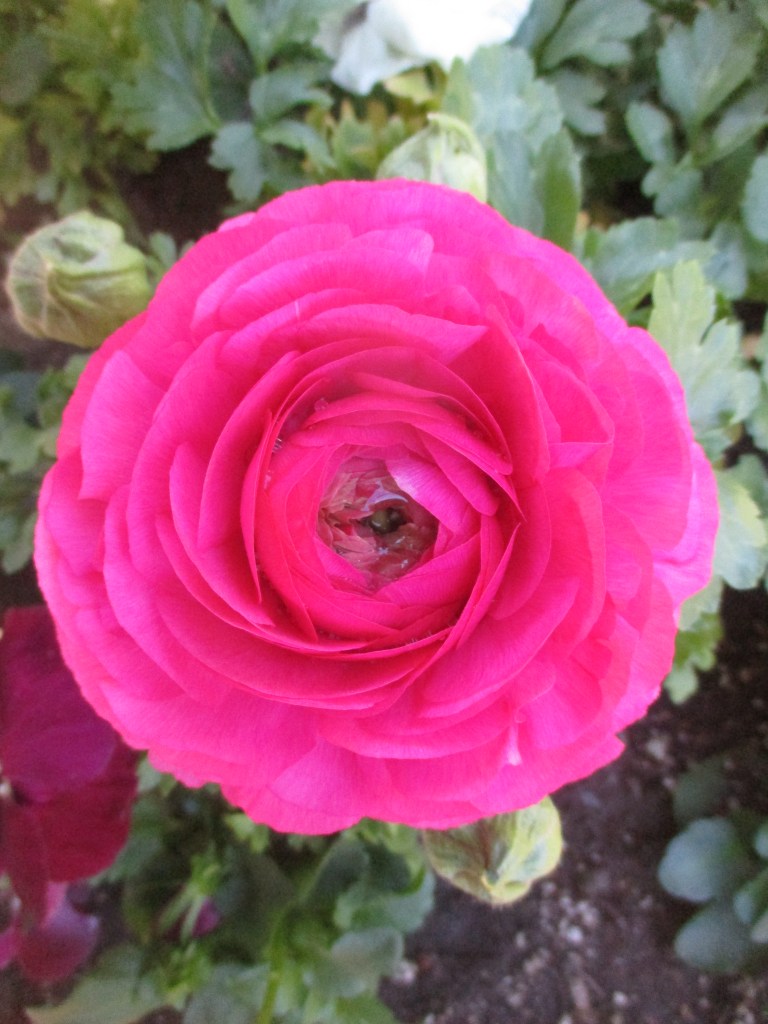
Ranunculus enjoys mild weather through spring.

If their strange tubers got into the garden last autumn, ranunculus should be blooming by now. Although their schedule suggests that they crave winter chill like other spring bulbs, they merely want to disperse their roots early. Then, they can bloom as winter ends, and continue until spring weather gets too warm for them. They mostly finish prior to summer. 

If tubers did not get into the garden earlier last autumn, young ranunculus plants become available from nurseries late in winter. Although generally a spring annual, tubers, which go dormant by summer, have potential to regenerate perennially for subsequent springs. Digging and storing tubers through most of their dormancy might improve their potential.

Ranunculus bloom can be pink, red, orange, yellow, purple, cream or white. Flowers are plump and neatly dense with many papery petals, like little peony flowers. They stand on sturdy stems about half a foot to a foot high. Their finely textured basal foliage resembles parsley, but with a lighter color. Dormant tubers are tufts of short, plump and woody roots.

Queen Palm

The elegant queen palm has a slender trunk and a billowy canopy. Grouped trees lean gracefully away from each other.

While Mexican fan palms and Canary Island date palms dominated the palm fad in California during the Victorian period, the queen palm, Syagrus romanzoffiana, was still relatively uncommon. Since then, selective breeding has improved their foliar color and density. They are now the most popular of palms.

Modern queen palms grow a bit faster than their Victorian ancestors to about thirty feet tall, and then grow somewhat slower for another ten to even twenty feet. Their long and arching feather (pinnately compound) leaves are quite billowy. The elegant trunks are generally slender, but often develop constrictions or bulges from fluctuations of irrigation or nutrient availability. The abundant fruit can be messy.

Blue Gum

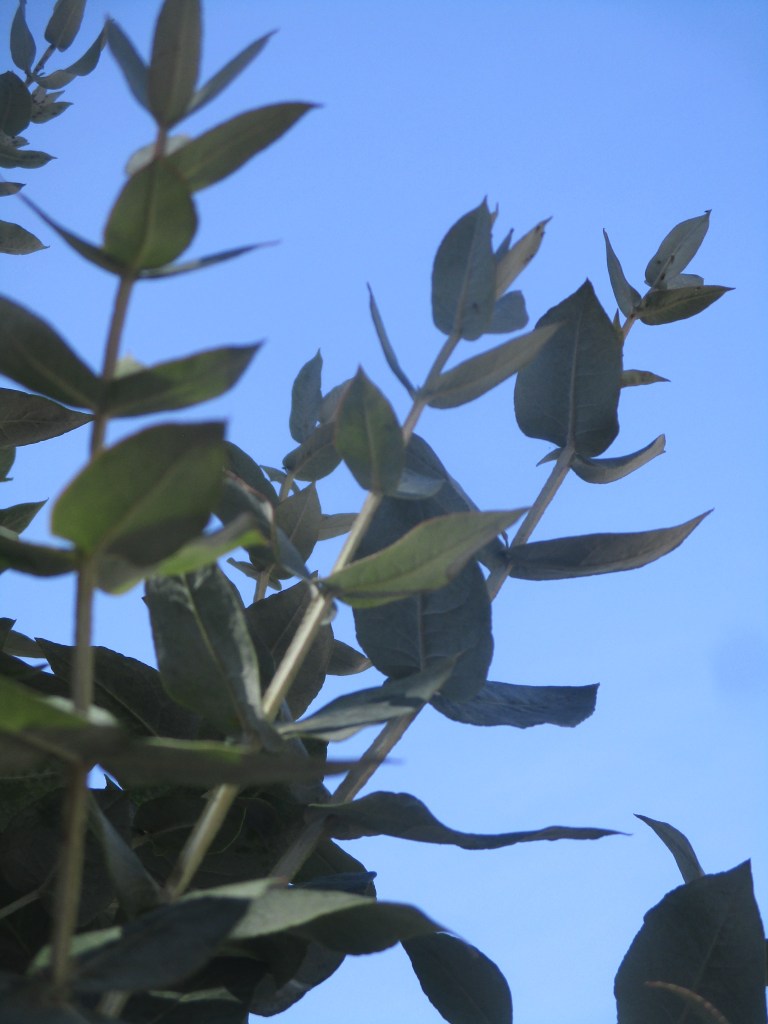
Juvenile blue gum foliage is very aromatic.

This is the primary eucalyptus that earned a bad reputation for all other eucalyptus. Blue gum, Eucalyptus globulus, arrived in California in the 1850s, and grew on plantations for timber. As its timber proved to be of inferior quality, and demand for wood pulp dwindled, the plantations succumbed to abandonment. Feral trees naturalized into adjacent areas.

Although once a common timber and wood pulp commodity, and effective as windbreaks for agricultural purposes, blue gum was never popular for landscapes. Those that inhabit urban or suburban situations were generally there prior to urban expansion around them. They are far too massive, messy and combustible, and inhibit the growth of other plants.

Mature blue gum trees can be significantly taller than a hundred feet, with elegantly high branched form. Limbs that fall freely from such heights are very dangerous. The aromatic foliage is evergreen. Adult leaves are stereotypically lanceolate and curved. Silvery blue juvenile leaves are blunt, sessile (lacking petioles) and more aromatic than adult foliage. Strips of smooth tan bark shed to reveal paler bark.

Bismarck Palm

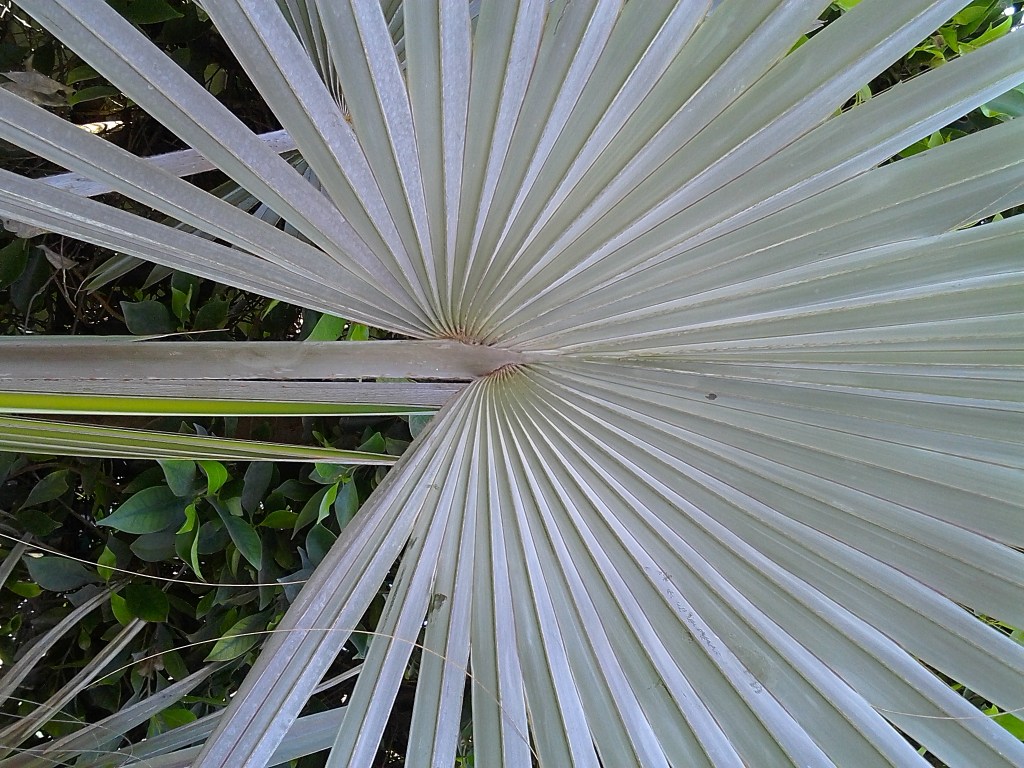
Silvery gray that is almost comparable to blue spruce is even more striking from a palm, like the Bismarck palm.

Most palm enthusiasts believe that the distinguished Bismarck palm, Bismarckia nobilis, is rare because it does not like local climates. It can be damaged by frost in winter, and prefers warmer weather in summer. Another concern is that they get too broad for compact urban gardens, since their shady foliar canopies can get more than twenty feet wide. However, a few seemingly happy specimens are sometimes seen about town.

Foliage of this rare palm is strikingly silvery gray. Green Bismarck palms are even more scarce, both because they are less tolerant to frost, and because they are not so striking. The big and rather rounded leaves are more than six feet wide, and maybe up to eight feet wide, on petioles (stalks) about six to eight feet long!

Candytuft

Candytuft is like a perennial alyssum.

Alyssum is popular because of its lightly fragrant and lacy white bloom that lasts through most of the year. It seems to be more perennial than it actually is because it sows seed to replace aging plants. Candytuft, Iberis sempervirens, is a bit less prolific with bloom and fragrance, but otherwise resembles alyssum. Without seeding, it can be nicely perennial. 

Candytuft does not get much larger than alyssum although it supposedly has potential to get almost a foot high and a foot and a half wide. Shearing after bloom phases enhances foliar density and subsequent bloom. Primary bloom occurs during late winter, spring, or perhaps early summer. Minor random bloom is possible at any time, particularly autumn.

Plants propagate readily by division of small tufts of rooted stems from within established plants. Alternatively, creeping outer stems develop roots if simply pressed into the soil or held down with stones. Pruning scraps are tiny and awkward to handle, but can grow as cuttings. When disturbed, candytuft exudes an aroma similar to that of related cabbages, which might be objectionable to some.

Pink Jasmine

These pale, inch-wide, star shaped flowers of pink jasmine may not be much to look at, but are remarkably fragrant.

As winter turns to spring, pink jasmine, Jasminum polyanthum, blooms with abundant, loose trusses of small but very fragrant star shaped flowers. The flower buds that are initially deep pink open to soft pink, and then fade almost to white. Light shade inhibits bloom and limits foliar density, but does not prevent the wiry vines from climbing to twenty feet or so. The dark green leaves are compound with five or seven leaflets. Pink jasmine is one of the few vines that can climb lattice and light trellises without tearing them apart like wisteria and so many other popular vines eventually do. Even if it escapes confinement and gets into trees or onto roofs, it does not get too far to be pruned back within bounds.

Mustard

‘Wild mustard’ includes a few species.

A few species of mustard came to naturalize in California, and for a few distinct reasons. Some likely grew first as greens in the gardens of the original Spanish Missions. At least one species also provided culinary and medicinal mustard seed. The more prolific types became cover crops and fodder for livestock. Later in history, mustard seed provided oil.

According to legend, Spanish Missionaries established the route of El Camino Real with mustard. After sporadically dropping seed as they traveled between Missions, they could follow the bright yellow bloom by the next winter, and find greens to eat. El Camino Real became worn enough to navigate before the mustard dispersed too extensively to assist. 

Most but not all species of mustard that are naturalized locally are of the genus Brassica. Wild turnip and wild radish provide similar greens, but are generally more likely to bloom pale pink or pale white, rather than bright yellow. Garden varieties of mustard, which are available as seed or in cell packs, provide delightfully tender new leaves with mild flavor.

Coprosma X kirkii

Variegated Coprosma X kirkii has very glossy light green leaves with white margins that look great cascading over retaining walls.

Coprosmas are so innately undemanding and complaisant to all sorts of conditions, that some types self sow and thrive untended in riparian or coastal environments. If they were more aggressive, they would likely naturalize (proliferate as if native) where the soil does not get too dry through summer. With such glossy foliage that looks like plastic, they might be appealing weeds.

Coprosma X kirkii is a resilient ground cover that mostly stays less than two feet deep and five feet wide, although overgrown plants can get three feet deep. Varieties with colorful or variegated foliage probably stay too small to be reliable ground cover over large areas, but make nice edging, or can cascade nicely from raised planters or urns.

Tomato

Tomato champions the warm season vegetables.

Like most warm season vegetables, tomatoes, Solanum lycopersicum, are actually seed bearing fruit. They are both the most diverse and the most popular home grown produce. Grape tomatoes are smaller than little grapes. ‘Beefsteak’ can get wider than five inches. Although mostly red, some are yellow, orange, pink, green, brown, purple or pallid white. 

The most popular varieties of tomato for home gardens are indeterminate. They produce fruit sporadically throughout the season, on irregularly sprawling stems. Tomato cages or stakes support their growth. Shrubbier determinate varieties seem to be more productive only because all of their fruit develops within a brief season. They work well for canning.

Small tomato plants in cell packs and four inch pots, which are available from nurseries, should grow efficiently in the garden as the weather warms through spring. Varieties that are unavailable as small plants can grow from seed in cold frames through late winter, to be ready for the garden after last frost. Directly sown seed can be vulnerable to mollusks.