Sea Green Juniper

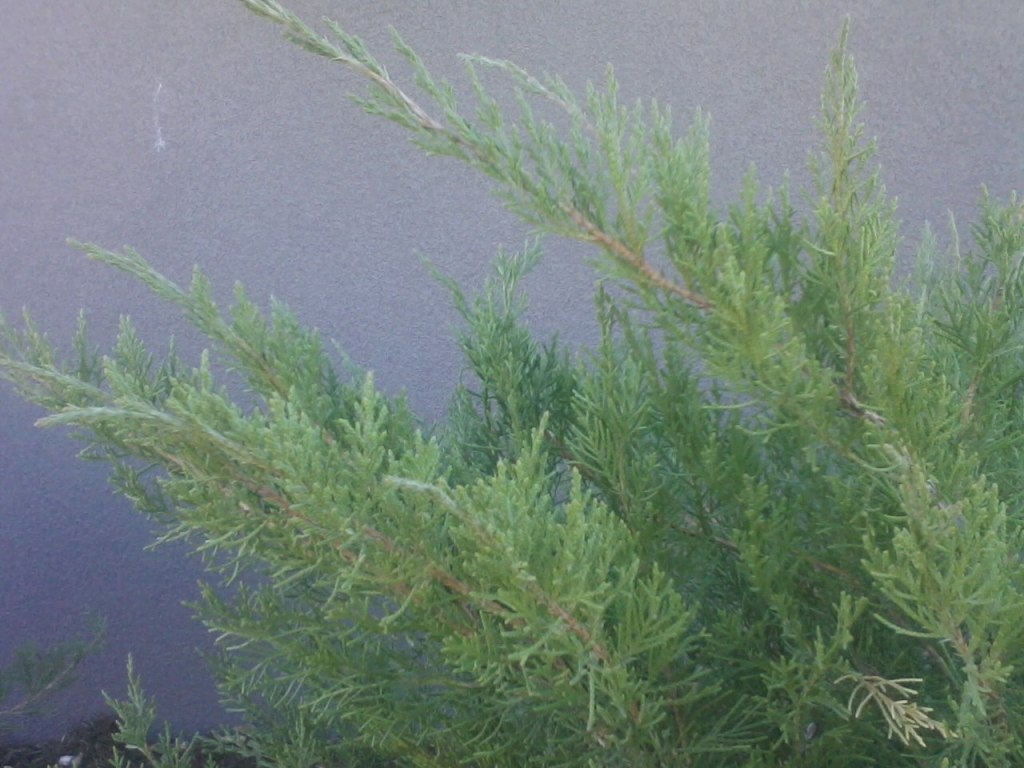
It may seem to grow slowly, but ‘Sea Green’ juniper outgrew the stigma that has followed junipers since the 1950’s.

No one can deny that junipers are useful, sustainable and resilient. They tolerate cold, heat and harsh exposure. Once established, they do not need much water.

Sea green juniper, Juniperus chinensis ‘Sea Green’, is a bit lighter green than more traditional dark green junipers. It can grow somewhat slowly, eventually getting to about five feet tall, and a foot or two wider. Like all junipers, it should never be indiscriminately shorn, but should instead be selectively pruned to exploit its distinctive ‘fountain’ shaped branch structure that points up and outward from the base.

Stock

Stock happens to excel at purpleness.

This is one of those annuals that could be a short term perennial if it gets the opportunity to do so. In most climates, stock, Matthiola incana, is a popular warm season annual that relinquishes its space to cool season annuals before it gets too worn in autumn. Locally, because it does not mind mild frost, it is more popular as a cool season annual for winter.  

Floral color ranges through both pale and rich pastels of purple, red, pink, yellow, cream and also pure white. Flowers may be single or double. In close proximity, bloom is richly fragrant. Foliage is light grayish green. Individual leaves are somewhat narrow. Removal of deteriorating floral stalks before they develop seed pods prolongs subsequent bloom.

Many garden varieties of stock stay relatively low and compact. Some may get no higher than a foot. Florist varieties that produce long stems for cutting might get as high as three feet. Overgrown plants get shabby after a primary season, but may regenerate from hard pruning. However, secondary growth is generally irregular and likely marginally reliable.

Dragon Wing Begonia

White blooming dragon wing begonia are still quite rare.

The modern hybrid of wax begonia and angel wing begonia, known as dragonwing begonia, wants to be out in the garden like wax begonia, but like angel wing begonia, needs to be sheltered from direct sun exposure in summer. This time of year, it also needs shelter from frost. It gets two or three feet high and wide, and makes quite an impressive display with abundant red or pink flowers against glossy foliage. A white blooming cultivar became available only recently. Pruning scraps are easy to root as cuttings.

Torch Lily

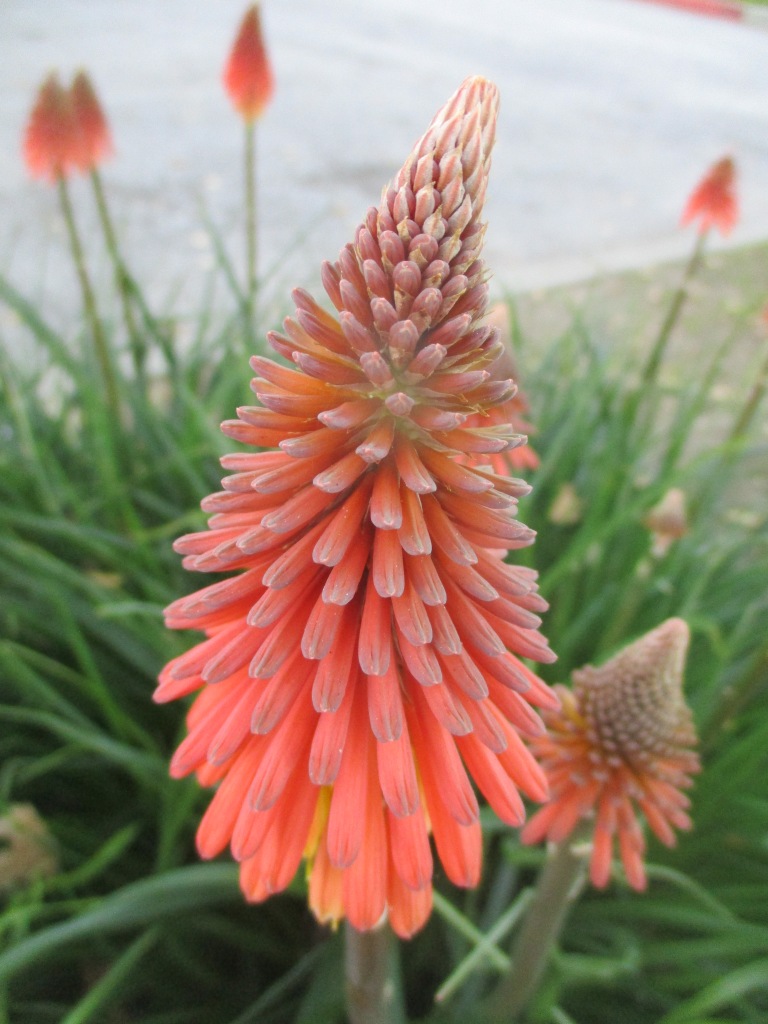
Torch lily might bloom for autumn.

Technically, it should bloom during spring and summer. Torch lily, Kniphofia uvaria, does not seem to know that though. Some bloom for late summer. Most are presently in bloom. Old fashioned sorts that survive without irrigation may bloom through winter or whenever they want. Modern cultivars are likely more predictable and punctual with their schedule. 

Torch lily, or red hot poker, blooms with densely conical floral spikes of many narrow and tubular flowers. Bare stalks boldly support bloom as high as five feet. The grassy foliage below forms dense mounds that should not get much higher than three feet. Established plants can survive without watering, but appreciate it through the arid warmth of summer. 

Floral buds are generally orange as they develop, and then fade to yellow as they bloom and age. Since floral spikes bloom upwards from the bottom, they are yellow at the base, and orange at the tip, like candy corn. Some cultivars are more reddish orange at the tip, or creamy white at the base. Others are rather uniformly orange, yellow or creamy white.

Tropical Hibiscus

This tropical hibiscus was found in Oklahoma, where it needs shelter from frost.

This humongous six inch wide tropical hibiscus, Hibiscus rosa-sinensis, looks like it might be from Hawaii or Florida, but was actually found in K and K Nursery and Landscape of Norman, just south of Oklahoma City, where winter nights are already seriously cold by our coastal California standards. It is happy to bloom so impressively only because it is in a greenhouse. Even here in our pleasantly mild climates, tropical hibiscus are happiest where sheltered above from frost, by eaves or evergreen shade trees that are high enough to also allow warming sunlight through. In the cooler spots, even sheltered plants occasionally get damaged by frost, and need some time to regenerate after winter.

Some of the classic tropical hibiscus that typically have smaller flowers can grow above single story eaves if not pruned down. Most modern varieties with larger or ruffly double flowers rarely reach the eaves, and many stay less than six feet tall even without pruning. The evergreen foliage has an appealing glossy sheen, which is an ideal backdrop for the red, pink, white, yellow or orange flowers.

Japanese Black Pine

Japanese black pines develops delightful cones.

It is unfortunate that most live Christmas trees grow too large for compact home gardens. Japanese black pine, Pinus thunbergii, which is very rarely available as a live Christmas tree, does not get much taller than twenty feet locally. Although it can slowly get about as broad, its sculpturesque branch structure adapts to pruning for containment if necessary.

Japanese black pine is a notably versatile pine. Most pines are excurrent (with a primary central trunk) or develop another similarly uncompromising form. Few are as cooperative with such casual form and relatively contained size as the Japanese black pine is. In the wild, it grows taller than a hundred feet. Yet, it is also very popular for bonsai and niwaki.

The evergreen foliage is richly deep green. The paired needles are about four and a half inches long, and perhaps stiffer than they appear to be. The cones are about two or three inches long, and nicely symmetrical. Fresh foliage and fresh or dried cones are useful for home decor. Even young trees have handsomely flaky bark, which darkens with rain.

Burro’s Tail

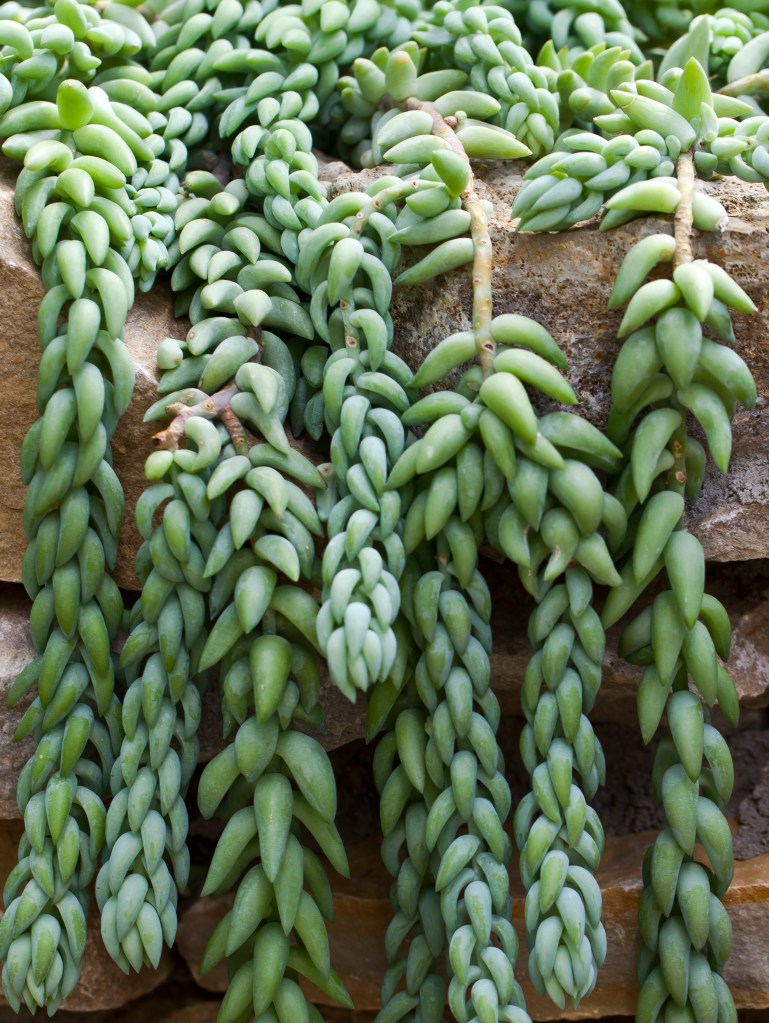
Burro’s Tail is old fashioned, but can also be contemporary.

Back when big spider plants or Boston ferns suspended in fancy beaded macrame were all the rage through the 1970’s, burrow’s tail, Sedum morganianum, was an unusual but also trendy succulent perennial for sunny spots in the home or sheltered and slightly shaded spots in the garden. The refined foliar texture and light bluish green color contrasted nicely with the big and deep green leaves of comparably trendy philodendrons. The thin stems are too limber to stand up, but cascade excellently. Plants in the garden that get pruned back while dormant in winter can easily get two feet long through summer. Without pruning, big plants can get longer than six feet. Pruning scraps and even the small but plump leaves can be rooted and grown into new plants. It is impossible to prune or even move burro’s tail without dislodging some of the leaves anyway. Watering should be regular but not excessive, but then minimal for plants in the garden through winter.

Mediterranean fan palm

The strikingly silver Atlas Mountain palm.

Not all palms are trees. Some lack trunks, so develop more as shrubbery. Some develop many slender stems, like bamboo. The thin canes of most rattan palms sprawl onto other vegetation for support, as vines. Mediterranean fan palm, Chamaerops humilis, develops multiple stout trunks, but grows so slowly that it can function as big sculptural shrubbery.

Old trunks can eventually get as high as twenty feet, and generally lean randomly. If they get too tall, smaller and more vigorous trunks can replace them. (An arborist can remove the bulky and thorny old trunks.) New trunks develop from basal pups, which can can get too densely foliated without occasional thinning. Removal of such pups might be difficult.

Mature trunks might be as wide as ten inches, with dense coats of basal petiole fiber and thorny petiole stubs. Thorough grooming can eliminate the stubs. However, petioles that suspend the evergreen palmate leaves are outfitted with the same wickedly sharp teeth. Leaves are about two feet wide. Atlas Mountain palm, Chamaerops humilis var.(iety) argentea has strikingly silvery foliage, and grows even slower.

Angel Wing Begonia

Begonia involucrata at Monte Verde

The simple pink or sometimes red or white flowers of angel wing begonia are not as flashy as those of other begonias, and are not abundant enough to provide much color. During warm weather, they are merely a minor bonus to the striking foliage. As the name implies, the big and angularly lobed leaves are shaped like wings of angels. Upper surfaces are glossy and dark green with irregular silvery spots. Undersides are even glossier and reddish bronze. With support, the lanky cane stems can get more than twelve feet tall. However, because older tall canes produce runty foliage, they are often pruned out to promote more vigorous and lushly foliated young canes.

Because they are sensitive to frost, and also because they are ideal houseplants, angel wing begonias are typically grown in containers. They like rather regular but not excessive watering, and rich potting soil. Abundant sunlight enhances foliar color; but harsh exposure roasts foliage. Partial shade is not a problem.

Mound Lily

Mound lily cultivars are generally variegated.

A few of the fifty or so species of Yucca go by the names of Spanish bayonet or Spanish dagger. Both common names apply to Yucca gloriosa. However, only this single species is also the mound lily. Most other Spanish bayonet and Spanish dagger are from deserts or chaparrals. Mound lily is from southeastern North America, so likes periodic watering.

If that is not confusing enough, the curved leaf yucca, which had been Yucca recurvifolia, is now Yucca gloriosa var.(iety) tristis. It has distinctly pliable leaves with a matte surface texture, and is rarely variegated. Mound lily has stiffer and smoother leaves that are more likely to be variegated. It had been rare, but is becoming one of the more popular yuccas. 

Although it does not grow fast, and takes many years to form stout trunks, mound lily can eventually get taller than six feet. Taller floral panicles rise above the densely evergreen foliage. The small and pendulous flowers are pale white, perhaps blushed with brownish purple and pink. The leaves are about a foot or two long and maybe three inches wide, with very sharp terminal spines.