Chinese Evergreen

With such lush foliage, Chinese evergreen is a bold houseplant alone, and is also quite compatible with all other houseplants.

It is no coincidence that Chinese evergreen, Aglaonema, is perhaps the most common tropical plant for interiorscapes. It is quite easy to care for, and available in so many unique personalities. Many have rich deep green foliage. Most are elegantly variegated with white, silvery gray or gold. Leaf shape is quite variable, although most have rather narrow leaves radiating outward from dense rosettes. Leaves can be half a foot to more than a foot long, and a bit more than an inch to almost six inches wide. Mature plants are at least a foot tall and a foot and a half broad.

Indirect sun exposure or partial shade is best. Chinese evergreen likes humidity, so likes to share sheltered enclosed atriums with other lush foliage plants. New plants are easy to propagate by division.

Persimmon

Ripe persimmon is surprisingly sweet.

Most other deciduous fruit trees provide delightfully profuse spring bloom as well as fruit. Persimmon, Diospyros kaki, does not. It compensates though, with brilliant orange foliar color for autumn. Defoliation reveals comparably bright orange ripe fruit. The awkwardly bulky fruit may look silly on lanky limbs of otherwise bare trees, but they sure are yummy! 

Persimmon trees will not require a pollinator to generate an abundance of fruit. However, according to some experts, paired trees of different cultivars produce more abundant fruit of slightly better quality. Abundance is not necessarily an asset though. Unfortunately, all that very perishable fruit ripens at the same time. Fruit is inedible before completely ripe.

Mature persimmon trees can get big enough to become moderate shade trees. If they do, their abundant fruit will be too high to reach, and will generate a horrendous mess when it falls. Although they are handsome trees, they should probably stay relatively short and compact. New trees should be planted while dormant during winter, preferably bare root.

Miscanthus Grass

For those who like pampas grass but lack space, miscanthus grass has similar texture, and moves softly in a breeze.

Even as the flower spikes and perennial foliage start to deteriorate over winter, Miscanthus sinensis provides distinctive texture and the element of motion if there happens to be a breeze. Mature specimens can be about six feet tall and broad. The feathery flowers are pale purplish pink when they first appear, then fade to light tan. ‘Zebrina’ has yellow stripes across their slightly wider leaf blades. ‘Variegata’ has white margins.

Lantana

Lantana just might bloom until frost.

Where winters are very mild, common lantana, Lantana camara, might bloom through all but the coolest of weather. It generally takes more of a break though. It could finish bloom at any time now, and resume at the end of winter. Where winter weather is cooler, foliage and perhaps stems may succumb to light frost. Growth should regenerate through spring. 

The tiny tubular flowers bloom inwardly from the margins of round umbels that are about and inch and a half wide. Flowers typically bloom yellow, and then fade to orange, red or pink. Therefore, the umbels have yellow centers with orange, red or pink margins during the middle of bloom. One cultivar blooms with one hue of yellow. Another fades to white.

Modern cultivars mostly stay rather low and compact. Some sprawl. Older cultivars might get as tall as six feet after a few years. However, after frost damage or coppicing, mature plants may regenerate from their roots, with vigorous stems that get six feet long through summer. The faintly raspy foliage appears to be smooth, and is aromatic when disturbed.

Sea Green Juniper

It may seem to grow slowly, but ‘Sea Green’ juniper outgrew the stigma that has followed junipers since the 1950’s.

No one can deny that junipers are useful, sustainable and resilient. They tolerate cold, heat and harsh exposure. Once established, they do not need much water.

Sea green juniper, Juniperus chinensis ‘Sea Green’, is a bit lighter green than more traditional dark green junipers. It can grow somewhat slowly, eventually getting to about five feet tall, and a foot or two wider. Like all junipers, it should never be indiscriminately shorn, but should instead be selectively pruned to exploit its distinctive ‘fountain’ shaped branch structure that points up and outward from the base.

Stock

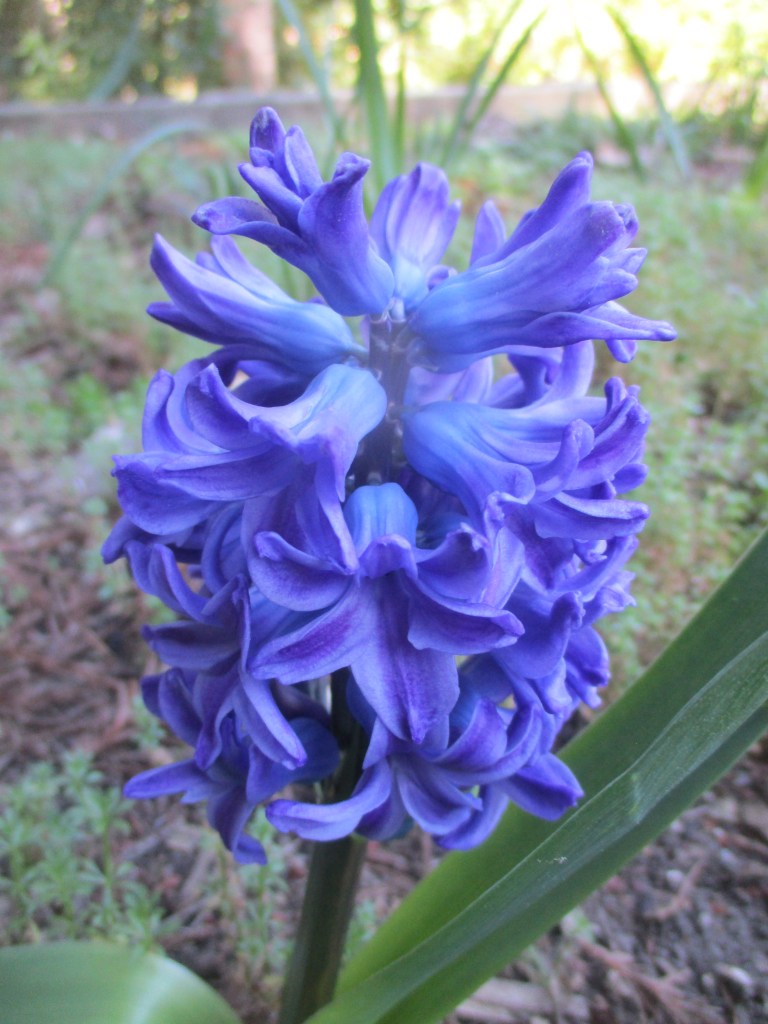
Stock happens to excel at purpleness.

This is one of those annuals that could be a short term perennial if it gets the opportunity to do so. In most climates, stock, Matthiola incana, is a popular warm season annual that relinquishes its space to cool season annuals before it gets too worn in autumn. Locally, because it does not mind mild frost, it is more popular as a cool season annual for winter.  

Floral color ranges through both pale and rich pastels of purple, red, pink, yellow, cream and also pure white. Flowers may be single or double. In close proximity, bloom is richly fragrant. Foliage is light grayish green. Individual leaves are somewhat narrow. Removal of deteriorating floral stalks before they develop seed pods prolongs subsequent bloom.

Many garden varieties of stock stay relatively low and compact. Some may get no higher than a foot. Florist varieties that produce long stems for cutting might get as high as three feet. Overgrown plants get shabby after a primary season, but may regenerate from hard pruning. However, secondary growth is generally irregular and likely marginally reliable.

Dragon Wing Begonia

White blooming dragon wing begonia are still quite rare.

The modern hybrid of wax begonia and angel wing begonia, known as dragonwing begonia, wants to be out in the garden like wax begonia, but like angel wing begonia, needs to be sheltered from direct sun exposure in summer. This time of year, it also needs shelter from frost. It gets two or three feet high and wide, and makes quite an impressive display with abundant red or pink flowers against glossy foliage. A white blooming cultivar became available only recently. Pruning scraps are easy to root as cuttings.

Torch Lily

Torch lily might bloom for autumn.

Technically, it should bloom during spring and summer. Torch lily, Kniphofia uvaria, does not seem to know that though. Some bloom for late summer. Most are presently in bloom. Old fashioned sorts that survive without irrigation may bloom through winter or whenever they want. Modern cultivars are likely more predictable and punctual with their schedule. 

Torch lily, or red hot poker, blooms with densely conical floral spikes of many narrow and tubular flowers. Bare stalks boldly support bloom as high as five feet. The grassy foliage below forms dense mounds that should not get much higher than three feet. Established plants can survive without watering, but appreciate it through the arid warmth of summer. 

Floral buds are generally orange as they develop, and then fade to yellow as they bloom and age. Since floral spikes bloom upwards from the bottom, they are yellow at the base, and orange at the tip, like candy corn. Some cultivars are more reddish orange at the tip, or creamy white at the base. Others are rather uniformly orange, yellow or creamy white.

Tropical Hibiscus

This tropical hibiscus was found in Oklahoma, where it needs shelter from frost.

This humongous six inch wide tropical hibiscus, Hibiscus rosa-sinensis, looks like it might be from Hawaii or Florida, but was actually found in K and K Nursery and Landscape of Norman, just south of Oklahoma City, where winter nights are already seriously cold by our coastal California standards. It is happy to bloom so impressively only because it is in a greenhouse. Even here in our pleasantly mild climates, tropical hibiscus are happiest where sheltered above from frost, by eaves or evergreen shade trees that are high enough to also allow warming sunlight through. In the cooler spots, even sheltered plants occasionally get damaged by frost, and need some time to regenerate after winter.

Some of the classic tropical hibiscus that typically have smaller flowers can grow above single story eaves if not pruned down. Most modern varieties with larger or ruffly double flowers rarely reach the eaves, and many stay less than six feet tall even without pruning. The evergreen foliage has an appealing glossy sheen, which is an ideal backdrop for the red, pink, white, yellow or orange flowers.

Japanese Black Pine

Japanese black pines develops delightful cones.

It is unfortunate that most live Christmas trees grow too large for compact home gardens. Japanese black pine, Pinus thunbergii, which is very rarely available as a live Christmas tree, does not get much taller than twenty feet locally. Although it can slowly get about as broad, its sculpturesque branch structure adapts to pruning for containment if necessary.

Japanese black pine is a notably versatile pine. Most pines are excurrent (with a primary central trunk) or develop another similarly uncompromising form. Few are as cooperative with such casual form and relatively contained size as the Japanese black pine is. In the wild, it grows taller than a hundred feet. Yet, it is also very popular for bonsai and niwaki.

The evergreen foliage is richly deep green. The paired needles are about four and a half inches long, and perhaps stiffer than they appear to be. The cones are about two or three inches long, and nicely symmetrical. Fresh foliage and fresh or dried cones are useful for home decor. Even young trees have handsomely flaky bark, which darkens with rain.