Statice

Statice is about as colorful dried as it is while fresh.

The papery flowers of annual statice, Limonium sinuatum, are so popular as seemingly synthetic dried flowers that many garden enthusiasts are surprised to find that they are happy to bloom naturally in home gardens. The clear shades of blue, purple, pink, orange, yellow and white seem to be dyed. The one or two foot tall flower stems are outfitted with odd papery ‘wings’ that make the stems seem wider than they actually are. Deeply lobed basal foliage forms shallow rosettes. Mature plants are about one or two feet tall, and a foot or so wide. Bloom begins late in summer, and continues into autumn. Good sun exposure and good drainage are preferred. Seed can be sown directly, or young plants can be added to the garden early in spring.

Blue Spruce

Most blue spruce are garden varieties.

Sitka and Brewer spruce both live at low elevations and near the coast within their native ranges. Yet, neither perform as well here as blue spruce, Picea pungens, which is native to much higher inland regions of the Rocky Mountains. It grows neither as big nor as fast here as in the wild, so few old local trees are taller than thirty feet, or broader than twenty. 

Although compact, blue spruce should get sufficient space to develop its densely conical form without pruning for confinement or clearance. Such pruning is disfiguring. Since the evergreen canopy is so dense, it should retain low branches to the ground for as long as possible. Blue spruce works more like big and formal shrubbery than like compact trees.

Some cultivars of blue spruce are very stout and rounded. Most have remarkably blue or silvery color. Seed grown trees (which are not cultivars) are sometimes available online. They have potential to exhibit notable variation. Some might develop slightly more open canopies, with elegantly upwardly curved limbs. Spruce needles are about an inch long with quite a prickly texture.

Coral Bells

Most coral bells are grown for their colorful foliage.

From Santa Barbara to Vancouver, and also in central Idaho, the humble native coral bells, Heuchera micrantha, is not much to look at, with compact rosettes of relatively small and bronzy rounded leaves with weird tomentum (hairs). In spring and early summer, and sometimes again in autumn, sparse trusses of minute brick red flowers hover about a foot above on wiry and slightly fuzzy stems. Old plants that get bare in the middle can be divided into several small plants in spring or autumn.

Modern cultivars are considerably more interesting, with more substantial foliage in various shades of green, gold, tan, brown, bronze and purplish bronze. The larger and variably lobed leaves can be two inches wide or slightly wider. The flowers stand as much as two feet high, but lack color. Most are pale greenish white. ‘Palace Purple’ has deep bronze or almost purplish foliage. ‘Ruffles’ has deeply lobed and ruffled green leaves. Unlike undemanding wild plants that can grow in cracks in exposed stone, modern cultivars like rich soil. Harsh exposure can scorch foliage, so a bit of partial shade is preferred.

Many coral bells have delightful bloom as an added bonus to their foliage.

Curly Willow

Curly willow is also corkscrew willow.

They start out simply enough, as weirdly twisted bare stems in fancy floral arrangements. By the time the last flowers fade, the submerged parts of these bare stems develop roots and perhaps leaves. These now rooted cuttings then graduate into pots or gardens. Most curly willow, Salix matsudana ‘Tortuosa’, is therefore unplanned. It is rare from nurseries.

Mature trees should not get much taller than fifteen feet, with awkwardly irregular branch structure. Regular pruning and grooming eliminates congested and structurally deficient growth. Alternatively, pollarding or coppicing during winter dormancy promotes vigorous growth. Healthy trees can drop overburdened limbs, and might live for only twenty years. 

Curly willow, which is also corkscrew willow, is popular more for distinctively curly stems than as a small deciduous shade tree. Specimens that provide such stems for cutting do not need to be very big. If cut and dried while dormant during winter, stems can not grow roots in water. Nor will they require plucking to remove their leaves, which are also curly.

Valley Oak

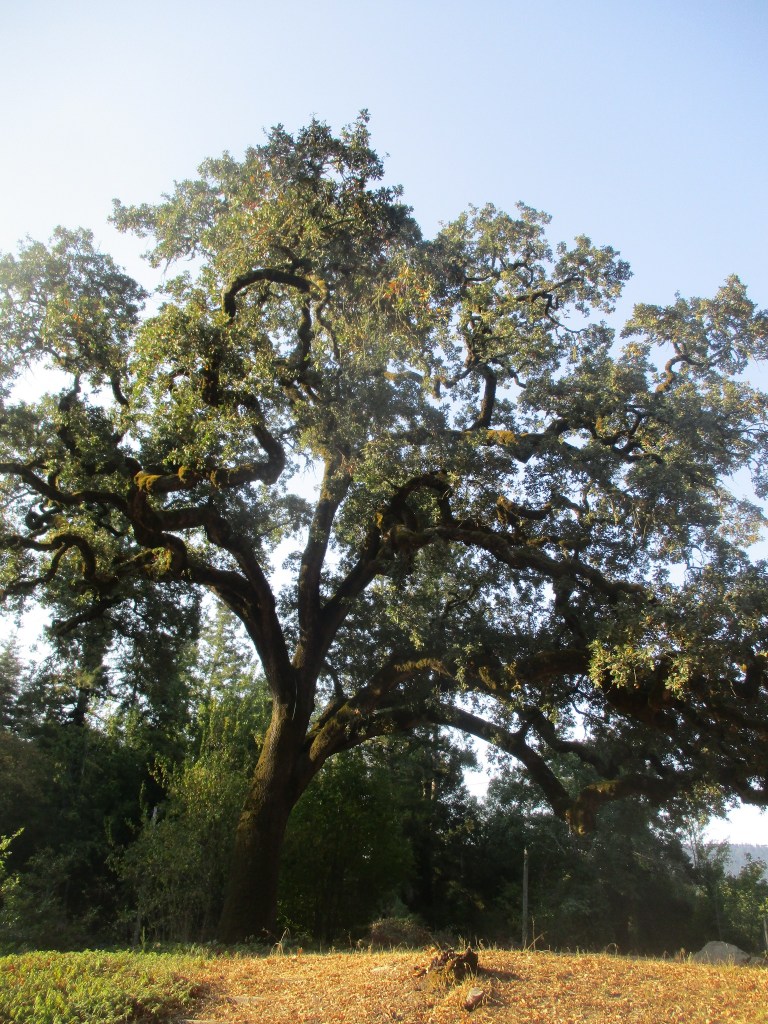
Valley oak is the grandest of oaks.

From the north end of the Sacramento Valley to the San Fernando Valley, the valley oak, Quercus lobata, is among the most familiar and distinctive of native oaks. It is the largest oak of North America, reaching more than a hundred feet tall with trunks as wide as ten feet, which is why it is rare in urban gardens. The hundred fifty foot tall ‘Henley Oak’ of Covelo is the tallest hardwood tree in North America. The oldest trees are about six centuries old.

The two or three inch long leaves have deep and round lobes. The foliage turns only dingy yellow and then brown in autumn, and can be messy as it continues to fall through early winter, particularly since the trees have such big canopies. The gnarly limbs are strikingly sculptural while bare through the rest of winter. The gray bark is evenly furrowed.

Incidentally, Oakland, Thousand Oaks, Paso Robles and various other communities within their range are named for valley oaks. (‘Roble’ is the Spanish name.)

White Alder

White alder is a sporadic native.

After a forest fire, white alder, Alnus rhombifolia, might be the first trees to regenerate into freshly deforested riparian situations. It grows quickly to exploit such an opportunity, and temporarily dominate a recovering ecosystem. Individual trees do not live for much more than half a century though. Then, they relinquish area to slower but more enduring trees.

Years ago, white alders did the same in new landscapes that needed shade. They grew fast to provide shade while preferable trees matured slowly. They subordinated and then vacated their landscapes as the preferred trees grew. Unfortunately, this technique is not so practical within municipalities that require but rarely grant permits for removal of trees. 

Although native, white alder is not prominent everywhere within its natural range. It might seem to be rare in Southern California, with only a few sporadic trees to provide seed for regeneration after a fire. Farther north, large and sustained colonies resist encroachment of other trees. Mature white alders can get forty to eighty feet tall, or taller where crowded by taller trees.

Maidenhair Tree

Maidenhair tree leaves look rather ‘fishy’.

There are not many trees that are as reliable for strikingly bright and clear yellow autumn foliar color as the maidenhair tree, Gingko biloba, is, even in mild coastal climates. The distinctive leaves flare out like fish tails, each with a prominent cleft that divides it into two wide lobes. (The species name ‘biloba’ means ‘two lobed’.) Some cultivars lack foliar clefts, have narrower leaves, or even develop milder yellow color in autumn. Those developed for home gardens exhibit relatively symmetrical branch structure, and are exclusively male, so can not produce the stinky fruit that some older female trees drop. (Trees grown from seed can be either male or female. Female cultivars are grown for fruit production and bonsai.) Some ancient trees in Japan, Korea and China are more than a hundred feet tall. Fortunately, maidenhair tree grows slowly enough to stay proportionate to compact urban gardens for many decades.

Maidenhair trees develop the best yellow fall color.

English Hawthorn

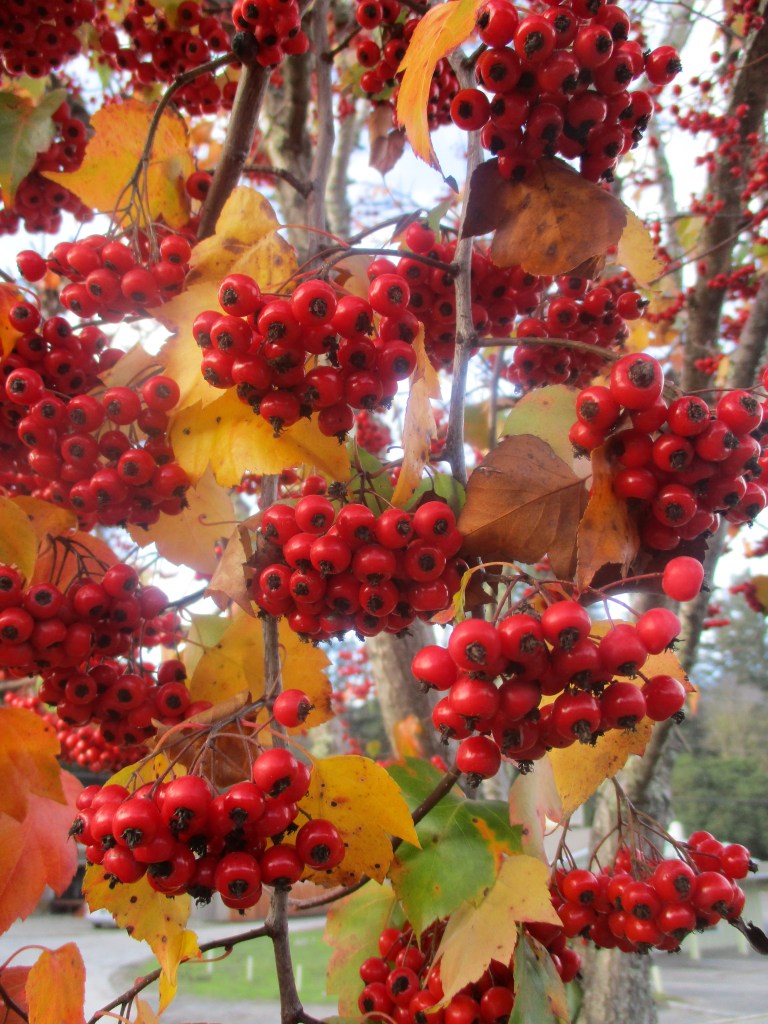
English hawthorn is small but distinguished.

Most red berries that provide color and attract birds through late autumn and winter grow on shrubbery. Berries of English hawthorn, Crataegus laevigata, grow on trees. They are not big trees, but they are distinguished. Mature trees might get no taller than twenty feet, but their furrowed trunks with weathered bark resemble those of older and statelier trees. 

Trusses of small white flowers that bloom in spring are comparable to those of pear. Like pear bloom, they emit a potentially objectionable musky fragrance. Modern cultivars that bloom with pink, double pink or double red flowers are less fragrant. English hawthorn is uncommon locally. The few cultivars that produce yellow or orange berries might be rare. 

The deciduous leaves of English hawthorn are only about an inch or two long and wide. They are deeply lobed, with a handsomely coarse texture. Foliage can turn rusty orange or brownish yellow for autumn. Defoliation exposes any remaining berries, at least until the birds finish with them too. Thorns are unfortunately unavoidable.

Philodendron selloum

Philodendron selloum is unfamiliar with autumn.

There are all sorts of philodendrons with all sorts of fancy names. Yet, the biggest and boldest lacks a common name (at least one that is actually ‘common’), and is most popularly known by a Latin name that is not even correct. The proper name for Philodendron selloum is really Philodendron bipinnatifidum. It is a big awkward plant with big and deeply lobed leaves on long petioles (leaf stalks), and weirdly thick aerial roots. Well exposed plants can stand on wobbly trunks. Partly shaded plants can creep along the ground, and prefer to grab onto and climb tree trunks, fences or anything that they can get a hold of. The aerial roots are harmless to trees, and generally too slow to catch a healthy cat, but will take paint off of walls. All parts of Philodendron selloum are toxic.

Chinese Pistache

Chinese pistache colors with minimal chill.

Those who crave fall color in mild climates should appreciate Chinese pistache, Pistacia chinensis. It is happy to provide fiery yellow, orange and red color in response to a slight chill. Actually, it retains its colorful foliage later into the season with mild chill than it does with frosty weather. Rain eventually dislodges all of its deciduous foliage through winter.

Because it is so resilient to harsh situations, Chinese pistache is popular as a street tree. Pruning is necessary to establish adequate clearance of broad limbs over roadways and sidewalks. Since roots can be shallow with regular watering, root barriers should protect nearby pavement. However, established trees do not need regular watering, if any at all.

Old Chinese pistache trees, as well as those that grow wild from seed, are either male or female. Female trees produce tiny but annoyingly abundant fruit. Modern cultivars are all male, and therefore fruitless. They may get more than forty feet tall, with broad canopies. The pinnately compound leaves are just about eight inches long.