It is amazing what just a few parishioners and friends can accomplish in just a few hours from about nine to noon on Saturday morning. It is only happens a few times through the year, so we make the most of it to catch up on all sorts of maintenance and projects at Felton Presbyterian Church. (My parish should do this sort of thing.) I was there to work in the minimal landscape.
I started working with this ‘Prairie Fire’ flowering crabapple several years ago. As I pruned for clearance above the adjacent parking spaces and patio, I retained lower growth in the space in between. The tree bloomed too nicely to unnecessarily remove all that was right where it was most visible. Besides, from the patio, it was more visually appealing than a view of parked cars.
Then, I missed a work day. There were plenty of volunteers. There…
Redwoods are some of the most stable trees in the World. That is partly why they can survive for thousands of years. In my entire career, I have seen very few fall, and only inspected two.
Of those two, one fell because it had co-dominant leaders (double trunks) that fell away from each other, which is more of a structural deficiency than instability. The other, which I suspect was demonically possessed, was a small tree less than thirty feet tall, that literally jumped up out of the ground and onto an Astro van more than ten feet away. A rare ‘updraft’ was blamed.
Almost all of the redwoods here regenerated from the stumps and roots of much older trees that were clear cut harvested a century or so ago. Most of those that grew back with structurally deficient co-dominant leaders are very effectively sheltered from wind by their collective groves…
Perhaps the signs should be down instead. They are obscured by the crape myrtles where they are now. They would be more visible if they were either higher or lower, but not in line with all these trees. The trees were planted only a few years ago, but have done very well. Lodgepoles need to be removed. The specimen to the left is recovering well from earlier disfigurement.
Selection of trees for parking lots is not easy. Such trees must disperse complaisant roots that are not likely to displace pavement or curbs. They should should be reasonably high branched and conducive to pruning for clearance above parked cars, and where necessary, for delivery trucks. Excessive floral or foliar mess would be a problem. So would fruit that attracts wildlife.
Unfortunately, not many trees conform to all limitations. Those with the most complaisant roots do not get big enough to be…
Okay; so this is neither the first, nor real autumn foliar color. It just happened to be convenient for me to get a picture of. Someone left this unfortunate Japanese maple right outside on the driveway a few years ago. It colors early from uncomfortable exposure to late summer warmth. The picture below is even more colorful, and was from even earlier in the year, last August.
Foliage that is starting to color here is nothing to brag about. Some of the older dogwoods leaves just shrivel and turn brown. I can only hope that enough newer foliage lingers to color as well as it did last year. Cottonwoods start to drop foliage while it is still green, but should eventually color to a subdued yellow before the last foliage falls. Sycamores are bland no matter how late.
There are only a few trees that reliably develop vibrant foliar color…
Warnings were broadcast in local news for a few days prior. Because of the extreme potential for catastrophic forest fires, electrical service was to be disabled to our region, and large areas of California. Weather was predicted to be warm, windy and dry (with minimal humidity). Such conditions are exactly what cause fires to spread so explosively through the overgrown forests.
The potential for sparks from electrical cables, especially as debris gets blown onto to them, was why the electricity needed to be disabled. Supposedly, it is more likely for fires to be started by sparks from utility cables than by sparks from the many generators and barbecues that compensate for a lack of electricity. These considerations are taken very seriously in this region.
There are many reasons why the local forests are more combustible than they would naturally be. The less combustible redwood forests were clear cut harvested about…
Halloween is a topic that I could rant about for days. Seriously. I loathe it. I dislike any formerly respectable holiday that has been ruined by excessive commercialization. We all know what happened to Christmas. For me, Halloween, in some regards, is even worse. Christmas is at least pretty. Halloween is intended to be morbid and grotesque and creepy and . . . just plain bad.
This should be about gardening though. Yes, there is always that guy who gets too drunk at the Halloween party down the road, but manages to stagger just far enough to vomit on my lawn. Then, I need to figure out how to get all the toilet paper out of the redwoods. The nasturtiums that get trampled by hasty brats who are too old for trick-or-treating will eventually recover.
The worst, though, are the Halloween ‘decorations’ in the front yard! We put too much…
Jocular reference was made to ‘The Grapes Of Wrath’ on our our backward version on the way to Oklahoma several years ago. We happened to drive through Salinas, where author John Steinbeck was from, and Bakersfield near Weedpatch, where the migration from Oklahoma in the story ended. From there, we literally drove the same route from Oklahoma, but in reverse.
I never read ‘The Grapes Of Wrath’.
I do enjoy growing the sort of grape vines that some of us grow in our home gardens for fruit that can be eaten fresh. (I loath wine grapes and vineyards, but that is another topic for later.) There happens to be a nice big unidentified grapevine at work that needed major pruning last winter. It was a sloppy and formerly unpruned mess, with rampant long canes strewn about.
Some of these canes developed roots where they had been laying on the ground…
Palms are like ‘Red Delicious’ apples. It seems that most people dislike them; but they also seem to be very popular. Seriously, if only a few people like ‘Red Delicious’ apples, why are they so common in supermarkets? If most of us dislike palms, why are they so common in the San Jose Skyline?
I suspect that palms really are as unpopular as they seem to be, but that they are also very conspicuous within their situations. Not only are they focal points of the landscapes in which they live, but most types eventually stand as tall as the tallest trees in the neighborhood, and some get significantly taller. They are innately the most prominent trees within their neighborhoods.
Palm are not like other trees though. Arborists may classify them as ‘herbaceous trees’. They are foliar plants while young, producing increasingly large leaves from terrestrial rosettes. They only ‘launch’ and…
The Lumberjack Contest at which I procured this picture was three years ago, at the Santa Cruz Mountains Harvest Festival. The Santa Cruz Mountains Harvest Festival for this year will be this weekend!
Personal Protective Equipment. That is what PPE is for. Acronyms can be so vague. PPE could be for Purple People Eater for all we know. That movie just happened to be released to cinema at the end of 1988, just a few months after my summer internship with an exemplary crew of arborists who instructed be about the importance of PPE. I am glad to have missed the movie.
In 1988, the machinery used by arborists as well as lumberjacks was more dangerous, and PPE was more primitive. Hearing protection was only beginning to be standardized. Many of us were not even using it back then, even though the chippers were terrifyingly loud. For some of us, cheap sunglasses sufficed as eye protection. Chaps had been available, but were quite rare.
From the beginnings of their respective careers, younger arborists and lumberjacks learn to use safer machinery and standardized PPE…
Flowers produce seed. That is their priority. Flowers that do not rely primarily on wind for pollination are colorful and fragrant merely to attract pollinators. They deteriorate as seed develops after pollination. Many flowers finish bloom between summer and autumn. This can generate an abundance of true to type seed to potentially collect for the next season.
Seed of most wild plants is naturally true to type. That means that it generally grows into plants that are genetically and physically very similar to the original plants that produced it. Genetic aberration is rare. Unless such aberration is an asset, such as floral color that pollinators prefer, it dissipates within a few generations. This likely continues indefinitely.
Many popular plants are simple varieties of wilder plants. These varieties are products of selection rather than breeding. Although technically true to type, their progeny can revert to wilder versions of their species, possibly within their first generations. White California poppy, without culling, reverts to genetically stable orange within only a few generations.
Of course, the transition from white to orange California poppies might not be a problem. Likewise, basic and exclusively yellow and orange nasturtium may be no less appealing than predecessors with more elaborate color. Potential reversion may not dissuade seed collection. Money plant, rose campion, white phlox and campanula are more true to type.
Many other popular plants are cultivars, which are cultivated varieties. Most cultivars are not true to type, so are reliant on vegetative propagation for perpetuation. Therefore, they are clones that are genetically identical copies of their original single parents. Almost all exhibit desirable characteristics that do not transmit reliably to seed, such as variegation.
Cultivars may be genetically unstable because of extensive breeding, or sterile because of hybridization. Canna exemplifies both categories. Most cultivars with lavish bloom are mostly sterile hybrids. Their seed is rare and unpredictable. Cultivars with modest bloom produce seed profusely. Although also potentially unpredictable, much of it is reliably true to type.

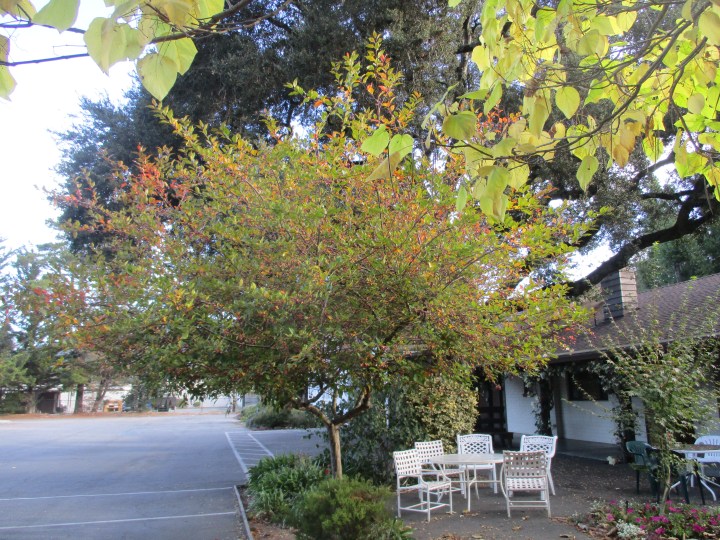
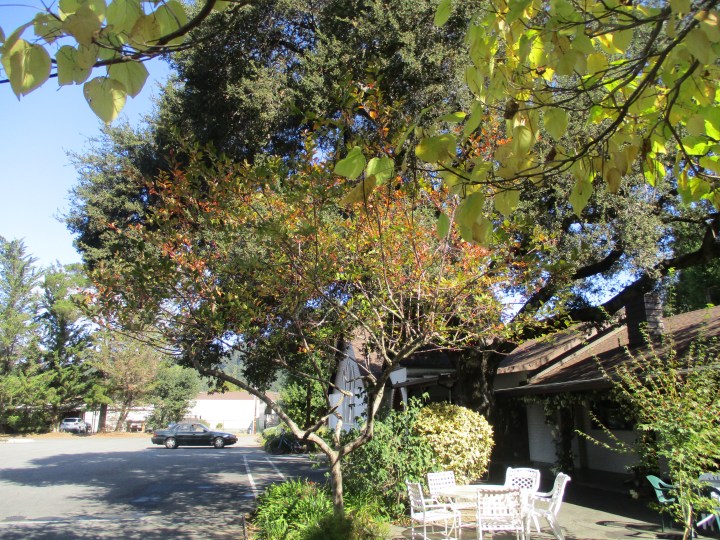 It is amazing what just a few parishioners and friends can accomplish in just a few hours from about nine to noon on Saturday morning. It is only happens a few times through the year, so we make the most of it to catch up on all sorts of maintenance and projects at Felton Presbyterian Church. (My parish should do this sort of thing.) I was there to work in the minimal landscape.
 Perhaps the signs should be down instead. They are obscured by the crape myrtles where they are now. They would be more visible if they were either higher or lower, but not in line with all these trees. The trees were planted only a few years ago, but have done very well. Lodgepoles need to be removed. The specimen to the left is recovering well from earlier disfigurement.
 Okay; so this is neither the first, nor real autumn foliar color. It just happened to be convenient for me to get a picture of. Someone left this unfortunate Japanese maple right outside on the driveway a few years ago. It colors early from uncomfortable exposure to late summer warmth. The picture below is even more colorful, and was from even earlier in the year, last August.
 Warnings were broadcast in local news for a few days prior. Because of the extreme potential for catastrophic forest fires, electrical service was to be disabled to our region, and large areas of California. Weather was predicted to be warm, windy and dry (with minimal humidity). Such conditions are exactly what cause fires to spread so explosively through the overgrown forests.
 Halloween is a topic that I could rant about for days. Seriously. I loathe it. I dislike any formerly respectable holiday that has been ruined by excessive commercialization. We all know what happened to Christmas. For me, Halloween, in some regards, is even worse. Christmas is at least pretty. Halloween is intended to be morbid and grotesque and creepy and . . . just plain bad.
 Jocular reference was made to ‘The Grapes Of Wrath’ on our our backward version on the way to
 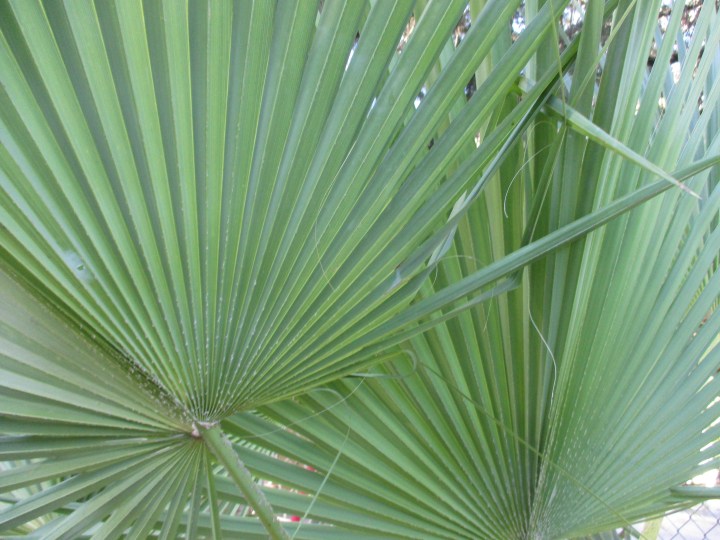 Palms are like ‘Red Delicious’ apples. It seems that most people dislike them; but they also seem to be very popular. Seriously, if only a few people like ‘Red Delicious’ apples, why are they so common in supermarkets? If most of us dislike palms, why are they so common in the San Jose Skyline?
 Personal Protective Equipment. That is what PPE is for. Acronyms can be so vague. PPE could be for Purple People Eater for all we know. That movie just happened to be released to cinema at the end of 1988, just a few months after my summer internship with an exemplary crew of arborists who instructed be about the importance of PPE. I am glad to have missed the movie.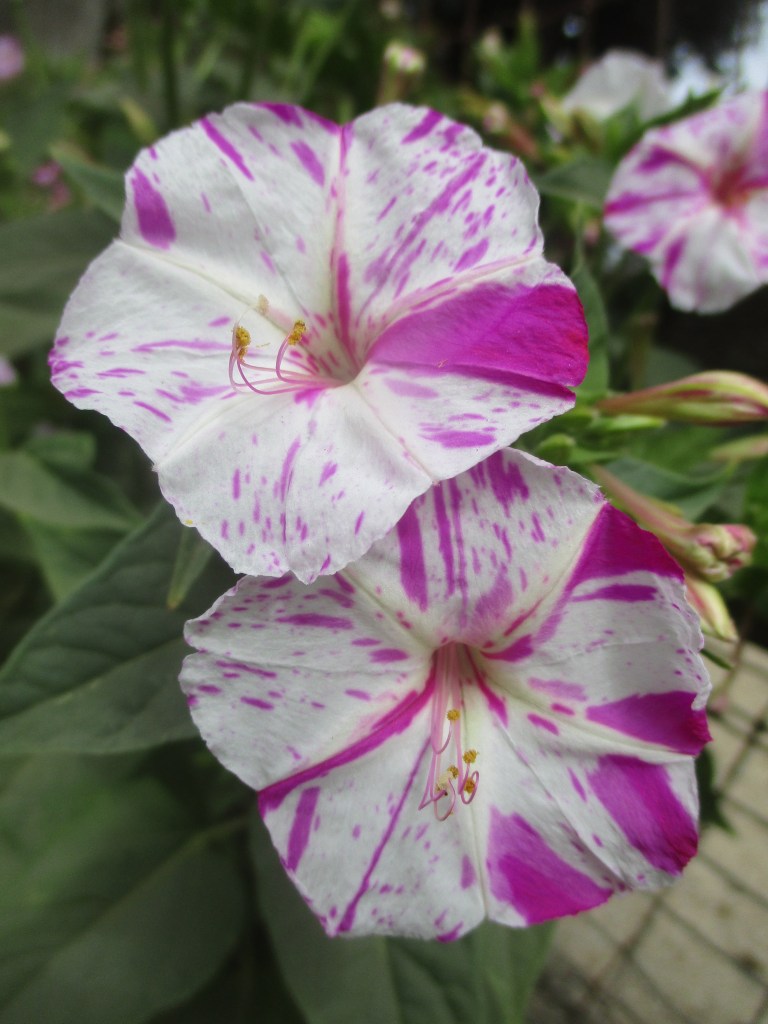
 Tony Tomeo