The only reason we developed a small vegetable garden here this year is that we have been unable to go to work for about a month. Without my second most time consuming employment, I had time to clear a small unused space (which was not nearly as simple as that sounds) and sow seed for vegetables. It was a late start a month ago, but not too late.
In fact, there was still time to do it before the last storm to go through. I know that sounds trivial, but as a Californian who is accustomed to gardening in a chaparral climate, and sometimes where there is no water available, planting prior to a storm ‘seems’ to be rather important. I know it is not. Water is available here. Otherwise, I would not grow vegetables.
Not only was there a storm, but there was a second storm later! Of…
Much has changed during the previous two weeks while Rhody, Carson and I were in the Pacific Northwest on vacation. The previously incessant rain suddenly stopped when we left. Canned and potted plants were consequently in need of irrigation after we returned. The weather is splendid now. Delayed bloom is now making up for lost time. Vegetation is growing like weeds, and much of it is, particularly beyond refined landscapes. Work is about as behind schedule as it always is. I got all but the last of these six pictures at work this week. Pictures of vacation are not transmitting from the telephone to the computer. Perhaps I will share some next Saturday. I did not take many.
1. Iris X louisiana ‘Black Gamecock’, Louisiana iris is a gift from Skooter’s Family. There is enough for this closely spaced row on fifty linear feet of the edge of the drainage pond.
2. Rumex occidentalis, dock is a prolific native that inhabits another portion of the edge of the drainage pond. It is pretty but may later be replaced by multiplying Louisiana iris.
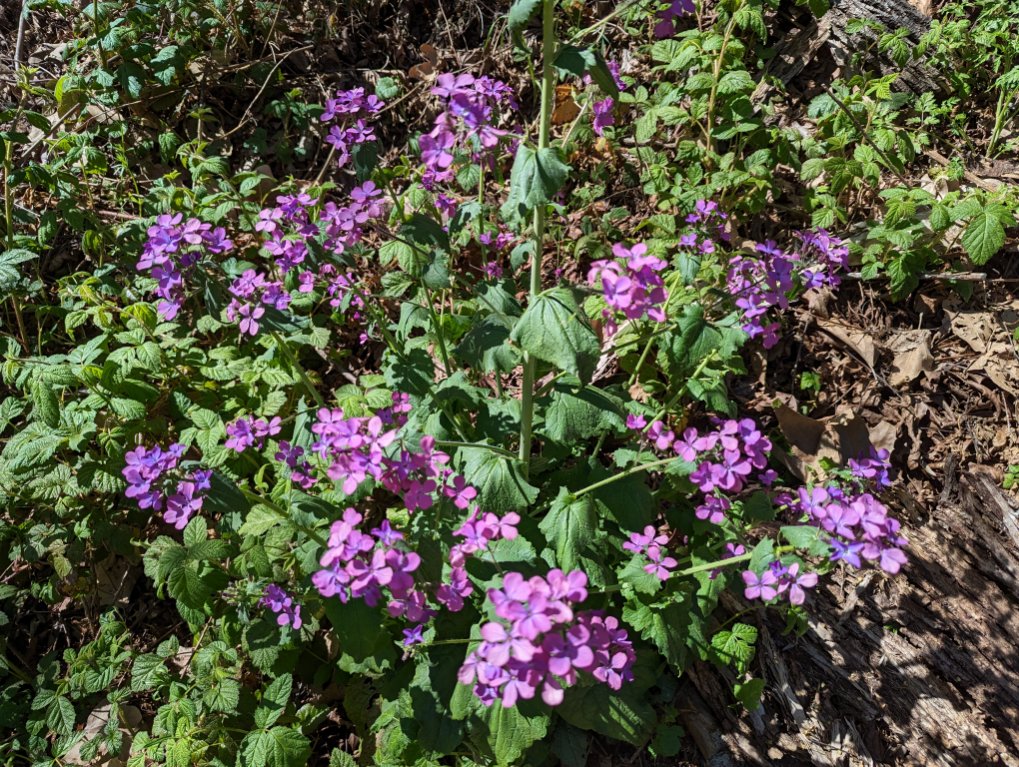
3. Lunaria annua, money plant seems to be naturalized, but only because someone who retired from here used to collect and disperse its seed. We try to continue this tradition.
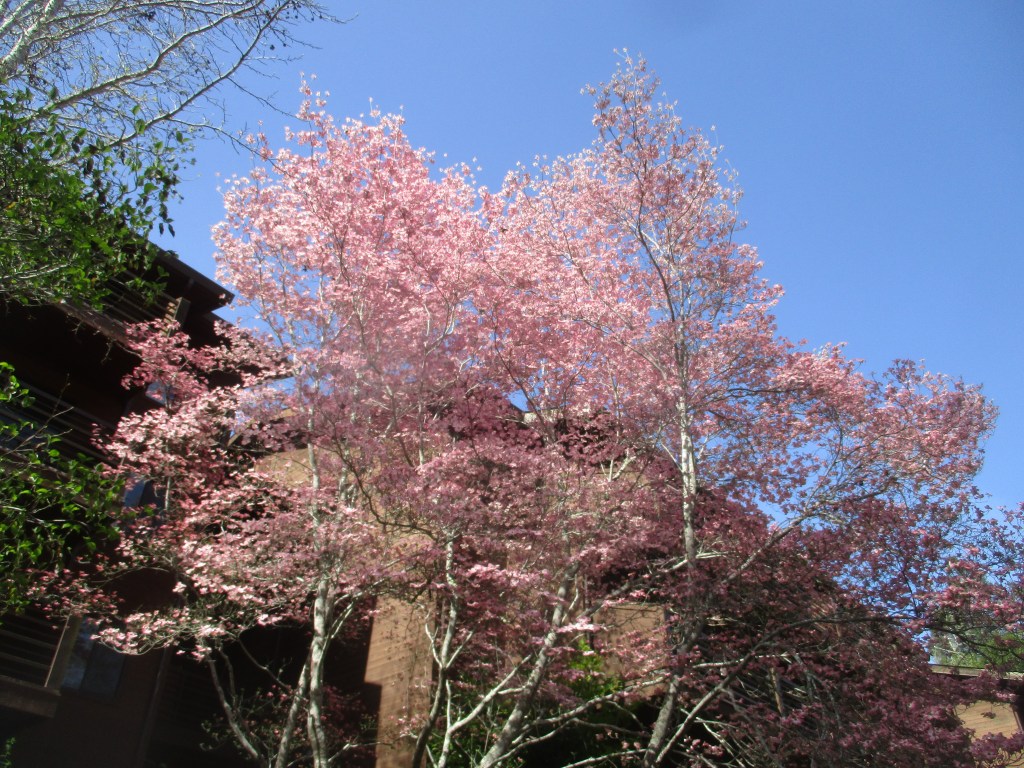
4. Cornus florida, flowering dogwood is late but spectacular. It does not perform as well within the arid chaparral climate of the Santa Clara Valley, just a few miles to the North.
5. Malus ‘Prairiefire’, flowering dogwood is about as spectacular. I believe that it blooms about now naturally though. I do not know what its species is, which is why it is omitted.
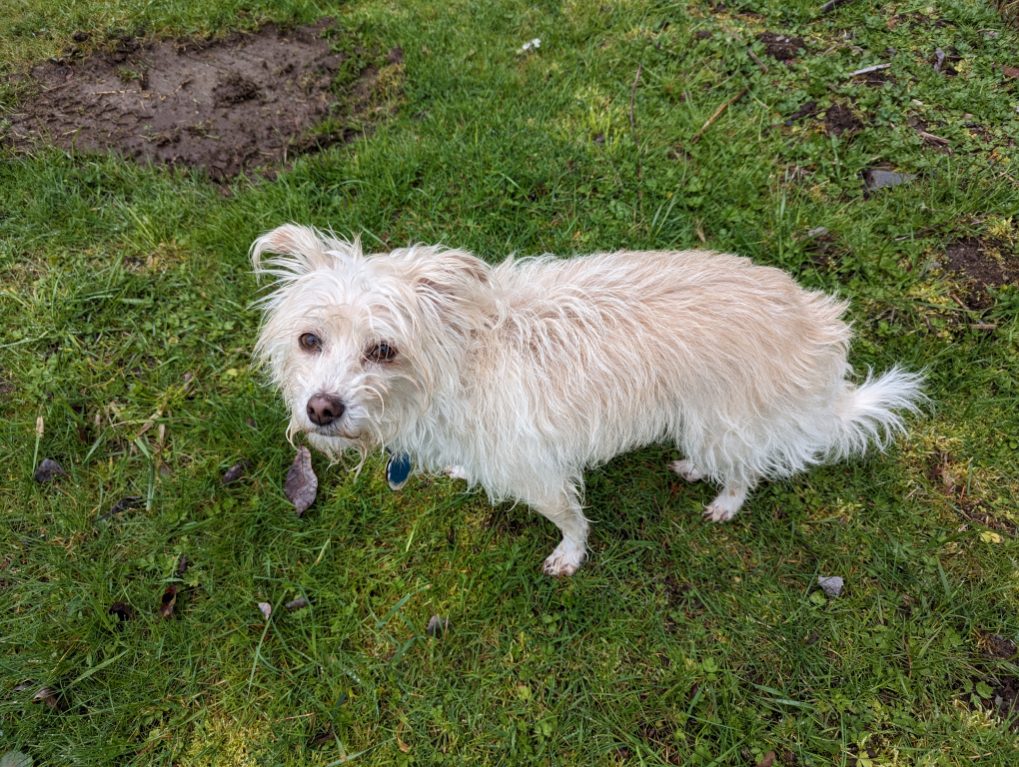
6. Rhody enjoyed the Pacific Northwest but not getting his picture taken. This was taken just before we left the farm near Poulsbo where I pruned several abandoned apple trees.
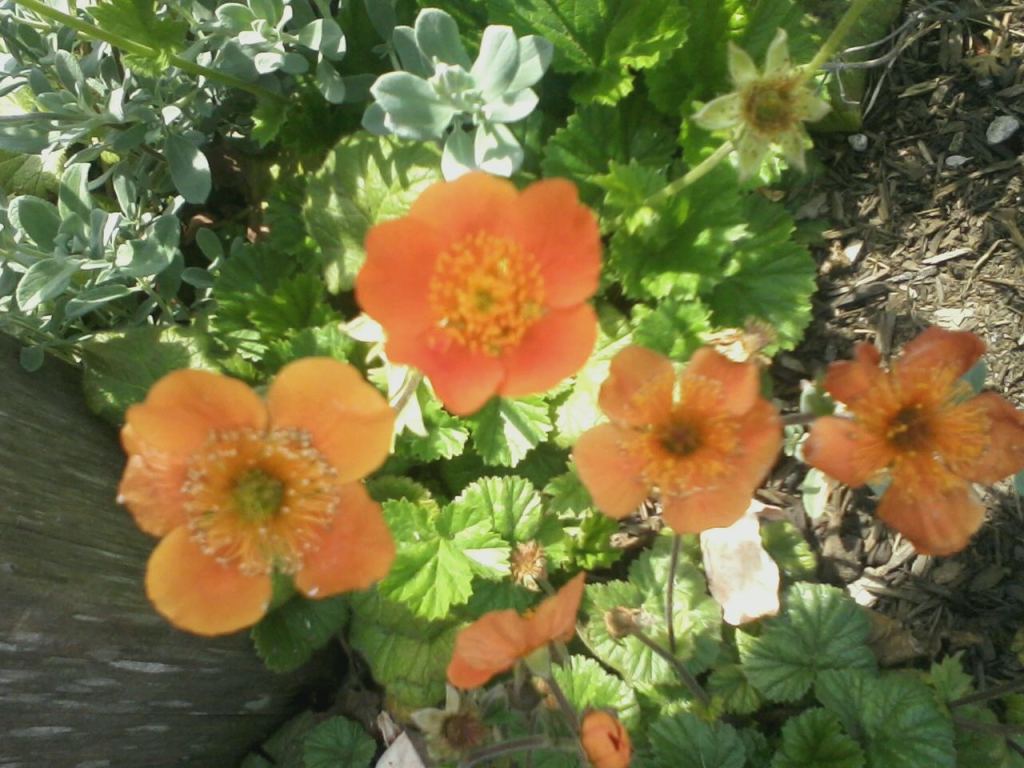
Old fashioned geum (or ‘avens’), Geum coccineum, was popular in rock gardens of the 1970’s because it clings to stone, and cascades somewhat. In modern gardens, it works just as well in large pots or planters, mixed with other perennials. The fuzzy foliage forms compact mounds about half a foot high and wide. The bright orange flowers with fuzzy yellow centers stand about twice as high, and bloom from spring through summer. Removal of fading flowers promotes continued bloom.
Landscapers and gardeners are only the two most familiar of horticultural professionals. There are also landscape designers, horticulturists, greenskeepers and various nurserymen, just to name a few. Each of the many distinct horticultural professionals works within a specific horticultural industry; like each of the many different types of physicians works within a specific medical industry, even though many might work together in the same hospital.
Arborists are the horticultural professionals, or even horticultural ‘physicians’, who work specifically with trees. In fact, they had historically been known as ‘tree surgeons’ because they perform what might be considered to be surgery on trees. After nurserymen grow trees in nurseries, and landscapers install trees in landscapes, arborists take over to care for the same trees like gardeners take care of landscapes below the trees.
Arboriculture, or the horticulture of trees practiced by arborists, is important because trees are so different from other plants in the landscape. Obviously, trees are larger than anything else. Structural problems or instability can have devastating consequences, not only to the affected trees, but also to anything around them that might be damaged by falling limbs or even entire trees. Some trees are large enough, or even have limbs that are large enough to crush an entire home.
Arborists who are certified by the International Society of Arboriculture, or ISA, have passed an examination of their arboricultural expertise, and maintain their certification by attendance to educational seminars, workshops and other relevant ISA approved events. Certified arborists are the most qualified to assess the health, stability and structural integrity of trees, and prescribe any necessary arboricultural procedures. Such matters should not be trusted to other horticultural professionals who specialize in other aspects of horticulture.
The website of the ISA at www.isaarbor.com is the best resource for finding certified arborists and the tree service businesses that they are affiliated with. Arborists can be found within particular regions by city or ZIP code, or directly by name. The website also features all sorts of information about trees that is useful to anyone who lives with them or wants to add more to the landscape.
Of course, there is more to gardening than trees. For those who missed reading about it already, it is nearly time for the most locally grown of horticultural events. Spring in Guadalupe Gardens will be April 28, from 10:00 a.m. to 3:30 p.m., in the Guadalupe River Park and Gardens between Taylor Street and Coleman Avenue in San Jose. More information can be found online at www.grpg.org or by telephoning 298 7657.
We installed canna for next summer into five pretty glazed pots with slim rims. I am not so keen on the pots, but they are pretty, and I do not expect canna to come out in one piece.
If I put a spider plant in the pot on the right, I may never get it out.
Clay pots have been around for a very long time. It is impossible to know for how long exactly. It is logical to say that they have been around long enough to evolve into the perfect shape for their function. Although the dimensions and proportions are variable, the basic design characteristics of the simplest and best engineered clay pots can not be improved on.
Clay pots are circular from above and below for a few reasons. Such a shape is easily formed on a potters’ wheel. It is more structurally sound than a form with flat sides and more corners. The space within is evenly distributed around the vertical center, without more remote corners. Although roots will circle within, there are not so many corners for them to congregate in.
Almost all California lilac that inhabit refined landscapes are cultivars of native species. Ceanothus thyrsiflorus is one of such native species that grows wild near here. It is a bit less adaptable to home gardens than cultivars are. However, it can be splendid within unrefined and wildland landscapes. New plants need irrigation only until they establish their root systems. Wild plants need none.
Wild California lilac can get taller and wider than fifteen feet. That is larger than cultivars, but with more open branch structure. Their evergreen foliage is somewhat glossy. Individual leaves are only about an inch and a half long, with prominent veins. Fluffy floral trusses that bloom in spring are about two or three inches long. Tiny individual flowers are sky blue or pale blue.
Like many chaparral species, California lilac does not respond favorably to pruning. It performs best where it can grow without disruption. Wild specimens perform well for only about ten years. They might then die suddenly. Some may survive for nearly fifteen years. They grow faster with occasional irrigation, but do not survive as long.
California native plants seem like they should be very appropriate for home gardens. In the wild, they require neither irrigation nor maintenance. They are quite satisfied with local climate and soil. Of course, gardening with natives is not so simple. Home gardens are very different from wild ecosystems.
Furthermore, wild ecosystems here are very different from wild ecosystems elsewhere. California is a very big place, with many different ecosystems. Some alpine species from the Sierra Nevada would be unhappy on the coast. Some coastal species from Del Norte County would be unhappy in the Mojave Desert. California native plants should be regionally appropriate.
Therefore, chaparral species are generally most appropriate for local chaparral climates. Many riparian species perform satisfactorily here as well, but expect more irrigation. However, appropriateness to a climate is not the same as appropriateness to a garden. Actually, many chaparral species are unappealing within home gardens. Some are difficult to domesticate.
A few species of California lilac are native here. Any of them are pleased to inhabit local home gardens. However, some grow quite large, and then die after only ten years or so. They may not last even that long with typical irrigation. Few respond favorably to pruning. They prefer to grow wild. Such big, awkward and temporary plants are undesirable within many compact and refined home gardens.
Combustibility might also be a concern for chaparral plants. Some chaparral ecosystems rely on fire for periodic renovation. In the wild, some such ecosystems may burn as frequently as every few decades. After burning, fuel begins to accumulate for the next fire. Even if not copious enough to be hazardous, such accumulation can be unkempt.
Only a few specialty nurseries provide wild California native plants. Most nurseries provide cultivars of such plants that are more adaptable to home gardens. ‘Carmel Creeper’ is a densely sprawling California lilac that gets only a few feet tall. It is commonly available. The original species can get more than fifteen feet tall, with open branch structure.
Honey badger don’t care. Neither does the gopher who did this.
Deer do not eat all plants. There are a few that are toxic to them. There are more that deer simply dislike. With a minimal bit of research, it is not difficult to find a few lists of plant species that deer are supposed to avoid. The problem with such lists though, is that deer do not read them. Only toxic plants are reliably safe from deer.
It would not be so bad if only deer were a bit more cooperative. They would be welcome in gardens if they ate only weeds that no one wants anyway. We all know that they can eat weeds, they just choose not to do so while they are in our gardens.
For that matter, gophers would not be such a problem if they ate only weeds, and aerated only soil that needs…
Shasta Lake is a large reservoir on the Sacramento River. It contains water for flood control and to generate electricity. Some of the water within is used for agricultural irrigation and, to a relatively minor degree, to supply regional municipal water.
It is a very common misconception that the volume of water within Shasta Lake is necessarily relative to ‘drought’ conditions. Low water level is supposedly indicative of a ‘drought’. High water level is supposedly indicative of ‘normal’ weather conditions, including adequate precipitation. This same misconception seems to apply to all reservoirs in California.
Well, after the rainiest winter since 1982 and 1983, Shasta Lake is still not full. The level fluctuates, so might have been full earlier, or might be full later, but regardless, is not presently full. Water must be released prior to expected rainy weather, which can still occur during spring, in order to accommodate more water to control flooding. Less water may be released as drier weather is expected. Shasta Lake could therefore be fuller or completely full for summer, when almost no rain is expected. The presently observed water level does not indicate deficiency of water any more than a potentially higher water level during summer indicates surplus.
Most of California has a chaparral climate. Some of California has a desert climate. Such climates are naturally dry through summer. It is quite normal. It does not constitute a drought. A drought is an unusually dry weather pattern. It is not so normal.
Contrary to popular belief, California is NOT in perpetual drought. Although droughts occasionally happen, they are not annual events. Dry weather that occurs annually every summer is normal climate. If there is a deficiency of water here, it is because there are nearly forty million people relying on a limited supply of water.
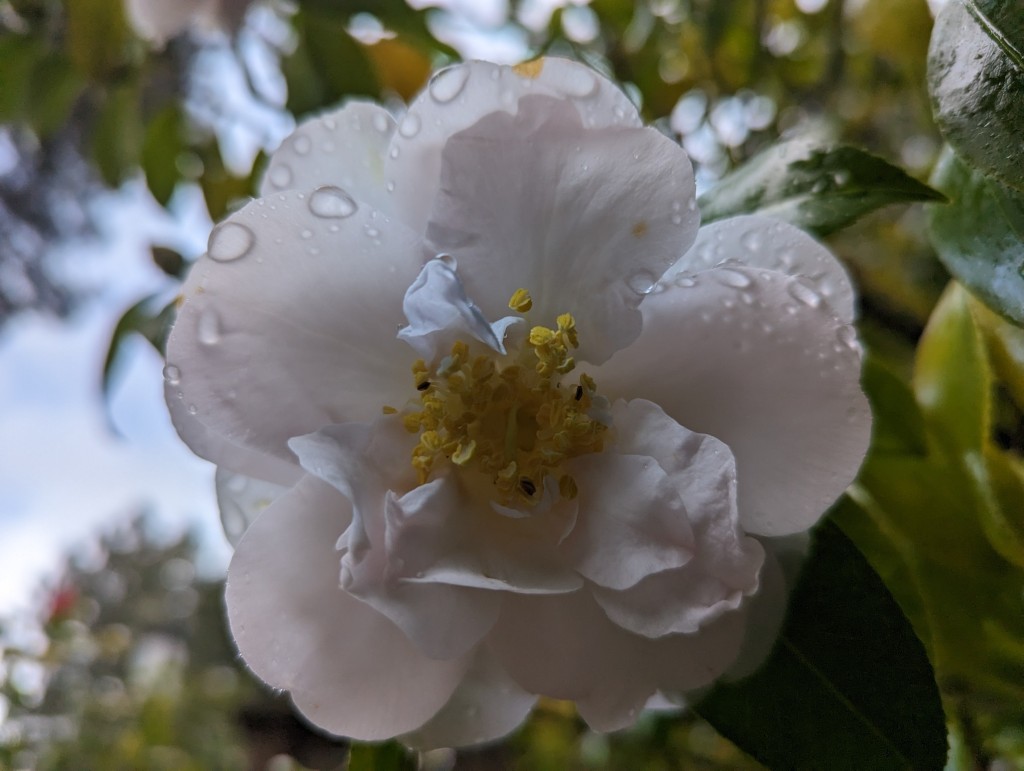
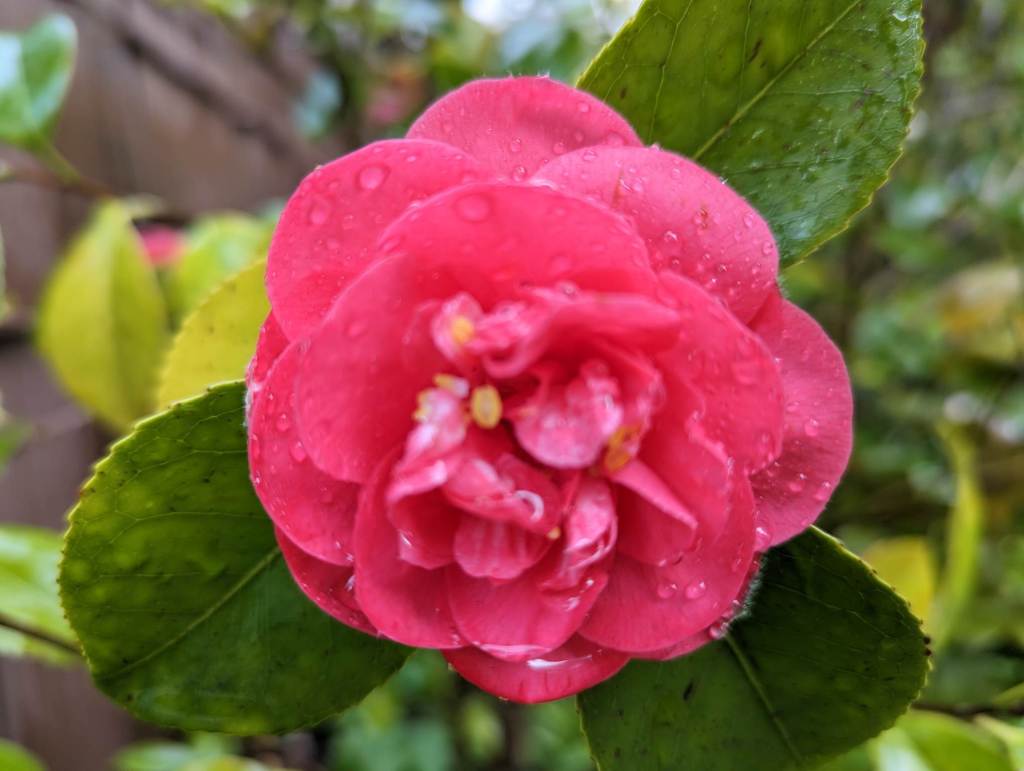
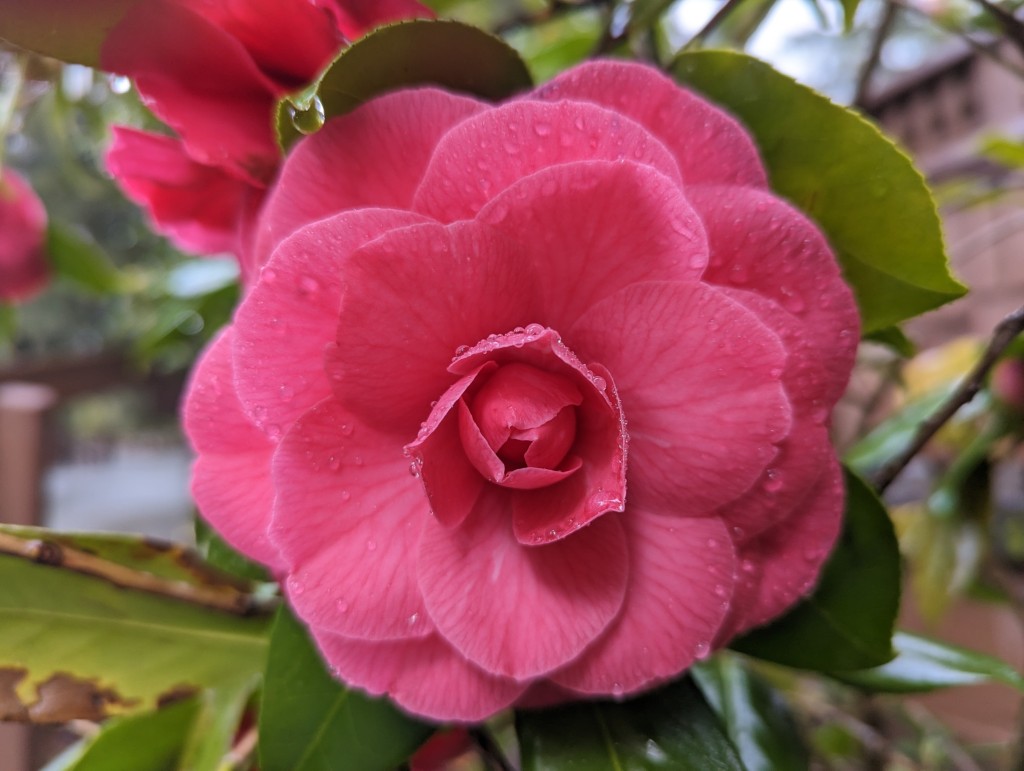
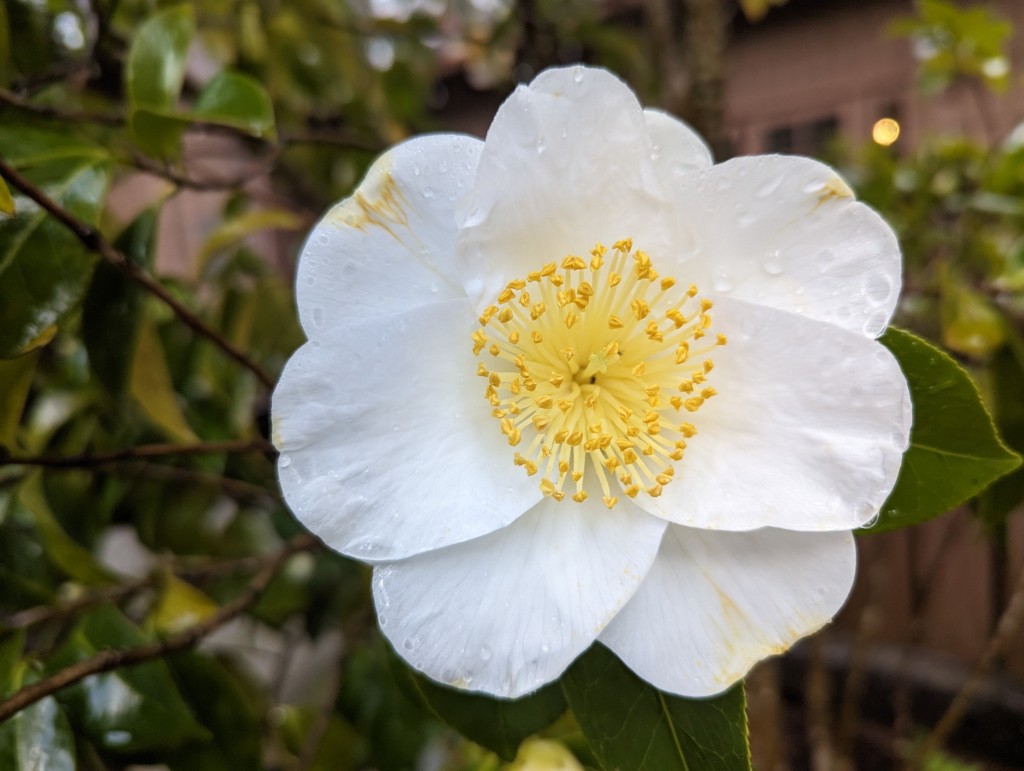
All but the first of these six are Camellia japonica. They bloomed late this year, likely as a result of the exceptionally wintry winter. Also, these pictures are more than two weeks old. They likely finished blooming by now. I do not know because I am not there. Rhody, Carson and I are still on vacation in the Pacific Northwest. As these Six on Saturday post at midnight, we will begin our trip home. Pictures of our vacation would be appropriate, but are not processed yet. Besides, I do not take many pictures. Also, although these few pictures are now outdated, I did not want to waste them. These five camellias and single flowering cherry demonstrated commendable diligence by blooming after such a wintry winter.
1. Double white flowering cherry is obviously not a Camellia japonica, but happens to be my favorite of our several flowering cherries here. The tree is in rough condition though.
2. Frilly white camellia with a relatively modest staminate center may be the prettiest of the white camellias here, but does not look so pretty in this shaded picture after the rain.
3. Pinkish watermelon red camellia blooms with variable floral form. Some flowers seem to be of peony form. Some seem to be of anemone form. I have no idea what form this is.
4. Very pallid pink camellia seems to be almost white. Whiter white or pinker pink could be prettier, but its pastel color seems to be very appropriate to its distinctive floral form.
5. Pinkish watermelon red camellia resembles the color of #3 now, but normally blooms deeper red. Perhaps the unusually harsh weather last winter somehow altered the color.
6. Single white camellia with a prominently staminate center looks like a sunny-side-up egg. Camellia blight around the edges proliferated during the exceptionally rainy winter.

 Mudslide!


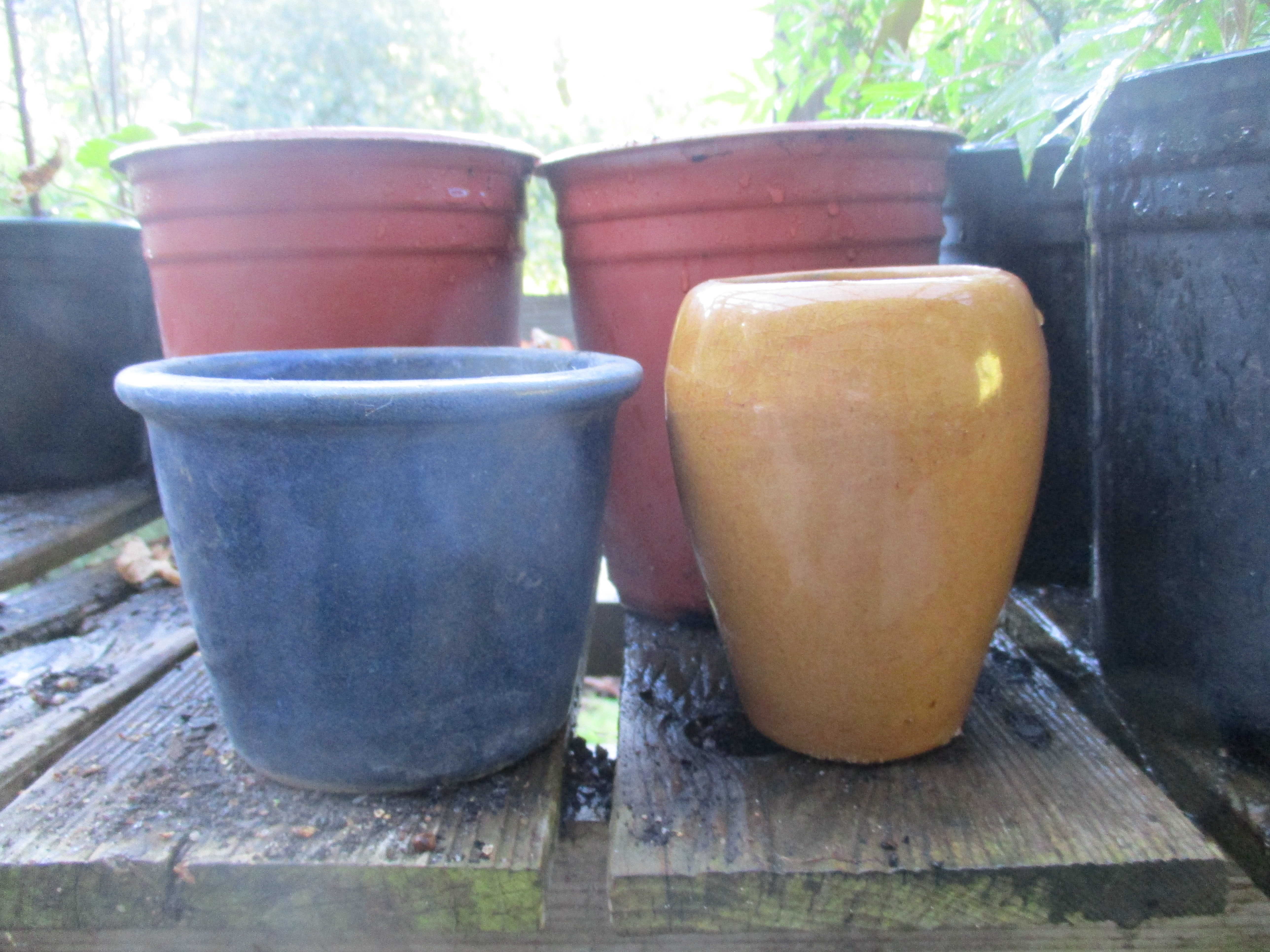 If I put a spider plant in the pot on the right, I may never get it out.

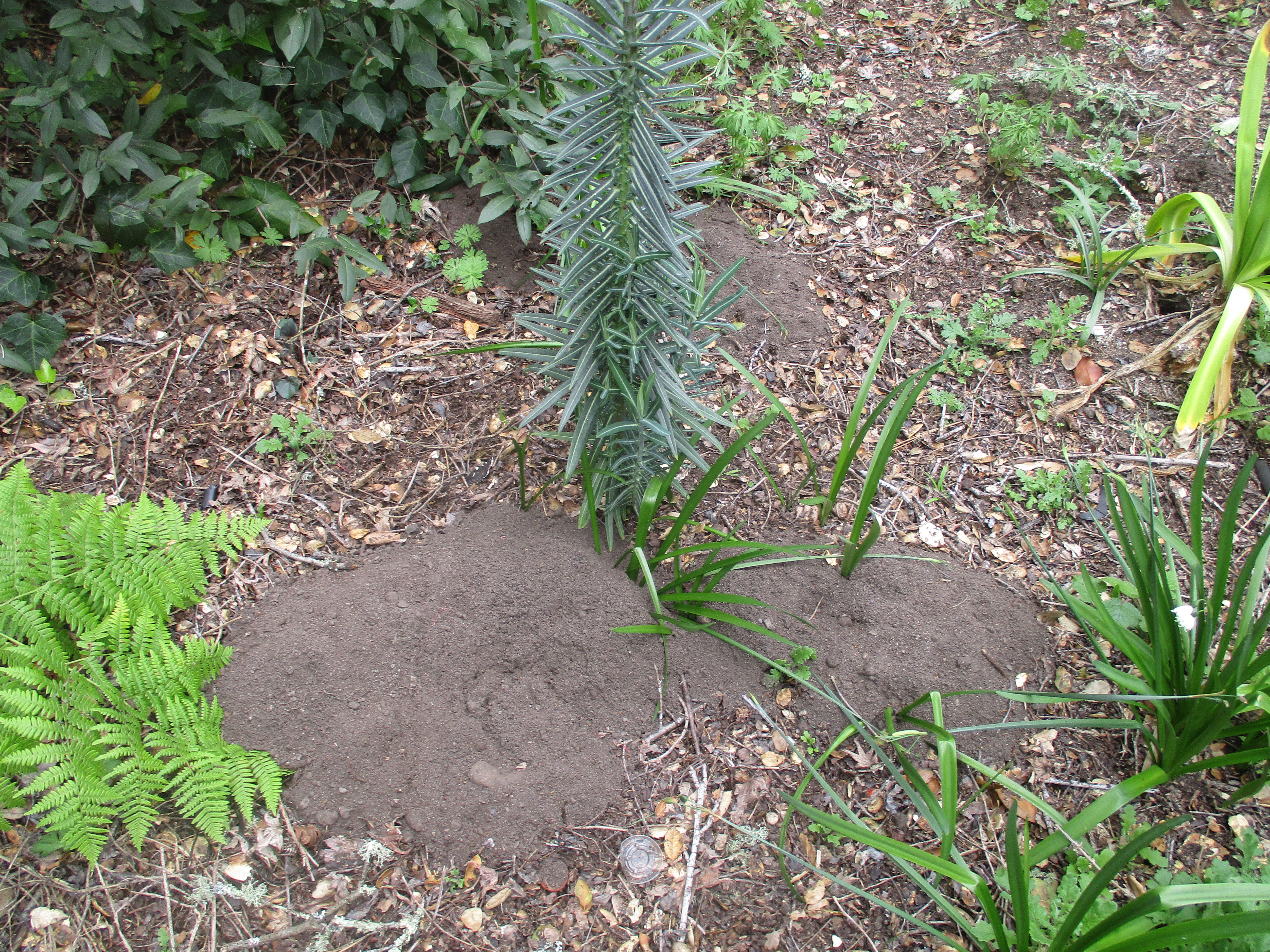 Honey badger don’t care. Neither does the gopher who did this.


 Tony Tomeo