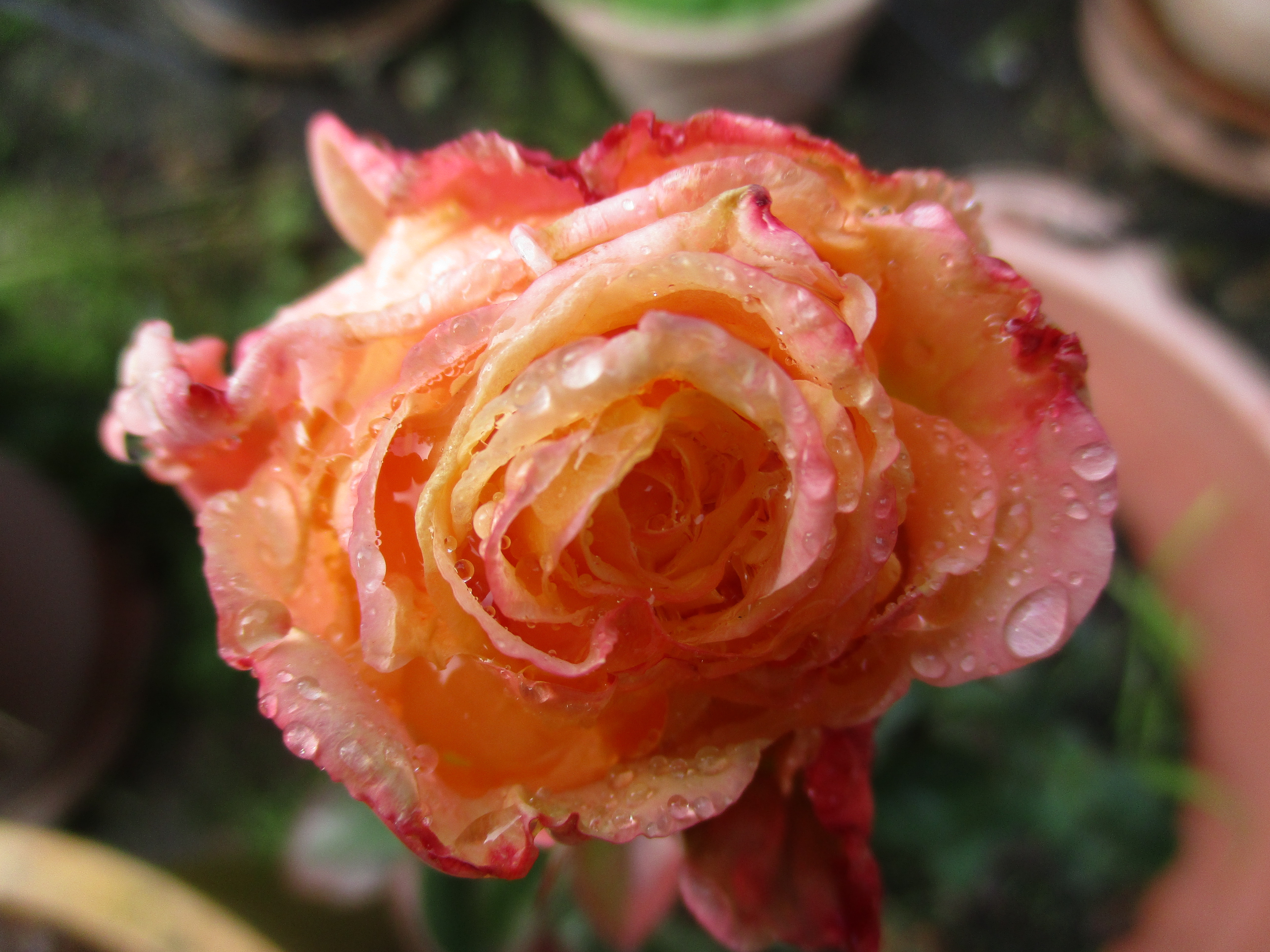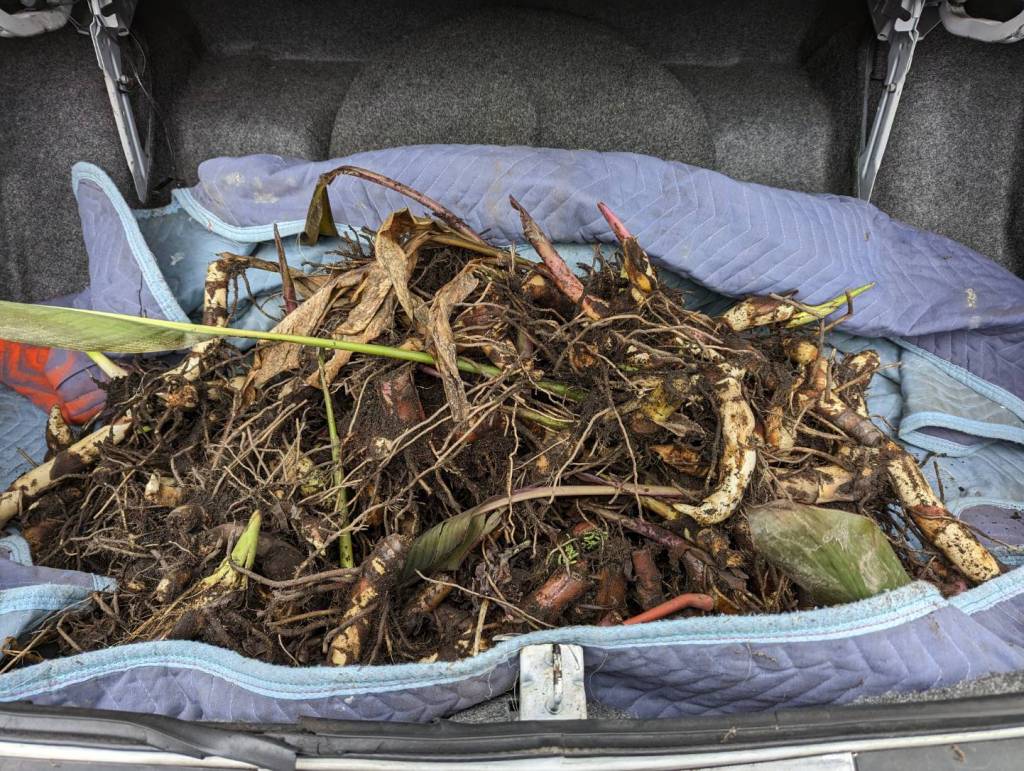
Dried prunes are experiencing something of an identity crisis.
Nomenclature used to be more predictably standardized than it is now. When I write about how it works, I compare it to the names of cars. For example, ‘General Motors’ is just a family. ‘Buick’ is a genus. ‘Electra’ is a species. ‘Limited’ is a variety. Well, my Sebring was labeled as a Chyrsler but made by Mercedes Benz. Modern horticultural nomenclature is no more accurate.
With all the promiscuity going on nowadays, it is impossible to know who the parent of some of our favorite plants are. Many are interspecific hybrids. Some are intergeneric hybrids. Some are so complicated that their species names are merely omitted; and no one seems to notice! That is like driving a Mercury LS without knowing or caring if it is a Grand Marquis or a Lynx.
Mandarin orange, Citrus reticulata, and nuts are some of the more traditional goodies for Christmas stockings. In Northern Europe centuries ago, nuts from the Americas were still exotic treats. The availability of perishable citrus fruits from Mediterranean regions relied on expensively efficient shipping. Consequently, citrus fruits were almost like delicacies.
Even when shipping was slow, Mandarin oranges ripened in time to arrive by Christmas. However, they needed fast shipping because they are more perishable than other citrus. They are innately more prone to oxidation because their rind and segments fit so loosely together. Of course, that is why they are so delightfully easy to peel, pull apart and share.
Mandarin oranges are smaller, more oblate, brighter orange, but also more variable than common sweet oranges. Among their many cultivars, their smaller leaves and thorniness are likewise variable. Very few very old trees grow taller than fifteen feet. Tangerines are merely barely genetically distinct Mandarin oranges that developed within the Americas.
Chilled lemonade certainly is nice when the weather gets warm during summer. Orange juice also seems to be more appropriate to warm weather. In fact, most citrus fruit seems to be more summery than wintery. Yet, most of it ripens through winter. Mandarin oranges are more perishable than most other citrus fruit, so are best long before warmer weather.
Citrus trees are defiantly contrary to the deciduous fruit trees that produce fruits of spring and summer. Not only does their fruit ripen during opposite seasons, but they also prefer pruning during opposite seasons. Many need no pruning or only minor grooming as they age. Any necessary pruning should happen after the last cool or frosty weather of winter.
Citrus fruit is not as perishable as spring and summer fruit are. Mandarin oranges oxidize within a month or so only because their rind is so loose. Other citrus fruit remains fresh in the garden for months, even through warm weather. Some actually improves with a bit of aging. For fruit that lingers late, vermin are more likely to be a problem than deterioration.
Slow deterioration is a major advantage for such abundant citrus fruit. There is less rush to collect more after collecting too much. For more sporadic production, many cultivars of citrus bloom sporadically prior to and after their primary season. ‘Eureka’ lemon is not too overwhelmingly productive in season, but before and after, provides a few more lemons.
Citrus fruit are remarkably diverse. Many are best simply for fresh eating. Many are better for juicing. Some are best for other culinary applications. Mandarin oranges and oranges are basically sweet. Lemons and limes are basically sour. Grapefruits are basically bitter. Citrus fruit exhibits a prevalence within combination of these three basic flavor elements.
Citrus trees are as variable as the citrus fruit that they provide. Almost all are dwarf trees, which stay more compact than standard orchard trees. However, ‘Eureka’ lemon, ‘Marsh’ grapefruit and ‘Sanguinelli’ blood orange can eventually get as big as small shade trees. ‘Meyer’ lemon, kumquats and most Mandarin oranges remain much lower and shrubbier. Some are thornier than others.
What species is this naturalized Cyclamen? hederifolium – coum – feral persicum – or something else?
Could this be Cyclamen hederifolium? Perhaps it is some sort of Cyclamen coum, or possibly feral Cyclamen persicum. I really do not know. Common florists’ cyclamen is the only cyclamen that I have any experience with. I grew it as a perennial when I was in high school, but never saw any feral colonies growing from self sown seed. I have never met the other species before.
Several colonies of this naturalized species of Cyclamen grow wild in the garden of a colleague. No one knows how they got there. I noticed them while procuring specimens of what might be other species that I have been wanting to grow, even though I am not certain of their identities either. I suspect that one could be Sorbus americana, and that…
Pruning was right on schedule this year, and only a few days prior to the date on which this posted three years ago. Hydrangeas finished were a bit more ready for it they year though.
The good news is that these billowy white blooms were not wasted.
The main difficulty with such a mild climate is that many plants do not get sufficient chill in winter. Several types of apples do not perform well here without it. Only a few are productive in Beverly Hills (in the Los Angeles region), where I sometimes need to modify my gardening column accordingly. A few of my neighbors here somehow grow peonies; but I do not even bother.
Even plant that require more chill than they get here seem to be aware that it is cooler at this time of year. Their deciduous foliage turns color and eventually falls to the ground. They just want the weather to get a bit cooler and to stay cooler for a bit longer before they are convinced that it is really winter. Otherwise, they think that autumn simply merges directly into…
2022 ended with what might have been the worst series of storms since 1982. More rain is in the forecast, so the situation has potential to get worse. As I was composing my ‘Six on Saturday’ for last week, Zayante Creek behind the shop buildings at work was coming up higher than it has been in many years. An adjacent neighborhood was evacuated later in the day. Evacuated neighbors parked their vehicles in a big parking lot across Zayante Creek, and partied in the rain until 2023! By then, they could go home on muddy roads. It was a unique way to celebrate the New Year. Picture #1 was yesterday. #2 and #3 were Wednesday. #4, #5 and #6 were last Saturday, 2022.
1. Mudslides caused a few road closures and other damage elsewhere in the region. This was the worst for us. It was mitigated yesterday. Vegetation did not control this erosion.
2. Fallen trees were another major problem elsewhere in the region. A big coast live oak squashed a car nearby. This Italian buckthorn was the worst for us. It damaged nothing.
3. Widowmakers are terrifyingly dangerous during windy weather. All too many free fall silently for more than a hundred feet from the exteriors of canopies of coastal redwoods.
4. David Fritiof Lindberg Memorial Tree is barely visible to the right of the center of the lower edge of this picture. It is immobile, but has never been this close to Zayante Creek.
5. Steven Michael Ralls Memorial Tree resides in the same Memorial Grove as the David Fritiof Lindberg Memorial Tree, so is also now closer to Zayante Creek than it should be.
6. Conference Drive Bridge over Zayante Creek is a short distance north and upstream of the Memorial Grove. At the time, most vegetation was obscured from view under water.
California wild rose hips remain long after bloom, as well as foliage, is gone.
Prickly thickets of California wild rose, Rosa californica, are not often much to look at, even while adorned with small and sparse pink roses in spring and summer. The fragrant flowers can actually range in color from white to rich pink, and may have more petals, but are not abundant enough to be very impressive at any one time. In autumn though, all the flowers that bloomed in the previous few months leave bright orange or red fruiting structures known as ‘hips’, that linger on the bare canes through winter.
The rose hips of California wild roses had historically been used to make herbal tea because they contain so much vitamin C and have a pleasant flavor. (California wild rose is a ‘tea’ rose but not a hybrid ‘T’ rose.) They can also be made into jelly or sauce. The only problem is that birds like them too, so often take them before anyone else has a chance to.
Proper pruning during winter promotes the best roses during summer.
(This recycled article is eleven years old. Therefore, the event that it describes is no longer relevant.)
Just about anyone can plant roses in the garden, and care for them for at least the first year. Pruning them properly while they are dormant in winter in order to get them to perform satisfactorily every subsequent year is what most of us who grow roses have difficulty with. Like deciduous fruit trees, roses should not be planted and expected to perform with minimal attention. They certainly should not be pruned with hedge shears!
The once modern, but increasingly old-fashioned, hybrid T roses have traditionally been the most common victims of inadequate pruning, since they need such aggressive pruning every winter to prevent overgrowth that interferes with healthy cane growth and bloom. More modern cultivars (cultivated varieties) designed to resemble older roses, as well as reintroduced old fashioned roses are generally not so demanding, but likewise perform best with proper dormant pruning. There are slightly, and not so slightly, different ways to prune the different types of roses. Even the ‘low maintenance’ carpet roses should be pruned to some degree.
Fortunately for those of us who are just learning about roses, the first of several free rose pruning lessons in the San Jose Heritage Rose Garden began this morning, January 4. These hands-on lessons continue at 9:00 a.m. every Wednesday and Saturday until late February. Participants meet in the center of the Garden. The minimum age to attend is sixteen; but minors without parental supervision require a signed minor release form that can be obtained from the Guadalupe River Park Conservancy.
Participants should bring bypass shears, leather gloves, closed-toe shoes and preferably a water bottle. Those who lack shears or gloves can borrow what they need at the Garden. The Heritage Rose Garden is located on West Taylor Street near Walnut Street in San Jose. Parking can be found on Seymour, Taylor or Walnut Streets. More information can be obtained by email to Emily of the Guadalupe River Park Conservancy at emily@grpg.org or by telephoning 298 7657.
The Heritage Rose Garden is the most complete collection of old world roses, the ancestors of modern roses, in the world! Although it lacks modern cultivars, it exhibits a remarkably extensive variety of roses, with all sorts of growth habits. There really is no other garden where one can prune roses with the same basic techniques in so many different ways.
Incidentally, modern hybrid T roses derive their designation from the ‘T budding’ technique employed to attach the scion (upper blooming portion) to the understock (roots), not because the rose hips (fruiting structures) are used to make tea. However, all sorts of roses, including floribundas, polyanthas, grandifloras and all sorts of climbing roses, are budded by the same means; and many hybrid T roses are actually grown on their own roots and not budded onto understock at all. The designation of hybrid T seems somewhat out dated, but is still effective.
This is no horticultural gripe, as is traditional here on Wednesday. Actually, it is not much of a gripe at all. It is merely a brief description of the unpleasantries of the current situation here.
Rain is predicted to resume prior to two this morning, and continue almost until tomorrow evening. It is expected to be remarkably voluminous. Strong wind that begins about eleven is expected to continue for a bit more than a day, until about two tomorrow. The ground is already saturated from the major storm on New Year’s Eve, and minor rain afterward. Rain may pause only for Friday, but may then resume for the foreseeable forecast.
This weather could be the worst since the winter of 1982 and 1983. If so, the results would be worse now than they were then. So many more people live here and nearby now. Flooding, mudslides and everything that stormy weather causes will affect many more people than ever before.
The area across the road from here is to be completely evacuated in the morning because of expected flooding. It already flooded on New Year’s Day. A parking lot nearby is already full of cars from that neighborhood.
The burn scar from the CZU Fire two years ago has not yet recovered, so is unusually susceptible to erosion and mudslides.
This sort of weather may be no more than what is normal in ‘average’ climates. It is just more than we are accustomed to in the mild climate here. As I schedule this to post at midnight in about a quarter of an hour, the weather is still pleasant, without indication of what is predicted.
I should get some sleep now. The crew and I will likely be very busy in the morning, and exhausted, cold and wet by noon.
The most common of a few species of cottonwood that are native to California seems as if it should not be. Populus deltoides is the Eastern cottonwood. This name implies that it should be native primarily to regions of the East. Yet, it naturally inhabits every American State except for Hawaii and Alaska. Since it is so familiar locally, it is simply cottonwood.
It grows wild in riparian ecosystems, and occasionally sneaks into adjacent landscapes. It is almost never an intentional acquisition. Cottonwood grows too aggressively and too large for refined home gardens. It works better as a grand shade tree for parks and urban waterway trails. As a riparian species, it requires either riparian ecosystems or irrigation.
Mature cottonwood trees may be almost a hundred feet tall, and rather broad if exposed. Their bark is handsomely furrowed. Yellow autumn color of the deciduous foliage can be surprisingly vibrant within arid climates, or if rain is later than frost. Vigorous trees can be susceptible to spontaneous limb failure, so may occasionally justify aggressive pruning. Roots might be voracious.