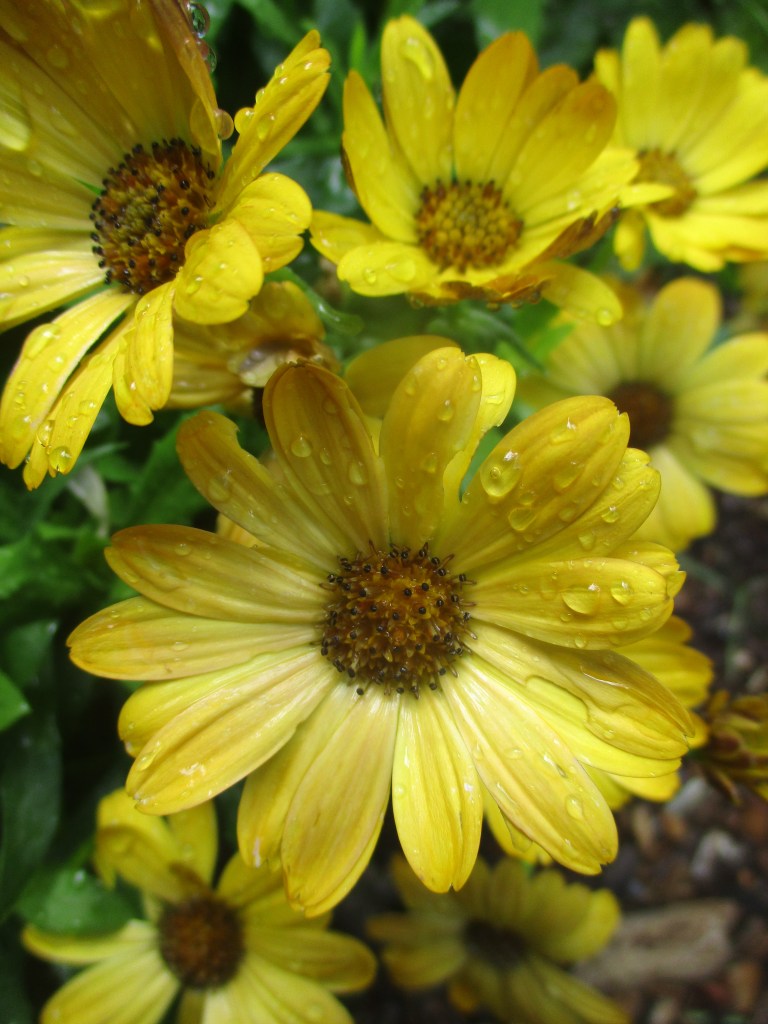
Old fashioned trailing African daisy was becoming too common by the time it succumbed to the Big Freeze just prior to Christmas of 1990. Shrubbier and more colorful cultivars of hybrids with similar species, particularly Osteospermum ecklonis, are now more popular. Such hybrids mostly lack species designation because their lineage is very complicated.
Mature specimens do not grow much wider than two feet, so do not migrate as efficiently as old fashioned trailing African daisy. Since they are hybrids, they do not produce viable seed either. However, if pressed into damp soil, peripheral stems generate roots to grow as new plants that extend the collective width. They also replace deteriorating old plants.
Sporadic bloom may be almost continuous between a few profuse phases, with the most profuse phase between winter and spring. Only the coolest and warmest weather inhibit bloom. It can be difficult to shear overgrown plants between phases without ruining a few flowers. Floral color is pastel hues of purple, lavender, red, pink, orange, yellow or white.
Flowers produce seed. That is their priority. Flowers that do not rely primarily on wind for pollination are colorful and fragrant merely to attract pollinators. They deteriorate as seed develops after pollination. Many flowers finish bloom between summer and autumn. This can generate an abundance of true to type seed to potentially collect for the next season.
Seed of most wild plants is naturally true to type. That means that it generally grows into plants that are genetically and physically very similar to the original plants that produced it. Genetic aberration is rare. Unless such aberration is an asset, such as floral color that pollinators prefer, it dissipates within a few generations. This likely continues indefinitely.
Many popular plants are simple varieties of wilder plants. These varieties are products of selection rather than breeding. Although technically true to type, their progeny can revert to wilder versions of their species, possibly within their first generations. White California poppy, without culling, reverts to genetically stable orange within only a few generations.
Of course, the transition from white to orange California poppies might not be a problem. Likewise, basic and exclusively yellow and orange nasturtium may be no less appealing than predecessors with more elaborate color. Potential reversion may not dissuade seed collection. Money plant, rose campion, white phlox and campanula are more true to type.
Many other popular plants are cultivars, which are cultivated varieties. Most cultivars are not true to type, so are reliant on vegetative propagation for perpetuation. Therefore, they are clones that are genetically identical copies of their original single parents. Almost all exhibit desirable characteristics that do not transmit reliably to seed, such as variegation.
Cultivars may be genetically unstable because of extensive breeding, or sterile because of hybridization. Canna exemplifies both categories. Most cultivars with lavish bloom are mostly sterile hybrids. Their seed is rare and unpredictable. Cultivars with modest bloom produce seed profusely. Although also potentially unpredictable, much of it is reliably true to type.
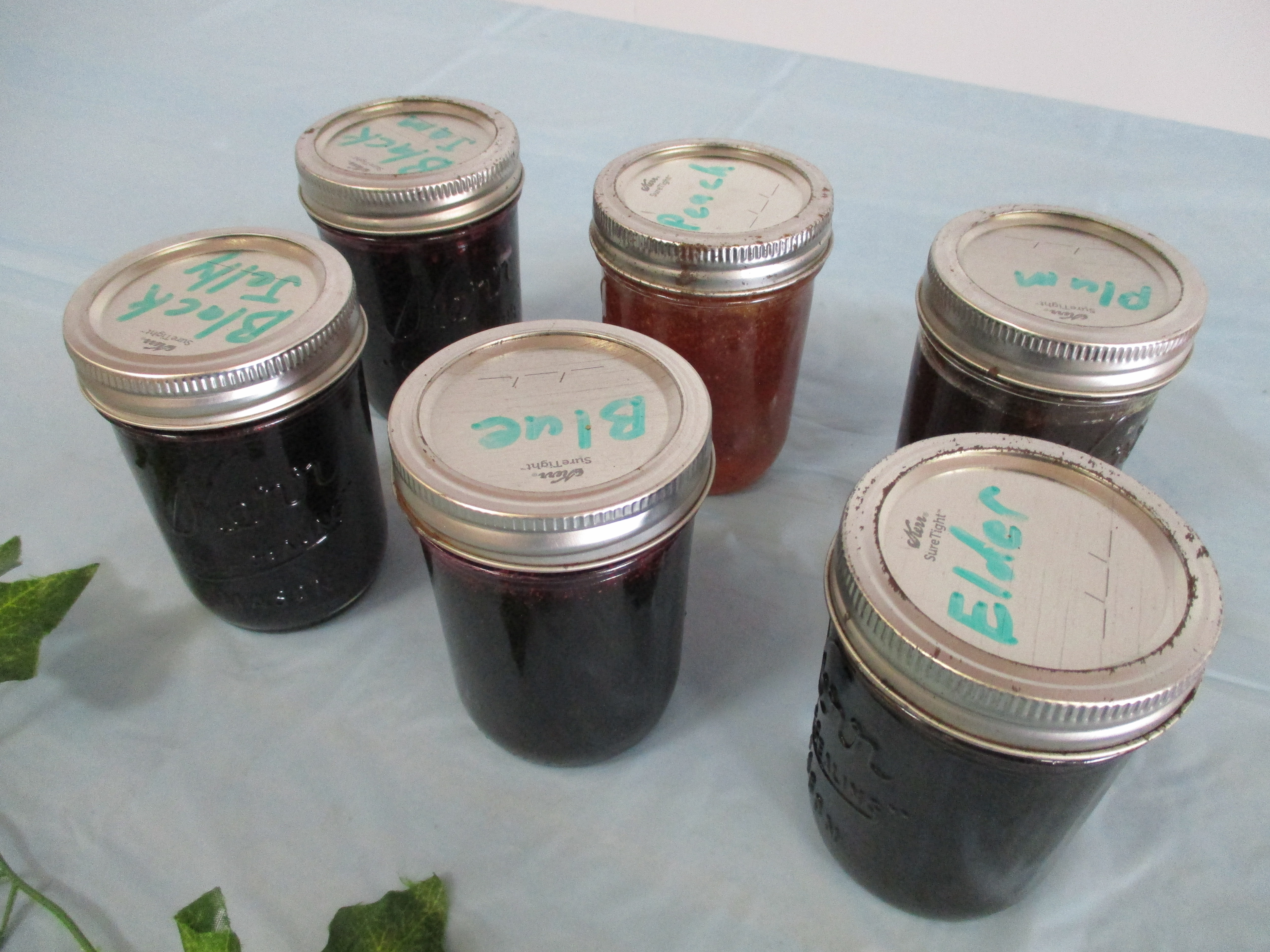
After all that fuss yesterday, about how much I wanted to win a first place blue ribbon for one of my jams or jellies at the Jam, Pie and Chili Contest of the Santa Cruz Mountains Harvest Festival, I must still do without! Not only did I not win the ever elusive first place blue ribbon that I so desperately crave, but for the first time ever, I did not win second or even third place!
However, it is not as disappointing as it seems. There were no ribbons to win. There was only the same single prize for each of the three categories, which is a winter pass for the hot tub and sauna at the Bear Creek Recreation and Community Center of Boulder Creek. Although it is not the blue ribbon that I can flaunt and brag incessantly about, it is a fabulously generous prize.
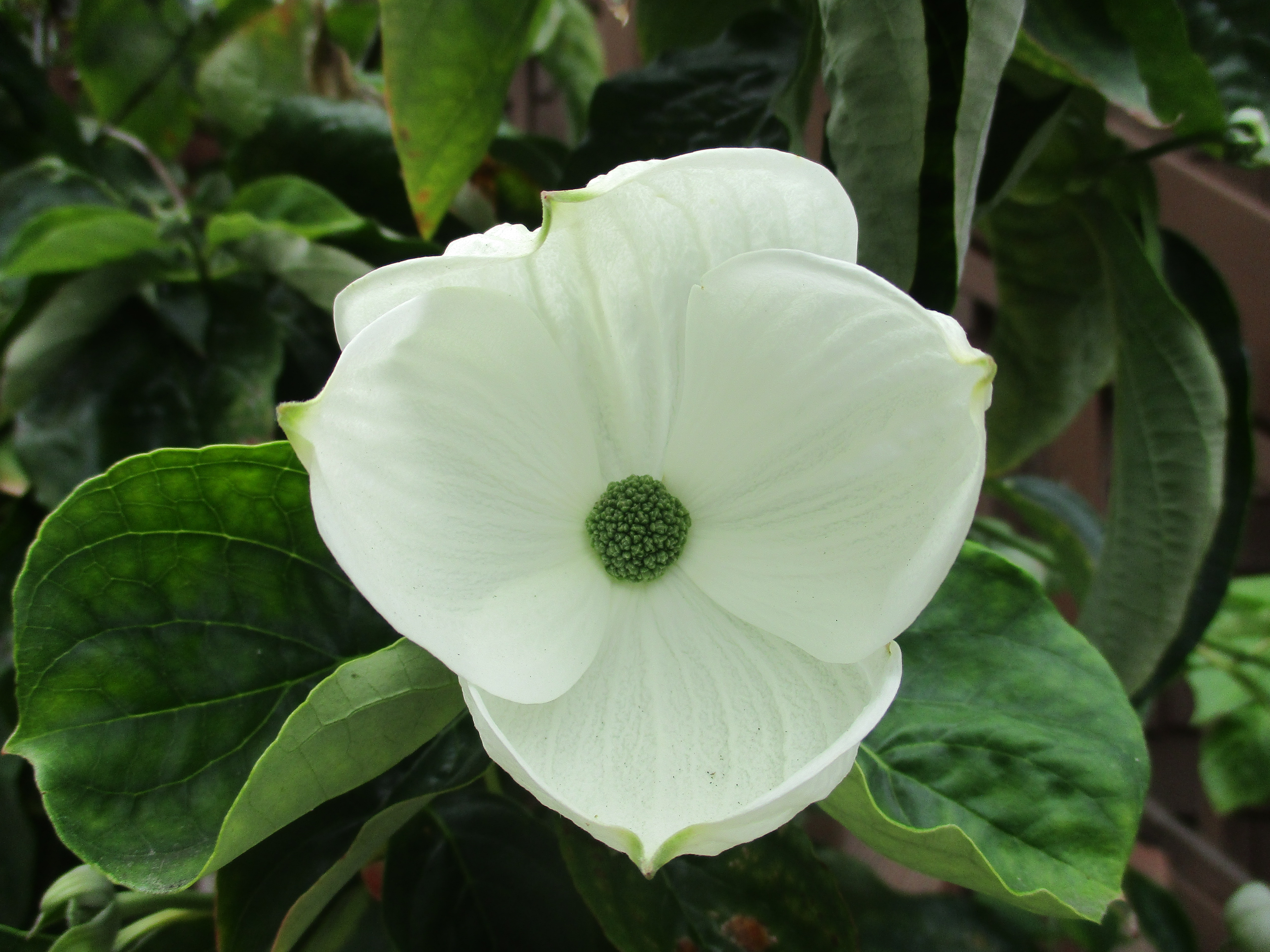
Three years later, these particular ‘Eddie’s White Wonder’ dogwood trees are more synchronized with the seasons, although they will likely always generate a few errant blooms.
Dog days of summer are no time for a dogwood to bloom. It should be slowing down and getting ready for autumn. Plump floral buds start to develop, but then wait dormant as foliage turns color and falls away. Only after winter dormancy, just prior to the emergence of new foliage, floral buds bloom spectacularly. September is either half a year too early or half a year too late.
So, what is this dog and pony show?! ‘Eddie’s White Wonder’ dogwood is blooming not only in our landscape, but in other regions too. It is not just because our six new trees were distressed from installation earlier this year. That process would not have affected other trees. It was not because of our locally variable weather. It affected too many trees in too many other regions.
I certainly do not mean to dog our trees for their eagerness to bloom…
Most of what comes to recover in the nursery here was originally from the landscapes at work. Some needed to be removed because it was deteriorating. Some was obstructive to another project. Some of what is here grows from seed that was found in the landscapes. Several plants here came from more unusual and unexpected sources. A few plants grew from seed or cuttings that I found while out and about elsewhere, merely because I took interest in them. Such procurement would not be such a bad habit if more of such plants were actually useful to the landscapes here. Vines require too much maintenance. Cacti, palms and tropical foliage are not sufficiently compliant with the style of our landscapes.
1. Salvia elegans, pineapple sage is the most likely of this Six to be useful to landscapes at work. I grew cuttings from a stem that was obstructive to my use of an ATM machine.
2. Distictis riversii (or Distictis ‘Rivers’), royal trumpet vine grew from cuttings of a wiry and stray stem that encroached far enough into a public parking space to annoy Carson.
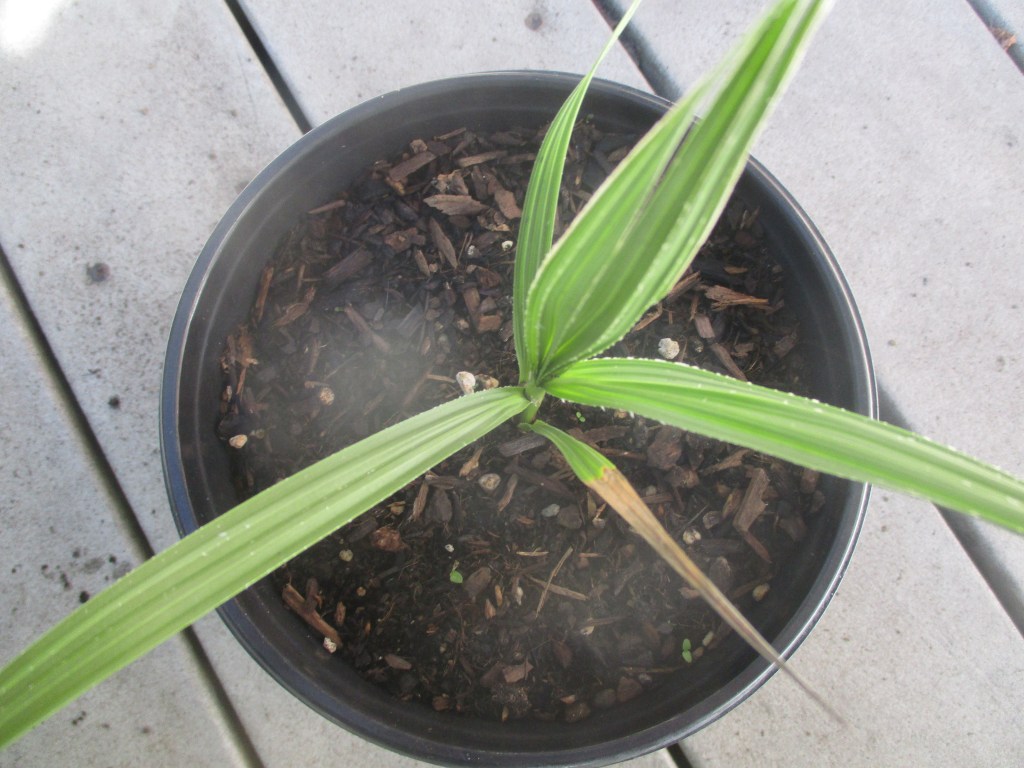
3. Washingtonia filifera, California fan palm, or desert fan palm, is the only palm that is native to California, but is rare locally. I took seed when I got the chance, but now what?
4. Musa basjoo, Japanese banana is one of four pups that I was quite pleased to acquire from an established specimen within a private garden. It now has three additional pups!
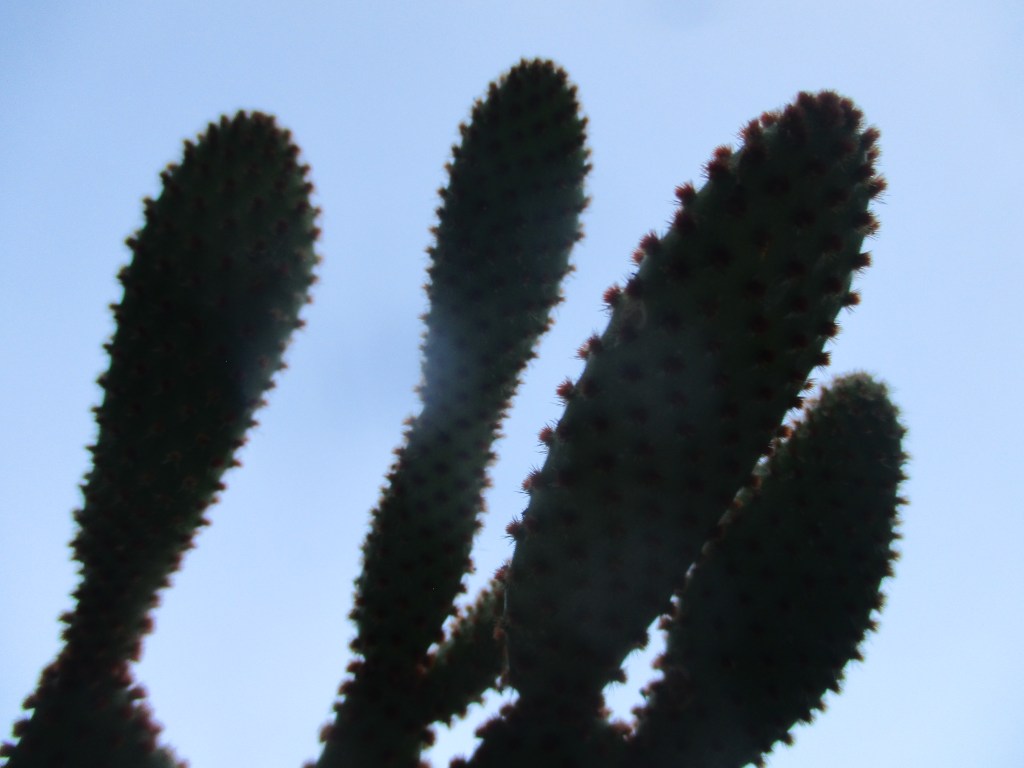
5. Opuntia microdasys, bunny ears cactus was originally a component of a prefabricated ‘terrarium’ of small tropical plants that need regular water. It was removed and left here.
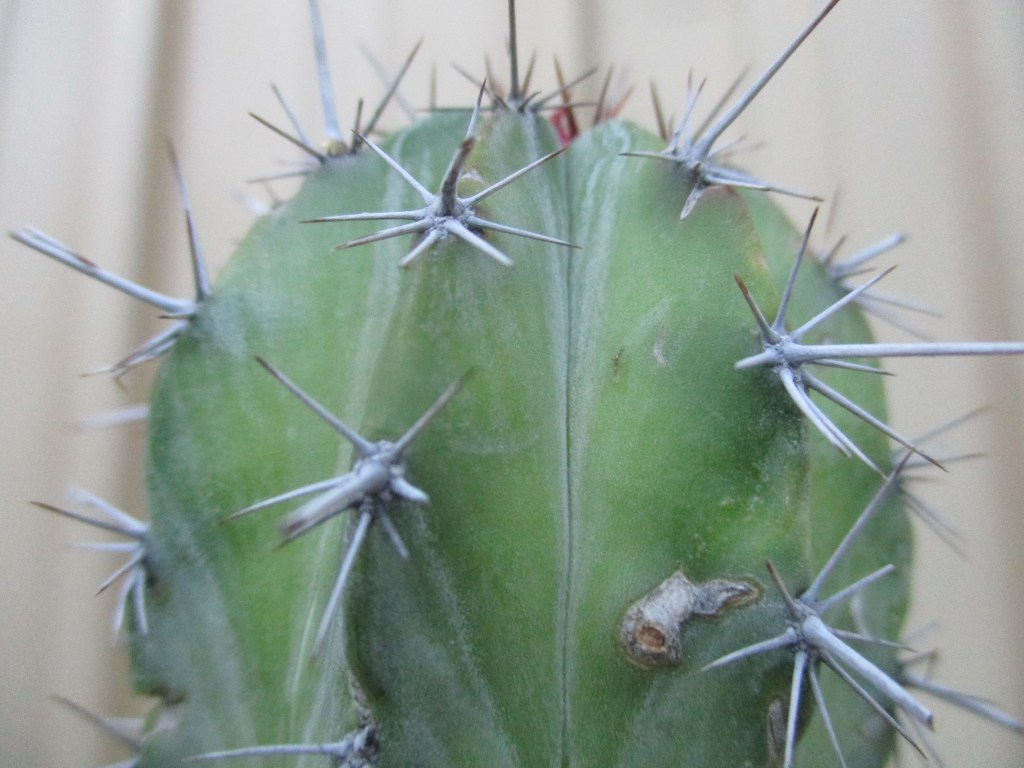
6. Carnegiea gigantea, saguaro cactus arrived with assorted potted succulents that were left by a relocating neighbor family. Actually though, I have no idea what species this is.
Pansy is one of the most familiar of cool season annuals.
All sorts of shades and combinations of yellow, orange, red, purple and blue, as well as white and monochromatic black can be found among the many varieties of pansy, Viola X wittrockiana. Pansy flowers are mostly about two inches wide, with a pair of overlapping upper petals, a pair of side petals and a single lower petal. Even though they stand only about half a foot high, flowers hover slightly above the foliage.
Here where winters are so mild, pansies get planted in autumn to bloom through winter, and then get replaced with warm season annuals in spring. They can survive through summer, but do not perform so well while weather is warm. Deadheading (removal of deteriorating flowers) promotes continual bloom. Related violas typically produce more profuse but smaller flowers, which are actually physiologically different.
Petunia must eventually be replaced, even if the tips of deteriorating stems continue to bloom.
Here in the mild climates on the west coast of California, the difficulty of getting new cool season annuals into the garden to bloom through autumn and winter is not selecting, procuring and installing the new annuals. It is the removal of the warm season annuals while they are still blooming and looking so good! Knowing that planting new annuals sooner than later will get them an earlier start is not always much consolation.
Pansy, viola, primrose, snapdragon and alyssum are probably the most familiar and favorite of cool season annuals, and are often allowed to bloom late into spring when they probably should be replaced by warm season annuals. Alyssum easily naturalizes, and can actually bloom all year in coastal or cool areas. Snapdragon are probably the most difficult of these favorites to grow, since they so often get infested with rust, a common fungal disease that proliferates where winters are mild.
Cornflower (bachelor’s button), stock, Iceland poppy, sweet William and calendula are probably a bit less popular only because they are not so conducive to mass planting as bedding plants. Cornflower and stock get taller than they should for beds, although they look great behind beds; and stock is excellently fragrant. Iceland poppy, sweet William and calendula do not often grow uniformly enough for large beds; and calendula does not offer much variety of color beyond shades of yellow and orange. Yet, all are great in mixed plantings.
Ornamental cabbage and kale are grown for their colorful foliage instead of flowers. Cabbage may be a bit more colorful; but kale can provide more variety of foliar texture. Because they form such bold rosettes of foliage that do not blend into each other like other bedding plants do, they are more often grown as narrow borders or in small mixed plantings instead of in broad uniform beds.
The ornamental potential of both Swiss chard and parsley should not be denied. Swiss chard has distinctively ruffled and glossy foliage that can be dark green or deep burgundy. Their prominent midribs and veins can be even more colorful with shades of greenish white, yellow, orange, red or pale purple. Parsley is rich green, with full, intricately textured foliage that happens to look quite sharp with white alyssum. The main problem with these two cool season vegetables is that their appearance can be compromised if they get eaten.
Do we really know the differences between watersprouts and suckers? It seems simple enough. The definitions of each should be rather distinct.
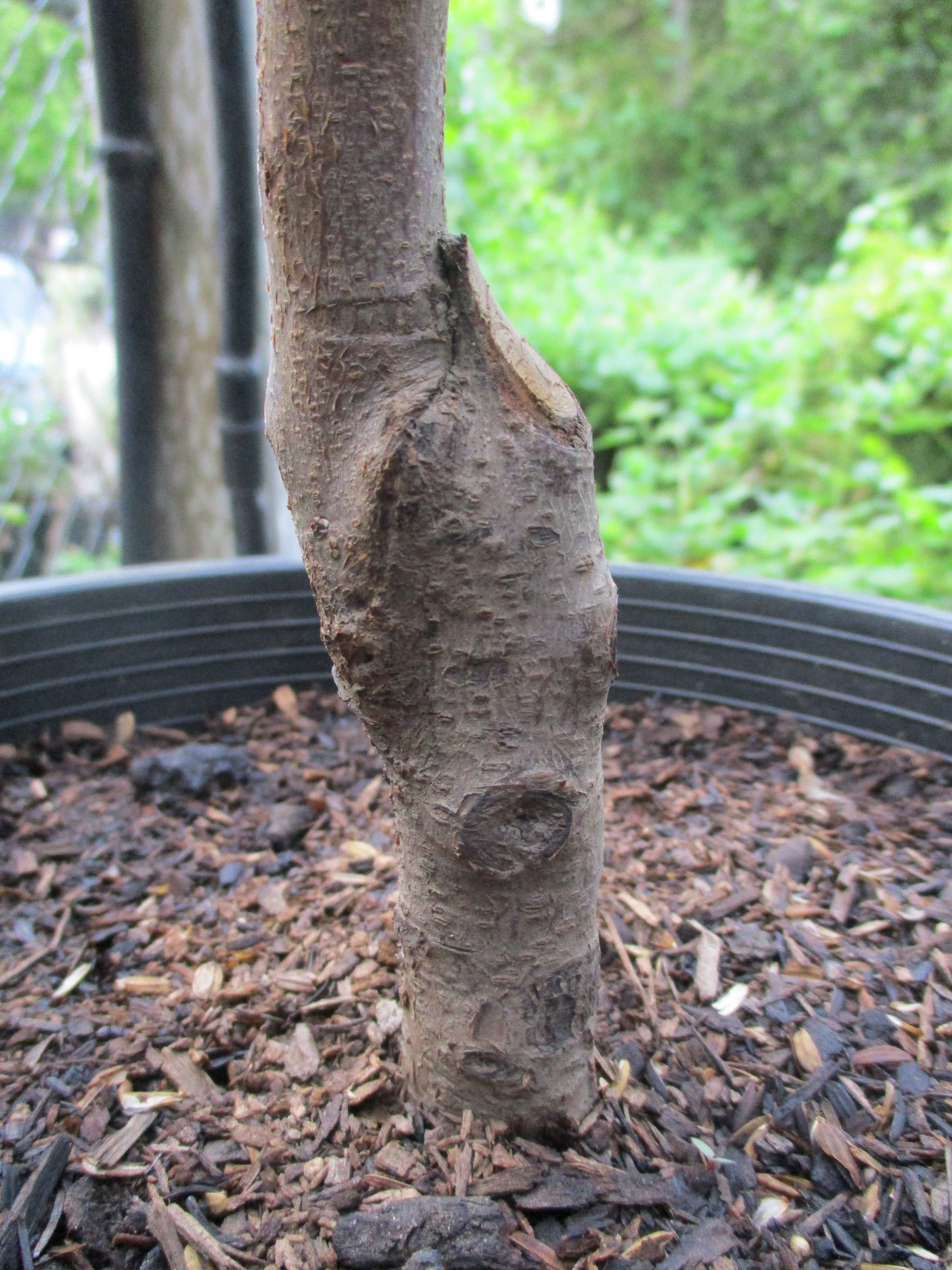
When I grew citrus, I knew what sort of sucker that I had to contend with. Suckers were any unwanted stem and foliar growth from the understock below the graft union. In the picture of the trunk of the young plum tree above, the graft union is clearly visible between the scion to the upper left and the understock to the lower right. Suckers would be below such a graft union.
This sort of sucker is known as such because it sucks resources that should be directed to the more desirable but often weaker scion. A sucker that is more vigorous than its associated scion is likely to overwhelm and replace it if not removed. Scions are expected on freshly grafted plants, but should become less prevalent as…
The Maya cultivated marigolds long before the French. After all, the ancestors of modern French hybrid marigolds, Tagetes patula, are endemic to Mexico and Guatemala. French horticulturists merely developed the hybrids that are now most popular. The largest might grow a foot high and wide. Otherwise, almost all grow lower as compact bedding plants.
Although many varieties of French hybrid marigold are available, their floral color ranges only through yellow, orange and red. Ruddy brown is merely dark orange. Creamy white is merely very pale yellow. Combinations of color within this minimal range are amazing nonetheless. White is rare only because richer traditional colors remain so very popular.
French marigolds are technically warm season annuals. With frequent deadheading and grooming, they can bloom from spring until frost. However, since they perform best while young, they are more popular as a shorter term annual. They often replace warm season annuals that finish a bit early, while the weather is still too warm for cool season annuals.
Cool season vegetables will replace warm season vegetables during autumn. Also, cool season annuals will replace warm season annuals. Neither simple task is easy for warm season plants that continue to perform too well to remove. Conversely, some finish early. Autumn annuals may compensate until cool season annuals become more seasonable.
Summers here are long, dry and somewhat warm. Even petunias and other annuals that enjoy warmth and tolerate aridity may not want to perform for so long. Without occasional grooming, they can get shabby by late summer. The recent unusually warm weather only accelerated the process for this year. Summer weather might continue into early autumn.
Consequently, it may still be a bit too early for some favorite cool season annuals that do not appreciate arid warmth. Pansies can get scrawny and lay low in response to warmth. Ornamental cabbage and kale is likely to bolt (general floral stalks) after exposure to too much warmth. Such annuals perform better or for a longer season after summer warmth.
This is why autumn annuals are so popular. They replace tired warm season annuals by the end of summer, and bloom until the weather is cool enough for cool season annuals. Autumn annuals generally bloom for shorter seasons than warm or cool season annuals, but most last until frost or significant rain. After bloom, a few are actually perennial plants.
Chrysanthemums and marigolds may be the most familiar of autumn annuals. Marigolds are actually warm season annuals that can perform just as well during spring or summer. Late installation allows late performance, which can continue until frost or sustained rain. Chrysanthemums are actually perennials, so can grow and bloom again for next autumn.
Celosia and alyssum, like marigold, are warm season annuals that perform late after late installation. Sweet William is a cool season annual that, after early installation, begins to perform earlier. Several types of aster naturally bloom late in summer or early in autumn. Even if nasturtium already succumbed to warmth, fresh seedlings may perform until frost. Old plants, prior to deterioration, could have provided seed, albeit feral, for their own replacement.

 After all that fuss
  Dog days of summer are no time for a dogwood to bloom. It should be slowing down and getting ready for autumn. Plump floral buds start to develop, but then wait dormant as foliage turns color and falls away. Only after winter dormancy, just prior to the emergence of new foliage, floral buds bloom spectacularly. September is either half a year too early or half a year too late.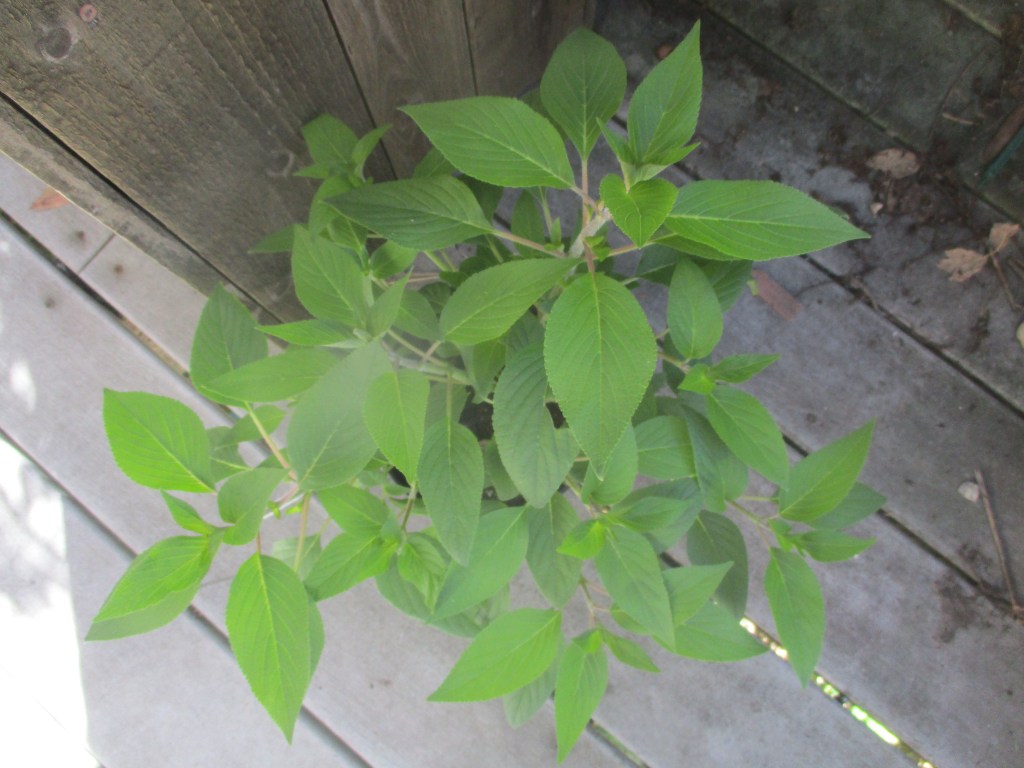




 Do we really know the differences between watersprouts and suckers? It seems simple enough. The definitions of each should be rather distinct.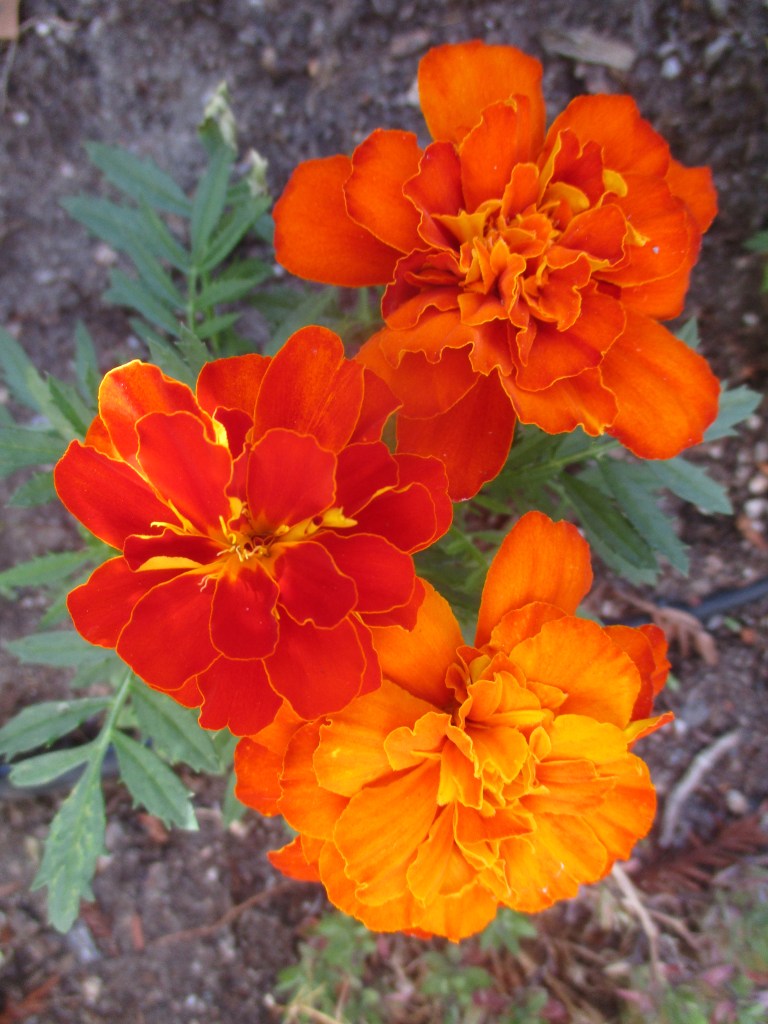

 Tony Tomeo