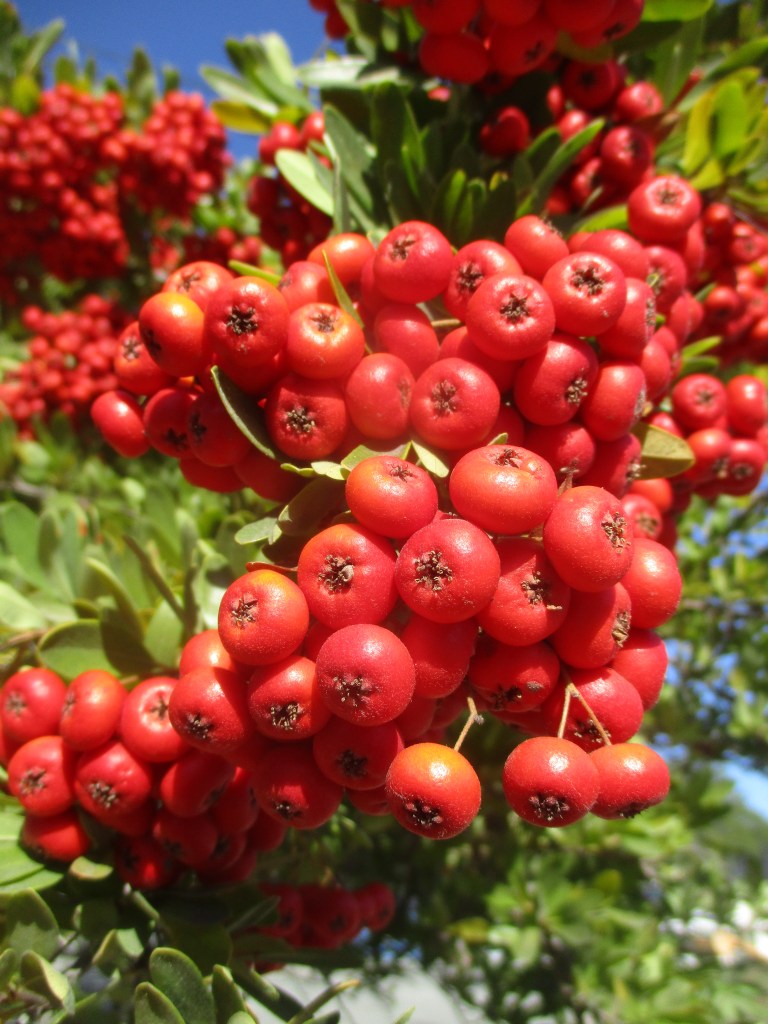
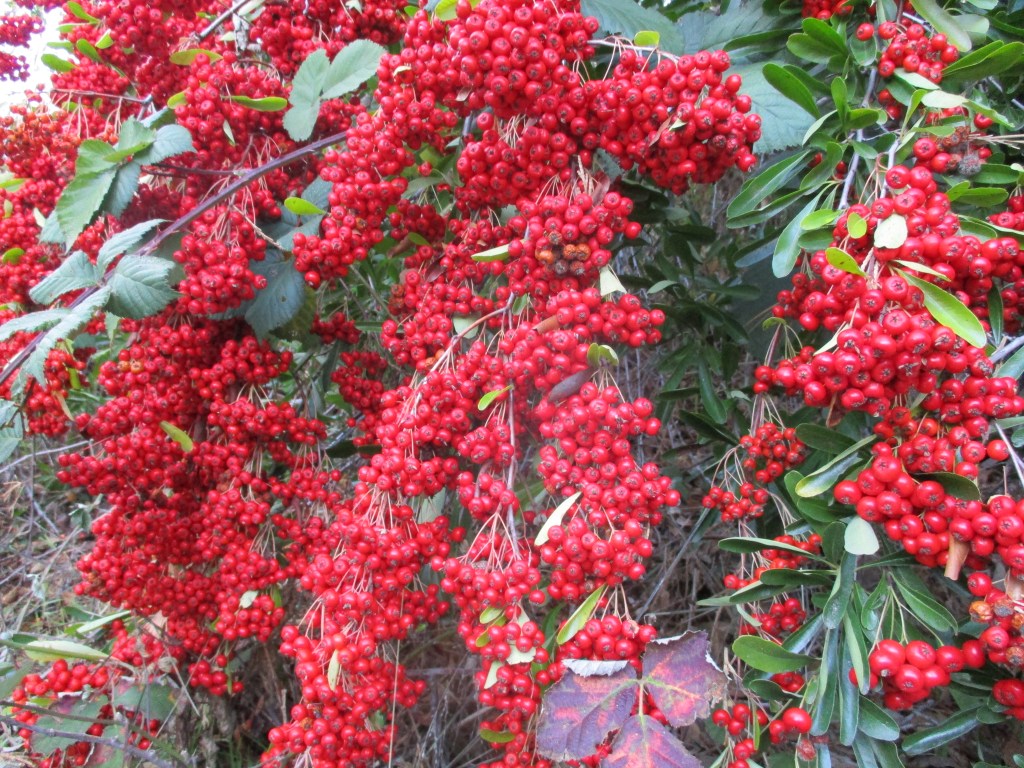
Its name says it all. Firethorn, Pyracantha coccinea, produces an abundance of fiery red berries on unavoidably thorny stems. A few old fashioned cultivars produce equally fiery orange berries. Cultivars with fiery yellow berries are now rare. Berries ripen for autumn, in time to feed migratory birds. Late berries can last longer after migratory birds are gone.
The rigid and wickedly thorny stems of firethorn work well as impenetrable hedges. They are rather difficult to prune and handle without impalement though. Unfortunately, simple shearing deprives formal hedges of some of their new growth that blooms and fruits most abundantly. Selective pruning is tedious and more hazardous, but might enhance bloom.
Shrubby cultivars of firethorn can grow higher than first floor eaves. Mature and vigorous hedges with hefty interior trunks at such height can generate spirelike growth that almost reaches second floor eaves. With pruning, some cultivars that sprawl close to the ground can stay quite low. Without pruning, some slowly form thickets that are several feet deep.
Bloom and colorful foliage provide most of the color besides green within home gardens during spring and summer. Deciduous foliage becomes more colorful for autumn. Winter berries and a few other lingering fruits become more colorful as deciduous foliage sheds through winter. All this color adheres to precise schedules within a collective ecosystem.
Many plants exploit wildlife. It is how they compensate for their immobility. Many provide incentive for the services that they desire from the wildlife that they exploit. For example, after enticing pollinators with fragrance or color, flowers happily exchange extra pollen or nectar for pollination. Many plants provide edible fruits in exchange for seed distribution.
It is no coincidence that so many different winter berries ripen through autumn for winter. They provide sustenance to many migratory birds who rely on them. Overwintering birds who compete with migratory birds appreciate their efforts as well. Such winter berries are small but abundant, for ‘grab and go’ convenience. Bright color is the best advertisement.
Some people appreciate how winter berries attract birds and squirrels into their gardens. Some appreciate the seasonal color of such berries more than the wildlife. Unfortunately, wildlife decides the outcome, and such outcomes are variable. It is impossible to predict if berries will disappear as they ripen, or linger as they deteriorate through most of winter.
Firethorn is likely the most familiar of the winter berries here. It seems to be more prolific with its brilliant red berries than any other species. Some old fashioned cultivars produce bright orange or perhaps even bright yellow berries. Some sorts of cotoneaster resemble firethorn, but with subdued rusty or orangish red display for less refined woodsy gardens.
Toyon, or California holly, is most prolific with winter berries where it grows wildly without pruning. It gets big though. Real hollies, which are more popular in other regions, do not produce many berries locally, particularly since male pollinators are uncommon. English Hawthorn is a small deciduous tree that displays berries that resemble those of firethorn, but on bare stems.
While in the Los Angeles region a month or so ago, it was gratifying to see some of the trees that we installed within the median of San Vicente Boulevard years ago.
Much of my work involves street trees. They need more of my kind of attention than most other trees. They must conform to more restrictive limitations. They endure more abuse. They are the most prominent trees on urban properties. Because some are assets of their respective municipalities, they are more stringently protected by local ordinances than other trees are.
I planted quite a few street trees too. While selecting trees for the medians of San Vicente Boulevard in Los Angeles, we considered the clearance of the lowest limbs above the highest truck traffic, the docility of roots under curbs and pavement, the potential for foliar debris, the resiliency to neglect, and the resistance to pathogens. Those were just some of the major concerns.
We sort of wanted them to look good too.
Ginkgoes, at least modern (fruitless) cultivars, work well as street trees. They are tall and slender, and can…
There have been only three hints at precipitation since last spring.
The (sideways) picture above shows the same dampened hood of a Chevrolet that provided the illustration for a post on another blog on September 30.
The picture below shows a similarly dampened but different windshield from that which provided the illustration for a post on November 16, regarding a bit of precipitation two days prior, on November 14.
All four pictures here were actually taken just after a very brief rain shower that happened just after midnight on November 19. I tried to be artistic with them, but I am not a photographer.
The picture below demonstrates how difficult it is to hold the camera steady while getting a close up picture of rain dripping from a lumber rack at night. Do digital cameras automatically extend exposure to accommodate for the darkness? Is it blurred or merely…
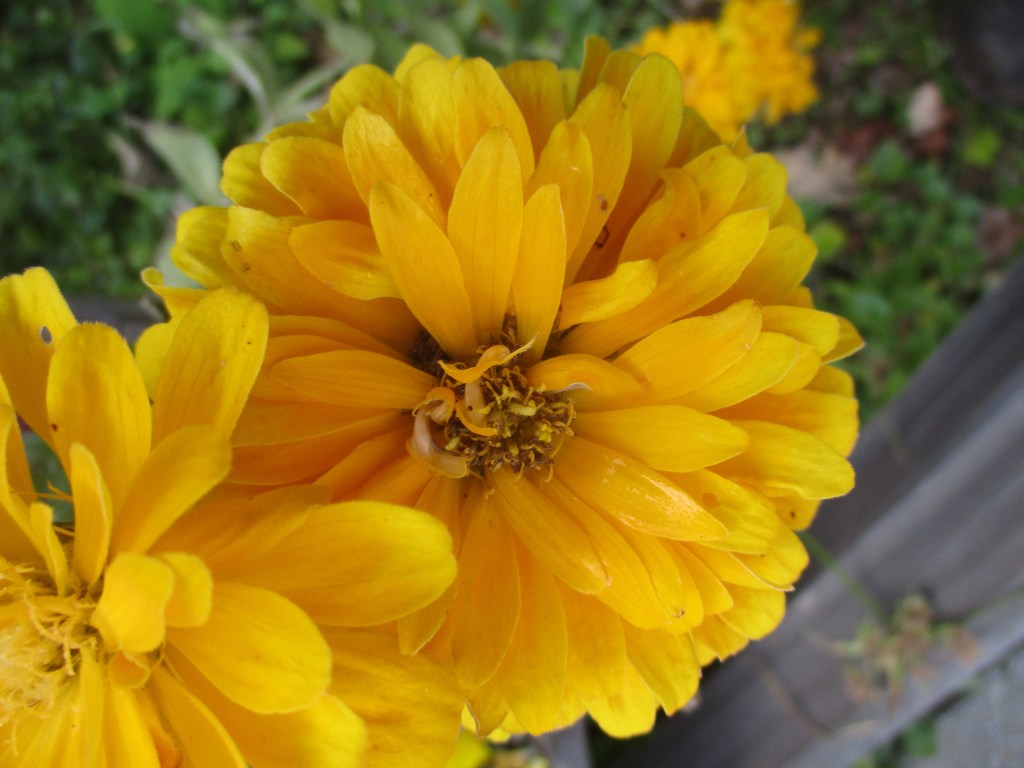
Zinnia are enviable. They seem to perform exemplarily for everyone else and everywhere else. They have never done well for me though. I can not explain why. I stopped trying to grow them many years ago, but I encounter them at work, where the other horticulturist grows some as warm season annuals. This year here, some performed reasonably well as bedding plants, and a few more bloomed impressively within a pair of half wine barrels. They are done now that the weather is cool, but I got a few pictures of them as they were removed and replaced with pansies for winter.
1. Yellow is a primary color, but the scarcest among the few prolific zinnia that grew in a pair of half wine barrels through summer. Only one of the ten zinnia here bloom yellow.
2. Orange is a secondary color between yellow and red, but is a bit more abundant in our barrels than either yellow or red. Maybe three or so of the ten zinnia here bloom orange.
3. Red is another primary color, which is beyond orange from yellow. Perhaps two or so zinnia bloom red, but they are less profuse than those that bloom pink, orange or white.
4. Pink is not really a color, but is merely a tint of red, or red mixed with white. Only two of the ten zinnia here bloom pink, but they are bigger and more profuse than the others.
5. White should be my favorite, but to me, seems to be mundane relative to other colors. Two of the ten zinnia bloom white, but they are neither prominent nor prolific in bloom.
6. Rhody is as unimpressed with our unusually florific zinnia as he is uncooperative with my attempts for a good picture of him. Fortunately, even a bad picture of Rhody is good.
With such densely foliated low limbs reaching the ground, Colorado blue spruce functions as much as large shrubbery as a small tree.
Colorado and Utah share the same stately state tree; the Colorado blue spruce, Picea pungens, which is native to the Rocky Mountains between Arizona, New Mexico and southern Idaho. Colorado blue spruce are stoutly conical trees that grow slowly to eventually get more than seventy five feet tall. Where they need to compete with other trees in forests, the biggest are nearly twice as tall with trunks nearly five feet wide. However, because they grow so slowly, and do not get much bigger then they need to, well exposed trees stay proportionate to home gardens for many decades. Many shrubby compact cultivars actually stay less than ten feet tall. Foliage can be grayish green to silvery pale blue. The stiff and sharply pointed needles are about three quarters to an inch and a quarter long, and densely set on relatively rigid stems.
The elegant silvery blue foliage of the Colorado blue spruce is striking either in front of or behind darker evergreen foliage, like that of redwoods or junipers. These stout and densely foliated trees make any garden look a bit more woodsy.
Pyracantha, although inedible, is likely the most colorful of the winter berries here.
Seasonal color is as variable as the weather. Just as the many different spring flowers bloom differently every spring, and the autumn foliage color is different every autumn, the colorful berries and fruits that linger on many plants through winter respond to the weather. Then, the various birds and other animals that devour them do so at different times, and at different rates every year.
Pyracantha (or firethorn) is probably the most reliable for an abundance of brightly colored red berries. Old varieties with orange or even yellow berries are very rare, perhaps because they are comparably wimpy. Unfortunately, because they are so colorful, and also because they ripen before many of the migratory birds have gone, the berries often get eaten by birds soon after they ripen.
Berries of the various cotoneasters are not quite as colorful, and many ripen slightly later, so they are not so efficiently stripped by birds. Cotoneasters are now more popular than related pyracantha because there are so many varieties with so many different growth habits. Larger types grow into large shrubbery while prostrate types grow as ground cover. Cotoneaster also has the advantage of lacking thorns.
The native toyon can provide large clusters of similar red berries, but only if it is allowed to grow somewhat wildly. It is unable to bloom and subsequently produce berries if regularly shorn. Yet, even in the wild, toyon is unpredictable. Because damp weather can cause berries to rot before they ripen, toyon may be unproductive for many years, and then produce remarkably colorful displays of berries when least expected.
Hollies are the most familiar of colorful winter berries, but are not as colorful as pyracantha or the various cotoneasters because they are almost never provided with male pollinators that they require to develop fruit. Fortunately, their remarkably glossy and prickly foliage is appealing alone.
Flowering crabapples are grown for their impressively colorful pink, white or nearly red spring bloom, but some types also produce sparse and minute red, orange or even yellow crabapples that stay after the foliage turns yellow and falls. English hawthorn lacks the flower color of flowering crabapples, but has more abundant and colorful red or orange berries that linger into early winter after the foliage is gone, or at least until birds find them.
One of these things is not like the others
One of these things just doesn’t belong
Can you tell which thing is not like the others
By the time I finish my song?
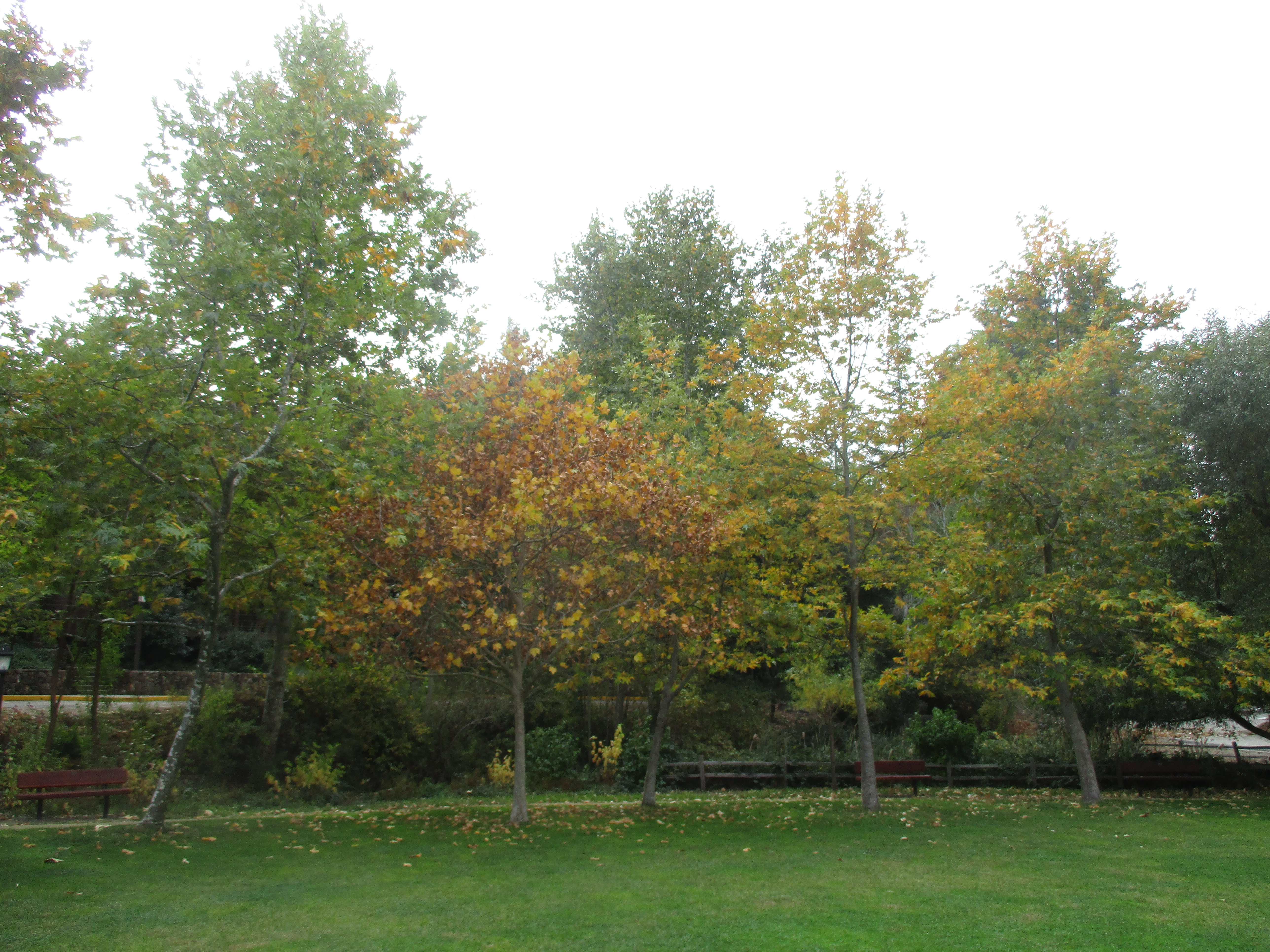
Identifying a blue balloon as different from three red balloons might be construed as discriminatory, but was fun back before we went into kindergarten. So was selecting the bigger bowl of Big Bird’s birdseed from three small bowls; or the beanie from three pairs of sunglasses; or the letter from three numbers. It is not so fun now, when conformity to a landscape is important.
In the picture above, one of the four prominent trees in the foreground of the walkway and rail fence, excluding the obscured middle tree, is different from the others. They are all the same age. They are all sycamores. They are all happy and healthy. They were…
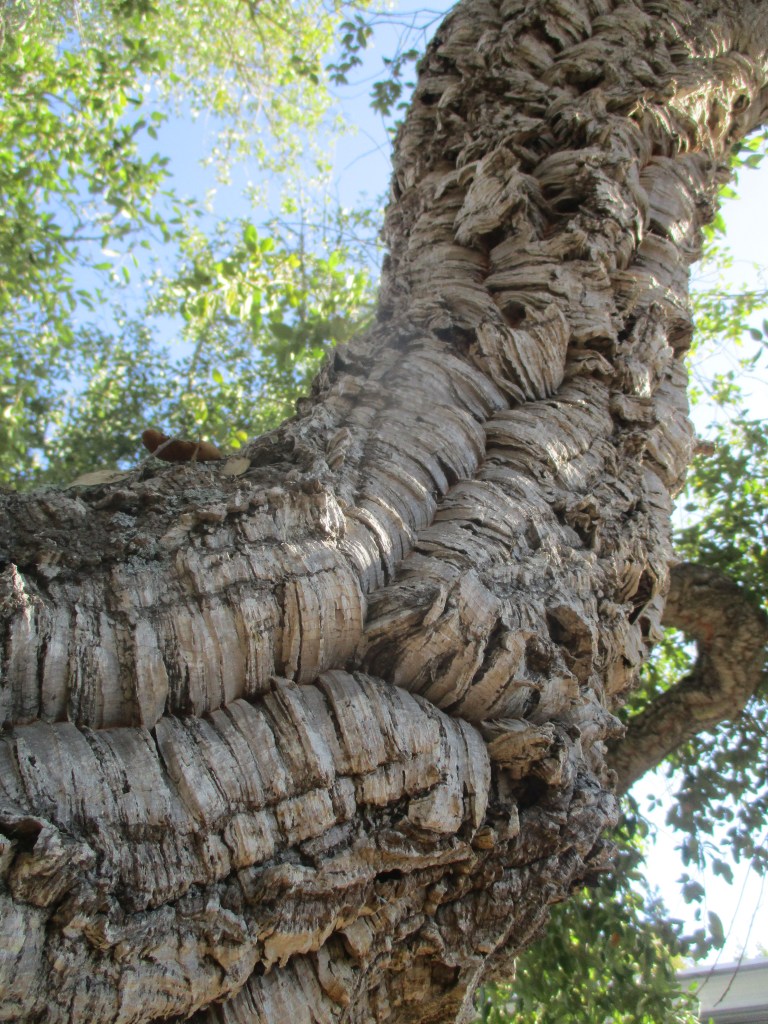
This is a tree that takes some time to impress. Bloom is uninteresting. Foliage is no more distinctive than that of coast live oak. Instead, the most spectacular characteristic of cork oak, Quercus suber, is the boldly striated and uniquely spongy texture of its mature bark. Such bark takes a few years to develop, but gets so thick that it seems significantly older.
As its name implies, cork oak had historically been the exclusive source of bark for corks and cork products. As modern and more practical materials diminished demand for such bark, cork oak became more popular as an evergreen shade tree. It is quite happy within the arid chaparral climates of California. In fact, it behaves much like native oak species.
Mature cork oak trees generally stay less than forty feet tall, even if their trunks are wider than three feet with their unusually thick bark. Without excessive irrigation, their roots are notably complaisant. Low branches are more visibly sculptural than high branches. With pruning for adequate clearance though, trees with high branches are striking street trees. Foliar and floral debris is quite messy during spring bloom.
Chimney clearance pruning is easy to overlook nowadays because, for various reasons, chimneys are becoming obsolete. Modern homes lack them completely. Some chimneys of older homes succumbed to earthquakes. Because of simpler and cleaner alternatives for heat, remaining chimneys and their fireplaces, as well as firewood, are almost passe.
Ironically, chimineas and fire pits have become a fad. Most modern fire pits use propane for fuel, but a few use firewood. Although such fire pits and chimineas burn less firewood than fireplaces, they are ridiculously less efficient. Their warmth simply escapes into the atmosphere. Relative to the volume of wood they burn, they generate much more smoke.
Nevertheless, whether for fireplaces, wood stoves, fire pits, or chimineas, firewood is not yet completely obsolete. Some households only rarely use small quantities for ambience fires. Some households still use more significant quantities to supplement home heating. A few households rely on firewood as their primary or exclusive source of home heating.
For unrelated reasons, the availability of firewood has declined with its demand. Orchard trees that were still relinquishing their space decades ago are now gone. Also, wildlands are now farther from large urban regions where most people live. Wood from demolished buildings is more likely to become chipped mulch than to become available as firewood.
Fortunately, most tree services sell firewood that is a byproduct of their work. Such wood is generally a mix of various species, so may include some degree of softwoods, such as pine. Rural tree services are more likely to be able to provide specific types of hardwood, and are also more likely to be able to deliver it. Their softwoods might be less expensive.
Tree services prefer to leave wood where they do tree work, and actually charge a bit for removal. Cut rounds of logs should be firewood length, but need splitting and seasoning. Inadequately seasoned or damp wood generates more smoke than properly dried wood. It should stay sheltered from rain. Palms and yuccas are impractical for use as firewood.


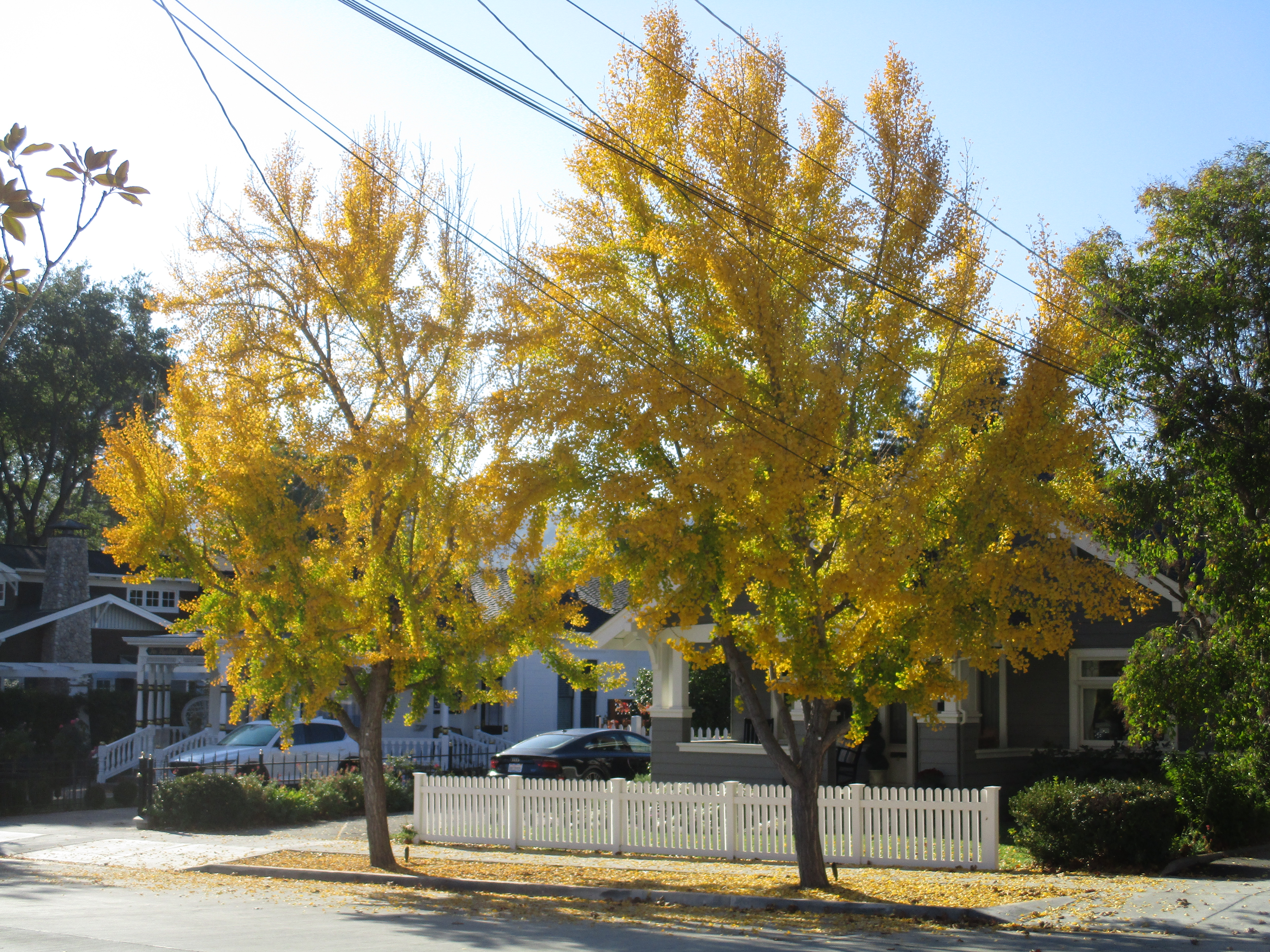 Much of my work involves street trees. They need more of my kind of attention than most other trees. They must conform to more restrictive limitations. They endure more abuse. They are the most prominent trees on urban properties. Because some are assets of their respective municipalities, they are more stringently protected by local ordinances than other trees are.
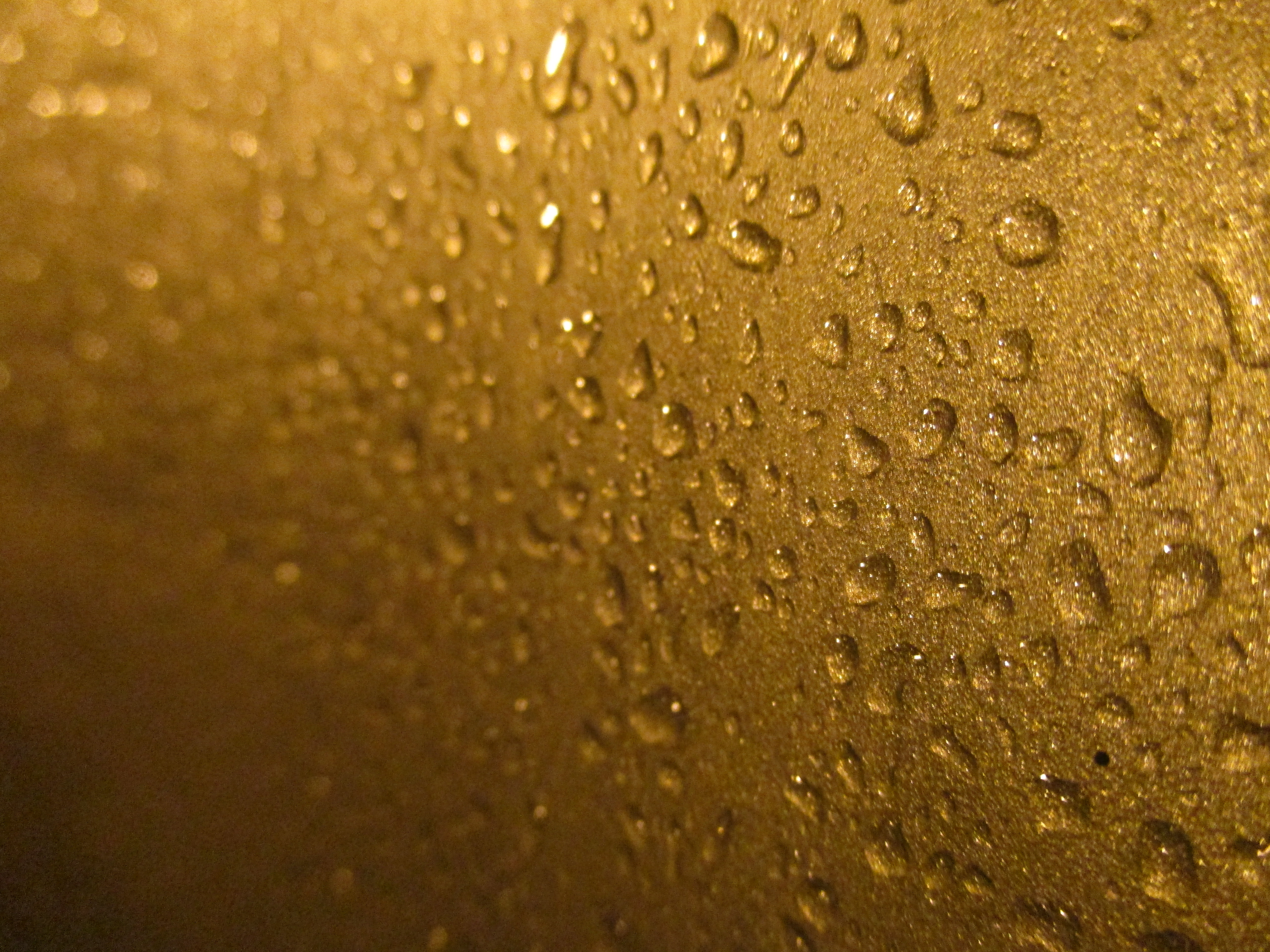 There have been only three hints at precipitation since last spring.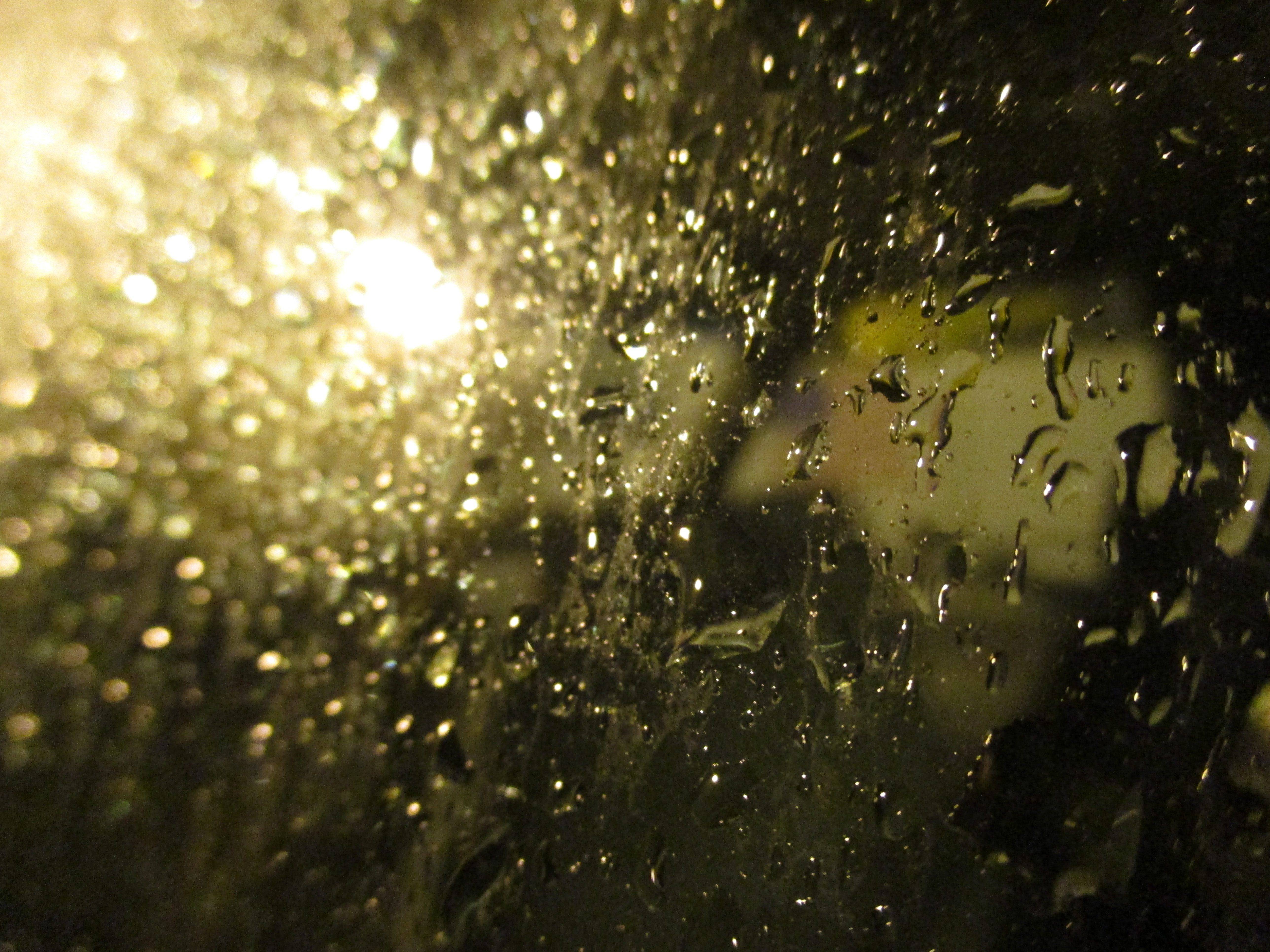


 Remember this from Sesame Street?