Felton League

This old article is irrelevant to horticulture or gardening, but is reblogged here now for consistency with the reblogging of all of the other articles from that time. It explains the source of the few articles that are shared from my other blog.

tonytomeo's avatarTony Tomeo

P81007

When I started posting my weekly gardening articles here, along with a few other odds and ends, I reserved the right to occasionally post articles or information that is not directly related to horticulture. I do not do it often, but I will do it now, in order to briefly explain another blog that I started today.
Felton League
It will feature articles and insight about the distinguished small group of displaced or socially marginalized people and their friends in Felton in California. In other words, it will be about our homeless Community.
In about 2013, at a time when the homeless were more openly persecuted and assaulted, and evenly violently attacked, Felton League began as an informational forum on Facebook. We had been discouraged by the portrayal of the homeless in other so-called ‘community’ groups. Disparaging pictures, often contrived, were shared openly for the amusement of haters. This is…

View original post 308 more words

Six on Saturday: Rhody’s Rhodies 2022 – Pretty In Pink

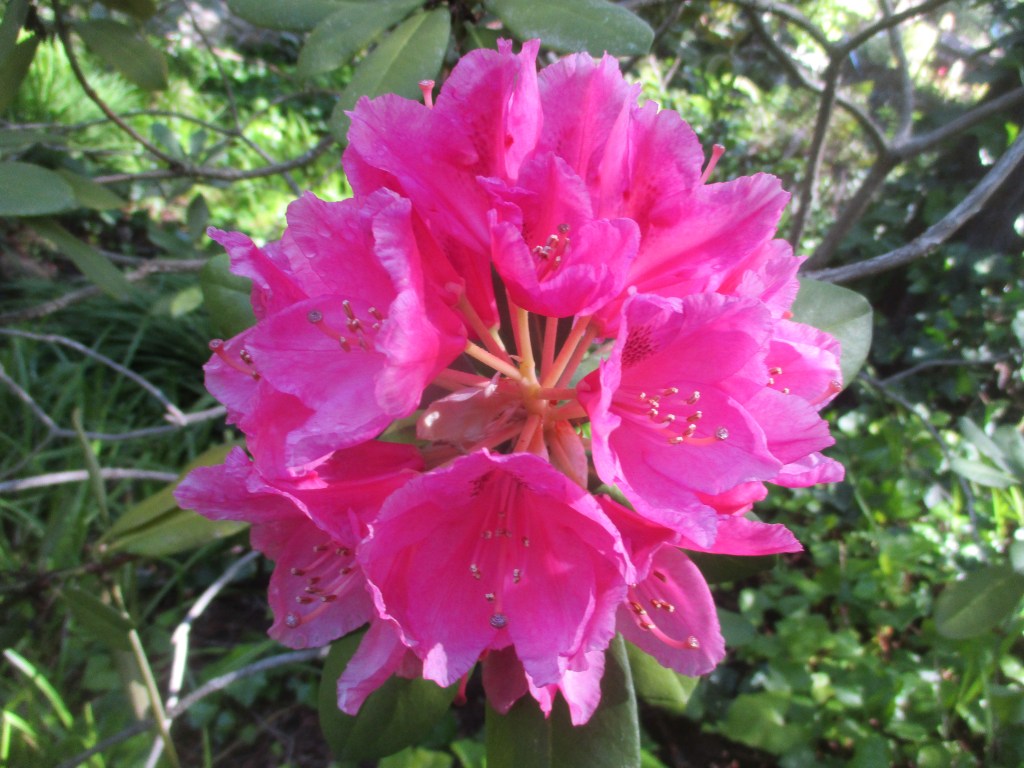
There are too many rhododendrons here. Working with them in a landscape situation is very different from growing them on the farm. The farm generates hundreds of primary cultivars, with hundreds of others to potentially introduce. Thousands of plants grow in cans on much of forty acres. Ideally, most develop an abundance of floral buds, but then leave the farm prior to bloom. Here, only a few hundred rhododendrons bloom well and mature within their landscapes with no intentions of ever leaving. These are mostly pink with one that blooms pinkish red.

1. Mothers’ Day Rhododendron blooms reliably for Mothers’ Day annually, regardless of how early or late other neighboring rhododendrons bloom. No one knows its real name.

2. Now that I see this one in this picture, I do not remember if it was more rosy in color. It seems to be a simpler but bright pink now. I am not so proficient with analyzing color.

3. This one also seems to be a bit different from how I remember it. I thought that it was more like watermelon red, rather than reddish pink. This is why I will not choose colors.

4. Oh, I should remember the name of this one. My colleague grew it! I delivered it years ago. It looks like ‘Rocket’ but I do not believe that it is. I should have saved the old label.

5. Of these Six, this is the only rhododendron that I know the name of, and is one of only a few that I may identify here. It is one of the most common cultivars; ‘Mrs. G. W. Leak’.

6. Most of our rhododendrons here are pink or purple. Only a few are red. This might be the darkest red here. I refer to it as ‘Taurus’, but it is not. Individual flowers open widely.

This is the link for Six on Saturday, for anyone else who would like to participate: https://thepropagatorblog.wordpress.com/2017/09/18/six-on-saturday-a-participant-guide/

African Daisy

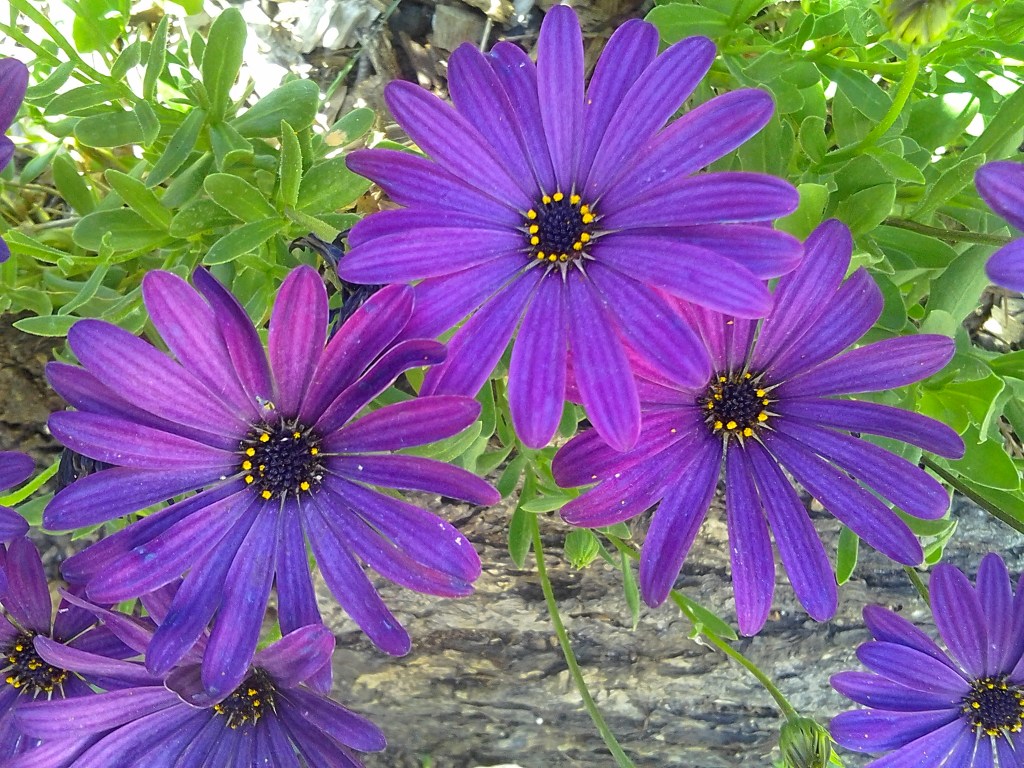
Modern African daisies are surprisingly colorful.

Only a few decades ago, the only familiar African daisies, Osteospermum spp., were the sprawling and often sparsely branched ‘freeway daisies’ with blue-eyed white or rarely light purple flowers. They made nice blooming ground cover that could be planted in drifts for a bit of color among the deep green of Algerian ivy on expansive freeway embankments.

Modern varieties are shrubbier perennials with more profuse bloom of white, cream, pink, purple, pale yellow or pale orange flowers, mostly with blue or purple centers. Some yellow flowers have yellow or cream centers. Some of the fancy types have spooned petals like some types of cosmos or chrysanthemums. After the primary bloom phase in spring, a few sporadic flowers may continue to bloom through summer until the secondary light bloom phase late in summer. However, the old fashioned ‘freeway daisy’ types do not always display a second bloom phase. Varieties with variegated foliage are still rather rare.

Even though African daisies can survive in inferior soil with minimal watering, they perform best with good soil and regular watering. Plants in containers can not disperse their roots like they want to, so are are more dependent on regular watering. Fertilizer prolongs bloom.

Watering Water Wise Plants

Excessive watering rots drought tolerant yarrow.

Native plants like coast live oak, valley oak, toyon, flannel bush, Western redbud and California lilac (ceanothus) are among the most resilient of plants as the weather gets dry and warm after spring. So are plants from similar climates, like bottlebrush, oleander, rockrose, grevillea, acacia and eucalyptus. They survive dry summers by dispersing their roots deeply into soil that does not get as desiccated as surface soil naturally does (without irrigation).

Ironically, these most resilient plants can also be difficult to work with while they are young. Because they rely on extensive root dispersion for survival, new plants that have not yet dispersed their roots can not survive long without regular watering. They only become tolerant to drought as their roots disperse into deeper soil.

However, because they are adapted to arid conditions, they do not like to be too damp for too long. Roots soon rot in soil that does not drain adequately between watering. They therefore need to be watered frequently, but not too frequently. Yes, that is as confusing as it sounds.

To make it even more confusing, these plants will need less watering as they mature and disperse their roots. Bottlebrush, oleander, contoneaster, hop bush, firethorn, grevillea and juniper can certainly tolerate more water than they really need; but wasting water is contrary to selecting drought tolerant plants to conserve water. Manzanita, coyote brush, rockrose, flannel bush and redbud may actually succumb to rot if watered too much. Even perennials like Pacific coast iris and yarrow can have problems.

Pine, oak, acacia and especially eucalyptus disperse their roots as soon as they can, so do not want to be confined in containers. It is therefore best to plant smaller young specimens than larger ones. #5 (5 gallon) eucalypti get established in the garden more efficiently than larger but more expensive #15 (15 gallon) trees. If #1 trees were available, they would be even better.

Horridculture – Fake Environmentalism

Ah, the hypocrisy of NIMBYs. Actually, though, few of us consider how our lifestyles, regardless of how simple, affect the environment.

tonytomeo's avatarTony Tomeo

P90515Fake environmentalism is a HUGE topic, so for now, will be limited to fake environmentalism as justification for the eviction of homeless encampments.
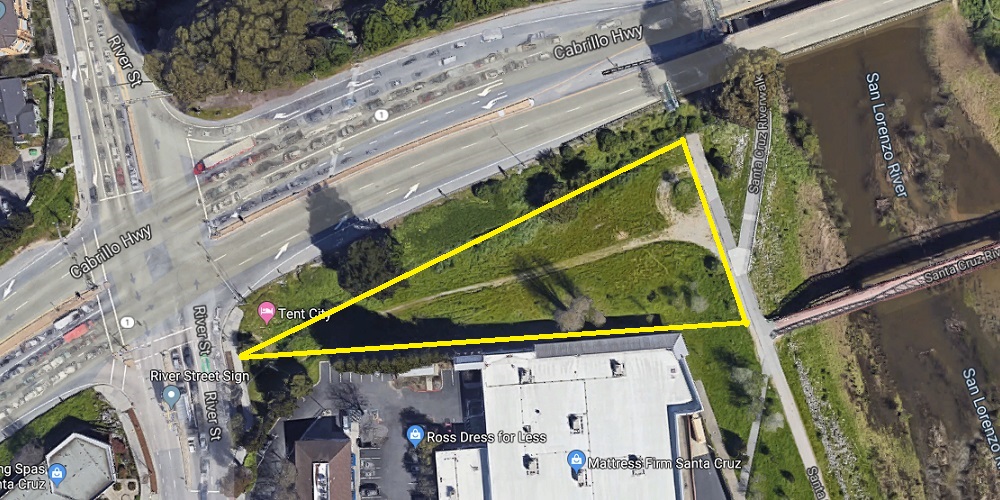
The yellow triangle in the picture above was the site of the Hero’s Camp, which was more commonly known as Ross Camp, and located behind Ross Dress For Less in Gateway Plaza in Santa Cruz. It is gone now. This satellite image was taken by Google Maps prior to the development of the Camp. I did not get pictures of the camp while inhabited, but you have likely seen enough other camps in the news to imagine what it looked like.
It really was as big as it looks, and really did exhibit all the problems that you hear about in the news, although not to such an exaggerated degree. Not everyone there used syringes to inject illicit narcotics. Not everyone there was an alcoholic. Not everyone…

View original post 717 more words

Tanoak

Tanoak is rare within refined landscapes.

Its plump and inch-long acorns are misleading. Tanoak, Notholithocarpus densiflorus, is not actually an oak. Otherwise, it would be a species of Quercus. Regardless, its wood is potentially as practical for furniture and flooring as wood of other oaks. It also works very well as firewood. Historically, tanoak bark was useful for tanning leather, hence its name.

Although native and somewhat common in some coastal forests, tanoak is almost never a choice for intentional planting. Those that inhabit home gardens likely either grew from acorns, or were there prior to development of the landscapes. Young trees can grow fast to more than forty feet tall, typically with conical form. Mature trees might get twice as tall.

Tall trunks of tanoak are elegantly upright, and eventually develop lofty branch structure. Their gray or brownish bark is handsomely furrowed. The somewhat leathery evergreen foliage produces potentially objectionable tomentum. The dentate leaves are two to four inches long. Sadly, tanoak is very susceptible to Sudden Oak Death Syndrome (SODS).

Evergreen Foliage Has Distinct Advantages

Evergreen foliage is shady all year.

Gardening was easier before suburban lifestyles became so passe. Now, larger modern urban homes occupy smaller urban parcels. Modern fences are taller to enhance privacy for such densely situated homes. Garden space is both minimal and shaded by so much infrastructure. Ironically, shady evergreen foliage is now more practical for such gardens.

Deciduous trees are still practical for single story suburban homes on suburban parcels. They provide cooling shade for summer, and allow warming sunshine through for winter. Smaller evergreen trees and shrubs closer to fences obscure unwanted scenery beyond, without shading homes during winter. Such strategy is facilitated by sufficiency of space.

It is not so practical for confined and modern urban gardens though. Space is insufficient for big deciduous shade trees. Smaller trees can not get tall enough to shade roofs of tall modern homes. Insulation of modern homes is fortunately so efficient that summer shade and winter sunshine are not as advantageous as they still are for older suburban homes.

Therefore, most trees in modern home gardens primarily obscure unwanted scenery and provide privacy, rather than merely provide shade. Not only should they be proportionate to their gardens, but such trees should also retain evergreen foliage as low as the tops of associated fences. Some of the more practical options are actually evergreen shrubbery.

Large evergreen trees, such as Southern magnolia, California pepper, camphor, various palms and some eucalypti, are too big for some confined modern home gardens. English laurel, New Zealand tea tree, hopseed bush, various arborvitae, and particularly various pittosporum function as small evergreen trees that are proportionate to confined gardens.

As practical as evergreen foliage is for modern urban home gardens, it requires as much maintenance as other forms of vegetation. Contrary to common belief, evergreen foliage sheds. It is just sneaky about doing so slowly throughout the year. Additional foliage also innately adds shade to already shady situations, which can complicate other gardening. To become compact evergreen trees, shrubbery requires directional pruning.

Fake New Lawn

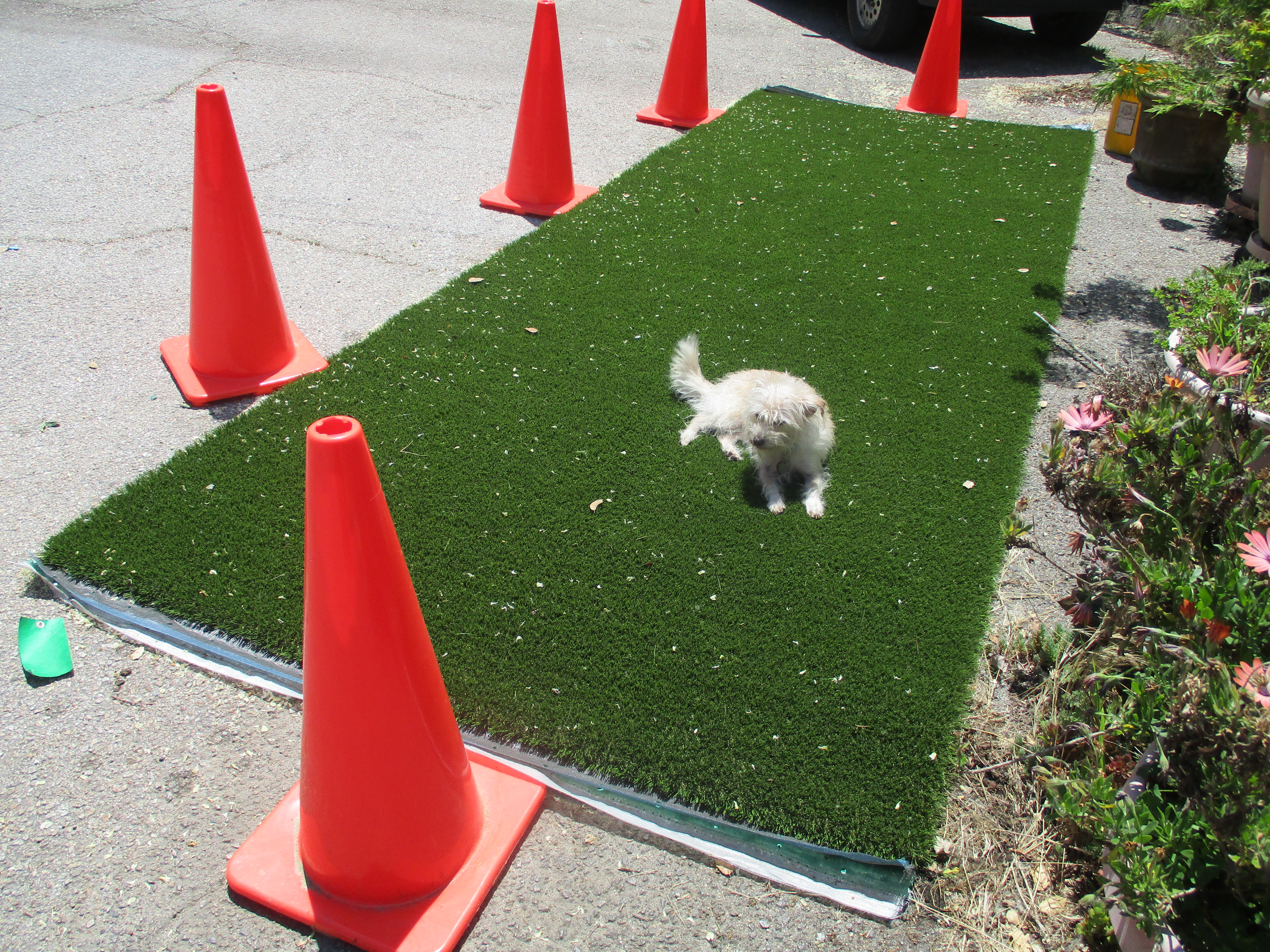
After this article posted in 2019, the new fake lawn was installed, but with a very minor glitch. The quantity of material was very slightly insufficient to finish the lawn. A small bare patch was to remain until a small piece of material arrived to patch it. Instead, someone remembered the sample at the yard, which Rhody had already claimed. A piece of the sample patched the bare spot, and the lawn was complete. Rhody, however, was temporarily annoyed by the deprivation of his new lawn. Later, we went to where the new lawn had been installed, and Rhody somehow located his patch of lawn. He was pleased to flip around and sprawl and do what little dogs do on their lawns, and finally claimed it before we left, just so that everyone knows that he owns it.

tonytomeo's avatarTony Tomeo

P90512A new lawn is getting installed at work. Yes, installed. It will not be grown like lawns were decades ago. It will be unrolled and fastened into place, not like sod, but more like carpet. It will be synthetic artificial turf. After considerable deliberation, it was determined to be the most practical option for the particular application. The real turf that was there before succumbed to excessive traffic above and very sandy soil below.
The contractor who will be installing this lawn sent a sample piece of it prior to the final installation. We actually do not know why we got a sample, since we already know what the particular artificial turf is like. There was some concern that it would get too warm in sunlight, but it arrived with no explanation. It was unrolled onto the asphalt driveway at our maintenance shops, and surrounded with cones to protect it…

View original post 178 more words

The Seventh On Saturday

Since this is recycled from 2019, it is not actually relevant to the ‘Six on Saturday’ that posted this morning.

tonytomeo's avatarTony Tomeo

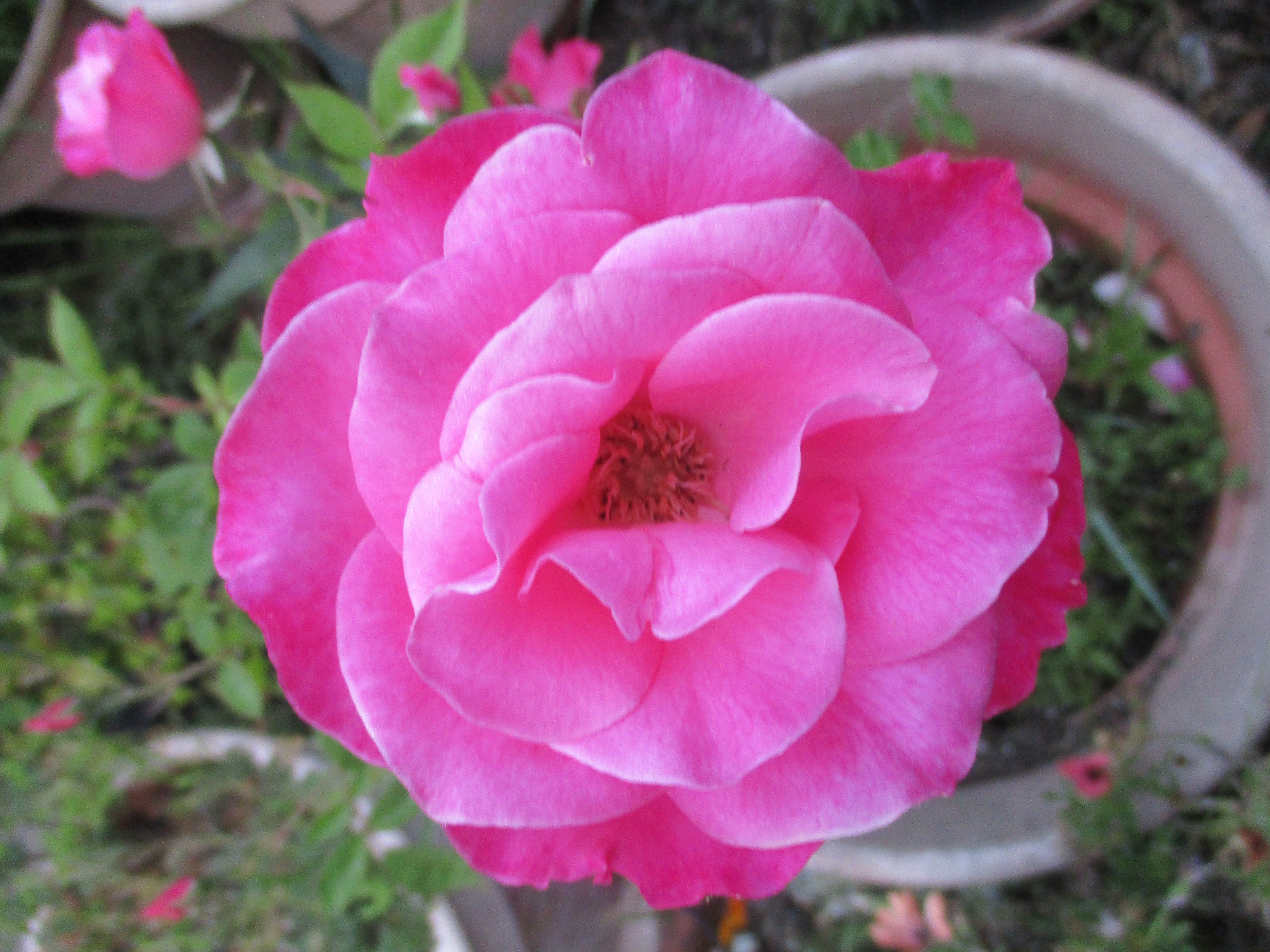
P90511KThis is the one that got away; or actually, the one that was never caught. It bloomed after I got the pictures for the ‘Six on Saturday’ post for this morning. It could be the same unopened bud in picture #3 of the Six on Saturday post, as it is now blooming. If not the same bud, it is on the same plant, and now looks even more like the common ‘Simplicity’ rose. It is not my favorite, but I did not select it.
That is how the recovery nursery works. It is where we bring salvageable plants that need to be removed from their landscapes. Some were in the way of other projects. Some were not the right plants for their particular situations. Some were even donated by neighbors who thought we might be able to utilize them somewhere in the landscapes.
Some of plants brought in are not…

View original post 150 more words

Six on Saturday: Politely Naturalized Exotics +1

Exotic plant species that appreciate endemic climates and soils seem like they should be the next best options to native plant species. A few unfortunately naturalize aggressively enough to displace native plants species, and interfere with the natural ecosystem. A few can not naturalize without their preferred pollinators that did not come with them from their origin. Some have potential to naturalize, but either refrain, or are civil about doing so. Some that are invasive within landscapes are not as invasive in the wild, particularly if they need more water than they get from local weather. I occasionally find exotic plant species, including a few that I am surprised to find.

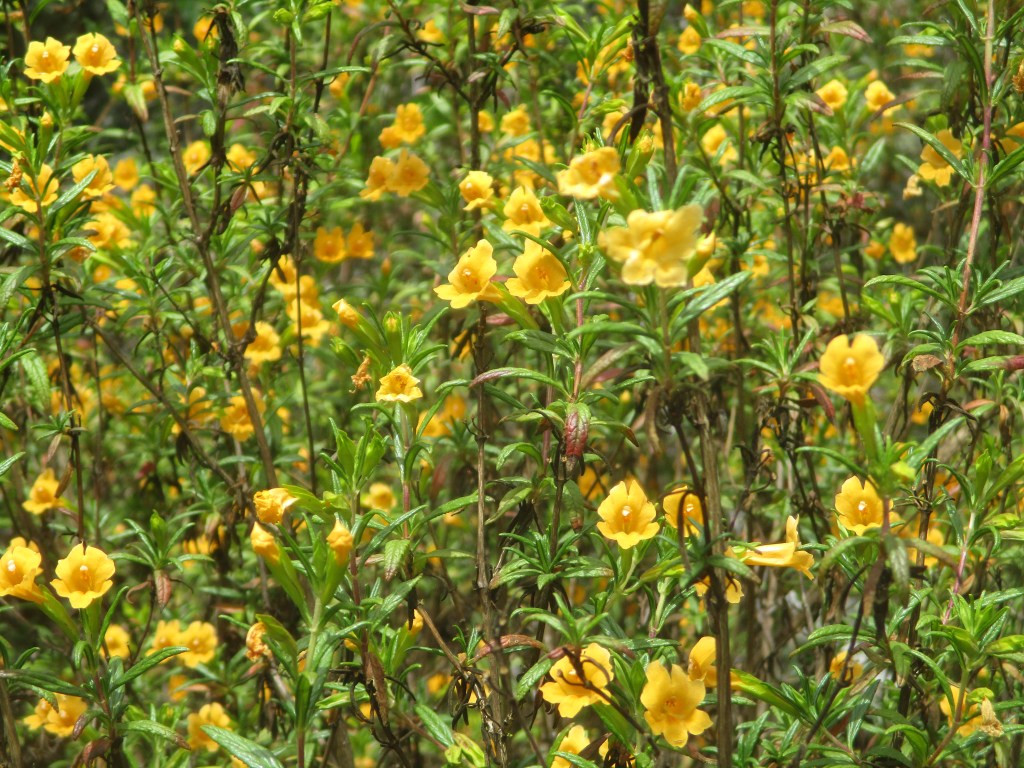
1. Sticky monkey flower is the ‘+1’. It is the only one of these six that is native rather than exotic. Its odd name leaves one pondering how a monkey is involved and why it is sticky.

2. Mock orange seems to be naturalized, but contrary to common belief, may actually be native. A single flowered variety and a double flowered variety may be different species.

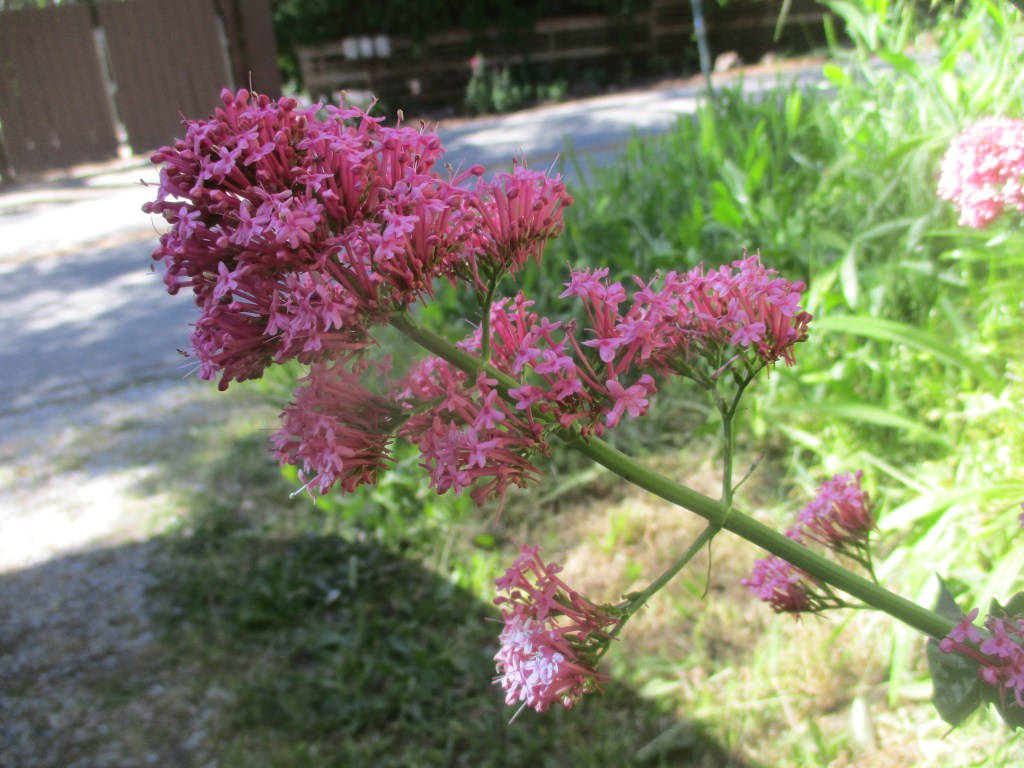
3. Jupiter’s beard is most certainly exotic and naturalized, but does not seem to be polite about it. It can get quite invasive. However, it does not get far from irrigated landscapes.

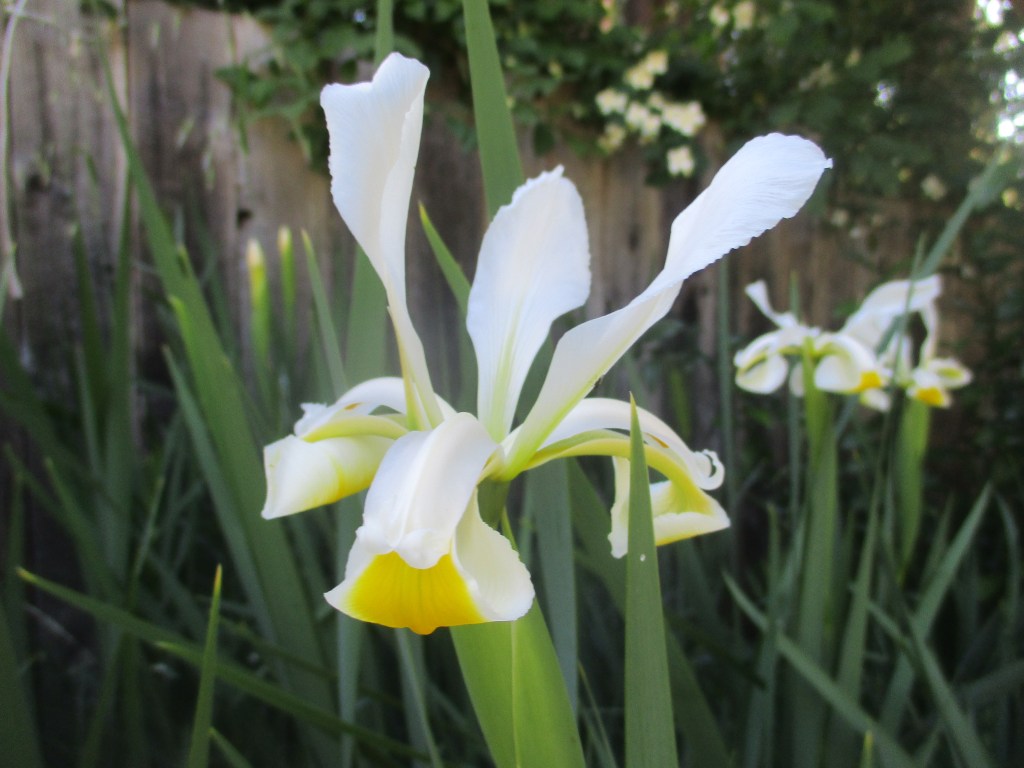
4. Iris remains a mystery to me. I grew this same seemingly simple species while in high school, but have never identified it. It naturalizes, but only where it gets sufficient water.

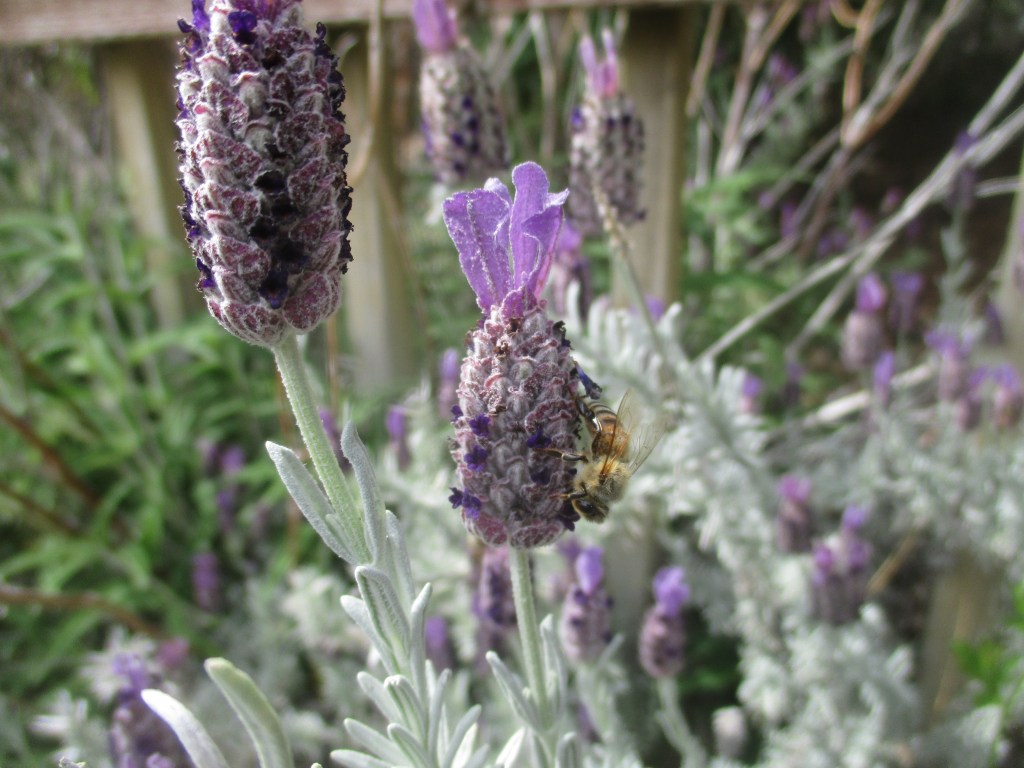
5. Spanish lavender is obviously not native since it is from, well, Spain. It can naturalize, but is not aggressive about it. The honeybee is much more aggressively naturalized here.

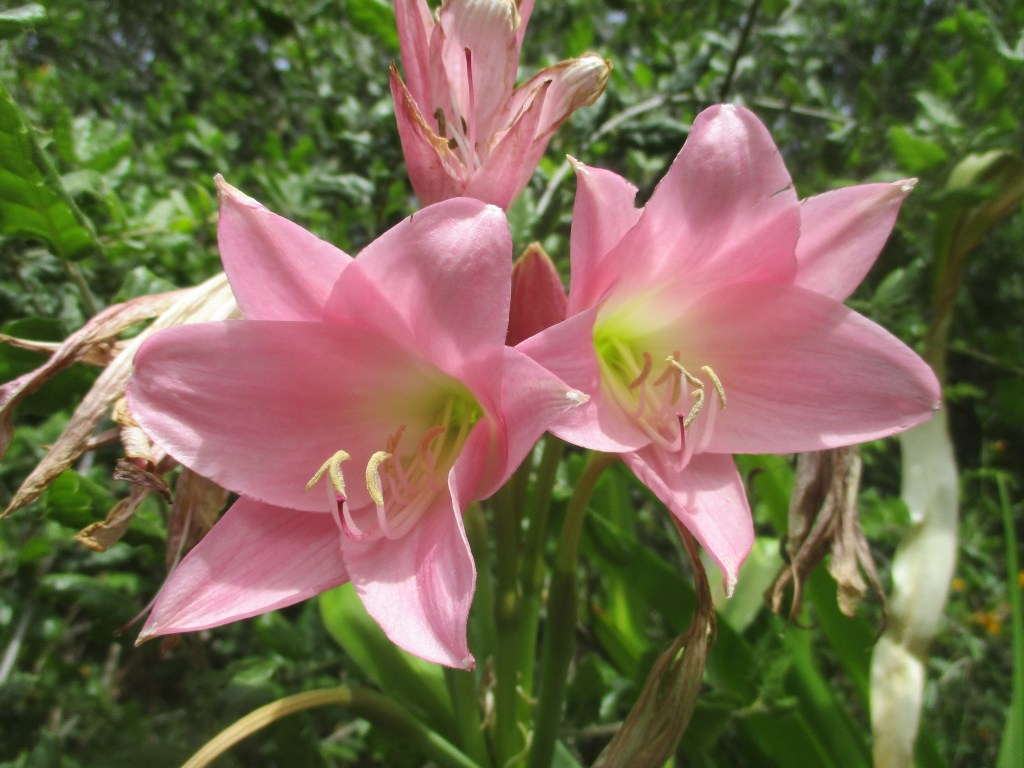
6. Crinum, like the Iris, is unidentified. I am not even sure if it is a Crinum. It grows wild with sticky monkey flower, in sandy soil that gets dusty, dry and warm through summer.

This is the link for Six on Saturday, for anyone else who would like to participate: https://thepropagatorblog.wordpress.com/2017/09/18/six-on-saturday-a-participant-guide/