Saint Joseph did not have it so good. He is still the most famous carpenter, and somehow got the most excellent city in the World named after him, but he did not work in a shop like this one. The most well outfitted carpentry shops back then lacked modern power tools, and the selection of woods that are now so easily imported from all over the World.
The best lumber in this shop at the Conference Center (where I work in the landscapes part time) is actually not the exotic sort. Three very important timber crops, (coastal) redwood, Douglas fir and ponderosa pine, happen to be native. A few of the larger of these trees that need to be removed get milled into lumber that gets used here.
Much of the lumber shown in this illustration is recycled from old buildings that were built from local lumber at a time…
Today’s episode is brought to you by the letter ‘T’.
This is not Sesame Street.
Nor is this freshly painted concrete ‘T’ a monogram that designates the garden as mine. Even I am not ‘that’ vain.
It is part of a sign at the train depot. There happen to be enough of the right letters for my last name. I suppose that with a pry bar and a shovel, I could be ‘that’ vain.
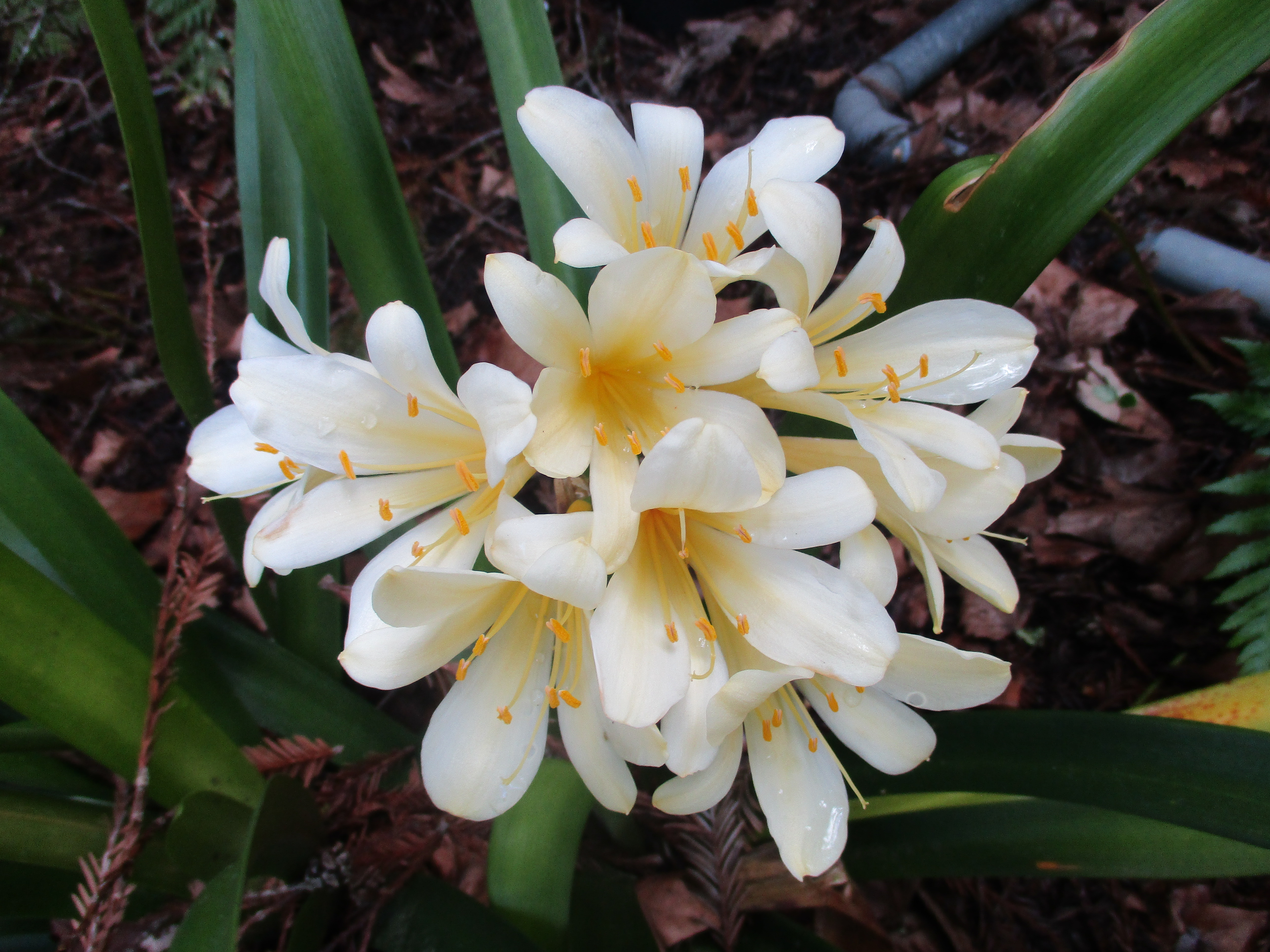
There is no ‘Y’, so my first name would not work, particularly in conjunction with my last name, which would take the only ‘T’ and ‘O’ available. Am I really vain enough to be putting this much thought into this? Oh my! For right now, I should only be concerned with keeping the vegetation clear of the sign. The amaryllis foliage above barely flops into it. The overgrown photinia hedge behind the amaryllis was just removed…
Esperanza and poinciana (pride of Barbados) from Crazy Green Thumbs will be delayed again. I still have not sown the seed, and when I do, I will likely delay posting pictures of them until I have exhausted all of these pointless pictures that Brent sends to me. There may be six more for next week after these six. Fortunately, the few that arrived since this purging began are not very interesting, so need not be shared. These six pictures arrived at various times through the past few months; and I did not document dates for them. It would be difficult to identify their chronology without inquiring with Brent, and without familiarity with potentially observable seasonal indicators of the particular climate. I am less than three hundred fifty miles away, but in an entirely different climate and region.
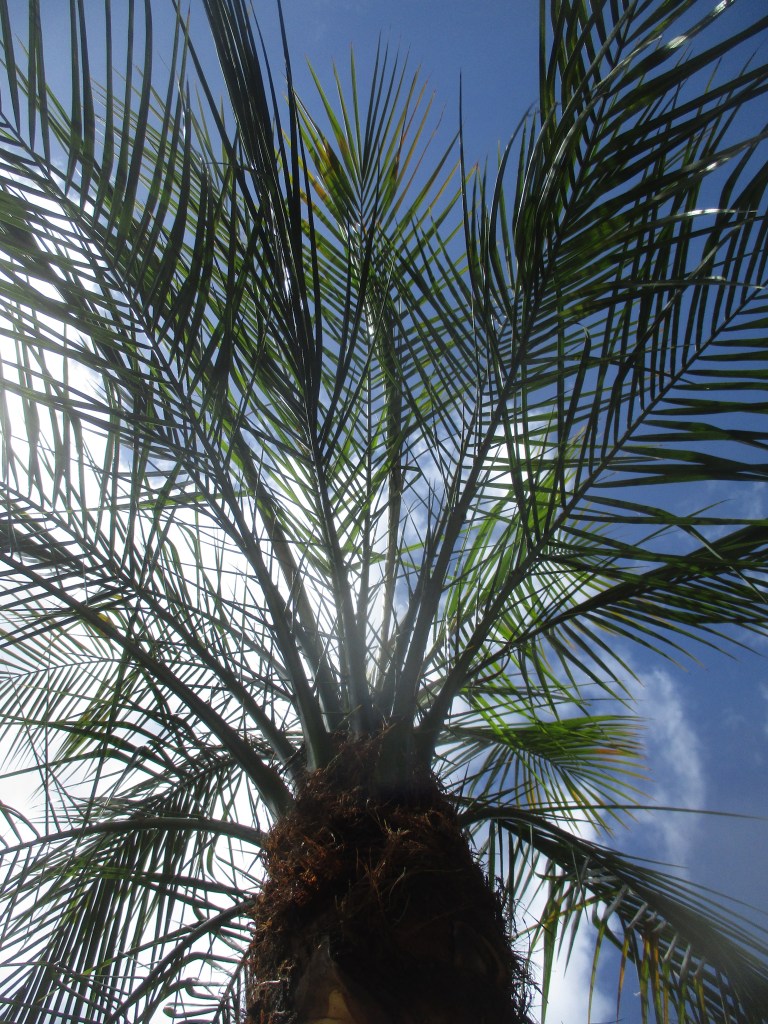
1. Baby queen palm, Chamaedorea plumosa, which is not princess palm, Dictyosperma album, is related to popular bamboo palm, Chamaedorea seifrizii. Brent got this for me.
2. Of all of Brent’s landscapes, this might be my favorite. The formality is rad. However, these illuminated Canary Island date palms, Phoenix canariensis, must be embarrassed.
3. Mexican fan palm, Washingtonia robusta, is a most common palm of the Los Angeles region. Although palms are popularly informal, some might be formal and symmetrical.
4. Mexican fan palm dominate the view. Kentia palm, Howea forsteriana, California fan palm, Washingtonia filifera, and queen palm, Arecastrum romanzoffianum, got in too.
5. Brent likes to show off his palms. They are more visible from next door than from the garden they inhabit. The Mexican fan palm is a Memorial Tree for Brent’s brother Brian.
6. Coons! The arborist who pruned this Mexican fan palm returned to finish shaving the trunk, but found that a pair of coons who inhabited the beard were not ready to relocate.
The soft yellow or rusty red bare stems of osier dogwood have better color where exposed to cold and sunlight.
New spring foliage will soon be obscuring the rusty red or light yellow stems of osier dogwood, Cornus sericea (or Cornus stolonifera). Because this odd dogwood is grown for these distinctively colorful stems instead of blooms, it can be pruned harshly before foliation, to promote more twiggy growth for next winter. Unpruned plants form thickets five to ten feet high and ten or more feet broad. The flowers are actually rather pathetic relative to those of other dogwoods, since they lack colorful bracts. Where exposed to frost, the opposing two or three inch long and one or two inch wide leaves can provide nice reddish autumn color.
My neice finds seeds for most of her favorite vegetables, flowers and herbs, like this prolific chamomile, at Renee’s Garden.
Even after a few years of trying most of the seeds available from Renee’s Garden Seed catalog, my niece still wants to grow them all every year. Sadly, her compact garden and landscape designer father who thinks he owns it can not accommodate all the seeds that she wants. She is therefore forced to limit selection to her favorites and those that she has not yet tried.
‘Cupani’s Original’ and ‘Perfume Delight’ are still her favorite sweet peas because they are so very fragrant. The big softly blushed pale yellow flowers of ‘April in Paris’ are a close second. Although not as fragrant, I wanted her to try ‘Electric Blue’ for its shaggier darker green foliage and smaller but refined deep blue flowers.
Perhaps as a strategy for an alliance, my niece’s oppressive father planted ‘Buttercream’ nasturtiums, which was a new variety with semi-double cream colored flowers. She rebelled with the brilliant red shades of ‘Copper Sunset’. The softer orange shades of ‘Creamsicle’ was a diplomatic compromise.
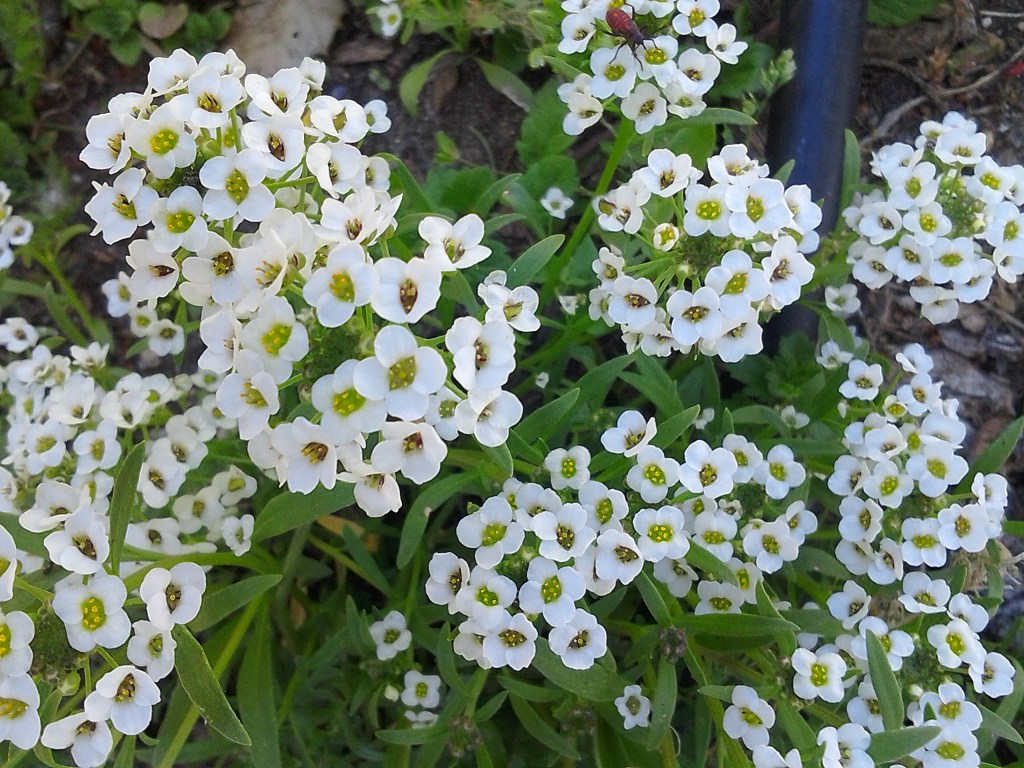
Both could agree on the soft lavender and pink shades and white of ‘Gulf Winds’ alyssum, the rich deep pinks of ‘Mountain Garland’ clarkia, and the traditional ‘Mrs. Scott Elliot’ columbine, since all three are so complaisant with mixed annuals and perennials. Taller and more vigorous cosmos got their own space. ‘Dancing Petticoats’ provided a mixture of cheery pink shades. ‘White Seashells’ looked sharp against the deep green privet hedge.
Since utilitarian vegetable plants are inconsistent with such a designer landscape, my niece grew vegetables that are as flashy as foliage plants. I suggested richly colored ‘Scarlet Charlotte’ chard, with a bit of ‘Italian Silver’ that exhibits distinctive white petioles and veins. She went for the more colorful ‘Garden Rainbow’, ‘Neon Glow’ and ‘Bright Lights’.
Some (but not all) of Renee’s Garden vegetable seed mixes have a distinct advantage of color coding. The various seeds withing these mixes are dyed with different colors so they can be planted separately if desired. Since seed packets usually contain more seeds than are actually needed, vegetable seed mixes are a practical way to get fewer but enough of a few different types of seed in single packets.
More varieties of seeds are available from the online catalog of Renee’s Garden Seed at www.reneesgarden.com than at retail nurseries. Yet with so many fun varieties to try, the retail seed racks certainly have more selection than any garden really needs. If it were at all possible to try them all, my neice would have figured out how to do it already.
This landscape is nothing fancy. It is out in front of a fast food establishment on Ocean Street in Santa Cruz. It is low maintenance, and starkly simple. It would be nice if the so-called ‘gardeners’ would cut back the African iris and English lavender a bit better, but they may have left them like this so that they are less likely to get trampled. The colored chips get replenished regularly, and the trash gets harvested quite efficiently. As I said, it is nothing fancy. The only remarkable feature had been this exemplary crape myrtle in the middle.
Only a few weeks ago, it was a perfect small specimen. Even though it is still quite dinky, the main stems were all at good angles, well spaced and aimed in the right directions. None of the stems were crossing over others, damaged or otherwise misshapen. I can not explain what happened…
Even when weather is more typical for the local climate, many types of flowering apricot, Prunus mume, bloom during winter. Flowers seem to be a bit more resilient to wind, rain and frost than those of flowering cherry that bloom a month or so later. Nonetheless, they are delicate and share their white or pastel pink color with wintry landscapes only briefly.
Although many garden varieties of flowering apricot are fruitless, some, particularly feral trees, produce fruit. Some of such fruit is desirable to those who utilize it. However, most is unpalatable without specialized processing. Flowering apricot works as understock for a few related trees, so occasionally grows from the roots of such trees after their removal.
Flowering apricot is quite rare locally, which is why it seems to be so unseasonable as it blooms so early. Like flowering cherry and plum, it blooms on otherwise bare stems prior to generating new foliage for spring. Copious bloom of garden varieties is nicely fragrant. Flowers are nearly an inch wide. Mature trees are about ten to more than twenty feet tall, and almost as broad.
Unseasonable warmth and dryness has been great this winter. Such weather is often an advantage of this locally mild climate. Chill never gets too harsh. Rain does not continue for too long. However, even by local standards, the weather has been unusually dry and warm for quite a while. Although appealing to people, it can get disruptive horticulturally.
Obviously, a lack of rain eventually becomes a lack of moisture. Some evergreen plants, potted plants, ground cover plants and lawns may already need watering. Although rain, or lack thereof, does not affect availability of water from municipal sources, it determines when irrigation with such water becomes necessary. It will be sooner than later this year.
Obviously, warmth accelerates this process. It draws moisture both from intact evergreen foliage and the soil below. (Dormant deciduous plants still do not lose as much moisture without foliage.) Unseasonable aridity (minimal humidity) and wind intensify the effect of unseasonable warmth. Desiccation is not the worst consequence of the weather though.
Unseasonable or premature warmth might stimulate premature spring bloom and growth. This can be very disruptive for plants that rely on sustained chill to maintain their minimal dormancy requirements. Peonies that are marginal where they normally experience their minimal chill requirements might be dissatisfied with inadequate chill through this winter.
Even for plants that do not require much or any chill, premature bloom can be vulnerable to normal aspects of wintry weather if and when it resumes. Flowering cherry trees might bloom during sustained warmth. Such bloom would be quite susceptible to damage from resuming winter rain. Resumed chill might stall premature magnolia bloom until it molds.
Prematurely developing fruit, accelerated by unseasonable warmth, is also vulnerable to resumption of wintry weather. Heavy rain, which is still possible through the remainder of winter, can dislodge freshly pollinated flowers, or small fruit as it begins to develop. More developed fruit is vulnerable to rot or mold during cool and damp weather prior to spring.
If there were lawns and fences in this neighborhood, the grass would likely seem to be greener on the other side of the fence. In this situation, the greenhouse probably seemed to be more comfortable than being left out in the storm. This tall Douglas fir tree dropped in to find out. It did not go well. What remains can be seen in the middle of the picture above, just to the right of the fallen fir, and in the close up of the picture below. Miraculously, the two coastal redwood trees that caught and guided the fir to a direct hit on the greenhouse also prevented it from destroying the associated house. Well, at least the redwood on the left did. There would have been less damage if the fir had fallen farther to the right. Regardless, a deck was crushed, an eave was destroyed, but the rear wall…
What is this? It looks more like hail now. It was softer and squishier when it fell out of the sky only an hour or so before this picture was taken. There was a slight bit of snow up on Summit above Los Gatos. It will probably melt as quickly as the clouds clear to let the sunlight through. Snow sometimes appears on the higher peaks around the region, but is rare in lower elevations. Forty three years ago from today, on February 5 in 1976, snow fell in the Santa Clara Valley. It was about half an inch deep in some areas, an inch and a half in others, and was the last snow to fall there.