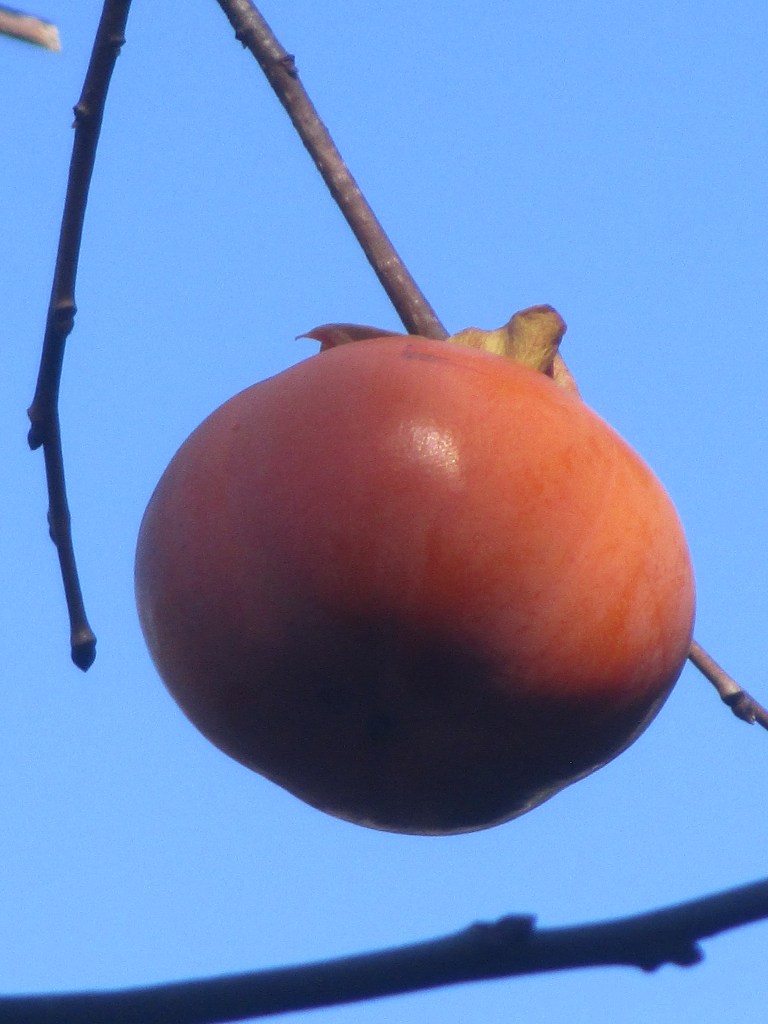
Most other deciduous fruit trees provide delightfully profuse spring bloom as well as fruit. Persimmon, Diospyros kaki, does not. It compensates though, with brilliant orange foliar color for autumn. Defoliation reveals comparably bright orange ripe fruit. The awkwardly bulky fruit may look silly on lanky limbs of otherwise bare trees, but they sure are yummy!
Persimmon trees will not require a pollinator to generate an abundance of fruit. However, according to some experts, paired trees of different cultivars produce more abundant fruit of slightly better quality. Abundance is not necessarily an asset though. Unfortunately, all that very perishable fruit ripens at the same time. Fruit is inedible before completely ripe.
Mature persimmon trees can get big enough to become moderate shade trees. If they do, their abundant fruit will be too high to reach, and will generate a horrendous mess when it falls. Although they are handsome trees, they should probably stay relatively short and compact. New trees should be planted while dormant during winter, preferably bare root.
While they are dormant through winter, deciduous fruit trees require specialized ‘dormant pruning’. Exceptions are rare. Most need major pruning that might seem to be excessive. Without such pruning, fruit trees produce more fruit than they can sustain. Excessive fruit is very likely to be of inferior quality, beyond reach, and heavy enough to disfigure limbs.
Dormant pruning limits the volume and weight of fruit that can develop during a following season. By eliminating structural deficiencies and maintaining compact form, it improves the structural integrity of trees. It eliminates diseased stems, and concentrates resources into healthy stems. Dormant pruning concentrates resources into less but better fruit too.
Dormant pruning is necessary because of extensive breeding to improve the quality and quantity of fruit that fruit trees produce. The ancestors of modern cultivars of fruit produce either smaller or less abundant fruit that they can generally support in the wild. However, even some wild fruit trees will produce better fruit with pruning to concentrate resources.
The many various types of fruit trees need various types of specialized dormant pruning. Unfortunately, such trees, which are so commonly available from nurseries, do not come with instructions. It is important to be aware of the sort of maintenance any particular fruit tree will require, prior to incorporating it into a garden. Some dormant pruning is extreme!
The various stone fruits are the most popular deciduous fruit trees. They are of the genus ‘Prunus‘. Their fruits contain single large seeds, or ‘stones’. This includes apricot, cherry, nectarine, peach, plum, prune, almond and all their hybrids. They need the most intense dormant pruning. (Almond nuts are stones of leathery fruits that are the hulls of the nuts.)
Although uncommon within the mild coastal climates of Southern California, pome fruits, primarily apple and pear, are very popular too. They require specialized dormant pruning that is very different from what stone fruits need. Likewise, persimmon, pomegranate, fig, mulberry, currant, kiwi, grape and cane berries, each need customized dormant pruning.
Since the date today does not coincide with the date on which this article posted three years ago, it is now five days into winter instead of two as prefaced in this article.
We are now two days into it. Is it any different than three days ago, the last day of autumn? Not really. Even in harsher climates, the changes from one season to the next are gradual. Like the phases of the moon, the seasons are constantly phasing out of the previous, and into the next. The dates of the first and last days of each season, which are determined by the position of the Earth within its orbit around the sun, are technicalities. Seasons in the Southern Hemisphere are of course opposite of what they are here. That seems odd to me. The calendar is the same there as here. It seems obvious to me that winter and all seasons should be determined by the same dates there that they are determined by here. If winter began last Friday here, it should have done the same there, on the the…
It was one of the more common types of snow in the Santa Clara Valley in the early 1970s.
In school, we made paper snow by folding paper squares in half and then into thirds (so that they were folded into sixths), and then cutting notches and slices out of them. They unfolded into the prettiest and laciest snowflakes!
In Westgate Mall, snow was blown by small fans about the new models of Singer sewing machines that were magically suspended in big acrylic spheres. We children could not get into the spheres, so were left wondering if the snow within was as cold and wet as we were told it was, and why it was necessary to demonstrate that the new sewing machines were resistant to weather. Our mother did her sewing inside. We sort of suspected that the snow around the Nativity at Saint Thomas of Canterbury and other…
Six on Saturday is cancelled for Christmas. I should have remembered that. Well, I already posted my Six on Saturday, as well as these extra Six.
. . . .
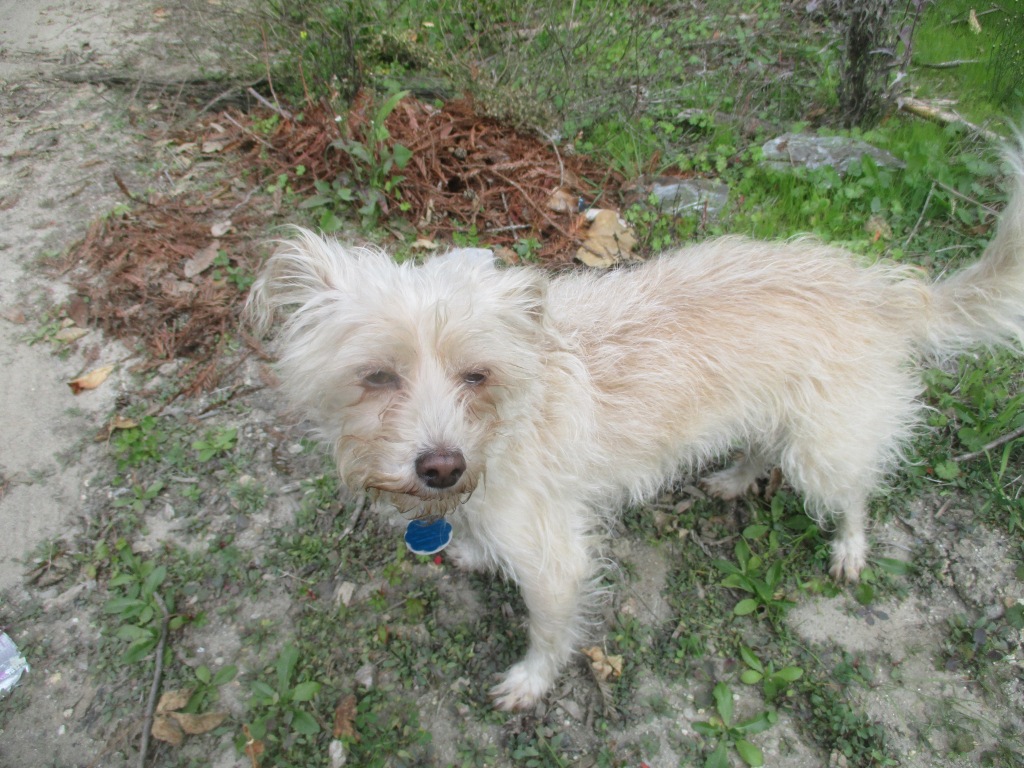
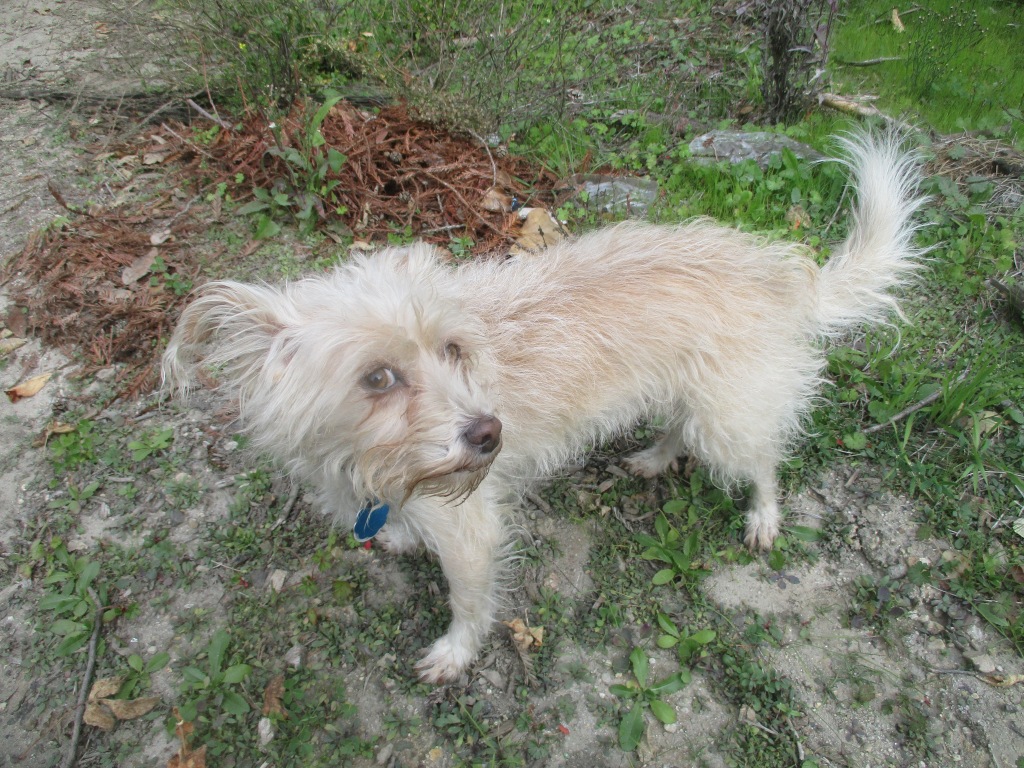
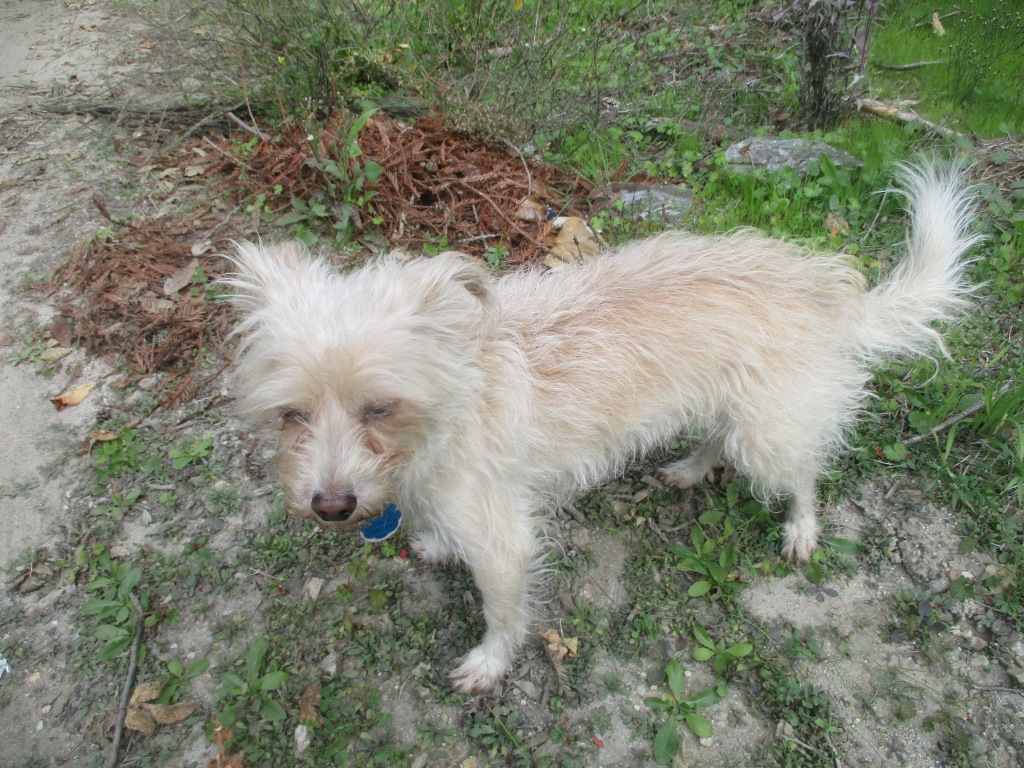
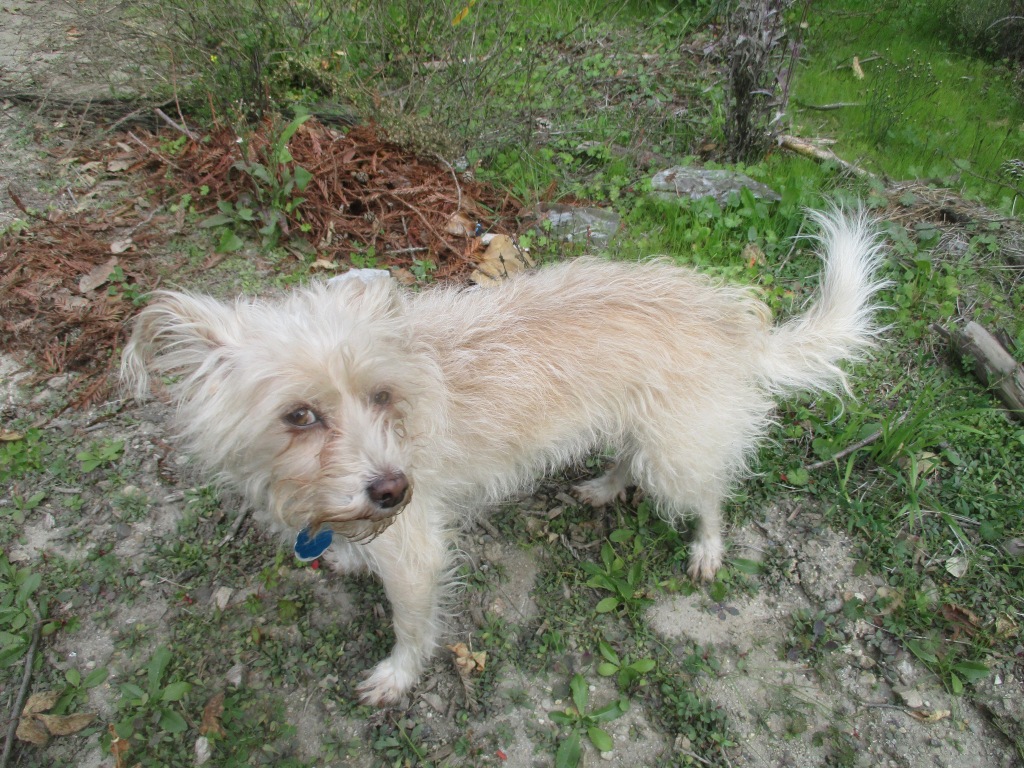
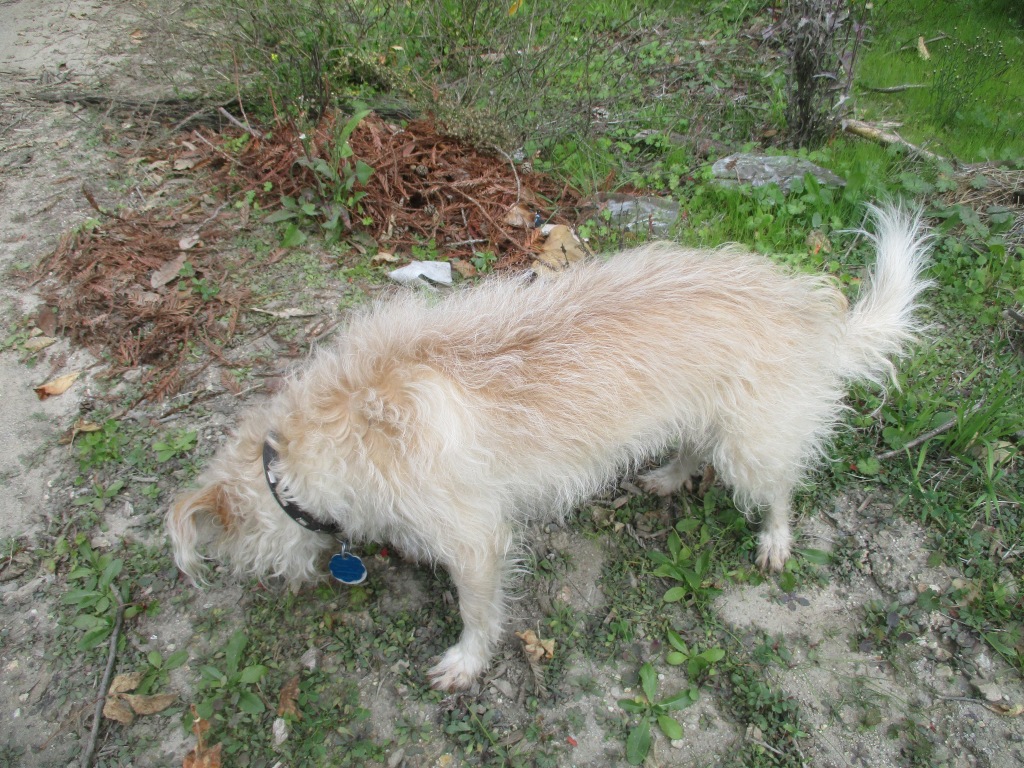
Rhody is who everyone who comes to my blog really wants to see. I would share more of his pictures, but there simply are not many. He dislikes getting his picture taken, so does not cooperate. These six pictures demonstrate that splendidly. This is not my real Six on Saturday for today. I submitted them a moment ago. I just added these because Rhody is just that popular, and because I did not know what else to do with these six silly pictures that do not conform to any particular horticultural topic.
1. If only I could get a few simple candid pictures of Rhody before he notices the camera.
2. Oops! It is too late now. He gets so annoyed when he sees me aiming a camera at him.
3. Then I get ‘the look’, which, as one can imagine, means that he is even more annoyed!
4. Now he is contemplating where he will hide each left boot of every pair of boots I own.
5. Again I get ‘the look’, but a bit more resigned. He just wants me to finish and go away.
6. Now he just does not care. He knows I will take pictures anyway. He does as he wants.
This is the link for Six on Saturday, for anyone else who would like to participate:
Oh drat! I should have remembered that Six on Saturday is cancelled for Christmas! Well, here are mine anyway. I suppose I could have saved these and the next six for next week, but they are not so great anyway. I should get a better six for then.
. . . .
Christmas is a very important Holiday that is worthy of themed pictures. Unfortunately, I can not provide. The few pictures that I managed to get within the past few days simply do not qualify. Rain was a splendid event. I then went to San Jose on a wild goose chase. A neighbor gave me a very delightful Christmas gift when I returned. Ultimately, I got to work with the little Memorial Tree in Felton Covered Bridge Park.
1. Rain was sufficient to fill creeks early in the week. This is the San Lorenzo River under Felton Covered Bridge. San Jose gets gritty through summer, but should be rinsed now.
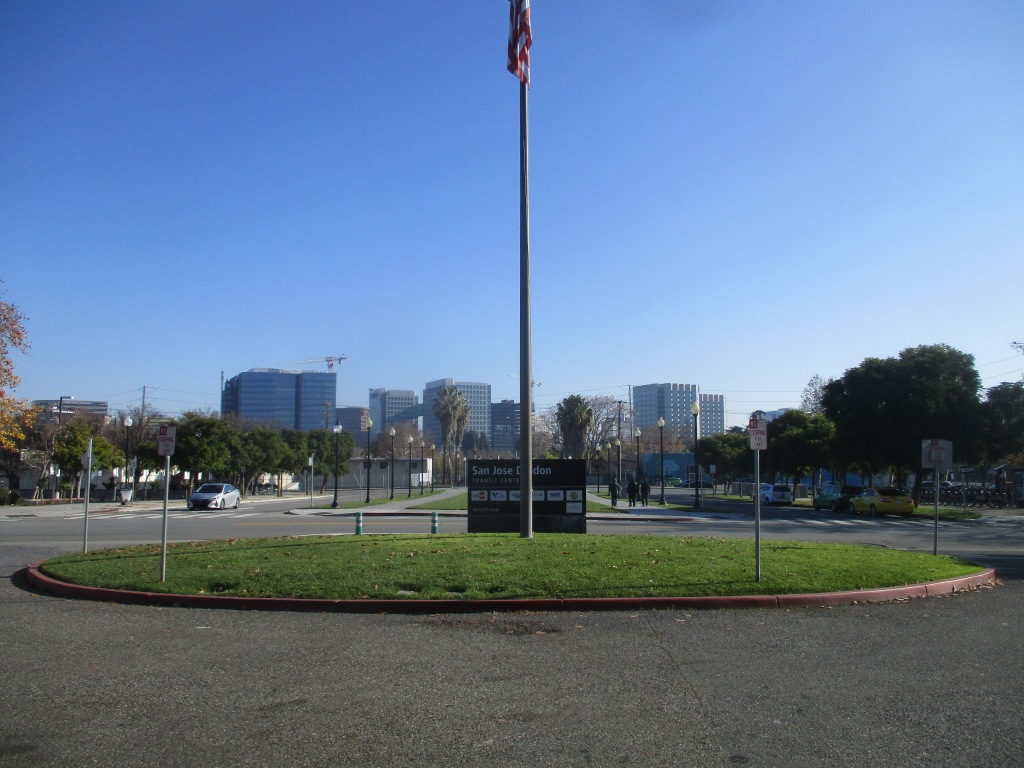
2. Clear blue sky lacked any scrap of the clouds that shared all their rain not so long ago. Although that San Jose skyline is not much to look at, the Diridon Station behind me is, which is why there are no trees to obscure the scenery. I should have taken pictures of it.
3. This old mural within the Diridon Station depicts how the Santa Clara Valley looked a very long time ago, with only a few oaks set sparsely over an otherwise empty chaparral.
4. Mexican fan palms are likely what most outsiders expect to encounter here. These are to the south of Arena Green Park where Los Gatos Creek flows into the Guadalupe River.
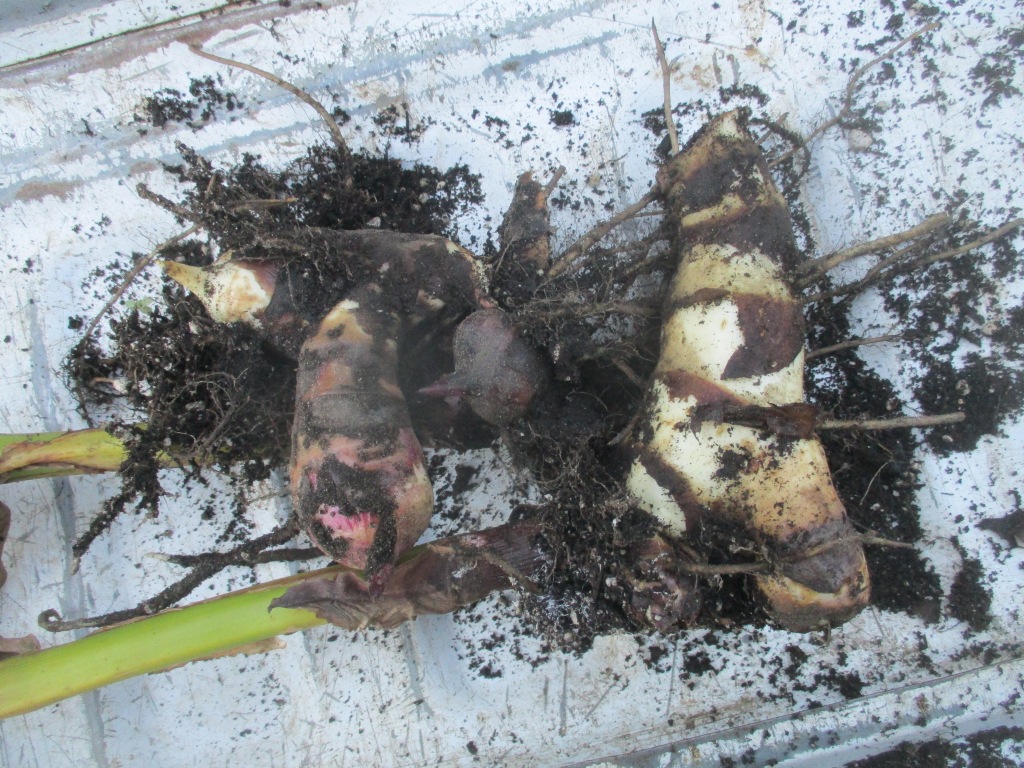
5. Back at home, I was pleased to procure several rhizomes of what I believe to be achira, Canna edulis, from a neighbor, along with a lot of seed! Canna rhizomes are edible, but achira rhizomes are the largest and tenderest. These are nearly as big as small potatoes.
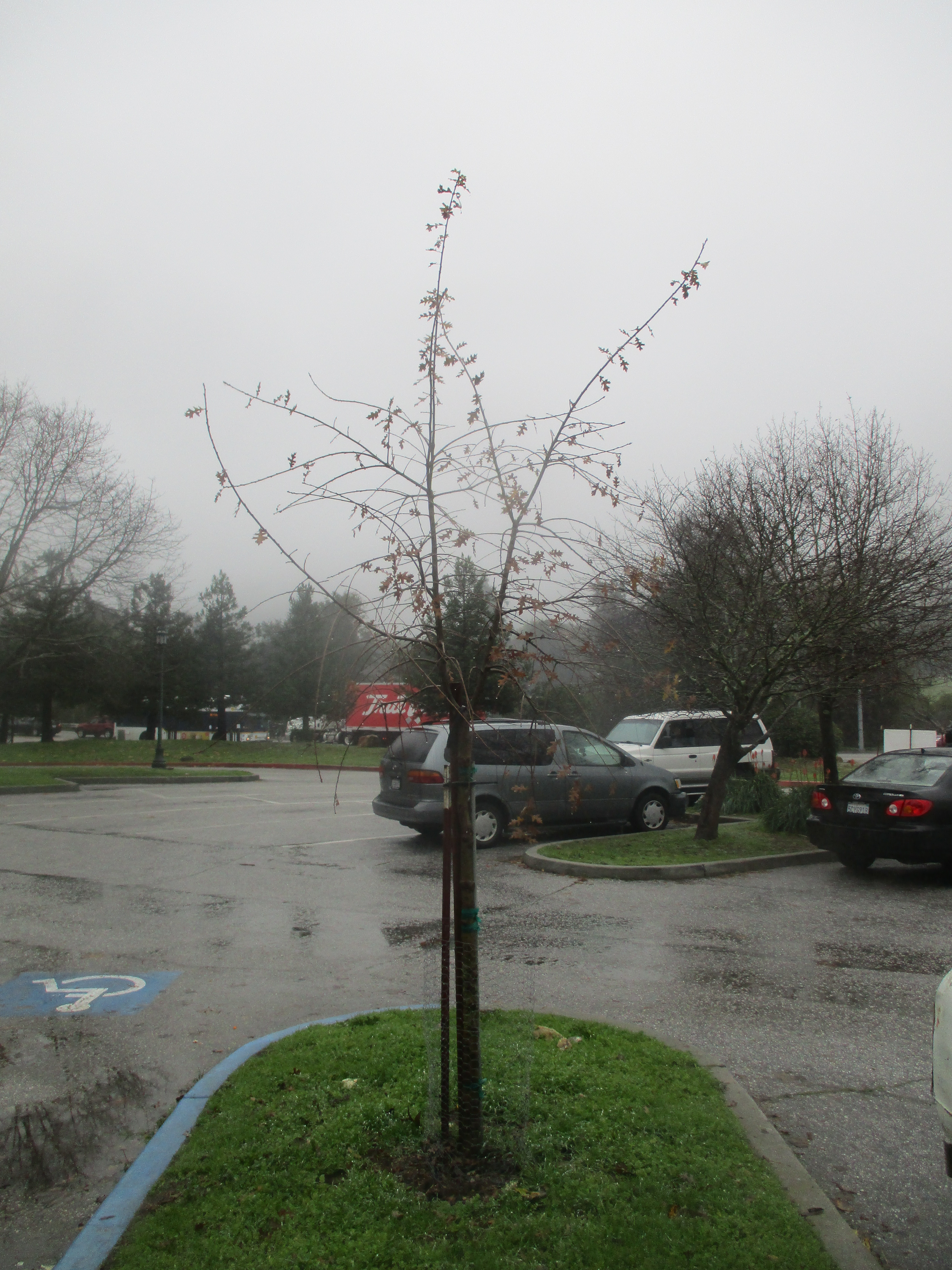
6. Rain resumed and dissipated again before I pruned the little Memorial Tree in Felton Covered Bridge Park for winter. The last of the binding of the trunk was finally removed.
This is the link for Six on Saturday, for anyone else who would like to participate:
For those who like pampas grass but lack space, miscanthus grass has similar texture, and moves softly in a breeze.
Even as the flower spikes and perennial foliage start to deteriorate over winter, Miscanthus sinensis provides distinctive texture and the element of motion if there happens to be a breeze. Mature specimens can be about six feet tall and broad. The feathery flowers are pale purplish pink when they first appear, then fade to light tan. ‘Zebrina’ has yellow stripes across their slightly wider leaf blades. ‘Variegata’ has white margins.
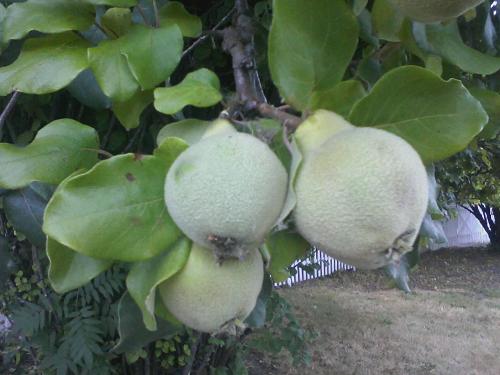
Quince and other fruit used to be much more common in home gardens.
The vast orchards of the Sacramento and San Joaquin Valleys are there for a reason. California is one of the best place in the world to grow fruit trees. However, whether they are in vast orchards or compact urban gardens, even the happiest and healthiest of fruit trees need considerable and specialized attention.
Most of the classic deciduous fruit trees have been bred and selected and bred some more over the past many centuries to produce unnaturally large and abundant fruit. Consequently, most are unable to support the weight of all the fruit that they are capable of producing. This is why it is so important for them to be pruned while dormant through winter.
Pruning improves the structural integrity of fruit trees, and limits the abundance and weight of the fruit produced during the following season. With a bit of planning, pruning can keep much of the fruit within reasonable reach so that those picking it do not need to go dangerously high on ladders. Annual winter pruning also promotes vigorous spring and summer growth that is more resistant to disease.
Apricots, plums, prunes, nectarines, peaches and cherries are all related ‘stone’ fruits (of the genus Prunus), so need various degrees of similar pruning. Peaches need more aggressive pruning because the fruit is so heavy. Cherries and almonds need less pruning because the fruit is lighter. (Almonds can grow beyond reach because the nuts get shaken or knocked from the trees instead of picked.) Regardless of the extent of pruning, the ‘four D’s’, which are ‘dead, dying, damaged and diseased’ stems, should be pruned from all deciduous fruit trees.
Vigorous stems that grew last year need to be thinned and cut back but not removed completely since they are the stems that will bloom and develop fruit next year. The stems that grow from them this year will get pruned next winter to produce the following year. Apples, pears and quinces require similar pruning of their vigorous upper growth, but produce much of their fruit on lower ‘spur’ stems that do not elongate much and may never need pruning.
Fig trees are probably the most tolerant of pruning mistakes, since they produce fruit twice each year. Overly aggressive pruning may compromise their first phase of fruiting, but promotes the second phase. Light pruning does the opposite, compromising the second phase by allowing excessive production of the first phase.
Winter pruning of deciduous fruit trees will undoubtedly seem harsh to a beginner. Trees will need more pruning each year as they grow. Fortunately, pruning becomes more familiar with experience, and as the results of pruning can be observed over time. It is among the most important of gardening tasks for those who grow fruit trees, so is really worth studying more thoroughly.
Nomenclature of the botanical sort was so much simpler back when we studied it back in the 1980s. It was intended to be like that. It was how the various specie of plants were identified and classified. There were certain rules that simply made sense. After ‘family’, plants were classified into general ‘genera’, and then further classified into specific ‘specie’. Some specie were further classified into ‘varieties’ and ‘cultivars’. (Cultivars are simply ‘cultivated varieties’ that need to be perpetuated by cloning because they are too genetically unstable to be true-to-type from seed.)
The genus name is always first. The species name is always second. Because they are Latin, they should be italicized. Any variety or cultivar names are last, not italicized, and in semi-quotations.
Back in the 1980s, there were a few specie that did not quite fit into such neat classification. Intergeneric hybrids (between two parents of different genera)…
Where winters are very mild, common lantana, Lantana camara, might bloom through all but the coolest of weather. It generally takes more of a break though. It could finish bloom at any time now, and resume at the end of winter. Where winter weather is cooler, foliage and perhaps stems may succumb to light frost. Growth should regenerate through spring.
The tiny tubular flowers bloom inwardly from the margins of round umbels that are about and inch and a half wide. Flowers typically bloom yellow, and then fade to orange, red or pink. Therefore, the umbels have yellow centers with orange, red or pink margins during the middle of bloom. One cultivar blooms with one hue of yellow. Another fades to white.
Modern cultivars mostly stay rather low and compact. Some sprawl. Older cultivars might get as tall as six feet after a few years. However, after frost damage or coppicing, mature plants may regenerate from their roots, with vigorous stems that get six feet long through summer. The faintly raspy foliage appears to be smooth, and is aromatic when disturbed.


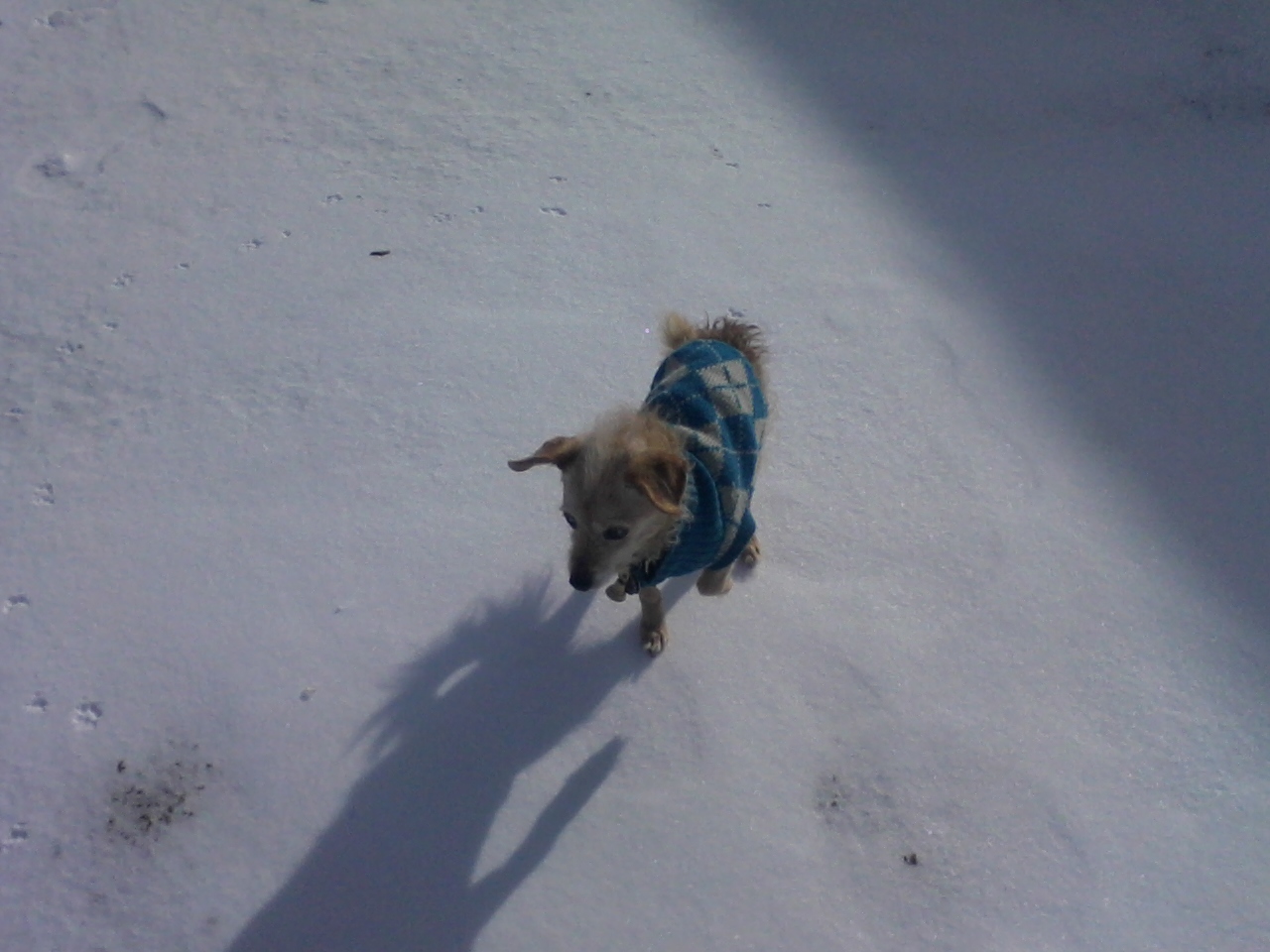 We are now two days into it. Is it any different than three days ago, the last day of autumn? Not really. Even in harsher climates, the changes from one season to the next are gradual. Like the phases of the moon, the seasons are constantly phasing out of the previous, and into the next. The dates of the first and last days of each season, which are determined by the position of the Earth within its orbit around the sun, are technicalities.
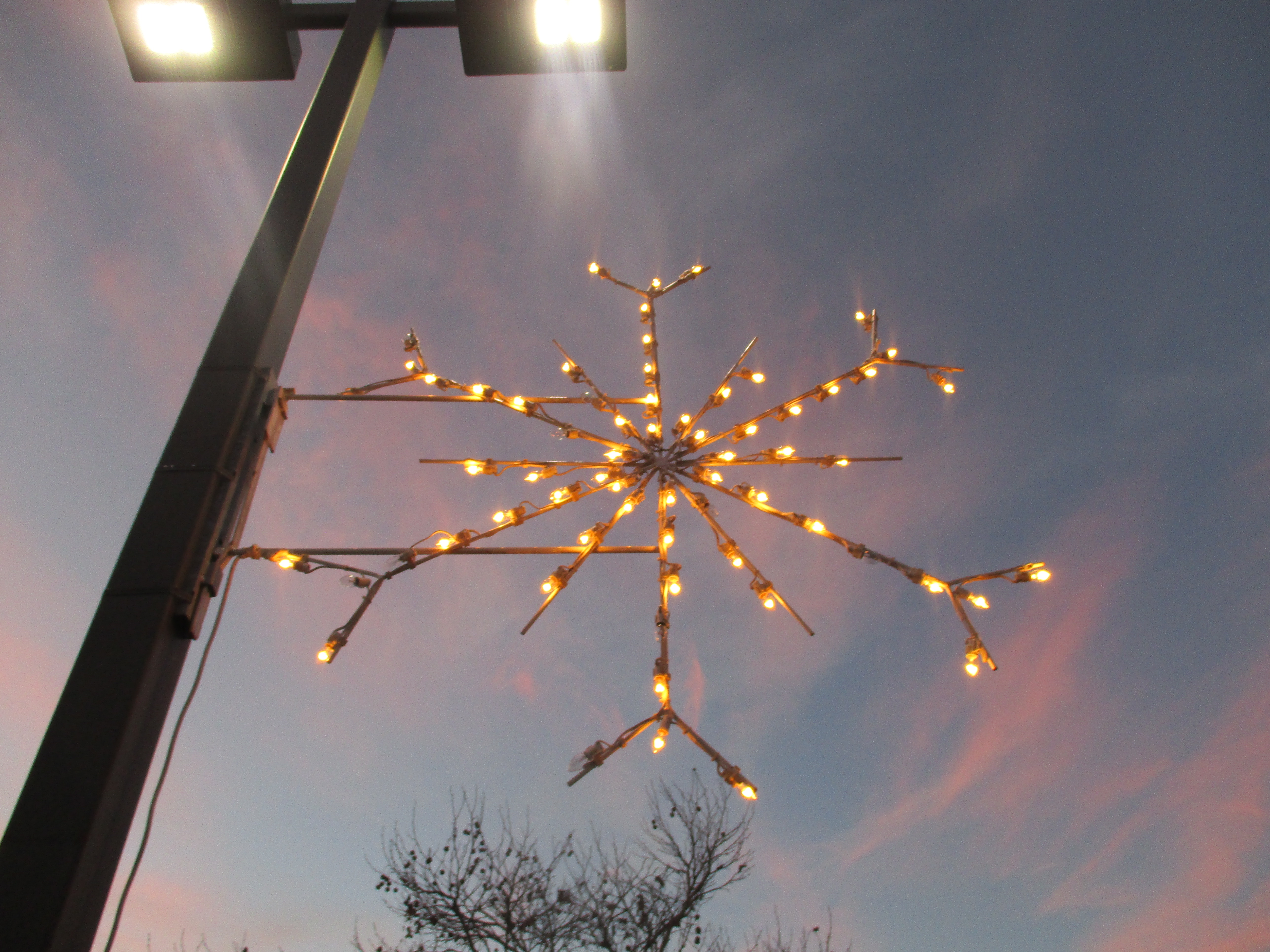 It was one of the more common types of snow in the Santa Clara Valley in the early 1970s.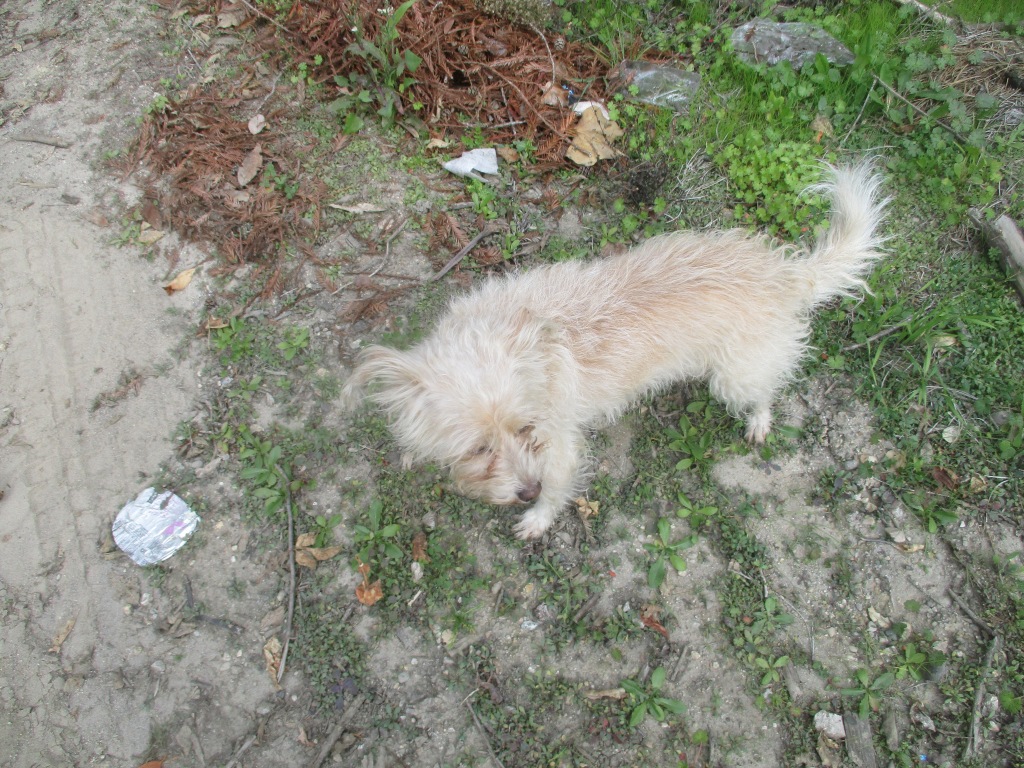




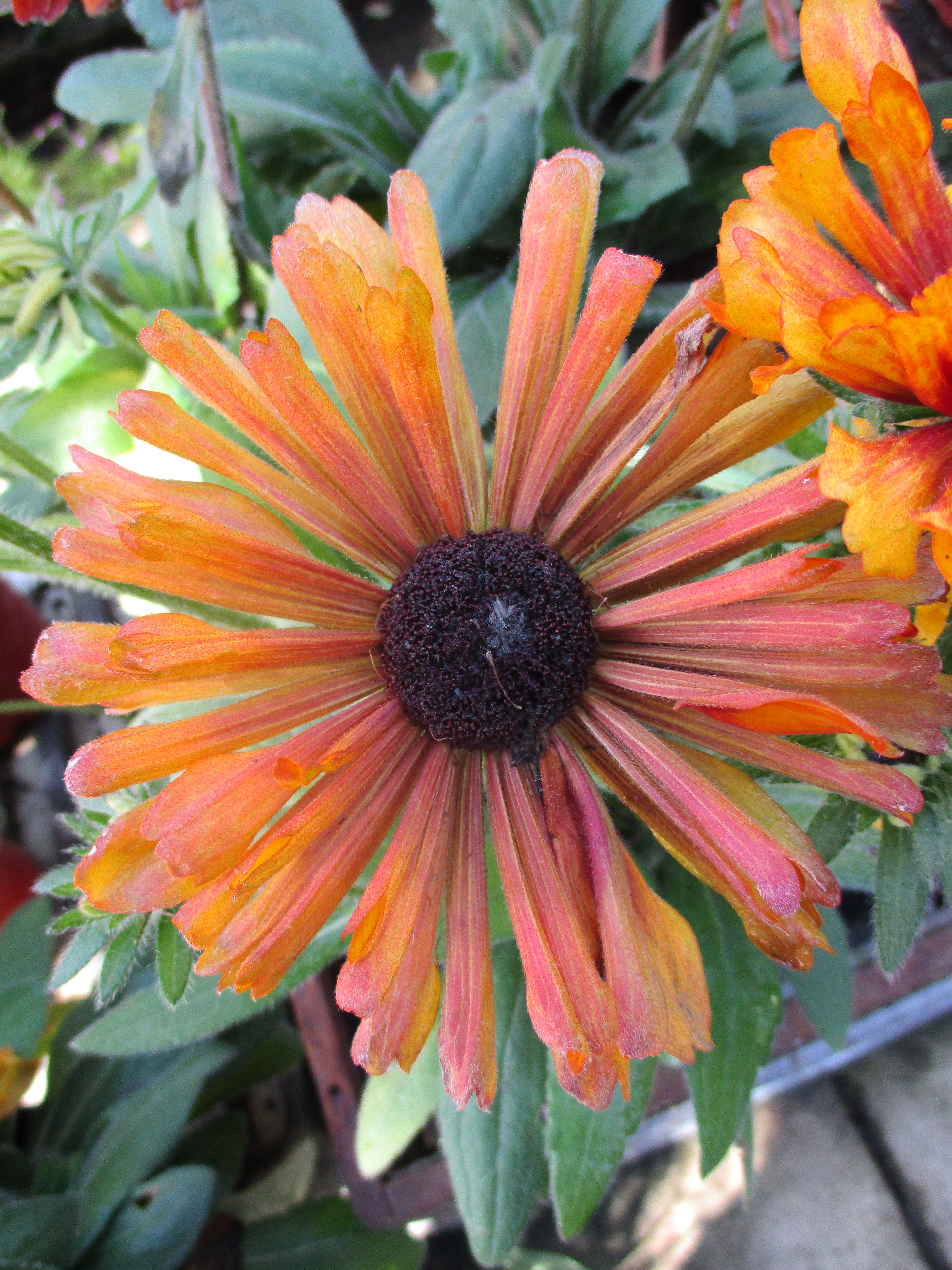 Nomenclature of the botanical sort was so much simpler back when we studied it back in the 1980s. It was intended to be like that. It was how the various specie of plants were identified and classified. There were certain rules that simply made sense. After ‘family’, plants were classified into general ‘genera’, and then further classified into specific ‘specie’. Some specie were further classified into ‘varieties’ and ‘cultivars’. (Cultivars are simply ‘cultivated varieties’ that need to be perpetuated by cloning because they are too genetically unstable to be true-to-type from seed.)
 Tony Tomeo