New Zealand Flax

New Zealand flax provides bold texture.

Simple old fashioned New Zealand flax, Phormium tenax, has been popular on the West Coast for as long as anyone can remember. Big specimens are prominent in old pictures of Victorian era gardens. The upright and olive drab foliage gets as high as ten feet, and as broad as fifteen feet. Bronzed and variegated cultivars stay somewhat more compact.

Modern cultivars of New Zealand flax might be Phormium colensoi, or hybrids of the two species. They are generally even more compact, with more colorful foliage. Foliage may be olive green, greenish yellow, brownish bronze, rich reddish bronze or striped with like colors. Some bronze sorts are striped with tan or pink. ‘Yellow Wave’ has floppier foliage. 

New Zealand flax is a tough evergreen perennial. Its long and narrow leaves can be too fibrous to cut without scissors. These leaves grow as tall as they do from clumping basal rhizomes. Interestingly rigid floral stalks stand slightly higher than the foliage, with yellow or red bloom. After bloom, these floral stalks can be a delightful and bold dried cut flower, and work well with pampas grass bloom.

Cooler Weather Is Slower Weather

Cooling weather can damage new growth.

Weather is not quite as warm as it had been. Warm days do not last quite as long as they did earlier in summer. Afterward, the longer nights get a bit cooler. Technically, autumn is only a few days from now. Although seasonal changes are mild, and a bit later here than in other regions, they eventually catch up. Plant activity has already been getting slower.

Seasonal changes keep gardening interesting. Plants that are now growing slower than earlier may need less attention. However, some need more attention, precisely because they are growing slower. Some of the work that was so important through summer should conclude until spring. Some of the work that will be important through winter begins now. 

Although evergreen, photinia and pittosporum hedges do not do much between now and next spring. If shorn too late, new growth develops slowly, and may become shabby as a result of cooler and rainier weather later. Late pruning of citrus stimulates vigorous newer growth that may be sensitive to frost through winter. Lemons are particularly susceptible.

Conversely, dormant pruning can begin as deciduous foliage starts to fall. Although most roses and fruit trees supposedly prefer to wait until winter, they may soon be too dormant to notice if pruning is a bit premature. This is partly why autumn is the season of planting. Mostly dormant plants are more resilient to discomforts than they would be while awake.

New Zealand flax, lily of the Nile, African iris and other rugged perennials are conducive to division now. They will soon be about as dormant as they get, but will want to disperse roots for winter anyway. They resume growth before winter ends, so want to be ready for it. Once rainier and cooler weather resumes, they will need no watering until next spring. 

Fertilizer should be passe soon also. Most plants consume less nutrients through cooler weather. Besides, many nutrients are less soluble, and therefore less available to plants while the weather is cool. Turf, cool season vegetables, cool season annuals, and some small palms are a few exceptions that could benefit from minor applications of fertilizers.

Kenny

Ah, (dysfunctional) wildlife in the garden.

tonytomeo's avatarTony Tomeo

If you watch Southpark, you shouldn’t.
If you do anyway, you shouldn’t admit to it.
If you happen to know someone who watches Southpark, you might have heard indirectly about Kenny. He dies in every episode. Actually, he typically dies a few times in each episode, and typically does so violently. Experts claim that there are two episodes of Southpark in which Kenny does not die, but proof is all too conveniently scarce.
There is also an opossum named Kenny. Like Kenny of Southpark, Kenny the opossum dies in every episode.
Apparently, Kenny startled someone who was working too intently in the garden to notice his approach on top of a fence directly behind where this unnamed someone was working. This unnamed someone grabbed a stick and clobbered Kenny right across the backside. Although the blow was not terribly aggressive, and not intended to be harmful, Kenny surprisingly died violently…

View original post 237 more words

ICK!

Since this recycled article posted three years ago, the aggressively invasive pampas grass actually has not gotten noticeably worse.

tonytomeo's avatarTony Tomeo

P80915K.JPGJust about everything in this picture is icky! This species of pampas grass, Cortaderia jubata, is one of the most aggressive and noxious of the invasive exotic specie that have naturalized here. It seems to be incarcerated behind the weathered cyclone fence with barbed wire on top. The big water tank is is a harshly stark background. The tired old Douglas firs and ponderosa pines to the left and right seem to be unhappy here. The small coast live oak that is at least trying to make a more cheerful appearance is only oppressed by the surroundings. Only the clear blue sky above lacks the ick factor.

What is not visible in the picture is that there is no other flora in the area. Most of the area is covered with a thick layer of gravel to prevent vegetation from getting established close to the water tank. Weeds that…

View original post 250 more words

Six on Saturday: Ghost Town

As a result of prioritizing our efforts within the landscapes at facilities that have been in use through summer, landscapes at unused facilities have been neglected. It would be embarrassing if anyone else were here to see the results. Those who maintain the other infrastructure have mentioned that these neglected areas resemble ghost towns. Flowers continue to bloom without any assistance. Also though, weeds continue to grow and toss seed for the next generation. There is so much to catch up on. What is worse is that I will not be working here much until November, and will be gone again in February.

1. While no one is looking, lily of the Nile continues to bloom into the middle of September. I was not here to see it, but I suspect that this particular colony was not blooming on time for July.

2. Kahili ginger is blooming too, but right on schedule. This is obviously a substandard bloom. I am impressed nonetheless. It was not expected to bloom at all. It was just planted over winter.

3. Otherwise, most of the bloom here is that of weeds. Strangely, I do not remember anyone pulling weeds from the pavement before. Could the formerly constant traffic have inhibited them?

4. Should this say “PLEASE LET US GROW ON WALKWAYS” or maybe “PLEASE LET US STAY ON WALKWAYS”? Regardless, I am impressed by the ability of weeds to compose a sentence.

5. Grapes would certainly be easier to reach if they grew on neglected, hanging vines like these. Unfortunately, if left long enough to produce fruit, these vines would become a tangled thicket.

6. Goodness! This is what happens when a ponderosa pine seedling grows under a deck, and no one is here to pull it out before it grows right through! The weed problem here is now serious!!!

This is the link for Six on Saturday, for anyone else who would like to participate:
Japanese Aralia

The bold foliage of Japanese aralia is quite striking, whether kept low and dense, or suspended on taller lanky stems.

It may not grow too rapidly, but Japanese aralia eventually gets nearly eight feet high and wide, and commands a bold presence. The deeply and symmetrically lobed leaves can get as broad as a foot and a half, on long petioles (stalks). The foliage of ‘Vairegata’ emerges with a yellow border that turns pale white. ‘Moseri’ stays quite compact.

Plants grown for their foliage can be maintained by cutting the oldest stems to the ground as they begin to deteriorate, so that newer stems can replace them. Alternatively, lower growth can be pruned away as it develops to elevate the canopy and expose interior stems. However, individual stems do not last indefinitely, and will eventually need to be replaced by any convenient watersprouts.

Gardening Has Something In Common With Automobiles.

Buick is the genus. Electra is the species. Buick Electra is universally the most elegant luxury sedan of all time!

Horticulturists, biologists, and many other professionals who may interact with colleagues who speak other languages or even slightly different regional dialects use Latin to identify, among other things, biological organisms. Latin names may be cumbersome to pronounce and daunting to spell, but are universal to those of us who use them. This is important because common names are so regionally variable.

For example, some of the European maples that we know as maples here are known as sycamores in England, but are known everywhere by their Latin name of Acer. Similarly, North American sycamores that are known as maples or plane trees in various regions are all likewise known everywhere by their Latin name of Platanus. The universality of Latin names therefore facilitates accurate identification.

Latin names are very helpful when researching plants. A tree known simply as a ‘cedar’ might be a calocedrus, arborvitae, juniper, cypress, chamaecyparis or a true cedar, just to name a few. Knowing that the particular tree is more specifically a ‘red cedar’ perhaps limits the possibilities to arborvitae or juniper. Identifying the tree specifically as a Juniperus virginiana will help us find the most accurate information about it, even though it is not really a cedar at all, but a juniper. Juniperus is the general ‘genus’ name of all junipers. Virginiana is the specific ‘species’ name of the particular juniper that is known locally as the Eastern red cedar. (‘Genera’ and ‘specie’ are plural for ‘genus’ and ‘species’.)

Latin names work like the names of cars. Buick, Chrysler and Mercury are all like genus names. Electra, Imperial and Grand Marquis are all like species names of particular Buicks, Chryslers and Mercurys. ‘Limited’, ‘Custom’ and ‘Brougham’ are like variety names, like ‘Variegata’, ‘Compacta’, and ‘Schwedleri’.

As universal as Latin names should be, a few sometimes get changed. This can be confusing, and causes some plants to become known more commonly by either their new or old name, as well as the other name as a ‘synonym’. For example, Dietes bicolor and Morea bicolor are the same plant; but not many know for certain which name is more correct. It is like when Datsun became Nissan, but was also known as Datsun for many years afterward.

Horridculture – Think Outside The Box

Goodness! This is one of the worse of the ‘Horridculture’ meme.

tonytomeo's avatarTony Tomeo

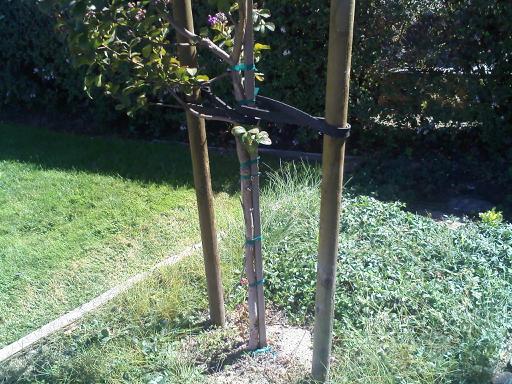
P80912Straight out of college, I worked briefly for a wholesale nursery that grew landscape stock, which included boxed trees. We also recycled a few trees, particularly from the abandoned homes in the neighborhood around the nursery. (The neighborhood, including the nursery, were in the easement of the Norman Mineta Freeway, which in the process of being constructed at the time.) I had believed that the boxed and recycled trees were for ‘instant’ landscapes, the sort that were for clients who did not want to wait for things to grow. It made sense, particularly in our region where so few stay in the same home long enough for trees to mature.

Many trees were good candidates for growing in boxes. Some were naturally small trees. Others had fibrous root systems that did not mind the confinement. Japanese maple, crape myrtle, purple leaf plum, flowering cherry, flowering crabapple, magnolia and various specie…

View original post 681 more words

Barberry

Delicate foliage hides sharp barberry thorns.

It certainly looks innocent enough. The modern cultivars of barberry, Berberis thunbergii, barely get taller and wider than six feet. Densely dwarf cultivars might not get much taller and wider than only two feet. Columnar sorts are quite narrow with mostly vertical stems. Even the old fashioned types get less than ten feet tall. Barberry is not exactly imposing.

However, like an angry chihuahua, it has a nasty bite. Its finely textured foliage obscures thin but very sharp spines. These spines are numerous enough to be visually appealing while the thin stems are bare through winter. Where necessary, they are sharp enough to inhibit encroachment. Unfortunately, these spines are annoying to handle while pruning.

Most popular cultivars of barberry have richly reddish or almost purplish foliage. Few are variegated with white. Some have bright yellowish chartreuse foliage. Formerly common green barberry is now rare. The small and neat leaves are obovate, and may seem to be circular. They turn vivid reddish orange through autumn, prior to defoliation during winter. Tiny red berries are rare.

Thorny Vegetation Is Naturally Repellent

Black locust is painful to handle.

Roses might be more fun to grow and prune without their thorns. Blackberries are easier to pick from thornless canes. Thorny vegetation is simply unpleasant to work with. Some very desirable plants, such as roses and most blackberries, are innately thorny. The only alternative to contending with their thorny condition is to grow something totally different.

Thorns and similar structures are as diverse as foliage, with a few distinct classifications. True thorns are simply modified stems, like those of hawthorn. Spines are modified foliar structures or leaves, such as those of cacti. Prickles, such as those of rose, are modified epidermal structures. Spinose foliar margins, like those of holly, serve the same purpose. 

The purpose that thorny vegetation serves is defense. It intends to inhibit consumption of foliage, fruit or bloom. That is why some trees are thorny only while young and low to the ground, then almost thornless as they grow beyond the reach of grazing animals. Thorny trunks of honeylocust may protect seed pods from bears, so birds can disperse the seed. 

It is therefore no mystery that many of the thorniest plants are endemic to desert regions. The scarcity of edible vegetation in such regions increases the need for protection. Also, it is no mystery that most grazing animals are not too deterred by thorny vegetation to get enough to eat. Otherwise, roses and firethorn would be exempt from the ravages of deer.

Despite its intentions of deterrence, thorny vegetation inhabits home gardens for various reasons. Some produces desirable bloom or fruit, like roses and blackberries. Cacti and agaves develop remarkably striking forms. Such plants should be situated appropriately. Rose canes can be bothersome close to walkway. Agaves can be downright dangerous. 

Thorny shrubbery, such as firethorn, barberry, Natal plum and English holly, is a practical deterrent for unwanted traffic. Firethorn espaliered on the top of a fence is as effective as barbed wire, and is more appealing. Maintenance of thorny plants is more of a challenge than for thornless plants. Otherwise, thorny plants should be more popular than they are.