Before I continue, I should mention that I have worked for some of the BEST horticultural professionals in the entire Universe! Seriously! I have worked for the single most excellent nurseryman EVER, and not one, but a FEW of the most excellent arborists EVER! YES, I am bragging! I can write about some of them another time.
I have also worked for some of the worst, including those who were involved with the maintenance of landscapes associated with various residential sites that were in the process of being renovated or demolished and redeveloped at the old Fort Ord. They engaged in more unethical activity at Fort Ord than I can write about in just a few articles. For now, I will just rant about one such incident. Back in about 2007 or 2008, I was asked to go out to investigated a distressed ‘Marina’ madrone on Abrams Drive. The subject…
It is as familiar for culinary application as it is for home gardens, even with its new name. Rosmarinus officinalis is now known as Salvia rosmarinus, but the common name is still just rosemary. Like many Mediterranean culinary herbs, it is a member of the Lamiaceae Family. Since it is native to Mediterranean regions, it is quite happy within local climates.
While many culinary cultivars of rosemary are shrubby or upright, the most popular home garden cultivars are trailing types. Trailing rosemary disperses its woody stems laterally, but can eventually get deeper than two feet. Shrubbier cultivars get at least twice as high in less time. The finely textured dark green foliage is evergreen and pungently aromatic.
Bloom is generally most profuse from late spring through the middle of summer, but may never really stop. It can continue in sparser sporadic phases whenever the weather gets warm, and even throughout the year. The tiny flowers are various shades of blue. Purple, white and pale pink bloom is very rare. Bloom is appealing to bees and other pollinators, including hummingbirds.
Gardening is unnatural. Most popular plant species are not naturally native. Cultivars are products of unnatural selection and breeding. Most plants like unnatural watering. Some enjoy unnatural fertilizers. Removal of their detritus is unnatural. So is the replacement of their detritus with mulch. Actually, most of what happens in the garden is quite unnatural.
Ironically, gardening is how many of us incorporate more nature into our lifestyles. Much of our effort compensates for what plants naturally crave but unnaturally lack. Watering is necessary for plants that get rain through summer within their natural ecosystems. Mulch might be nice for plants that naturally benefit from the decomposition of their own debris.
In nature, most plants benefit from their own debris. They enjoy the nutritiously decaying organic matter and enhanced moisture retention. Their shallow roots enjoy the insulating effect on the surface of the soil. Debris of some plants excludes other competitive plants. Mulch is not a perfect substitute for such detritus, but partly compensates for its removal.
Although it would likely be an asset to the plants that produce it, the detritus produced by most plants can not stay in the garden. Much of it is too abundant. Some is too shabby or too coarsely textured. Some might become combustible as it accumulates. Diseases can overwinter in some types of debris. Mulch is more sanitary, neater and less combustible.
Most mulches are organic matter of one sort or another. Compost does not last long as a mulch, but is appreciated by most plants. Uncomposted chips from a tree service occupy nitrogen as they decompose, but are more effective for inhibiting weed growth. Products that are available as mulch at garden centers are more refined, but also more expensive.
Some dense ground cover plants perform something like mulches. Many consume more moisture than they retain though. Also, they can retain bits of potentially infectious debris that falls from diseased plants above. Nonetheless, they insulate the surface of their soil, and inhibit or exclude weeds. Gravel over ground cloth is inert, but requires no watering.
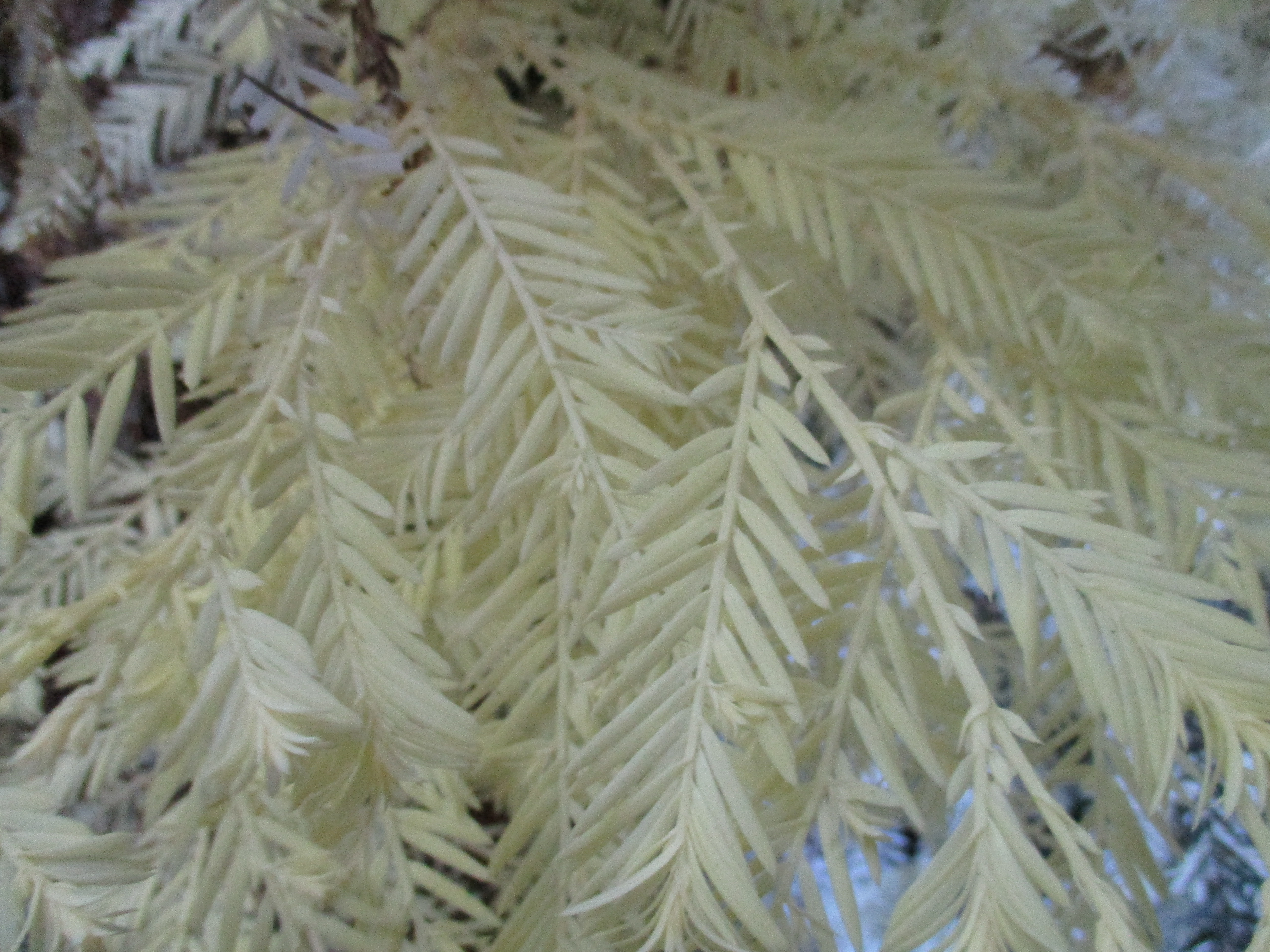
This foliage really is striking, particularly with black bearded iris. It does not last long once cut, but neither does bearded iris. I still want to figure out how to graft this onto a normal green tree.
How Italian! Red, white and green! A coastal redwood with a white albino sport (mutant growth) amongst otherwise deep green foliage. Actually, it is very Californian. Coastal redwood is endemic to California with only a a few north of the border on the extreme southern coast of Oregon.
Such sports are quite rare. Back in the late 1970s, an article in World Magazine mentioned that only five of these albino ‘trees’ where known to exist. There were actually more, even back then, but others were not documented. (They were WithOut Papers – WOP.) The specimen in the picture is at a home that is about a century old, so it was known about for a very long time, although not documented. Albino foliage is a lethal mutation. It lacks chlorophyll, so can not sustain itself. It only survives because it originates as basal watersprouts that remain attached to the original…
As I was recycling this three year old article, it occurred to me that the larger of our two bald cypress is now gone. It needed to be removed to relinquish space for a picnic area for outdoor dining (during the situation with Covid). The buttressed roots were just too lumpy.
When a plant that should be compact or shrubby gets too lanky with exposed lower stems, it is described as ‘leggy’. We do not hear much about plants that develop ‘knees’. Perhaps that is because there is only one species that does so. That one species happens to be very rare here. If there are other specie that develop knees, I do not know what they are.
‘Knees’ are weird appendages that grow upward like stalagmites from the roots of bald cypress Taxodium distichum, particularly where the trees grow wild in swampy conditions. Knees can get quite tall. One of our professors used to tell us that they could do some serious damage to a canoe. Perhaps knees are why bald cypress is locally unpopular in landscapes.
However, I happened to notice that bald cypress is a common street tree in downtown Oklahoma City. Just like most other street…
There is a certain degree of silliness to horticulture. Some of us indulge in it whenever there is an opportunity to do so. I prefer to conform to most rules when I can, but even I rarely engage in irresponsible gardening tactics. My predilection for white, and associated lack of appreciation for more interesting color, might be the most obvious example. Another example is my desire to grow too many useless plants simply because propagation stock happens to be available, or because I happen to enjoy the particular plants. Hey, it keeps me happy.
1. Agave attenuata – fox tail agave needed to be removed from one site, so should have been relocated neatly to another. It instead got cut down (with a chain saw!). It is now a shabby cutting.
2. Calandrinia grandiflora – rock purslane was more fortunate as it remained intact for removal and relocation, but will now get dismantled into a bunch of cuttings. Look at its silly little pot!
3. Phoenix dactylifera – date palm grew from seed in a neighbor’s compost pile. It would be nice if one is female and the other is male, but they could not produce fruit for many years anyway.
4. Lathyrus latifolius – perennial pea is common, but only a few bloom white. I tagged two to dig and can this winter. Well, I did not wait. They were already dormant. Now they are sprouting.
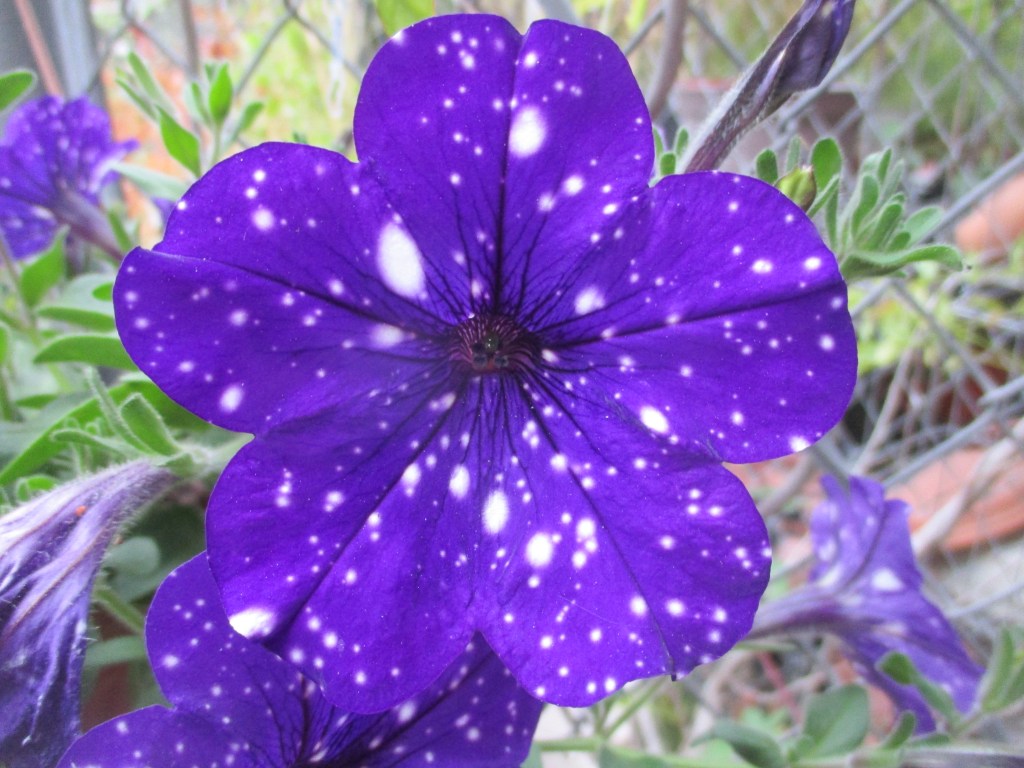
5. Petunia X hybrida – petunia is something that I do not get involved with at work. I lack proficiency with color. My colleague found this ‘Night Sky’ petunia, and despite reviews, is trialing it.
6. Rhody would not allow me to get a good picture of him, so I got this bad one instead. Everyone loves Rhody. He really is exemplary. Even his bad pictures are the best of all Six on Saturday.
This is the link for Six on Saturday, for anyone else who would like to participate:
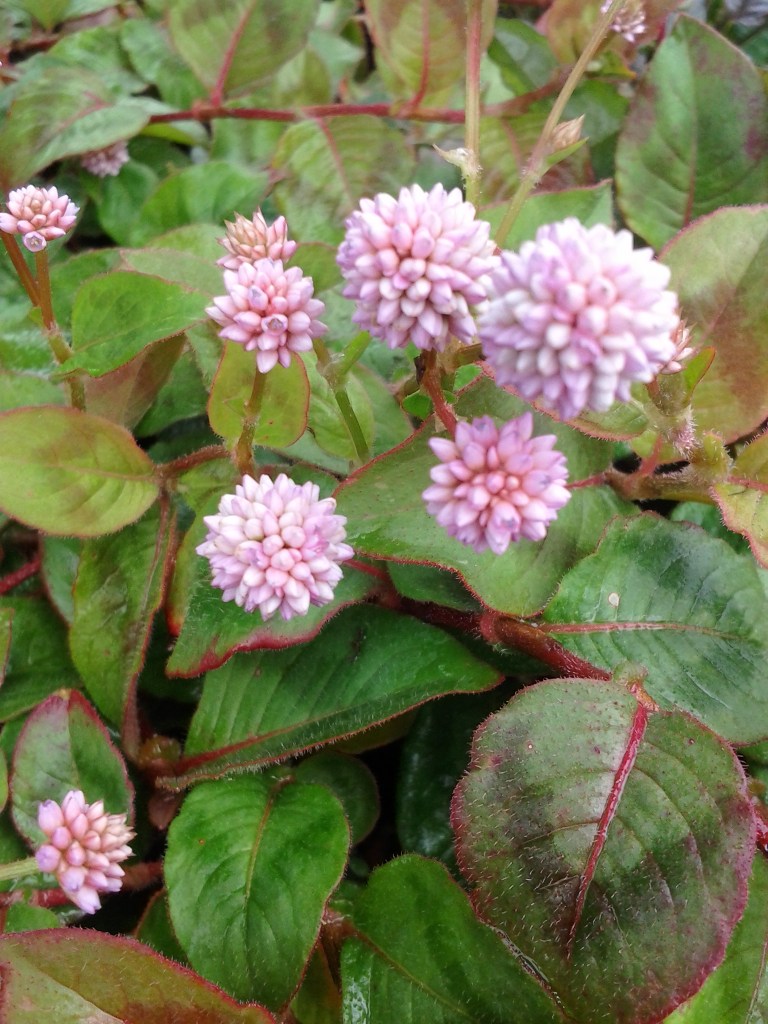
There are no fancy varieties, but many different fancy names for knotweed. It used to be known as Polygonum capitatum, but is now easier to research as Persicaria capitata. The many common names include pink knotweed, pink clover, pink fleece flower, pinkhead, pink bubbleweed and smartweed. Obviously, the tiny and spherical blooms are pink, about the color of bubble gum. Each small leaf has a distinctive brown chevron, which makes the collective foliage rather bronzy. The wiry stems can not stand much more than three inches high, but creep indefinitely, rooting as they go. Knotweed is an excellent but potentially invasive groundcover, and is also a nice component to mixed plantings in large urns or behind retaining walls, where it can cascade several inches over the edges. A bit of partial shade is no problem. Bloom continues through the end of summer, and resumes at the end of winter.
Mulch was not invented by humans. Most plants make some sort of mulch naturally. Even desert plants that live on bare ground shed foliage that decomposes to be recycled back into the soil, and provide nutrients for the roots below. Redwood, most pines and most eucalyptus are extreme mulchers that generate thick layers of foliar debris that benefit their own roots, but inhibit the growth of competing trees. Knotweed, Hottentot fig (freeway iceplant), ivy (both Algerian and English) and other dense groundcovers are their own mulch, and also work well for substantial plants that grow amongst them.
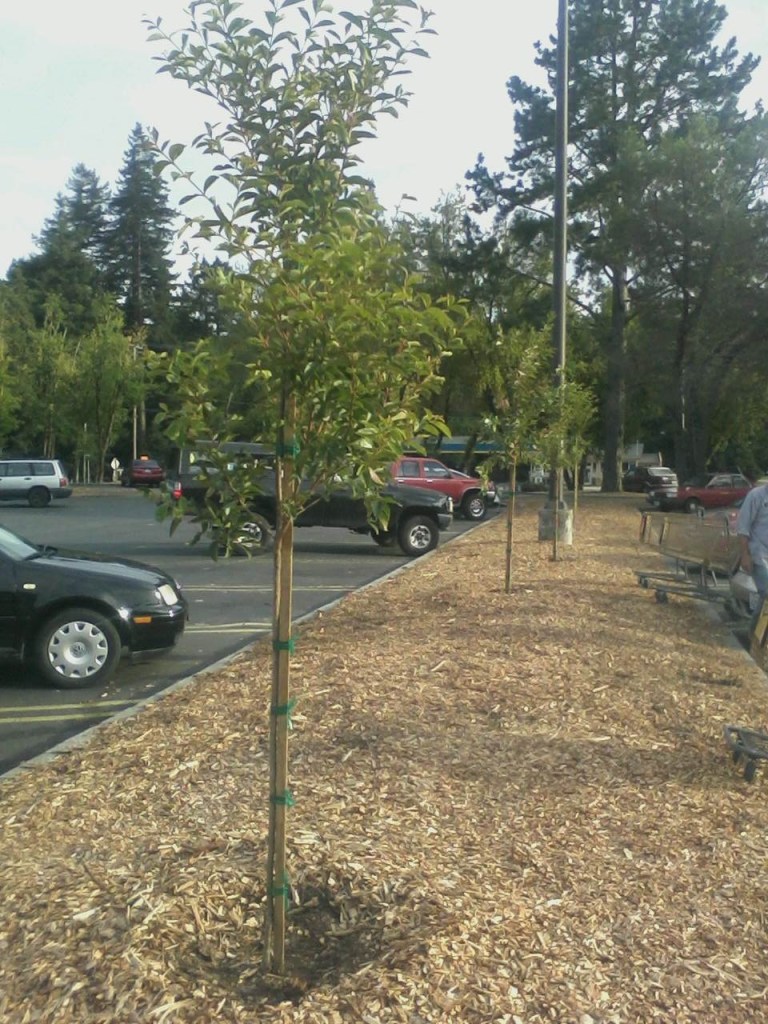
There are a few advantages to mulch. Although ground cover mulches consume some degree of moisture, mulches benefit plants by retaining moisture at the surface of the soil. Mulches also insulate the soil, so that it is more comfortable for roots that want to be near the surface. Most weed seeds that get covered by thick mulch can not germinate and emerge through it. Those that try to germinate on top probably can not get their roots through to the soil below. Besides, mulch simply looks better than bare soil.
Mulch is generally spread in early spring, before weed seeds are completely germinated, and while the soil is still damp. However, moisture retention is still a concern through the warm and dry weather of summer. A thin layer of finely textured mulch added over thinning groundcovers (without completely burying the foliage) can rejuvenate tired old stems by giving them something more to root into. This works well for knotweed, English ivy and even trailing gazanias.
Mulches should generally be well composted so that they do not take too many nutrients out of the soil for their own decomposition. However, uncomposted coarse wood chips, like those often recycled from tree services, are even more effective at controlling weeds while fresh, and they tend to decompose before they become a bother to larger plants.
Small volumes of mulch can be purchased in bales at nurseries and garden centers. Composted redwood soil conditioner is a popular soil amendment that can alternatively be a nice finely textured mulch to spread thinly over small areas or in planters. Larger volumes of more coarsely textured and less expensive mulching materials can be obtained by the yard from garden supply stores.
Back when my colleague and I were roommates in the dorms at Cal Poly in San Luis Obispo, we noticed how badly the photographs in bare root catalogs had been modified to enhance color. Years before modern digital editing, colored film was cut out to any desired shape and placed over a photograph to produce a new photograph with enhanced color. We looked at pictures of flowering crabapples with canopies that were entirely bright pink, including the stems, leaves and everything associated with the canopy of the tree. We could easily see the outline of the bright pink film that had been placed over the original photograph. It was done with blue fescue, hydrangeas, azaleas, callas and really just about anything that…
Compared to Algerian ivy, English ivy, Hedera helix, may seem to be more complaisant. As ground cover, it mostly stays a bit lower, with smaller leaves, and a more refined foliar texture. It is generally easier to maintain and to mow if it does not get too deep. However, where it naturalizes, English ivy is more aggressive and more invasive than Algerian ivy.
If contained, English ivy is a splendidly dense and evergreen ground cover that excludes most weeds. Containment is very important! English ivy must not climb into shrubbery or trees. It otherwise overwhelms its support and disperses seed. Although reasonably safe on bare concrete walls, it ruins wooden, painted and stucco surfaces. Growth is very fast!
‘Hahn’s’ is likely the most popular cultivar of English ivy. It branches well, to fill out fast as ground cover. Cultivars that are variegated with white or yellow grow significantly slower, but provide elegant foliage for big pots or planters of mixed annuals or perennials. Foliar lobes are variable. For example, lobes of ‘Needlepoint’ are distinctly narrow and pointed.

 Before I continue, I should mention that I have worked for some of the BEST horticultural professionals in the entire Universe! Seriously! I have worked for the single most excellent nurseryman EVER, and not one, but a FEW of the most excellent arborists EVER! YES, I am bragging! I can write about some of them another time.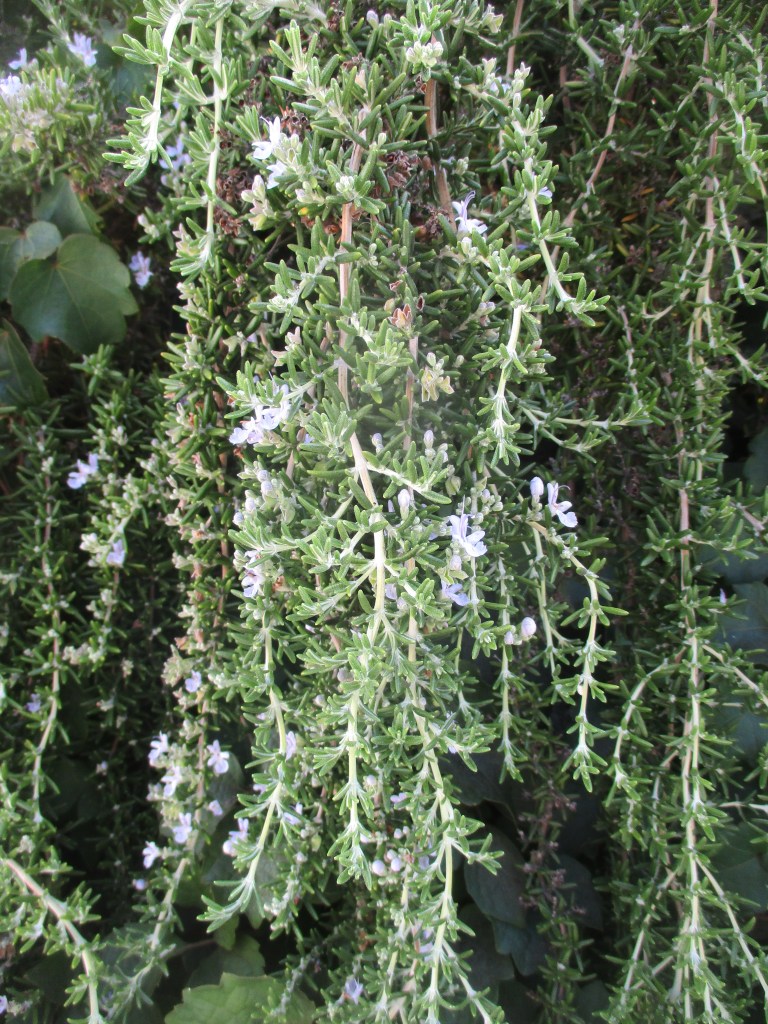

 How Italian! Red, white and green! A coastal redwood with a white albino sport (mutant growth) amongst otherwise deep green foliage. Actually, it is very Californian. Coastal redwood is endemic to California with only a a few north of the border on the extreme southern coast of Oregon.
 When a plant that should be compact or shrubby gets too lanky with exposed lower stems, it is described as ‘leggy’. We do not hear much about plants that develop ‘knees’. Perhaps that is because there is only one species that does so. That one species happens to be very rare here. If there are other specie that develop knees, I do not know what they are.




 Tony Tomeo