Foliage Can Provide Color Too

There is considerable variety in variegation.

Flowers get all the credit for color. They certainly are the most colorful features in the garden, as well as the most fragrant. However, foliage can do so much more than simply provide green. It can be hued with yellow, red, blue, purple, bronze, gray, or variegated with white or yellow. Plants with colorful foliage can range in size and function from small annuals and perennials to shrubbery, vines and even trees.

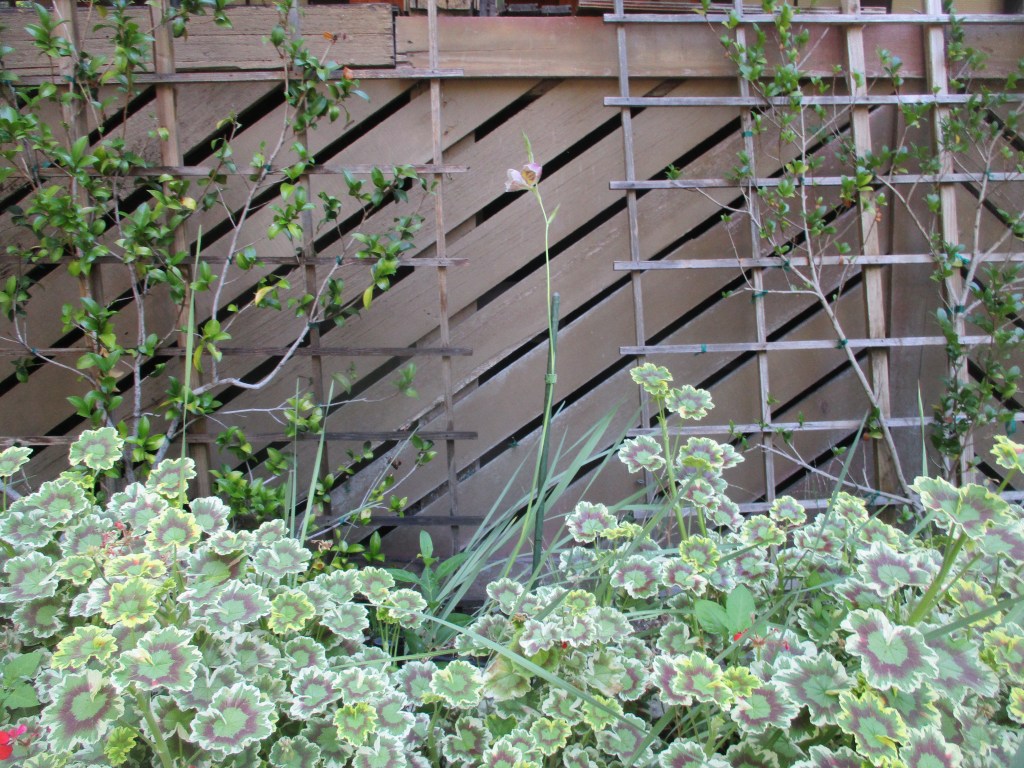
Hydrangea, hosta, ivy, English holly and various pittosporum are some of the more popular plants for white variegation, and are often variegated with yellow. Euonymus can conversely be variegated with white, but is usually variegated with yellow. New Zealand flax can be variegated with pink, bronze, brown or gold. Box elder is a good sized deciduous tree that can be variegated with white, or alternatively frosted uniformly with gold as new foliage emerges in spring. There is even a variety that has slightly purplish or smoky colored new foliage.

Silver mountain gum, silver Mediterranean fan palm, lamb’s ears, artemesia and the various dusty millers have remarkably silvery foliage. Silver mountain gum can grow into a mid-sized tree with a stout trunk. Lamb’s ears is a low perennial. Olive trees, some junipers and the various lavenders have gray foliage. Colorado blue spruce and some agaves have striking blue color.

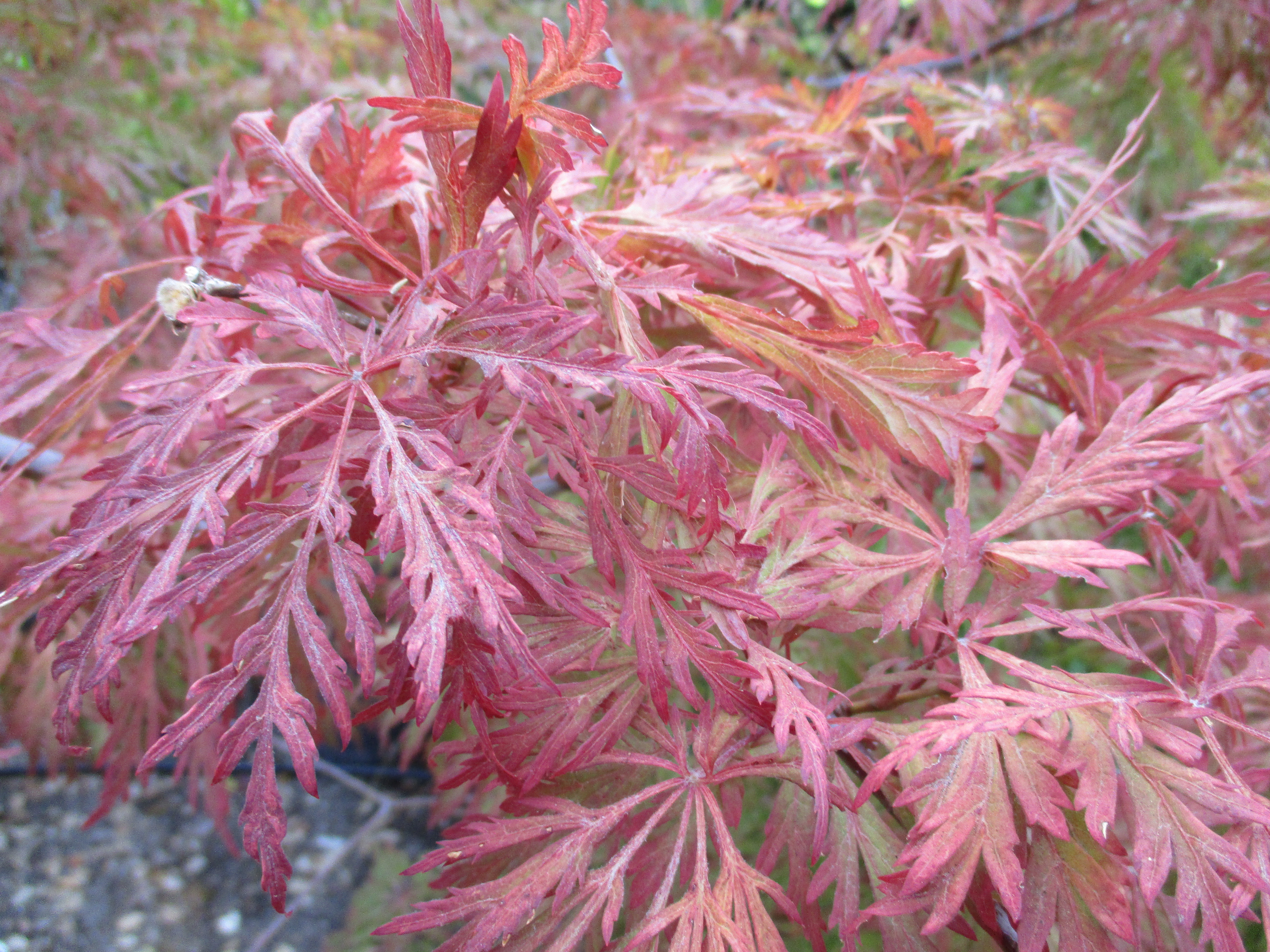
Various purple leaf plums and Japanese maples are famous for their purplish foliage. Smoke tree and some beech have even darker purplish foliage. Some New Zealand flax and cannas can be just as purple or comparably bronze.

Actually, New Zealand flax and cannas, as well as junipers known for blue or gray foliage, can alternatively be bright yellow. Golden arborvitae, golden honeylocust and golden Monterey cypress really stand out nicely against darker green.

Colorful foliage tends to be most colorful as it develops freshly in spring, and tends to fade somewhat through summer. Gold junipers can actually fade to basic green by autumn. Shade inhibits most types of coloration, but can show off variegation better. There really is so much variety with colorful foliage that it is impossible to generalize.

Jumping Juniper!

Finally, a recycled article that ‘almost’ conforms to the ‘Horridculture’ meme for Wednesday. I do find the unpleasant stigma of junipers to be objectionable.

tonytomeo's avatarTony Tomeo

P80519KOh, the stigma of juniper never gets old! No matter how many cool new cultivars get introduced, and how many specie get rediscovered, they are still though of as those nastily prickly ‘tams’ that were too common in the 1950s. Even some of us who really like junipers dislike tams, not only because they share their stigma with all other members of the genus, but also because they really are nasty and prickly, and not as useful as their overuse would suggest. Are they deep ground cover or shallow shrubbery? They might work for a few years, or maybe many years, but they eventually crash into each other or other plants and pile up into a dense thicket that can not be pruned without being deprived of all dignity.

In the neighborhood where I primarily work, we have a ‘do not plant’ list. Such lists typically cite specie that are…

View original post 445 more words

Fraser’s Photinia

Bronzed new foliage fades to green.

Almost all photinia in local landscapes is Fraser’s photinia, Photinia X fraseri, which is a thornless and fruitless hybrid of two species that are now rare. Some of the old fashioned photinia are thorny. Some produce copious berries that can get messy, or feed birds who can get messy. More modern cultivars of Fraser’s photinia are becoming more available.

Fraser’s photinia is popular as a shorn evergreen hedge. New foliage that develops after shearing is richly reddish bronze, and fades to dark green. Bronze color is best in spring, after late winter shearing. Summer shearing stimulates a repeat performance, although it may not last as long before the foliage fades to green. Shearing enhances foliar density.

Unshorn photinia can develop into small trees as tall as fifteen feet, with new growth that is a bit less richly colored than that of shorn photinia. It also blooms, often profusely, with big and rounded trusses of tiny creamy white flowers. Bloom is not impressively colorful. Floral fragrance is objectionable to some. All photinia types are susceptible to fire blight.

Shearing Can Not Fix Everything

Shearing enhances foliar density without bloom.

Mowers are for mowing lawns and shallow ground cover. Blowers are for blowing debris from pavement, decking and other flat surfaces. The names of these tools suggest these particular functions. Those of us who use such tools tend to be aware of their limitations. Why are simple concepts of shearing and the associated tools so difficult to understand? 

‘Mow, blow and go’ gardeners are not so bad if they simply mow, blow and go. They tend to the two most significant but also least pleasurable tasks in the garden, and then leave before causing problems. Most are also qualified to add bedding plants or shear hedges. However, some will shear anything that is within reach of their powered hedge trimmers.  

Shearing is for hedges or shrubbery that is strictly foliar. There are few exceptions. Such shearing should be performed properly, and only for the few plants that are conducive to it. The process promotes foliar density, but also generally inhibits bloom. For hedges that function as living fences in the background of more interesting plants, this is no problem.

Otherwise, shearing plants that are not conducive to it ruins appealing form, and inhibits or prevents appealing bloom. Privet and photinia perform well as shorn hedges because their dense evergreen foliage is their primary asset. Their bloom is actually undesirable. Their natural forms are unremarkable, but their shorn forms can be remarkably practical.

Frequent or untimely shearing prevents lemon bottlebrush and oleander from blooming. However, shearing immediately after a bloom phase stimulates new growth to bloom for a subsequent phase. New growth only needs an opportunity to mature and bloom before removal. Such potentially blooming stems need extra space to extend prior to blooming.

As practical as it is for hedges, shearing ruins the foliar texture of other plants. Heavenly bamboo is worthlessly shabby without its naturally intricate foliar texture. Juniper retains good color, but becomes boringly plain. Rhododendron and hibiscus become disfigured and can not bloom. Each of these plants and all others are discriminating about pruning. Few are agreeable to shearing.

Honeysuckle

Oh, I still like to brag about this unimpressive honeysuckle.

tonytomeo's avatarTony Tomeo

P80526K

This is no ordinary honeysuckle. It is quite less than ordinary. It is not available in local nurseries. No one here wants it. Although it might be available from nurseries that provide native plants within the native range of this honeysuckle, most of those who find it in their garden probably do not want it there. After all, there are plenty of more desirable honeysuckles to grow. Some have more fragrant bloom. Some have more colorful bloom.

As you can see, this honeysuckle is not very impressive. It is about as shrubby as it is vining, and does not get very big. The small white flowers lack fragrance, and are not very abundant.

What I like about this honeysuckle is that it came all the way from Oklahoma. ( https://tonytomeo.wordpress.com/2017/11/19/oklahoma/ ) It is native there. I do not remember what honeysuckle it is at the moment. I brought it back…

View original post 149 more words

Fleabane

Since this recycled article posted three years ago, the fleabane has been removed from my planter box downtown because it was just a bit too aggressive there. It climbed over the succulents and looked sloppy through summer. At work, it still acorns stone walls where nothing else survives.

tonytomeo's avatarTony Tomeo

P80513Erigeron karvinskianus

Is it really supposed to be the bane of fleas? If so, why? I learned it as Santa Barbara daisy. Is it native there, or was a particular variety of it named for Santa Barbara? Is it a weed? Is it native? Is it a native of somewhere else in California that merely naturalized here? There are so many questions about this simple little flower that is growing wild under a cyclone fence at the backside of a motorcourt at work.

Whether it really is native or not, or whether it is a straight species or a selected variety of one, fleabane happens to do well in drought tolerant landscapes composed of native plants. It naturally spreads out to form shallow but wide mounds. If it gets cut back in its off season, it comes right back. Although it dies after only a few years, lower stems typically…

View original post 149 more words

Six on Saturday: Rhody Approved

This is more than Rhody Approved. These are SIX rhodies that I approve of. (I do not know what Rhody thinks because I did not ask.) These pictures were taken early last week. All this bloom is deteriorating now, with only the latest bloom lingering. Most of the rhododendrons here are quite mature. Their identities are unknown. Does it really matter?

1. Trude Webster looks something like this, but should stay lower. The specimen that produced this bloom is more than twenty feet high! It is a lanky tree that bends from the weight of bloom.

2. I have no idea what this is. I am not certain about the identities of any of the rhododendrons here; but this one is different. I really do not know what it even resembles! It certainly is pretty.

3. Rhododendron ponticum is a simple species of Rhododendron, rather than an extensively bred cultivar. Unlike its progeny, it is somewhat uncommon in cultivation. This just might be one.

4. Anah Kruschke is what I thought this resembled last year. It looks nothing like it now. I suppose that it could be another specimen. Anah Kruschke is common, so must be here somewhere.

5. Taurus is what I designated this one as, although I doubt that it really is. It is a big and sprawling specimen, with the simplest and brightest red bloom. It happens to be one of my favorites.

6. Lord Roberts blooms with rich burgundy red like the velour upholstery of the 1978 Electra I learned to parallel park with. If you can parallel park an Electra, you can parallel park anything. Anyway, I do not know what cultivar this is, but I know it is not actually Lord Roberts. Its foliage is not right. Nonetheless, without a good white rhododendron, this is my favorite of these six.

This is the link for Six on Saturday, for anyone else who would like to participate:

https://thepropagatorblog.wordpress.com/2017/09/18/six-on-saturday-a-participant-guide/

Shiny Xylosma

Shiny xylosma has pleasantly glossy foliage.

Where it had been left to develop naturally in old freeway landscapes, shiny xylosma, Xylosma congestum, grew as small trees. The largest are significantly taller than twenty feet. They can be pruned up to expose their nicely flaking bark on sculptural trunks and stems. The evergreen foliage is shiny and rather yellowish green, somewhat like that of camphor tree. The slightly serrate leaves are about two inches long or a bit longer. The tiny and potentially fragrant flowers are rarely seen, and not worth looking for. In refined landscapes, shiny xylosma is popular as a shorn hedge. Xylosma congestum ‘Compacta’ has denser growth, and can be kept only a few feet high if necessary. Vigorous shoots can have nasty thorns hidden in their deceptively gentle foliage. Once established, shiny xylosma does not need much water. It prefers full sun exposure, but will tolerate a bit of shade.

There Are Rules To Hedging

Few plants are conducive to shearing

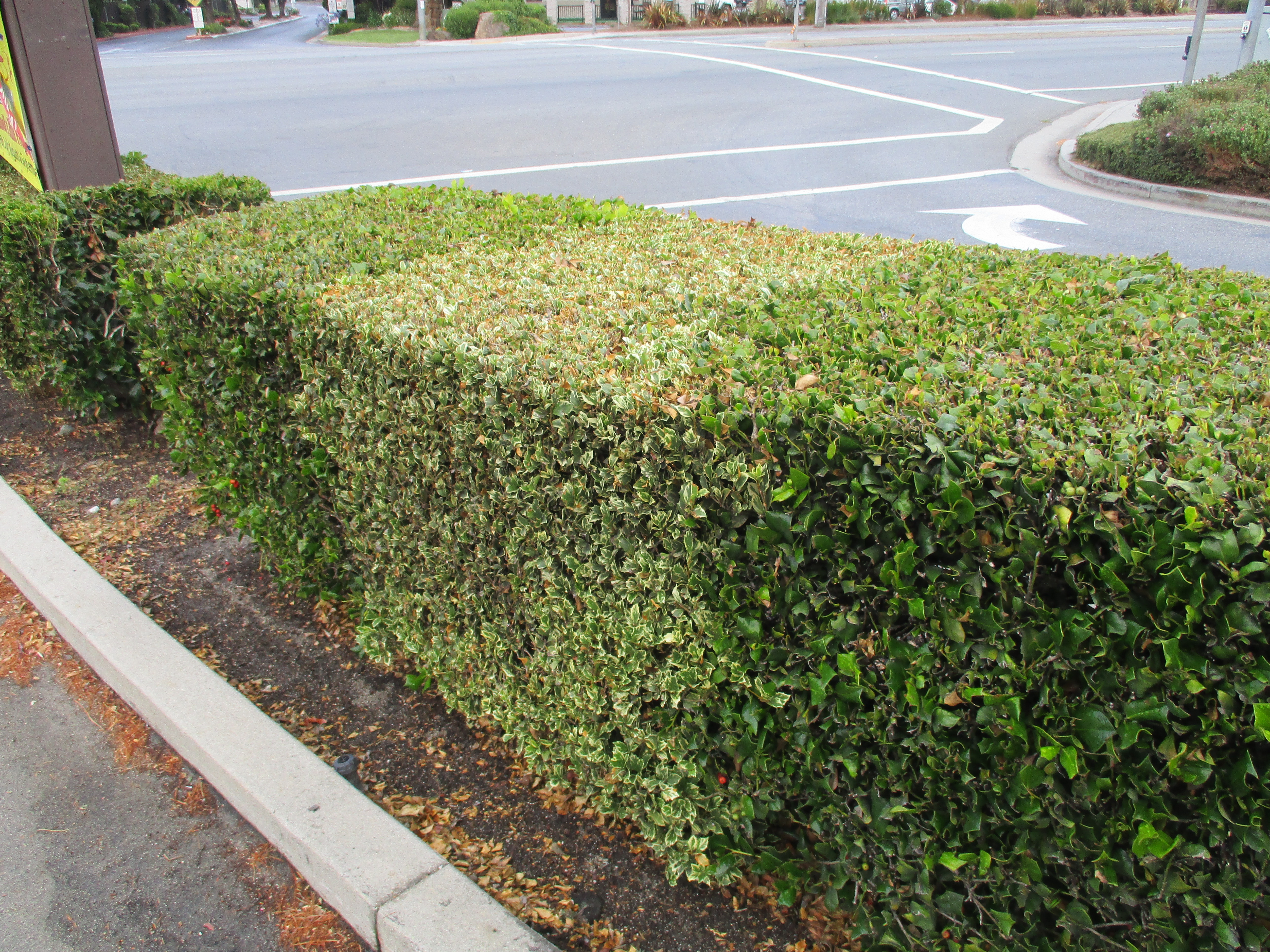
All the wrong plants get shorn. Mow, blow and go gardeners are known for shearing everything that they can reach into creepy and unnaturally geometric shapes, usually flared out at the top, and bulging obtrusively into otherwise usable space. Yet, functional formally shorn hedges are passe and almost never shorn properly.

First of all, a formal hedge should be uniform, which means that all the plants that comprise it should be the same, and planted at the same distance from each other. Any plants within a formal hedge that die should be replaced with the same plant. A single English boxwood plant added to a Japanese boxwood hedge will always stand out with a different shade of green and growth pattern. Seedlings of other plants that grow up into a hedge should be removed before they become part of it.

Secondly, a formal hedge should be contained within defined boundaries. It should get neither too tall, nor too deep (from front to back). A fat hedge wastes space. There is no excuse for a hedge to encroach obtrusively over walkways, driveways or patios.

The vertical faces of a hedge should be completely vertical or slope very slightly inward at the top, but should certainly not slope outward to shade lower growth. A slight inward slope is more important on a northern face of plants that are sensitive to shade.

Hand pruning hedges (with hand shears) produces the best finish, but takes quite a bit of time for big hedges. Shearing with typical hedge shears cuts leaves as well as stems, so can cause foliage with large leaves to look a bit tattered for a while. Hedges that grow fast may need to be shorn twice or more annually. Some hedges can get shorn back aggressively once annually, and then allowed to fluff out evenly through the rest of the year. Bottlebrush and escallonia hedges can bloom nicely and evenly if shorn only once annually.

Glossy and wax leaf privet are among the most traditional of formal hedges. Glossy privet can get quite tall, but wax leaf privet actually has glossier foliage. Photinia and shiny xylosma have a bit more color, but want a bit more space (from front to back). Boxwoods make very nice small hedges. Pittosporums are available in various shapes and sizes. Pittosporum eugenioides gets quite tall, and can be kept quite lean. Pittosporum tobira is shorter and wider.

Drunk Stick

Again, these recycled articles are deficient in those that conform to the ‘Horridculture’ meme for Wednesday. This one is just weird.

tonytomeo's avatarTony Tomeo

P80516Seriously, I am not making this up. ‘Drunk Stick’ is what the Spanish name of ‘palo borracho’ translates into. It is one of the few common names of the tree I know only as floss silk tree, Chorisia speciosa or Ceiba speciosa. Yes, it sounds crazy, but not as crazy as what the trunk and limbs looks like. One can speculate why it is known as ‘drunk stick’. I am not certain that I want to know.

The trunk in the picture is that of a small tree still in a #5 can. Larger trunks are no better. They are fat and green, and outfitted with these weird conical thorns. The thorns are not too terribly sharp like those of hawthorns or cacti, but they are terribly stout. Seriously! They are like made of wood! As the green trunk grows, it becomes distended, but only makes more thorns to…

View original post 149 more words