Again, this reblogged article does not conform to the ‘horridculture’ meme for Wednesday, since it is more about bad wildlife than about bad horticulture.
Halston, with the help of several friends, could make a nice pill box hat. That is the origin of the name; from pill box hate fame. This might help clarify, https://tonytomeo.wordpress.com/2018/01/27/caution/ . Yes, Halston was a gopher.
Halston was causing some significant damage that was more of a concern than fashion. Halston started by making several large volcanoes under an already distressed ‘Yoshino’ flowering cherry tree right on the edge of the main road. I really did not want any more of the roots to be ruined. I dug into the main tunnels and set traps; but Halston was very elusive, and pushed traps out of the tunnels, and left them unsprung at the surface of the soil.
Halston was very busy last weekend, creating a chain of volcanoes like the volcanic islands of Hawaii. They were right along the edge of a paved walkway, so were both unsightly and…
Garden varieties with fluffier white, pink or pinkish red flowers, and more mounding foliar growth, are popular annuals. With grooming, they might survive as short term perennials. The more familiar form of English daisy, Bellis perennis, though, is a persistent perennial that commonly infests lawns. Stems stay very low. Flowers are white with yellow centers.
Some consider English daisy to be a noxious weed in turf. Others like its random drifts of white bloom on otherwise plain lawns. English daisy works nicely as a rustic component of mixed perennials too. The common weedy form is unavailable in nurseries, but is very easy to divide from established colonies. Once established, it is impossible to eradicate.
Bloom is most profuse about now, and can continue in random minor phases until cooler weather late in autumn. Sporadic bloom is possible during winter. Warm and dry weather during summer can inhibit bloom temporarily. English daisy prefers partially shaded sites and steady watering. Flowers are an inch wide. The spatulate leaves are less than two inches long.
Lawns require significant maintenance and weeding.
Weeds are constantly a problem here. There is no season in which every sort of weed is inactive. As some annual types finish dispersing seed and die off for winter, others begin their season. Most weeds just happen to be most active as winter becomes spring. They try to stay ahead of desirable plants. Lawn weeds have been proliferating faster than turf.
Annual weeds were easiest to pull while still dispersing roots, and while the soil was still damp from winter rain. Biennial weeds that grew last year are more firmly rooted, even if their soil is damp. Perennial weeds are most persistent, with extensively dispersed roots. Of course, as lawn weeds, all three types are more challenging than in the open ground.
Separation of weeds from turf grass is significantly more work than pulling weeds alone. It is not so easy to reach down into the roots of the weeds. Nor is it so easy to pull weeds without pulling some of the turf grass with them. The process is likely to leave bald spots. Many of the persistent perennial lawn weeds are more firmly rooted than the turf grass is.
Dandelion is notorious for leaving bits of root behind when pulled. These bits regenerate into new plants that are even more difficult to pull than the originals. The various species of oxalis persist by various means. Some produce bulbs or offsets that are impossible to separate from the soil. Others develop thick networks of sinewy stolons that break apart.
Some persistent lawn weeds, such as plantain and English daisy, as well as many of the feral grasses, are so difficult to eradicate that they ultimately integrate into the lawns that they infest. It is simply easier to mow over them than to try to eliminate them. They never quite assimilate though, so interfere with the uniformity of color and texture of their lawns.
Unfortunately, some lawn weeds do worse than merely compromise the visual appeal of turf. Burclover and foxtail can be dangerous to pets. Their seed is designed to stick to fur. Burclover seed structures can tangle and accumulate in long fur, causing dense matting. Foxtail seed structures can lodge into eyes, nostrils, throats and ears, or pierce soft skin.
Staghorn ferns are epiphytes. They cling to tree trunks, rocks or whatever they happen to grab onto. They can root into decayed wood if it is porous enough, but they are satisfied to just cling to the exterior. They do not need soil. They sort of make their own soil by collecting debris that falls from the canopies of trees above. In the jungles where they live, they get all the water they need from rain. They often live in the crotches of branches because that is where they happen to land. (The epiphyte I wrote about earlier was just a palm that landed in the wrong place, but is not really an epiphyte. https://tonytomeo.wordpress.com/2017/11/15/epiphyte/ )
In home gardens, staghorn ferns are often grown on wooden plaques so that they can be moved around like potted plants. Because it does not rain much here, they need to be watered occasionally…
This exquisite yet elegantly simple persimmon orange cravat is to die for! See how distinguishing it is for the Umbellularia californica sporting it! The brilliant color is so appropriate for a tree that needs to stand out in a crowd! How else would the arborists coming to cut it down find it? Yes, it is to die for!
This sort of high fashion is not normally so high. Trees that are tagged by surveyors are typically more discretely tagged with spray paint down near the ground. We just used this orange tape because we were only hastily marking a few or our own trees for removal, and nothing else.
The problem with tape in other situations is that it can be removed and applied to another tree. One of my colleagues sent his crew to cut down a street tree downtown that had been marked with orange tape, only to…
The first four of my Six on Saturday are somewhat dated since they are not really from last week. It did not seem right to simply waste them. Actually, my pictures for the next two Saturdays were taken yesterday, so will also be more than a week old when they post. Perhaps I should not mention such violations. What is more important is the sixth picture here and now. It is not of particularly good quality, but it is what everyone really wants to see.
1. Laurustinus never got my attention before I noticed others sharing pictures of it. Still, I do not quite understand the allure. It is somewhat naturalized here. This one is whiter than others.
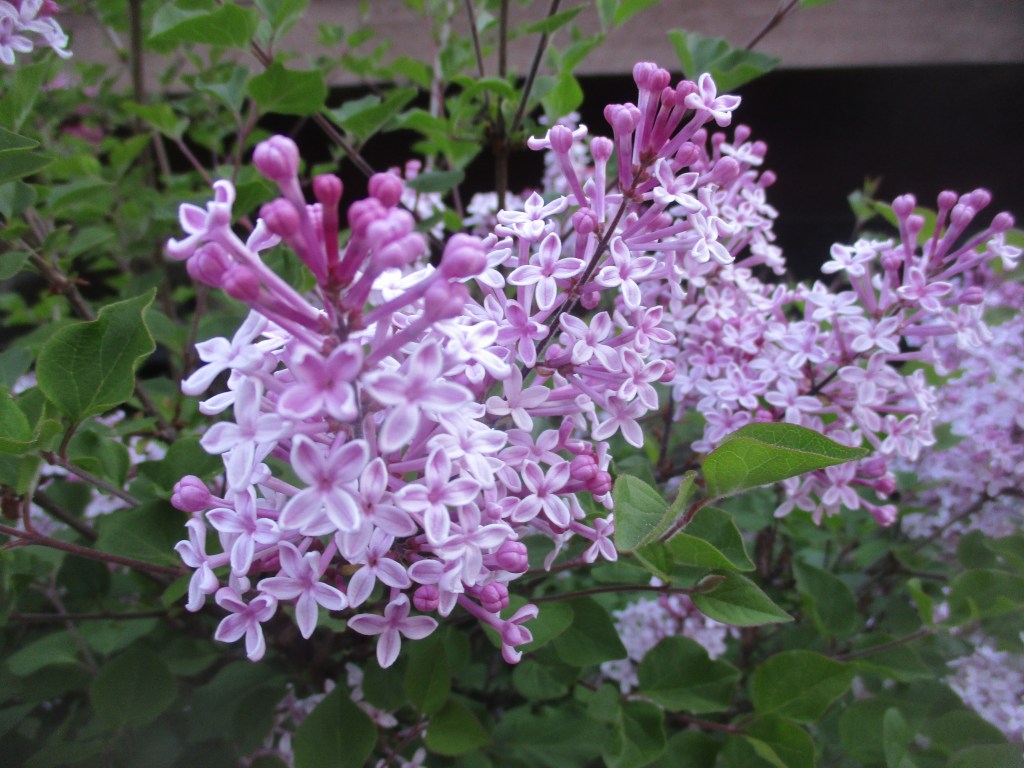
2. Fake lilac fails to impress those of us who know what real common lilac is. This runty little scrub is a trip hazard that happens to smell pretty. Its fragrance makes me crave common lilac.
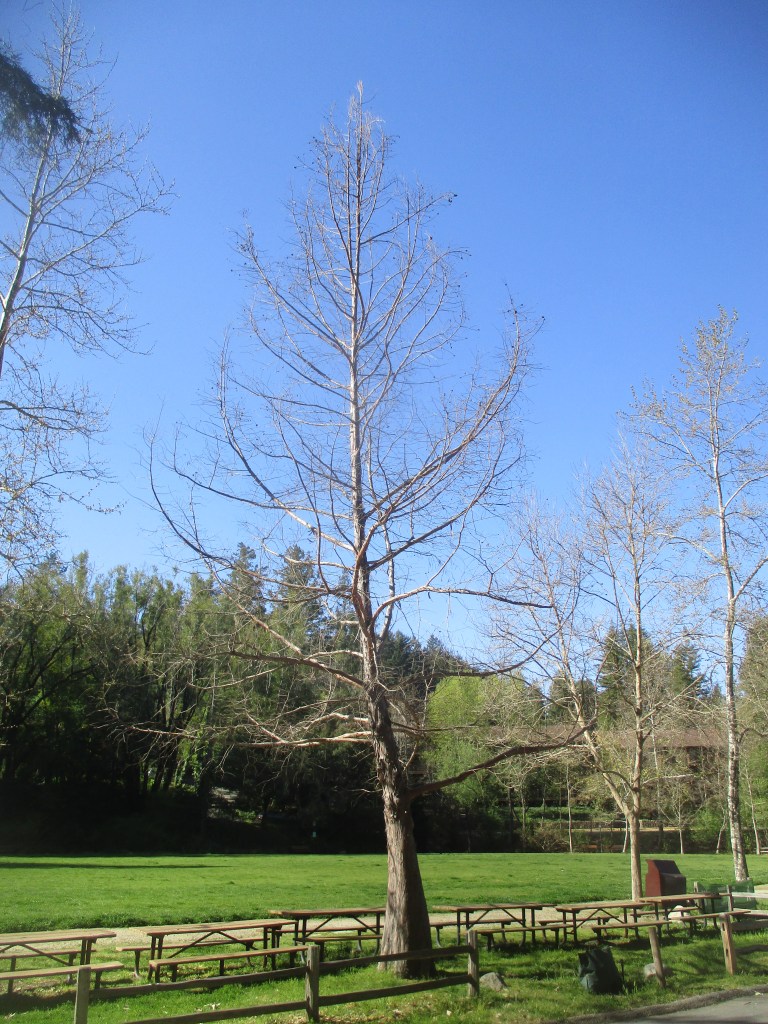
3. This is the first bald cypress that I ever got to work with, after meeting the species for the first time in Oklahoma in the autumn of 2012. Sadly, this is its last picture before it got cut down.
4. ‘In A Vase On Monday’ (IAVOM) is a meme that I almost participated in for the first time three weeks ago or so. I just could not get a good picture. There is quite a bit to write about here.
5. What must I say about this one? I encounter all sorts of weird situations at work. Part of this black cherry tree is getting milled. Part of it is firewood. The process was rather ‘complicated’.
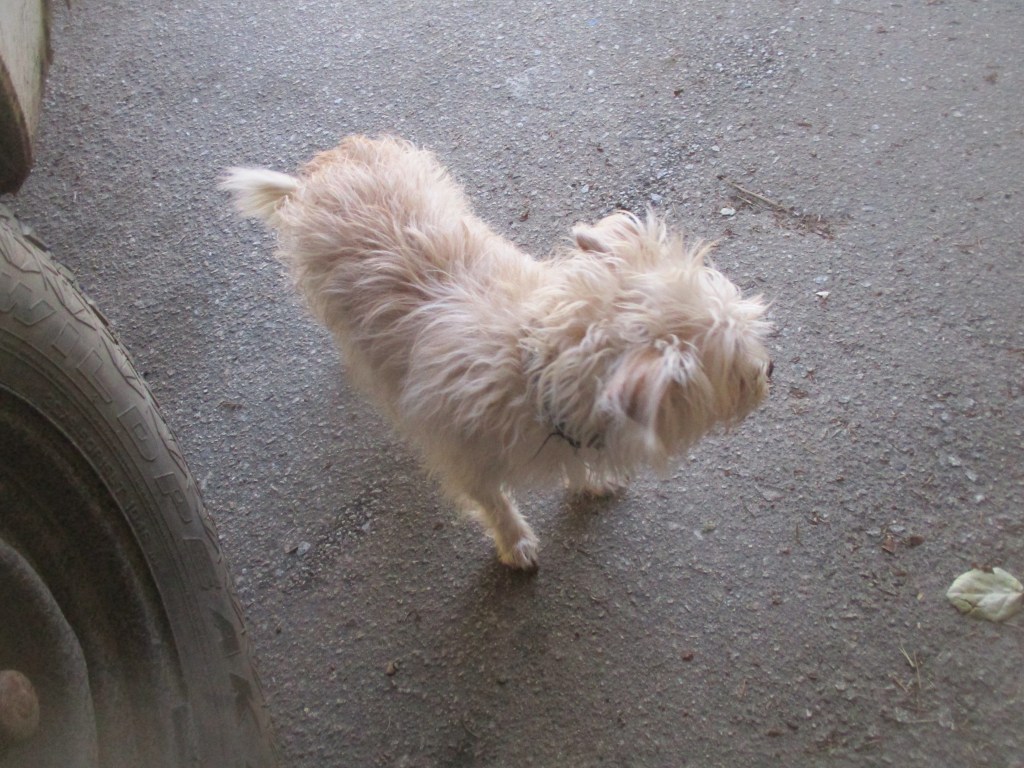
6. Rhody says the first three pictures are mundane, the fourth is too dark, and the fifth is just VERY weird. The sixth picture could have been the best, if only Rhody would have cooperated.
This is the link for Six on Saturday, for anyone else who would like to participate:
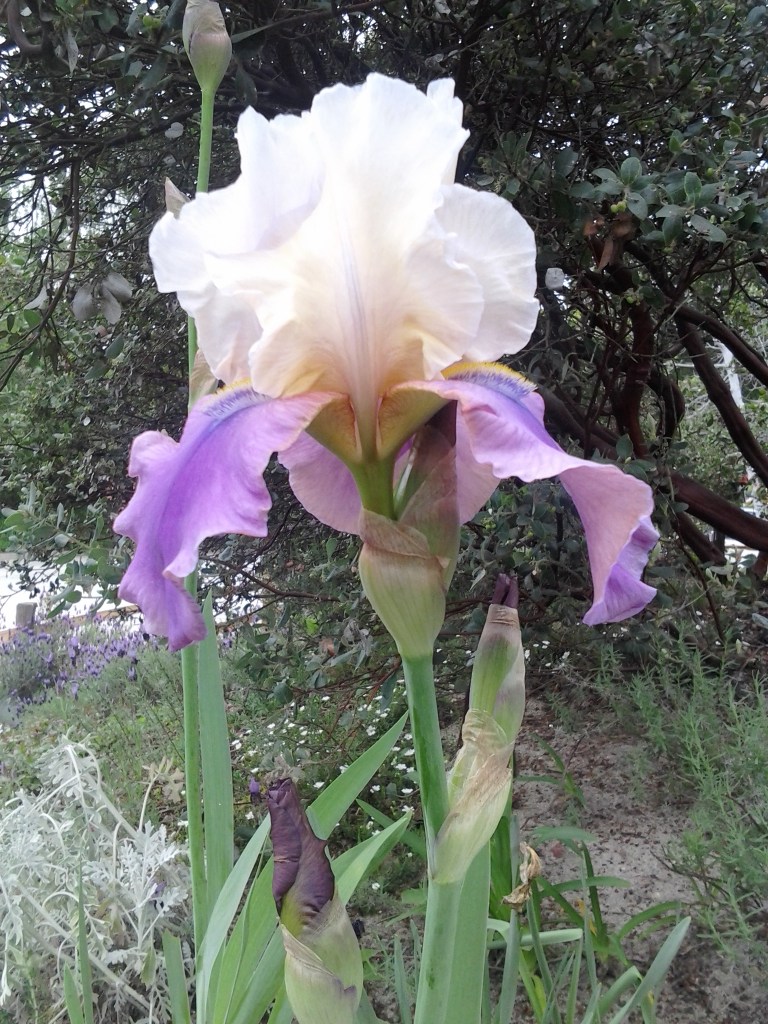
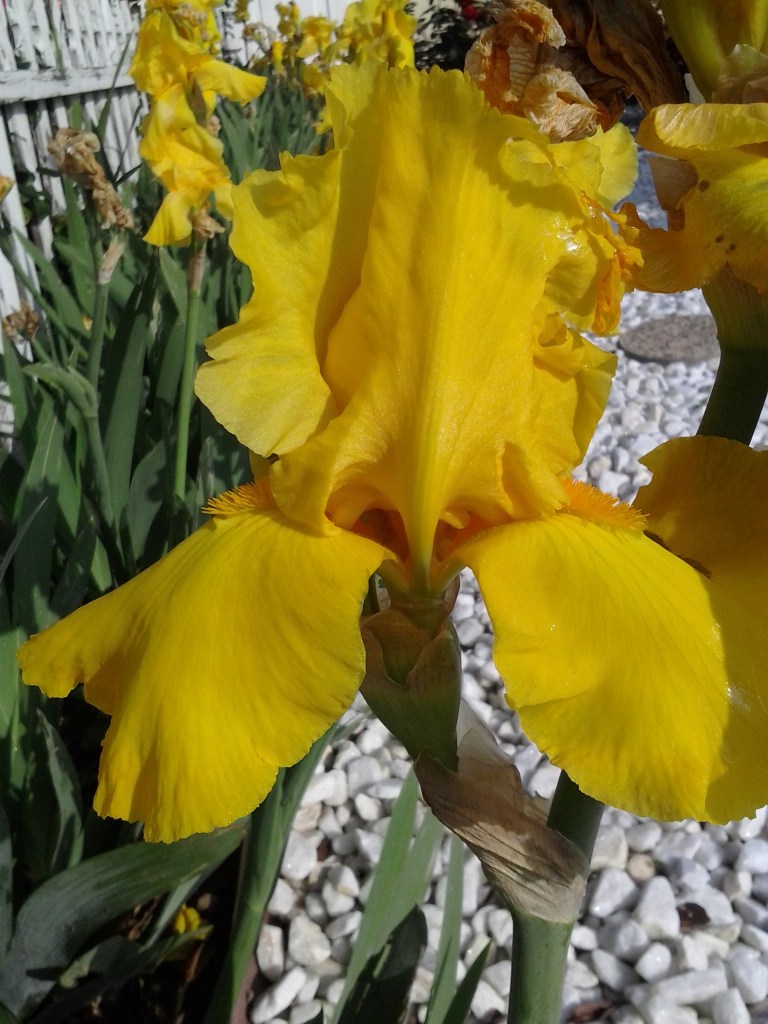
When there is not an app for that, there is probably a bearded iris that will work just fine. Really, there is just about every shade of yellow, blue, purple, orange, pink and almost-red imaginable, ranging from wildly bright to subdued pastel. There are actually several shades of white, and a few rare flavors of dark purplish black.
It seems that the most popular of the bearded iris bloom with two or more colors. The standards may be very different from the falls. Any part of the flower may be striped, spotted, blotched or bordered with another color. Flowers may be relatively simple or garishly ruffled. Many are fragrant.
Bearded Iris bloom between March and May. Some of the modern varieties bloom again in autumn. Flower stems can be as short as a few inches, or as tall as four feet, with only a few to several flowers. The rubbery and somewhat bluish leaves form flat fans that look neater if groomed of deteriorating older leaves. Each fan dies back after bloom, but is efficiently replaced by about two more new fans. Colonies of fans should be divided over summer every few years, or as they get too crowded to bloom well. Bearded iris likes well drained soil and at least six hours of direct sun exposure daily.
Iris got its name from the Greek word for rainbow, because all the colors are included. There are thousands of varieties of bearded iris alone, to display every color except only true red, true black, and perhaps true green. (However, some are convincingly red, black or green.) Then there are as many as three hundred other specie of iris to provide whatever colors that bearded iris lack.
Bearded iris are still the most popular for home gardening because they are so reliably and impressively colorful, and because they are so easy to grow and propagate by division of their spreading rhizomes. Siberian, Japanese and xiphium iris are less common types that spread slower with similar rhizomes. Japanese iris wants quite a bit of water, and is sometimes grown in garden ponds. The others, like most other rhizomatous iris, do not need much water once established. Dutch iris grows from bulbs that do not multiply, and may not even bloom after the first year.
Iris flowers are so distinctive because of their unique symmetry of six paired and fused ‘halves’ that form a triad of ‘falls’ and ‘standards’. The ‘falls’ are the parts that hang downward. The ‘standards’ that stand upright above are the true flower petals. As if the range of colors were not enough, the falls and standards are very often colored very differently from each other, and adorned with stripes, margins, spots or blotches. Many specie have fragrant flowers. Each flower stalk supports multiple flowers. Some carry quite a few flowers!
Some types of iris are so resilient to neglect that they naturalize and grow wild in abandoned gardens. Bearded iris are more appealing and bloom better with somewhat regular watering, but can survive with only very minimal watering once established. Some iris multiply so freely that they get divided after bloom, and shared with any of the neighbors who will take them. Newly divided rhizomes should be planted laying flat, with the upper surfaces at the surface of the soil.
Again, this old article does not conform to the ‘horridculture’ meme for Wednesday. It is not so much about bad horticulture as it is about ‘distinctive’ taste and landscape design.
After all the years it was out there, someone, somewhere must have gotten good pictures of it. I never did. Nor did anyone I know. It was something of a famous landmark in Santa Clara.
First, I should explain these pictures that my niece sent from here Mid City Heights neighborhood in Los Angeles. As you can see, this is a well kept middle aged home with minimal setback from the sidewalk. It is in a delightfully tree shaded neighborhood of comparable homes.
What are those black and white silhouettes of city skylines on those two plastic panels in front, you ask? They are a fence. Seriously. There are several similar panels around the perimeter of the front yard, at the edge of the sidewalk, and up the sides. They depict a variety of familiar landmarks, such as the Golden Gate Bridge, the Space Needle, the Eiffel Tower, the Tower…
Both the common and botanical names of lithodora are variable. Many know it as purple gromwell. The botanical name can be either Lithodora diffusa or Glandora diffusa. Many of the cultivars lack their species name after one of these two genus names. There might be less variety with the cultivars than with the names! Floral color is the primary variable.
White blooming ‘Alba’ is uncommon. After all, lithodora is popular for its rich blue bloom, which ranges from light sky blue to indigo. As the name implies, ‘Blue Star’ flowers have a white edge around a blue center. ‘White Star’ flowers have blue around white. Flowers are tiny but profuse in sunny situations. The dense evergreen leaves are likewise small.
Mature plants are generally only a few inches deep and perhaps two feet wide. They can eventually get more than six feet wide by rooting as they migrate. Although they grow too slowly for large scale ground cover, they work nicely in a sunny atrium, around boulders, or with mixed perennials. Lithodora is susceptible to rot in pots or if watered to frequently.

 Halston, with the help of several friends, could make a nice pill box hat. That is the origin of the name; from pill box hate fame. This might help clarify, https://tonytomeo.wordpress.com/2018/01/27/caution/ . Yes, Halston was a gopher.

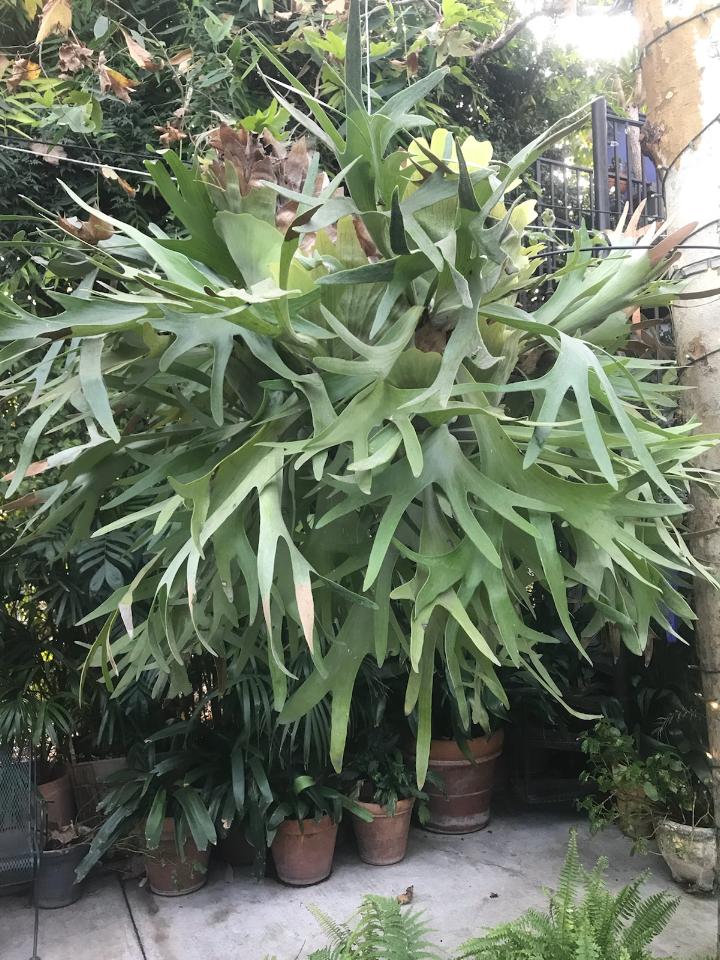 Staghorn ferns are epiphytes. They cling to tree trunks, rocks or whatever they happen to grab onto. They can root into decayed wood if it is porous enough, but they are satisfied to just cling to the exterior. They do not need soil. They sort of make their own soil by collecting debris that falls from the canopies of trees above. In the jungles where they live, they get all the water they need from rain. They often live in the crotches of branches because that is where they happen to land. (The epiphyte I wrote about earlier was just a palm that landed in the wrong place, but is not really an epiphyte.
 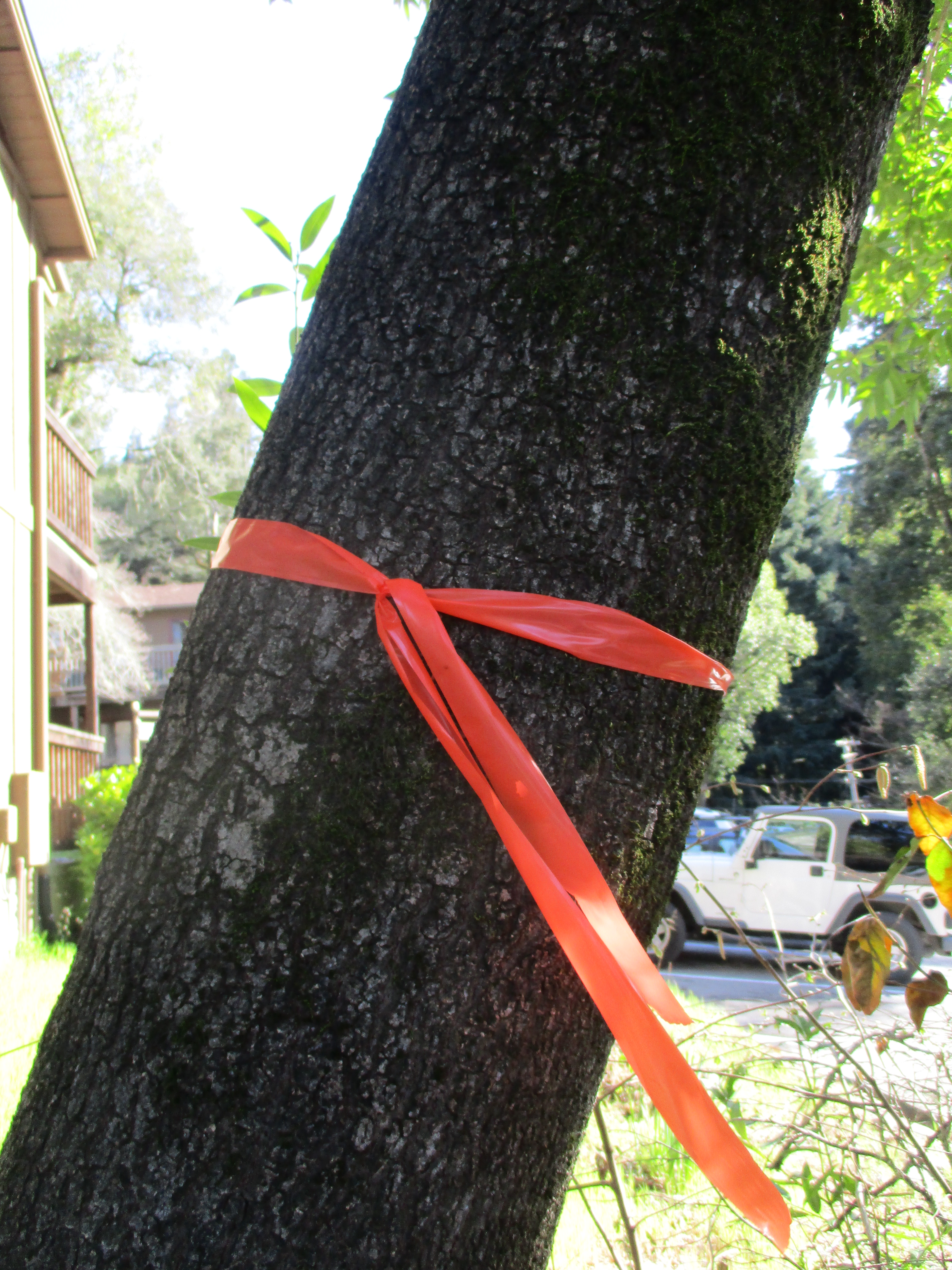 This exquisite yet elegantly simple persimmon orange cravat is to die for! See how distinguishing it is for the Umbellularia californica sporting it! The brilliant color is so appropriate for a tree that needs to stand out in a crowd! How else would the arborists coming to cut it down find it? Yes, it is to die for!


 After all the years it was out there, someone, somewhere must have gotten good pictures of it. I never did. Nor did anyone I know. It was something of a famous landmark in Santa Clara.

