Six on Saturday: Closeups II

This is the more foliar counterpart to the closeups for my Six on Saturday from last week. Some are closer than others. Some would be more easily identifiable without captions than others. All are quite random. All these subjects are in the storage nursery; but only #1 and #5 will eventually find homes in the landscapes here. The others will likely go into one of my own gardens. I have no idea of what to do with #2.

1. Agave pedunculifera – provided the most abstract picture of the six. The name is only a guess. Someone else might have been able to identify it as something else if more of it were visible.P00711-1

2. Eucalyptus globulus ‘Compacta’ – compact blue gum – was my second choice for juvenile blue gum foliage. It was easier to reach because it is more . . . compact. The other blue gum is tall.P00711-2

3. Cinnamomum camphora – camphor – is light yellowish green most of the time, and then gets slightly blushed with new growth late in spring. This young tree started late in partial shade.P00711-3

4. Trachicarpus fortunei – windmill palm – provided the second most abstract picture of the six. It is more recognizable though. Mediterranean fan palm is darker. Other fan palms are light.P00711-4

5. Picea sitchensis – Sitka spruce – was brought from Smith River, on the coast just south of Oregon. It does not seem to mind being so far from home. The happy new growth is impressive.P00711-5

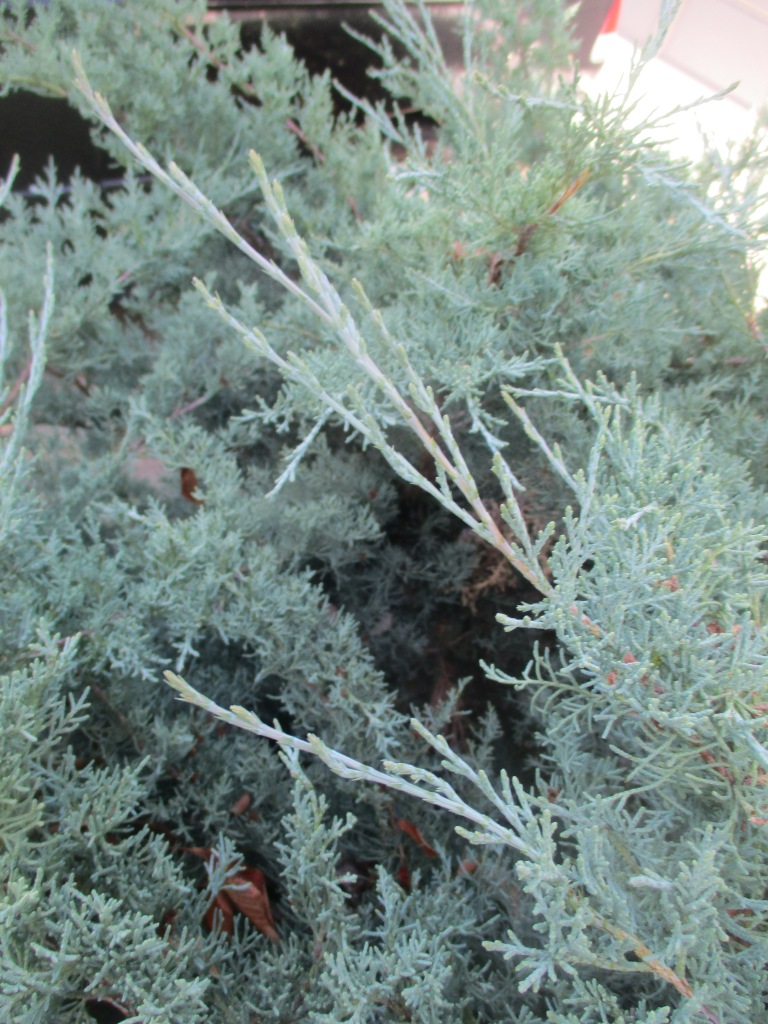
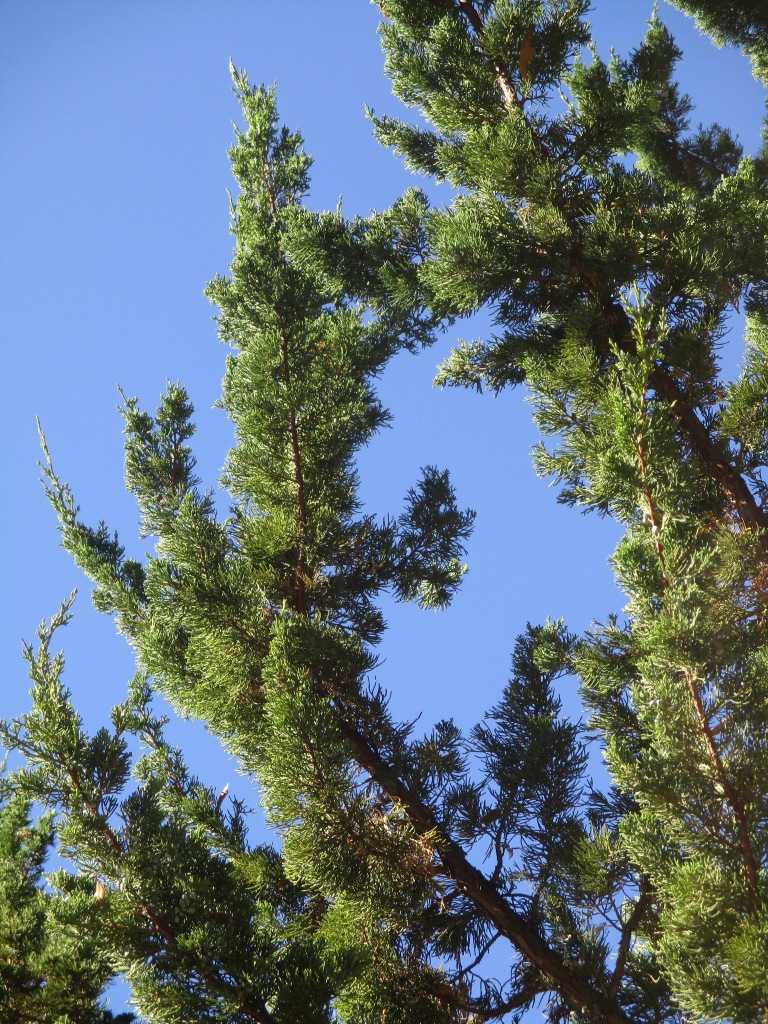
6. Juniperus virginiana – Eastern red cedar – is my favorite this week because I brought it from Oklahoma. Cedrus deodara – deodar cedar – is the real cedar that provided the background.P00711-6

This is the link for Six on Saturday, for anyone else who would like to participate:

https://thepropagatorblog.wordpress.com/2017/09/18/six-on-saturday-a-participant-guide/

Million Bells

50708-c
Million Bells look like small petunias.

Its name may be something of an exaggeration, but million bells, or Calibrachoa, certainly is profuse. However, although it is potentially perennial, it is usually grown as a warm season annual, so it  only has a few months from spring to autumn in which to bloom with a million flowers. Many plants combined might be up to the task.

The tiny flowers resemble petunias more than bells. Actually, the entire plant grows something like very compact petunias, which they are obviously closely related to. The stems are too limber to stand half a foot tall as they spread to about a foot wide. The small and unremarkably hazy green leaves are adequate backdrop for bloom.

The bloom is the remarkable part, displaying all sorts of shades and hues of red, yellow, blue, purple, orange, pink and white. There are not many colors left out. Just like petunia, million bells cascades nicely from pots. Unlike petunia, it does not benefit from deadheading (removal of deteriorating flowers). What is good for petunia is generally good for million bells, although a slight bit of shade is somewhat more tolerable. They want rich soil, regular watering and regular application of fertilizer. (Monthly application of common slow release fertilizer is probably as good as anything fancy.)

Pots Make More Out Of Less

00627-1
Half barrels are a bit elevated, and seem to show off their flowers better.

With conservation of water being so important right now, annuals are not a priority. Many of us are trying to use as little water as possible, and only to keep the more significant trees, shrubbery and perennials alive until winter. Lawn and annuals are usually the first to succumb, mainly because they use more water than anything else.

They are also somewhat expendable. Lawn is certainly expensive, but realistically, can be replaced as soon as water becomes available. Hopefully, new lawns will be more conservative with water, like they should have been since the last “drought” (and the one before that). Annuals are planted annually (duh), so they get replaced anyway.

Annuals as bedding plants over large areas were already somewhat passé before the last few dry winters. Even the more indulgent landscapes used annuals merely as relatively modest borders around or in front of more substantial, but less consumptive, perennials and shrubbery. Pots and planters are already more appropriate.

Some of the trendiest big pots are so ornate that they do not need flowers to provide more color. Besides, with a few striking perennials for colorful foliage or form, there is not much space left for annuals. What matters with annuals is that fewer in a pot can be flashier than more in the ground. Fewer annuals mean less water is required.

Elevated planters may not be as ornate, but display flashy annuals just as effectively. Petunia, million bells, lobelia and alyssum can cascade over the edges, to be colorful both on top and on the sides. Marigold, zinnia, celosia and any interesting foliar or sculptural perennials get a bit more height. It all helps to get a bit more out of less.

Pots and planters are not necessarily less work. They just need less water than larger beds, because they are smaller. Relative to their area, they actually need more water, and must be watered very regularly to sustain the confined roots within. Hanging pots need the most water. All confined plants benefit from fertilizer.

Horridculture – Weed Whackers

P00708
This must be the better half.

This neatly sliced prickly pear is too silly to rant about. There is another just like it. Two others were not sliced, as if, after the first two, someone realized that there was more to the roadside meadow than combustible dry grass. The prickly pear were put out there just last winter. They each extended only a single pad half a foot or so above grade, so were obscured by the grass.

Realistically, the damage is minimal and tolerable here. The priority of the crew who performed the vegetation management was to cut down all the combustibles. They did an efficient job of it. They did not expect to encounter anything that had been intentionally installed out there, or even any desirable vegetation. Besides, this prickly pear will recover as if nothing happened.

Unfortunately, damage caused by weed whackers is rarely so innocuous. Weed whackers are one of the most commonly misused horticultural power tools, and are very often used by those who are not aware of how to use them properly. They are easy enough to operate that minimal consideration is given to the potential for damage that they can cause. It is a bad combination.

Because weed whackers are often and improperly used to cut tall grass that is too close to trees for lawn mowers to cut, they commonly strip off bark and cambium from young tree trunks. A tree can not survive without its cambium, and quickly dies if too much is stripped away from the base of its trunk. That is why it is very important to pull weeds from around trees instead.

For now, there is nothing to do for the two sliced prickly pear. The bud to the upper right corner of the pictured specimen is beginning to develop into a new pad.

California Bay

00715
California bay is not Grecian bay.

Because of the common name, California bay, Umbellularia californica, sometimes substitutes for Grecian bay. The two are actually very different. Grecian bay is a culinary herb that grows as a compact tree. California bay has a distinctively pungent flavor that is objectionably strong for most culinary applications. It grows fast to thirty feet tall, and gets a hundred feet tall in shady forests.

Because it gets so big and messy, California bay is not so popular for planting into home gardens. However, because it is native, it sometimes self sows into landscapes. Some mature trees live within gardens that developed around them. California bay can work well in spacious landscapes, with plants that do not mind its shade and leaf litter. Annuals and seedlings dislike the leaf litter.

Old forest trees make the impression than California bay typically develops an awkward and lanky form. That is only because they do what they must to compete for sunlight. Well exposed trees, although lofty as they mature, are more densely structured. Some have a few big trunks, with checked gray bark. Old trees are likely to develop distended basal burl growth known as a lignotuber.

Culinary Herbs With Landscape Appeal

00715thumb
Culinary herbs work well within landscapes.`

Vegetables grow mostly in designated vegetable gardens because they are not appealing enough for the rest of the landscape. Flowers for cutting might grow in designated cutting gardens, from which they are not missed after harvest. Culinary herbs can grow in herb gardens for the same reasons. Some might not be very pretty. After harvest, some might be too shabby for the landscape.

Of course, such perceptions are debatable. Home gardens are casual and customized. If Swiss chard, artichoke and other vegetables can grow in front yard landscapes, then culinary herbs can too. In fact, some already do. Rosemary, thyme, lavender and a few other culinary herbs happen to be popular for landscapes because they are so appealing and practical. There is a slight catch.

Culinary cultivars of herbs are distinct from landscape cultivars. Trailing rosemary is a landscape cultivar with sprawling growth that works well as a resilient ground cover. Another cultivar exhibits more sculptural upright growth. Both are well flavored. However, neither is as richly flavored as culinary cultivars of the same species. Yet, culinary cultivars are not so remarkable for landscaping.

Most of us are satisfied with landscape cultivars of rosemary for culinary application. Alternatively, culinary cultivars, which are rare in nurseries and landscapes, can adapt to landscape functions. Cultivars of culinary rosemary happen to make nice low and mounding hedging. Infrequent shearing or selective pruning does not constantly deprive it of too much of its more flavorful new foliage.

The same applies to several herbs that have both culinary and landscape applications. Compromise might be in order.

Incidentally, two culinary herbs, Grecian bay and bronze fennel, are presently quite trendy. Grecian bay or sweet bay (which is not California bay) is a very popular potted plant. In the ground, it can grow into a midsized tree. Bronze fennel is supposedly comparable to common fennel, but with sepia toned foliage. Chive, parsley and borage all work nicely with mixed perennials and annuals.

Sunburn

P00705-1
Out with the old, . . .

There are two types of horticultural sunburn. Sun scald is what happens to formerly shaded bark if it suddenly becomes too exposed. (As I mentioned in my gardening column for this week, which posted last Monday here, sun scald that occurs during winter in colder climates is caused more by frost than by sunlight.) Scorch is what happens to overly exposed sensitive foliage.

The picture above is an example of scorch on a significant scale. The bigleaf maple was formerly shaded by a big Douglas fir that fell last May, leaving the maple both severely disfigured and very exposed. Such exposure would not have been a problem it the foliage had always been so exposed. The problem was that it developed in shade, so could not adapt to the new exposure.

The exposed foliage survived for a while, but eventually succumbed to warmth, sunlight and aridity (minimal humidity). Deterioration accelerated as the weather became warmer in just the last several days. Because the foliage scorched rather than succumbed to cooling autumn weather as it would have done a few months later, it remains attached to the stems that it grew on.

That is actually an unsightly advantage for the bark of the stems that are shaded below. If the bark suddenly became exposed too, it would be susceptible to sun scald. This tree knows what it is doing. Deteriorated foliage that does not get dislodged by later winter weather will be dislodged as new foliage develops next spring. The new foliage will be adapted to the new exposure.

The picture below shows how new grow that is adapted to the new exposure develops adventitiously from the exposed trunk. It does more than just exploit the increase of sunlight. Ideally, it shades suddenly exposed bark to protect it from sun scald.

P00705-2
. . . and in with the new.

Fourth of July

P00704K
Lily of the Nile are floral Fourth of July fireworks.

Fireworks, Fourth of July parades, and the associated crowds are of course canceled for this year.

Lily of the Nile does not mind. It blooms in time for the Fourth of July regardless of what the rest of us are doing, or not doing. That is one of the two reasons why some of us know it as the ‘Fourth of July flower’. The other reason is that the nearly spherical floral trusses resemble exploding skyrocket fireworks. They are mostly blue, with some white. All that is missing is red.

The bloom in this picture is not exactly exemplary. It would have been larger, rounder, and likely more advanced in bloom if it had developed in a sunnier location. There are enough of them that we do not notice that most are somewhat diminutive. In autumn, many of the overgrown plants will be relocated to a sunnier situation where they can bloom as they would prefer too.

Lily of the Nile was the first perennial that I grew a significant quantity of. While in junior high school, a neighbor instructed me to remove a healthy colony of lily of the Nile that had grown obtrusively large in only twenty years. I could not just discard it, so chopped it into more than sixty pups, and planted it all over the neighborhood. Much of it is still there. A bit of it is here.

Back then, it was known as Agapanthus orientalis. In school, I learned it as Agapanthus africanus. I still do not know if they are two different species, or if one is just a variety of the other. I do know that mine are distinctly different from common sorts, with bigger and rounder floral trusses. The others have straighter stems that support their blooms batter, and finer foliage.

Six on Saturday: Closeups


This is not how we normally look at these flowers, stems and vegetables (fruits). They might look strange out of context. That was sort of intended. ‘Six on Saturday’ allows more freedom of creativity than the simple illustrations that I use for the gardening column. The last two are closeups of the same two gladiolas that were featured last week. Perhaps they show color better.

I should try this again for next week.

1. Lily of the Nile is the ‘Fourth of July Flower’. It blooms for the Fourth of July, and the florets radiate from the center of their floral truss like fireworks. I will write more about this at noon.P00704-1

2. Epiphyllum stems, like the stems of other cacti, do all the work of foliage. Because they are flat, they actually look like big and weirdly arching leaves. New tip growth is still rather blushed.P00704-2

3. Zucchini is too productive. I neglected to go down to harvest it for two days or so, and then found that some fruits had gotten as big as bowling pins. They are fortunately not too tough yet.P00704-3

4. Red willow is a weedy tree that I should not be growing intentionally. This is special though. I brought its cuttings from Reno. It will be coppiced, and not allowed to grow as a real tree.P00704-4

5. Gladiola got enough attention last week that I got closer pictures of them this week. This one seemed to be more purple or less blue last week, with just a bit of white, like elderly Grimace.P00704-5

6. Gladiola are more fun when someone else selects bold colors that I would not consider. This flashy orange and yellow bloom is exquisite, and looks like Grimace’s friend, Ronald McDonald.P00704-6

This is the link for Six on Saturday, for anyone else who would like to participate:

https://thepropagatorblog.wordpress.com/2017/09/18/six-on-saturday-a-participant-guide/

Periwinkle

50701-c
Bloom is sporadic, but the delightful purplish blue color is worth it.

If the Latin name of dwarf periwinkle is Vinca minor, it is logical that large periwinkle should be Vinca major. Large periwinkle is more commonly known simply as periwinkle or common periwinkle, although it is not as common as dwarf periwinkle is, at least in landscapes. In some regions, it has naturalized as an invasive weed.

Some might accurately say that periwinkle is shabbier than the relatively neat and dense dwarf periwinkle. Others might say that it is just rustic or informal. The wiry stems stand less than a foot tall before they bend over from their own weight. Fallen stems can root where they touch the ground, and grow into new plants over winter.

The evergreen foliage is rich green, and a bit darker than the top of a billiard table. The simple paired leaves are about an inch and a half to two inches long. The slightly purplish blue flowers are about an inch and a half wide, with five petals each. Bloom is sporadic, but almost continuous, except for a lapse through winter.