They do not come with instructions for their maintenance. Deciduous fruit trees, particularly the stone fruit trees (such as cherry, plum, prune, apricot nectarine and peach) and pomme fruit trees (such as apple and pear), can be procured as easily as nasturtium seed or petunias. Whether bare-root in winter or canned (potted), they very often get planted into gardens where they are expected to produce their fruit as easily as daisies bloom.
Instructions for planting that come with bare root stock are useful for getting those particular trees started, but mention nothing about how even brand new trees need to be pruned after installation, and will need specialized pruning annually every winter thereafter. The same applies to rose, raspberry, blackberry (all varieties), grape, and to a lesser extent, fig, pomegranate, persimmon and several other fruit producing trees, vines and shrubs.
The problem with the stone fruit and pomme fruit trees is that they were bred to produce an unnatural abundance of unnaturally large fruits that are too overwhelming to sustain as they ripen, and too heavy to support. The others are in a similar situation, but are somehow able to continue to produce and generally support their own weight as they get overgrown and congested. Roses deteriorate and succumb to disease as they get congested.
This is why annual winter pruning is so important. Such pruning concentrates resources into fewer but superior fruits, rather than too many inferior fruits. It also limits and contains (closer to the main trunk and limbs) the weight of the fruit, so that limbs are not so likely to break as fruit develops.
These wimpy stems hanging vertically from the weight of the maturing apricots might be able to support the weight of the fruit, but the excessive fruit will be of inferior quality.
Box Elder
This ain’t no ordinary maple. Although there are other maples with trifoliate leaves (divided into three distinct palmately arranged leaflets), box elder, Acer negundo, is the only maple with pinnately compound leaves (divided into three or more distinct leaflets that are arranged pinnately on a central rachis). Leaflets might be solitary too. Almost all other maples have palmately lobed leaves.
Box elder is considered to be the ‘trashy’ maple. It grows fast, but only lives for about half a century. The happiest barely get to be twice as old. Because it gets more than forty feet tall, possibly with multiple trunks wider than two feet, it can become quite a big mess as it deteriorates and drops limbs. Yet, it is aggressive enough to have naturalized in many regions where it is not native.
Despite all this, and the lack of good foliar color where autumn weather is mild, a few cultivars of box elder have been developed for landscape use. ‘Flamingo’, which is likely the most popular, is variegated with white through summer, after pink new growth fades. ‘Violaceum’ develops smoky bluish growth in spring. ‘Auratum’ starts out yellowish. Mature leaflets are about three inches long.
Spontaneous Limb Failure Is Real
It sounds like science fiction, but it is not. Every spring and during particular summer weather, limbs can fall from trees without warning, and seemingly for no reason at all. It happens when least expected, while the weather is warm and perhaps humid, but notably without wind. The lack of wind is what makes it so unexpected. It is a phenomenon known simply as spontaneous limb failure.
Those who witness it might think that the arborists they call to clean up the mess will not believe their descriptions of what happened. Yet, arborists are familiar with it. Quite a few species of trees are notorious for it, especially in urban landscapes where they get watered regularly. Most of such trees are either chaparral trees that do not expect much water, or riparian trees that do expect it.
Spontaneous limb failure occurs as warmth accelerates vascular activity, but humidity inhibits evapotranspiration, which is evaporation from the foliage. Accelerated vascular activity increases the weight of the foliage. Inhibition of evapotranspiration limits the ability of the foliage to eliminate some of the excess weight. Limbs break if unable to support the increasing weight of the foliage.
Spontaneous limb failure is not as easy to predict as the more familiar sort of limb failure that is caused by wind. Limbs that get blown down typically exhibit some sort of structural deficiency or disfigurement prior to failure. Some limbs that succumb to spontaneous limb failure do so as well, but most do not. They just happen to be the healthiest and most densely foliated parts of a tree.
Native coast live oak and valley oak are the two most familiar of the chaparral trees that are notorious for spontaneous limb failure. Native cottonwood, willow, box elder and sycamore are riparian trees that are perhaps even more susceptible to spontaneous limb failure. Sweetgum, carob, stone pine and various eucalypti are some of the exotic trees that might drop limbs spontaneously.
In summer, spontaneous limb failure is less likely as growth slows and limbs strengthen.
Campground II
This is a formerly unplanned sequel to the article ‘Campground‘ from last Sunday. That article described my concern for any of the homeless who might camp on the banks of an adjacent creek, below innately unstable and structurally deficient riparian trees. Just a few minutes after the article posted at midnight, the biggest and most deteriorated box elder tree in the area of concern coincidentally fell! No one was there at the time to be hurt.
The tree that fell was located just a few yards to the right of those in the picture of the previous article. It happened to be the only tree that was inside the fence. Therefore, as it fell inward, it did not damage the fence. The trailer that it landed on is for heavy tractors, so was undamaged. Only the top few timbers of a pile of lumber that it landed on were broken, and only because the lumber was recently milled, and stacked so loosely to dry.
The upper picture at the top shows the fallen tree laying on the trailer and loosely stacked lumber, with its dislodged trunk suspended above the ground. The middle picture here shows the base of the dislodged trunk suspended pitiably above the ground, with no roots remaining attached to the soil.
The lower picture below shows how efficiently the trunk pulled out of the crater as if there were no roots holding it down. The few roots that were there were so decayed that none stayed attached to the soil. It is amazing that the tree did not fall earlier! When if fell, it sounded just like one might imagine it would, with a loud but quick crash. There was no sound of tearing or crunching roots. Fortunately, there was no one else there to hear it!
Garter Snake
This little critter surprised me at work last week. Even though I knew it to be harmless, my instinctual response was to get away from it fast. I have encountered enough rattlesnakes to know better than to take the time to identify a snake before getting some distance from it. Even after identifying a snake as a harmless garter snake, I still prefer to avoid it as it leaves. This one was in no hurry, so got picked up with a rake and set safely aside.
Between high school and college, I took a summer job for a (primarily) retail nursery in Miramar on the coast of San Mateo County. At this job, I sometime went with the maintenance crew to work in a few home gardens. At one such job, just overlooking the beach in Montara, I needed to mow an overgrown lawn. Rather than mow back and forth from the upper edge to the lower, I mowed a concentric pattern inward from the outer edge.
What that meant was that I mowed the edge first, and then just inside the freshly mown edge, and then just inside that second track, and so on, with the intention of finishing at the center of the lawn. What I did not consider was that this technique concentrated the several garter snakes that happened to be on the lawn at the time into the diminishing unmown center. Needless to say, I needed to stop mowing while I chased them off with a stick.
What I also neglected to consider during my Indiana Jones experience was that these were no ordinary garter snakes. They were the more colorful and endangered San Francisco garter snake. I remember their extra pair of red stripes on top. Supposedly, they also had an extra pair of blue stripes underneath. I did not get close enough to notice.
Six on Saturday: Abbreviated Rose Parade
There are a few other roses that I could have gotten pictures of in order to submit a complete set of six, but I wanted to show off just these four that bloom in what is known as the ‘rose bed’. A fifth purple cultivar was not blooming when I got these pictures. What seems to be a sixth cultivar that I did not get a picture of is really suckers of ‘Doctor Huey’ understock that appeared far enough away from the original plant to not be a problem.
There are several rose shrubs and standards (trees) in the rose bed, but they are limited to these five and a half distinct and mostly unidentified cultivars. They are the most prominently located roses that I work with. The other roses are in other landscapes, or at the yard of the maintenance shops. Two of the larger groups of roses are uniform beds of carpet roses, which I am really none too keen on.
1. The few rose standards (trees) seem to be floribundas. This one looks familiar, but not familiar enough for me to guess the name of it.
2. I would guess that this hybrid tea rose that grows in a shrub form is ‘Double Delight’. It does happen to be quite pleasantly fragrant.
3. This one seems to be a floribunda like the standards (trees) but grows in shrub form like #2 above. I do not believe it is notably fragrant.
4. I would guess that this one is the common floribunda ‘Iceberg’, growing as a standard. One is a double graft with a purple floribunda.
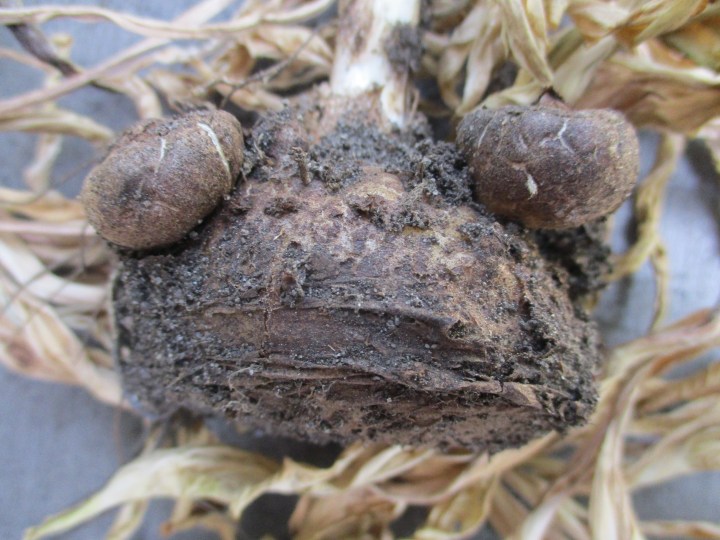
5. Well, that was it. The fifth purple cultivar is not blooming, and ‘Doctor Huey’ bloomed only once for the year. This nearby yellow calla is irrelevant.
6. This piece of dead madrone is just as irrelevant, but I though it was amusingly sculptural. I probably should have been more careful while cutting it apart.
This is the link for Six on Saturday, for anyone else who would like to participate:
https://thepropagatorblog.wordpress.com/2017/09/18/six-on-saturday-a-participant-guide/
Zonal Geranium
New and improved is not always better. Modern garden varieties of zonal geranium, Pelargonium X hortorum, with bigger, fuller and more profuse blooms, are more colorful than the relatively weedy classic varieties, but they are considerably more demanding. In fact, because they are so unhappy through winter, they are often grown as warm season annuals instead of as perennials.
They are certainly worth growing though, and are reasonably easy to propagate from cuttings. Flowers can be red, pink, white, peachy orange or almost purple. Bloom is almost continuous. Each rounded dark green leaf might be adorned with a darker halo about halfway between the center and the outer margin. Mature plants do not get much more than three feet tall, and not much wider.
Old varieties might get twice as tall, with smaller blooms, and lighter foliage.
Try Some Unconventional Cut Flowers
There is nothing like growing our own; whether vegetables, fruit or cut flowers. Most fruit and vegetables are grown to be eaten, so are not missed too much when harvested. Even colorful citrus fruit is better harvested than left out in the garden. No one wants to waste it. Flowers are not so simple. They are so colorful and fragrant in the garden, that it is tempting to leave them all out there.
Cosmos and many kinds of daisies are so abundant that there are plenty for both the home and garden. Gladiolus are not so fortunate. They bloom only once. Cutting the flowers to bring into the home deprives the garden of their color. What is worse is that cut gladiolus, although excellent cut flowers, do not last quite as long as they would in the garden. Roses at least continue to bloom.
Daylily can be a good cut flower, but individual flowers last only a day (obviously). This is not a problem in the garden because new flowers bloom daily to replace those that that have finished. Cutting stems not only takes flowers in bloom, but also takes the flower buds behind them that are waiting for their turn to bloom. However, not many, if any, of the unbloomed buds bloom once cut.
Many types of iris, except for Dutch iris, have the same problem. Attentive garden enthusiasts might leave iris to bloom in the garden, and might even groom fading blooms from fresh blooms on the same stems, and then cut stems to bring into the home when the last bud on each stem is just beginning to bloom. The last flowers are not as excellent as the first, but it is a fair compromise.
Cannas are not so functional. They are great in the garden for both flowers and foliage, but fade too soon in the home. Bougainvillea and crape myrtle stems likewise start to wilt and drop flowers immediately after getting cut, but for those who do not mind cleaning up after them, there are plenty of papery flowers to last a few days. The wilted tips of bougainvillea stems can be pruned out.
There are no rules to cut flowers. Lily-of-the-nile might seem like a silly choice, but works quite nicely for those who dare to try it. New Zealand flax flowers are not very colorful, but provide striking form. Zonal geranium and nasturtium work well with or without foliage attached. Lemon bottlebrush, photinia, New Zealand tea tree, bugle lily, various hebes, and all sorts of salvias are worth a try.
Horridculture – High Fences
There is no doubt that fences are useful for a variety of functions. They exclude deer from the garden. They confine livestock. For suburban homes, they enclose a relatively safe space for children and pets. Fences should be designed according to their intended functions. Those designed to exclude deer might be as simple as coarse mesh on posts. Those enclosing backyards might be more refined and compatible with the landscape.
Over the years, conformity to modern suburban and urban landscapes, as well as modern architecture and lifestyles, has changed the standards of how fences are designed. Low picket fences do not adequately obscure the scenery that adjacent and often dissimilar landscapes contribute to a view. Where common vegetable gardens might have been, most of us want private outdoor rooms, with a distinct style of landscape.
It seems that everyone wants privacy nowadays. Those who have no need for privacy will get it anyway because no one will build fences that will not provide it. In the 1950, fences were commonly four feet high, and not every backyard had them. By the 1970s, they were more commonly six feet high, and standard for almost every backyard. Now, fences are expected, and many are seven feet high or higher, with lattice on top!
Modern architecture and lifestyles are part of the justification for such tall fences. Low profile older homes on formerly suburban lots are commonly replaced with two or more larger homes on smaller subdivided city lots. They are much closer to each other than the older homes were, with only narrow spaces between upstairs windows, where even eight foot high fences will not provide privacy.
So, not only do much larger homes on much smaller parcels mean that there is much less space for gardening, but taller two story (or taller) homes with weirdly high fences mean that more of the very limited space available for gardening is shaded!
Columbine
Colorado is another state that was able to designate one of the most excellent wildflowers of North America as the Official State Flower because it happens to be native there. Rocky Mountain columbine, Aquilegia caerulea, however, did not contribute as much to the breeding of the many modern hybrid varieties of columbine as did common European columbine, Aquilegia vulgaris.
Most are short term perennials that are more often grown as biennials or, if they do not continue to perform through the dry warmth of summer, as spring annuals. Seed can be sown directly earlier in spring, but new plants may not bloom until the following spring. Plants that are grown in a greenhouse through winter, as well as self sown plants that grow though winter, should bloom in spring.
The famously spurred flowers can be just about any color; white, blue, purple, red, orange, yellow, pink and even pale green (fading to white). Most are combinations of two colors. Some varieties proudly bloom with frilly double flowers. The thin flower stems stand about a foot tall, with flowers facing slightly downward. The trifoliate and delightfully lobed leaves are like big lacy clover leaves.