Trees Need Clearance From Utilities

30320thumbPalm trunks grow in only one direction; upward, toward sunlight and away from gravity. Each trunk is equipped with only a single terminal bud. If that bud encounters an obstacle, it can not be pruned around it. Palm trunks that get get too close to high voltage cables, or that might sway too close with a breeze, must therefore be removed to maintain minimal clearance from the cables.

Queen palms are notorious for getting planted under high voltage cables because they are so often impulse purchases that get planted without much planning. They are popularly planted along rear fences, exactly where high voltage cables are often located. Mexican fan palms often grow along rear fences as well because that is where birds and rodents are likely to drop the seeds.

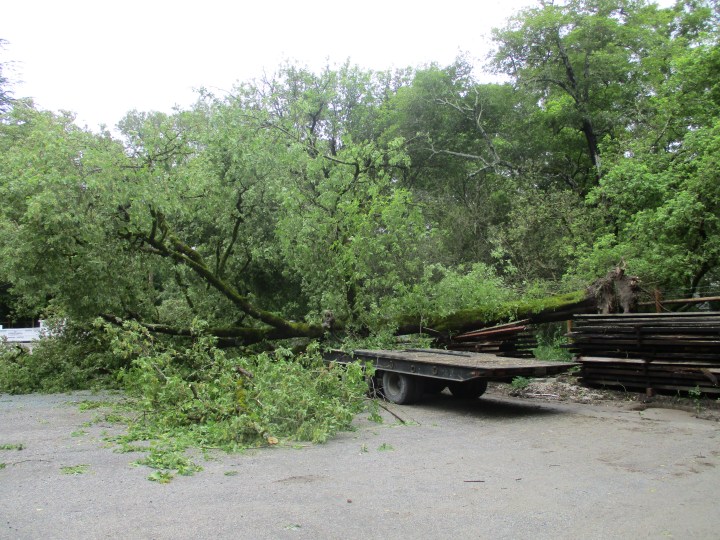
Trees with single central leaders, like redwoods, spruces and certain pines, will be disfigured if their main trunks need to be topped for clearance from cables. Removal of such trees is often more practical than this sort of disfigurement. More extensively branched trees like sycamores, ashes, oaks and elms, are more adaptable to clearance pruning if it is not too severely disfiguring.

It is much simpler to not plant trees that get too large under high voltage cables. Elsewhere in the garden, where there is enough lateral (side) clearance, vertical clearance is not such a problem for larger trees. Small trees like redbud, purple leaf plum, photinia and various pittosporums, either do not get tall enough to reach upper cables, or will require only minimal pruning for clearance.

Below high voltage cables, the lower cables are for lower voltage, telephone and television. ‘House-drops’ are the cables that extend from utility poles to houses and other buildings. Although clearance is not so important for these lower risk cables, limbs that lean on them and blow around in wind can be abrasive. Sagging limbs can cause utility cables to sag more than they should.

Unfortunately, those who prune trees for utility clearance are efficient, but rarely arboriculturally correct.

Horridculture – Fads

P90313This is why I do not grow hellebores in my own garden. The specimen in the pictures above and below are about as good as they get here. Most are quite a bit worse. Some put out only one or two flowers. Some do not survive their first year in the garden.
No one seems to know why they don’t do well here. It might be the lack of chill in winter, although they do better in even milder climates. It might be the minimal humidity, although they generally do no better in the damp redwood forests where the specimen in these pictures lives. Those that might get too much sunlight do no better or worse than those that get too much shade. They are simply not happy here.
My solution to this ‘problem’ is to not grow them in my own garden. I do not particularly like them anyway. Even those that look ‘good’ look like huge African violets dipped in paraffin. Those in the landscapes that I work with now are the colors of worn vinyl upholstery of 1970s Chryslers. Yup, I will pass on hellebores. ‘Problem’ solved before it happened.
That ‘solution’ does not work for everyone.
Some landscapers get what they can from the few growers who will grow them here, and plant them in all sorts of landscapes that they just do not belong in. Some will do it because they read somewhere that hellebores do well in shade, which is technically true, but only in regions where other environmental conditions are appropriate. Some do it because they saw pretty pictures of them, and read a nice article about them in some gardening magazine that features such articles about what does well where the respective magazines are published.
Sadly, many do it because hellebores are a fad here, and something that many landscapers with something to prove like to brag about. They are like dawn redwood and unusual varieties of Japanese maple that are so often installed into inappropriate situations just so the landscaper can add pictures of them to their portfolios. Fortunately, hellebores merely struggle or die without causing any other damage to the landscape.
There are a few kinds of fads, and some of them actually make sense, but good landscape designers should use fads responsibly and with discretion.P90313+

Bell Pepper

90320There are too many varieties of chili or pepper to count; but there are surprisingly few that are known as bell pepper, Capsicum annuum. They are the select few that lack capsaicin, which is what makes others so distinctly ‘hot’ and ‘spicy’. Most are quite mildly flavored. Green bell peppers, particularly those that are green because they are unripe, are generally more bitter and less sweet.

Bell peppers are warm season vegetables that get planted at the same time as tomato and eggplant, which they are incidentally related to. They are more productive where summer nights stay warm. In mild coastal climates, they are likely to start production later, or finish production sooner, than they would in warmer climates. They like warm sunshine, rich soil, and regularly watering.

The myth that green bell peppers are merely unripe red bell peppers is not completely untrue. They all start out green, and red bell peppers are often used green. Furthermore, most green bell peppers eventually turn red if they ripen enough. However, varieties that are grown as red bell peppers are different from varieties that are grown as green bell peppers. Orange and yellow bell peppers are increasingly popular. Purple, brown and white bell peppers are still rather rare. Red and green are the most productive and easiest to grow.

Summer Vegetables Replace Winter Vegetables

90320thumbEvery year at about this time, there is the same concern that it is too early to put summer or warm season vegetables into the garden. When the time comes, replacing warm season vegetables with winter or cool season vegetables will also seem to be too early. Nonetheless, it is best to start the transition early so the garden will be ready for production as the weather warms into spring.

Broccoli, cauliflower and cabbage that are in the garden now should have time to finish before warmer weather makes them bitter. If the warm season vegetable plants that will be planted in their place are adaptable to it, and if the spacing is correct, they can be planted in amongst the cool season vegetables so that they will be ready to go when the the outgoing vegetables get harvested.

Unlike most of the cool season vegetables, which are truly ‘vegetative’ vegetables, most of the warm season vegetables are actually fruits, which is why they start to develop in spring, and mature through summer. Tomato, pepper, cucumber, eggplant, corn, bean and both summer and winter squash are the most popular here. Most produce from spring to autumn. Some produce only once.

Corn and other vegetable plants that produce only once can be planted in phases every two weeks or so to prolong production. By the time one phase finishes, the next should be starting. Corn is more efficiently pollinated, and therefore more productive, if grown in square blocks rather than in narrow rows. Corn and many warm season vegetables should be grown from seed sown directly.

However, tomato, pepper, eggplant and maybe zucchini and other squash can be planted as small plants from cell packs, because only a few of each type are needed. A cell pack of six or eight cost about the same as a packet of seed, but all the seed in the packet are not really necessary. Besides, the small plants are less likely to be eaten by snails than newly germinating seedlings.

Oregon

P90310KIf California is the most excellent state in the entire Unites States of America and surrounding Universe, and Oklahoma is the second most excellent, then Oregon might be number . . . hmmm . . . fourteen or fifteen . . . or maybe like twenty or something. However, in MY (very important) opinion, Oregon is like the third most excellent state, and almost ties with Oklahoma! That makes it even slightly more excellent than Pennsylvania, Vermont and Arizona! Yes, it is THAT excellent!
Even the state tree of Oregon is excellent. It is the Douglas fir, pseudotsuga menziesii. That is like the second most excellent of the state trees, right after the coastal redwood of California. If California did not claim the coastal redwood as the state tree, Oregon is the only other state that can claim it as a native, since the native range of coastal redwood extends ever so slightly into the very southwest corner of Oregon.
There was a time when redwood was the main timber tree here, but that was only because it was the most readily available. As the supply was depleted, it was reserved for fences, decks, structural lumber that is in contact with concrete foundations, or any other situation in which its innate resistance to decay was important. Douglas fir became the most common lumber, and is still what homes are built from now.
Besides all that, Douglas fir is one of the grandest of trees in North America.
Then there is the state flower of Oregon. Well, it is not so much to brag about, although it is still better than the state flower of Oklahoma, which happens to be mistletoe. (Okay, that is another subject for later.)
Oregon grape, Mahonia aquifolium, blooms late in winter with these bright golden yellow, but otherwise unimpressive flowers. The few small black berries that develop over summer are mostly taken by birds before anyone notices. The glossy and prickly dark green foliage is quite appealing, and happens to do well in partial shade, but this is the state flower, not the state foliage.

Splat!

P90310There are a few consequences to all this excellent rain. Gutters are flooding. Trees are falling. Mud is sliding. As much as we should be grateful for what we are getting while we are getting it, it is getting rather old. Clear and sunny weather that is forecast after today will be a welcome relief from all this muddy sogginess.
Almost all of the flowering cherries have somehow postponed bloom. It has not been unusually cold. It is as if the trees somehow know better than to bloom while so much unusually heavy rain is falling. Otherwise, they might have bloomed only briefly before the blossoms got knocked off. The buds are so fat that I expect they will begin to bloom by the middle of the week.
Only one flowering cherry that always blooms significantly earlier than the others bloomed on time, and is already finished. Considering how heavy the rain was during that time, the light duty bloom actually lasted impressively well.
Daffodils tried to delay their bloom as well; but some could wait no longer. Many were not bothered by the heavy rain. Others were knocked flat, and needed to be propped with small hoop stakes. Only some of those that were planted late in the planting season kept their buds closed this late.
I should be pleased that these hyacinth bloomed at all this year. They are the sort of bulbs that bloom only once in their first year, but then do not get sufficient chill in winter to bloom again. They must be in a cold spot. Unfortunately, it is also a shady spot. The floral stems stretched so much in the shade that they were easily knocked down by the heavy rain. Now they lay there like they have fallen and can’t get up.

Sci-Fi

P90309KThere are thousands of them, these weird motionless caterpillar like ‘things’, in big herds under all the cottonwood trees. They make a squishy mess in the rain, and stain concrete. They may not look like much from a distance, and are merely ignored as a minor nuisance that must be swept from pavement, but on closer inspection, they really look unworldly, like something from another planet, or a bad Japanese science fiction movie.
They are just male catkins of the native cottonwoods. At least I believe they are. If there are female flowers mixed in, I would not know it. Nor would I know if they really are from another planet. I know that the cottonwoods will later make quite a mess with their cottony fluff that carries their seed away on the wind, so they must do what it takes to generate seed, which generally involves flowers of both genders. I just never look that closely. Their privacy should be respected in such matters, even if they choose to do it out in the open. Those that dropped this . . . whatever it is . . . were doing . . . whatever they were doing . . . right out in the big lawn of Felton Covered Bridge Park!
Why must cottonwood trees bloom so profusely? They must know what they are doing. Maybe they expect most of their tiny seed to get eaten by small seed eating birds. Perhaps all but a few of their seed stay in the same riparian situations from which they came, or blow far enough away to land in other equally hospitable riparian situations. Otherwise, almost all land in situations that are too dry for them to survive long after spring. It is difficult to know what their potentially nefarious motives are.

Six on Saturday: Mudslide


With all the rain, it was no surprise. Mudslides are somewhat common here, and they sometimes close roads. In fact, we were sort of expecting a small mudslide almost in this particular spot right when we got the call about it. The only slight surprise was that it was right next to where we expected it to be. The cliff that we expected to make this sort of mess was still intact under the tarps put over it to deflect some of the rain.

Fortunately, it was a small mudslide that blocked only one lane. We were able to direct traffic through the other lane while the blocked lane was cleared of debris by a small bulldozer.

The top of the cliff slid to the bottom along with a stump of a Douglas fir that was cut down many years ago. The Douglas fir was cut down so that it would not destabilize the soil that it was rooted into as it moved in the wind. However, The soil was destabilized as the Douglas fir roots that held it together decayed. This is actually a common dilemma, since trees sometimes need to be cut down before they cause such problems, but the death and decay of the roots of such trees ultimately cause the same problems.

The sorts of trees that could be coppiced do not do so well in the dry soil on top of cliffs. Otherwise, we could plants willows, cottonwoods or something of the sort, and cut them down as they get too big, without killing the roots. They would be happy to regenerate and continue the process. The sorts of plants that prevent surface erosion do not do much to stabilize the soil. Otherwise, we could put something as simple as freeway iceplant (Carpobrotus chilensis) on top, and let it cascade downward over the unstable area.

1. It was nothing too serious, but just enough to block the inbound lane. Tarps over the cliff that we expected to make this sort of mess are visible above the retaining wall just beyond. My work pickup in the lower right corner of the picture blocked the inbound lane with its headlights and hazard flashers on. I directed incoming traffic around it into the clear outbound lane as it was available. The young man off in the distance moved his pickup out of the outbound lane, and also directed traffic accordingly. When necessary, he stopped traffic while incoming traffic used the outbound lane. We communicated by radio and hand signals.P90309

2. This is the stump of the Douglas fir that was cut down so that it would not dislodge the soil and cause a mudslide. A decayed stump of a smaller madrone tree is to the right. Their rotting roots and the English ivy were insufficient to stabilize the top of the cliff.P90309+

3. These significant mudstone boulders on the far side of the road could have done some serious damage to a car if one had gotten in their way.P90309++

4. That is where the Douglas fir stump came from, just to the left of the drainage pipe. It did not get very far. That is it at the lower left corner.P90309+++

5. We arrived about ten. By noon, there was not much evidence of what had happened. We left the cones because the road was slippery with mud.P90309++++

6. This is supposed to be a gardening blog, so here is an unidentified fern that witnessed the whole ordeal from a stable portion of the same cliff. There is slightly more flora to this story than two dead stumps and a bit of ivy.P90309+++++

This is the link for Six on Saturday, for anyone else who would like to participate:

https://thepropagatorblog.wordpress.com/2017/09/18/six-on-saturday-a-participant-guide/

Mayten

60309It does not grow fast, but by the time it gets old, mayten, Maytenus boaria, might be tall enough to reach upstairs eaves, and nearly as broad. The main trunk and limbs are nicely outfitted with uniformly checked grayish bark. Smaller stems are so very limber that it is a wonder that trees are able to gain any height at all. These stems arch gracefully, with their wiry tips hanging vertically.

Almost all modern maytens are of the cultivar ‘Green Showers’, which has slightly larger leaves. Yet, the evergreen leaves are so small that it is not easy to discern much difference from the slightly yellower leaves of older trees. Ironically, older trees seem to be more resilient. Newer trees seem to be more sensitive to rot if watered too frequently, particularly if soil does not drain adequately.

Pruning and grooming is not as simple as it might seem to be from the outside. If the very pendulous stems around the edges get cut like bangs, bunched stems accumulate and lose their softly pendulous texture. They need to be thinned too, so that they can hang more softly. Dead stems should be groomed from within. Main stems are not likely to regenerate if cut back too severely.

Motion As A Landscape Element

60120+Landscapes appeal to our senses. The colors and textures of blooms and foliage are visually appealing. Floral fragrance and foliar aroma appeal to the sense of smell. Fruits and vegetables can provide flavor. Wind chimes, fountains and birds visiting bird feeders might add a bit of delightful sound and motion. Yet, the motion of certain plants in the breeze is rarely considered.

Weeping willow is famous for the way it blows softly in even a slight breeze. Unfortunately, it is also famous for thirsty roots, structural deficiency, and getting too big too fast. Mayten can do the same on a smaller scale, and in drier situations. California pepper is somewhere in between, since it can eventually get too big, and might have structural problems, but takes a while to do so.

Some of the various eucalypti have softly pendulous stems as well. Lemon gum and red ironbark are two of the better known specie that know how to blow in a breeze. Silver dollar gum is nice too, even though it is not as pendulous or as dynamic in the wind. Eucalypti that get too big for home gardens can be seen blowing in the wind in larger landscapes, such as parks or on freeways.

Two of the best trees for motion in the wind are not as popular as they used to be. European white birch that was so popular in the 1970s has become considerably less common that the less pendulous (but brighter white) Himalayan birch. The elegant and formerly popular Chinese elm has been replaced by modern ‘improved’ cultivars with stiffer stems, like the Drake Chinese elm.

Almost all bamboos, most big clumping grasses, and many palms are ideal for taking advantage of breezes. Mexican weeping bamboo really is comparable to weeping willow, but on a much smaller scale. Taller bamboos can catch a breeze on top even if lower foliage is sheltered. Pampas grass, although certainly not for every garden, has both dynamic foliage and dynamic blooms.

Of course, plants that move in a breeze can only do so with a breeze. They can not do much if sheltered by larger trees or buildings.P81222++++