Horridculture – Ivy League

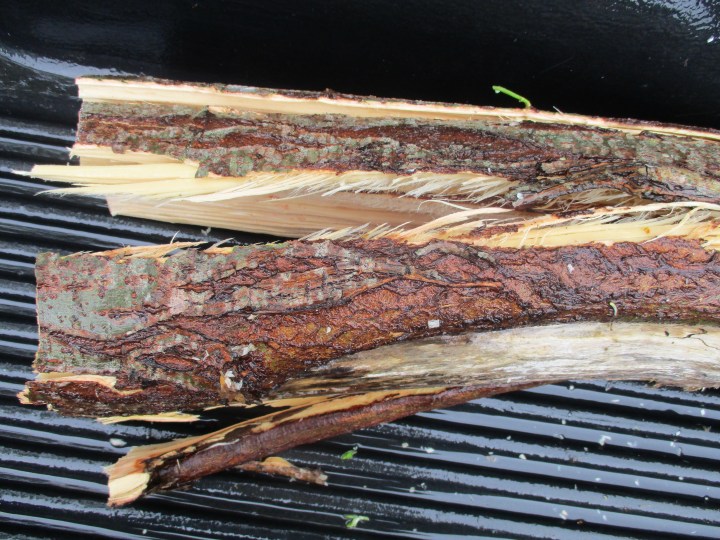
P90306English ivy, Hedera helix, is probably the nastiest and most aggressively invasive exotic species that I work with. It climbs high into redwood trees and overwhelms understory plants (that live below the trees). It invades many of the landscapes, and worst of all, it climbs building where it ruins paint and causes rot. It grows faster than we can keep up with it.

English ivy is actually a nice ground cover plant for refined landscapes. I grew it at my home in town. Contrary to popular belief, it does not root into and parasitize the trees that it climbs. Actually, it rarely overwhelms and shades out large trees. It prefers to keep them alive for support, from which it disperses its seed. However, it does promote decay in the trunks that it climbs, particularly where it retains moisture at ground level. Native trees are not accustomed to that.

We try to remove as much English ivy at work as possible, which includes removing it from trees and buildings. So far, with a few exceptions of small bits of ivy that broke off high in the trees that it climbed, I have been able to remove all ivy from the trees and walls that I have worked on.

Others were not so fortunate. When quick and efficient removal of ivy from the bases of as many mature trees as possible is the priority, ivy is more often severed down low, and left to die on the trunks of the infested trees. It looks shabby to say the least, and takes many years to deteriorate and fall away. In the picture above, dead ivy that was severed within the past few years is already being replaced by new ivy, which will also need to be severed.

The same technique happens with ivy on buildings. It gets cut at the foundations, but left on the walls to shrivel and turn brown. The dead ivy in the picture below was reaching upstairs eaves when it was severed, and remains there a few years later.

What annoys me so much about this technique is that it does not take much extra effort or time to tug quite most of the lower ivy from trees and walls. For most situations, all ivy can be dislodged, although tiny aerial roots remain. It is much easier to dislodge while fresh than after it is dried and crispy.P90306+

‘Icee Blue’ Yellowwood

90313No, it is not an oxymoron. ‘Yellowwood’ is the common name for a few specie of Podocarpus. The evergreen (or ‘everblue’) foliage of ‘Icee Blue’ yellowwood, Podocarpus elongatus ‘Monmal’, really is as silvery grayish blue as the name implies. It can be as striking as some cultivars of Colorado blue spruce. It grows slowly in narrow columnar form to only about fifteen or twenty feet tall.

The finely textured evergreen foliage is ideal for both formal hedges and informal screens, although it takes a while to fill in, particularly for larger hedges and screens. Tip pruning of lanky growth of informal screens improves density. The narrow leaves are about two inches long. Fresh new foliage may be lighter and very slightly greener, which can contrast nicely with more mature foliage.

‘Icee Blue’ yellowwood will tolerate a bit of partial shade, but exhibits the best color in full sun. It prefers to be watered somewhat regularly while getting established. As it matures, it becomes less reliant on watering. Like many other Podocarpus, it is susceptible to infestation by scale insects and the ants that cultivate them. Scale produce sticky honeydew which blackens with sooty mold.

Pruning Late Might Be Justified

90313thumbThere may not be exceptions to every rule, but there are a few exceptions to the rule that winter is the best time for pruning. It is generally true that most plants are the most dormant through the coolest part of winter. It is also true that while they are the most dormant, most plants are less sensitive to pruning, as well as other horticultural techniques that interfere with their normal function.

However, certain ‘special’ plants get pruned later, either because it is healthier for them, or just because they are allowed to do what they do best in spring before getting deprived of some of what they need to do it with. Some get pruned rather soon after coming out of winter dormancy. Some should probably wait for their new spring growth to mature a bit. It is not as confusing as it sounds.

Evergreen plants that drop much of their older foliage through winter should probably be pruned late in winter or early in spring, essentially at the last minute, just before new foliage develops. If shorn early and deprived of outer foliage that should survive through winter, photinia looks scraggly as it continues to lose much of what had been inner foliage until new foliage develops in spring.

Red twig dogwood and some types of willows that are coppiced or pollarded to maximize production of their colorful twigs should be allowed to show off their colorful bark for as long as possible. Like photinia, they too can be pruned at the last minute, just before vascular activity resumes. However, red twig Japanese maple really should be pruned in winter so it does not bleed afterward.

Flowering cherry, plum, peach, crabapple and quince are grown for prolific but sterile bloom which is diminished by winter pruning. If they need it, they can instead be pruned after bloom, but before too much foliage develops, or after such foliage matures in late spring or early summer. They do not need to be pruned nearly as aggressively as fruiting trees that would otherwise produce too much burdensome fruit. Some may only need to have dead stems pruned out.

Bullwinkle II

P90303What makes this Bullwinkle worse than most is that I pruned it like this myself. What makes it worse than worse is that it did not need to be pruned in this disfiguring manner for clearance from utility cables like the last one I wrote about was. https://tonytomeo.com/2018/08/08/horridculture-bullwinkle/ It is instead an attempt to renovate an overgrown hedge that was behaving something like a fat hedge. https://tonytomeo.com/2018/06/06/horridculture-fat-hedges/

In fact, the only reason it did not qualify as a fat hedge is that it had plenty of space for all of its superfluous bulk The side to the left was only beginning to encroach into the driveway on that side, and was easily pruned back to the curb, which for now, is adequate confinement. The side on the right was only beginning to encroach into the upstairs balconies, and was likewise easily pruned back for reasonable clearance.

The problems with this hedge were within and on top. It had been shorn back only for minimal confinement for so long that all the foliage on the sides was within a thin external layer. Pruning any farther back would have exposed a thicket of necrotic stems in various degrees of deterioration that had been accumulating within the interior for many years. Almost all growth was directed to and concentrated on top, which shaded the interior and lower stems even more than the accumulation of necrotic crud within did. Since the top had always been pruned down to the same height, all subsequent growth after pruning on top was above where it had been pruned previously, which was of course above the height where it was wanted, and consequently removed when the hedge was pruned again. There was no incentive for lower foliage to develop.

The hedge is there to obscure the view of a building on the left from the windows of the building on the right. The most important foliage for that purpose is the lower foliage, which is precisely what is lacking. Almost all resources were going to the upper foliage, which was contributing nothing, while shading out the lower growth. Although the inner thicket of necrotic stems was partially helping to obscure the unwanted view, it was also inhibiting healthier lower growth.

The illustration shows what remains after the useless top and necrotic interior were removed. After the picture was taken, the left and right sides of the hedge were pruned lower to eliminate the useless upper foliage that was not contributing to the function of the hedge. As unsightly as it is, it partially obscures the view of the building on the left from the building on the right, and will obscure it more as new foliage develops. Now that the interior is exposed, new growth should develop within the interior, and lower to the ground. Because the area is partially shaded by nearby redwoods, the exposed interior limbs are not likely to be damaged by sun scald.

After the new interior growth is established and obscuring the view, the external sides that are there now can be pruned back farther and sloped inward toward the top so that the lower growth of the hedge gets more sunlight. The hedge certainly does not need to be as wide as it is. It would be easier to maintain if it were narrower and so close to the allowable boundaries. Ultimately, with appropriate pruning over the next few years, this old hedge should be restored.

Looks Like Rain

P90202KSupposedly, all this rain has not been too terribly excessive. It seems to have been raining more frequently than it normally does, with only a few days without rain in between, and more often, many consecutive days of rain. The rain also seems to be heavier than it normally is. Yet, the total rainfall is not too much more than what is average for this time of year, and well within a normal range.
The volleyball court at Felton Covered Bridge Park looks more like a water polo court at the moment. The pair of ducks out of focus on the far side seem to dig it. The water is not as turbulent at it is the San Lorenzo River where they live.
Speaking of the San Lorenzo River, it has been flowing very well and at a relatively continuous rate. It came up high only for a short while. None of the heaviest downpours lasted long enough to keep it very high for very long. The ivied log laying in the river in the middle of the picture below was an upright cottonwood tree only recently, but fell into the river as many riverbank cottonwoods do when the ground is softened by rain and higher water.P90202K+
When things get as soggy as they are now, this great blue heron strolls the lawn at Felton Covered Bridge Park, probably because the San Lorenzo River is too turbulent, and also because the worms that live in the lawn come to the surface as the lawn gets saturated. He or she is never in a hurry, but just strolls about slowly, occasionally prodding the muddy soil. However, when it wants to move fast, it is quick enough to catch small frogs. Supposedly, this great blue heron caught and ATE a small gopher!P90202K++

Six on Saturday: Another Day At The Office


There is no rush to leave the office and shop when the weather is cold and rainy. We have been getting quite a few of the inside chores done. When we do go out in the rain, I do not like to take the camera out from under my rain gear; so I do not take many pictures. Besides, since most of my work involves pruning right now, I have not been working much around what is blooming or other interesting subjects.

1. Sitka spruce brought back from near Smith River within their native range are now happily canned in the recovery nursery at our shop. They look as if they were grown here, or are on a bench in a production nursery. They will eventually go out into the landscapes.P90302

2. Staghorn fern that the same colleague with the Sitka spruce brought back from his grandparents’ home in Orange County are not so happy. They were desiccated on arrival. Now that they are getting much more rain then then need, they are just rotting. The specimen that is still attached to the plywood on the left is probably beyond salvage. The specimen that broke its wire and fell onto the deck to the right is only partially viable. The viable portion will probably be separated from most of the rotting necrotic portion when it is attached to a new slab.P90302+

3. Colorado blue spruce and a young coast live oak are adjacent to the deck where the Sitka spruce and staghorn fern reside. This is not a good picture, but shows how the young oak to the left is crowding the older spruce to the right. Their main trunks are only about two feet apart at grade. The spruce was planted back in the middle of the 1980s, and would be a more desirable tree, but is very distressed, and is not likely worthy of salvage. The native oak grew from seed within only the past several years, and is not particularly remarkable, but happens to be quite healthy and well structured. It is not easy to decide which tree to cut down. I sort of suspect that the oak will win, and the spruce will need to go. Those are cruddy box elders in the background.P90302++

4. Bucket of rain water is impressively full next to the spruce and oak . . . and other spruces and staghorn ferns. There is an open recycle bin nearby that is also full. It must have been somewhat dark rather early in the morning for the flash to operate when I took this picture. I do not know if it ruined my selfie or just made it more artistic.P90302+++

5. Wild plum is still blooming in some spots. These survived all the rain rather well by delaying their bloom somehow. It will be raining again by the time you see this after midnight on Saturday morning, so this bloom will not last long. There may be others that bloom even later though, and with one exception, the flowering cherries have not started their bloom yet. That darkness in the background is the trunk of a big redwood tree.P90302++++

6. Wild plum close up shows the detail of the blossoms, and the unfocused silhouette of the redwood trunk in the background.P90302+++++

This is the link for Six on Saturday, for anyone else who would like to participate:

https://thepropagatorblog.wordpress.com/2017/09/18/six-on-saturday-a-participant-guide/

‘Little Ollie’ Olive

60302Those of us who appreciate olive trees for their fruit production or distinctively gnarly trunks probably would not understand the popularity of the Little Ollie olive, Olea europaea ‘Little Ollie’. Not only is is completely fruitless, but it lacks sculptural trunks and limbs. It is instead a short and and shrubby plant that gets only about three or four feet tall, with very dense grayish green foliage. Only the narrow evergreen leaves are recognizable as those of an olive tree.

Little Ollie olive behaves something like boxwood, and does not grow much faster. It can even be shorn as a hedge or topiary. It is quite resilient to heat and harsh exposure, and once established, it does not need much water. Because it is so compact, and has such resilient roots, it is popularly grown in large urns or planters. The grayish foliage is a nice backdrop for more colorful annuals and flowering perennials.

Nomenclature Is The Name Game

60302thumbNomenclature is a standardized technology of naming. It dictates the universal ‘botanical’ names of all plants, so that everyone everywhere can communicate more efficiently about horticulture. Botanical names might seem confusing, and maybe even unflattering, but they eliminate the confusion associated with regional common names that are as variable as languages and cultures.

For example, the white pine from Northern California is not the same as the white pine from Maine, even though they both have the same common name. However, Pinus monticola, the white pine from Northern California, is the same everywhere, even if grown in Maine. This particular botanical name is only for this particular white pine, so eliminates confusion with other white pines.

Botanical names are also known as ‘Latin’ names because they are (obviously) Latin. The first name is the more general part of the name, so is known as the ‘genus’ (or ‘genera’ in plural). The second name is the more specific part of the name, so is known as the ‘species’ (or ‘specie’ in plural). The genus name should be capitalized; but the species name is not. Both are italicized.

Acer is the genus of all maples. Salix is the genus of all willows. These names identify particular genera, but are no more specific alone. Acer rubrum more specifically identifies a popular North American maple that is known locally as red maple. Salix babylonica specifically identifies a common willow known locally as weeping willow. This is almost as specific as nomenclature gets.

A few specie have varieties or cultivars (cultivated varieties) which are variants of the basic species. Variety or cultivar names are added after specie names. They are capitalized, unitalicized and semi-quoted. For example, Acer rubrum ‘October Glory’ is the October Glory red maple. Olea europaea ‘Little Ollie’ is a fruitless, dense and short cultivar of the familiar European olive tree.

Nomenclature of plants is similar to nomenclature of cars. Buick, Chrysler and Mercury are genera of cars. Electra, Imperial and Grand Marquis are specie of Buick, Chrysler and Mercury, respectively. ‘Limited’, ‘Custom’ and ‘Brougham’ are their cultivars. There are of course many more plants with bigger and stranger names, but the system for identification works the same way.

Horridculture – Good Design / Bad ‘Maintenance’

P90227From a distance, this landscape does not look so bad. It seems to have been only recently installed, and features the sort of material that was likely intended to not necessarily obscure the sleek architecture of the building behind it, but to eventually soften the starkness of it.

Let’s analyze the landscape. A glossy privet hedge in back should grow up into an informal screen to provide some substantial green against the wall, but with a bit of proper pruning, should not become too obtrusive. A lower hedge of variegated tobira (Pittosporum tobira ‘Variegata’) in front can be pruned into a semi-formal hedge to obscure the bases of the trunks of the glossy privets, which will undoubtedly shed lower growth as they mature. The lightly colored variegated foliage of the tobira contrasts nicely against that of the dark green privets. The blue festuca in front of the variegated tobira hedge provides even more contrast of color, as well as contrast of form, and also ties in with the same blue festuca elsewhere in the landscape. The only two ‘intentional’ interruptions of the simple sleekness of this landscape is where a pair of grapevines flanking a doorway await the installation of an arbor, and a single ‘Icee Blue’ yellowwood is expected to provide additional contrast of form and color in front of the glossy privets. Both features are well situated, and balanced within the symmetry of the landscape. Yes, it is all quite well designed.

And yes, this is Wednesday; the day for my ‘Horridculture’ rant. So, let’s look closer.

Firstly, this is not a new landscape. It has been here long enough to mature better than it has so far. The so-called ‘gardeners’ know that allowing the material to grow means that they will need to put more effort into maintaining it. They would prefer to just keep the glossy privet hedge down low where it does not produce much debris, rather than allow it to grow most of the way up the wall, where it should be by now. A row of cinder block painted green would work just as well, and not need to be shorn at all. The ‘Icee Blue’ yellowwood should likewise be larger than it is now, and looking like a small and neat but informal tree. It actually seems to be growing slowly, which is no fault of the so-called ‘gardeners’.

The pair of grapevines have the opposite problem of the privet hedge. They are not being contained enough. Without the arbor that has yet to be built, they have no place to go, so are just being pruned as rampant and fat shrubs that will fall over as soon as their old stakes rot at the ground. If an arbor is ever built, all that congested and disfigured growth should be cut to the ground in winter, and started over from the ground up. However, it is unlikely that the so-called ‘gardeners’ would maintain them any better on an arbor than they do with them within reach; so it is probably just as well that they are in the ridiculous situation they are in.

That low spherical shrub in the front and center of the landscape, which is just to the left of the lower center of the picture, and is the unintentional interruption to the simplicity of the otherwise well designed variegated tobira hedge that I alluded to earlier, is a variegated Pittosporum tenuifolium. It is so ridiculously shorn and abused that I can not identify the cultivar. I can only guess that it is the common and overly popular ‘Marjorie Channon’. Apparently, one of the variegated tobiras died and needed to be replaced. Hey, it happens. A so-called ‘gardener’ knew that the necessary replacement plant needed to be variegated. He also knew that it needed to be a pittosporum, which is probably more than most so-called ‘gardeners’ could ascertain. The problem was that he went to a nursery and grabbed the first variegated pittosporum that he found, which, as you can plainly see, does not match the tobiras. It assumed a different form, flopped forward as they often do when shorn in such an inappropriate manner, and continues to be shorn into the ‘shape’ seen here now . . . as if it is somehow an asset to this otherwise well designed landscape. The blue festuca that it landed on gets shorn right along with it.

The only feature in this well designed landscape that does not have a serious problem, except for its one member that was clobbered by the single disfigured pittosporum, is the blue festuca, and that is only because the so-called ‘gardeners’ do nothing to it.P90227+

English Boxwood

90306While flashier but typically weaker modern cultivars of so many other specie are being developed, the most popular of the many cultivars of English boxwood, Buxus sempervirens, remain the same. There is not much to improve on. Most cultivars get only a few feet tall, and are densely foliated with inch long evergreen leaves that are excellent for topiary and low formally shorn hedges.

One of the difficulties with formal hedges, or any formal application, is replacement of any specimens that die. There are not very many of the different cultivars available locally; but it can be quite difficult to distinguish between some of them. One specimen of the wrong cultivar ruins conformity! Another concern is that the aroma of the foliage when disturbed may be objectionable to some.

In the wild, English boxwood grows as small trees or rather larger shrubs with relatively open structure. Locally, such specimens are only very rarely found in old Victorian landscapes, such as at the Winchester House. ‘Suffruticosa’ is so compact that it popularly allowed to grow as as unshorn and nearly spherical shrubs. ‘Argenteo-Variegata’, ‘Variegata’ and ‘Marginata’ are variegated.