Not my shame of course; but that of the trees in the pictures below.
Do not try this at home. I only did it because I am a horticulturist and arborist; and I happen to be one of the last arborists in America who condones coppicing and pollarding, which are depicted here.
Coppicing is cutting trees or shrubbery down to the ground annually, or at least regularly every few years or so. Some coppiced trees form basal burls or lignotubers. Some just form thicket growth that replaces itself after getting coppiced back to the ground.
Pollarding is similar to coppicing, but rather than cutting all growth back to a stump or stumps at ground level, it involves pruning all growth back to the same distended knuckles at the ends of a few main limbs annually, or at least regularly every few years or so. It is done in such a manner that the pruning wounds are compartmentalized by the new growth of the following year. Knuckles can be elongated by leaving single short stubs.
There are a few reasons for coppicing and pollarding. Some subjects develop an abundance of appealingly lush foliage. Some develop an abundance of appealing or useful twiggy growth. Coppiced red twig dogwoods are much twiggier and more colorful while bare in winter. Pollarded or coppiced willows produce an abundance of canes for basketry. White mulberries are pollarded to provide an abundance of lush foliage to feed silkworms.
I coppiced a Eucalyptus globulus ‘Compacta’ and pollarded a Eucalyptus globulus for two main reasons. Both are such problematic trees that I do not want to plant either into the ground, so must keep them contained. Also, I want the remarkably aromatic juvenile foliage that develops in response to coppicing and pollarding.
1. Eucalyptus globulus ‘Compacta’ coppiced stump. It is not such a great example of a coppiced stump, since the tree did not grow enough two years ago to get coppiced last year. Consequently, the few main trunks that were just recently coppiced are already starting to form their own separate lignotubers on top of the original, which is now rotting below. Soon enough, they will fuse to form a single lignotuber, concealing the evidence.
2. Eucalyptus globulus ‘Compacta’ before getting coppiced. It is quite small for a specimen that was not coppiced last year.
3. Eucalyptus globulus ‘Compacta’ after getting coppiced. Rhody is not impressed.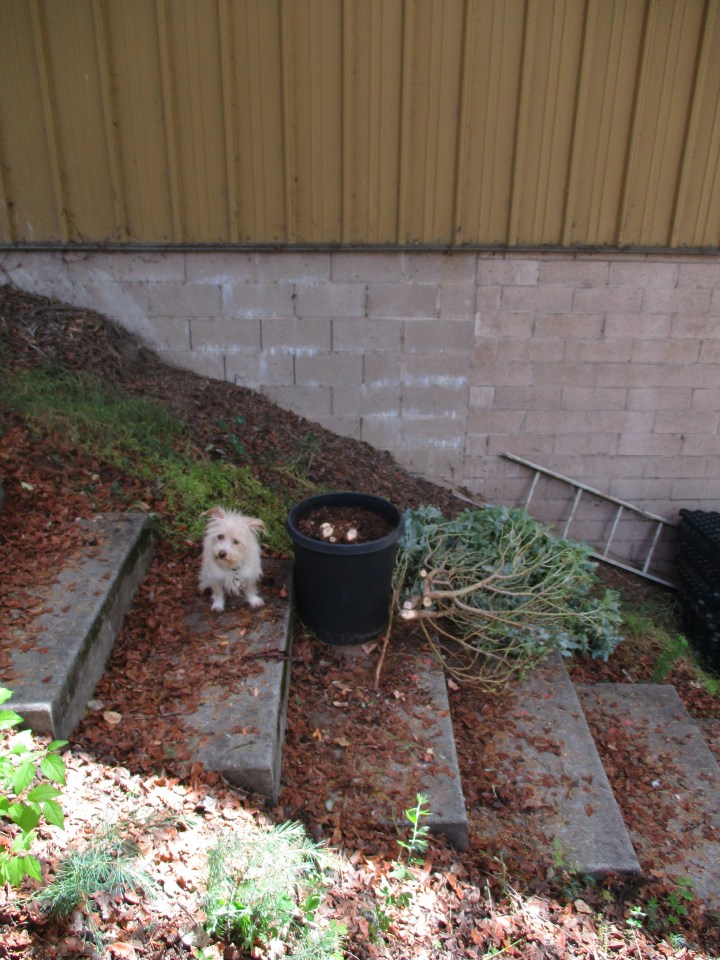
4. Eucalyptus cinerea in need of pollarding. This tree grew too big too fast to survive any longer in the relatively small #15 (15 gallon) can. Fortunately, in just a few days, it will instead get installed into a landscape where it can disperse roots and mature into a normal unpollarded tree. After a few years, it might get pollarded anyway, just to produce silvery juvenile foliage withing reach of the ground, but that is not a concern just yet.
5. Eucalyptus globulus pollarded knuckle. This is only the second pollarding procedure for this subject. The first procedure involved lopping the lanky single trunk off right here where the knuckle is now. The multiple limbs that developed were just recently lopped off, leaving this distended knuckle to repeat the process, hopefully annually.
6. Eucalyptus globulus pollarded trunk. This is why Eucalyptus globulus should not get pollarded! They look ridiculous if deprived of their naturally elegant form. They do not look much more dignified with multiple pollarded limbs. Oh, the shame!
This is the link for Six on Saturday, for anyone else who would like to participate:
https://thepropagatorblog.wordpress.com/2017/09/18/six-on-saturday-a-participant-guide/
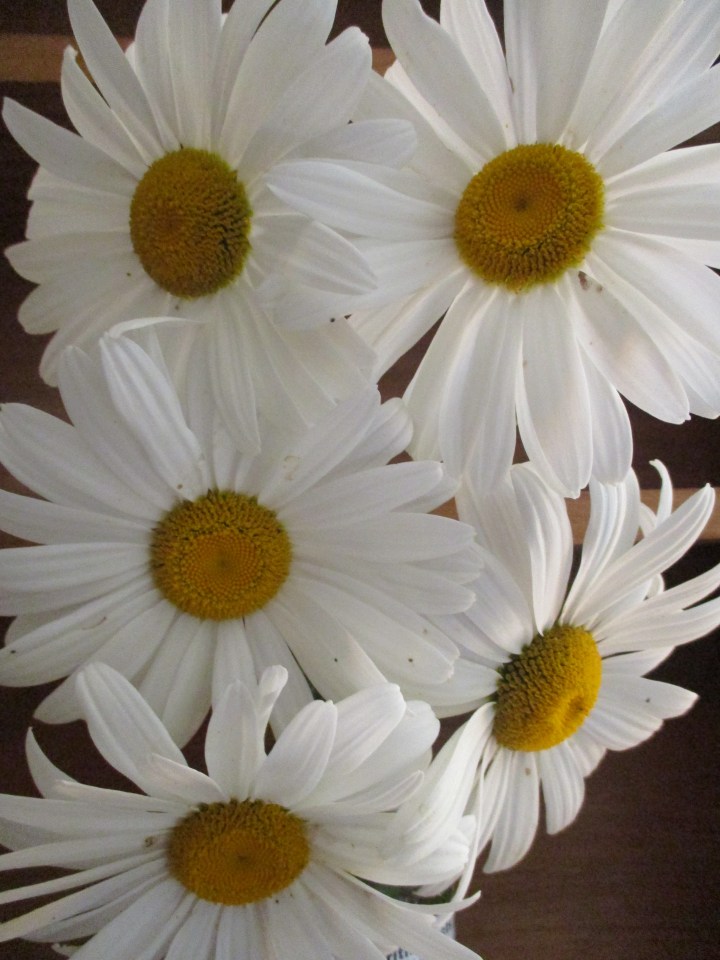 It just might be one of the most popular daisies nowadays, but Shasta daisy, Leucanthemum X superbum, is not a naturally occurring species. It was developed by Luther Burbank in 1890, as a complicated hybrid of four different species, one of which is of a different genus. Yet, it is somehow genetically stable enough to produce viable seed, although seed of cultivars is not true-to-type.
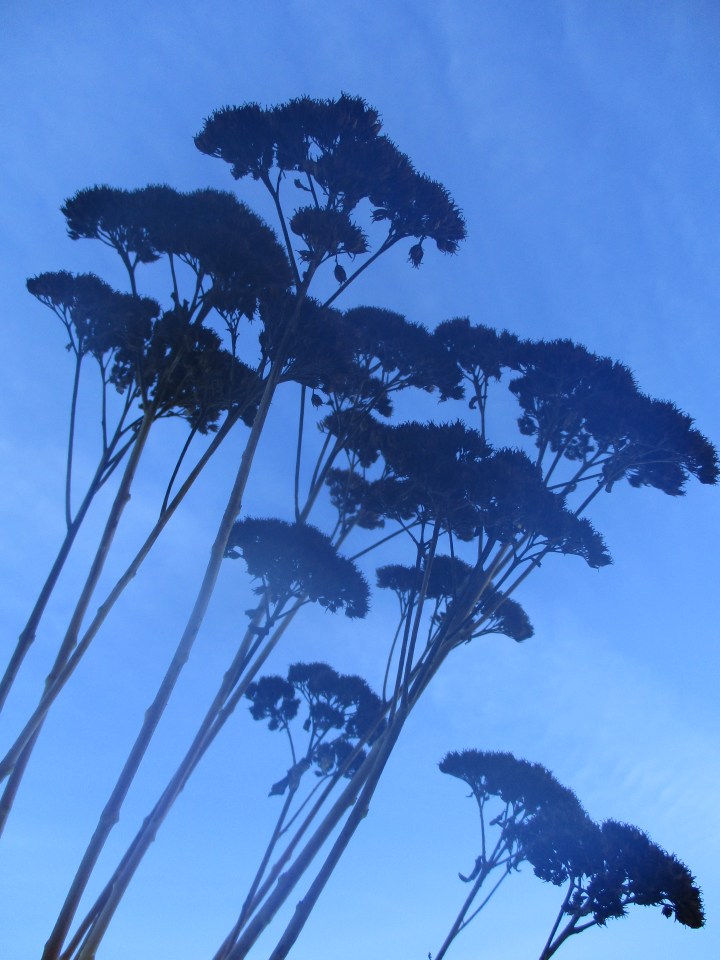 April showers bring May flowers. May flowers make a mess. Well, some of them do. Most simply disintegrate and fall from the trees, shrubs and vines that produced them, and decompose into the soil below. Some might have needed to be swept off of pavement and decks. Regardless, most of us do not notice the very minor consequences for the majority of spectacular spring bloom.
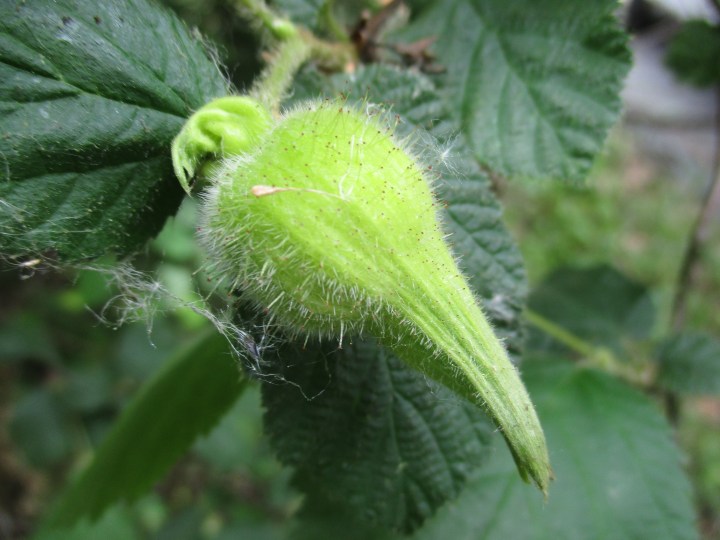 Not just any nuts, but precisely the sort that I recently discussed with a colleague, as I explained how they do not grow here. The nuts that is. The big thicket forming shrubs that are supposed to produce them not only grow here, but are a relatively common native. I just rarely see even a single nut on them. I sort of wondered how they mange to procreate with such rare seeds that invariably get taken by unconcerned rodents or birds.
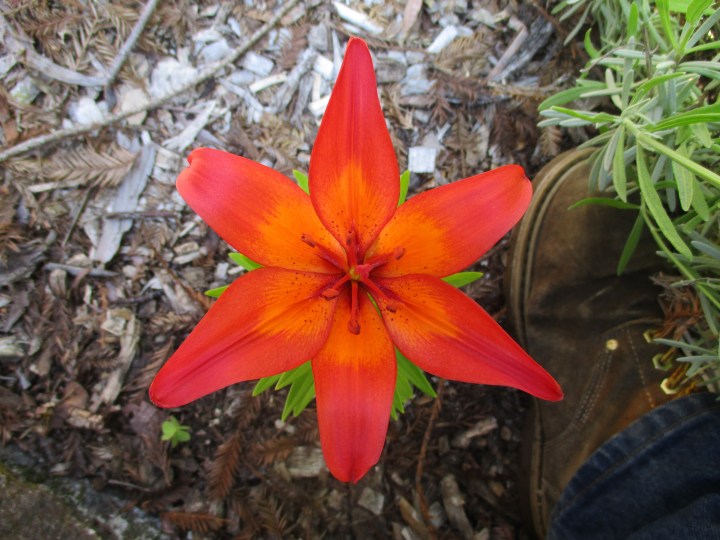 What a delightful surprise! It happens sometimes here in the rose garden. It may not look like much, as a short stemmed single lily floret that is mostly overwhelmed by the English lavender that I held back with my boot for this picture. It should be three feet tall or so, with several florets. The surprise is that no one planted it. Well, at least no one planted it recently. This rose garden has more history than is obvious from what blooms here now.
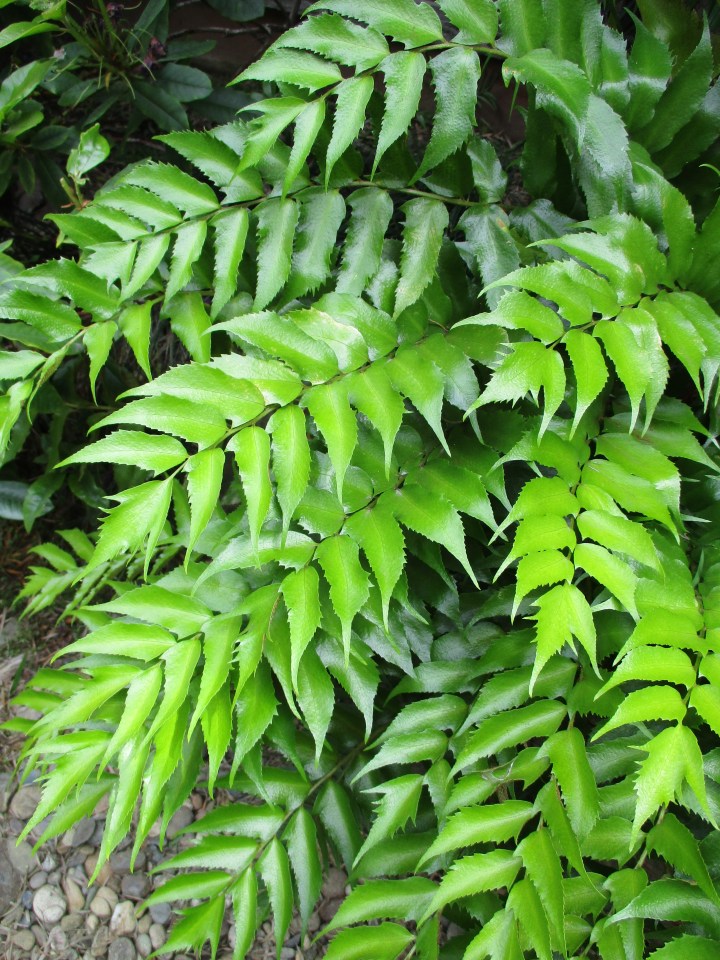 This is one of those perennials that has mixed reviews. Although relatively tough once established, holly fern, Cyrtomium falcatum, is susceptible to rot and fungal leaf-spot. It likes to be watered somewhat regularly, but rots if the soil is constantly saturated. Leaf-spot is not as dangerous as it looks, but can be unsightly. Too much fertilizer (to correct the damage) can burn the foliage too.
 It could be either an asset or a liability. With few exceptions, ferns do not want to be too exposed to direct sunlight or wind, especially during warm and dry weather. However, as long as they get just enough filtered light, they can be quite happy in sheltered spots that are a bit too shady for other plants. Most like to be watered regularly, and perhaps lightly fertilized in spring and summer.
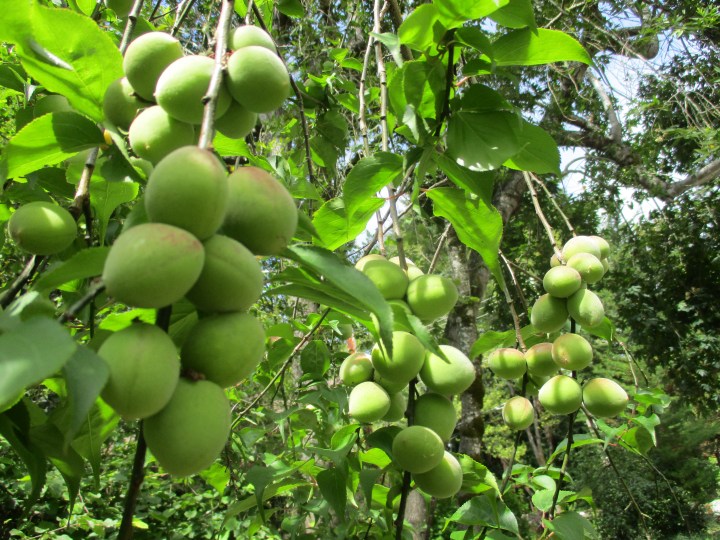 They do not come with instructions for their maintenance. Deciduous fruit trees, particularly the stone fruit trees (such as cherry, plum, prune, apricot nectarine and peach) and pomme fruit trees (such as apple and pear), can be procured as easily as nasturtium seed or petunias. Whether bare-root in winter or canned (potted), they very often get planted into gardens where they are expected to produce their fruit as easily as daisies bloom.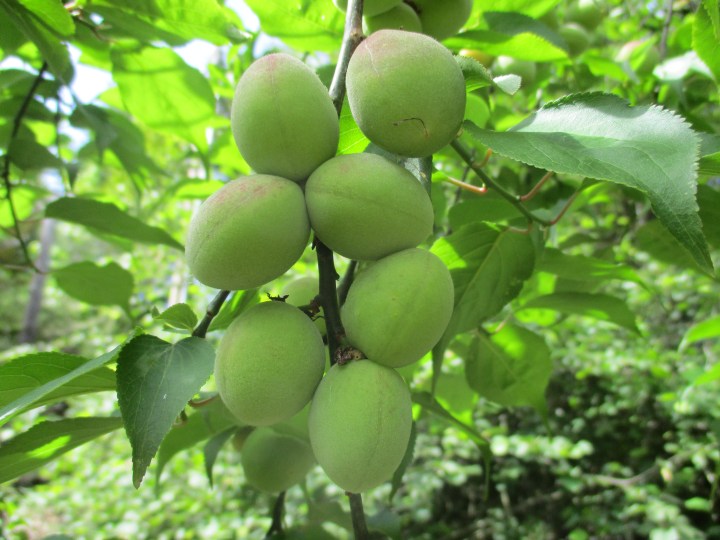
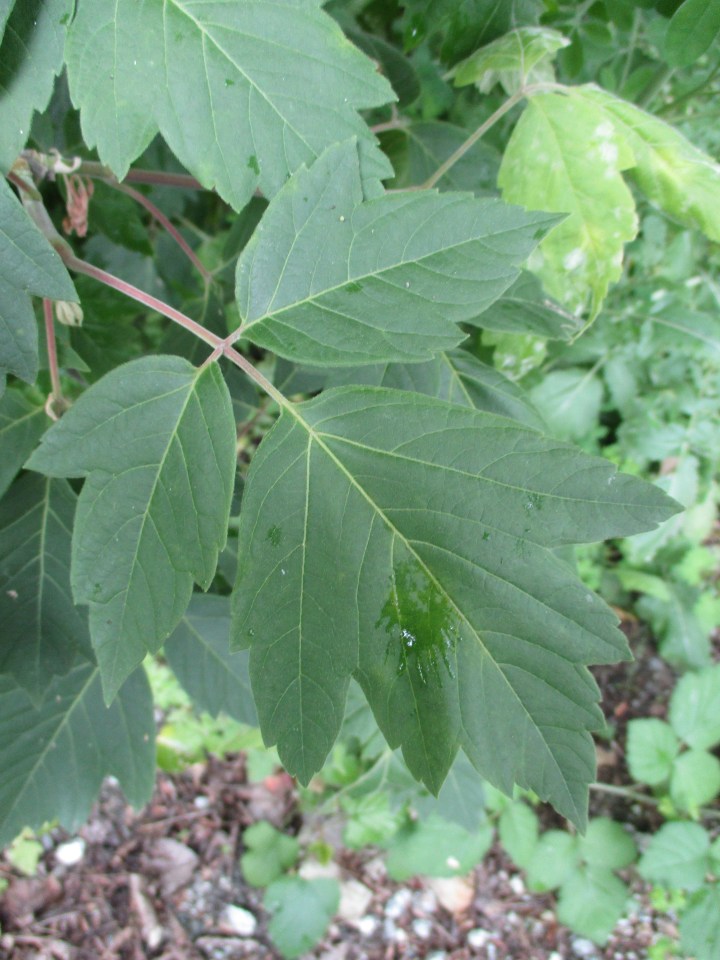 This ain’t no ordinary maple. Although there are other maples with trifoliate leaves (divided into three distinct palmately arranged leaflets), box elder, Acer negundo, is the only maple with pinnately compound leaves (divided into three or more distinct leaflets that are arranged pinnately on a central rachis). Leaflets might be solitary too. Almost all other maples have palmately lobed leaves.
 It sounds like science fiction, but it is not. Every spring and during particular summer weather, limbs can fall from trees without warning, and seemingly for no reason at all. It happens when least expected, while the weather is warm and perhaps humid, but notably without wind. The lack of wind is what makes it so unexpected. It is a phenomenon known simply as spontaneous limb failure.
