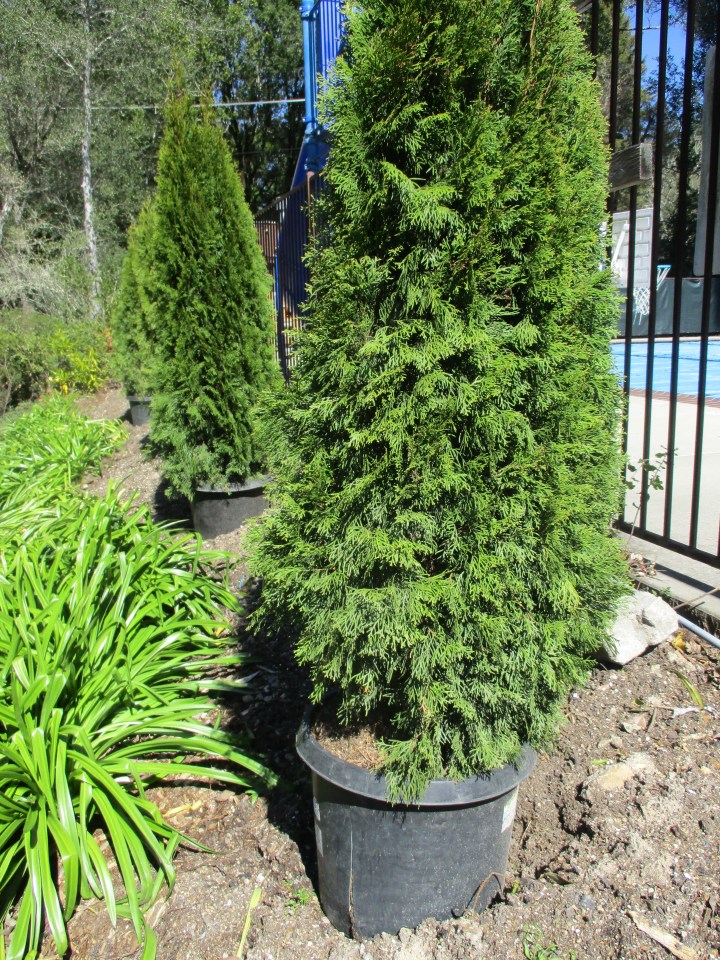
 B & B, formally known as ‘balled and burlapped’ nursery stock, was expected to be the next big ‘thing’ in nursery commodities here in California back in the late 1980s. As those outside of California know, it is field grown plant material that gets dug and marketed with its roots wrapped in burlap. It was more common in other regions, so was expected to become more common here as more nursery stock was to be imported from Oregon.
However, growers in Oregon started growing more of their stock in cans like we do in California, and then did not send as much of their B & B stock to California as predicted. Only certain slow growing commodities and large items are still field grown, and then dug and ‘balled and burlapped’ for export. Of these, arborvitaes, rhododendrons and various deciduous shade trees are the more commonly available locally.
B & B stock from Oregon is typically of exceptional quality. Horticulture is taken more seriously there.
Because B & B is still a foreign concept in California, it is typically canned to be more familiar to local consumers. It does not take long for it to root into the little bit of extra potting medium and fill out the cans. There is no need for the roots to be unwrapped, since the burlap decays as fast as the root disperse and expand. The now canned but formerly B & B arborvitaes in the picture above are exemplary.
Yet, they are not perfect. The problem with B & B stock here is that there are not many horticultural professionals here who know how to work with it, or even care to do so properly.
The picture below shows how shallow the B & B root systems of the arborvitaes are relative to the squat #15 (15 gallon) cans that they were purchased in. They obviously did not get enough time to root into their potting medium after they were canned. This is not due to a lack of horticultural expertise. This is either (and hopefully) a mistake in scheduling, or merely a lack of concern. But hey, no bother. They are still excellent specimens.
At least they seemed to be. A potentially serious problem was revealed when they were installed and the loose potting medium fell away from the burlap.
Many years ago, the burlap containing the balled root systems of B & B stock was bound with biodegradable jute twine. It rotted away before it could do any damage. Since then, nylon twine became more commonly used. Those who are familiar with B & B know to simply cut and remove the nylon twine before planting.
Whomever processed and canned these arborvitaes are either (and hopefully) not familiar with B & B, or just do not care. The nylon twine was still tightly bound and tied. If these arborvitaes had rooted into their potting medium and held it intact, this twine would not have been visible. Because it is wrapped a few times around the main trunks as well as wadded up burlap, it could have girdled the main trunks as they grew and expanded!
In a way, it was fortuitous that the potting medium fell away to expose the nylon twine, which was cut to allow for expansion of the main trunks. These exemplary B & B arborvitaes from Oregon should live happily ever after.
Pole Beans
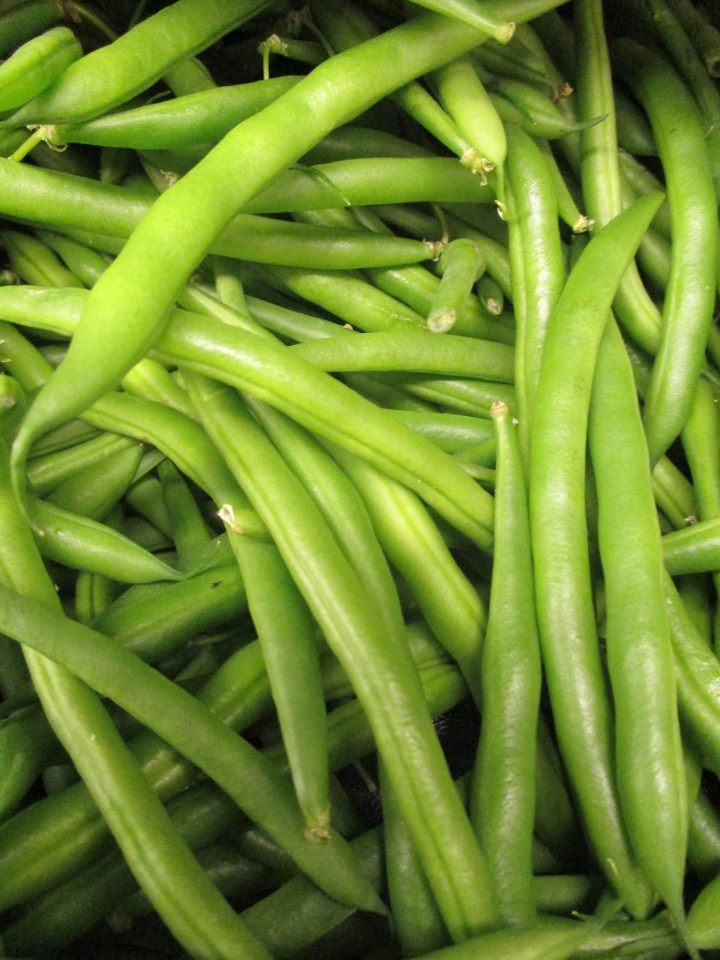 The main difference between pole beans and bush beans should be obvious. Pole beans climb poles. Bush beans are bushy. To complicate things, bush beans are more common in commercial agriculture because they are more adaptable to harvesting machinery, and they are most productive in a brief season, so are more efficiently harvested all at once rather than throughout summer.
Pole beans are generally more popular in home gardens for the opposite reason. They will not produce all at once, but will instead produce enough somewhat continually until the end of summer. Some varieties can climb past second story eaves, so should be confined to reachable trellises or other supports. They are annual, so the tangled thicket of vines that forms on top is no problem.
Most pole beans, which are also known as green beans, string beans, snap beans, French beans and haricot vert (French for ‘green beans’) are varieties of Phaseolus vulgaris. Some heirloom varieties of the original string beans produce beans with annoying ‘strings’ along one side of each bean. Dried beans are different varieties. Regular harvesting promotes continuous production.
Crop Rotation Improves Vegetable Production
 A south or west facing fence is a perfect place to grow pole beans. Twine can be strung in a zig-zag pattern between single rows of partly protruding nails along the top and bottom. The spacing of the nails should match that of the pole bean plants. Bean seed sown at the base of the fence germinate and grow quickly. Vines are happy to cling to the string and climb to the top of the fence.
Alas, it is temporary. Pole beans are annuals. They start to grow now, produce all summer, and then yellow and ultimately die by autumn, leaving the fence bare again. If the technique is repeated in the same spot with the same sort of pole beans the following spring and summer, the plants could be noticeably less vigorous. Repeating if for a third season could be downright disappointing.
It is best to grow beans in a different location every year if possible. After a few years, they can return to the same fence. Until then, tall plants, like caged tomatoes or corn, can be cycled through the area in front of the fence. Tomatoes and corn also perform better if not grown in the same spots for more than one season at a time. This process of cycling crops is known as ‘crop rotation’.
Soil borne pathogens proliferate along with the host plants that sustain them. Such pathogens may not be a noticeable problem in the first year while they get established. However, they are likely to be established and ready to infest the same sorts of host plants more aggressively in a subsequent season. Crop rotation of the host plants to cleaner locations annually interrupts this process.
In local soils, crop rotation is likely more important to compensate for nutrient depletion. Tomatoes are greedy with particular nutrients that other vegetable plants may not need in such quantities. The same applies to other vegetable plants. Tomatoes planted where other tomatoes grew last year may notice a lack of the nutrients that they crave the most of. However, zucchini may not miss what the tomatoes of last year took. Conversely, tomatoes may not notice what may be lacking where zucchini or other vegetables grew last year.
The Davey Tree
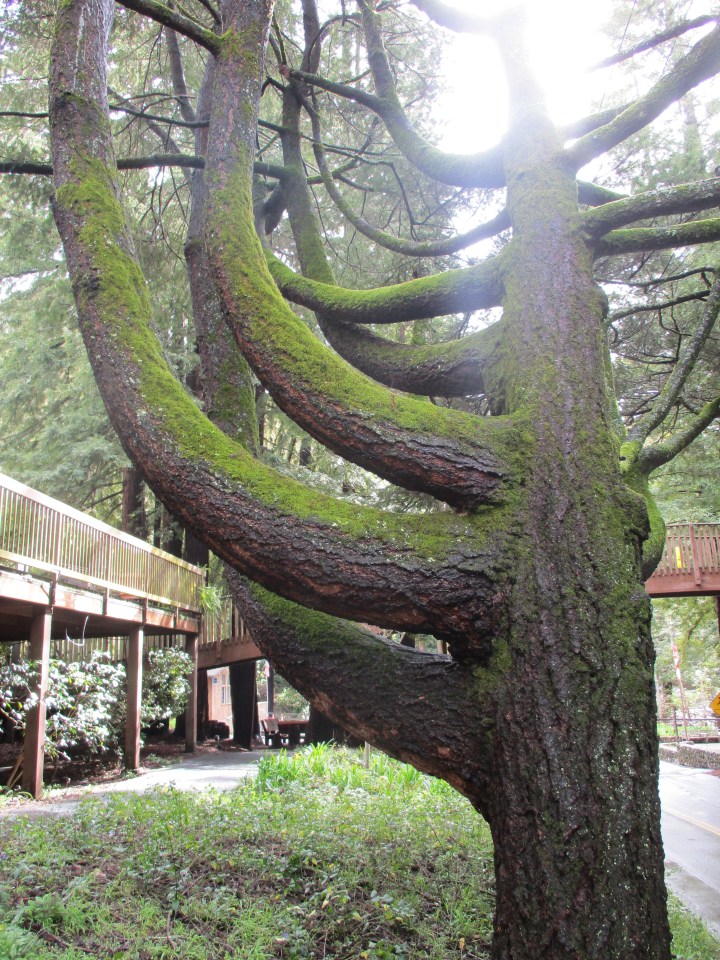 This is no common Douglas fir. It is the ‘Davey Tree’, named after the tree service that so diligently prunes it for clearance from the utility cables above. Yes, I can see as easily as you can how disfigured it is. The plan is to cut it down before it falls apart. At least that is the excuse for cutting it down. It is relatively short an stout, so is likely quite able to support its own weight, regardless of this disfigurement. We really just want it gone because it is so unsightly.
Most who see the Davey Tree are quick to blame the disfigurement on those who prune it for clearance. They do not consider that without such pruning, the utility cables would eventually be ruined and unable to deliver the electricity that so many of us use. Those who prune the trees do what they must to keep the electricity and other utility cables operational. Unfortunately, such work sometimes ruins trees.
As an arborist who sometimes works with other arborists who must perform clearance pruning, I am more likely to blame other landscape professionals. Some landscape designers design landscapes with trees that get too tall or broad within utility easements. Heck, many designers do not even designate where such easements are on the drafts of their landscape plans. Some so-called ‘gardeners’ plant such trees in utility easements with no plan at all. For what they all charge for their services, landscape professionals should know better than to put inappropriate trees into situations where they will eventually need to be mutilated or removed. Not many think that far ahead, or even care.
Anyway, the inappropriate location and disfigurement of the Davey Tree really can not be blamed on anyone. It is a wild tree that grew there from seed.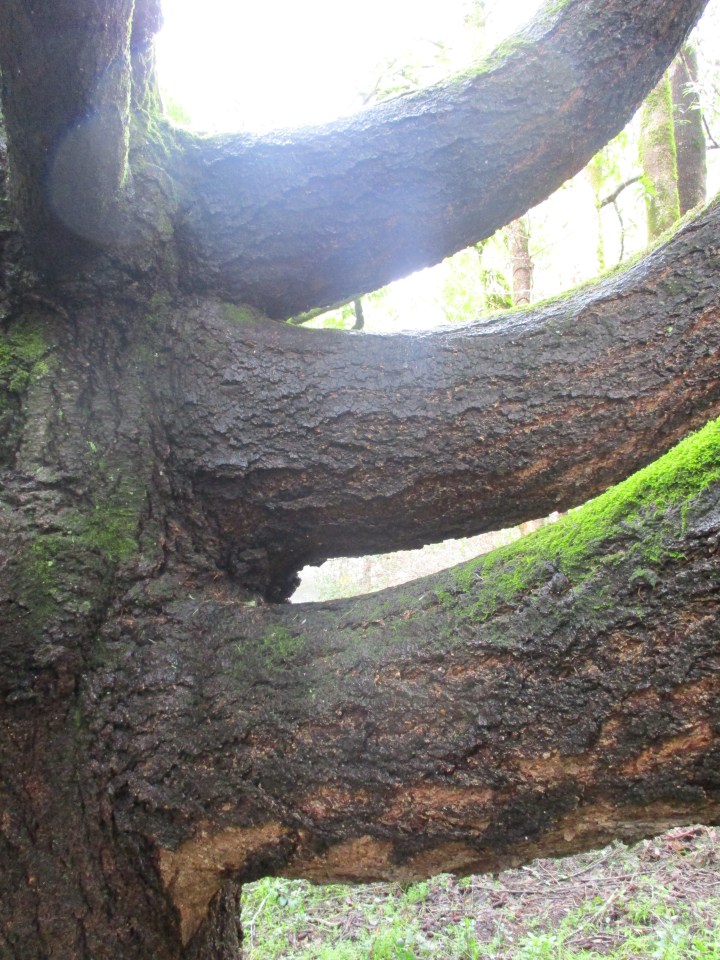
Sugaring Season
 There is no sugaring season here. Spring comes on too suddenly. By the time sap starts to flow, buds are already swelling.
Bigleaf maple, Acer macrophyllum, happens to be native here, although it is not common. It is the sugaring maple of the Pacific Northwest. A tree next to my driveway gave me enough sap to boil about four ounces of maple syrup a few years ago. That was all I needed to make the point to my colleagues who insisted that it could not be done that it really could be done.
Box elder, Acer negundo, is also native, and in riparian zones, is much more common than bigleaf maples is. I am told that is provides sap for sugaring just like any other maple does. Some say the sap is of inferior quality, or boils to cloudy syrup. Others say that it is comparable to that of any other maple.
Now that I made my point about getting a tiny bit of syrup from a bigleaf maple tree, I have no intention of sugaring again. However, sugaring season is still something that I need to be aware of. It is when I can not prune the maple trees. I can prune them earlier in winter or later in summer, but not while they are most vascularly active during sugaring season. Otherwise, they don’t stop bleeding. Even if the bleeding is harmless, it is unsightly if it stains the trunks and becomes infested with sooty mold as the weather warms.
The same rule applies to birch trees.
I pruned a few of the European white birch, Betula pendula, at work last week, believing that it was still too early for them to be too active. It was not much at all, and involved only a few small upper limbs and two significant lower limbs that had been disfigured by pruning for clearance from adjacent utility cables. I did not notice bleeding from the small stubbed limbs that I pruned from high in the canopy with a pole saw. Yet, the sap started to pour from the pruning wounds before I finished cutting away the two larger lower limbs that happened to be on the same tree. They are still bleeding now. In fact, they are bleeding so much that I feel badly that the tree is losing so much sap. If I had known how much sap would bleed, I could have put a bucket under each of the two wounds to catch the sap to make a small bit of syrup as is done in Alaska.
Six on Saturday: Picture Dump
No topic. No excuse. I just have these few pictures that I have no other use for. Some are sort of interesting, depending on perspective. Some are weird. #5 is just plain unsightly.
I considered sharing six pictures of camellias from Nuccios’ Nursery in Altadena that Brent sent to me, but I did not want to totally dismiss these pictures. Besides, Brent takes really lame pictures. I might share them next week just so we all can see how lame they are. I believe that most are different from the camellias at work that I shared pictures of last year, but I really do not know.
1. Arum italicum, which is also known simply as Italian arum, is something that I had always dismissed as a naturalized and sometimes invasive exotic species. In other words, I thought of it merely as a weed. Then, I noticed others using the foliage with cut flowers. It never occurred to me how pretty it is. I am not sure if this is the real deal, but it is what grows here. Some of the garden varieties that others have shared pictures of are more intensely variegated. It seems to me that another species that is not variegated might live here too, but I can not remember where I saw it.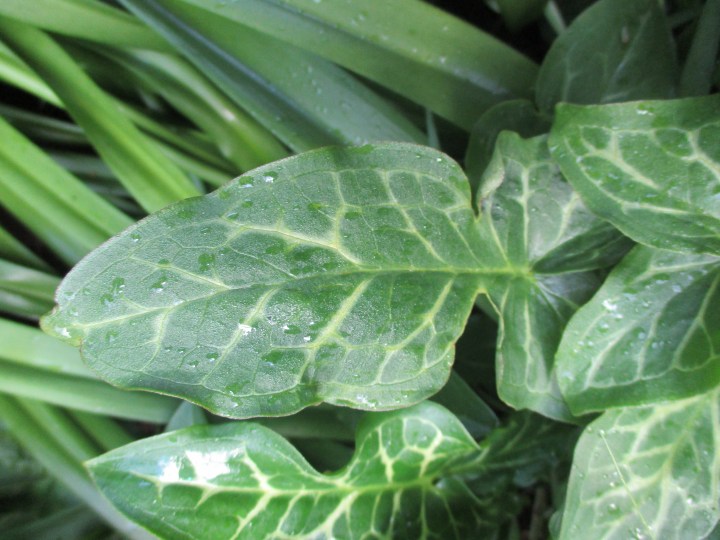
2. It never rains in Southern California. This is not Southern California. Besides, contrary to popular belief, it really ‘does’ rain in Southern California. Anyway, the incessant and abundant rain has been damaging a few of the spring blooming flowers, although most are doing quite well. This odd bearded iris bloom seems to be melting. Those that bloomed immediately afterward are doing just fine. The stems seem to me to be unusually slim for bearded iris, but I am no expert.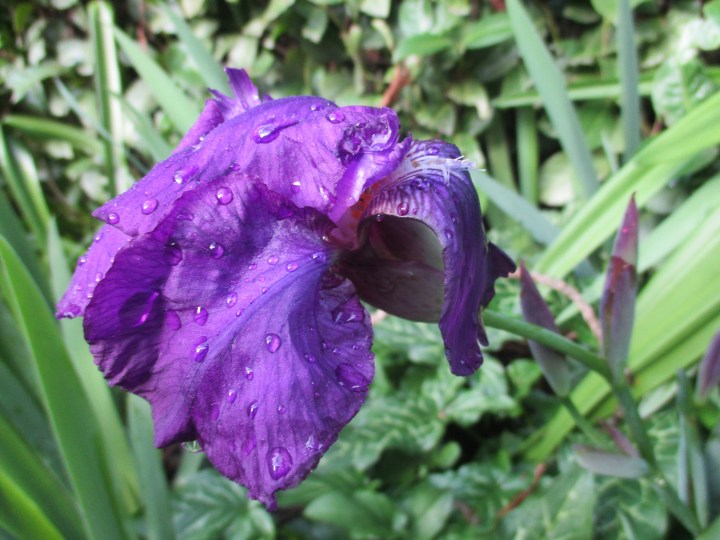
3. WHAT IS THIS?!? I believe it to be Kerria japonica, which is also known simply as Japanese kerria. . . . sort of like Arum italicum, which is also known simply as Italian arum. I thought it was something completely different until it bloomed. I will not say what I though it was, because my assumption was about as lame as Brent’s camellia pictures, and we can’t have that.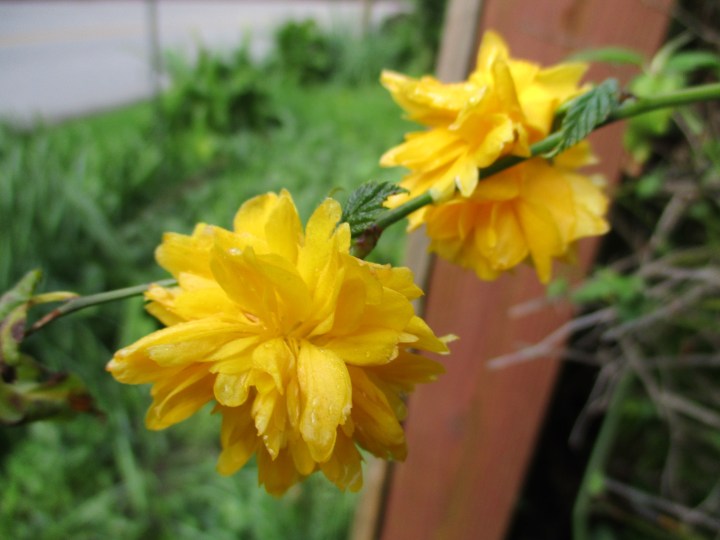
4. Clematis armandii, which is also known simply as Armand clematis (I bet you didn’t see that one coming.) is more popularly know here as evergreen clematis. It grows like the weed that it is, and climbs into the lemon tree that it is next too. It always seems to be very vigorous and healthy, but many of the leaves have crispy tips. Those at the top of the picture are about half dead! The vine does not get any fertilizer, although it probably reaches where other plants are fertilized. The damage is attributed to the water.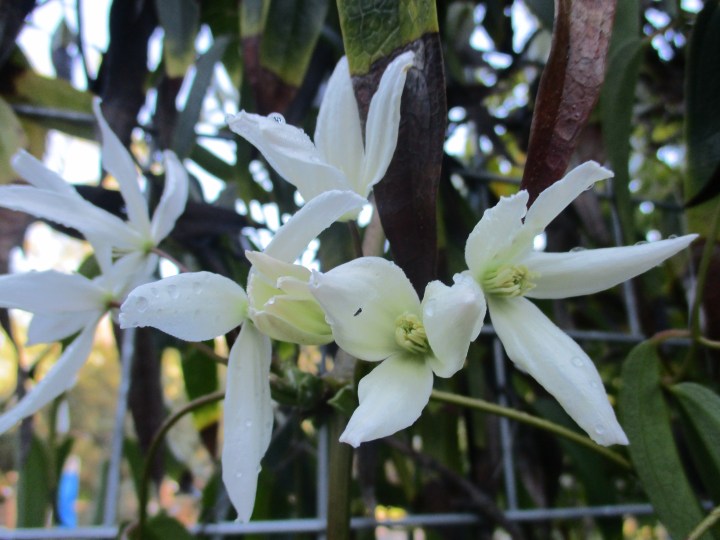
5. Lagerstroemia indica, which is NOT also known simply as Indian lagerstroemia, is the familiar crape myrtle. Some might disdainfully spell it without the first ‘e’. I am none to keen on it either. Actually, I am none too keen on its overuse! It is everywhere, and very often in situations that it does not belong in. This one is under larger trees, so does not get enough sunlight to bloom well. Prior to pruning, it was more disfigured than it is now. Since it can not grow as tall as it would like to be, it should be pollarded annually. As it matures and develops knuckles, some of the superfluous stems can be removed. As much as I dislike crape myrtle in bad situations, I want this tree to be pollarded properly. ‘Crape murder’ is unacceptable! There are MANY in the region that are indiscriminately hacked by so-called ‘gardeners’, who leave nasty stubs and unsightly stubble.
6. Eureka lemon originated as a ‘sport’, or mutant growth, of Lisbon lemon. The only difference between the two is that Lisbon lemon produces all fruit within a limited season, while Eureka lemon produces a bit less within the same season, and then continues to produce a few additional fruit sporadically throughout the year. Lisbon lemon works well for orchards that produce lemons for lemon products. Eureka lemon is better for home gardens, where it is always happy to provide lemons whenever they are desired. I got this picture of a single ripening fruit because there are not many others on the tree right now. That means the tree is doing its job; and people who work here are using the lemons.
This is the link for Six on Saturday, for anyone else who would like to participate:
https://thepropagatorblog.wordpress.com/2017/09/18/six-on-saturday-a-participant-guide/
Photinia
 As a shorn evergreen hedge or simple shorn shrubbery, photinia, Photinia X fraseri, produces handsomely glossy bronzy red foliage without bloom. It is best if shorn as weather warms at the end of winter, and then allowed to grow out for a while. It can be shorn again through summer as bronzy foliage fades to green, but should not be shorn so often that it is always deprived of red foliage.
Without regular shearing, photinia becomes a small tree or large shrub. Trees can either be staked on single trunks, or allowed to develop multiple trunks. New growth in spring is not as vigorous as it would be in response to shearing, so is not as colorful. Domed trusses of tiny white flowers bloom about as soon as new foliage appears. The floral fragrance can be objectionable to some.
Only the biggest and oldest trees reach high voltage cables. Most stay less than fifteen feet tall and broad. Hedges can be kept less than six feet tall, and ideally, should be kept less than half as deep (from front to back). Photinia can grow rather well while young, but then grows slower as it matures. Partial shade or a lack of water through summer compromise foliar color and density.
Trees Need Clearance From Utilities
 Palm trunks grow in only one direction; upward, toward sunlight and away from gravity. Each trunk is equipped with only a single terminal bud. If that bud encounters an obstacle, it can not be pruned around it. Palm trunks that get get too close to high voltage cables, or that might sway too close with a breeze, must therefore be removed to maintain minimal clearance from the cables.
Queen palms are notorious for getting planted under high voltage cables because they are so often impulse purchases that get planted without much planning. They are popularly planted along rear fences, exactly where high voltage cables are often located. Mexican fan palms often grow along rear fences as well because that is where birds and rodents are likely to drop the seeds.
Trees with single central leaders, like redwoods, spruces and certain pines, will be disfigured if their main trunks need to be topped for clearance from cables. Removal of such trees is often more practical than this sort of disfigurement. More extensively branched trees like sycamores, ashes, oaks and elms, are more adaptable to clearance pruning if it is not too severely disfiguring.
It is much simpler to not plant trees that get too large under high voltage cables. Elsewhere in the garden, where there is enough lateral (side) clearance, vertical clearance is not such a problem for larger trees. Small trees like redbud, purple leaf plum, photinia and various pittosporums, either do not get tall enough to reach upper cables, or will require only minimal pruning for clearance.
Below high voltage cables, the lower cables are for lower voltage, telephone and television. ‘House-drops’ are the cables that extend from utility poles to houses and other buildings. Although clearance is not so important for these lower risk cables, limbs that lean on them and blow around in wind can be abrasive. Sagging limbs can cause utility cables to sag more than they should.
Unfortunately, those who prune trees for utility clearance are efficient, but rarely arboriculturally correct.
Horridculture – Fads
 This is why I do not grow hellebores in my own garden. The specimen in the pictures above and below are about as good as they get here. Most are quite a bit worse. Some put out only one or two flowers. Some do not survive their first year in the garden.
No one seems to know why they don’t do well here. It might be the lack of chill in winter, although they do better in even milder climates. It might be the minimal humidity, although they generally do no better in the damp redwood forests where the specimen in these pictures lives. Those that might get too much sunlight do no better or worse than those that get too much shade. They are simply not happy here.
My solution to this ‘problem’ is to not grow them in my own garden. I do not particularly like them anyway. Even those that look ‘good’ look like huge African violets dipped in paraffin. Those in the landscapes that I work with now are the colors of worn vinyl upholstery of 1970s Chryslers. Yup, I will pass on hellebores. ‘Problem’ solved before it happened.
That ‘solution’ does not work for everyone.
Some landscapers get what they can from the few growers who will grow them here, and plant them in all sorts of landscapes that they just do not belong in. Some will do it because they read somewhere that hellebores do well in shade, which is technically true, but only in regions where other environmental conditions are appropriate. Some do it because they saw pretty pictures of them, and read a nice article about them in some gardening magazine that features such articles about what does well where the respective magazines are published.
Sadly, many do it because hellebores are a fad here, and something that many landscapers with something to prove like to brag about. They are like dawn redwood and unusual varieties of Japanese maple that are so often installed into inappropriate situations just so the landscaper can add pictures of them to their portfolios. Fortunately, hellebores merely struggle or die without causing any other damage to the landscape.
There are a few kinds of fads, and some of them actually make sense, but good landscape designers should use fads responsibly and with discretion.
Bell Pepper
 There are too many varieties of chili or pepper to count; but there are surprisingly few that are known as bell pepper, Capsicum annuum. They are the select few that lack capsaicin, which is what makes others so distinctly ‘hot’ and ‘spicy’. Most are quite mildly flavored. Green bell peppers, particularly those that are green because they are unripe, are generally more bitter and less sweet.
Bell peppers are warm season vegetables that get planted at the same time as tomato and eggplant, which they are incidentally related to. They are more productive where summer nights stay warm. In mild coastal climates, they are likely to start production later, or finish production sooner, than they would in warmer climates. They like warm sunshine, rich soil, and regularly watering.
The myth that green bell peppers are merely unripe red bell peppers is not completely untrue. They all start out green, and red bell peppers are often used green. Furthermore, most green bell peppers eventually turn red if they ripen enough. However, varieties that are grown as red bell peppers are different from varieties that are grown as green bell peppers. Orange and yellow bell peppers are increasingly popular. Purple, brown and white bell peppers are still rather rare. Red and green are the most productive and easiest to grow.

