Horridculture – Promiscuity


71206Nomenclature of the botanical sort was so much simpler back when we studied it back in the 1980s. It was intended to be like that. It was how the various specie of plants were identified and classified. There were certain rules that simply made sense. After ‘family’, plants were classified into general ‘genera’, and then further classified into specific ‘specie’. Some specie were further classified into ‘varieties’ and ‘cultivars’. (Cultivars are simply ‘cultivated varieties’ that need to be perpetuated by cloning because they are too genetically unstable to be true-to-type from seed.)

The genus name is always first. The species name is always second. Because they are Latin, they should be italicized. Any variety or cultivar names are last, not italicized, and in semi-quotations.

Back in the 1980s, there were a few specie that did not quite fit into such neat classification. Intergeneric hybrids (between two parents of different genera) were designated by an ‘X’ before the genus name, such as X Fatshedera lizei, which is a hybrid between Fatsia japonica and Hedera helix. Interspecific hybrids (between twp parents of different specie) were designated by an ‘X’ before the species name, such as Platanus X acerifolia, which is a hybrid between two different specie of the same genus of Platanus. Then there are different species that hybridize freely, but are still designated as separate specie, such as Washingtonia robusta and Washingtonia filifera, but that is another story.

Nowadays, with so much weirdly promiscuous breeding, it is difficult to know what specie or even genera some of the modern varieties and cultivars fit into. Consequently, species names are often omitted, and genus names are sometimes changed. It is getting difficult to know the differences between the two formerly distinct genera of Gaillardia and Rudbekia.

What is even sillier is that all this is happening while ‘sustainability’ and gardening for ‘bees’ are such fads. Weirdly bred specie . . . or whatever they are, are likely unable produce viable seed, so are just the opposite of sustainable. They only sustain their own marketability by ensuring the need for replacement. Some make no pollen for the bees that visit the flowers expecting to find some. Some make pollen of questionable nutritional value, or serve it in complicated flowers that might be difficult for bees to navigate.

There certainly are advantages to simplicity.71129

Apologies for the delay of posting ‘Horridculture’, which is normally posted on Wednesday. I was unable to write, so advanced the article that was intended for today to Wednesday, and finished writing this rant for today.

Prune Now For Fruit Later

70726thumbModern fruit trees have been so extensively bred to produce abundant and unnaturally large fruit, that most types are unable to support the weight of the fruit that they can produce each season. Without specialized dormant (winter) pruning to limit production, the weight of excessive fruit breaks and disfigures the limbs of the trees that produce it. Fruit becomes too much of a good thing.

Pruning not only limits the weight of the fruit; but it also improves the structural integrity of the limbs that must support it, and ideally, keeps fruit more reachable. Concentrating resources produces fewer but better fruits, instead of wasting resources on excessive fruits of inferior quality. Fewer stems that grow in spring are more vigorous and resistant to disease than more stems would be.

‘Stone’ fruits (of the genus Prunus) generally get similar pruning. However, peaches and nectarines produce such heavy fruit that they get pruned more severely than apricots, plums and prunes. Cherries and almonds are so lightweight that they may not need to be pruned at all. Cherries may be pruned for height. Since almonds get shaken from their trees, height is not so important.

Stems that grew last summer should produce fruit next summer. They should therefore be pruned short enough to support the weight of the fruit that they can produce (or what stems produced in previous years). For peaches, stems may need to be pruned to only a few inches long, even if the new stems are several feet long. Upper stems that get too high can be pruned out completely.

Apples and pears benefit from the same sort of pruning, but can be cut back even more aggressively, since their new stems tend to be more productive at the base. Crowded clusters of vigorous new stems can be thinned to eliminate the largest and most dominant stems. Stunted ‘spur’ stems that do not elongate more than two inches or so each year many not need to be pruned at all.

The ‘four Ds’, which are ‘Dead, Dying, Diseased and Damaged’ stems, are the first to get pruned out, even if they happen to be in the right places. There is just too much potential for problems later. Young trees that do not need much pruning now should be pruned for structure. Dormant fruit tree pruning is so important and specialized, that it is worth studying in more thorough detail.

Domingo Pine

90102The big name of this little pine takes some explaining. Domingo pine is a cultivator of an interspecific hybrid of two distinct specie, Eastern white pine, Pinus strobus, and Mexican white pine, Pinus ayacahuite. Until a better name in invented, it is known as Pinus strobus X ayacahuite ‘Domingo’. It is typically but incorrectly abbreviated as Pinus ‘Domingo’, or Pinus strobus ‘Domingo’.

Like many hybrids, Domingo pine got the best of both parents, and also stays compact enough for suburban gardens. Although not quite as soft and blue as Eastern white pine, its finely textured and dense pine needle foliage has a grayish sheen to it. Like the Mexican white pine, it does not need much water once established. It wants full sun exposure but is otherwise not demanding.

Young trees may seem to grow quickly, but growth slows significantly with maturity so that trees to not get much taller than second story eaves. Their typically conical form does not get much more than half as wide as tall. They look best where they have room to stay well branched from top to bottom. Because they are not very big, clearance pruning of lower limbs comprises their symmetry.

Secret Lives Of Christmas Trees

90102thumbPeople really stress out over Christmas trees. Some do not want a cut Christmas tree because it involves killing the tree. Some do not want an artificial Christmas tree because it is . . . artificial. Some do not want a living Christmas tree because it is too expensive for a tree that is too small. There are so many myths and misconceptions about Christmas trees, yet everyone wants one.

As mentioned, artificial trees are . . . artificial. Obviously. They are not a horticultural commodity, so are not an appropriate topic for a gardening column. What can be said about them is that they are not a more environmentally responsible option to disposable cut real trees. Countless dinosaurs died to make the petroleum for the plastic that these non-biodegradable trees are made of.

Cut trees are still the most environmentally responsible option. They are not harvested from forests, but from plantations, just like any other cut foliage, cut flowers or vegetable crops. Many are grown from the branched stumps of previously harvested trees, by a process known simply enough as ‘stump culture’. It works like coppicing, and allows some stumps to produce for many years.

Potted living trees are the most misunderstood type of Christmas trees. There is nothing environmentally friendly about them. They are exotic (non-native) trees grown in synthetic media (potting soil) in vinyl pots. They get synthetic fertilizer, artificial irrigation and very unnatural pruning while growing within artificially regulated environments that are designed to promote efficient production.

Only a few of the more compact types of living Christmas trees, like Colorado blue spruce and dwarf Alberta spruce, can survive confinement in pots for more than just a few years. Austrian black pine and dwarf limber pine need a bit of trimming as they grow, but also have the potential to work for a few Christmas seasons. The common small potted Christmas trees that are already decorated are Italian stone pine and Canary Island pine, which do not survive confinement for long, and get too big for home gardens.

Winter

P80110We are now two days into it. Is it any different than three days ago, the last day of autumn? Not really. Even in harsher climates, the changes from one season to the next are gradual. Like the phases of the moon, the seasons are constantly phasing out of the previous, and into the next. The dates of the first and last days of each season, which are determined by the position of the Earth within its orbit around the sun, are technicalities.
Seasons in the Southern Hemisphere are of course opposite of what they are here. That seems odd to me. The calendar is the same there as here. It seems obvious to me that winter and all seasons should be determined by the same dates there that they are determined by here. If winter began last Friday here, it should have done the same there, on the the same date. Longer days and warmer weather are consequences of location, south of the Equator. It is hard to imagine that January and February are summer there.
It also seems odd to me that all maps are oriented with North directed towards the top. Shouldn’t South be at the top South of the Equator? Must Australia be the ‘land down under’ to those who live there? Things would be so much simpler if Columbus has just stayed home, and the World was still flat.
Anyway, we do not get much winter here. The weather gets a bit cooler, and we will eventually get more rain. When I went to Oklahoma six years ago, I thought that I would finally get to experience a real winter, but we left just before New Year’s Day, while the weather was still somewhat mild. This little bit of snow was about all we got.

Red Sky At Morning

81222K.JPGRed sky at morning; sailor take warning. Stormy weather is to be expected.
Back before modern meteorology, there were all sorts of ways to predict the weather. Some of the ways to know what to expect in the short term were obvious, such as simply observing what was happening off in the distance in the direction from which the weather comes. For the experienced, it is easy enough to feel changes in humidity and temperature in an incoming breeze.
Halos around the moon or sun, as well as the color of the sky at sunrise, provided a bit of insight about what could be expected a bit farther out than the short term. Some techniques were not always accurate, and some were not accurate at all.
Flora and fauna are better at predicting the weather than we are. Horses, dogs and cats get extra fluffy if they expect the winter weather to be colder than it normally is, and they shed early if they expect an unusually warm summer. Sycamore trees are so responsive to the weather that what they are saying about it is not always obvious. Are they browning and defoliating just because the weather got too hot and arid late in summer, or because autumn is going to be extra cool? Experts could tell, but because of modern meteorology, there are not many experts left here.
This red sky over Mount Hermon occurred at sunrise last Sunday, just prior to the storm that finished early Monday morning, and provide picture #6 for my earlier Six on Saturday post. I tried to avoid the streetlamp at the bottom of the right edge. I did not see the bird when I took the picture. The tree to the left is a golden honeylocust.

Six on Saturday: Rain On My Parade


Actually, this rain ‘is’ the parade. In parts of California, we do not get much of it, so when rain happens, it is worth celebrating. Although this side of the Santa Cruz Mountains gets significantly more rainfall than the chaparral on the other side in the Santa Clara Valley, there are not many more rainy days here. What that means is that when it rains here, it does so with more volume than in the Santa Clara Valley.

Rain is not easy to get pictures of. The first four picture just show water from one of our first major storms of the season. The fifth pictures does not even show that much. The sixth picture is from the most recent storm that came through Sunday night and finished on Monday morning.

1. This waterfall was flowing both through and over the deteriorated and also clogged gutter on the roof of the shop building across the driveway from the gardening shop at work. The gutter is so deteriorated that I would have expected all of the water to just flow through it. Incidentally, the big roll-up door to the lower left of the picture happens to be that of the plumbing shop.P81222

2. This waterfall was flowing through a storm drain on the Mount Hermon Road bridge over Zayante Creek, East Zayante Road, and the railroad tracks in between them.. This section of Mount Hermon Road is known to some as ‘the Bypass’ because it bypassed the older Conference Drive in picture #5. What is not visible in this picture is that the upper part of the waterfall lands in the ditch on the side of East Zayante Road below. It might have seemed like a good idea when the bridge was built, but so much water falls from so high up that it erodes the ditch, and splatters gravel onto cars driving by. The lower part of the waterfall flows into a ditch on the edge of the railroad tracks, and then under the tracks towards picture #3 below.P81222+

3. This waterfall was flowing out into Zayante Creek from a culvert just downhill from the culvert under the railroad tracks mentioned in #2 above. It is the same water that was falling from the Mount Hermon Road bridge.P81222++

4. These two waterfalls were flowing from the roofs of the local supermarket and adjacent drug store and pharmacy, and onto the newsstand below. What is disturbing about this picture is these drains are merely back up drains that do not allow the flat roofs surrounded by parapet walls to fill with too much water if the main drains get clogged. The main drains are likely at the rear of the building where they can drain discretely and out of the way. These back up drains are on the front of the building so that they get noticed if they start to flow. All this water flowing out of them indicates that the main drains are clogged, and that the roofs are flooded.P81222+++

5. This is the Conference Drive bridge over Zayante Creek, East Zayante Road, and the railroad tracks in between them. It is the bridge that was bypassed by the Mount Hermon Road bridge in picture #2. The big greenwaste pile where I dump debris from the landscapes is directly below the southern edge of this bridge, which is to the left in this picture. You can not see it in this picture that was taken before the rain started, but a bit of water drains from this bridge onto the greenwaste pile. It is not much, but it is enough to be a bother when I am unloading debris in the rain. It falls from so high up, that even if I am avoiding the spot where the falling water lands, the wind can blow it all over me. From that height, any bit of road gravel that falls with it can give me quite a sting.P81222++++

6. The most recent storm finished early Monday morning, after dropping two and a half inches of rain.P81222+++++

This is the link for Six on Saturday, for anyone else who would like to participate:

https://thepropagatorblog.wordpress.com/2017/09/18/six-on-saturday-a-participant-guide/

Coast Rosemary

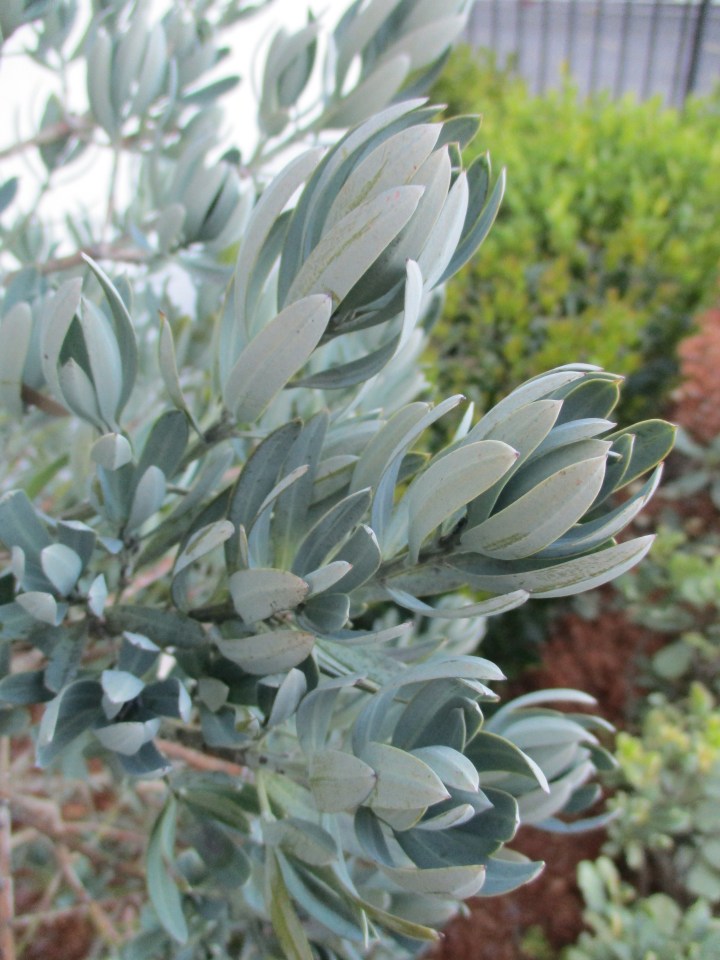
51223Just like real rosemary, the coast rosemary can either be a low ground cover or a dense shrub. Lower cultivars can get nearly five feet wide without getting much more than a foot high. Shrubby types can get nearly six feet tall without getting much wider. Shrubby types are more popular than ground cover types, and are often pruned so that they do not get too broad.

The tiny leaves of coast rosemary are silvery or grayish green, and can be variegated. Small white or very pale lavender flowers bloom sporadically throughout the year, and can be profuse in spring. Established plants do not need much water, but are probably happiest if watered somewhat regularly through summer. Shade subdues silvery foliar color and inhibits bloom.

Shrubby coast rosemary makes a delightful low hedge. It can be shorn like any other formal hedge, but is best where it has space to develop naturally. If space is limited, but not ‘too’ limited, a coast rosemary hedge can be aggressively shorn once annually at the end of winter, and then allowed to grow wild for the rest of the year.

Winter Is Bare Root Season

80124thumbWhile dormant for winter, some types of plants get dug from the soil and sent to nurseries as ‘bare root’ stock. Some get packaged with their otherwise bare roots contained in bags of damp sawdust. Most just get heeled into damp sand in the retail nurseries where they get sold. These simply get pulled from the sand when sold.

At their new home gardens, bare root plants simply get planted where they will sleep through the rest of winter. In spring, they wake up and start to grow as if nothing ever happened. How sneaky! They do not need big holes for their bare roots. Their graft unions (the ‘kinks’ at the bases of the trunks of grafted plants) must stand above grade. Roots only need to be spread out laterally.

Soil amendment should be minimal. Too much soil amendment promotes root growth around the trunk, which can inhibit root dispersion elsewhere. Too much excavation and amendment below the roots may eventually settle, so that graft unions sag below grade, and get buried. A light dose of fertilizer a bit later promotes early root growth, even while the branches are still bare.

Bare root plants are much more portable than canned (potted) plants. Several can be wrapped and sent home in a small car, or even through the mail; which is why so many bare root plants can be purchased online. (Climate zones should be considered when purchasing online.) Because they occupy less space than canned plants, many more varieties are available in nurseries.

Because they are so easy to handle and process, bare root plants cost about a third of what canned plants cost. Mail order plants from growers often cost even less than those that must be sent to retail nurseries first. Bare root plants are at least as reliable as canned stock, disperse roots more efficiently, and are less likely to be infected with disease when they arrive.

The most popular bare root plants are roses, cane berries, grapevines and fruit trees, like apricot, peach, nectarine, cherry, plum, prune, almond, apple, pear and persimmon. Flowering crabapple, flowering cherry, poplar, lilac, forsythia, wisteria, rhubarb, strawberry and asparagus are also available.

Horridculture – Three Is A Magic Number

P81219We learned it young from Schoolhouse Rock. Those of us who studied Landscape Design were compelled to learn why, and assume that it is always true.
Well, I am not a landscape designer. I am just a horticulturist and arborist. I can see why three is the best number for groups of trees, and that five is probably the second best option for larger groups, followed by seven, and then nine, and so on. I sort of understand why two, four, six, eight and so on are not so desirable. However, these rules are not absolute.
When I was a kid, many suburban front yards were outfitted with three European white birch trees. Such groups were typically in a corner of the rectangular yards, just outside of the curvacious mowing strips that were designed to make the rectangular spaces seem to be more irregular than they really were. Individually, the groups of three birches were appealing. Collectively, they were cliché. They were supposed to look more ‘natural’; but there is nothing natural about contrived groups of three trees, especially when it is so prevalent. That is not how they grow in forests.
Now, although I am no landscape designer, I do happen to know that good landscape design is compatible with the architecture of the building that it is associated with.
Early American architecture really should be landscaped in the Early American style. This might seem to be simple, just because Early American landscapes are simple and utilitarian, with most of the plant material at a safe distance from the buildings. The difficulty is that such landscapes are very symmetrical, with paired shrubbery and trees, and several paired and evenly spaced trees flanking roadways. The left matches the right. That means quite a bit of twos, fours, sixes, eights and so on. Early American landscape design developed at a time when nature was something to be dominated and utilized in the most efficient manner possible. Not many landscape designers comprehend this philosophy, or would adapt to it if they did understand.
The group of three dwarf Alberta spruce in the picture below was not intended to be a rebellious expression of formality. As you can see, it really is a group of three. Yet, they are also evenly spaced in a straight row that parallels the adjacent wall. Without pruning, they will always be very symmetrically conical. Cool!P81219+