 This theme may be getting a bit redundant about now. There is just so much that needs to be done in the garden through winter for what will bloom in spring and summer. We plant new fruit trees, and prune mature ones. When we finish planting spring bulbs, we can start planting summer bulbs. Berries, rhubarb and grapes all get planted. With all this going on, it is also time to prune roses.
Like so many fruit trees through the past few centuries, modern roses were bred to maximize production. Instead of big and abundant fruit, they produce big and colorful flowers. Such enhanced production is more than overgrown rose plants can sustain. Pruning eliminates superfluous stems to concentrate resources into fewer but more vigorous stems, and flowers of superior quality.
Pruning also eliminates diseased, damaged, dead and dying stems; which are known as the ‘four Ds’. Foliage falls from the stems naturally through winter, but should be raked and disposed of because it can spread disease to new foliage in the spring. (Dormant fungal spores and bacteria overwinter in fallen foliage.) Foliage that clings to stems after pruning should be plucked away.
Pruning should ideally be done by the time buds begin to swell in late winter. Of course this is not as easy as it sounds in the mild local climate. Buds swell early, and may even start to grow before rose flowers from the previous season finish blooming! Modern ‘carpet’ roses and a few other shrubby types barely go dormant, but fortunately, they do not need such meticulous pruning anyway.
Hybrid tea roses need the most severe pruning, which leaves only three to seven canes approximately two feet high. These canes should ideally be unbranched below where they get pruned, and be spaced somewhat evenly around the center. Stout canes that grew last summer from the base of each plant are best. However, canes below graft unions are suckers that need to be removed.
Floribunda roses are pruned similarly, but can retain a few more canes. Some grandiflora roses are allowed to get significantly taller, with new canes on top of canes from the previous year, which may already be on top of canes from another previous year. It may take a while before they develop replacement canes from the base. Climbing roses likewise retain old canes for a few years.
Tree roses should be pruned as if the upper graft union is at ground level, so that canes should be about two feet high above the graft union. (Although, tree rose canes are usually pruned shorter.) Carpet roses and a few bramble types only need to be pruned low, but cane quality is not so important. They are not grafted, so can not develop suckers.
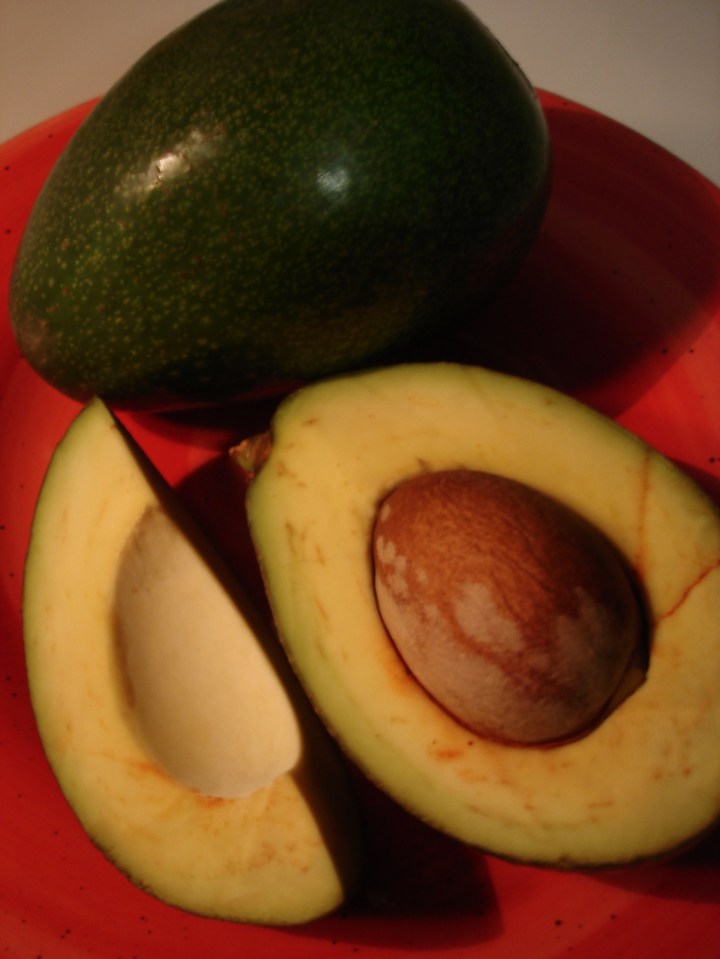 Avocado trees, Persea americana, grown from seed need to be about five years old to produce fruit that can be considerably different from the fruit from which the seed was taken, although such fruit is almost always quite good. Some trees need to be twice as old to produce. Grafted trees from nurseries are specific varieties that can start to produce their specific fruit immediately.
 Climate is what makes gardening so excellent here. It is just warm enough in summer for plants that like a bit of heat, but not too unbearably hot for too long. It is just cool enough in winter for plants that like a chill, but not cold enough for hard frost or heavy snow. The climate is also comfortable for us while out in the garden! Yet, even local climate is neither perfect nor predictable.
 This landscape is nothing fancy. It is out in front of a fast food establishment on Ocean Street in Santa Cruz. It is low maintenance, and starkly simple. It would be nice if the so-called ‘gardeners’ would cut back the African iris and English lavender a bit better, but they may have left them like this so that they are less likely to get trampled. The colored chips get replenished regularly, and the trash gets harvested quite efficiently. As I said, it is nothing fancy. The only remarkable feature had been this exemplary crape myrtle in the middle.
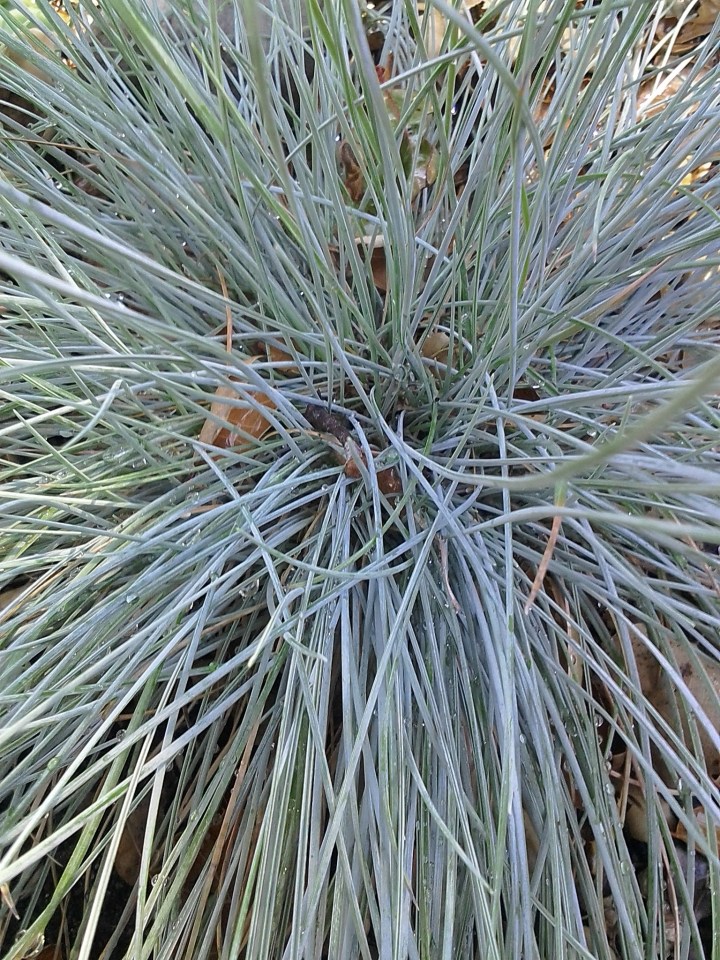 To avoid confusion with dwarf fescue blue turf grass, Festuca ovina glauca is more familiarly known as blue festuca. If planted close together and left to spread as a small scale ground cover, it is much lumpier and mounding than uniformly spreading turf. It is a clumping perennial that is more popularly grown as distinct tufts of finely textured blue gray foliage that looks like gray sea urchins.
 Autumn is for planting; and for good reasons. It is the beginning of dormancy for almost all plants, including evergreens. It precedes cool and rainy weather that inhibits desiccation until new roots are able to disperse sufficiently to sustain new plants. Some plants need to be in the garden in time for winter chill in order to initiate bloom. However, not everything should get planted in autumn.
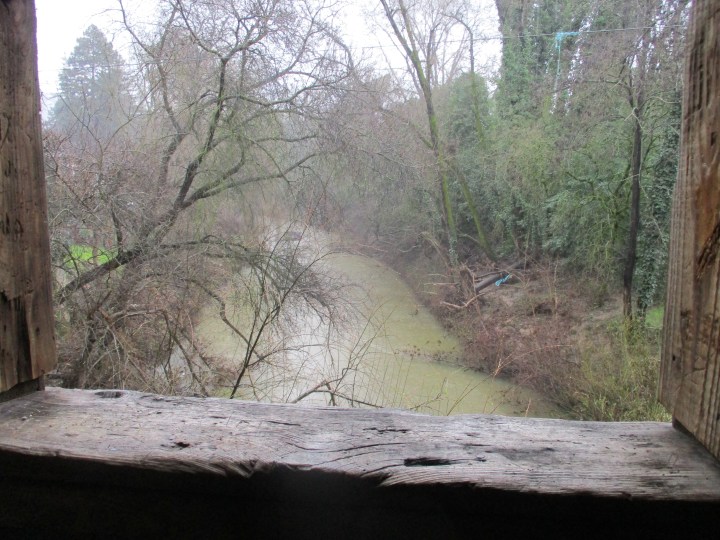 It may not look like much, but before all the rain started, the San Lorenzo river was shallow enough here to walk across. The water was clear and barely flowing. It is impossible to guess how deep it is now. It looks like cafe au lait, and is certainly flowing better than it had been. The watershed is less than a hundred and fifty square miles, so all this water is not coming from very far away.
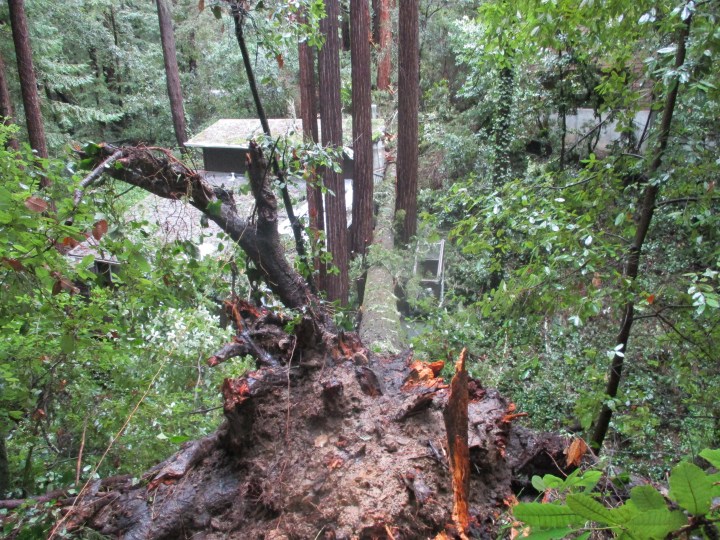 If there were lawns and fences in this neighborhood, the grass would likely seem to be greener on the other side of the fence. In this situation, the greenhouse probably seemed to be more comfortable than being left out in the storm. This tall Douglas fir tree dropped in to find out. It did not go well. What remains can be seen in the middle of the picture above, just to the right of the fallen fir, and in the close up of the picture below.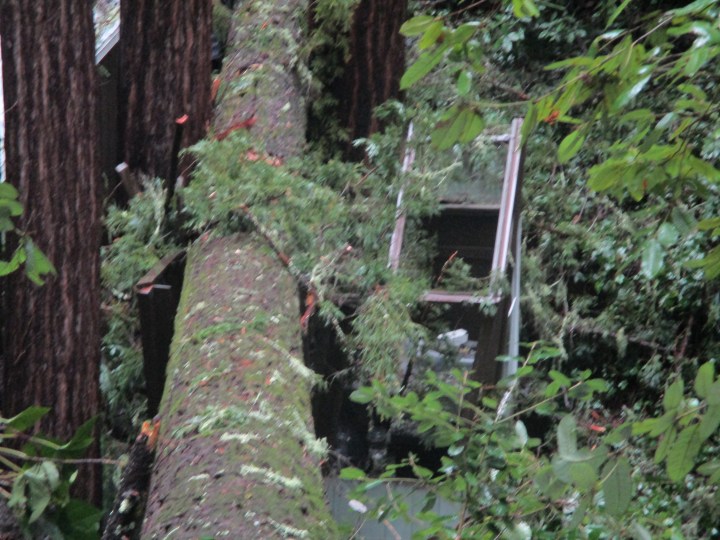

 The dark bronze and variegated varieties of tree houseleek, Aeonium arboreum, are so much more popular than the simple species, that the simple species with plain green foliage is now rather rare. The succulent stems do not stand much more than three feet tall. They get about as broad, and can get even broader as lower stems develop roots and grow into new plants. The succulent rosettes of foliage of well watered plants can be fragile to handle. Mature plants can bloom in spring with unusual conical trusses of yellowish or chartreuse flowers.
