Flowering Pear

60928Now that they have been so popular for so long, the deficiencies of flowering pear, Pyrus calleryana, (which is also known as Callery pear), are becoming increasingly evident. The dense branch structure and compact form that are so appealing while trees are young compromise structural integrity as trees mature. Symmetrical trees can be severely disfigured if limbs get broken by wind.

In the past, flowering pear had been quite resistant to disease and insect infestation. However, now that there are so many of them within minimal proximity of each other, it is nearly impossible to avoid infection with fire blight. To make matters worse, they share this very contagious bacterial disease with fruiting pear, evergreen pear (fruitless) and apple (fruiting and flowering crabapple).

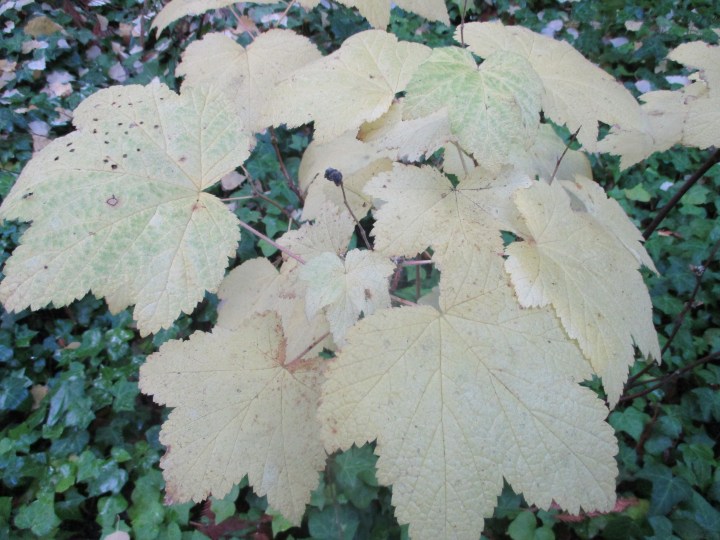
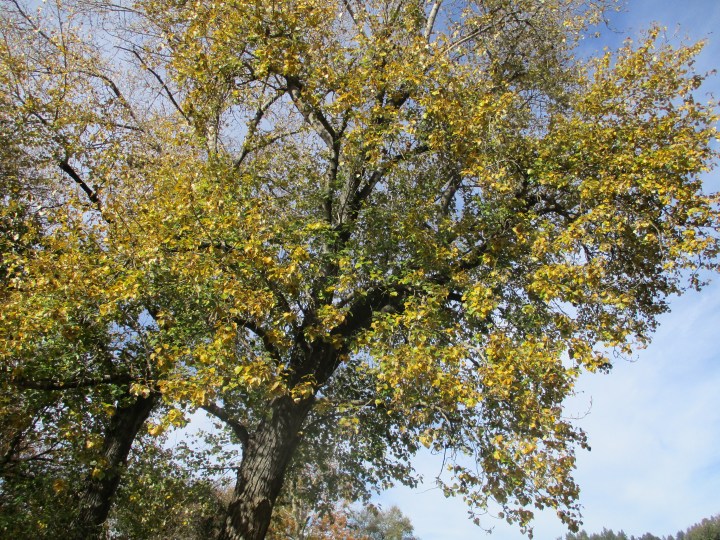
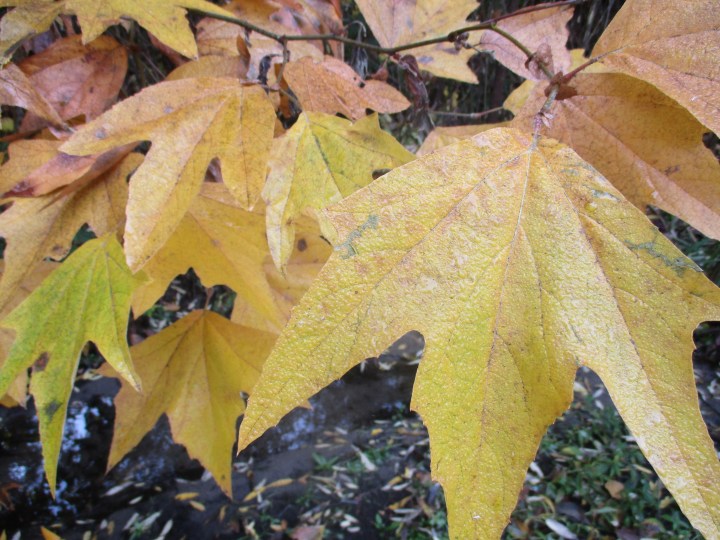
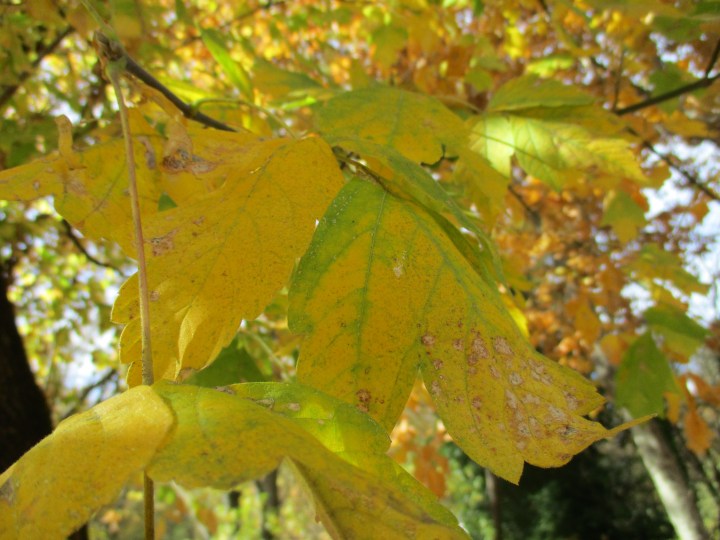
Otherwise, healthy and well structured trees provide some of the best autumn color for mild climates. Foliage that was rich green through summer becomes bright yellow and orange on a weak season, with more bright red and burgundy with a good chill. The white spring bloom is likewise more colorfully profuse after a colder winter, although some find the fragrance to be objectionable.

Guilt Trip

P80923It was so long ago that I barely remember it. I was just a little tyke. My older sister tripped on the driveway and broke one of the Japanese boxwood shrubs in the hedge on the edge of the driveway and front walkway. The hedge was still young then, and not completely filled in. My Pa replaced the missing shrub shortly afterward, but not before my younger brother and I learned that the gap was a shortcut through the hedge. The puny new shrub was not enough to compel us to go around like we had done before. Of course, it did not survive for long. It too got broken off.
We did feel sort of guilty, but only for a while. The second shrub was replaced with a third, which seemed like it should be sufficient to patch the gap in the otherwise formally shorn hedge. We were careful with this one, and actually got into the habit of going around the hedge to avoid altercation with it. However, it died even without our influence. Again, we felt guilty about the g. ap.
I do not remember if there were more attempts to fill the gap in the hedge with other shrubs. When we moved away from that house, the shrubs on either side were slowly filling in to obscure the void. A few years later, the gap could not be seen.
However, many years later, the hedge was pruned with an up-do, which exposed the lower few inches of trunk of each of the individual shrubs. Although there was no gap in the very uniform hedge, it was very obvious that one of the trunks was lacking, right where it had always been lacking. Oh, the guilt!
Even if someone wanted to go through the effort to cut a hole in the otherwise exemplary hedge to replace the missing shrub, it would be very difficult or impossible to find a shrub of that now old fashioned cultivar of Japanese boxwood. Modern cultivars are darker green. A single shrub of a modern cultivar would only compromise the uniformity of the now very uniform hedge. The missing shrub will need to stay missing forever. More guilt on top of guilt!
The satellite image below and the street level view from Google Maps shows that the hedge is now foliated all the way down the the ground. I will not even bother mentioning where the the missing shrub is missing from. I know you could not see it anyway. The hedge is a bit more overgrown than I can remember it ever being before, and it has a bit of that fat hedge syndrome going on, but it still looks great for half a century old. The gap is long gone. Only the guilt remains.P80923+

Early Autumn Color Might Disappoint

60928thumbIt might seem like autumn color is a bit early this year. In the wild, where there is no irrigation, native box elders, and maybe some of the cottonwoods and sycamores, are already yellowing. The box elders are already dropping some of their foliage. However, this is not caused by an early chill. It is caused by late warmth after an otherwise mild summer, and might inhibit better color later.

It is still impossible to say for certain. There are so many variables that affect autumn color, such as temperature, humidity and daylength. Some of the plants that develop color late, like flowering pear trees in irrigated landscapes, might not be bothered too much by the same variables that are troubling wild box elders now. Where autumn weather is so mild, color is unpredictable anyway.

Sudden cool weather after mild weather late in summer would have been better for autumn color. (Warmth through the middle of summer is no problem.) Foliage lingers best if the weather stays cool without getting too cold. Wind and rain will eventually dislodge foliage. Sheltered sweetgums might hold their foliage until just before it gets replaced by new foliage late in the following winter.

The earliest trees to color, as well as those that are notoriously less reliable for color, are the most likely to be inhibited by the weather this year. Besides box elders, cottonwoods and sycamores, other marginally colorful trees like willows, walnuts, maples, elms, redbuds, smoke trees and deciduous oaks, may develop bland color. Mulberries and tulip trees, though early, are more reliable.

Sweetgums (which are also known as liquidambars) , flowering pears, Chinese pistaches and maidenhair trees (which are also known as gingkos) are the most reliable trees for color locally. Maidenhair trees turn remarkably bright yellow. The others can be various shades of bright yellow, orange, red or burgundy red, (although Chinese pistaches do not not often get burgundy color here). Crape myrtles have the potential for the same color range if conditions are right.

Illegally Planting!

P80902K“ . . . others illegally planting whatever they wish . . . illegally.” Someone actually said that about the installation of our little Memorial Tree in Felton Covered Bridge Park. It was within the context of a review of the Park on Facebook, written by someone who has not stopped complaining about Felton since she moved here. It was forwarded to me quite some time ago by someone who documents and files such information that is relevant to hate crimes, and what is now known as ‘hate speech’, which is another completely different topic that we can not get involved with here.

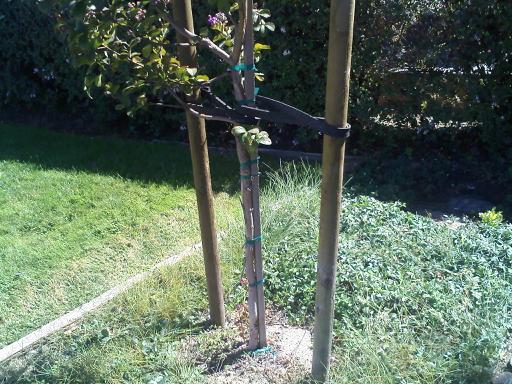
Technically, it is accurate. The tree was planted without a permit, and does not comply with the standards of Santa Cruz County Parks. Compliance would have been quite an expensive imposition. It would have required an expensive #15 (15 gallon) tree, outfitted with lodgepole stakes and straps. The overworked gardener would have needed to take time from his busy schedule to install it. Because the irrigation system to the site is now defunct, the gardener would have needed to irrigate the tree until it got established. It was easier, much less expensive, more horticulturally correct, and socially responsible for us install the tree and maintain it on our own. Call 911 if you must.

There are of course reasons why we should not plant trees or other plant material in parks and public places. We do not want to make more work for gardeners, interfere with the landscape plan, or add plants that are inappropriate to the situation. This Memorial Tree happened to have been planted with the supervision of a horticulturist and arborist (me), on the exact spot where another oak that was installed with the original landscape had been knocked down by a car. Otherwise, in most places in Felton Covered Park, vegetation management, including the removal of large volumes of biomass and invasive exotic specie, should be the priority. (Unfortunately, the overgrowth of invasive exotics is mostly within a protected environmentally sensitive riparian zone.)

The little Memorial Tree has quite a history, even though it is still a baby. I do not want to post links to all the other updates about it, but I can post this link to another article that contains another link to others . . . Oh, you can figure it out if you like: https://tonytomeo.com/2018/04/15/memorial-tree-update-to-the-updated-update-etc-the-sequel-to-all-those-other-sequels/ .

Six on Saturday: Gazania


Gazanias were not planned. The English daisies that were planted last spring as warm season annuals that might hopefully continue as perennials succumbed to rust. Seriously! This rust was nasty! I had no idea that English daisy was so susceptible to rust! They were so ugly that they needed to be removed. They were replaced with the gazanias a bit more than half way through.

Gazanias are not the flashiest of choices for the prominent planters that they went into, but they work. If they continue to bloom through winter, they can stay as long as they like. If they stay long enough to get bald spots, we can trim around the edges and plug the scraps back into the bald spots. I would rather put a bit of effort into maintaining them than replace them as the seasons change.

These pictures were taken about two weeks ago, along with the picture of the gazania that was posted last week. For some unknown reason, the gazanias are presently taking a break from blooming.

1. White is actually not my favorite color for gazanias. Yes, white is my favorite color. I just think that gazanias are at their best in brighter colors like yellow and orange. This white is not the best anyway. It looks like very pale yellow to me.P80922

2. Yellow, in conjunction with orange, is one of the two classic colors for gazanias, and is one of my two favorites . . . in conjunction with orange.P80922+

3. Orange is the other half of the caption to the picture above. (Just read the same caption, and switch ‘yellow’ for ‘orange’, and ‘orange’ for ‘yellow’.)P80922++

4. Pink might really be light burgundy. It was a bit darker when it first bloomed. This might be one of those colors that only girls can identify.P80922+++

5. Yellow with red stripes looks like something that blooms in the garden of Ronald McDonald.P80922++++

6. Cream with burgundy stripes looks like something that blooms in the garden of a clown with slightly more discriminating taste.P80922+++++

This is the link for Six on Saturday, for anyone else who would like to participate:

https://thepropagatorblog.wordpress.com/2017/09/18/six-on-saturday-a-participant-guide/

Tree of Heaven

50923‘A Tree Grows In Brooklyn’ documents the resiliency and invasiveness of the common but typically undesirable tree of Heaven, Ailanthus altissima. Once a single female tree get established, the extremely prolific seeds get everywhere, including cracks in concrete. The resulting seedlings conquer wherever they are not dug out. If cut down, they just resprout from the roots.

Male trees smell horrible while blooming for about a month in spring or summer. They are pollinated by flies, so naturally smell like what flies like. The tiny yellowish or tan flowers hang on panicles that can be a foot and a half long. Female blooms are not as big, prolific or objectionably fragrant. However, stems, leaves and all other parts of both genders smell rotten when handled.

Tree of Heaven, which has earned the alternative names of ‘tree of Hell’, ‘stink tree’, ‘ghetto elm’ and ‘ghetto palm’, is no longer a tree that gets planted by choice. It is typically a tree that plants itself, and on rare occasion, happens to grow into a good situation. They should not be allowed to overwhelm more desirable trees, or get too close to concrete or other damageable features.

Young trees grow very fast to about forty feet tall. Older and slower trees do not get much taller, although sheltered trees can get twice as tall, with elegant gray bark. They do not live much more than fifty years. The big pinnately compound leaves are surprisingly pretty. On vigorous shoots, individual leaves can get as long as two and a half feet, with leaflets as long as six inches.

Leaves Are Starting To Fall

50923thumbAutumn color is different every year. Sometimes, early and sudden cool weather after a mild summer promotes good foliar color that lingers longer while relaxed trees slowly realize that they should probably start to defoliate. Sometimes, early wind and rain accelerate defoliation of otherwise good color. There are a few variables that trees must adapt their performance to.

Warm and arid weather two weeks ago started the process of defoliation suddenly and a maybe slightly early this year. Even before the weather gets cool, deciduous trees are already starting to shed the oldest of their foliage that they do not need in order to hold their youngest foliage a bit later into autumn. Evergreen trees do the same to limit desiccation.

Slightly breezy weather that was so pleasant after such heat was just enough to start dislodging deteriorating foliage. Now, leaves are already starting to fall before they develop much color. Redwoods and pines are likewise dropping browned needles. Fortunately, trees that are the most colorful in autumn tend to hold their foliage better until the weather gets cooler.

It is impossible to predict how colorful trees will be this autumn; although if storms are as healthy as predicted, the mild temperatures may inhibit color, while wind and rain dislodge colorful foliage. Regardless, it is already time to start raking falling leaves and needles. They can get messy, and when the rain starts, they can stain pavement and clog gutters.

When more foliage falls later in autumn, it will need to be raked from ground cover, surviving portions of lawn, and any other plants that collect it, so that it does not shade out the sunlight.

Horridculture – Needle Mania!

P80919Throughout my career as a horticulturist, I have worked in more public landscapes than most. Some of these landscapes were in some of the most notorious neighborhoods of the San Francisco Bay Area and the Monterey Bay Area. Yes, I have found some rather strange items strewn about, including a few that necessitated telephone calls to local law enforcement. Yet, I have never once found a single used syringe.

Syringes are more commonly known as ‘needles’ by those who fear them. We are sometimes warned about them, particularly in areas where the sorts of people whom we are supposed to fear might have left them strewn about, whether or not these fearsome people actually use syringes. If found, such syringes are dangerous because they are used to inject illicit narcotics, and are consequently contaminated with the blood of those who use them. Such blood is always assumed to be infected with any variety of the communicable diseases that afflict all fearsome people, and is assumed to stay infectious for all eternity.

When I consider some of the situations that I have worked in, I believe that I am fortunate to have never found a syringe. On rare occasion, I have been presented with pouches and ‘sharps’ containment boxes containing syringes so that I can dispose of them properly. I actually expect to find a few at a site that I will be inspecting this next week or so, which will be a new experience for me. Caution is justified.

I know that syringes are out there, and that they are dangerous. So are rattlesnakes. I have seen and killed many rattlesnakes. They used to be quite common at the farm, and are still somewhat common at home. I know people who have been bitten by rattlesnakes, even though we all know to be careful out in regions where we expect them to be. Signs warning those who might not be familiar with rattlesnakes are posted in county and state parks inhabited by rattlesnakes. People are bitten by rattlesnakes much more commonly than people are accidentally pricked by used syringes. Accidental ‘needle pricks’ are actually extremely rare. For those unfortunate enough to experience such an injury, infection with any one of the communicable diseases that we all fear is very rare. Contrary to popular belief, infectious blood does not stay infections forever.

Needle Mania is really the most infectious affliction associated with used syringes. In a nearby Community, several people are so obsessed with discarded syringes that they have developed a ‘needle watch’ online, in order to monitor the number of syringes found, and the locations of where they were found. Some like to post pictures of the syringes that they find, sort of like trophies. Some people have found several syringes; which is quite commendable for those who live and work mostly inside. (I spent my entire career outside, but have never found a single syringe.) The numbers of syringes found is disturbing. So are the many pictures of syringes laying out in public spaces.

A few pictures are perplexing as well. One locally found syringe was pictured laying out neatly on a serpentinite outcropping. Another that was found in spring on the bank of the San Lorenzo River was laying on top of fallen autumn leaves of quaking aspen, Populus tremuloides. Neither serpentinite nor quaking aspen are endemic to this region.

A syringe was recently found in my neighborhood! As unfortunate and disturbing as this news was, it is not completely unexpected. Syringes can be discarded anywhere, and are probably likely to be discarded on isolated rural roads.

The neighbor who found the syringe believes that it is a problem that is serious enough to justify posting pictures of it all over the neighborhood! These pictures include a description of where the syringe was found, and instructions of what to do to curtail suspicious activity. They are everywhere! They were originally just stapled to trees, utility poles, mail boxes, fences, barns . . . and anything that a staple would stick into. Now that they have been out in the weather for a while, some are blowing about in the roadway and collecting in ditches. When they were first posted, a few were within view from every point on the road. More posters were added to replace those that blew away. These posters are now a prominent feature of our Community landscape.

I do not doubt that the discarded syringe is a problem for the Community. However, the pictures of it posted so prominently and abundantly throughout the neighborhood landscape are unsightly, trashy and unbecoming of such a safe and idyllic neighborhood.P80919K

Laurel-Leaf Snailseed

80926The first half of the name sound appealing enough. The second half, not so much. Do the seeds grow into snails? Do they just look like snails? Not many have seen them. Tiny pale white flowers that are supposed to bloom in spring, as well as small black berries that develop after bloom, are rare. Laurel-leaf snailseed, Cocculus laurifolius, is grown just for its glossy evergreen foliage.

The foliage superficially resembles that of common privets. Upon closer inspection, the leaves are somewhat elongated, and outfitted with distinct marginal veins flanking the midveins. As stems that become heavy with lush foliage lean over, vigorously vertical stems fill in the space, until they too arch over as they become fluffy with foliage. Mature trees might get twenty feet high and wide.

Because of its complaisant roots and tolerance of partial shade, laurel-leaf snailseed is popularly installed as a foundation plant (at the foundation of a home) but then obscures windows as it gets too big and awkward. Its arching branch structured does not do well with formal shearing. It works much better as an informal screen in the background, or as small tree with multiple trunks.

Cool Season Vegetables Are Coming

80926thumbIt is getting close to one of those two unpleasant times of year for the vegetable garden. It happened last spring, and it will happen again this autumn. Plants that so dutifully produced vegetables through the last season must relinquish their space for plants that will produce vegetables for the next season. In autumn, it will be cool season vegetables that replace warm season vegetables.

They are all on their own distinct schedule. Pulling up corn stalks is not so distressing because we know when they are finished. Pole beans, bell peppers and summer squash might make it easy as well, if they start to look shabby as their season ends. Tomatoes are the more unpleasant ones to pull up, since they can continue to produce right up to the end, even as the nights get cooler.

If they were planted on the edge of the vegetable garden, and allowed to grow outside of the space needed for incoming cool season vegetables, winter squash can stay until their vines succumb to frost. Fruits that get harvested just prior to frost last better in the cellar. Those exposed to a bit of frost attain better flavor. Winter squash really are summer vegetables. They just finish in autumn.

Seed for beets, carrots and various root vegetables that are grown this time of year should be sown directly into the garden. Root vegetables do not transplant well. Besides, too many relatively expensive seedlings would be needed to grow a substantial quantity of such vegetables. Seed should be sown in phases every few weeks so all the vegetables do not mature at the same time.

Peas, spinach and leafy (non-heading) lettuces should likewise be grown from seed sown directly into the garden. However, it is more practical to grow broccoli, cauliflower and cabbage from seedlings rather than seed. Because only a few plants of each are needed, they are not terribly more expensive than seed. One or two six packs might suffice. Another option that is useful for those who grow varieties that are unavailable in nurseries, is to grow seedlings from seed in small pots or flats, to plant out later.