Summer Deciduous

P80623K+++That is a term that we do not hear much. There are not many plants that it applies to. Cyclamen is one of the more familiar plants that is summer deciduous. It is from a climate with reasonably mild winters and unpleasantly dry and warm summers. Just like most deciduous plants are dormant through winter to avoid the unpleasantries of the weather, cyclamen defoliates as the weather gets warm in early summer to avoid the expected heat and aridity. It somehow knows how to stay dormant until the weather starts to get cooler in autumn, and is ready to regenerate new foliage and bloom as the rain starts. The active growing season is through autumn, winter and into spring. It is all a matter of taking advantage of the weather while it can, and avoiding the discomforts of severe weather when necessary.

Rhody, like most dogs, has been shedding his fluffier inner winter coat through spring. He still seems to be too fluffy for the weather, but he must know what he is doing. The remaining wiry outer coat provides a bit of shade, and helps to dissipate a bit of warmth when necessary.

Unlike Rhody, I do not have a fluffier undercoat to shed. All that I could do is shed some of the sparse and wiry outer coat. It might have provided shade, but also interfered with cooling air circulation. It does not seem to be designed to dissipate heat like Rhody’s is. Regardless, it was shed just before the Summer Solstice, and will not regenerate until autumn. A barber sheared back the upper evergreen growth first. I then pollarded most of the lower growth, leaving only a pair of formally shorn hedges flanking the upper margin. They too may be removed soon. Antithetically of https://tonytomeo.wordpress.com/2018/01/17/winter-coat/P80623KP80623K+P80623K++

Six on Saturday: Nursery Rhyme


I wish we had one. There is no rhyme and only a few disjointed reasons for what happens at the small storage nursery at the maintenance shops. This is nothing like acres of production nursery full of rhododendrons, azaleas, camellias and such. Nor is it like the retain nurseries that sell the rhododendrons, azaleas, camellias and such. This is merely a small yard where we store a few plants that get removed from landscapes, and plants that were recently procured from a nursery but have not yet been planted.

It is like the nursery version of the wood shop, with its collection of new lumber and old recycled lumber that gets used on the historic buildings. The plumbing shop contains all sorts of new plumbing and fixtures, as well as many old fixtures that might someday be useful. The landscape shop, which is separate from the nursery, is #7 of about twelve specialized shops used by the maintenance staff. The nursery might seem to be the most dysfunctional of the several shops, but only because plants are dynamic and need maintenance . . . and because, without necessary maintenance, a few have deteriorated, died or conversely thrived and made themselves at home.

Newly procured plants like #5 and #6 are easy to work with. They come in with a plan, and generally leave within a week or two as they get installed out somewhere in the various landscapes. Recycled plants like #1 and #2 were removed from the landscapes either because they were in the way of something, or because they proliferated too much, but could someday go back into other landscaped areas. Then there are a few plants like #3 and #4 that stay long enough to disperse roots through the bottoms of their cans and into the ground, essentially planting themselves on the spot because they got tired of waiting for a new home.

1. Peruvian lily was so prolific at the Post Office that many needed to be pulled. They were canned to be installed elsewhere, but no one wants to put them into a situation where they might proliferate like they did at the Post Office. Besides this pink, there is also peachy pink and yellow. All are the tall types that were originally grown fro cut flowers, rather than the lower mounding home garden varieties. Consequently, they need to be staked or caged like tomatoes so that they do not lay on the ground.P80623
2. Chrysanthemum was grown as annuals in a few various locations, but when they were removed to relinquish their space for more seasonable annuals, a few were canned. It is not always easy to discard certain perennials just because their time is up. The problem is that, although they look so good in the nursery, and bloom in spring instead of autumn, they do not get cycled back into the landscape. When new color is needed, it is often purchased and planted before the old stock is considered.P80623+
3. Potato vine has been growing like a weed on the cyclone fence and shade structure for so long that no one knows where it came from. I do not even know where the vines originate from. I would guess that somewhere under the overgrowth, the main canes emerge from the remains of a #1 can that the roots split apart years ago. This vine lives here now. Even if we had a spot for it, relocation is not practical. If it gets too overgrown, it might get cut back.P80623++
4. Campanula was probably in a 4” pot that got set into the #15 can of a ‘Black Lace’ elderberry and forgotten about. It might have been recycled, or it might have been something new that never got installed. Before the elderberry was relocated, the campanula had spread into the cans of other trees, so like the potato vine, it lives here now.P80623+++
5. Cone flower is easy. I just arrived from a nursery, and will be installed into a landscape in just a few days.P80623++++
6. Yarrow came with the cone flower, and will be planted nearby in the same landscape at about the same time.P80623+++++

This is the link for Six on Saturday, for anyone else who would like to participate:

https://thepropagatorblog.wordpress.com/2017/09/18/six-on-saturday-a-participant-guide/

Mandevilla

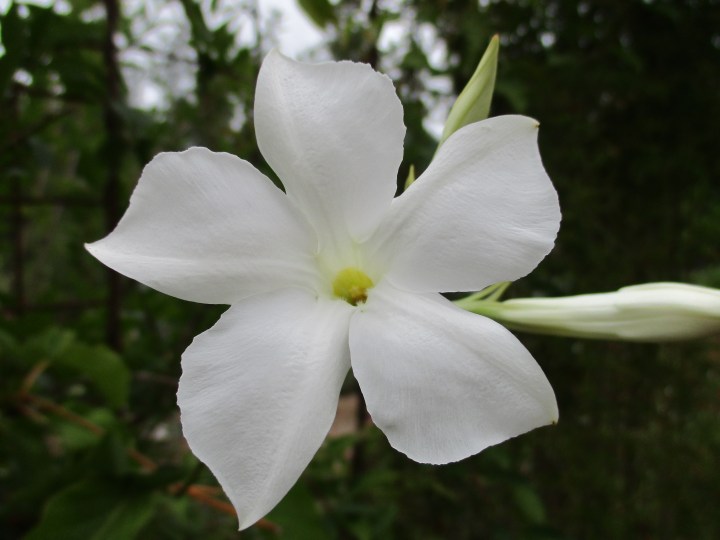
70621Pink, red or white are the only choices. There happens to be a darker shade of red. Yellow throats are more conspicuous in white flowers. Otherwise, there is not much variation of color amongst the various mandevillas. The flowers are very similar in both color and form to those of related oleander, but are larger. Some are as wide as three inches. Small flowers can have pointed petals.

Mandevilla vines are surprisingly vigorous and sneaky. The lower portion of a mature plant may seem to be rather tame while it extends aggressively twining vines into trees above. Vines on small trellises can get congested on top. Pruning upper growth helps to even out growth and bloom. Exposed vines are likely to get killed back by frost in winter, but should regenerate efficiently.

The evergreen foliage is quite glossy. Some varieties have interestingly rippled leaves. Partial shade is best for rich green foliar color. Full sun can scorch leaves. Dipladenias are very similar to mandevillas, but are shrubbier and more compact, with smaller flowers and leaves. They are probably a better option for large pots. Sap of both mandevillas and dipladenias is caustic and toxic.

Catalog Shopping Has Certain Limits

70621thumbThe temptation is unbearable. The catalog of Adelman Peony Gardens, either in print or at www.peonyparadise.com, shows how spectacular peony blossoms can be. There are one hundred and seventy-eight exquisite pictures of the cultivars available for mail order on online purchase. The only problem, and it is a big one, is that peonies are recommended for USDA Zones 2 through 8.

So maybe some of us in Zone 9 might conveniently neglect to read that part of the catalog. Maybe some of us believe that since peonies can not read that part of the catalog, they might not mind getting cheated out of the winter chill they need for good dormancy. Somehow, many of us are able to grow peonies where they have no business growing. Perhaps we should keep that a secret.

So many more plants are available online and by mail order than can be found in nurseries. Most of them are appropriate to local climates. Some are not. Catalogs from the best nurseries are careful to make that distinction obvious by describing what zones their plants are recommended for. That can be a lot of information for nurseries that have many different types of plants available.

Plants that have potential to transmit disease or become invasive might be banned from certain states. Nurseries can send plants to inappropriate climate zones for clients who really want them, but can not send plants to states where they are banned. Black elderberry plants can not be imported into California. Only black elderberry plants that were grown in California can be sold here.

Unfortunately, many plants are sold online without any regulation whatsoever. Anyone can sell any extra seeds, seedlings or cuttings online, whether or not they actually know what the seeds or plants are. Some plants are not really what they were described as when sold. Many others get sent to climates where they will not be happy, and might not even survive. Worst of all, there is serious potential for plants to be vectors of disease and insect pathogens, or to become invasive in formerly uninfested regions.

Horridculture – Stub

P80620.JPGHow can a professional ‘gardener’ leave such a stub on the little California black oak in Felton Covered Bridge Park. It is not as if it is high in the canopy of a large tree, and out of reach to an arborist. This one is right at eye level, exactly where someone getting out of a car parked in the adjacent parking space would run into it. The entire tree needs some major corrective pruning, which would include the removal of significant limbs and portions of the canopy, but that is only because of years of neglect, and is another story. Right now, we are focusing on the eye-level stub.

It is not easy to see in these pictures because the lower branches are so congested. The stub extends from the lower left to the upper right in the first picture. It is right in the center of the second picture, protruding upward and to the left of the trunk, and then kinking back to the right. The last picture shows how easy it would be to reach from the ground. This particular tree is located right across from the Memorial Tree. https://tonytomeo.wordpress.com/2018/04/15/memorial-tree-update-to-the-updated-update-etc-the-sequel-to-all-those-other-sequels/

We are always taught to not leave stubs. They interfere with compartmentalization of the pruning wound, or in this case, grow back into a disfigured wad of useless growth that will just need to be removed later. This poor tree already has plenty structural problems. Even if it were not unhealthy for the tree, it is just plain unsightly. Seriously, this looks ridiculous.

‘Gardeners’ do it all the time, as if they all take the same class on ‘how to leave stubs’. What was the advantage to cutting the limb right there instead of two feet closer to the trunk to eliminate the entire stub?P80620+P80620++

Oregano

80627It is considered to be an Italian herb, but since it was popularized in America in the late 1940s, oregano, Origanum vulgare, has become more popular in Italian-American cuisine than it is in Italy. It is now the traditional ‘pizza herb’ for American style pizza. Oregano happens to be one of the few herbs that is preferred dried rather than fresh. Only foliage is used, either before or after bloom.

Prior to bloom, foliage is low to the ground, on wiry stems. Blooming stems stand vertically as tall as two feet, with more foliage and tiny purplish flowers that are not very flashy. The flavor of the foliage on the upright blooming stems is distinct from that of the prostrate vegetative stems. The opposite leaves are only about an inch long, or slightly longer. Flavor can be variable with weather.

Flavor is also variable by cultivar. Some are spicier than most. Some are more bitter. Some cultivars were marketed to be more visually appealing in the garden than flavorful in the kitchen. ‘Nana’ is a dwarf. ‘Aureum’ is variegated with yellow. The famously flavored ‘Greek Kaliteri’ has compact growth, with atypically thick and slightly fuzzy leaves that are dark on top and purplish underneath.

Herbs For Kitchen And Garden

80627thumbHerbs might be in our garden right now, whether we are aware of it or not. Trailing rosemary happens to be a popular and practical groundcover, and some varieties grow as low shrubbery. A few varieties of thyme also work as ground cover for small areas, or between stones. Various lavenders are popular low mounding shrubbery. Quite a few common landscape plants are also herbal.

It is important to be aware though, that some varieties of herbal plants are better for landscape applications, and others are better for herbal applications. All cultivars of rosemary can be used for culinary applications, but some happen to be grown specifically for that purpose because of superior flavor. Cultivars with the best flavor may not be as useful for groundcover or as low shrubbery.

The same goes for the lavenders. French lavender may be the best for culinary applications, but the various Spanish and English lavenders might be better options for landscape applications, cut flowers or for their aroma. California bay that grows wild as a big tree is actually a completely different genus than the shrubbier culinary Grecian bay, and can ruin a recipe if used as a substitute.

As if that were not complicated enough, once the preferred herbal plants are identified, it is important to know how to use them. Chive, cilantro, parsley, mint and most others are usually preferred fresh. Lavender and bay leaf are more often used dried. Rosemary, oregano and sage can be used fresh or dried, depending on the desired flavor. Almost any herb can be dried for convenience.

Drying herbs is convenient for those that are only available within certain seasons, even if they can be used fresh while in season too. For example, chamomile is not a foliar herb like most, but is unbloomed floral buds that must be harvested at a very specific time. They should be plump, but not completely open. Once harvested and dried, they are useful for herbal tea throughout the year.

Herbs can be flowers, seeds, bark or any part. Most are foliage of the family Lamiaceae.

Gemini

P80617Astrology is an interesting concept. It is amazing how accurate the various zodiacs are. In fact, they are so accurate, that all twelve of the zodiacs can apply to just about anyone, regardless of their respective birthday.

For example, Gemini people are gentle, affectionate, curious and adaptable. Well, who isn’t? If I told you that these traits applied to Leo, Aquarius or Sagittarius, would you believe me? The weaknesses of Gemini are nervousness, inconsistency and indecisiveness. We all of us experience these weaknesses at one time or another. Gemini people like music, books, magazines and strolling about town. What about Aries, Capricorn and Taurus? Don’t they? Are Gemini people unique in their dislike for loneliness, confinement or repetition? Probably not.

June 20 will be the end of Gemini. It will then be time for Cancer, with its set of distinctive traits, strengths and weaknesses.

Gardening according to astrology might seem to be just as ‘accurate’, but there is a bit more science to justify it. Back before calenders were commonly in use, the seasons were identified by the weather. Since weather changes like . . . well, like the weather, astrology provided another level of accuracy based on the time of year rather than on variable weather. For years when warm weather lingered into autumn, astrology dictated when cool season vegetables needed to be planted, even if the weather suggested that it was too early. Astrology was also used to forecast the last frost date, even while winter was still cold. It might have taken decades to compile enough data for the system to work, but it really was, and continues to be effective. After all, the calendars that we use now are based on the position of the Earth within the Solar System, or in other words, astrology.

Gemini

P80617Astrology is an interesting concept. It is amazing how accurate the various zodiacs are. In fact, they are so accurate, that all twelve of the zodiacs can apply to just about anyone, regardless of their respective birthday.

For example, Gemini people are gentle, affectionate, curious and adaptable. Well, who isn’t? If I told you that these traits applied to Leo, Aquarius or Sagittarius, would you believe me? The weaknesses of Gemini are nervousness, inconsistency and indecisiveness. We all of us experience these weaknesses at one time or another. Gemini people like music, books, magazines and strolling about town. What about Aries, Capricorn and Taurus? Don’t they? Are Gemini people unique in their dislike for loneliness, confinement or repetition? Probably not.

June 20 will be the end of Gemini. It will then be time for Cancer, with its set of distinctive traits, strengths and weaknesses.

Gardening according to astrology might seem to be just as ‘accurate’, but there is a bit more science to justify it. Back before calenders were commonly in use, the seasons were identified by the weather. Since weather changes like . . . well, like the weather, astrology provided another level of accuracy based on the time of year rather than on variable weather. For years when warm weather lingered into autumn, astrology dictated when cool season vegetables needed to be planted, even if the weather suggested that it was too early. Astrology was also used to forecast the last frost date, even while winter was still cold. It might have taken decades to compile enough data for the system to work, but it really was, and continues to be effective. After all, the calendars that we use now are based on the position of the Earth within the Solar System, or in other words, astrology.

The Good Weed

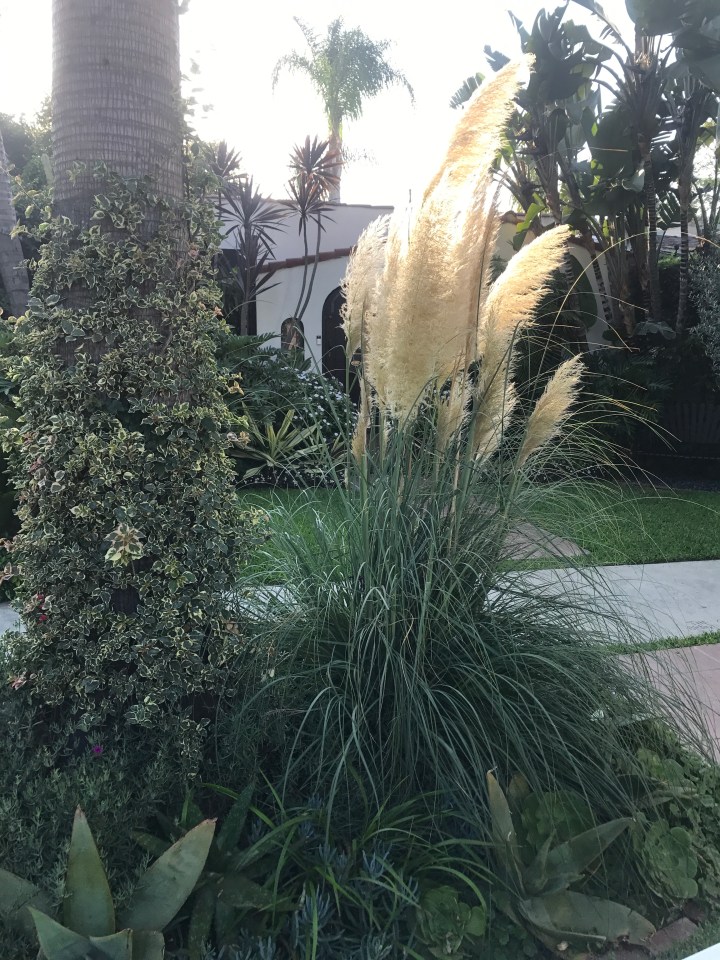
P80616KOnce in a while, a stray seed of a plant that would normally be considered to be an invasive exotic species happens to grow in a spot where it happens to fit. Those of us who regularly pull up unwanted feral seedlings, are typically skeptical. We probably pull up many such seedlings merely because we do not trust them, or because we do not want them broadcasting their seeds elsewhere in the neighborhood. In our region, Acacia dealbata, blue gum eucalyptus, black locust, pampas grass, broom, poke berry and Himalayan blackberry get no consideration; and their seedlings should be removed as promptly as they are discovered. English ivy does not get much more consideration, but every once in a while, it happens to wander into a situation where it is allowed to stay.

Catalpa is one that we are not quite sure about. It is an exotic species that happens to disperse unwanted seed at times, but is not invasive enough to warrant prompt removal of all seedlings. Many seedlings appeared in the area several years ago, and most were removed because of where they were. However, if any other seedlings have appeared since then, they have been discreet enough to remain unnoticed. It was as if there was a very specific mating season. Catalpa had not been invasive prior to that, and has not been invasive since.

Two of the feral catalpa seedlings appeared on the edge of the parking lot at the Felton Presbyterian Church. One became disfigured and distressed, and finally died before being removed. The other just happened to be in the middle of a parkstrip, and in a location where a good sized shade tree had room to grow. Because no one could find a good reason for removal, it stayed. After only a few years, it is now a good sized and very well structured shade tree that blooms nicely this time of year. It may not last long, since catalpas are short lived, but for now, it is a nice component to the landscape. This weed gets a happy ending.