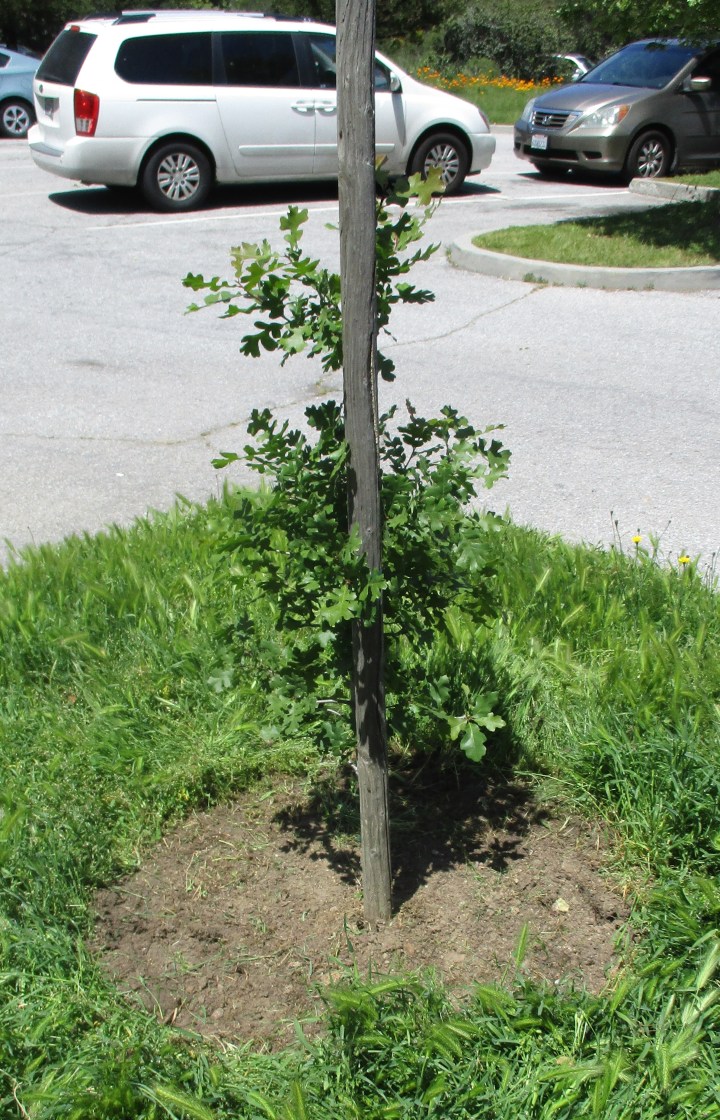
 When I started writing this blog eight months ago, I reserved the right to occasionally write about topics that were irrelevant to horticulture and gardening. I designated the category of ‘elaborations’ for posts that were not from my weekly gardening column; but so far, I have tried to post articles within this category that were at least remotely relevant to horticulture, even if only to discuss a single tree, or merely a single ginkgo leaf that somehow appeared in Felton Covered Bridge Park.
Today is May 2. My post for today is only relevant to horticulture in that it explains the importance of the ‘Memorial Tree’ in Felton Covered Bridge Park.
Steven Michael Ralls passed away a year ago, on May 2, 2017
Jeffrey Dale Scofield passed away two years prior to that, on May 2, 2015
They were two of my most intimate friends. I wrote both obituaries. The obituaries are posted below, and are irrelevant to horticulture.
The small valley oak ‘Memorial Tree’ that was planted in Felton Covered Bridge Park was originally designated as the ‘Scofield Tree’. However, a few more prominent friends of our Community passed away afterward; and the Park could not accommodate more memorial trees. Finally, when we could not find an appropriate situation for a memorial tree for Steven, the ‘Scofield Tree’ was designated simply as the ‘Memorial Tree’. These are a few brief articles about it.
https://tonytomeo.wordpress.com/2017/10/06/small-tree-in-a-big-park/
https://tonytomeo.wordpress.com/2017/12/24/scofield-tree-update/
https://tonytomeo.wordpress.com/2018/03/31/scofield-tree-update-spring-2018/
https://tonytomeo.wordpress.com/2018/04/15/memorial-tree-update-to-the-updated-update-etc-the-sequel-to-all-those-other-sequels/
These are two articles about some of our adventures with Steven, and a third about the ginkgo leaf that appeared in Felton Covered Bridge Park on Steven’s birthday last December 13:
https://tonytomeo.wordpress.com/2017/11/19/oklahoma/
https://tonytomeo.wordpress.com/2017/12/13/birthday/
https://tonytomeo.wordpress.com/2018/01/21/okie-mowers/

Jeffrey Dale Scofield of Felton passed away peacefully from complications associated with cancer on May 2, 2015, in Santa Cruz, only a short distance from where he was born on June 9, 1959. Except for when he traveled for work in other regions, he lived his entire life in the San Lorenzo Valley.
After harvesting timber earlier in his career, Jeffrey Scofield became well known professionally for setting “miles of tiles” and stone. More recently, he harvested firewood. He was a champion of both baseball and arm wrestling.
Mr. Scofield is survived by his sister Valerie of Las Vegas, nephew Rodney of Bethel Island, niece Christa, nephew Charles of Reno, and many lifelong friends of the San Lorenzo Valley. Ashes will be scattered privately.
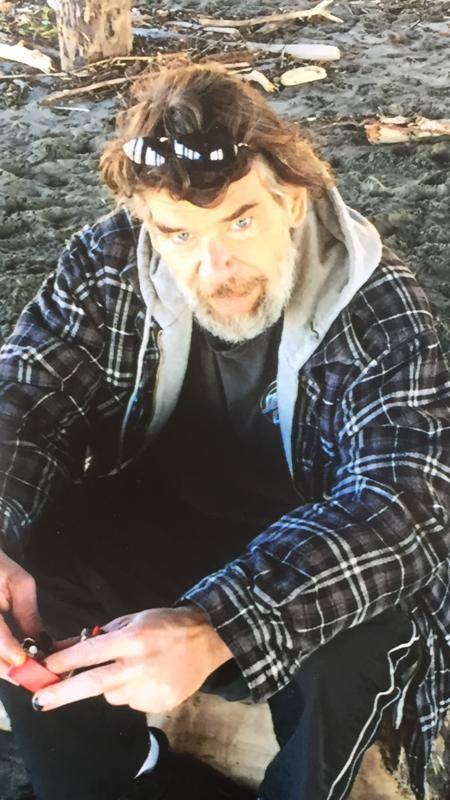 Steven Michael Ralls of Felton succumbed to complications associated with a variety of chronic medical conditions, and passed away in Aptos on May 2, 2017, at the age of 46. Steven was born on December 13, 1970 in Fort Leonard Wood, Missouri, and then spent most of his childhood in Norman, Oklahoma. He came with his family to Berkeley, California in 1987, and then lived in Hayward, before settling in Felton in 1999. His recent relocation to Aptos was considered to be only temporary, as he would have preferred to return home to Felton.
Prior to the onset of debilitating medical conditions, Steven had a distinguished career in specialized woodworking and finish carpentry. His work can be found in some of the more luxuriously outfitted homes and offices of the San Francisco and Monterey Bay Areas. Steven was also remarkably proficient with the restoration of old homes, cabinetry and furniture.
Later in life, Steven devoted more attention to art, particularly drawing and guitar music. His talent with the guitar was exceeded only by his exquisite voice that accompanied it.
Steven Ralls is survived by his son Michael Forrest Ralls of Oakland, California, wife Gayle Schermerhorn of Murphys, California, brother Jonathan Ralls of Hayward, California, sister Tammy Roberts of Wichita, Kansas, sister Brandi Ralls Sullivan of Lakewood, Washington, brother Brent Patty of Saginaw, Texas, mother Virginia Bates of Newalla, Oklahoma, father Michael Ralls of Olathe, Kansas, and many old friends of the San Lorenzo Valley.
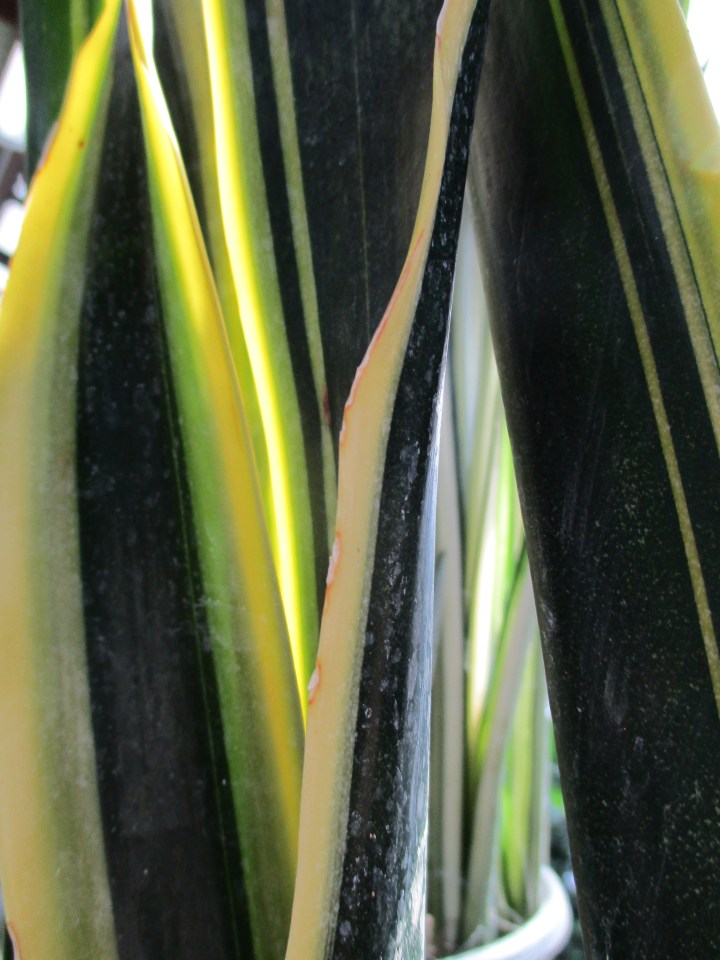 It is not science fiction. It involves neither ninjas nor turtles. Cultivars really are mutant plants that can only be propagated by cloning. The word ‘cultivar’ is a portmanteau (two words combined into a single word) of ‘cultivated’ and ‘variety’. Unlike other varieties of plants that can be perpetuated by seed, cultivars must be cultivated by unnatural techniques to maintain their genetic distinction.
 There really is a bearded iris that happens to be named ‘San Francisco’. It is related to ‘Los Angeles’, but not ‘San Jose’. (I really want to find a copy of ‘San Jose’ for my own garden!) Both ‘San Francisco’ and ‘Los Angeles’ are white with a slight blue highlight, and an even slighter reddish edge that is easy to miss. I can not remember which one of the two is whiter than the other, but the whiter one may lack the reddish edge altogether.




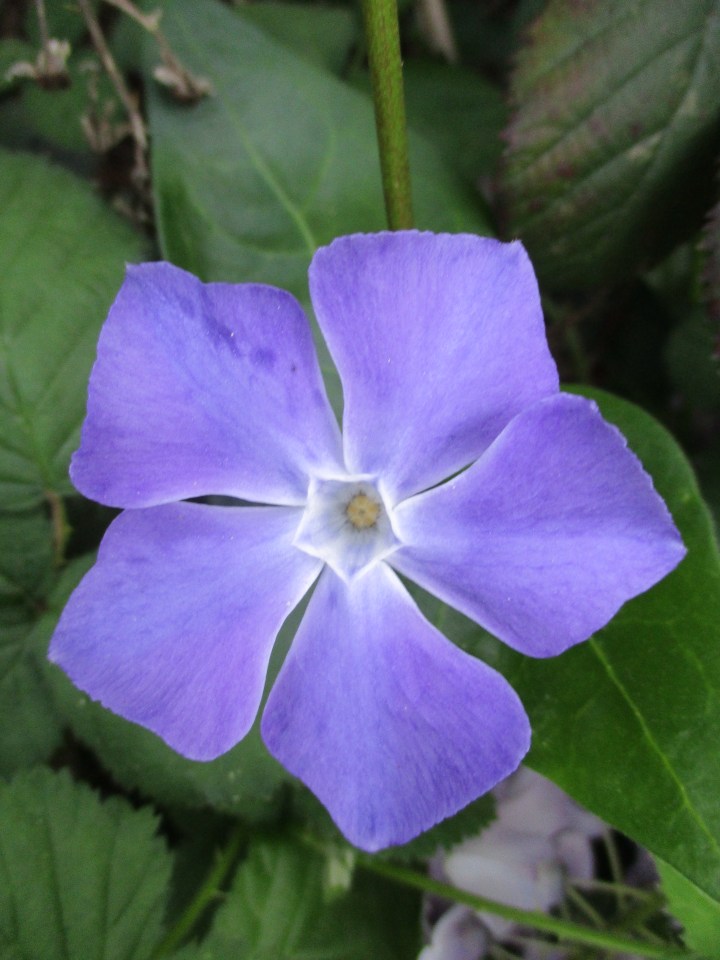 Like so many of the easiest to grow plants, periwinkle, Vinca major, is too easy to grow. It has become an invasive exotic (nonnative) weed in many moist riparian environments. It can get rather weedy in home gardens as well. This can be an advantage if it happens to fill in for bald spots in areas of other ground cover. It is a disadvantage if it overwhelms or competes with other plants.
 Lawns composed of turf grasses are the most functional, but also the most demanding forms of groundcover. That is old news. There are so many other less demanding low growing plants that that can cover the ground in areas that are not used like lawns are. Sometimes they work nicely just to control weeds. Sometimes they help to control erosion on otherwise unlandscaped hillsides.
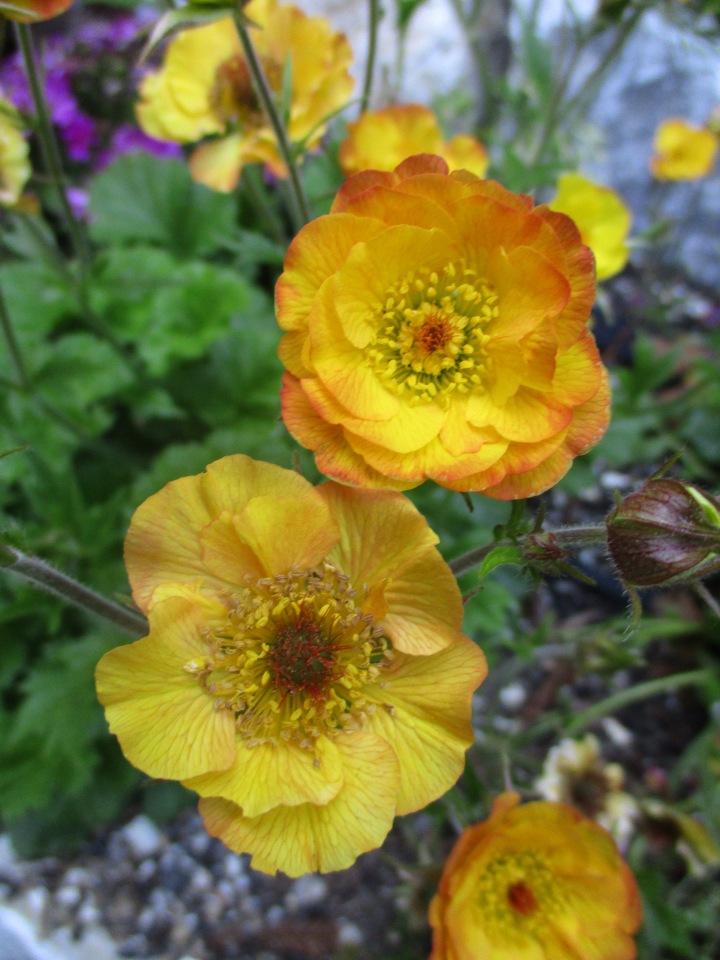 Wow, this is quite old school. Is it making a comeback? That would be nice. Avens, which is also known as Chilean avens, Geum quellyon, is an old fashioned perennial relative of the strawberry. Instead of producing fruit, it provides handsome yellow, red or coppery orange flowers that look something like small single, semi-double or double anemones, but can bloom through most of May.
 Who do they think they are?! This ain’t ‘Caddy Shack’! They have such attitude! Gophers move into our gardens and lawns, take what they want, and build their messy volcanoes of loose soil. They do not care how much work we put into our gardens, or how much we spend on nice plants, or how much we crave our first zucchini of the year. They are safe in their subterranean tunnels.
 Redwood Glen was the ‘camp’ that we all went to in the sixth grade. It was probably our equivalent of what is now known as ‘nature camp’. For most of us, our experience at Redwood Glen was the longest time we had ever been away from our homes and families. We arrived on Monday morning, and returned home on Friday afternoon. It was something that we looked forward to with great anticipation for the few years prior.

