Brachyscome

70125Most of the brachyscome found in nurseries nowadays are the annual Brachyscome iberidifolia. Perennial species are rare. The name is still often spelled as ‘brachycome’, without the ‘s’, as it had been spelled for decades. Although it is a warm season annual, brachyscome is also popular now because it can bloom better through the locally mild winters than the warmth of mid summer.

The blue, lavender, pink, yellow or pale white flowers are like tiny aster flowers. The finely textured foliage forms soft mounds about a foot deep, or mixes nicely with sturdier plants. Brachyscome might work better as a component to urns of mixed annuals rather than as a uniform bedding plant. It likes full sun exposure, but tolerates a bit of shade. Deadheading promotes continued bloom.

Rain Is Necessary But Messy

10914Water is no more scarce in California than it has been in recorded history. The problem with it is that it is a limited resource that must be shared amongst too many people. Likewise, rainstorms are no more torrential than they have ever been. Floods, erosion and wind are only more destructive now because there is so much more infrastructure that can be damaged than ever before.

Rain and wind are perfectly natural. Furthermore, it is natural for the weather to knock down limbs or entire trees. It only seems unnatural when these limbs or trees fall on houses, cars or anything else that gets in their way. Plants actually enjoy rainy weather much more than we do. Some like to be rinsed of dust and debris left from former infestations of mites, aphid, scale or sooty mold.

What plants do not like about rain is erosion. It is bad enough that so many plants in refined gardens are deprived of their own litter to insulate the surface of the soil. It is even worse if the bare soil gets eroded away from fine feeder roots at the surface of the soil. This is something that the rest of us would agree on. We do not want gullies carved into slopes, or drains clogged with mud.

Trees, shrubs and some stout perennials with aggressive roots are useful where the potential for major erosion is a concern, but might not do much for annoying surface erosion. Sprawling and spreading plants that form dense networks of low branches and surface roots are more effective. They soften the splatter of rain, slow the flow of drainage, and catch much of any dislodged silt.

Groundcover plants like ivy, gazania and iceplant are probably the best option for controlling surface erosion. Dense and low shrubbery that spreads over the ground and holds its own debris probably work just as well. These include low junipers, trailing rosemary and dwarf coyote brush. Larger shrubbery can help if it can drag its lowest limbs on the ground, and no one rakes below it.

Mulching limits erosion while new plants grow. Although new mulch needs to be added annually as old mulch decomposes, less will be necessary as plants grow and cover more area. Mulch is also effective where no plants are desired. For large areas, especially where plants are not expected to fill in, landscape cloth below ornamental bark inhibits weeds. However, coarse bark slowly shifts downhill, so replaces one kind of erosion with another, and will eventually need to be raked back uphill.

Kitty City

P80124Los Gatos is named after bobcats. More specifically, it is named after an interchange that was named after bobcats; La Rinconada De Los Gatos. There are a few theories about how and why it was named after bobcats. The most popularly accepted theory involved the remarkably violent demise of everyone involved, leaving no one to document it as accurately is it has been repeated for generations. Don’t question it if you ever hear it. It is quite entertaining. I prefer to think that we do not need an elaborate excuse for naming our town after native wildlife. The bobcats were here. People noticed them. BINGO – La Rinconada De Los Gatos.

Regardless and contrary to what my colleague Brent would tell you, ‘Los Gatos’ does not mean ‘The Ghettos’ in Spanish.

Other towns in California have horticultural names. Some are named for horticultural commodities that were grown there. Others are named for native flora. Some are named after native flora that was harvested as a horticultural commodity!

Apple Valley, Citrus Heights, Greenfield, Lemon Grove, Orange, Orange Cove, Prunedale, Rosemead, Roseville and Wheatland might have been named after what was grown there commercially, although Orange was probably a recycled name from somewhere else. Calabasas is a Spanish name for pumpkins that were grown there. Hesperia is derived from citrus.

Del Rey Oaks, Live Oak, Oakdale, Oakland, Oakley and Thousand Oaks were probably named for the native oaks that grew there naturally. Paso Robles was named El Paso De Los Robles, and Roble is the Spanish name for the valley oak. Encino is the Spanish name for coast live oak, and a few small ones are Encinitas.

La Palma, Palm Desert, Palm Springs, Palmdale and Twenty Nine Palms are obviously named for palms, both the native desert palm and exotic palms. Yucca Valley is of course named for the native specie of yucca. Cypress, Hawthorne, Palos Verdes Estates, Rancho Palos Verdes, Walnut, Walnut Creek, Willow Glen and Willows should be easy to figure out, although some are not as obvious as they would seem to be.

Redwood City was probably named for the mills that processed redwood lumber there, rather than the trees.; just like Mill Valley. Madera translates into wood; and Corte Madera is a place to cut wood. Palo Alto translates to something like ‘high stick’, but was really derived from a tired old redwood tree with a dead top. Fresno translates into ash tree.

Bell Gardens, Bellflowers, Cloverdale, Elk Grove, Ferndale, Garden Grove, Gardena, Grass Valley, Hawaiian Gardens, Laguna Woods, Lake Forest, Larkspur, Lawndale, Pacific Grove, Tulelake, Woodland, Woodlake and Woodside are open to interpretation. Then there is Weed. After all, this is California.

Kumquat

80131Tet, on February 16, will be the Vietnamese New Year’s Day for the Year of the Dog! Any year associated with the dog must be pretty excellent. Anyway, potted and fruited kumquat trees are very traditional decorations for Tet. Although less popular than orange and lemon trees, they are the most compact of the citrus trees, so are therefore the most adaptable to compact home gardens.

They grow slowly and may never reach first floor eaves. The evergreen leaves are a bit thicker, smaller and darker green than those of Mandarin orange. Stems are mostly thornless. The compact growth is quite symmetrical, so might only occasionally need to be trimmed for a stray stem here and there. Clusters of small white flowers bloom about the time the last of the fruit gets harvested.

Kumquat has the distinction of being the ‘other’ citrus. Although the genus is alternatively known as Citrus, experts know it as Fortunella. Those with round fruit are Fortunella japonica. Those with oval fruit are Fortunella marginata. The abundant fruits are not much bigger than big grapes, and are eaten whole, with the seeds spit out. The tart pulp with the sweet skin is a tangy combination.

When Life Gives You Lemons

80131thumbWhen life gives you lemons, it is likely this time of year. Although, the most popular garden varieties of lemon, like ‘Meyer’ and ‘Eureka’, continue to produce at least a few more fruits sporadically through the year. ‘Lisbon’ lemon that is still used in orchard production, and is the ancestor of the household ‘Eureka’ lemon, produces almost all of its fruit in winter, and blooms shortly afterward.

Ripe citrus in the middle of winter impresses those in climates where winter is too cold for much to happen in the garden. They could not grow a citrus tree if they wanted to. Even here, frost can damage some of the more sensitive citrus varieties, like ‘Mexican’ lime. Unlike the fruits of summer, citrus fruits ripen slowly and are not so perishable, so do not need to be harvested right away.

This means that if it is raining, cold or just to wintery to go outside, citrus fruits can be left on the tree until the weather improves. Most of us prefer to pick them in small batches anyway. Ideally, fruit should get picked as it is consumed. Lemons and limes typically get picked individually as needed, until there are so many that some need to be bagged and shared with friends and neighbors.

Mandarin oranges are the most perishable of the citrus. Because their skins are so loosely attached to the pulp, the pulp can oxidize, lose flavor and eventually get dry and pithy. Incidentally, a ‘tangerine’ is merely a Mandarin orange that was developed in North or South America. A surprisingly sour (unknown) Mandarin orange might really be a ‘Rangpur lime’, which is not a lime at all.

Unlike most fruit that continues to ripen after harvest, or pears that actually delay ripening until after harvest, citrus fruits stop developing flavor once picked. It is best to taste them for confirmation of ripe flavor prior to harvest. Some Mandarin oranges may have slightly greenish blotches on them even when completely ripe. The best ‘Valencia’ oranges can look rather yellowish. Grapefruits might mellow if left in their trees past ripeness, but can also inhibit bloom.

Okie Mowers

P80120They are excellent at weeding and vegetation management too, particularly where brambles are too thick to get through. They also convert unwanted vegetation into useful fertilizer. Goats are remarkably versatile and useful machines around the garden.

The goat in this picture is no ordinary goat. She is a pygmy fainting goat. Her kind were bred to faint when startled, in order to keep a predator occupied instead of eating other more desirable livestock in their herd. What a strange job description! When we went to Oklahoma a few years ago, we stayed on a farm with quite a herd of these small and pleasantly mannered goats.

It was winter while we were there, so there was not much to do in regard to vegetation management or gardening. There were a few blackjack oaks near the homes that I pruned up for clearance and just to neaten them up a bit. The goats came over to watch what I was doing, and seemed to know to stay back when branches fell. Nonetheless, the commotion of some of the larger branches falling was enough to cause some of the closer goats to faint and fall to the ground. They would get back up within a few seconds and proceed to eat the twigs from the branches. By the time I was finished pruning, only the larger stems remained to be dragged off and staged next to a burn pile of other debris that had accumulated earlier in the year.

Late one evening, my friend Steven decided to burn the burn pile. ( https://tonytomeo.wordpress.com/2017/11/19/oklahoma/ and https://tonytomeo.wordpress.com/2017/12/13/birthday/ ) I do not know why Steven thought that it would be a good idea to burn it in the dark. The neighbors off in the distance were probably wondering the same thing. Once it was started, there was no point in extinguishing it for a more convenient time. I went out to help him finish the job.

The initial pile flared up pretty well, and then took some time to die down. All the goats who happened to be in the main pasture at the time came over and gathered around to watch. They all seemed to be so interested, and formed a very neat and uniform circle around the fire. Their happy faces glowed like those of a really big troop of Boy Scouts.

It took a while, but the fire eventually died down enough to start throwing on the staged limbs of the blackjack oaks. The goats did not seem to mind as Steven shooed a few of them aside to get a nice hefty limb. From a few feet back, Steven innocently dropped the limb onto the fire.

The limb went down.

The flurry of sparks went up.

The entire herd of goats went down.

Neither Steven nor I saw much of what happened after that. As fast as the goats got back up, we both went down, laughing too hard to stand. The neighbors must have thought we were crazy. The goats were more certain of it. By the time we recovered and got back up, all the goats were gone . . . off into the distance and the darkness of that cool winter night in Oklahoma.

Litter Box

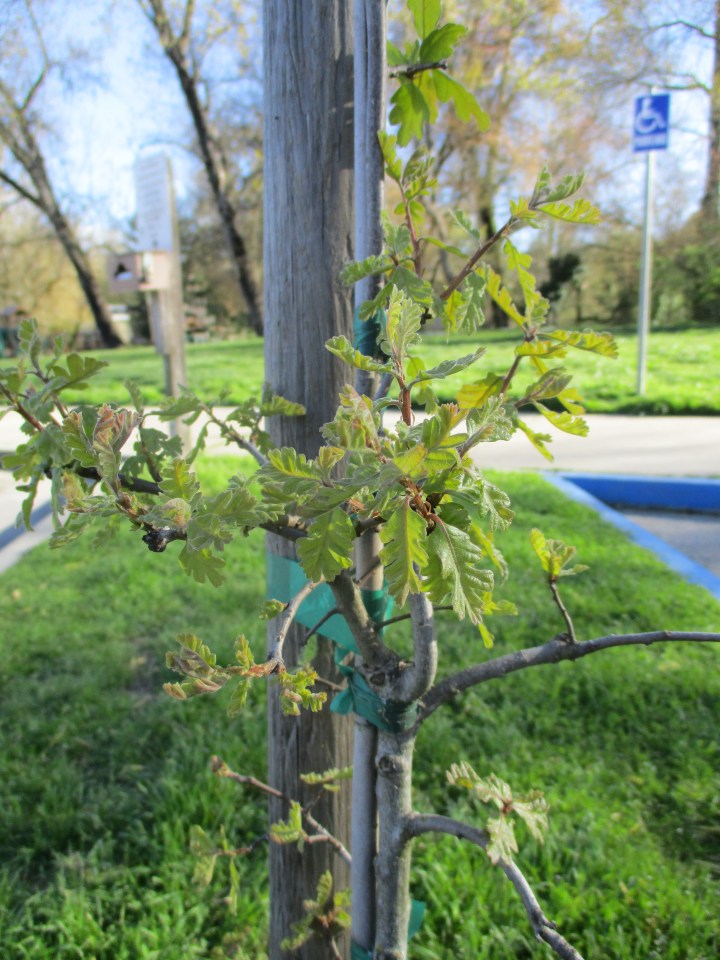
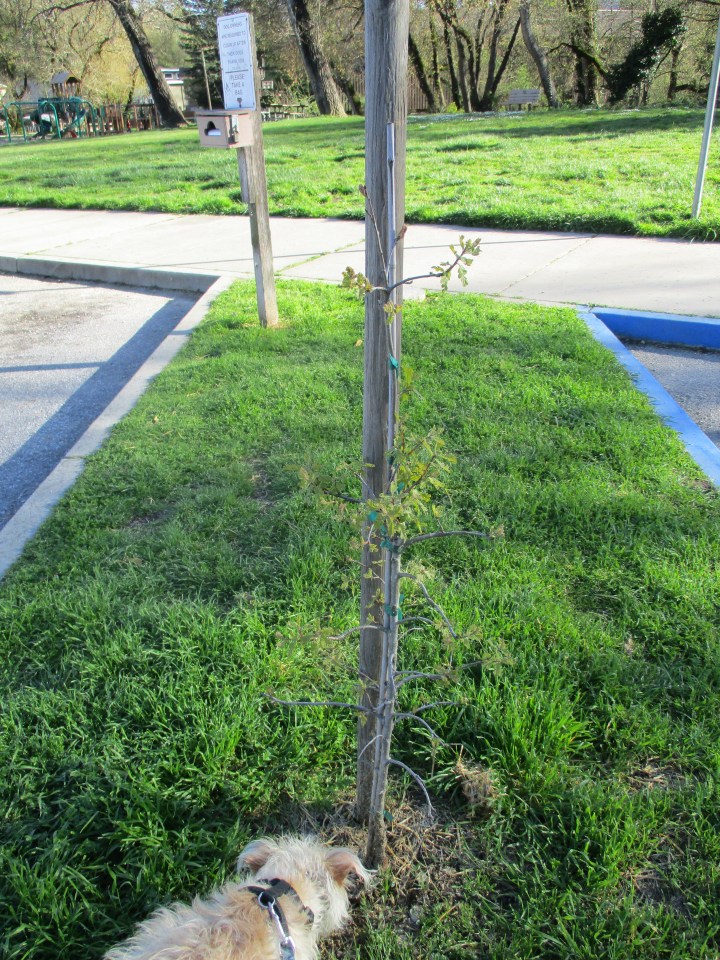
P80120+++++Perhaps I should elaborate on the ‘litter boxes’ in the ‘Six on Saturday’ post earlier this morning. As I already mentioned, they are in the same parking lot as the Leo and Leona sculptures. They were formerly inhabited by Italian cypress trees that would now be like those nearby if they had survived.

This is no joke. Someone really selected the tree that provides the least shade for hot pavement, and attracts the most birds to do what birds do on parked cars.

Because they were installed as large boxed specimens, and were watered generously enough to maintain swampy conditions in the surrounding soil, most of the cypresses could not disperse their roots fast enough, and consequently got blown over onto parked cars in their first or second winter. The survivors took many years to get established, and were bound to big and unsightly lodgepole stakes for years.

Rather than getting outfitted with ‘shade’ trees or perennials, . . . or anything, these litter box planters remain as blank and uselessly small rectangular lawns, requiring regular mowing, edging and lots of watering. Incidentally, many of us around town let our lawns die to conserve water. Brown is the new green.

Because they are in such a high traffic area, and sometimes get run over by cars, the sprinkler heads are always in need of adjustment. They are quite generous with sharing their water with the surrounding pavement and any cars that might be parked there early in the morning, which makes the waste of water more blatant. The curbs are tripping hazards.

So, what are these litter boxes good for? Are they reserved for grave sites? ‘Very’ miniature golf perhaps? No one knows. This is not exactly a nice spot for a picnic or a game of volleyball.P80120k

Six on Saturday: Cat Walk in the Kitty City

P801201. What have we here?

P80120+
2. Oh, directions.

P80120++
3. Oh my! What is THAT!

P80120+++
4. Another one!

P80120++++
5. Meet the parents.

P80120+++++
6. These must be their litter boxes.

The Cat Walk is a rather ingenious exhibit of several concrete cat sculptures displayed in various street trees on the two main streets of downtown. The locations of these sculptures are cited on a map available to anyone who wants one. Most of us prefer a light duty challenge of trying to find all of the sculptures without the map. Some are hidden better than others, but all are easily visible from the sidewalk. What a fun way to utilize our otherwise unremarkable downtown street trees! Unfortunately, some of the sculptures have been dislodged from their original positions, which is why the two pictured here in opposite sides of the same holly oak seem to be be out of sorts. I am sorry for the bad quality of the pictures, especially #4.

The parents are not sculptures of the Cat Walk, but are modern reproductions of the famous and historical ‘Cats’ flanking the driveway of the old Wood Residence. No one knows which one is Leo and which one is Leona. The only difference between the two is that one has his or her eyes closed, and the other has his or her eyes open. They flank the driveway of a shopping center just north of Highway 9 on North Santa Cruz Avenue.

The sixth picture of the grassy ‘litter boxes’ is included as an almost funny example of really bad landscaping. They are in the same parking lot as the Leo and Leona sculptures, and formerly contained Italian cypress trees like the the one in the foreground and the two in the distance.

This is the link for Six on Saturday, for anyone else who would like to participate:

https://thepropagatorblog.wordpress.com/2017/09/18/six-on-saturday-a-participant-guide/

Blue Hibiscus

70118Like euryops daisy, sweet pea shrub and New Zealand tea tree, the blue hibiscus, Alyogyne huegelii, blooms whenever it wants to, even if it wants to bloom sporadically through winter. It should bloom more abundantly in phases though spring and summer, but even that is difficult to predict. The three inch wide flowers are lavender blue, but can be rich purple or white. Pink is very rare.

Young plants can grow quickly but sparsely. Lanky stems can be tip pruned after a spring bloom phase to promote branching and improve density. Growth slows with maturity. Plants can get five feet high and wide in their second year, but might never reach the eaves. They like full sun and shelter from wind, but should not mind a bit of shade. Established plants do not need much water.

Berries Are For The Birds

51125It is probably no coincidence that certain berries and small fruits are so colorful through winter while colorful flowers are relatively scarce. Like flowers, they want to get others to do something for them. Flowers use color, aroma, flavor and sometimes even texture to attract and reward pollinators. Colorful berries and fruits do the same to attract birds and animals who disperse their seeds.

There are not many colorful flowers blooming in winter to distract anyone from colorful berries and fruit. Those who want them are pretty intent on finding them anyway. There is not much else for overwintering birds to eat. Squirrels probably have plenty of acorns and nuts stored, but might enjoy a few berries too. No matter how abundant they are, there is serious competition for berries.

Most types of berries and small fruits that are so colorful through winter contain tiny seeds that get eaten along with the fruit. In this manner, the seeds get taken away from their origin as easily as birds fly away. They then get dispersed as birds do what birds do (that can be so annoying on a freshly washed car). Digestion only scarifies these seeds, which might not germinate otherwise.

This all might be much more information than necessary for home gardening. All we really need to know is that there are several plants that can produce colorful berries through winter while other color is limited. Although, it might be useful to be aware that these colorful berries are likely to eventually be depleted by the birds and any other wildlife that they are intended to be appealing to.

Then again, winter berries are popularly grown specifically to attract birds and wildlife to the garden. Either way, if berries are grown for their color or to attract birds, they have the potential to be messy. Those that do not get eaten eventually fall onto whatever is below them. Those that do get eaten fall (in ‘another form’) all over the neighborhood, and of course, onto freshly washed cars.

Coincidentally, most plants that produce colorful winter berries are related. They are of the ‘rose’ family, ‘Rosaceae’, and produce similar ‘pomme’ fruits that look like minute apples. Firethorn (pyracantha) is the most colorful and prolific. The various cotoneasters, including some low growing ground-covers, are similar, but not so prolific. Toyon is a colorful native that works nicely in unrefined landscapes. English hawthorn is a small deciduous tree.