Late Cotoneaster

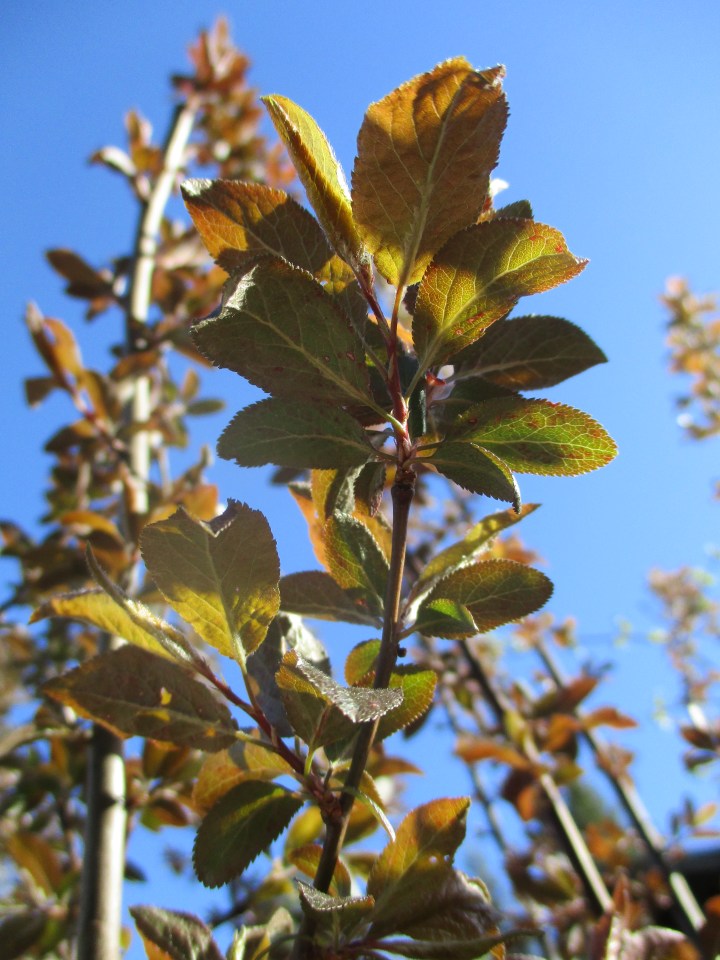
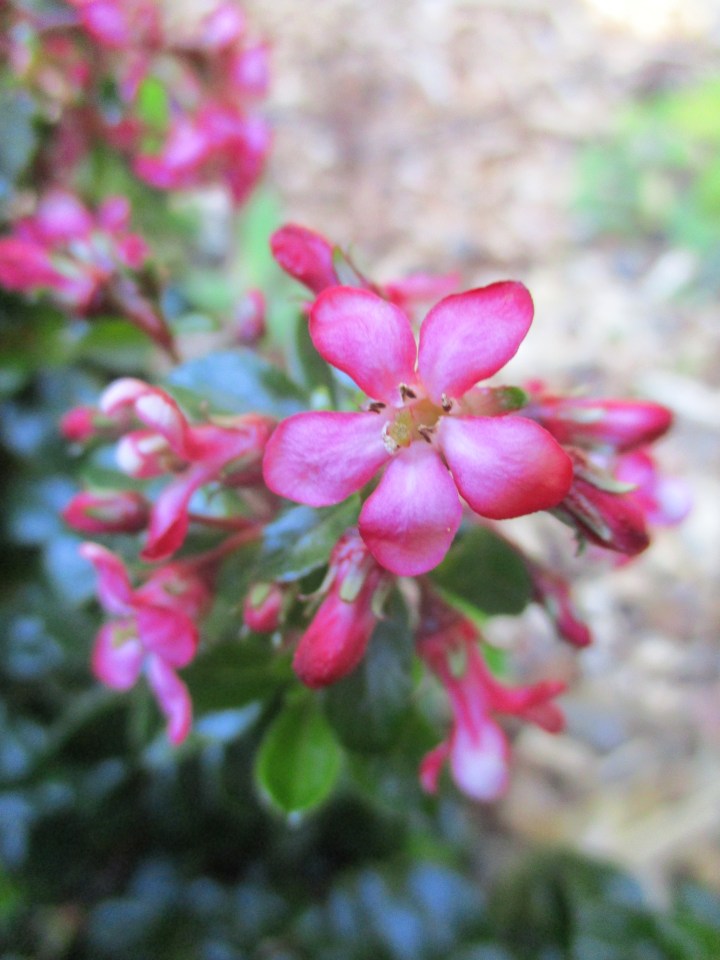
80214The bright red berries of late cotoneaster, Cotoneaster lacteus, that ripen in autumn may not be as profuse or as bright red as those of firethorn, but they last longer, and even into winter. Birds strangely seem to avoid them. Although the clustered small berries can look just like firethorn berries, they are usually less shiny, and darker red. Clusters of tiny pale white flowers bloom in spring. The small evergreen leaves have a nice glossy and veined texture on top, with hazy gray or tan tomentum (fuzz) below. The grayish brown bark of old stems resembles that of apple or pear trees.

Tall arching stems can get just tall enough to reach first floor eaves, or taller if they happen to be shaded or leaning onto other larger shrubbery for support. In full sun, growth is more dense. Mature plants get a bit broader than tall. Unlike firethorn, late cotoneaster lacks thorns, which make it easier to work with as an espalier or informal hedge. Growth is a bit too irregular for a formal hedge.

Established plants do not need much water, and in some situations can do well without any watering. Unfortunately, late cotoneaster has naturalized as an invasive exotic weed in some regions.

Colorful Berries Feed Overwintering Birds

80214thumbPlants compensate for their immobility by procuring the services of animals and insects. They bloom with flowers that attract pollinators with colors, fragrances and flavors. Their fruits use similar techniques to attract those who consume the fruits to disperse the seeds within. It is a pretty ingenious system. The animals and insects probably think that they are taking advantage of the plants.

Firethorn, toyon, cotoneaster, English hawthorn and the hollies all produce profusions of small bright red berries that are designed literally for the birds. They are just the right size for birds to eat them whole. If they were smaller, birds might prefer other fruits. If they were any bigger, birds might eat them in pieces, and drop the seeds. The bright red color is a blatant advertisement to birds.

Firethorn is probably the most prolific with its berries. It might also be the most popular with the birds. If the colorful berries are not gone yet, they will be soon. Toyon berries seem to last longer, perhaps because they do not all ripen at the same rate. Because it gets big and takes some work to contain. toyon is more common in unrefined landscapes and in the wild than home gardens.

English hawthorn and cotoneaster are variable. Some varieties are more productive with berries than other are. Some types of English hawthorn are grown more for their bloom or foliar color in autumn. They are deciduous, so their berries hangs on bare stems. Late cotoneaster produces more berries than other cotoneasters, and somehow manages to keep its berries late into winter.

Holly is not related to firethorn, toyon, cotoneaster or English hawthorn, which are all in the Rosaceae family, although the bright red berries suggest that it should be. Because most holly plants are females that lack a nearby male pollinator, berries can be scarce. Some plants in nurseries are actually two plants together in the same pot, one male and one female, to ensure adequate pollination and berry production. Deciduous hollies are unfortunately rare.

If you want your garden to grow, you have to talk to it.

P80131So the spelling is a bit . . . off. Ignore the ‘E’ before ‘If’ and the ‘n’ after ‘grow’. They are crossed out . . . sort of. ‘wont’ means ‘want’. ‘haf’ means ‘have’, as in ‘have to’ or ‘need to’. It made sense at the time, more than four decades ago. Perhaps I should rephrase it.

If you want your garden to grow, you must talk to it.

You must talk to your garden in order for it to grow.

Your garden requires regular discourse for healthy growth.

This concept dates from a time of big Boston ferns and spider plants suspended by coarse macrame with big wooden beads. Coleus and rubber tree were popular house plants too. Remember terrariums? There were big flowered daisies, tam junipers and big petunias in the yard. A group of three European white birches was cool, as if it was somehow unique . . . even though everyone else was doing it too.

Some people believed that gardens and houseplants were healthier if they were regularly engaged in conversation. Some of us would say that this is true only because those who talk to their gardens and houseplants are more involved with them, and are therefore more attentive to their needs. That makes sense. Otherwise, the theory has been neither confirmed or disproved by any reliably documented data.

I do not need data. My gardens did quite well with this technique. So did many of the annuals, perennials and trees I got to plant back then. The little disfigured Monterey pine that I met on my way to school ( https://tonytomeo.wordpress.com/2018/01/01/new-year-old-school/ ) is still doing well, long after all the others that I did not converse with are gone.

Makrut Lime

80207Of all the weird citruses available, this is one of the strangest. Makrut lime, Citrus hystrix, is not grown for its ugly wrinkled fruit. The rind and the juice are only rarely used for culinary or medicinal purposes. The important part of makrut lime is the aromatic foliage, particularly the modified petiole ‘wings’ that look like leaves. Fresh or dried, they are popular in the cuisine of Southeast Asia.

Mature trees can eventually reach second story eaves, but are usually kept significantly lower. They are so shrubby that even large trees should have plenty of foliage within easy reach from the ground. Once a tree gets overgrown, it is not as easily pruned lower as some other citrus trees are. Pruning stimulates vigorously long and arching stems, rather than more desirable fluffy growth.

The winged petioles are almost as long and wide as the actual leaves are. In fact, they look just like the leaves, making them look like ‘double leaves’. Although the petiole wings separated from the petiole are supposedly the most aromatic parts, leaves are useful too. The hard fruits are about as big as golf balls, and are the same rich green as the foliage, until they ripen to a light yellow.

Herbs Add Spice To Life

80207thumbOut in deserts, where vegetation can be a scarce commodity, cacti, agaves and yuccas protect themselves from grazing animals with thorns, spines, caustic sap and distastefully textured foliage. None of these defense mechanisms is perfect. They only need to be better than what the competing specie are using. Many plants find that objectionable flavor and aroma work just fine for them.

The funny thing about the objectionable flavors and aromas that some plants use to discourage grazing animals from eating them, is that these same flavors and aromas are what make so many of them appealing to people. It is ironic that what was supposed to make them distasteful to some is what makes them tasty to others. Yet, it also gets us to perpetuate them in our home gardens.

Mint, thyme, lavender, rosemary and sage, which all happen to be in the same family, are culinary herbs that also work well in the landscape. The mints need the most watering, and containment if their innate invasiveness is a concern. Thymes need less water, and some are nicely aromatic ground cover for small areas. Lavenders and rosemaries can survive with minimal watering here.

Both rosemary and sage are popular for landscaping anyway. Rosemary is most commonly grown as a ground cover that cascades nicely over low retaining walls, but some cultivars are shrubby. Sages are extremely variable. Some are showier than they are useful in the kitchen, with elegant and colorful flower spikes. Others are too strongly aromatic to cook with, but are used as incense.

Fennel and chamomile are often grown in vegetable gardens rather than out in the more refined parts of the landscape because they can get somewhat awkward. Fennel has such nice feathery foliage at first, but if not harvested, it gets tall, and then yellows after bloom. Chamomile gets tall and open in bloom, and then no one wants to ruin it by harvesting all the flowers if it looks too good. Chives are easier to work with. They have so many leaves that no one misses a few taken for the kitchen.

Brent is still an Idiot!


That is irrelevant here though. These are pictures of one of my ‘gardens’ in Brookdale, for comparison to pictures from the Jungalow. The pictures are no better than those of the Jungalow. ( https://tonytomeo.wordpress.com/2018/01/28/brent-is-an-idiot/ ) There is nothing to show anyway. It is just a forested vacant lot on Melwin Avenue. I have no pictures of the lower vacant lot on Logan Avenue where I grow my fig trees, berries, quince tree, rhubarb and a few other odds and ends. There is no landscape there either. It is just a vacant lot where I grow a few odd plants that I do not want to plant in riskier situations, where they might be in the way of other development or gardening. The fig trees can not produce good fruit in such cool shade, but will likely make plenty of cuttings for new trees elsewhere. Perhaps someday, I will have better pictures of a home garden, or at least pictures from the farm, rather than pictures from here or gardens of clients. What the pictures show quite well is the differences between Brent’s Jungalow and my unlandscaped ‘garden’.

IMG_20141004_153159

This is Melwin Avenue to the south and uphill. The ‘garden’ is out of view to the right.

IMG_20141004_153215

This is Melwin Avenue to the north and downhill. The ‘garden’ is out of view to the left. One of the big redwoods in the middle in the distance is on the corner of Logan Avenue, which is the corner of the other ‘garden’ The fuzzy tan person to the lower left is Bill.

IMG_20141004_153228

These tall coastal redwoods above are why the ‘garden’ is too dark to do much with.

IMG_20141004_153243

This is looking west and uphill into the ‘garden’ the circle of redwoods is bigger than it looks. Some of the larger trunks are about five feet wide. There is enough timber in them to build a house.

IMG_20141004_153304

The redwoods on the left are next door. The single redwood on the right is just inside the ‘garden’. Not much sunlight gets through.

IMG_20141004_153323

These redwoods are across the street to the east. They too are bigger than they look here.

Besides showing how different my garden is from the Jungalow, these pictures should demonstrate why I do not show pictures of my own garden. There just is not much to show. My clients’ gardens are much more interesting.

Brent is still an idiot.

Brent is an Idiot!


He might be the best landscape designer in West Hollywood, but he is an idiot nonetheless. Besides that, he takes worthless pictures. That is why I do not have any good pictures of his Mid City Los Angeles Jungalow garden to post. I will share a few of what I have, but they really do not show it off like it should be. ( https://tonytomeo.wordpress.com/2018/01/28/dreamscape-at-the-jungalow/ )

G1

Of course, the prettiest thing in the Jungalow garden is Grace, my niece. This is an old picture. She is learning to drive now! Oh my! She gets here cuteness from her mother; and she looks more like both of her grandmothers than her parents.

G4

She is adorable and knows how to use it.

30313thumb.jpg

This ‘Charles Grimaldi’ Angel’s trumpet is the same one that provided the flowers for an illustration in Sunset – Western Garden Book, although I do not remember in which year.

30320.jpg

This Bismarkia palm was supposed to be sent to my garden, but like so many plants that are to be sent to my garden, Brent killed it first. Brent is an idiot!

30327BRIAN

Brent recycled this Mexican fan palm and installed it at the curb in front of the Jungalow as a memorial tree when his brother Brian passed away a few years ago. It is quite tall now, and from the Santa Monica Freeway, it can be seen standing above the other foliage crowding the Jungalow.

30327.jpg

This is one of seven (!) queen palms at the Jungalow.

30313

This very fragrant pink jasmine climbs to the top of the hedge to the south of the Jungalow and blooms every winter. It gets cut down afterward, and starts the climb over again. Unfortunately, there is a serious problem with an objectionable aroma of a herd of feral cats next door. (That might be a topic for later.)

IMG_0211

Beanie is a good dog who deserves to live with someone who is not such an idiot. The lawn is artificial turf that was installed as a demo for clients. The strangler fig wall in the background is the old garage that was converted to Brent’s office, with the upper deck on the roof. That is where I sleep when I need to go to Southern California. Brent does not like me sleeping on the upper deck, but he is an idiot. I like it up there because the dogs are not so bothersome. The blue wall on the south side of the deck obscures the noise from the Santa Monica Freeway, as well as the view of the backyard and home next door. The foliage above the deck is the neighbor’s avocado tree that I wrote about earlier.

IMG_0242

This is a dwarf pampas grass in the parkstrip. The facade of the home is in the background.

IMG_0248

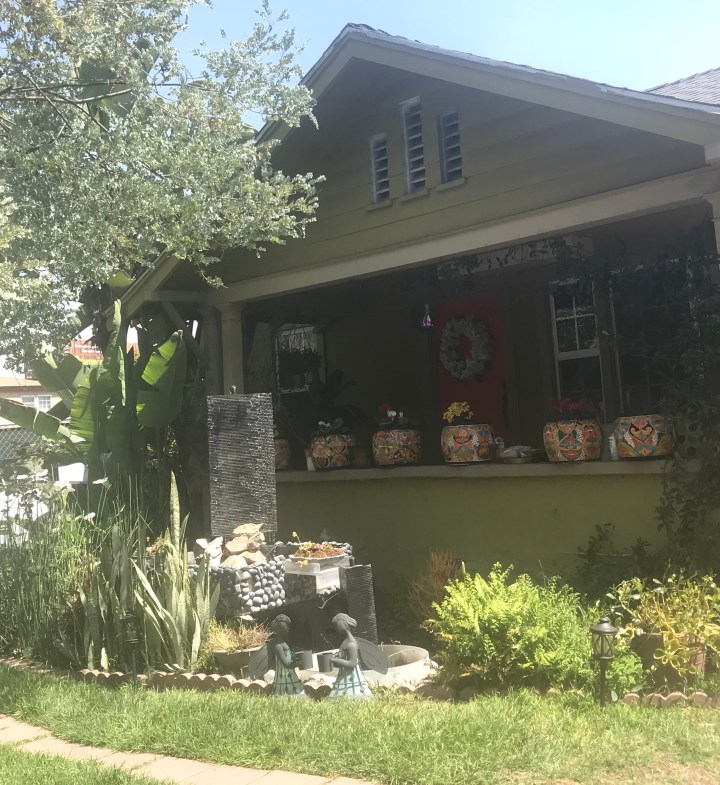
This is the facade of the home, barely visible behind all the foliage. I could never understand why Brent wants to obscure such a cute bungalow. He is an idiot. However, he is also the landscape designer. The door is actually a gate that was added to the arch over the porch. The front door is behind it. To the left, there is a small porch that is open above, with a low wall in front. Brent added some ornamental iron to enclose the space. It is quite nice how it all worked out, even though Brent is an idiot.

30731

This is the street out front, shaded by all the tipu trees that Brent planted. Brent has been planting street trees on other street in the neighborhood for twenty years. We started doing it on January 18, 1998! This is an old picture. The trees are bigger now, although some of the neighbors have cut some down. Apparently, Brent is not the only idiot.

Now, I will try to find some pictures of my garden for comparison.

Dreamscape at the Jungalow

B80128The Jungalow is my colleague Brent’s bungalow home, surrounded by a jungle of a landscape, just about a block off of the Santa Monica Freeway in Mid City Los Angles.

This picture very effectively illustrates that Brent has no business taking pictures . . . and that he should have had a V-8.

The landscape really is spectacular though. You might have seen bits and pieces of it in Sunset Magazine or other horticultural magazines. Pictures of specific flowers and plants were used to illustrate the Sunset – Western Garden Book.

Brent likes his garden to be spectacular. He uses it to trial a few plants before using them at the homes of clients, and to demonstrate how effectively his home garden functions as a lush jungle oasis in the middle of the city. The dense hedging obscures views of neighboring homes, and muffles the sound of the Santa Monica Freeway and La Brea Avenue. Fountains obscure more of whatever outside noise that happens to get through. Although the situation is completely synthetic, and includes species that were imported from all over the World, to be pruned, groomed and trained to do unnatural things, Brent likes to think that it mimics nature. The straight lines, square corners and flat surface of the compact urban lot are invisible behind curvacious borders, terraces, lush foliage and sculptural trees. There is way too much material for such a compact space. It is all so completely contrary to the big city that surrounds it.

Three hundred and fifty miles to the northwest, on acreage in the forests of the Santa Cruz Mountains above Los Gatos, my garden could not have been more opposite. Despite the abundance of more space than I could possibly use, the area used for gardening was quite confined to less than an eighth of an acre. The hilly terrain was flattened as much as possible, and surrounded with straight retaining walls and walkways. Native vegetation was removed to allow more sunlight through. There was no need for hedging because there was nothing beyond the garden to obscure the view of. There was no need for fountains to obscure outside noise because the only outside noise was that of Zayante Creek at the bottom of the garden. For efficiency, plants were installed in rows and grids, and very evenly spaced. It was completely contrary to the surrounding forest.

That is why Brent is a landscape designer and I am just a horticulturist and nurseryman. Who is right? I am.

Six on Saturday: Town Tree and Town Flower for the Kitty City

P80124I just can not resist; although I do not intend to make a habit of this.

I know I am sending this late, and that it is already Sunday east of India. It is still before noon on Saturday here. These pictures are not mine, but were used as illustrations for the selection of a town tree and a town flower for Los Gatos. There were more, but these are my six favorites; four trees and three flowers. I know that sounds like seven instead of six, but that is only because apricot can be either the town tree ‘or’ the town flower. Selection is limited to specie that are either native, or of cultural significance. The three trees besides apricot are native here, where the Santa Cruz Mountains meet the Santa Clara Valley, and the Los Gatos Creek forms a small alluvial plain. Apricot trees, which bloom with apricot ‘flowers’ were the main orchard crop here longer than anyone can remember, until only a few decades ago. Arroyo lupine is native on the alluvial plain of the Los Gatos Creek; and cat tails are native to the marsh surrounding Los Gatos Creek.

1 – California sycamorePLATANUSRACEMOSA

2 – valley oakQUERCUSLOBATA

3 – coast live oakQUERCUSAGRIFOLIA

4 – apricotPRUNUSARMENIACA

5 – arroyo lupineLUPINUSSUCCULENTUS

6 – cat tailTYPHALATIFOLIA

Cat tail would be my favorite choice for the town flower because this is the town of the Cats. Apricot would be my second favorite flower, only because cat tail is so appropriate, and also because apricot is my favorite for the town tree (and we can not have it do double duty). coast live oak is my second favorite for the town tree because it is native to both the Santa Clara Valley ‘and’ the Santa Cruz Mountains.

This is the link for Six on Saturday, for anyone else who would like to participate:

https://thepropagatorblog.wordpress.com/2017/09/18/six-on-saturday-a-participant-guide/

CAUTION!

P80127Halston was quite the rage when I was a little tyke.

I did not know exactly what that meant.

I can remember elegant ladies wearing Halston pill box hats. From the back seat of the new 1967 Chevelle, I could admire my Mother’s, while my younger brother on the other side of the car got tangled in our flower child Aunt’s abundant and long hair blowing in the wind.

Although I had never seen a Halston before, I could determine from hats made from them that they were soft, fuzzy and cylindrical. I knew that apricots, walnuts and oranges grew on trees, so I would sometimes look into unfamiliar trees, including the silk oaks next door, to see if I could see Halstons ripening in them.

My older sister eventually explained that Halston was they guy who made the hats. He was very busy. His hats were very popular. Apparently, he made the hats from coats formerly worn by small rodents known as minks. The minks were not really plumply cylindrical. In fact, they were so small that the coats of several of them were sewn together to make each hat. The thought of so many small rodents scurrying about naked until they got new coats was quite disturbing. It made me ponder the origin of the cuddly stole that Redd Foxx gave to Aunt Mary.

I certainly did not believe everything that my sister told me. Heck, she once tried to tell me that the dead bugs in Aunt Mary’s amber jewelry were trapped in tree sap millions of years ago. I know cheap Lego plastic when I see it. However, I do believe that fur obtained from animals lost popularity through the 1970s. The minks must have protested or something. My sister got a stylish coat with a furry collar made of imitation fur. Splendid; so now little kids will be cuddling naked teddy bears!

I have a better idea.

The pelts of all those nasty gophers that ruin lawns and gardens could be recycled into pill box hats . . . or maybe something more appropriate to modern fashion. Perhaps they could be sewn into reusable grocery bags. What an exquisitely stylish expression of environmental awareness that would be! Because gophers get killed when trapped, they could not protest the use of their pelts later.

Using gopher pelts in this manner would:

Protect our lawns, gardens, landscapes and green spaces from environmental annihilation

Recycle by-products of environmental protection

Provide stylish accessories that express our concern for environmental stewardship

Promote the use of materials that are completely organic, natural, non-toxic, biodegradable, sustainable and very renewable

Help save the Planet!

We only need to learn to be more efficient with trapping. What is the point of setting traps if gophers are warned to ‘KEEP AWAY’?