If you do not know what it is, ‘snow’ is like frozen rain.
If you do not know what rain is, I wrote about it earlier for those of us who are native to the drier parts of California. If you notice strange drops of water falling from the sky tonight, that would be rain. There is no need to be alarmed. It is expected to happen here tonight, and a few times for the next few days. Contrary to former experience, it is normal for this time of year.
Anyway, getting back to snow. Unlike rain, which sometimes happens here, snow does not happen here.
Well, perhaps that is not entirely true. It might have happened as recently as 11,700 years ago, as the Ice Age ended, and again in more recent history, in February of 1976, when an epically humongous snowstorm deposited as much as half an inch of snow over the Santa Clara Valley!
It is difficult to imagine such a huge volume of snow! It must have been disastrous! It would be even more disastrous now, with more than a million people just in San Jose, and many of them driving cars!
In 1976, we third graders did not consider it to be disastrous. We were not old enough to drive. We were perplexed and mystified at first, but rather quickly discovered that snow had serious potential for being fun. Our parents wadded it up into something known as ‘snowballs’ and then threw these snowballs at each other and the neighbors. Yes, I know it sounds crazy. Nonetheless, it looked like fun, so we tried it. It really was fun. We also discovered that we could just as easily throw snowballs at cars driving by, but we were instructed to not do that. We could see that the Santa Cruz Mountains were discolored by snow. They were an almost white hue of very pale blue, speckled with the more typical darker blue.
On very rare occasion, when the ‘smog’* and smoke blew away on clear and cold wintry days, we could see snow on the tops of the highest peaks of the Diablo Range east of the Santa Clara Valley, particularly on Mount Hamilton where Lick Observatory is located. We did not know what it was. Before snow happened in our own neighborhood, we wondered what discolored the peaks like that.
Now that smog rarely obscures the view of the Diablo Range, snow is visible on the group of peaks around Mount Hamilton almost annually. If it gets cold enough, a slight blush of snow might be seen on the lower East Hills in front of the Diablo Range. It is quite scary to think of how close to home snow can be. There happens to be snow up there right now!
I am sorry that I do not have a picture of the snow on Mount Hamilton. I will just recycle this picture of Bill trying to escape snow south of Oklahoma City.
* Historical notation – The East Hills and Diablo Range to the east of the Santa Clara Valley were rarely visible in the olden days because of ‘smog’. If you do not know what smog is, you are fortunate. I have not written about smog yet because it is a part of our history that we would prefer to forget. To be brief, smog was a common form of air pollution. Although there was less smog in winter, there was more smoke from ‘fireplaces’ and burning ‘orchard’ stubble. A fireplace was a primitive heating device that warmed the interiors of homes and other buildings with the combustion of wood. An orchard was a grove of trees that were installed and maintained for the production of fruits, nuts and a few other horticultural commodities. Orchards once occupied vast areas of the Santa Clara Valley. Orchards that were removed to relinquish space for other development provided some of the wood for fireplaces. Perhaps I should write more about these later. I understand that the ancient history of the Santa Clara Valley can be rather baffling at times.
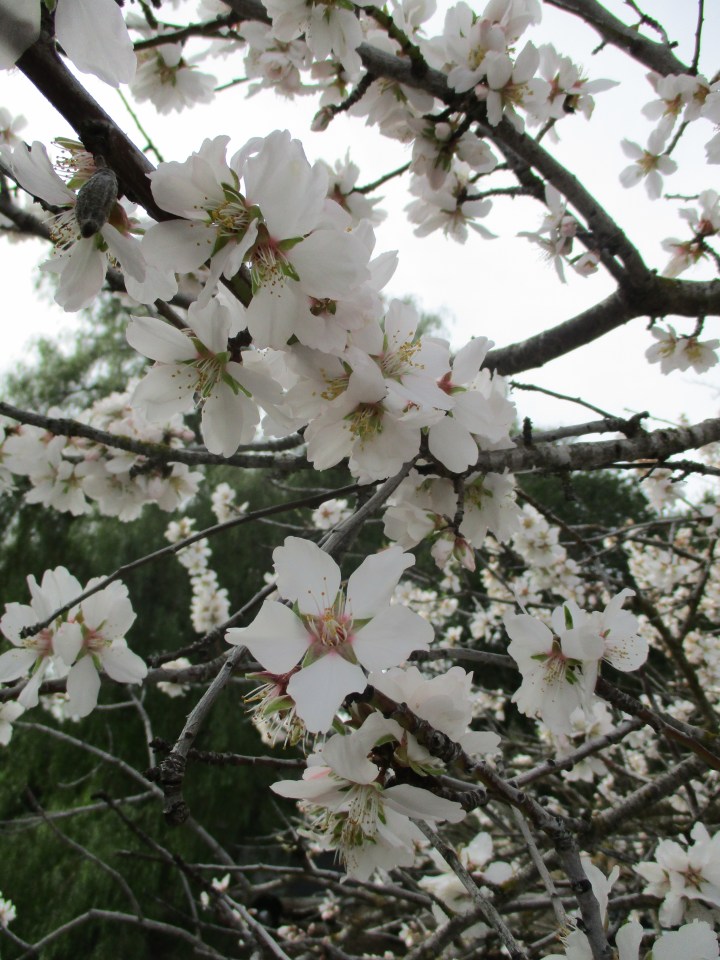 It is known more as a small to mid-sized shade tree that produces edible nuts, but almond, Prunus dulcis, also blooms magnificently as soon as the weather allows. Actually, it often blooms a bit earlier than it should. Nut production can be ruined if rain dislodges blossoms or developing nuts. The profuse white flowers are small but slightly larger than those of other related stone fruit trees.
 This is not sequel to ‘SNOW!?’ from yesterday.
 Watering has not been much of a concern lately. All the rain has kept our gardens too wet to work in. Some of us have been more concerned with erosion caused by runoff. Automated irrigation systems are probably disabled until the rain stops. Soil can drain somewhat between rain, but will not really dry out until the weather gets warm again. Dormant plants do not draw much moisture.
 In the autumn of 1989, small and temporary tent cities appeared in parks and other public spaces around the San Francisco Bay Area and the Monterey Bay Area, where many homes had been damaged or destroyed by the Loma Prieta Earthquake. They were necessary at the time, but were not intended to be permanent features of the landscapes. For a while, they were unpleasant reminders that some people could not go home until their homes were repaired or rebuilt.
 There is some controversy about the identity of the flowers that Micky Mouse picks at the porch to present to Minnie Mouse when she answers the door. Some insist that they are Transvaal daisy, Gerbera hybrida. When they are not in black and white, the substantial daisy flowers are cartoon hues of yellow, orange, red, pink and white, sometimes with chocolatey brown or black centers.
 Many of us already understand that daisies, sunflowers, asters and all related flowers are composite flowers, which bloom as many tiny flowers clustered tightly together to form what appears to be significantly larger single flowers. Distended ‘ray’ florets around the edges imitate petals that other types of flowers are equipped with. It is like one stop shopping for pollinators craving nectar.
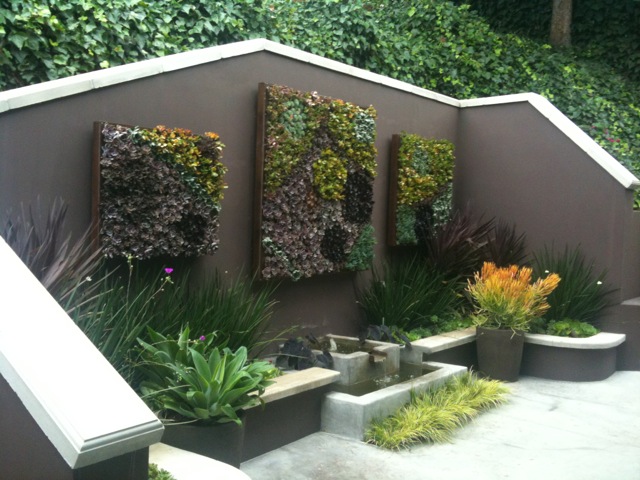 Succulent foliage is remarkably variable, even without bloom. There are so many unusual colors, textures and patterns to choose from. Many are complimentary to others. Many contrast exquisitely. What better way to display some of the favorites than to assemble them into a succulent foliar tapestry!?