‘Rain’

P80103+Like something from an old fashioned science fiction movie, this anomaly appeared in a roadway overnight. There are several more in other roadways and elsewhere about town. They are quite wet. In fact, they are composed almost completely of water. What is even weirder is that the water that they are composed of actually fell mysteriously from the sky overnight as many countless droplets all over town! Many of these droplets migrated into low spots such as this one to form what we now see in this picture.

People in other climates where these mysterious droplets are not so rare might be familiar with this sort of phenomenon. The droplets of water are known as ‘rain’. They precipitate out of the atmosphere as it cools and can not contain as much water vapor as it did when it was warmer. As the droplets migrate into low spots in roadways and anywhere else, they accumulate into these collective herds of droplets known as ‘puddles’. Many of the droplets continue to migrate as huge herds known as ‘creeks’, and even bigger creeks known as ‘rivers’. Some of these creeks and rivers migrate into really big puddles known as ‘ponds’, and even bigger ponds known as ‘lakes’. Sadly, not all of the droplets can be accommodated in ponds and lakes, so many continue to migrate out into the ‘ocean’, which is that really big pond full of salty water to the west that we are all familiar with.

Hopefully, some of these droplets of rain will stay around for a while and provide water for the plants in our gardens and forests. Ideally, some will burrow into the ground and stay for a very long time, and maybe even migrate into the aquifer to hibernate. In our climate, particularly after such a long and dry summer and autumn, these strange droplets of rain are very welcome to stay as long as they want to.

Austrian Pine

80110Relative to other pines and evergreens that are commonly grown as living Christmas trees, the uncommon and even rare Austrian pine, Pinus nigra, would be a better option. If it gets planted too close to the home, as Christmas trees often do, it does not get big enough to cause major problems. Although much bigger in the wild, local trees may take decades to reach second story eaves.

The species is divided into two subspecie, which are each divided into three regional varieties, which is a fancy way of saying that individual trees may have distinct personalities. Generally, they resemble Japanese black pine, with similar irregular branch structure, but are more dense, and may get a few pendulous stems with age. The dark green needles are slightly shorter and stouter.

The Austrian pine was likely named as such when much of its natural range was still within the Austro-Hungarian Empire, which has since been subdivided into the countries east of the Adriatic Sea. Other larger parts of the range are in Turkey and Spain. Only a small colony lives within Austria, west of Vienna. Austrian pine likes full sun and warmth like it would get naturally back home.

Collecting Seeds For Next Year

80110thumbWhere winters are cooler, the deteriorating stems of flowers that bloomed last year either got pruned away already or got knocked down by the weather, and are now rotting on the ground. Around here, where the weather is milder, and some flowers only recently finished blooming, used up flower stalks still stand in stasis. Most but not necessarily all should get pruned out and raked away.

Dahlias succumb to frost as soon as it arrives. If not already cut back, they fall to the ground like steamed spinach, and should get raked up and put into greenwaste. There is nothing to salvage. Sunflowers are related to dahlias, but do not collapse so easily. Even if they are not pretty, those that produce seed can be left for whatever birds like to eat them, and then recycled when empty.

Of course, not all of the seed must be left to the birds. Some or all can be saved for next year. The flowers only need to be allowed to dry so that the seed matures. If the birds start to eat them first, old flowers can be cut and stored in open bags or boxes in a shed or garage, out of reach of birds. Stems should be cut longer if they are still green. Seeds should fall from the flowers as they dry.

Seed can also be collected from lily-of-the-Nile and African iris, although these perennials are so easy to propagate by division that growing them from seed might be more trouble than it is worth. Their seed capsules must be allowed to dry, just like sunflower seed. Belladonna lily makes a few weirdly succulent seed that are worth collecting. Some primitive cannas make weirdly hard seed.

It might be worth researching flowers that happen to be in the garden to determine if they produce viable seed worth collecting. It is also important to know what seed requires scarification or stratification. Seed that needs stratification must be exposed to cold temperatures to be convinced that it is time to germinate in spring. Canna seeds need to be scarified by filing through the hard shells before they germinate. Other seeds need other types of scarification or stratification.

New Year & Old School

P80101Little kids were allowed to walk to school back in the early 1970s. The youngest had to walk with older siblings or neighbors who made them look both ways and hold hands to cross the streets, and stay back from the roadway. Once through the open gate into the schoolyard, younger kids could leave their slightly older chaperones to meet up with their friends and eventually go to their respective classrooms.

It is scary to think of how carefree we were back then.

The east side of our schoolyard was hedged with alternating Monterey pines and Monterey cypress, with a few random deodar cedars, redwoods and even a California pepper tree and a Canary Island date palm just inside the hedge. The random trees were somewhat mature, so were likely remnants of a landscape of a home that was on the site before the school was built there. The hedge was probably installed shortly after the school was built. It was that sort of shabby bad hedge that was common back in the mid 1950s. Nowadays, we know that neither the pines nor the cypress should have been shorn. The cypress could have made a nice hedge without the pines, but even back then, no one wanted to handle the sticky mess.

By 1972 and 1973, when the hedge was less than twenty years old, it was already beginning to assume a natural form. Only limbs that tried to grow through the fence on the outside, or too far into the schoolyard on the inside, got pruned back. No one was trying to keep it shorn. It was quite a thicket; perfect for a new kindergartener to hide out in.

Yes, I am speaking from experience. On my way to school one morning, I decided that I wanted to take a nap; so I weaseled my way in between the first cypress tree and the outer cyclone fence in order to do so. I somehow got past the cypress and found a nice soft spot on the thick layer of pine needles under the first pine, and promptly fell asleep.

Needless to say, my kindergarten teacher was very concerned when I did not get to school on time. Eventually, I woke up and emerged from my den to find the schoolyard empty. By the time I got to school all dusty and dirty and sticky with pine and cypress pitch, my teacher was really quite panicked. I did not understand why. I just wanted to take a nap.

Well, those first two trees in the hedge were the first Monterey cypress and Monterey pine I ever met. Sadly, through the 1980s and 1990s, almost all of the trees in the hedge succumbed to the variety of insect and disease pathogens that were so common in those two specie through that time. (New pathogens moved into the area and proliferated because these two host specie were so common at the time.) I can remember seeing that first cypress in the hedge dying like so many of the others in the hedge had died already.

While the trees were dying over the years, the school and adjacent neighborhoods were annexed into the city. The school was sold and rebuild at a private school. The schoolyard got a bigger fancy fence without gates. Students could only enter through a main entrance at the front of the school. A nice hedge row of redwoods was planted on the fence line where the pines and cypress had been. Then, a saran screen was affixed to the fence to obscure the view of the schoolyard and trees from the outside.

More recently, I had to go back to the old school to inspect a tree, and provide the arborist report needed to procure a removal permit from the city that the school is now annexed to.

Getting into the school was not nearly as easy as it was when I was in kindergarten. I had to go to the office, sign in with all my credentials and contact information, and wait for both a chaperone and a property manager to take me directly to the tree while also avoiding the pale protected children that now infest the old school. There were surveillance cameras everywhere, and security guards at the gates.

It is scary to think of how scared children are taught to be now.

Anyway, as you can guess, the tree that I was expected to condemn was that first Monterey pine that I had ever met, the second tree after the cypress in the original hedge.

There was a problem. I could find no problem with the tree. I mean, there was nothing wrong with it. It was healthy, stable and exhibited no symptoms associated with structural deficiency; which was weird considering what it had experienced through most of its life. When I asked the property manager what the problem was with the tree, he told me that it did not ‘fit in’ with the nice uniform row of redwoods. In other words, it did not conform. Oh. Ummmm. Well, that is no justification for removal of such a nice healthy Monterey pine that benefits the whole neighborhood. You can imagine how pleasurable it was to tell him that.

Now, I am the sort that believes that tree preservation ordinances are too restrictive. They actually prompt some people to cut trees down before they get big enough to be protected! Besides, such ordinances interfere with the rights of those who own property. There are certainly big and prominent trees that are worth protecting. This pine was not one of those. Yet, for once in my career, I was pleased that such an unimportant tree was protected by silly overprotective ordinances.

The property manager was annoyed that I could not do as he requested. There was no report condemning the tree. The tree service company that sent me out there for the inspection got no work out of the deal. Apparently, no other arborist would condemn the tree either.

Now that you are reading this, it is 2018, another New Year more than six decades after that nonconforming Monterey pine was planted where it still lives at the Old School.

(The gardening article that is regularly scheduled for Mondays is scheduled for tomorrow. The featured species that is regularly scheduled for Tuesdays is scheduled for Wednesday.)P80101+

Arboriculture: Deep Space Nine

P71231The “Poly” in Cal Poly is for “Polytechnic”, as in there are multiple schools within “California Polytechnic State University” at San Luis Obispo. There were seven school when I was there between 1985 and 1990. I was a student of the “School of Agriculture”. “Horticulture” was my “Major”, or major realm of study within this school. Within this major, I selected “Floriculture and Nursery Production” as my “Concentration” of study. That certainly is a lot of quotation marks.

While majoring in horticulture at Cal Poly, I studied with students whose concentrations of study were within “Landscaping” or “Floral Design”. Withing the School of Agriculture, we studied with students who majored in “Crop Science” or “Animal Science” and so on. Like horticulture, each of those other majors was divided into other concentrations.

Then there were all those students of the other six schools, which I will not even get into because I am wearing out the quotation mark key.

In the summer of 1988, while many of my colleagues were going to Australia, New Zealand or South Africa for their internships, I stayed right here in California, and took a job with a Lee’s Tree Surgeons in Saratoga. My colleagues thought that was a bad idea. Not only was that sort of internship for those in the landscaping concentration, but it was for the lowliest among them. They climbed trees and used chain saws and ropes and such. They were primitive. They were barbaric. They were not like us.

As it turned out, I was not like them. Fortunately, they did not mind. They took very good care of me, and trained me as best they could about arboriculture in the three months I was with them. They realized pretty quickly that I was not a good candidate for the job they gave me, but made accommodations for me. Although I was never proficient at climbing, and was not really good for much at all during that summer, I later went back to work for some of them, and eventually became a somewhat proficient groundsman; but that is another story for another time.

In my fourth year at Cal Poly, San Luis Obispo, after my internship with Lee’s Tree Surgeons, I relocated from my semi-rural home back into town, and lived in a big apartments with three roommates. We made a tradition of watching “Star Trek: the Next Generation” on television. One of the roommates, who is now a very respected professor at Cal Poly, made cornbread for the weekly event. Although I did not continue the tradition after we all graduated and went our separate ways, I did sometimes watch “Star Trek: Deep Space Nine” when it came out a few years later. I really need to stop with the quotation marks.

In Star Trek: Deep Space Nine, I liked the concept of so many different species living together in an society in which it was very necessary to make accommodations for those who are different. Everyone needed to respect everyone else. Some even learned to appreciate the differences. Even the bad guys had redeeming and very often likeable traits.

In my career, I am primarily a nurseryman. That means I grow things. Other horticultural professionals might compare my people to the Vulcans. They think that we are too uptight, efficient and plain to be much fun. Factory growers (who work for the big corporate growers) would be more like Romulans, and are therefore less dedicated to what is right and logical if it is to their disadvantage. Some of the better artistic landscape designers are likened to the Bajorans. Unscrupulous maintenance gardeners who will do what they must to make a buck are comparable to the Ferengi. Some of them work for the larger and imperialistic Cardassian landscape corporations.

Arborists are the most excellent of all; or perhaps the second most excellent after Vulcan nurseryman. They are like the Klingons; honorable, noble, independent, passionate and boisterous! I can understand why my colleagues think of them as barbaric and primitive, but I also believe that my colleagues should be more accommodating. When I consider what arborists must have though of me what I did my internship, I realize that it must not have been easy for them to accommodate me. Yet, they did, and in the most excellent way. They still respect that I have my own career in my own world, but to this day, thirty light years later, they are still pleased to invite me to their world.

Very Bad Houseplants

P71230Just because it ‘can’ be grown as a houseplant does not meant that it ‘should’ be. That is a lesson that Brent and I never learned in college. He and I were roommates in the dorms at Cal Poly in San Luis Obispo, which, as you can imagine, was a problem. Our room on the top floor of Fremont Hall was known as the Jungle Room. It was so stuffed full of weird houseplants, as well as a few plants that had no business inside. We had a blue gum eucalyptus bent up against the ceiling, an espaliered Southern magnolia, a Monterey cypress, and a herd of camellias that we rescued from a compost pile on campus.

After college, our own homes were no better. Because my dining room was rather small, Brent gave me tall weeping figs that had unobtrusively bare trunks down low, and plenty of fluffy foliage pressed up against the ceiling; a technique we did not quite perfect with our Jungle Room blue gum. I had a giant yucca in the guest suite, a redwood in my bedroom, king palms in the parlor, and a lemon gum eucalyptus over my desk in the office. The bathroom was the worst, with pothos and Algerian ivy hanging over the shower curtain, and billbergias up over the shower. A pair of small birds nested in the billbergias, and before I realized that they were there and evicted them, they started a family!

At least Brent kept most of his plants outside where they belong. The staghorn ferns grab onto the walls when they get the chance. Wisteria vines grab onto anything else. The flame vine climbed up the chimney (appropriately), and before Brent knew it, had sneakily spread to the opposite side of the parapet roof! Then there was the giant timber bamboo. Yes, that is what I said; giant timber bamboo. I know what you are thinking right now, so there is no need to say it.

There is a narrow space between north side of Brent’s home and the concrete driveway next door. It is almost three feet wide. Brent though that if he planted the bamboo there, it would not get to the other side of the driveway. He was actually correct.

Did I ever mention how vain Brent is? Well, that is another topic for another time. I will say for now that he has more clothes than his teenaged daughter Grace. A lot more. They do not all fit in his big closet. He hangs some of his longer coats that he does not need very often in Grace’s much smaller closet. One day, he was reaching around the clutter that is common in a teenaged girl’s room, and groping for one of his coats in Grace’s closet, when he grabbed a hold of something that should not have been there. He was not certain what it was at first, but when he found his coat and pulled it out, a few dried bamboo leaves came with it and fell onto the floor!

The bamboo did not even try to go under the neighbor’s driveway. Instead, it went under the foundation of the house. Where it came up, it had nowhere to go, so somehow weaseled in next to a water pipe, and followed it up behind the bathroom washbasin. Once inside, it somehow weaseled past a valve access panel behind Grace’s closet, and straight up to the ceiling. What is even funnier is that Grace knew it was there, but figured that it was just another one of Brent’s crazy landscaping ideas!

Just in case you are wondering, giant timber bamboo is a very bad houseplant!

The bamboo is gone now. It got so tall that the wind would blow it against the terracotta tiles on top of the parapet wall. Also, the foliar litter was too messy on the parapet roof and the neighbor’s driveway. It did not contribute much to the landscape anyway, and shaded only a driveway that is seldom used.

Australian Fuchsia

61228Pictures are probably prettier than the real thing. Australian fuchsia, Correa pulchella, really does bloom with pendulous soft pink flowers through winter when not much else is blooming. However, the flowers are quite small, and the color is rather hazy. The real appeal of Australian fuchsia is that it is so undemanding, and once established, only needs watering a few times through summer.

Mature plants get a bit higher than two feet, and maybe twice as wide, with a low mounding form. The small evergreen leaves have a nice density without any pruning. Obtrusive plants do not mind getting pruned back or even shorn for confinement, but are deprived or their naturally appealing form and texture if pruned too frequently. Good exposure for both sunlight and warmth is important.

Bare Root Stock Has Advantages

31225thumbAnyone who has had undergone surgery knows the advantages of unconsciousness. Any frat boy who woke up after a night of overly indulgent inebriation, with his face adorned with objectionable graffiti, knows the disadvantages. A lot can happen while one is unaware that it is happening. This is exactly why so many bare root plants become available while they are dormant through winter.

Bare root plants get dug and deprived of the soil that their roots grew in, leaving the roots bare. Some get their roots packaged into bags of damp sawdust. Others get their roots heeled into bins of damp sand in retail nurseries. Roots are only bagged or heeled in to stay fresh. They get pulled from their sand or separated from their bag of sawdust when ultimately planted into the garden.

It might seem violent, but it all happens while the plants are dormant and unaware of what is happening. They go to sleep happily rooted into the ground wherever they grew, and then wake up in a home garden somewhere else. It only takes a short while to get reoriented before they develop new foliage and new roots as if nothing ever happened. The whole process is surprisingly efficient.

Canned (potted) plants are actually less efficient in some ways. They are bulkier and therefore more difficult to bring home from the nursery. Their confined roots are more likely to be disfigured or binding. (Roots that wrap around the inside of a can will constrict on themselves as they grow.) The media (potting soil) could contain disease. Worst of all, canned stock is much more expensive.

Bare root plants are remarkably easy to plant. Their planting holes only need to be big enough to contain the roots. Soil amendment should be minimal. If too much amendment is added, or holes are too deep, new plants are likely to sink. Graft unions (the distinctive ‘kinks’ just above the roots) of grafted trees must remain above grade. Roots should be spread out laterally and downward.

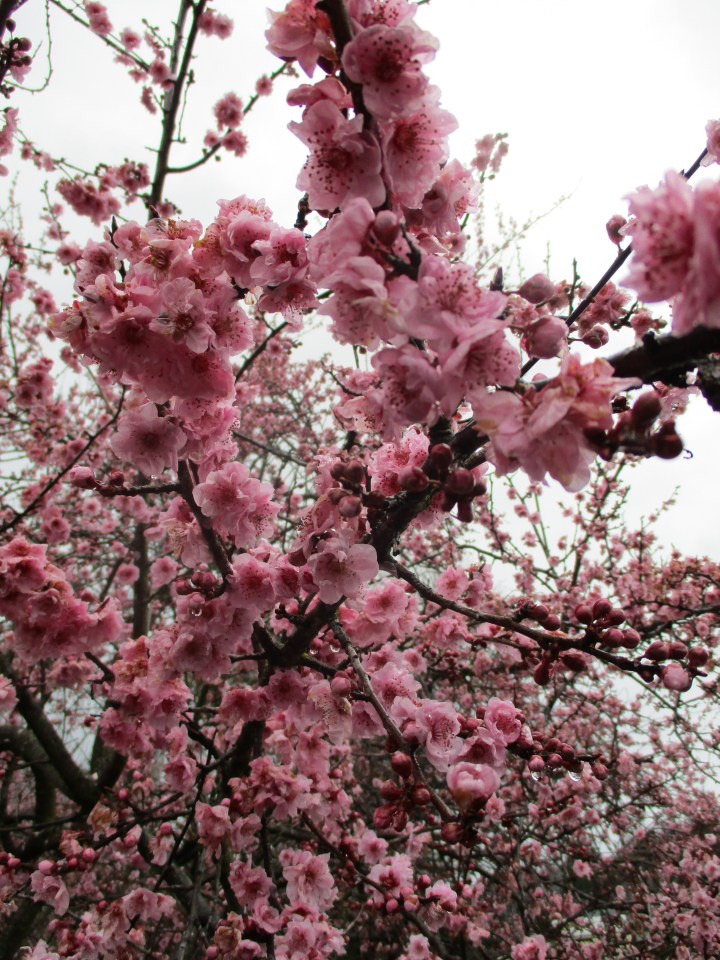
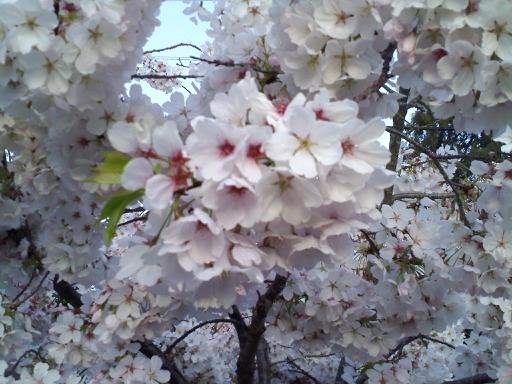
Smaller bare root plants like cane berries, grapevines, gooseberry and currant are already moving into nurseries where Christmas trees are relinquishing their space. Fruit trees like apricot, cherry, plum, prune, peach, nectarine, almond, apple, pear, quince, fig, pomegranate and persimmon will arrive next, followed by blueberry and roses. Poplar, flowering cherry, flowering crabapple, forsythia, lilac, wisteria, rhubarb, strawberry and asparagus might also be available.

Douglas Fir

80103Even those of us who live nowhere near its natural range live closer to Douglas fir, Pseudotsuga menziesii, than we realize. Most of our homes are constructed from Douglas fir lumber. Although very uncommon in landscaped gardens, Douglas fir is the most popular Christmas tree here. Trees introduced for timber have naturalized in parts of Europe, Argentina, Chile and New Zealand.

It is such a grand evergreen conifer that Oregon designated it as the state tree. The tallest trees in the wild are more than three hundred feet tall! Trees that do not compete within a forest do not get even a quarter as tall. The flattened needles are less than an inch and a half long, and arranged on opposite sides of the stems. Light brown female cones with jagged bracts hang downward.

Douglas fir is a native of the West Coast between about the middle of British Columbia to the North, and the Santa Lucia Mountains and the Northern Sierra Nevada to the South, with a few small colonies beyond. Rocky Mountain Douglas fir is another variety from farther inland. Because it is so big and structurally deficient, Douglas fir is almost never planted into landscapes intentionally.

Potted Plants For Christmas Color

80103thumbAfter all the Christmas decorations get put away for next year, and the Christmas tree eventually gets undressed from all its ornaments, and retired to the compost pile or greenwaste, all the pretty seasonal potted plants remain. Some will bloom, or at least maintain their current bloom, for months. Some might eventually get planted out in the garden. Others might stay potted in the home.

Poinsettias are the epitome of seasonal potted plants for Christmas. Their flashy red bracts last a very long time, even after the tiny yellow flowers are gone. Some are pink, white, pale yellow, peachy, marbled or spotted. They can be grown as foliar houseplants, but will not likely bloom next Christmas. If protected from frost in the garden, they get tall and lanky, and bloom in January.

Christmas cactus is an excellent potted plant either indoors or out where protected from frost. The pendulous growth cascades nicely from a hanging pot. It blooms in phases, but does not stick to a tight schedule. Amaryllis should also stay potted only because it does not do well in the garden over winter. Foliage that develops after bloom will die back next autumn before bloom next winter.

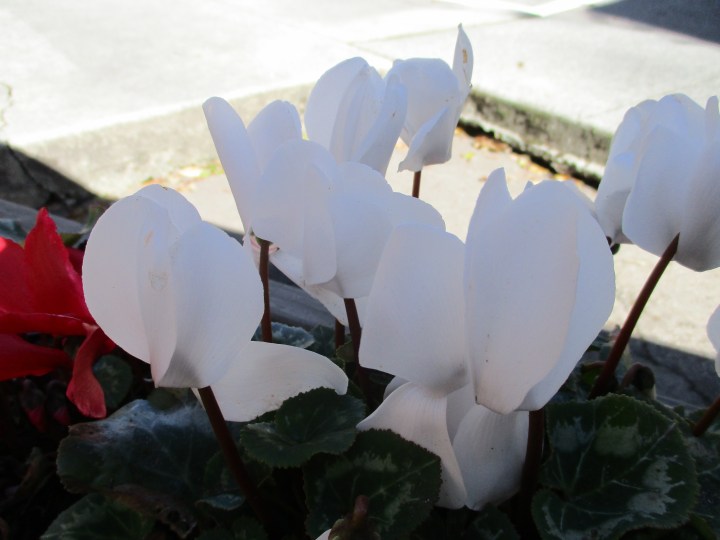
Holly and azalea can be planted directly into the garden where appropriate. Azalea will probably look shabby until it gets new growth. Cyclamen is a perennial in the garden, but dies back over summer. It just might come back with a surprise in autumn. Paperwhite narcissus is perennial too, but exhausts its resources on bloom, so takes a year or more to recover before blooming again.

Small living Christmas trees are more variable than they seem. Rosemary can either be kept potted and shorn, or planted into the garden and allowed to grow wild or into another form. Dwarf Alberta spruce can likewise stay potted or get planted into the garden, but needs no shearing. Both rosemary and dwarf Alberta spruce will want larger pots as they grow. Italian stone pine and Canary Island pine grow into large shady trees, so should only be planted into spacious landscapes that can accommodate them.