What’s In A Name? Sometimes, Not Much.

P71209Newer developments are often named after what was destroyed to procure space for them. Writers and historians have been making that observation for decades.

There are obviously no remnants of a ranch in the McCarthy Ranch Marketplace in Milpitas. Heck, there are no little cornfields left in Milpitas, which is what ‘Milpitas’ means. Cherry Orchard Shopping Center in Sunnyvale? Give me a break! The Pruneyard Shopping Center in Campbell is no better.

I just happen to find the Pruneyard to be less objectionable than the others because it was built about the time I was born. It has been there as long as I can remember. My parents can remember when it was a drying yard for the prunes harvested in the surrounding orchards. I remember the last remnants of prune orchards, but by my time, there were not enough of them to justify the less lucrative use of real estate for drying, which could be done elsewhere.

The Pruneyard Towers are an office complex just to the west of the shopping center. The original Pruneyard Tower might still be the tallest building between San Francisco and Los Angeles. I know it was only a few decades ago. (Downtown San Jose has a ceiling on the heights of their skyscrapers because of the flightpath of the Mineta San Jose Airport.) I can remember as a kid, seeing the big black tower standing proudly off in the distance, beyond the blooming apricot orchards. When our parents were shopping there, and we got close to the Pruneyard Tower, we felt a bit more cosmopolitan, as if we lived in a big world class city. Back then, we had no idea that nearby San Jose was well on the way to becoming exactly that!

The shorter tower was added about 1976. The third and lowest of the three bigger towers was added in the 1990s. The late 1960s architecture of the shopping center is still prominent, but several original buildings have been rebuilt with modern architecture, and a few new buildings were added.

As much as I miss the orchards and the horticultural past of the Santa Clara Valley, I can not totally dislike the Pruneyard Shopping Center and the associated big towers. To my generation, they are also part of our history. They have been here as long as we have.

The one thing that I dislike about the Pruneyard Shopping Center is the name. It is a constant reminder that something that was such an important part of our local culture and history was destroyed so that it could be built. Nothing about the site is associated with the orchards, or drying yards or prunes, or anything of the sort.

Someone Got Payed For This?!

P71216See what happens when the plants in the garden are happy? They do pretty things. It is now halfway through December and this honeysuckle is still blooming nicely. The cool weather has inhibited bloom somewhat, but has not totally prevented it yet. By the end of winter, this honeysuckle will get pruned back so that it can regenerate new growth to bloom through next year.

This honeysuckle happens to be growing on a chain link fence behind a small group of apartments. Someone who lives in one of the apartments enjoys tending a few vegetables and flowers, but really does not put too much effort into the surrounding vines and shrubbery that obscure the view of the parking lot next door. That region of the garden gets only the maintenance that is required to keep it under control. The person who does it is no horticultural professional; merely someone who enjoys a bit of home gardening.

Horticultural professionals should know more about horticulture than someone who just enjoys growing a few vegetables and flowers after coming home from working at another profession. That is what they get payed for. That is why they are professionals. . . because it is their profession.

Right across Highway 9 from the homes with the honeysuckled fence is a pharmacy with a parking lot that is ‘maintained’ by ‘gardeners’. It looks like a parking lot. There are some nice young but shady elms that were recently pruned up for clearance by professional arborists who did a rather impressive job. Below the elms is a mixture of typical ‘low maintenance’ plants that are often found in parking lots, including lily-of-the-Nile, African iris, Oregon grape and Indian hawthorn, with a few dwarf Heavenly bamboo to add a slight bit of Japanese ethnic diversity into an otherwise African-American landscape.

Except for the elms and other young trees, none of the plants are exemplary. They are all tough plants that are resilient to the climate and abuse that they get in a pharmacy parking lot. Their main problem is the ‘maintenance’ performed by the ‘professional gardeners’. I could go on about this, but for now, I just want to describe what was done to the Heavenly bamboo.

It never really looks that good. It does not get a chance to. At least this time of year, this particular cultivar of Heavenly bamboo gets some rather nice color on it. Even if the foliage is mutilated and crowed from a lack of ‘proper’ pruning and an excess of ‘improper’ pruning, the reddish or burgundy color is pretty from a distance. At least, it would have been.

The ‘gardeners’ cut all the foliage off, just as it was beginning to color. Yep. It is all gone. The canes were cut into these tightly shorn but somehow awkwardly asymmetrical cylinders with angular edges around the circular and flat tops. How does one put that much effort into shearing something so tightly, and perfecting the flat top, without getting it symmetrical? Why put that much effort into ruining something just before the performance that it waited all year for, and just prior to the longest time of year before the weather warms enough for it to recover?

Shear abuse – with shears.

Perhaps those are questions that Rhody is pondering in the picture. Perhaps he just wants to leave a ‘message’ for the ‘gardeners’.P71216+

Torch Lily In Fire Season

61214Okay, so this is not really the time of year that they should be blooming. Torch lily, Kniphofia uvaria, should bloom in the middle of summer. However, without watering, naturalized plants bloom when the weather prompts them to. Some wait out the warm and dry summer weather to bloom as soon as they get dampened by the first rains. Others bloom in spring, before things get too dry.

Flower stalks can get almost five feet tall, but are more typically about three feet tall. Small tubular flowers are arranged in dense conical trusses on top of these stalks. From the bottom to the top, red flower buds bloom orange, and then fade to yellow, and fold downward against the stalk. Different varieties bloom with more or less of these three colors, and at different times of the year.

The grassy foliage is not much to look at without bloom. By the end of winter, it can look rather grungy. It fluffs back nicely in spring, sort of like overgrown daylily foliage. Overgrown plants, or maybe just a few rhizomes, can be divided anytime. However, they should probably be divided just before the end of winter so that they can enjoy late rain, just before their spring growing season.

Rodents Eat Just About Anything

61214thumbNot much bothers old fashioned junipers. They tolerate heat and frost, and anything else the weather throws at them. They do not appeal to many troublesome insects. Once established, they do not mind if they do not get much water. So, aside from over-watering and bad pruning, they are pretty indestructible. Yet, once in a while, otherwise healthy junipers die suddenly and mysteriously.

Sometimes, entire plants die. Sometimes, only big pieces of them die. The foliage is intact, but dried to a nice light brown. The roots are firm. In fact, the damage that caused such efficient death might not become apparent until the dead stems get dismantled and removed. It might even get overlooked because it is not the sort of damage that we expect to find in our tame home gardens.

Rats! They sneak in under the dense foliage to chew the bark from the main stems. The thicket of rigid stems protects them from cats and dogs. They can kill both shrubby and ground cover junipers, as well as ivy, ceanothus, cotoneaster, firethorn, . . . and nearly any sort of shrubby plant that they feel safe from predators in. They also eat vegetables and fruits, particularly citrus fruits.

The damage should be rather distinct. Bark is missing. Bare wood is exposed. Squirrels sometimes cause the same sort of damage, but usually on smaller stems in trees. Gophers do their dirty work underground by eating roots. If they kill junipers or other shrubbery, the dead plants can be pulled up from the soil relatively easily, and fresh gopher ‘volcanoes’ should be evident in the area.

Protecting stems and roots from rodents is more difficult than protecting developing fruit. The rodents know that they are concealed by the dense growth that they chew the bark or roots from, so fake owls are not much of a threat. Poisons are very unpleasant for the targeted rodents (duh!), and very dangerous to cats and dogs that might catch the poisoned rodents. Traps are effective and safe (except for the rodents . . . duh!) but take serious dedication to empty and reset!

Poppies

P71213+K1Not just any poppies; California poppies, the state flower of California.

So why the picture of an old cinder block wall on the edge of an unkempt and weathered parking lot behind the old County Bank Building? Well, right there in the middle of the picture, where the lowest course of block meets the edge of the pavement are a few weeds, and some of these weeds are poppies showing how resilient they can be.

California poppies are opportunistic. They grow fast and bloom when they can. For most, that means that they bloom as the weather starts to warm up at the end of winter. For others in irrigated gardens, they can bloom in phases through summer. Some do their thing quickly as soon as they get a bit of moisture from the first autumn rains or even dew. They know what time of year it is, and that the weather will not likely get hot enough to cook them; so they bloom and throw their seed for another generation in a few more months, or maybe many months from now. They adapt. That is how they live on the edges of forests of the Santa Cruz Mountain, to interior valley chaparral, to the Mojave Desert. They are a remarkable specie.

Remember the poppies in the Wizard of Oz? There are several theories about what those poppies represent, and why the put Dorothy, the Cowardly Lion and Toto to sleep without affecting Scarecrow and TinMan. Duh, Scarecrow and TinMan do not breath. They can not inhale the narcotic produced by the poppies. Even if they did, they lack the physiology to be susceptible to opiates.

There is a significance to poppies blooming today, the same day I wrote about the gingko, on December 13; but this ain’t Oz.P71213+K2

Birthday

P71213This single yellow ginkgo leaf says a lot. It was found among the abundant cottonwood leaves on the broad walkway in Felton Covered Bridge Park (https://tonytomeo.wordpress.com/2017/12/02/felton-covered-bridge/). There are no ginkgo trees in the neighborhood that I am aware of. It must have come a long way to arrive here on the morning of December 13.

It really did not need to go through all the effort to get here. I need no help to remember the date. It is the birthday of a good friend who passed away last May.

Steven Michael Ralls is one of two friends I went to Oklahoma with late in 2012 (https://tonytomeo.wordpress.com/2017/11/19/oklahoma/). In the picture attached to my article about going to Oklahoma, there is a handsome gentleman to the left. That is me. The bronze guy in the middle was just standin’ on the corner in Winslow, Arizona. Steven is on the right. Gayle is on the sidewalk groping the bronze guy.

Steven did not know or care much about horticulture, but he knew ginkgo. It was his favorite tree; and it is the only tree that he remembered the botanical name for. There are a few gingko trees about Santa Cruz and elsewhere. He would sometimes point them out and exclaim, “Gingko biloba!”

I have not yet planted a ginkgo tree for Steven. At the spot under the Felton Covered Bridge where we scattered his ash, I planted a few canna seed that I brought back from Oklahoma, and some rooted cuttings of a pink brugmansia that I acquired during an outing with Steven to Santa Cruz. Neither grew enough to survive when the San Lorenzo River comes up this winter; so I will probably need to plant more.

Well, getting back to the single yellow ginkgo leaf. It says a lot. Today is December 13, the birthday of my good friend Steven.

Dwarf Golden Arborvitae

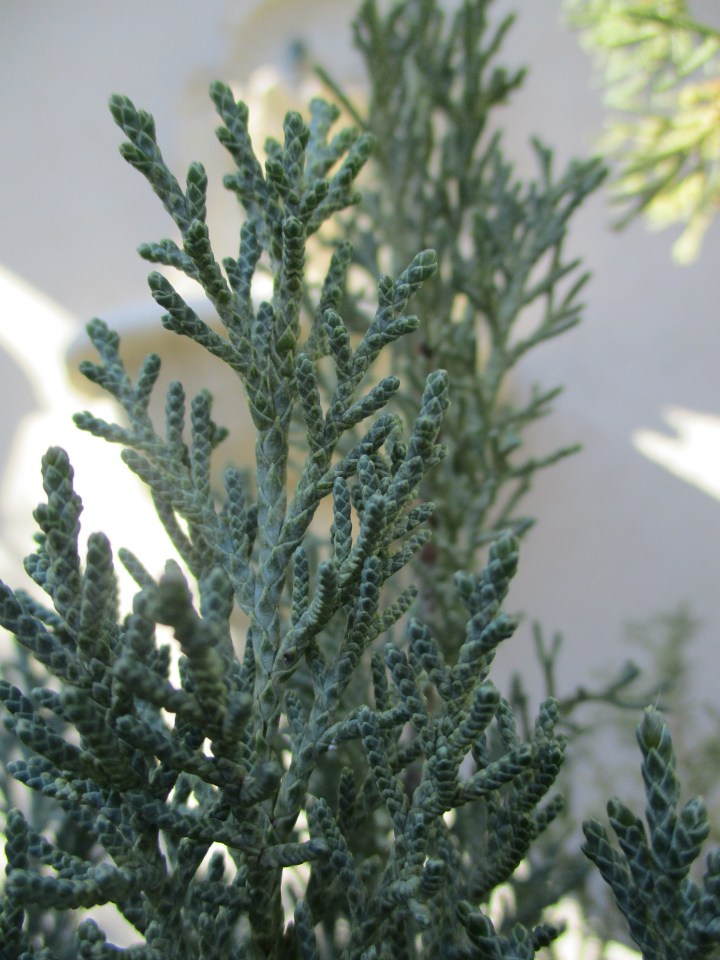
71220These pale blue . . . whatever they are, were just too cool to pass up without a picture. Technically, they are the ‘cones’ of dwarf golden arborvitae, Platycladus orientalis (formerly Thuja orientalis) ‘Aurea Nana’. They do not look much like cones. They are only about three quarters of an inch long, and are rarely as profuse as they are here. They are less appealing as they dry and turn brown.

Dwarf golden arborvitae grows nicely while young, then slows significantly once it gets only a few feet high. Mature specimens may not get as tall as six feet, with nicely rounded form and cheery yellowish foliage. Other uncommon cultivars that are not dwarfed can eventually reach second story eaves, with greener foliage. Flat sprays of soft evergreen scale foliage is suspended vertically.

Foliage is brightest yellow when fresh and new in spring, and then fades somewhat through summer, so that it might be yellowish green by this time of year. In frostier climates, exposed tips can get bronzed through winter. Partial shade is not a problem, but subdues foliar color. Dwarf golden arborvitae, although quite resilient once established, prefers good soil and occasional watering.

Christmas Trees And Cut Foliage

31211thumbThere should be no guilt associated with a cut Christmas tree. They were stigmatized many years ago, when some people believed that they were harvested from forests, and more of them likely were back then. However, most of us now know that, except for a few that actually are harvested from the wild, Christmas trees are grown on farms like most other cut foliage or horticultural crops.

That is how Christmas trees get their nice Christmas tree form. Only spruce and a few types of firs grow so densely and symmetrically in the wild; and spruce are not commonly cut as Christmas trees. Almost all types of Christmas trees need to be pruned or shorn for density, symmetry and maybe even form. Most of the foliage for wreaths and garlands is likewise grown on foliage farms.

Contrary to popular belief, living Christmas trees are no more environmentally responsible than cut trees are. They are farm grown and artificially irrigated exotic (non-native) trees in vinyl cans filled with synthetic media (potting soil) and synthetic fertilizers. Just like cut trees, they need to be shorn unnaturally. Then, after all that effort, most die and get discarded after Christmas anyway.

Those that survive are usually more trouble than they are worth. Because they are exotic, they should not be planted out in the wild. Because their roots are confined, they would not survive without irrigation through the first year anyway. A few types that grow slowly and maintain density might stay potted and be brought in at Christmas for a few years, but that requires diligent maintenance.

The worst problem with living Christmas trees is that they often get planted into home gardens that can not accommodate them. Few people know what kind of tree their living Christmas tree is, or realize how big it can get. Some trees are Italian stone pines or Canary Island pines, which simply get too large. Even junipers, arborvitaes and smaller pines need adequate accommodations. Arborists can attest to damage caused by living Christmas trees in bad situations.

Holy Guacamole!

P71202.jpgHorticulturists have a way of making all those long Latin names sound easy to pronounce. Lyanothamnus floribundus ‘Asplenifolius’ – Syzigium paniculatum – Metasequoia glyptostroboides. I do not know why proper pronunciation of their names is so important. They have no ears. They can not hear if we simply call them ‘Earl’. Even if they could hear, they would not respond.

Communication with other people is probably more important. Yet, we are so often unable to spell something as seemingly simple as the sound of a palm frond falling to the ground. Does it sound like “whoosh”, or “splat”, or some combination of both? What do the Santa Anna Winds sound like as they blow through a grove of Aleppo pines? What does a red flowering gum full of bees sound like?

Heck, Brent could not even tell me what an incident that he heard in his own backyard sounded like. As he came home from work and was getting out of the car in the driveway a few days ago, he heard in rapid succession, a loud ‘CRACK!’ followed immediately by a loud ‘WHOOSH!’ and a big ‘THUD!’ and ‘BANG!’. Well, I was sort of clear on all that, but it was the finale that was baffling him.

He said it sounded like someone dumping out a big bucked of tennis balls filled with something to make them heavy. I did not ask how he knew what that sounded like, or what the tennis balls were filled with, or why anyone would fill tennis balls with anything, or . . . He was obviously unsatisfied with that explanation, so said it sounded more like a whole bunch of billiard balls bouncing off of the bumpers all at the same time, without bumping into each other. Well, that is some pretty talented pool.

Okay, so it sounded like when you get into an elevator on the ninth floor of the Bank of America Tower, you know the big one downtown, and the bottom falls out of your big bag of ‘Eureka’ lemons somewhere between the fifth and fourth floors, and everyone is staring because it is noon thirty on Friday, and . . . well you know, . . . and then there was this . . . and . . . ain’t nobody got time for that!

Dude, just shut up! I get it.

Well, he went to the backyard to investigate. The source of the commotion was not immediately apparent from ground level. Everything seemed to be in order, maybe a bit sunnier, which might not have been noticed anywhere else after autumn . . . but this is Los Angeles. When Brent looked up to the deck on the flat roof of the office, it all became clear.

The big avocado tree in the neighbor’s garden dropped a big limb onto the deck. The last strange sound he heard was that of so many heavy avocados hitting the deck and scattering in every which direction, including down the wrought iron spiral stairs. All the patio furniture and cool potted plants up there got clobbered. Fortunately, there was no serious damage, and the avocado tree should be fine. Most of the fruit was in good condition. Only those that fell down the stairs were pulverized into lumpy guacamole.

Anti-Community Garden

P71217Isn’t this a delightful meadow? It is located right across from the historic Felton Covered Bridge (https://tonytomeo.wordpress.com/2017/12/02/felton-covered-bridge/). The trail to the left goes up the embankment into the parking lot of the old County Bank Building, right downtown. On a warm day, it is a nice cool short cut to the Felton Covered Bridge Park, just over the San Lorenzo River.

You should have seen it a few years ago. It was not such a nicely inviting meadow, but was instead an excellent collection of small garden plots within a fenced Community Garden that deer could not get into. There were about nine small olive trees behind the fenced area. The stumps in the foreground and to the left were two small curly willows. People living in apartments or where the shade of the surrounding mountains and redwood forests prevented gardening could rent parcels here to grow vegetables, flowers or herbs. It really was nice.

Then it was destroyed.

Everyone who rented plots there was evicted. Surrounding oaks, box elders, willows and other vegetation were eradicated. Fortunately, the olive trees were relocated. The whole area was graded by bulldozer; and the Community Garden was gone. Now, the vacant meadow grows only a thicket of thistles that needs to get mown down every summer.

P71217++Apparently, someone thought that there might possibly be the remote chance of the potential for homeless people to maybe engage in activities that could perhaps be determined to be bad, right behind the Community Garden. If you look closely, you might be able to see them back there. Maybe not. (More accurate information can be found at the Facebook page of Felton League at https://www.facebook.com/Felton-League-520645548069493/ .)

Well, after making this observation, the expert on the sociology of the homeless, and self-proclaimed representative of the thousands of others in Felton, convinced the owners of the property to fix the problem. You see, only by singling out and targeting a particular segment of our Community can we put Unity back into CommUnity. Demolishing a Community Garden certainly helps too. It took a lot of hassling, and a lot of lies, but it was finally done. This is what we have to show for it, as proof that killing a Community Garden helps with homelessness.P71217+.JPG