Black-Eyed Susan

71206Is it coincidence that the Latin name of black-eyed Susan is Rudbeckia, or was Becky rude enough to give Susan her black eye? The dark center is something that all varieties have in common, and what distinguishes them from most of the related blanket flower varieties. The daisy flowers of black-eyed Susan are traditionally yellow. Modern varieties can be orange, reddish or bronzed.

Most Black-eyed Susan are perennials that bloom through summer and as late as the first cool weather of autumn. A few are annuals that bloom in their first year only through summer. They get about three feet tall, although some can get taller, and some stay quite compact. Flowers are about three inches wide. Some varieties have even larger flowers that fold backward like coneflower.

Black-eyed Susan appreciates an open and sunny spot with somewhat rich soil and occasional watering. Deadheading keeps them tidy, and for some varieties, promotes subsequent bloom. It also inhibits self sowing where that might be a problem. Modern varieties should not become invasive even if allowed to self sow. Mature colonies can be divided for propagation every few years.

Prune Maples and Birches Before Sugaring Season

71206thumbMost of us Californians are probably wondering what that means. Sugaring season is more familiar to horticultural enthusiasts in New England, Canada, and more recently, in Alaska. It is the time of year that sugary sap get harvested from maples, and in Alaska, from birches. Maple sap gets refined into maple syrup and sugar. Birch sap makes birch syrup and sugar, a recent fad up north.

Why is this important here? Well, maples and birches know what time of year it is. Their sugaring season is relatively brief here; and they do not produce as much sap as they do in cold climates. Nonetheless, their sap will eventually start to flow later in winter, just when we expect it least. By the time we will be pruning dormant fruit trees and roses, it will be too late for maples and birches.

Therefore, maples and birches should either be pruned as soon as practical after defoliation, or after refoliation later next spring or early summer. They tend to defoliate before their sap gets too pressurized. However, if opting or the autumn pruning schedule, it is advisable to prune off one small stem first and then wait a few minutes to see if it bleeds. If it does, pruning should be delayed.

Bleeding may not be as harmful as it would seem to be for mature trees, especially since birches and many of the maples do not need much pruning of viable stems. If they get infested with sooty mold, a few small bleeding wounds on a big birch tree are more unsightly than unhealthy. However, several bleeding wounds can be somewhat distressful, especially for young Japanese maples.

If opting for the spring pruning schedule, maples and birches should be allowed to refoliate first. Their first leaves should be fully developed. This might be difficult for those of us who believe in pruning during dormancy, but it is better than causing sap to bleed when the trees need it most. Pruning can be done during summer too, but summer pruning should not be aggressive enough to suddenly expose formerly shaded bark to direct sunlight. Otherwise, bark can scald. So once again, timing is everything.

Franklin Canyon Park

P71126Because I sometimes go to Brent’s jobs sites while in the Los Angeles area, people sometimes ask me if I see many famous actors. Well, I try to stay out of everyone’s way, so rarely see anyone at the sites. If I see anyone famous about town, I would not know it. I do not watch enough television or movies to recognize many of them.

However, I did recognize this famous actor from my childhood as the renowned Wile E. Coyote of Looney Tunes. He was just out for a stroll in Franklin Canyon Park in the Santa Monica Mountains above Beverly Hills. It happens to be one of my favorite places in the Los Angeles Area, and has an interesting history.

Even those who have never been to Franklin Canyon Park might have seen it on television and in movies. Franklin Canyon Reservoir was Myers Lake on which Opie Taylor was skipping stones on the Andy Griffith Show. It was also a pond near the Ponderosa on Bonanza, and near where Daniel Boone lived, and on various far away planets on Star Trek. Even the Creature from the Black Lagoon lived there!

There are a few exotic plants that were planted there over the years, and a few that have naturalized. The familiar deodar cedars are of course exotic. So are the few coastal redwoods from farther up the coast. Yet, most of the flora of Franklin Canyon Park is native, and shows what the Santa Monica Mountains were like before the surrounding area became so developed. Large sycamores and cottonwoods live in the riparian area at the bottom of the Canyon. The upper slopes and ridges are much more open, with smaller trees and all sorts of scrub. There were a few toyons, which are also known as ‘California holly’ scattered about. I can not help but wonder if there were more of them decades ago when Hollywood(land) was named after them. I know that there is now more vegetation than there was when fires burned the area more frequently, and some plants are less competitive than others. It is fascinating nonetheless. Sometimes, it can be difficult to imagine that there was ever anything natural in Los Angeles. I am sorry that I have no better pictures.

Green Roof

P71125Is this a bad idea for a green roof?

Is it a houseplant that got too big?

Is it a wheelchair accessible tree-house?

None of the above. It is just weird architecture, designed to preserve a rare Chilean wine palm. The tree was probably planted in the front garden of a Victorian home that was on this site before the site was redeveloped. Chilean wine palms were more popular back then; and this one seems to be about that age. Although it seems to be healthy now, the constriction in the trunk indicates that it had been stressed by the redevelopment, which undoubtedly covered much of the established root system. The time it took for the length of trunk above the constriction to grow coincides with the estimated age of the building below. The tree very likely had better access to rainwater before.

Because it is a palm, the trunk will not get any wider than it is. Because the trunk is so stout, it probably does not move much in the wind. However, the blue tarp around the trunk indicates that there is a problem with the roof leaking around the trunk. It is obviously difficult to get a good seal.

It is impossible to determine from this picture if the building is built on a slab or a simple foundation. A foundation would be a bit healthier for the tree. Perhaps it is more accurate to say that a foundation is less detrimental to the tree than a slab would be. It probably would be better for the building too, since a slab could have been displaced by new roots emerging from the base of the trunk.

Perhaps all this discussion is pointless. This weird but creative idea works. Although distressed and very likely embarrassed, the tree was preserved, and shades the building below.

Red Flowering Gum

61123We all know about the bad reputation of eucalypti, especially the notorious blue gum. They are too big, too aggressive, too messy, too structurally deficient, and in groups, they are too combustible. However, there are several eucalypti that are not only appropriate for local home gardens, but because of their resiliency, drought tolerance and adaptability to the local environment, should be more popular than they are.

Red flowering gum, Eucalyptus ficifolia (which is now known as Corymbia ficifolia), rarely gets more than thirty feet tall and broad, with a stout branch structure. It is a good street tree because the roots are usually deep and complaisant. Constantly falling leaves and seed capsules are somewhat messy, but the mess is proportionate to the compact canopy, and is probably worth the spectacular summer and autumn bloom.

Fuzzy trusses of staminate flowers are usually some shade of red, but might be pink, salmon, reddish orange or pale white. Trees must be a few years old to bloom, so color might be a surprise when young trees bloom for the first time. Profusion of bloom can be variable from year to year, or from one portion of the canopy to another. Tree size and form are also variable. Some are vigorous while others are more compact.

Improvise While Flowers Are Scarce

61123thumbMuch of the color in the garden through autumn and winter is provided by foliage. Some foliage turns color as the weather gets cooler. Some had been blue, gray, gold, red, bronze or variegated all year, and just happens to get noticed more now that there is not much other color provided by flowers. There are a few flowers that bloom now or even later in winter, but not nearly as many as there were in spring and summer.

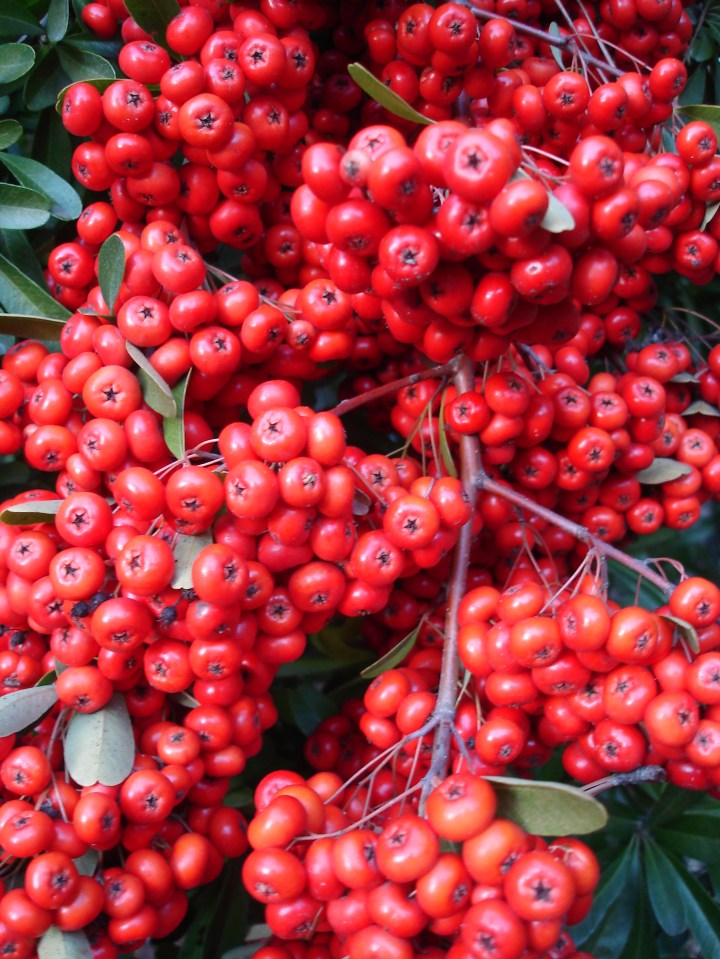
Coral bark Japanese maple and red twig dogwood display colorful defoliated stems as the weather gets cooler. The colorful berries of firethorn (pyracantha), cotoneaster and toyon will ripen about the same time, providing bright red color until the birds get them. Otherwise, there might not seem to be much more to cut and bring into the home to substitute for cut flowers, and add to all the colorful foliage, twigs and berries.

Well, this is where things get less horticultural, and more creative. All those old flowers and flower stalks that should get pruned off, and maybe a few old leaves, might be good for more than compost. Blooms of hydrangea, Queen Anne’s lace and lavender can be cut just as they begin to deteriorate, and hung upside-down to dry. They lose much of their color, and shrivel somewhat, but are nice options to fresh flowers.

Old flower stalks of New Zealand flax and lily-of-the-Nile have striking form once plucked of tattered flower parts and seed capsules. New Zealand flax stalks are tall and straight. Lily-of-the-Nile stalks are like star-bursts on sticks. If the natural color lacks appeal, they can be spray painted! Seed capsules of red flowering gum (eucalyptus) dry in loose clusters with stems that are long enough to arrange like cut flowers.

Pine-cones, magnolia grenades (seedpods) and sweetgum maces (seedpods) that fall from their stems can be drilled, and attached to sticks. There are no substitutes for real flowers, but there are no limits to creative and even weird alternatives.

Is That A Body?!

P71118

It seems that changes in fashion are sometimes partly motivated by rebellion against what they are changing from. The comfortably loose and pendulous ladies outfits of the 1920s that were so unflattering to the human form while revealing more of it than ever before were probably a rebellion to the impractically uncomfortable and strenuously refined ladies fashions of the late Victorian period that were designed to enhance the ideal of feminine form while also obscuring it. The simple and squared landscapes of the 1950s that were so neatly tailored that they would be considered to be bleak by modern standards were replaced through the 1970s and into the 1980s by a much more relaxed and curvaceous style with sculptural trees, shaggy foliar textures, hills and boulders. Ah, the boulders. They were still cool when Brent and I were studying horticulture at Cal Poly. We had to get some.

While Brent’s friend William was visiting from Los Angles, we drove out behind campus, and into the narrow and rocky Poly Canyon. Big serpentinite rocks often fell down the hillside above and into and sometimes blocking Poly Canyon Road. We found the smaller of the two rocks collected that day almost immediately and still within view of the campus. The second and much larger boulder was obtained closer to the gated end of the narrow one lane road. It took all three of us to get it into the trunk of the old Dart. We could not close the tailgate with the rocks back there, so we covered the rocks with an old wool army blanket from the Korean War, and tied the tailgate down against the rocks with an old hemp rope. We drove to the end of the road where we could turn around, and started to return home with out boulders.

We did not get far before we encountered a dusty white Maverick coming into the canyon. We simply pulled off into a turnout to let it by. Instead, the Maverick stopped next to the front of the Dart so that we could not leave, and the driver got out. She was an earthy looking hippie with long and flowing chestnut hair and lots of brown wooden beads that she clutched out of her way as she walked towards us. She looked concerned. She came over and asked loudly and seriously in an almost rude fashion (and none of us three will ever forget this) “Is that a body?”.

Now, consider this. On a secluded road without any witnesses around, a thin young lady encounters three healthy young men who she thinks have a body in their trunk . . . and she stops.

I was dumbfounded. Seriously, I could not say anything because I did not know how to respond to here craziness. It took me a moment to comprehend what she was asking. Brent’s response was exactly the opposite. He yelled at her to get out of the way, and that we only had a rock in the trunk, and then continued to say that if it were a body, that she would end up back there with it. William could only laugh, and laugh, . . . and laugh out loud uncontrollably. I was still trying to figure out what was going on.

To make matters worse, the hippie went to the rear of the car and started to untie the tailgate! Brent got out and tried to get here to stop literally by trying to shoo her away like a naughty dog. She was persistent and said that she wanted to make sure we were not dumping a body, and even told Brent, “I thought I saw it move.”. The crazy thing about it is that she seemed to be serious. Brent finally pulled the army blanket back enough to show her that it really was a rock. Brent continued to express his annoyance by shouting how stupid she was as she went back to her car and drove away. William was still laughing uncontrollably. I was still dumbfounded.

After all that drama, the big rock broke into smaller components when I unloaded it into my mother’s garden. They are nice pretty rocks nonetheless, and represent my little pieces of San Luis Obispo. The rock in the picture is one of the pieces of what my mother knows as the ‘body rock’. Incidentally, just in front of the rock are bits of the ‘Yellow Karma’ iris from ‘The Colors Of Karma’ at https://tonytomeo.wordpress.com/2017/09/12/the-colors-of-karma/ . The little terrier who is obviously unimpressed by any of this is Bill.

Coneflower

71129Known more as a medicinal herb, and by its Latin name, coneflower or Echinacea, is a delightful prairie wildflower that works just as well in refined home gardens. It blooms in summer and again in autumn, although autumn bloom can be inhibited if plants are not groomed of deteriorating stems from the previous bloom. Like related gaillardia and rudbeckia, coneflower is a nice cut flower.

Flowers start out like any other daisy flower, but then fold back with the long ray florets hanging downward around the more rigid centers of darkly colored disc florets, forming cones. Flowers can stand almost three feet high, mostly on unbranched stems. Many popular varieties stay lower. Leaves and stems are somewhat hairy or raspy. Old varieties were mostly purple or lavender. Newer varieties can be orange, yellow, red, pink, white or green. Big plants can be divided after autumn bloom, or in spring.

Planting Cool Season Cover Crops

71129thumbTraditional horticultural technology that was so common in the orchards, that were likewise more common, was more practical than so much of what we do in our modern home gardens now. Orchardists got good insects to take out the bad insects. They got mulberry trees to distract hungry birds from maturing apricots and prunes. They even got weedy annuals to control other weeds.

Once it got established, mustard grew wild under many orchards. It self sowed so efficiently that it did not need to be sown. It grew fast, and shaded out other nastier weeds. Anyone who wanted to pick greens could take all they wanted without setting it back. It was sometimes tilled in early, or cut early and left on the surface as mulch, but was probably most often left to die back naturally.

Besides controlling weeds, the mustard improved the soil and kept it friable, both by dispersing roots through it, and also by decomposing into it. Other types of cover crops help limit erosion through winter, or improve soil fertility. All are very easy to plant and grow, and almost all get all the water they need from rain through winter. They only need to be cut and tilled when they are done.

Of course, they are all ‘done’ at different times. Orchard mustard that never gets cut or tilled is never really done. It just perpetuates itself. Cover crops in home gardens are done when we say they are done, before the space is needed for something else. Some should be cut before self sowing and becoming more a weed than a cover crop, whether or not the space is needed right away.

Cover crops get planted by simply broadcasting seed onto freshly tilled soil that will not be used for anything until next year. After seed is broadcast, the soil can be raked lightly to cover the seed. If it is not watered right away, the rain will take care of it. Fava beans, oats, barley, millet, clover and annual rye grass are some of the more familiar cover crops. Sesame and sorghum are rare.

Freeway iceplant and old varieties of common geranium (Pelargonium X hortorum) can function as prettier perennial cover crops. The iceplant can be cut from established colonies and plugged as short cuttings about four inches long. When geraniums get cut back, the pieces can likewise be processed into cuttings. Unlike annuals, these would get removed when their space is needed.

Oklahoma

P71119Standin’ on the corner in Winslow, Arizona, specifically on the corner of West Second Street and North Kinsley Avenue, there was this bronze statue of someone famous. I am still not certain who he was. A statue of Glenn Frey was added nearby later, and might have replaced this one, but I could not find much news about it. The new statue does not look anything like this statue, which was the only one there when we stopped to get our picture taken there five years ago on our way to Oklahoma.

We did not plan the trip very well. We did not plan it much at all. We were in a less than ideal situation at home, so loaded up a tired old Blazer and went on our way. I sort of planned on staying for a few days or maybe two weeks, and then returning alone to Felton, and then tending to some work near Hilo in Hawaii by early December. Steven and Gayle who are with me and the bronze guy in the picture were to stay in Oklahoma. Of course, even these meager plans did not go as planned. I stayed much later, and all three of us, Bill the terrier and Darla the kitty all returned to Felton on the last day of 2012.

What a trip! It was the farthest I had ever gone from the West Coast, and the longest time I had ever been out of California. It was my first time in another time zone, and then another! I actually ‘lived’, albeit temporarily, in Oklahoma; and I got to drive through Arizona, New Mexico and a small part of Texas to get there!

I had always wanted to go to Oklahoma because I had heard so much about it growing up. My maternal grandmother was an Okie, so much of what I learned about horticulture was from that background. To me, it was one of those magical places where great grandparents lived and grew tons of fruits and vegetables in the rich red soil on their farm. It was where the wind comes sweepin’ down the plain, and the fragrant wheat sure smells sweet . . . okay, so maybe not that part.

Oklahoma certainly did not disappoint. It was exactly as I knew it would be, but was completely fascinating anyway. Pecan, black walnut and various hickory trees grew wild, as well as American persimmon, Eastern red cedar, redbud, honeylocust and blackjack oak. Vacant parcels were overrun with native red mulberry, campsis, honeysuckle, Arkansas yucca and sumac. I collected seed from more specie than I can remember.

The funny thing about all this is that the Okies did not understand my interest in all their flora. Much of it was the sort of stuff that they cut down and burn. The Eastern red cedar, honeylocust, red mulberry, campsis and sumac were quite unpopular for their habit of growing into rangeland. Even less invasive plants did not impress those who had always been around them. To them, redwood, big oaks, avocado, citrus and all the cool exotic specie that we grow in California are much more interesting. It was a matter of perspective.