Vegetables Grow All Year Here

71018thumbThe difficult part is pulling up the warm season vegetable plants while they still seem to be productive. It gets much easier after that. Putting new cool season vegetable plants back into the garden is much more gratifying. Vegetable gardening never stops here. One season starts before the previous season ends. If cool season vegetable plants get a late start, they take longer to produce.

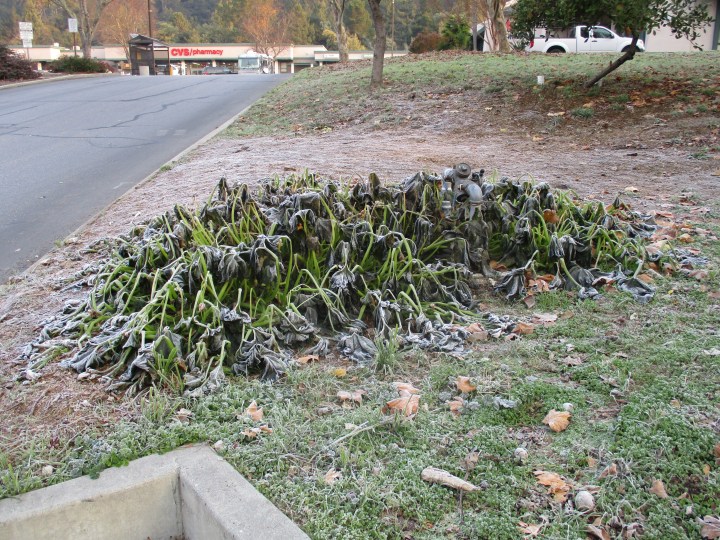
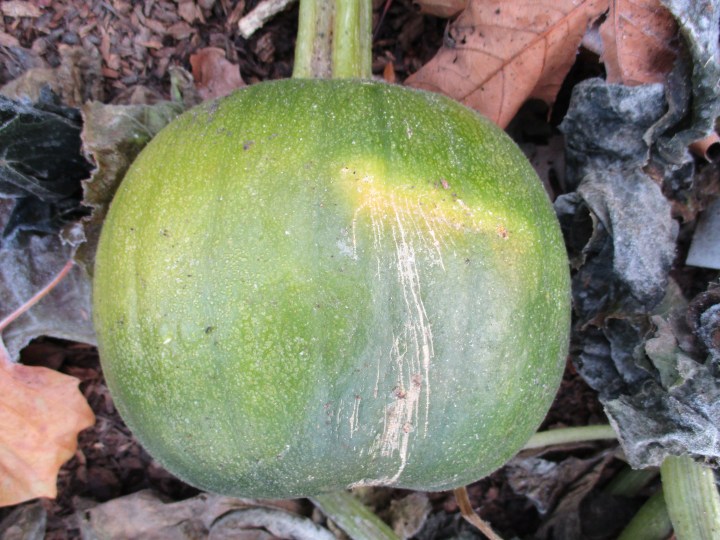
If there is enough space in the garden, the cool season vegetable plants can go somewhere else, while the warm season vegetable plants finish with what they might still be working on. Tomatoes might last until frost. Even when it get too cold for the foliage, green fruit can still ripen on the vine, and a bit more on the kitchen windowsill. Green tomatoes remaining after that can be pickled.

If the soil does not need too much amendment, and the spacing works out well, new cool season vegetable plants can be planted in with the warm season vegetable plants so that they can start to grow and disperse roots while the warm season vegetables finish. By the time the warm season plants succumb to cooling weather, the new cool season plants will already be maturing nicely.

This technique does not work so well with last season’s tomatoes only because they are so greedy with nutrients. Fertilizer might compensate for plants that seem slow where tomatoes had been previously. A bit of amendment can be added to the soil when new cool season plants get planted, and more can be added between them when old warm season vegetable plants get removed.

Broccoli, cabbage and cauliflower should all be planted as seedlings, so can work nicely with interplanting with aging warm season vegetable plants. Since only a few of each type are needed for a well outfitted garden, one or two cell packs of six or eight plants each should be sufficient. Each cell pack does not cost too much more than a packet of seed. Seedlings get established quickly.

Beets, carrots, lettuce, spinach and peas should be grown from seed sown directly into the garden, so do not work so well with interplanting. Too many individual plants of each type are needed. It just would not be practical to grow them from cell pack seedlings. Besides, they grow so efficiently from seed. Kale can be grown either from seed of seedlings. It might be too late for cucumbers.

Politically Incorrect Horticulture

P71008Landscape Designer, Brent Green and I are both very professional at work. Brent is particularly well dressed, well groomed and well spoken. I happen to be simpler and plainer, but it works for the clients who respect my expertise. What our clients do not see is how we interact with each other. It would be very easy to be offended. Yet, we consult with each other almost daily, usually when Brent is driving somewhere . . . alone. We get loud, obnoxious, rude, crude, potty mouthed and just plain nasty!

Years ago, when Brent got his telephone connected to the stereo in the car, he made the mistake of driving up to a drive through window at a fast food establishment while talking to me. I listened to him place his order, and then shouted, “THIS IS A HOLDUP! GIVE ME ALL YOUR MONEY!”.

Last year, while stuck in traffic on southbound Highway 17 with the top down in the old Chrysler, I took a call from Brent. I was using some weird hands-free device at first; but when Brent started rapping about some very objectionable subject matter, I just had to share. I disconnected the device so that the call was coming through on the stereo, and turned the stereo up very loud. I just sat there calmly and tried to look as if I did not know where all the commotion was coming from, although it was obvious. I just didn’t care. Neither did Brent. He was 350 miles away.

However, not all of our nonsense is so senseless. We have developed quite a bit or our own private vocabulary and horticultural slang. It works for us because we share so much common experience. Much of the slang applies to ‘ethnic horticulture’, which refers to the gardening styles of particular ethnic groups. Brent’s favorite ethnic group to invent ethnic horticultural slang for is of course mine. Although I am only halfway of Italian descent, I can really identify with Brent’s observations of the gardening habits of people of Italian descent.

My ancestors have been here so long that the ‘old country’ refers to Sunnyvale (California). Yet, somehow, some traditions continue through many generations. My great grandfather grew many of the plants that are very stereotypical of Italian American gardening. My pa is more cosmopolitan, but he and I still enjoy some of what we learned from my great grandfather.

This is some of the slang that Brent developed for some of what I grow in my garden:

  • dago pansy – nasturtium
  • dago begonia – geranium
  • dago sunflower – dahlia
  • dago rhododendron – oleander
  • dago tomato – tomato (duh)
  • dago wisteria – grape
  • dago plum – fig
  • dago berry – olive
  • dago spruce – Italian cypress
  • dago firewood – any fruitless tree
  • dago ghetto grass – Astroturf (not in my garden)
  • dago groundcover – red lava rock or white moonrock

Dago Pansies

P71007You can say what you like about nasturtiums. My landscape designer colleague, Brent Green certainly did when he named them ‘dago pansies’. They are still one of my favorite flowers, and just might be my favorite, even though none are convincingly white. They were my first. I discovered them when I was very young. They were growing near an old English walnut tree in my great grandfather’s garden. He noticed that I liked them, so found some seeds underneath to send home with me.

I did not know what to do with seeds, so I poked holes into the ground and dropped the seeds into the holes just like my great grandfather showed me to do. A few days later, small round leaves appeared where I had put the seeds. The leaves expanded and looked just like those of the nasturtiums in my great grandfather’s garden. Yellow, orange and even a few red flowers were blooming within a month. I was so impressed when the flowers first appeared, but was then briefly saddened when the first flowers to bloom faded.

I say that I was ‘briefly’ saddened because of what happened next. Where the flowers had been, I discovered what appeared to be the same sort of seeds that my great grandfather had given me! I still did not understand how these things worked; but I took the seeds and stuck them into the ground in other areas . . . anywhere I thought nasturtiums would be nice. They grew, bloomed and provided more seeds, which I took and planted elsewhere . . . and everywhere! To this day, my pa considers nasturtiums to be invasive weeds because of how they overwhelmed the garden that he thought was his.

In my kindergarten classroom, we had ‘color boards’ on a wall. Red, yellow and blue were the tree primary colors. Orange, green and purple were the secondary colors. There were also boards for pink, brown, black, white and gray. We could bring small disposable artifacts from home for our teacher to tape to the various boards. The artifacts were mostly bits of fabric, colored paper, pictures from magazines, Legos, buttons, or really anything we could find that could be taped to a wall. Of course, I had to bring yellow, orange and red nasturtium flowers, and a green nasturtium leaf. Our teacher probably did not want to tape them to the wall, but did anyway. They turned brown, but stayed there. I bragged about them for the rest of the school year.

I still grow descendents of those old nasturtiums. I also try new varieties just because I enjoy them so much. I still like the classic ‘Jewels mix’ because they have every color. They are smaller than wild nasturtiums at first, but are more prolific. After a few years, they revert to the common yellow and orange. Renee’s Garden Seeds at https://www.reneesgarden.com/ has some very interesting varieties, including a few old classics. The climbing types do not bloom as much, but are fun anyway. I probably have not tried them all yet, but I would if I could. I have history with dago pansies.

Small Tree In A Big Park

P71006How did the Featherstone Tree survive? (See: https://tonytomeo.wordpress.com/2017/10/05/big-tree-in-a-small-town/.) It was planted on the edge of a busy highway where heavy loads of lumber were driven by oxen, at a time when society was more interested in harvesting trees than preserving them. Yet, after more than a century, it is still here.

The Scofield Tree is a very small valley oak in an island of a parking lot at Felton Covered Bridge Park, just across the San Lorenzo River from the Featherstone Tree. In a few centuries, it might be comparable to the big valley oak that was recently cut down across the road (See https://tonytomeo.wordpress.com/2017/09/11/goodbye-to-an-old-friend/.) It is a good choice for this location because it develops a remarkably complaisant root system for such a large tree, and it is a native, so does not need to be watered.

However, it is the fourth tree to be planted here. The original California black oak that was planted when volunteers from the Community built the park years ago did not last long before getting run over by a car. It was not replaced until a small Eastern redcedar was planted on New Year’s Day of 2013. That tree was dead and crispy by summer. A bigleaf maple was planted the following winter, and sort of survived through the year, only to die the following winter. It was too late in winter to plant anything new that year, so the tiny valley oak was planted late in 2015.

Although tiny, it had a nice root system, which was more than the two bare-root trees before it had. The hope was that if it could survive getting peed on by dogs long enough to disperse roots, it would be fine. It started to foliate the following spring, only to get much of the bark gouged away by a ‘gardener’ with a weed whacker. The poor tree nearly died, but somehow survived and started to recover. However, it did not recover fast enough to get ahead of the dog pee. It really seemed to be struggling through this year, and is now getting ready to defoliate for autumn. It really needs to get some height next year. Small trees are just too vulnerable to all that goes on in a park.

Each of the redwood trees around the perimeter of Felton Covered Bridge Park is a memorial tree, sponsored by friends or family of the deceased. An additional sweetgum tree is a memorial tree for a French bulldog. Some of the trees are outfitted with memorial plaques. The tiny valley is named the Scofield Tree for an old friend of the Community, Jeff Scofield, who passed away in the spring after the tree was planted; but it is really a memorial tree for a few people who passed away within a few years of that time. The Scofield Tree was sponsored and planted for the deceased by Felton League, an informal group of displaced and socially disadvantaged people of Felton, and their friends. Their Facebook page can be found at https://www.facebook.com/Felton-League-520645548069493/.

Perhaps what is written now about the Scofield Tree will eventually become part of the history of Felton, and be summarized on a plaque like the one on the Featherstone Tree. It would be excellent enough if the Scofield Tree simply does what good treed do in a park for a few more centuries.

Big Tree In A Small Town

P71005Trees get planted all the time. Apparently, nature does not do the job adequately. Trees get put into specific locations to provide shade, produce fruit, enhance a landscape, obscure a view, or for any of a vast number of reasons. It is amazing that they are as accommodating as they are. It is rather presumptuous for us to think that they actually want to live with us in our synthetic environments as much as we want to live with them.

The coastal redwood is the tallest tree in the world. It can live for thousands of years. An individual tree can produce enough lumber to build a small house. It is no wonder that they are so impressive to anyone who sees one for the first time.

Many towns within the natural range of the coastal redwood were established for the redwood lumber industry. Felton, in the Santa Cruz Mountains, is one of those towns. George Featherstone of Ottawa came to Felton in 1888, and was so impressed with the coastal redwood trees, that he planted one in the middle of town only a few years after his arrival. This tree was only a teenager when redwood harvesting increased to supply lumber to rebuild San Francisco after the Great Earthquake and Fire of 1906, and then to develop the rest of the San Francisco Bay Area.

More than a century later, the Featherstone Tree is still here, and is the biggest thing in the small downtown. The Community Deck was built around it by volunteers from the Community many years ago. It is not as tall as trees in the forest are, but only because it does not need to compete with them. It is shorter and stouter, and really seems to enjoy being the center of town. It is quite the celebrity.

Mr. Featherstone had no idea of how important the tree he planted would become. It would be nice if we all could do such nice things for our communities, but then the world would be much too shady.

P71005+(‘ninties’ means the 1890s.) This Redwood Tree was planted in the early ninties by one of Felton’s early settlers, George Featherstone, a man who knew the wonder and beauty of these trees. Born in Ottawa, Canada in 1872, he came to the San Lorenzo Valley on March 17, 1888. He died on September 27, 1947.

What Is Killing The Box Elders?

P71004Remember our concern about the mistletoe? (https://wordpress.com/view/tonytomeo.wordpress.com) You might think that everyone would be pleased to see it gone. Yet, there is the concern that whatever killed the mistletoe might kill something else. That is what happened when the SODS killed so many coast live oaks after being ignored for a long time in the tan oaks. We were aware that the tan oaks were dying, but because the trees were so unpopular, we were not too concerned about it.

Now the box elders are dying around Felton. It is hard to say how widespread the problem is because it has not been investigated yet. Like tan oaks and mistletoe, the native box elders are not exactly popular trees. They do not even make good firewood. We only use them as firewood to get rid of them. However, when so many are die, it leaves big holes in the forest canopy. This is not really a problem, since the forest will have no problem filling the holes in, but it certainly gets our attention. Will the disease or insect pathogen that killed the box elders kill something else next?

The trees seemed healthy as they defoliated last autumn. They were bare through winter when the San Lorenzo River came up higher than it had since 1982. A few box elders got taken away by the River, along with all sorts of other riparian trees from the flood zone, but that is to be expected. Then, after the River receded, many box elders that were in the flood zone did not foliate in the spring. A few foliated, only to have their new foliage shrivel and die shortly afterward. Some of the dead trees became infested with boring beetles. All of the dead trees deteriorated rapidly through summer, and some have dropped big limbs or fallen over.

What is happening with the box elders could be completely normal, and caused by an endemic pathogen; but it makes one wonder. There are so many new insects and diseases being brought in with plants arriving from all over the world, without any regulations to limit the spread of such insects and diseases.P71004+

War Of The Worlds

P71003To a little kid, it really had the potential to be a scary movie. I did not understand all of it, but I got the important parts. Mars was red, so was probably near Oklahoma. Apparently, the people from Mars had big scary machines that destroyed anything and anyone that was in their way. I did not perceive much of a threat because my parents let me watch the movie. (We children could not watch really scary movies.)

Shortly after watching War of the Worlds, I went for a long walk with my older sister and some of her friends into the last remnant or orchard that was such a prominent part of our world. We went out onto a new section of roadway beyond where our street used to end, and turned east on a completely new street that was not there before. The fresh new pavement and neat curbs seemed so flat and desolate . . . and expansive compared to the orchard that it now divided. I wondered how the trees got out of the way of this thing. Obviously, some moved to the left, and others moved to the right.

We eventually arrived at a larger clearing off to the left of this new street. Within this clearing, there were huge concrete rectangles with short pieces of rebar sticking up from their perimeters. One of the concrete rectangles lacked rebar, but was outfitted with four tall poles that curved on top. They looked something like those scary weapons on top of those machines that came from Mars. My sister confirmed my suspicions by explaining that the big concrete rectangles where where the flying machines landed when they arrived. Now I was getting a bit scared.

A few days later, we started to hear strange noises coming from the orchard. I was not allowed to go that far into the orchard without my sister, and was too afraid to go investigate anyway. The noises were mechanical and metallic, mixed with the sound of what seemed to be a big diesel engine and wood breaking. I dismissed them as not ‘too’ terribly threatening at first; but by the next day, they were closer! Each day, they got closer, until I could actually see motion through the trees. Something yellow was moving around in there, and small puffs of black smoke sometimes squirted out above the trees. I was terrified! I told my mother that the mean people from Mars were out there destroying everything like in the War of the Worlds!

She explained that there were no mean people from Mars in the orchard, but that a new park was being built on the site. Well that did not help much. What is this ‘park’? My mother explained that it would be a place where kids could play and run around and climb things and play games . . . and you know. Well duh, that is what the orchard is for. She said that it would be better. I wondered what could possibly be better than the orchard. This is something that I need to see!

Well, for the next two days or so, as they tore out the last two rows or so of trees, it became apparent that they yellow machines from Mars that spurted out black smoke were bulldozers gouging the trees right out of the ground. No one even bothered to cut up the firewood to leave on the side of the road like was typically done. The trees were unceremoniously piled up and burned. I was no longer terrified. I was saddened and confused. I could not understand why anyone would want to do this to the most important part of our world.

The big concrete rectangles with rebar protrusions were not landing pads for the flaying machines from Mars. They were the foundations and floors of the Recreation Center for the new park. The concrete rectangles with the four curved poles that seemed to be an assembly site for the weaponry from Mars simply became two basketball courts. The curved poles were outfitted with backboards and hoops. The orchard, devoid of trees, was leveled in most areas and mounded in others, and mostly covered with a vast lawn. New trees were planted around the perimeter and within landscaped areas around the Recreation Center. I suppose as far as parks go, it was a nice one.

The only problem with it was that we did not know what to do with it. The new trees were too small to climb or hide behind or really to do anything with. The lawn was nice, but there was way too much of it. The Recreation Center was nice inside, but we wanted to be outside. Eventually, we learned how to enjoy our park, and it really was nice; although it will never be an adequate substitute for an orchard. Our suburban (or some might say ‘rural’) world was invaded and, unlike in the movie, conquered by a more urban culture.

I would not say that one culture is any better than the other. However, I will say that I believe that there was a certain advantage to knowing the orchard and some of the nearby undeveloped wildlands the way that we did. I really believe that it was more educational than the refined and synthetic landscape of the new park. The maintenance of the park certainly required some degree of horticulture. There are trees, lawn and all sorts of shrubbery and perennials. The orchard had only trees and mustard. We interacted with it differently somehow. This is something that I can not explain adequately. It can only be experienced.

Why Autumn Is Also Fall

71011thumb.jpgThe calender says that it is now autumn. The weather does not necessarily agree. Some of the trees are dropping their leaves. However, the leaves are not falling because the weather is getting significantly cooler. The leaves got cooked during that weird heat wave a few weeks ago. If the weather can be this confusing here in our very mild climate, it must be really crazy everywhere else.

It is hard to make sense of what trees are dropping leaves in response to the earlier heat. Coast live oak, which normally tolerates heat quite well, was really annoyed by the heat in some areas. Cottonwood and other poplars are expressing their discomfort too, but that is to be expected from them. Sycamores, which are normally sensitive to weather anomalies, are not overly concerned.

All this means to us, the janitors of our trees, is that some of us might be raking leaves earlier than expected. These leaves will not be the nice colorful sort that we like to see in autumn. Those will come later. It is still too early to know how the weather will affect autumn color. All we know so far is that some trees will have less foliage for coloring. Sweetgums are hinting at a colorful autumn.

Leaves should be raked as they fall. However, because no one wants to clean the eave gutters any more than necessary, they can be cleaned only a few times, or maybe only once if trees shed efficiently. They are easiest to clean before the rain starts and the wet leaves start to decay. Unfortunately, most deciduous trees continue to drop their leaves well into the rainiest part of winter.

Lawns and shallow or dense groundcovers really do not like to be shaded by fallen leaves for too long. To perform through winter like we expect them to do here in our mild climate, they want as much sunlight as they can get while the days are shorter and the sun is lower on the horizon. Besides, fungal pathogens like mildew and rot, are more likely to proliferate under damp fallen foliage.

Finely textured leaves under low shrubbery and coarsely textured groundcover that ‘eats’ fallen leaves is a nice mulch, so does not need to be raked. If it can not be seen, and is not too abundant, it is probably not a problem. The exceptions are fallen leaves of roses, grapes, cane berries, deciduous fruit trees, and any plants that are susceptible to diseases that overwinter in fallen leaves.

Blue Ribbon

P71001Somewhere in the San Lorenzo Valley, there is a little old lady who is stitching a blue quilt. It is made of all the blue ribbons that she wins every year at the Jelly and Jam Contest of the Santa Cruz Mountains Harvest Festival. I do not know who she is, but I recognize her squiggly writing on the fancy labels. It is barely legible. Her hands are worn and tired from three quarters of a century off picking fruit, processing it into jelly and jam, and then stitching all her blue ribbons together. She probably giggles as she works, and thinks about everyone who wins only red or white ribbons.

Three years ago, I submitted my blue elderberry jelly and ‘Shiro’ white plum jam into the contest. They both won! Blue elderberry won second place. White plum won third. Two years ago, the blue elderberry jelly won second place again, although the white plum jam did not win anything.

Last year, I submitted the maximum of five jellies and jams. I was determined to get my blue ribbon! In conjunction to blue elderberry jelly and white plum jam, I also submitted peach jam, blackberry jelly and Santa Catalina Island cherry jelly. However, the Jelly and Jam Contest was not publicized like it should have been. Very few people were aware of it. Consequently, there was only ONE other entry! It was a sloppy and seedy strawberry and kiwi jam made from fruit that was not likely home grown. I knew I would finally win my blue ribbon, and probably red and white too! Technically, it was not cheating. It was just the way things worked out.

It was no surprise that the blackberry jelly won third place. It was a bit of surprise that the blue elderberry won second place, even though it had done so twice before. I was hoping that it would be the blue ribbon winner. That was not a problem. I was sure it won second place only because one of the other three had won first place. I stepped off the grandstand after claiming each of the two ribbons, but thought about just staying there for the third. I did the tactful thing and walked off stage.

Finally, the first place winner of the blue ribbon in the Jelly and Jam Contest was to be announced. I was halfway into my first step back to the grandstand when I heard “STRAWBERRY AND KIWI JAM”! What?! How was this possible? What was she putting in that jam?! The winner was not present to claim her ribbon, but she won nonetheless. I imagined her watching with a telescope from the window of her secret hideout in the mountains above town, and laughing maniacally.

Well, the Santa Cruz Mountains Harvest Festival was yesterday. For the Jelly and Jam Contest, I submitted only two entries; blue elderberry jelly and blackberry jelly. There were only four other entries; fig jam, peach jam, another blackberry jelly and the infamous strawberry and kiwi jam. I was pleased that my blackberry jelly won third place, and I still hoped for the blue elderberry jelly to win second or first. The peach jam won second. It was made by . . . WHO? MY MOTHER’S PEACH JAM WON SECOND PLACE?! This was intolerable! I ALWAYS win at least second place! What made it worse is that I lost to my MOTHER’S peach jam! Where did she learn how to make jam? . . . and from peaches from the tree that I grew? Before I could recover from this baffling revelation, the first place winner was announced; and it was again, the strawberry and kiwi jam.

Wow! I do not know what to think. I got to meet the lady who makes the strawberry and kiwi jam. She is not a little old lady who lives in a secret hideout. She is a pretty young lady, and she actually told me that she does not intend to compete next year, and told me that I should try her recipe. I thanked here but declined. I do not want to use store bought produce. Now the difficult part. I need to deliver the second place red ribbon to my mother who was not there to claim it.

‘Peaches and Cream’ Grevillea

71011No one knows for certain who the parents were, so the hybrid Grevillea ‘Peaches and Cream’ lacks a species designation. (If it is important, the parent are most likely Grevillea banksii and Grevillea bipinnatifida.) It is an evergreen shrub that gets about four feet high and wide, with intricately lobed light green foliage. Individual leaves are about four inches long and two inches wide.

Four inch long floral trusses of tiny flowers can bloom at any time, attracting hummingbirds. Flowers bloom greenish yellow and then fade through a range of yellow, peachy orange and pink, from the bottom of the truss to the top. Warm and sunny exposure promotes bloom. Established plants do not need much water. Like other grevilleas, ‘Peaches and Cream’ grevillea can cause contact dermatitis. (It is best to know if one is allergic to it before planting it.)