Seriously?!

P71104Gardening is not for everyone. If you are reading this, you probably enjoy gardening. There are many more people who simply are not interested in it. Some tend to their own gardens in a basic manner just to keep their homes looking good. Most hire gardeners to maintain their landscapes for them.

I use the term ‘maintain’ very lightly. What they really do is keep the lawn from getting too deep, and other plants from getting too overgrown. Very few really care how they accomplish these basic requirements.

I could go into the detail about how they brag about saving water while wasting enough to drown trees, or how they shear everything within reach into nondescript . . . whatever they get shorn into, or how most problems that arborists encounter in their work are caused by gardeners. Instead, I am just gong to talk briefly about two examples of the lack of expertise or concern or both exhibited by gardeners who maintain the landscape at a small office building in my neighborhood.

There are a few healthy ‘Prairie Fire’ flowering crabapple trees in this landscape. A few years ago, they bloomed spectacularly! The following year, they were about to do the same thing. They were quite healthy, with plump buds that were swelling nicely as winter became spring. Just as the buds were about to pop, and the bright pink of the flowers within was becoming visible between the bud scales, the gardeners arrived and pollarded all the trees. Yes, they pruned away ALL of the blooming stems, cut them up, and disposed of them, leaving bare trunks and limbs. There was not bloom.

The trees recovered through the year, and produced plenty of stems to bloom the following spring. Again, the buds swelled at the end of winter, only to be completely removed when the trees were pollarded just before bloom. The trees were not even pollarded correctly. It was quite a hack job. This happens every year now. The trees never bloom.

A stone retaining wall below this landscape was well landscaped with rosemary hanging down from the top, and Boston ivy climbing up from below. The two will eventually be redundant to each other as the rosemary grows enough to cover the wall without the help of the Boston ivy, but for now, they work well together.

The Boston ivy was just beginning to show autumn color. It happens to be one of the few plants that colors reliably in our mild climate, with bright yellow, orange, red and burgundy. It would have been spectacular, but, like the budded stems of the flowering crabapples, all the Boston ivy was cut down to the ground. All the foliage that was just about to do what it does best was completely removed and disposed of.

There is certainly nothing wrong with exposing parts of the handsome stone wall. The rosemary still cascades from above to break up the expansiveness of the wall. The problem is the untimely removal of something that should have been an asset for the landscape, rather than just a liability. The Boston Ivy could have been cut back in winter, after displaying its spectacular autumn foliar color. Professionals should know how to accomplish this.

The property manager pays a lot of money for this sort of nonsense. Hey, we all know mistakes happen; but this is inexcusable. Seriously, people who know nothing about gardening could do better than these so called professionals.
My Tiny Downtown Garden

P71105Main Street and Santa Cruz Avenue are the two main streets of downtown Los Gatos. They are the main shopping district, and the part of town that everyone sees. As much as things have changed, a bit of the familiar remains. Gilley’s Coffee Shoppe is still next door to the (rebuilt) Los Gatos Cinema. The brick La Canada Building miraculously survived the Earthquake. The simple deco Park Vista Building across the street is just as elegant now as it was a century ago. There are still concerts in the Town Plaza in summertime, shaded by the Town Christmas Tree that gets lit up in December.
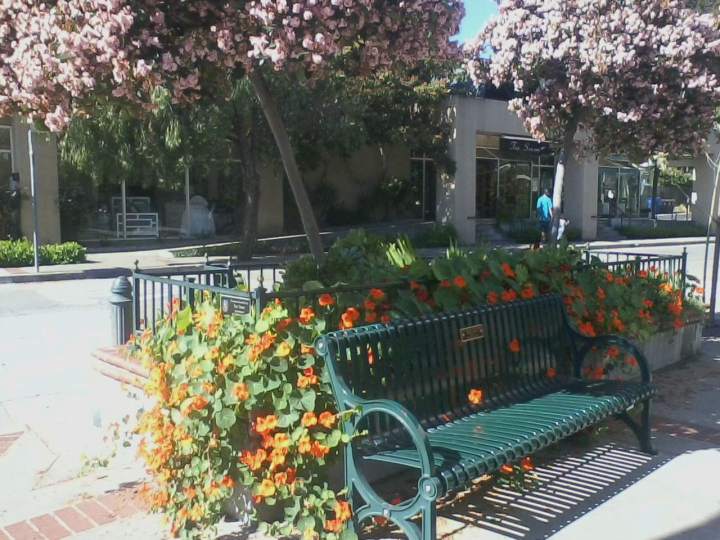
Both Main Street and Santa Cruz Avenue are outfitted with big planter boxes that give the downtown a more relaxed and colorful ambiance. Each planter is elevated about a foot and a half, and contains one or two Indian hawthorn trees. A low wrought iron railing protects the contents of the planter boxes. Irrigation s automated. That is about all that the planters have in common.

Each planter box is ‘adopted’ by a member of the community, or a community group, each with different styles and different ideas of what we should plant in our boxes. Some like things neat and trim. Others believe that bigger is better. Some like plenty of foliage. Others like lots of colorful flowers. Some planter boxes even get adorned with seasonal decorations.

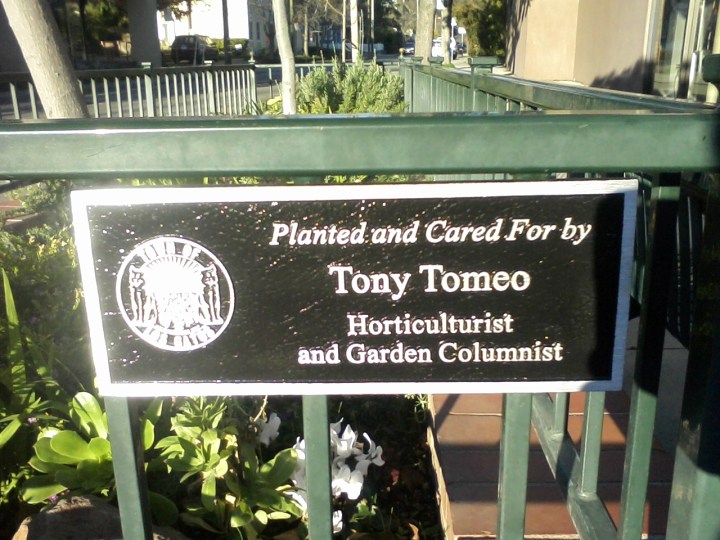
My little planter box is on the northwest corner of Nicholson Avenue and North Santa Cruz Avenue. It has a brass plaque with my name on it. It is my little garden space downtown, where I get to express my simple gardening style for everyone to see, even though I grow a few flowery things there that I would not actually waste space on in my own garden.

The trailing rosemary that cascades over the wall so nicely was there when I got the planter. So were the montbretia and liriope, which I did not want to remove because someone else had gone through the effort of planting them. When there was more space available, I planted a few inexpensive flowering annuals, like pansies and calendulas. As things grew, there was less space for annuals. Besides, I wanted to make a point of doing this planter nicely with sustainable plants that I propagated myself.

The two largest features are common aeoniums. The two original cuttings were on the dashboard in the car for weeks before I finally stuck them in the planter. They came from the home of a friend’s mother in Monterey. We emptied the home out after she passed away. It was gratifying that they found a home in my planter box, and even more gratifying that they grew so well and provided countless cuttings for copies all over town, including in other planter boxes. Between the two big aeoniums, there is a small bronze aeonium. It is the same age as the two big ones, but grows slower, and is regularly set back by people breaking off and taking the stems as fast as they grow.

These three aeoniums were not alone on the dashboard. They arrived with another related succulent, which I believe to be an old fashioned echeveria, and some sort of compact aloe. The echeveria has spread out over much of the area between the big aeoniums. The aloe is still confined to one corner.

To contrast with all the pale green foliage, I added two bronze ‘Australia’ cannas. They cost only a few dollars, and were probably my biggest expense in this entire project.

The most impressive feature of the planter box are the nasturtiums. Yes, common, simple and cheap nasturtiums. I wanted to get straight yellow nasturtiums for compatibility with the signs of the neighboring bicycle shop, but could not find any at the time. I instead started with the common ‘Jewels’ mix, which is still my favorite. After self sowing, the subsequent feral nasturtiums are only orange and yellow, with only one or two red blooming plants. What made them so excellent is how they grew! They overwhelmed the trailing rosemary (which is fine since they die back in summer when the rosemary takes over), and cascaded onto the walkway and curb. They filled the space between the railing and an adjacent bench, and even started growing through the bench. There was so much bright orange and yellow that no one seemed to mind that it was nasturtium.

After a long and warm summer, the aeoniums need serious grooming, and the nasturtium need to be replaced. I really hope that the planter box will be as impressive as it was last winter. The picture here is not very good. Perhaps I will get a better picture in a few months.

P71105+

Dwarf Bluegum

P71103Bluegum is famously problematic. It is too big, too invasive, too messy, too structurally deficient, and as demonstrated in the Oakland fire, too combustible. Dwarf bluegum, Eucalyptus globulus ‘Compacta’, is a completely different animal that does not even look related. It gets only about fifty feet tall, with a dense and somewhat symmetrically rounded canopy. The mess and falling limbs do not affect such a large area.

Dwarf bluegum is not a particularly appealing tree for home gardens, but happens to be practical on freeways or for quick shade in areas that are not landscaped. Once it gets going, it needs no irrigation. Too much water compromises stability. The distinctively curved lanceolate leaves resemble those of common bluegum, but are more densely arranged on shorter stems. Self sown seedlings grow as normal bluegums.

Plants Grow Up So Fast

50429thumbShortly after germinating and producing their first few leaves, many seedlings start to produce foliage that is indistinguishable from the foliage that they will produce for the rest of their lives. Other plants might initially be outfitted with leaves that are smaller, thicker, or somehow slightly different from what will appear later. Then there are those that produce juvenile growth that is completely distinct from later adult growth.

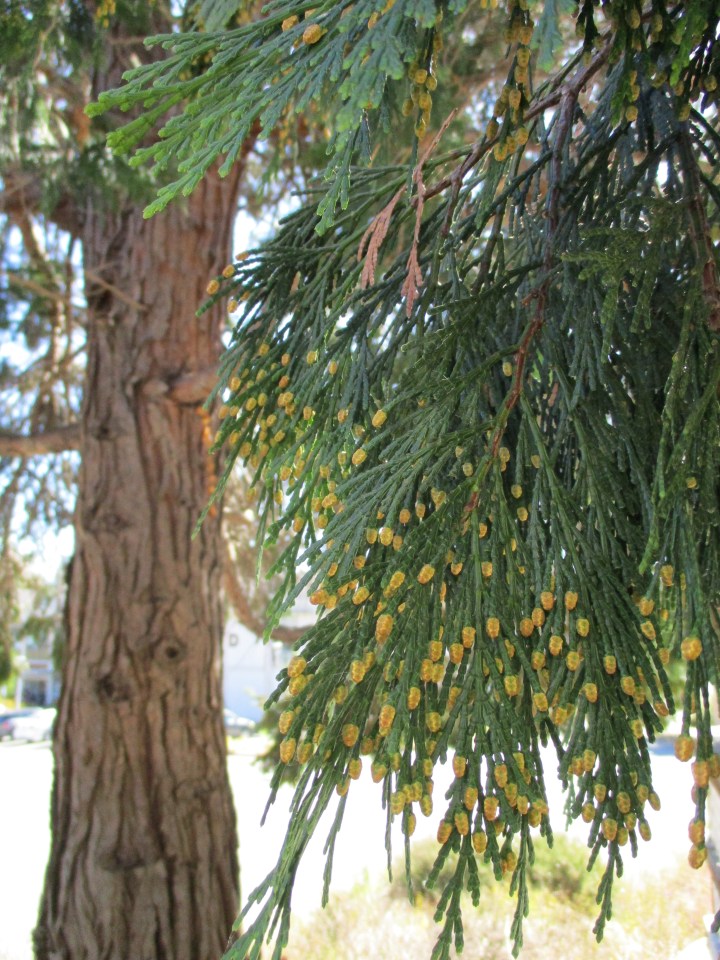
There are many reasons for juvenile growth. It might be a competitive advantage for plants that live in dense forests. For others, it might deter grazing animals. Ivy actually has three phases, with juvenile ‘ground cover’ growth that creeps over the forest floor in search of a vertical support, adolescent ‘vine’ growth that climbs the support, and adult ‘tree’ growth that blooms and seeds when it gets to the top of the support.

Eucalyptus trees produce juvenile growth that is more pungently resinous than adult growth, in order to deter animals that would otherwise eat it. Adult growth develops when the main trunks have grown beyond reach of most of the threatening animals. Vigorous new growth that develops in response to breakage or pruning later in life is also outfitted with juvenile foliage so that koalas and other climbers leave it alone.

Avocado trees grown from seed produce no obvious juvenile growth, but without wasting their effort on blooming and fruiting, they grow very fast and lanky to compete with a dense forest canopy, whether real or imagined. For their first several years, they need to be pruned for structure and containment. They eventually produce adult branches, and start to bloom and produce fruit (although the fruit might be variable.)

Avocado trees obtained from nurseries are grafted so that they are genetically identical to a specific cultivar (for conformity of fruit), and so that they can start to produce right away. Their ‘scions’ (upper part of grafted trees) are obtained from adult growth of stock trees, so do not take several years to mature. The same technique works for citrus, which otherwise produce fruitless and wickedly thorny juvenile growth.

Sometimes, juvenile growth is preferred. Ivy gets pruned out of trees and off of walls to preserve the juvenile growth as an appealing and efficient ground cover plant, while also eliminating the potentially destructive climbing vines.51104

Change of Format

P71019

This blog is now two months old; so it is about time that I start to recycle old articles instead of writing so many ‘elaborations’. The articles are probably more interesting and relevant anyway. They will be from the same time last year, or previous years. Like I have been doing with new articles, the old articles will be split into two separate postings. One will be the main topic. The other will be the ‘plant’ of the week. So, one new article and one old article split into two postings each week leaves only three days for ‘elaborations’. Redundant articles will be omitted. Eventually, I will refrain from daily postings. Also, I will try to keep my ‘elaborations’ brief. I know I tend to get carried away with this. Alternatively, I may recycle another article each week, leaving only one day for ‘elaborations’. I will figure this out as I go along.

While I am taking the time to post something that has nothing to do with gardening, I should also mention that one of my main objections to writing a blog is that so much of what I write about is specifically for the climate in which I live, and not necessarily applicable to other regions. My articles are written for newspapers between San Francisco and Beverly Hills (in Los Angeles County). However, since starting this blog, I have found that not only do the newspapers that I write for already share my articles with newspapers in other regions, but that people who read my articles in other regions are already as aware of regional differences as I am. People in Australia seem to be as interested in reading about autumn during their spring as I am interested in reading about their spring during autumn. People seem to know how much of the information that I present is actually useful to them, and can distinguish information that is not accurate for their respective applications. Now, I feel much better about posting my articles, as well as writing about whatever I want to write about.

If you are wondering how the picture of Rhody above is relevant to the posting, it has no relevance. He just had a way of getting you to read my blog earlier, so I tried it again, and it worked.

Incense Cedar

71108In the west, the incense cedar, Calocedrus decurrens, was made into cedar chests or paneling for cedar closets as a substitute for the more traditional Eastern redcedar (which is incidentally a big juniper). The wood is supposedly aromatic enough to repel moths from woolens and furs. The evergreen foliage is very aromatic as well, so is sometimes used for garlands at Christmas time.
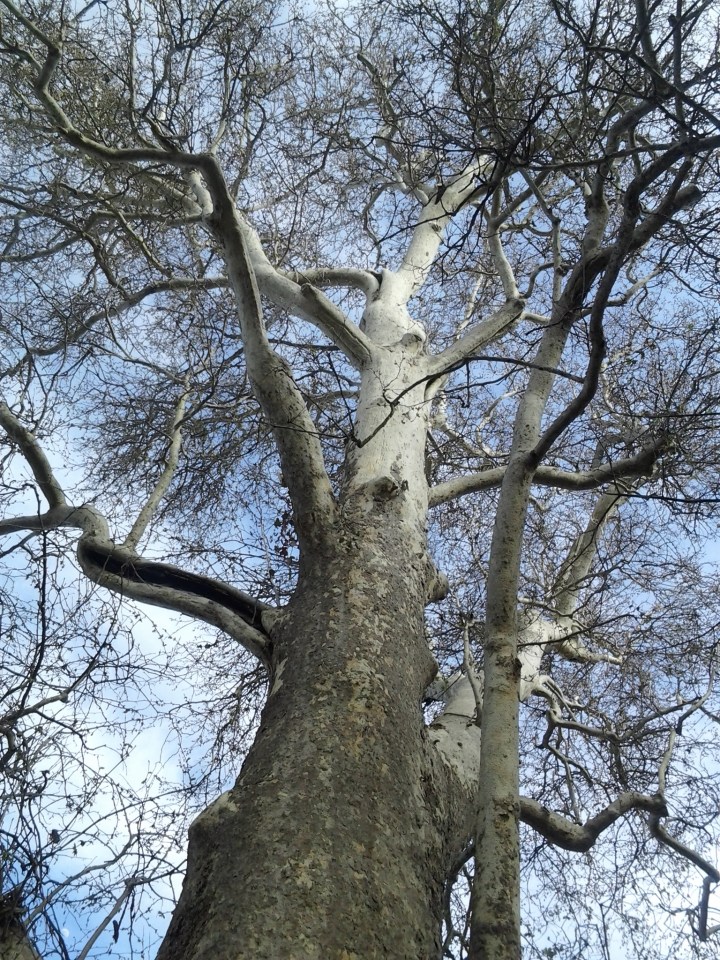
Old trees in the wild can eventually get nearly two hundred feet tall, with somewhat narrowly conical canopies. Yet, hundred year old trees that were planted in urban gardens during the Victorian period are not half as tall yet. Some are quite narrow. The rusty brown bark is deeply and coarsely furrowed. Branches can sag downward and curve back upward, which looks rather disfigured. Flattened sprays of scale-like leaves resemble those of arborvitae. Incense cedar is native to the Sierra Nevada and Cascade Mountains.

Arborists Are Physicians For Trees

71108thumbBefore the storms of winter get here, it might be a good time to make arrangements to get some help for big trees that need it. Smaller trees that can be reached from the ground may not need anything that we can not do ourselves. It is the big trees that have grown beyond our reach that may need professional help if they have problems. They are unsafe for us DIY garden enthusiasts.
Once late autumn and winter weather patterns start, storms can break limbs and destabilize trees. Identifying problems and executing necessary remedies can limit such damages before they happens. Disproportionately heavy or structurally deficient limbs can be pruned to reduce weight and wind resistance. Obtrusive limbs can be pruned for clearance from roofs and anything else.

Trees are the most significant and influential features of our gardens. They shade and extend their limbs over our homes and gardens. Not only can they cause serious damage by dropping limbs or falling, but they can also change how our home and garden are affected by their shade. They are worthy of proper maintenance, even when it is necessary to procure the services of an arborist.

An arborist is a horticulturist who specializes in arboriculture, which is the horticulture of trees. Arborists are essentially tree physicians, who evaluate the health, stability and structural integrity of trees, and make recommendations for maintenance, or to repair problems. Most municipalities require an ISA Certified Arborist report in order to issue a permit to remove an unsalvageable tree.

The ISA is the International Society of Arboriculture. Certified Arborists have passed an examination of their arboricultural expertise, and maintain their credentials by continued involvement with ISA educational seminars, classes and workshops. More information about the International Society of Arboriculture and local certified arborists can be found at the website, www.isa-arbor.com.

Arboriculture is not the sort of thing that gardeners should be expected to perform. It is completely different from the sort of mowing, shearing and pruning that they do. Sadly, much of the damage that arborists find in trees was caused by improper arboricultural procedures. Arboriculture also has the potential to be very dangerous to someone who lacks adequate training and equipment.

Colors

P71029+Remember the movie from 1988? I don’t either. I never saw it. Gang violence is not my idea of a good time. The title ‘Colors’ refers to the use of distinguishing colors by the gangs of Los Angeles. Gang members wear colors that correspond to their respective gang affiliation.

As autumn progresses, some of us get to gloat about our colors. New England gets the most and best colors, with a full range of reds, oranges and yellows, as well as browns and burgundies. The Appalachian Mountains to the south seem to go lighter on the reds and burgundies, concentrating more on oranges. The upper Midwest around Minnesota excels at the rich reds, with yellows confined to groves of cottonwoods. The lower Midwest does well with clear browns alternating with yellows, and even some oranges. The Rocky Mountains have a good range of color, with more gold than the Appalachians Mountains, but it is not as spectacularly concentrated. The bright colors contrast more with evergreens.

Here on the West Coast, we have yellow. . . . and redwoods . . . and palm trees. The bright yellow cottonwoods are quite flashy farther inland and in Nevada, where they grow along creeks and rivers that flow through the southern deserts. The only orange and rusty red we get from native specie here is from poison oak. Cottonwoods, willows, sycamores, box elders and even the bigleaf maples all turn yellow; and only when the weather is just so. Box elder foliage is more likely to shrivel and turn tan. Sycamore and willow foliage usually gets rather shabby.

To get the bright oranges and reds that everyone else in American enjoys, we plant exotic (non-native) trees; and there are not many choices that color reliably in our mild climate. Sweetgum is probably the most reliable, and the most variable with its color. Pistache and flowering pear are the second best choices, although flowering pear has a serious problem with fireblight here. Gingko colors very nicely, but is limited to yellow, which we already have a bit of.

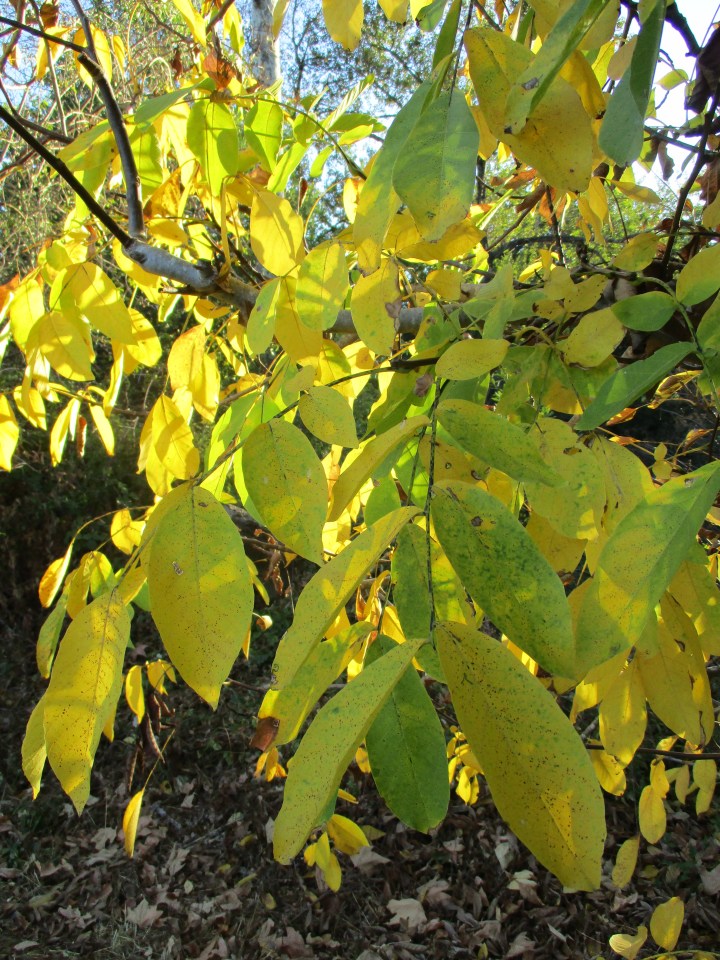
While everyone else is posting pictures of their autumn color online and bragging to Californians about it, our color is only beginning to develop here. The most reliably colorful of the exotic trees seem to be doing well; but the natives and some of the exotics are defoliating prematurely, without much color at all. Honeylocusts have dropped most of their foliage while it is still lemon-lime green. Box elders just look sickly. Cottonwoods drop leaves as soon as they turn yellow, leaving only green leaves up in their canopies. The English walnut in the picture is the best color I could find.

It happens this way sometimes. This year, it might be a result of the unusually warm weather so late in summer, after the weather had already started to turn milder. It is impossible to say for certain. We take what we can get. We are not known for autumn color here.

P71029

Planned Obsolescence

P71028For my exquisite 1979 Electra, planned obsolescence did not work out so well. It was probably a grand Buick for that time, and one of the last with tail fins! It was elegant. It was big. It was steel. It was made to last ten years or 100,000 miles . . . and that was it. Seriously, as much as I enjoyed that car, it did not want go to much farther than it was designed to go. It limped along for almost 20,000 miles more, but was not happy about it, and was really tired and worn out by the time it went to Buick Heaven.

Planned obsolescence used to mean something completely different in landscaping. Yes, we all know what it means now; that many of the so called ‘sustainable’ modern cultivars last only a few years so that they need to be replaced sooner than older cultivars. What it used to mean is that fast growing plants were used to get a landscape established quickly, while more desirable but slower plants took their time growing. As the more desirable plants matured, the fast growing plants could be removed.

For example, a large condominium complex was landscaped primarily with Norway maples and flowering pears. These trees would eventually grow to be proportionate to the buildings and the spaces that they shade. To provide shade sooner, and to help the landscape look established by the second summer, common cottonwoods were incorporated into larger areas. Their placement was not as important as it was to the maples and pears, but was strategic enough to avoid the other trees and buildings as long as possible. The intention was to allow the cottonwoods to be the prominent trees in the landscape only temporarily, but to remove them as the maples and pears matured. It was a practical technique used by landscape designers for as long as anyone can remember.

Sadly, few modern ‘gardeners’ understand this concept. The cottonwoods did not get removed when they should have been. They overwhelmed and crowded the other trees, and caused them to be disfigured as they grew. The cottonwood roots broke pavement and ruined lawns. Then, after all the damage and destruction, . . . the cottonwoods died, like cottonwoods do. Now the landscape is shaded by healthy but distorted maples and pears. The plan did not work very well.

Now, such planned obsolescence is simply impractical for trees. Even if those maintaining landscapes were reliable enough to follow through with such plans, modern tree preservation ordinances would prevent them from getting permits to remove temporary trees. Planned obsolescence can work with smaller shrubbery and perennials in home gardens, but those of us who use the technique must follow through with our plans so that things do not get too crowded.

Firewood

P71027Heating homes has certainly changed. It has gotten much more efficient and less polluting. Homes are much better insulated than they were only a few decades ago. Heating systems use much less fuel, and produce much cleaner exhaust. That is partly how more than a million people who live in San Jose now make less smog than when there were half as many.

The unfortunate part of that efficiency is the decline in popularity of traditional fireplaces and stoves. Burning wood is now politically incorrect, and at times, even illegal. ‘Spare the air’ days are strictly enforced when air quality gets unpleasant.

In San Jose, building codes do not allow fireplaces to be build into new homes. Only homes that were build with fireplaces or stoves prior to the ordinance are outfitted with them. Fireplaces that are damaged by earthquakes are often removed instead of repaired.

Tending a fire does not fit into modern lifestyles very well anyway. If someone stays home long enough to do so, he or she is too busy with other work. Tending a fire simply is not considered a common household chore anymore. Fireplaces do not have thermostats, so do not maintain the sort of consistency in temperature that so many of us have become accustomed to.

Those of us who still use our fireplaces (when permitted) must procure firewood. There are no more deteriorating orchards to supply it. We can not grow our own because permits are needed to cut down trees that are big enough to make firewood. Permits are only granted for trees that must be cut down for other reasons. The need for fuel is not good enough.

Consequently, it becomes necessary to purchase expensive firewood. To some of us, it is still worth it. We can either purchase mixed firewood from a tree service, or get it from a firewood cutter in the Santa Cruz Mountains. There always seem to be more trees that need to be cut down than are needed for firewood.