 How did the Featherstone Tree survive? (See: https://tonytomeo.wordpress.com/2017/10/05/big-tree-in-a-small-town/.) It was planted on the edge of a busy highway where heavy loads of lumber were driven by oxen, at a time when society was more interested in harvesting trees than preserving them. Yet, after more than a century, it is still here.
The Scofield Tree is a very small valley oak in an island of a parking lot at Felton Covered Bridge Park, just across the San Lorenzo River from the Featherstone Tree. In a few centuries, it might be comparable to the big valley oak that was recently cut down across the road (See https://tonytomeo.wordpress.com/2017/09/11/goodbye-to-an-old-friend/.) It is a good choice for this location because it develops a remarkably complaisant root system for such a large tree, and it is a native, so does not need to be watered.
However, it is the fourth tree to be planted here. The original California black oak that was planted when volunteers from the Community built the park years ago did not last long before getting run over by a car. It was not replaced until a small Eastern redcedar was planted on New Year’s Day of 2013. That tree was dead and crispy by summer. A bigleaf maple was planted the following winter, and sort of survived through the year, only to die the following winter. It was too late in winter to plant anything new that year, so the tiny valley oak was planted late in 2015.
Although tiny, it had a nice root system, which was more than the two bare-root trees before it had. The hope was that if it could survive getting peed on by dogs long enough to disperse roots, it would be fine. It started to foliate the following spring, only to get much of the bark gouged away by a ‘gardener’ with a weed whacker. The poor tree nearly died, but somehow survived and started to recover. However, it did not recover fast enough to get ahead of the dog pee. It really seemed to be struggling through this year, and is now getting ready to defoliate for autumn. It really needs to get some height next year. Small trees are just too vulnerable to all that goes on in a park.
Each of the redwood trees around the perimeter of Felton Covered Bridge Park is a memorial tree, sponsored by friends or family of the deceased. An additional sweetgum tree is a memorial tree for a French bulldog. Some of the trees are outfitted with memorial plaques. The tiny valley is named the Scofield Tree for an old friend of the Community, Jeff Scofield, who passed away in the spring after the tree was planted; but it is really a memorial tree for a few people who passed away within a few years of that time. The Scofield Tree was sponsored and planted for the deceased by Felton League, an informal group of displaced and socially disadvantaged people of Felton, and their friends. Their Facebook page can be found at https://www.facebook.com/Felton-League-520645548069493/.
Perhaps what is written now about the Scofield Tree will eventually become part of the history of Felton, and be summarized on a plaque like the one on the Featherstone Tree. It would be excellent enough if the Scofield Tree simply does what good treed do in a park for a few more centuries.
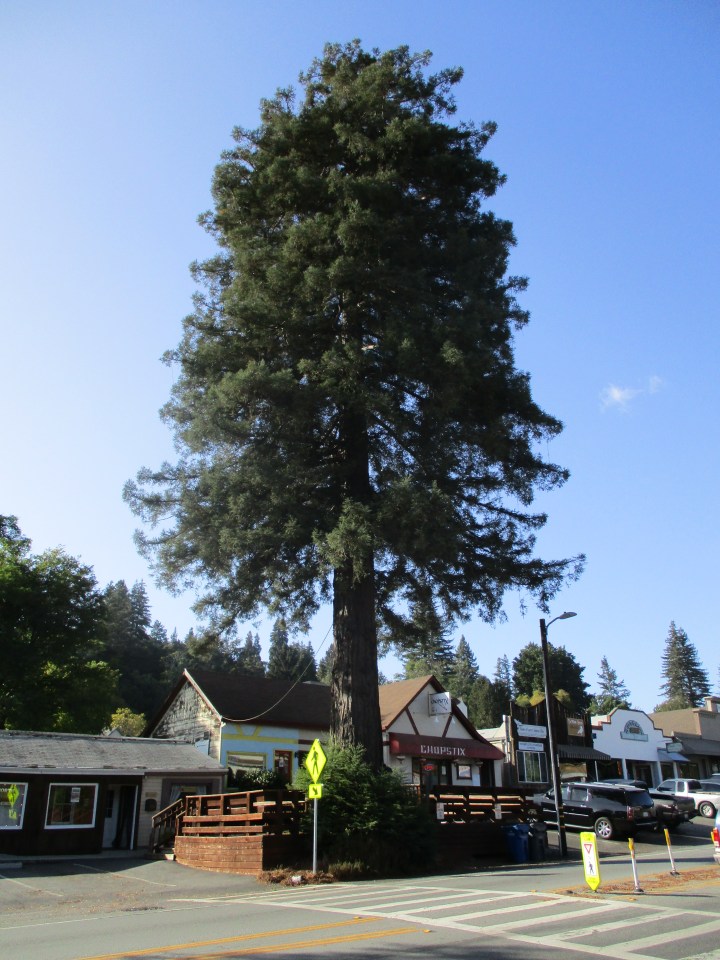 Trees get planted all the time. Apparently, nature does not do the job adequately. Trees get put into specific locations to provide shade, produce fruit, enhance a landscape, obscure a view, or for any of a vast number of reasons. It is amazing that they are as accommodating as they are. It is rather presumptuous for us to think that they actually want to live with us in our synthetic environments as much as we want to live with them.
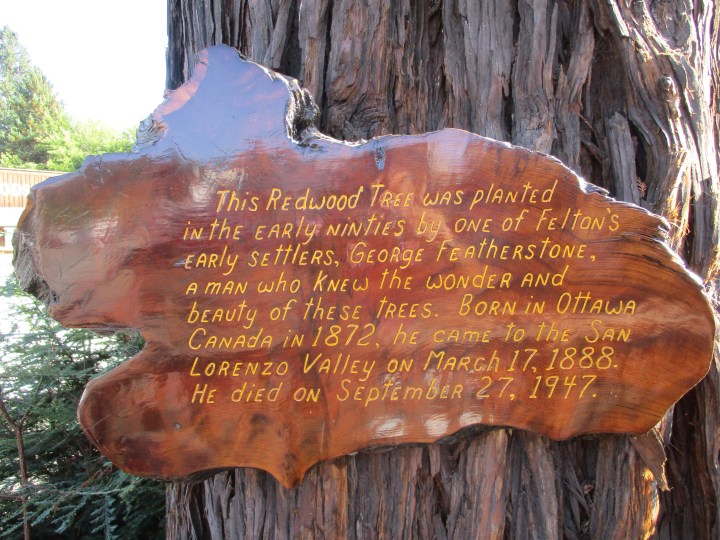 (‘ninties’ means the 1890s.) This Redwood Tree was planted in the early ninties by one of Felton’s early settlers, George Featherstone, a man who knew the wonder and beauty of these trees. Born in Ottawa, Canada in 1872, he came to the San Lorenzo Valley on March 17, 1888. He died on September 27, 1947.
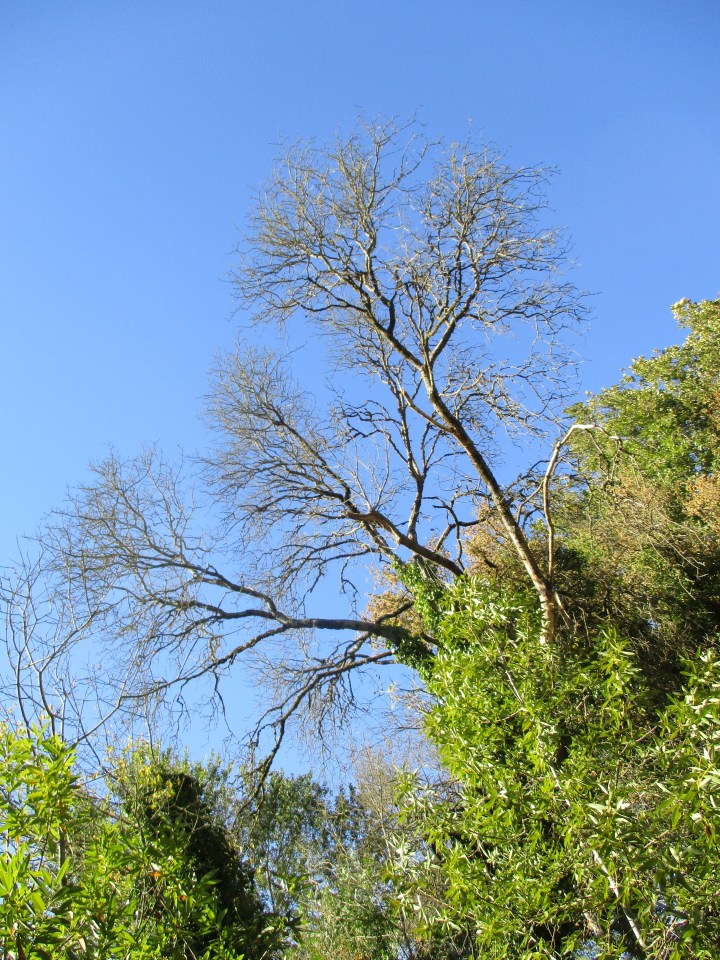 Remember our concern about the mistletoe? (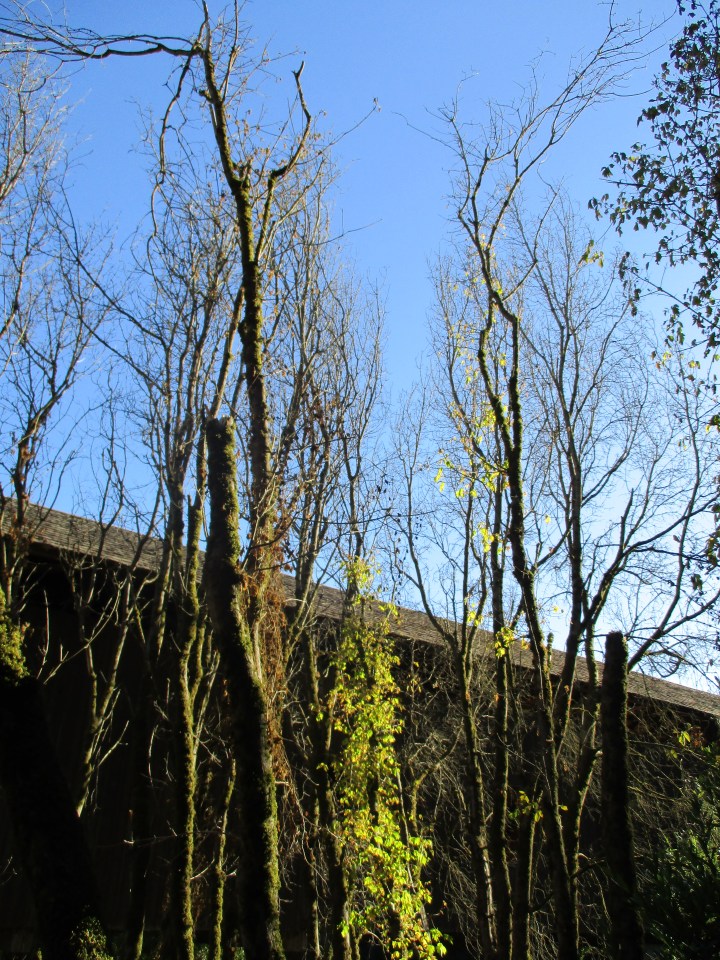
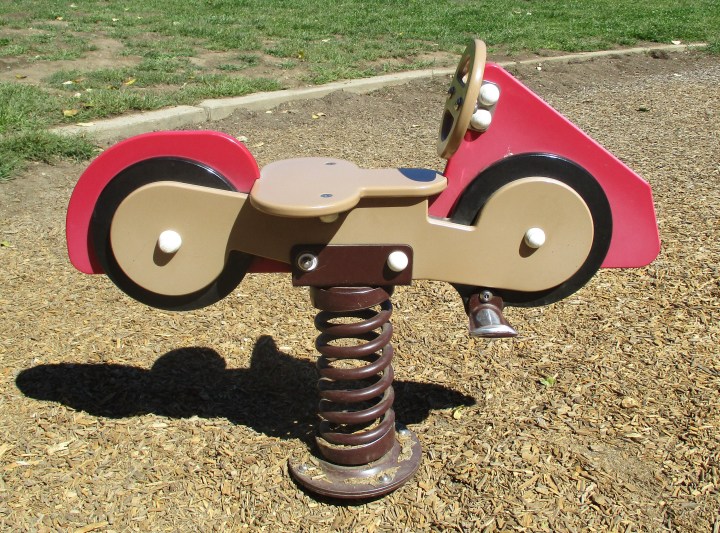 To a little kid, it really had the potential to be a scary movie. I did not understand all of it, but I got the important parts. Mars was red, so was probably near Oklahoma. Apparently, the people from Mars had big scary machines that destroyed anything and anyone that was in their way. I did not perceive much of a threat because my parents let me watch the movie. (We children could not watch really scary movies.)
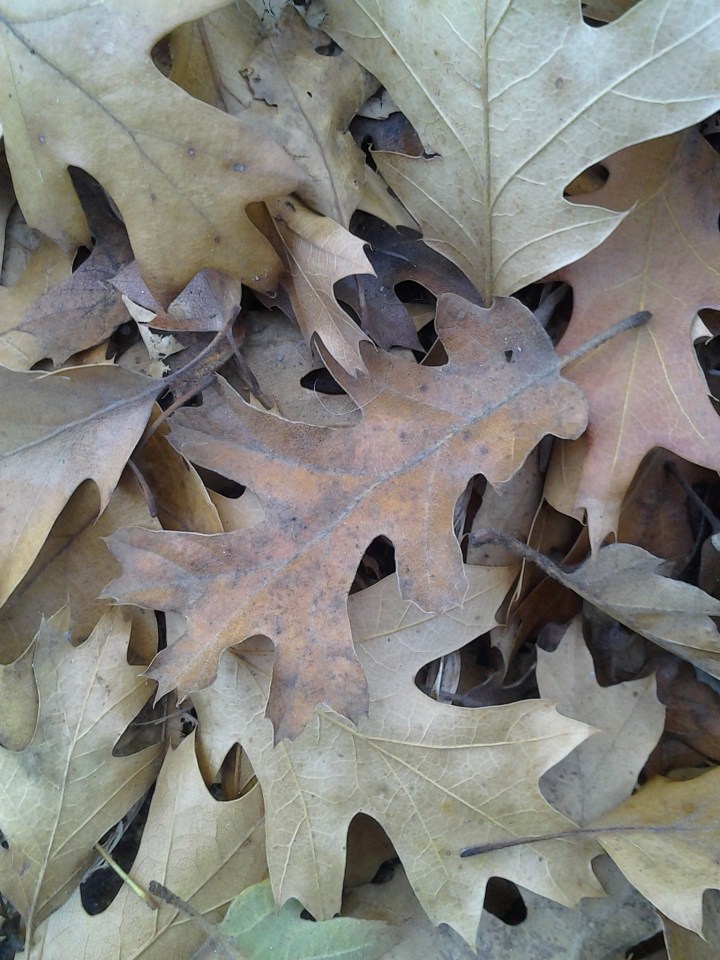 The calender says that it is now autumn. The weather does not necessarily agree. Some of the trees are dropping their leaves. However, the leaves are not falling because the weather is getting significantly cooler. The leaves got cooked during that weird heat wave a few weeks ago. If the weather can be this confusing here in our very mild climate, it must be really crazy everywhere else.
 Somewhere in the San Lorenzo Valley, there is a little old lady who is stitching a blue quilt. It is made of all the blue ribbons that she wins every year at the Jelly and Jam Contest of the Santa Cruz Mountains Harvest Festival. I do not know who she is, but I recognize her squiggly writing on the fancy labels. It is barely legible. Her hands are worn and tired from three quarters of a century off picking fruit, processing it into jelly and jam, and then stitching all her blue ribbons together. She probably giggles as she works, and thinks about everyone who wins only red or white ribbons.
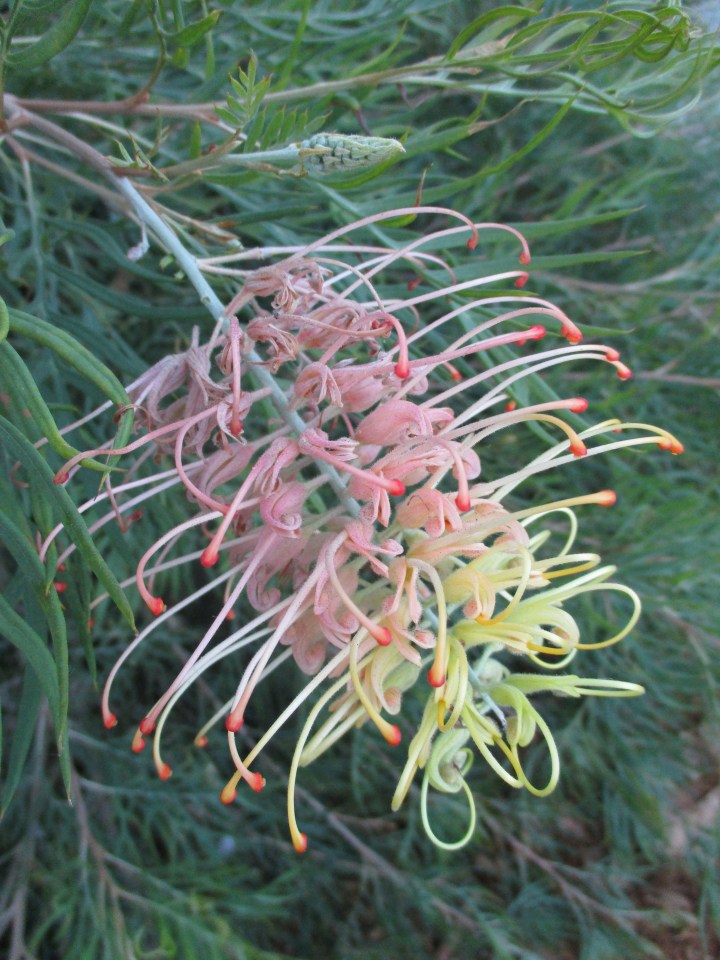 No one knows for certain who the parents were, so the hybrid Grevillea ‘Peaches and Cream’ lacks a species designation. (If it is important, the parent are most likely Grevillea banksii and Grevillea bipinnatifida.) It is an evergreen shrub that gets about four feet high and wide, with intricately lobed light green foliage. Individual leaves are about four inches long and two inches wide.
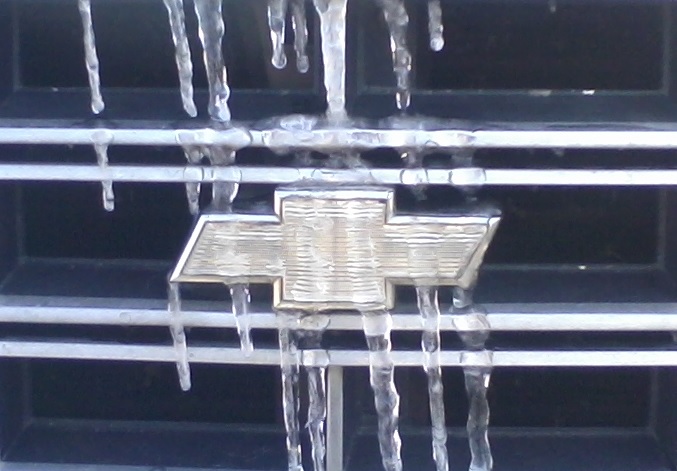 The nomenclature of horticulture, or the ‘naming’ of plants, is very similar to that of automobiles. All those confusing Latin names work just like the names of cars, with species, genus and even family. The Electra is made by Buick, which is a subsidiary of General Motors. I write an article about this every so often. It probably made more sense back many years ago, when both cars and plants were simpler.
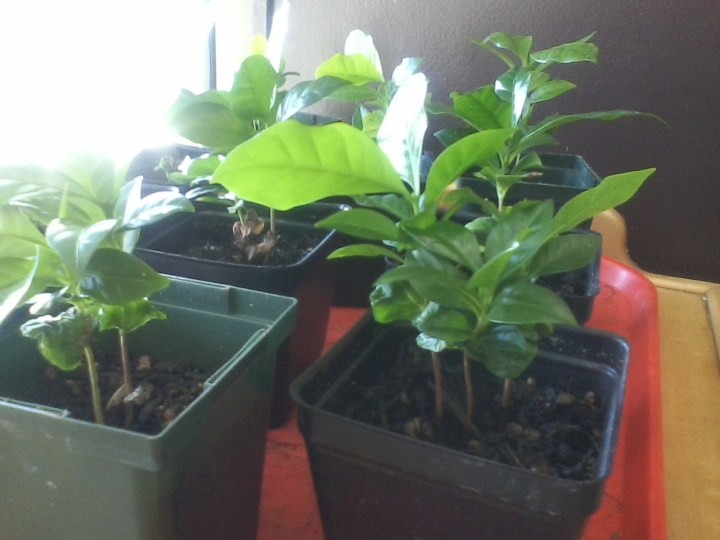 There are certain things that we expect to find in a coffee shoppe. Mainly, we expect to find . . . coffee. Yes, coffee, . . . duh. We can get all sorts of coffee beverages; hot, chilled, steamed, infused with things that have no business going into coffee. They have all sorts of cool sounding but strangely irrelevant Italian names that white people enjoy telling people of Italian descent how to pronounce. Yes, my name is Tony Tomeo; and I don’t want twenty cups of coffee with bread. Well, besides the coffee beverages, there are plenty of coffee beans; all sorts of roasts. I do not know of any coffee shoppe that grows any of the beans that it sells, but there is nice coffee shoppe in Felton, The Mountain Roasting Company, that grows coffee trees.
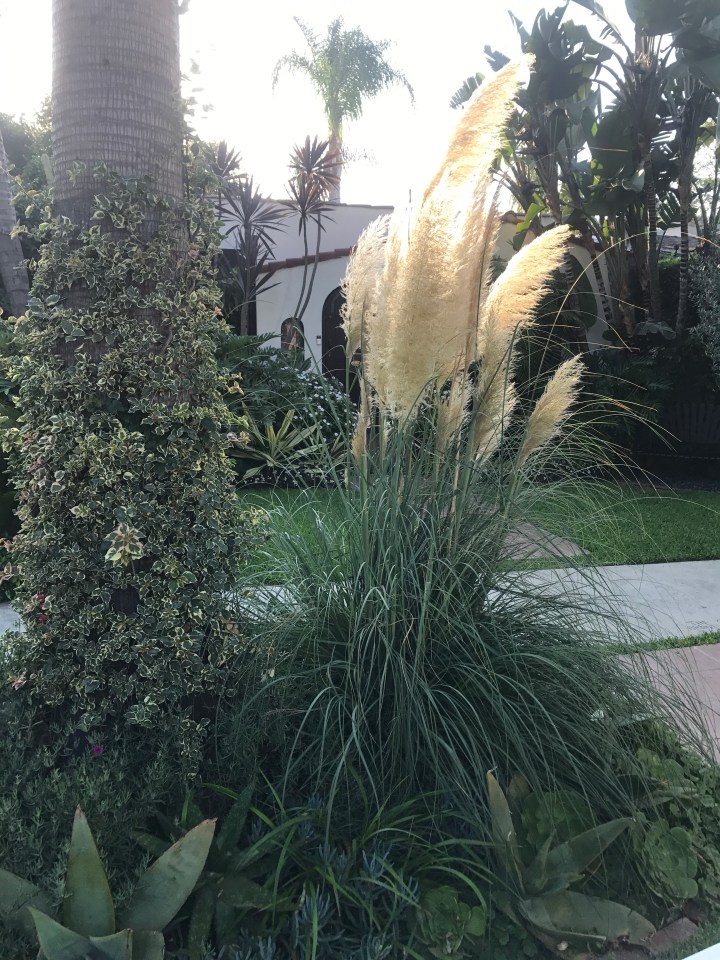 Modern garden varieties of pampas grass found in nurseries are generally non-invasive. Their flowers are described as ‘sterile’, and therefore unable to produce seed. What that really means is that they are exclusively female, and unable to produce seed without male pollinators. However, they have the potential to be pollinated by naturalized pampas grass, and sow a few hybrid seed.
