My Philosophy On Garden Chemicals

70927lthumbspareI have very few reservations about using chemicals in my garden. I bet you did not expect to read that. It is the quick and easy explanation about my philosophy on garden chemicals. Almost all chemicals that are available to the general public are reasonably safe if handled and applied properly. I am actually more concerned about the larger volumes of chemicals used in the landscape industry, and applied by technicians who can not read the labels or write their use reports. Yes, it happens. Anyway, some of the sugars, salts, preservative and other components of some of the food I eat is more dangerous than chemicals I use in the garden.

That is because I use almost no synthetic chemicals. I have almost no use for them. I only occasionally use semi-synthetic fertilizers like fish emulsion. Just about every disease or insect problem I have encountered in my own garden was most efficiently controlled by cultural methods or simple home remedies that have been effective for centuries, or even thousands of years, long before the first and worst of the really nasty garden chemicals were invented less than two centuries ago.

That certainly does not mean that all home remedies are completely safe, or even any safer that some of what are considered to be ‘chemicals’. I mean, they are supposed to ‘kill’ things. Tobacco is unfortunately toxic, and kills many people quite regularly. That is precisely why a cigar butt or a few cigarette filters can be simmered into a tea to spray onto small potted plants, like fuchsias, to kill aphid. Adding a few drops of dish soap makes it even more effective (although in a different way). Is it toxic? Yes. Am I concerned about it? Not really. Although, it would be nice if no one used tobacco anymore.

Dish soap that so many of us use as a ‘natural’ remedy for aphid is almost as effective for immediate kill even without tobacco tea, but lacks residual toxicity. Because it is necessary to use a slight bit more soap if it is used alone, it is more likely to damage tender foliage. Also, most dish soap is actually less ‘natural’ than tobacco is! Homemade soap made from bacon fat may seem to be more natural, but the fat contains of all sorts of unnatural nitrates. It certainly does not bother me any; but those seeking totally natural remedies should know. (They probably should not eat bacon anyway.)

What do I do for peach leaf curl? Nothing. Well, nearly nothing while the disease is actively ruining foliage. However, while the trees are bare through winter, I prune them very aggressively. Pruning is done so that the trees do not overburden themselves with fruit, but it also stimulates vigorous vegetative growth the following spring and summer. After bloom, while peach leaf curl is busy ruining the first phase of foliage, vigorous vegetative (non-fruiting) stems are busy speeding beyond infection with reasonably healthy foliage. Inadequately pruned trees lack vigor, and are therefore more susceptible to the disease.

The worst of the damaged foliage lower in the canopy falls away as it gets replaced by healthier foliage. It should be raked and disposed of (not composted) because spores of the disease overwinter in the fallen foliage. I actually prefer to pluck much of the damaged foliage from the trees because, technically, it dispersed spores more efficiently while still viable and actively infected. Does this eliminate the disease? No; but neither does spraying chemicals.

Does putting ‘Tanglefoot’ or axle grease around the trunk of a lemon tree infested with scale eliminate the scale? Of course not. It merely keeps out the ants that cultivated the scale. (Ants have a symbiotic relationship with the scale because the ants consume the honeydew excreted by the aphid. Ick!) Without the ants to herd them around and protect them from natural predators, the scale are not so prolific. You might not even know they are there. ‘Controlling’ them just might be better than ‘eliminating’ them with a chemical insecticide. Besides, it leaves something for their natural predators to consume so that they are there when we need them.

After centuries of breeding plants to do what we want them to do and behave very unnaturally, we really should consider how to get nature to do some of the work it really wants to do ‘naturally’.
No Respect

IMG_0417Horticultural industries are full of them; those who changed their respective careers half way through to do something ‘green’. We hear it all the time. “I used to be a ______ (Fill in the blank.), but I got so tired of ______ (Fill in the blank again.) and decided to get into landscaping.” Really?!? That is what you think of the landscape industry? Anyone who flunks out in your industry can ‘easily’ make it in landscaping?

While driving the delivery truck (because we could not hire a frustrated brain surgeon to do it for us), I had to deliver truckloads of rhododendrons to a ‘landscaper’ who did several jobs in Alameda and Contra Costa Counties. This ‘landscaper’ would walk through the nursery and tag whatever looked good at the time, and then assemble the landscape when the selected material arrived on site. Of course, he selected material that was in full bloom at the time, so the flowers were deteriorating by the time they arrived. His ‘landscapes’ were atrocious! The material was just tossed together so randomly, with plants that needed shade out in full sun, and full sun plants in the shade of big trees that were not pruned before the landscape was installed.

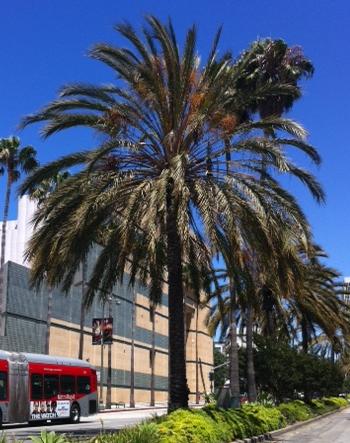
I can distinctly remember a job in the Oakland Hills that had two big Canary Island date palms that had not been groomed for many years. Decaying fronds were sagging low enough to mingle with the carcasses of agave blooms that were still sort of standing (or not) around the perimeter of the yard. Below these two palms (and I mean ‘below’, and within only a few feet of the trunks), the ‘landscaper’ had installed a few Colorado blue spruces, even more saucer magnolias, and about as many Japanese maples. These poor trees were literally pressed up against each other, and the rhododendrons that were getting delivered still needed to be stuffed in with them! Well, I could go on about how bad the ‘landscape’ was, but you probably get the point. Really, agaves and rhododendrons.

While unloading, the ‘landscaper’ explained to me, using the classic line mentioned above, “I used to be a chiropractor, but I got tired of all the stress and decided to get into landscaping.” He then continued to explain to me what made his career so stressful. After unloading the truck, I explained how frustrating it is to not be able to hire anyone to drive the truck or do the hard work at the farm. I hate working the irrigation through the middle of the night when summer gets hot. I am tired of the mud and rain in winter. Perhaps I should become a chiropractor!

Well, he did not like that much. He said that the two industries are completely different. Okay, I get that. He had to go to school for many years to earn his degree. Okay, I get that too. He had to work long hard hours for his career. Okay, I am still following here. It is a very stressful job that is not for everyone. Okay, have you worked out in the summer heat and dust, or winter cold and mud, until the sun went down, and sometimes into the night? Can you drive a tired old tractor or operate a chain saw? Do you even know how a shovel works?

The more he tried to explain to me that a chiropractor can become a horticultural professional, but a horticultural professional can not become a chiropractor, the more I realized how qualified I was for his former job. Yet, the horticultural industries are crowded with those who should be in other industries, or who simply do not take their work as seriously as it should be.

Myrtle

70920After many centuries of cultivation, myrtle, Myrtus communis, has not changed much. It was one of the more traditional plants for formally shorn hedges in Victorian gardens. It functions somewhat like a drought tolerant boxwood. Unshorn plants can grow as gnarly small trees not much higher than the eaves. ‘Compacta’ gets only about three or four feet high and wide, even without pruning.

The finely textured evergreen foliage is very aromatic and darker green than boxwood foliage. Individual leaves are not much more than an inch long. Not many of the tiny white flowers that bloom in summer develop if plants are shorn regularly. Unshorn plants that are allowed to bloom can produce small bluish black berries which might be messy on pavement. Foliar density is best in full sun. Shade can cause bald spots. Established plants may not need watering, and might live longer than anything else in the landscape.

Heat Lingers With Indian Summer

70920thumbIt is still too early to say if, or for how long, warm Indian Summer weather will linger into what should be autumn. This last spell of unseasonable heat (in California) was merely a heat wave. Of course, at the time, there was nothing ‘mere’ about it. It was downright hot! It was weirdly humid too. As uncomfortable as it was for us, the humidity made the unseasonable heat more tolerable for some plants.
Heat has a nasty habit of drying things out. Humidity does the opposite, although not quite as efficiently. Many plants might have been seriously desiccated if the weather had gotten so warm without the humidity. A cooling breeze might have made things more comfortable for us, but likewise would have been more uncomfortable for plants by enhancing the desiccating effect of heat.

So, again, we disagree with our plants. One thing we all agree on is that this last heat wave was unseasonable, and came at a time when summer should be on the downhill side toward autumn. Some evergreen plants are producing foliage designed for cooler weather. Worst of all, many of the gardening procedures that get done this time of year are in anticipation of cooling weather.

Not too long ago, pruning and shearing of hedges and other evergreens was an important topic. The objective was to get it done one last time before autumn. If done too late, new growth develops slowly through the cool winter weather, and is more susceptible to discoloration and frost damage. Now, the problem is that some of the fresh new foliage was scorched by the heat!

Also, fertilizer should have been applied one last time before autumn. Later application stimulates new growth so late in the season that it is sensitive to frost through winter. Just like pruning, the fertilizer stimulated new growth that might have been damaged by the heat. So, proper pruning and application of fertilizer to limit frost damage may have left plants more susceptible to scorch.

Just like with frost damage, scorched foliage should not necessarily be pruned away immediately. If not too unsightly, it might be best to leave it alone. Some evergreen plants will not replace it until next year anyway. Deciduous plants will shed it when convenient. Large leaves like those of philodendron and banana, may deteriorate so badly that pruning them away is the best option.

The Colors Of Karma

0407160708aThe statute of limitations allows me to discuss this now. It happened thirty years ago, in the spring of 1987. The famous landscape designer, Brent Green, was my roommate in the dorms at Cal Poly, San Luis Obispo. As the bearded iris started to bloom, Brent immediately noticed a bed of uniformly pink bearded iris off the edge of a lawn in the inner campus. He watched it bloom from beginning to end, and occasionally updated me on the progress. During the process, he convinced me that these iris were very rare. Neither of us had ever seen pink bearded iris before. We had no idea that they could easily be purchased from mail order catalogs or nurseries.
Late one warm spring night, Brent telephoned me from a landscape design lab where he had been working late. Back then, we answered a telephone when it rang. Before I could wake up enough to think about what I was doing, or just say “No.”, Brent convinced me to bring something that he needed from our room to the lab. Without thinking, I got dressed, grabbed his designated duffel bag and got on my way. I was sort of concerned that the duffel bag seemed to be empty. I figured that whatever was in it was very lightweight.

By the time I got to lab, Brent was in the lobby, and his associates were leaving. Brent did not seem to be interested in whatever was in the bag. He just thanked me for bringing it as we waked out as if to go back to the dorms. I was puzzled. As we walked, Brent explained that he only needed the bag, and confirmed that it really was as empty as I suspected. I was even more puzzled. I asked why he woke me up in the middle of the night to deliver an empty bag across campus. Well, in the few minutes it took for us to get this far into the conversation, we had arrived at the bed of pink iris. You can imagine what happened next.

Yes. Brent dropped the bag on the ground and began to stuff it full of all the bloomed-out iris rhizomes he could grab! Suddenly, I was very awake, and protested. He explained that now that the iris had finished blooming, they would be dug up and disposed of. What else could I do? I knew he was correct. I did not want to waste the iris. I also realized that panic would only draw attention, and that delaying the process would only increase the likelihood of getting busted. I pulled up as many rhizomes as I could hastily grab as well, and stuffed the bag until it was full. Brent was feeling rather satisfied as we walked back to the dorms. I was mortified.

The rhizomes got split and groomed, and eventually went into our mothers’ gardens. We each got about half. The following late winter and early spring, Brent would check in on his when he would go south for the weekend. I would check on mine when I would go north. They grew well, and fattened up to bloom. The stalks came up. The buds swelled. Then, finally, and with much anticipation, they bloomed! They were magnificent! They were glorious! They were spectacular! They were purple and yellow! WHAT?!?! Where was the pink? What happened? This is NOT FAIR! Wait a minute, . . . Could it be karma?

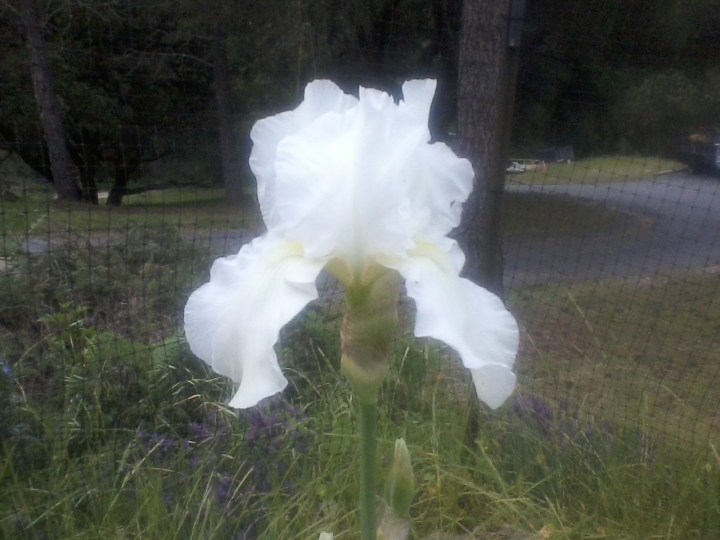
Thirty years later, we still grow these two bearded iris. They are known simply as ‘Karma Purple’ and ‘Karma Yellow’. We do not know their real names. A few years ago, they were joined by a nice tall ‘Karma White’, which was supposed to be a rusty red that I ‘borrowed’ from a neighbor. Neither Brent nor I have ever grown a pink iris.

Goodbye To An Old Friend

image(16)

After decades of deteriorating structural integrity, Quercus lobata of Felton finally succumbed to a need to prioritize public safety, and passed away at home in Felton Fair on June 20, 2017. His age is unknown, but may have been about three centuries. He was born in Felton before Felton was, and lived his entire life here. In the idyllic alluvial meadow between Zayante Creek and the San Lorenzo River, he was a simple forest tree for most of his career, and only became a distinguished shade tree when Graham Hill Road was built. Instead of retiring later in life, he became the most prominent tree in the parking lot when Felton Fair was constructed. In his spare time, he enjoyed feeding neighborhood squirrels. A tree of few words, or really none at all, Quercus lobata never complained about anything, even when cars crashed into his bulky trunk, and stripped away large portions of bark where decayed cavities later developed. His remains will be scattered as mulch,and used to warm homes throughout the region. Ashes will be scattered as stoves and fireplaces are cleaned. Rings will be counted privately. Quercus lobata is survived by an unknown number of children, countless squirrels, and countless admirers of various specie throughout Felton.

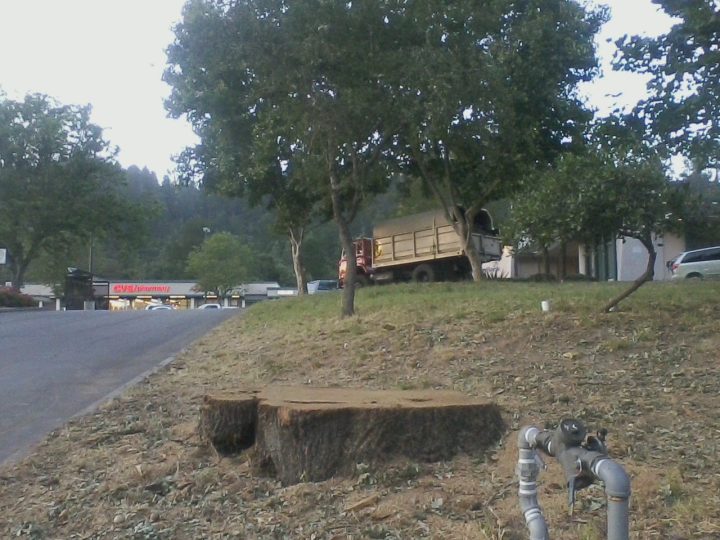
The obituary above was serious business when it was written. What it does not mention is that the deceased did not fall down or die completely of natural causes. It was cut down after dropping a very large limb onto a roadway, demonstrating how dangerous it could be. It would have gotten more dangerous if it aged and deteriorated more. No one wanted it to be cut down. It was just too necessary.

This is the part of the job of arborists that non-arborists do not seem to understand. We arborists love our work, and we love trees. However, that does not mean that we object to the removal of each and every tree. The people who live with trees are more important. Any tree that blatantly endangers people or property must be removed or made safe.

Unfortunately, valley oaks deteriorate and fall apart for many decades before they finally die. This particular tree might have survived for quite a while if it had not been cut down. It also would have continued to drop limbs.

Distinguished old trees are always the most difficult to condemn. No one is old enough to remember when they were not here. They witnessed more changes to their little part of the world than anyone. Without going anywhere, some of them here in California visited three different countries; Spain, Mexico and the United States of America.

In the end though, death is perfectly natural. The tree had spent centuries doing what it was put here to do. It was time for it to go. Behind the stump in the picture, one of its babies is already becoming a nice young tree. Another one is just to the east, just beyond the left edge of the picture. They might shade the road and driveway for a few more centuries. What history will they see during that time?


Roots

blog

In the lower right corner of this picture, next to the fenced garden gate, and just beyond the mown grass and what appears to be a walkway, there is a small clump of bearded iris foliage. No one knows where these iris came from, or for how long they had been there when this picture was taken in the summer of 1969. They were growing in the garden of my great grandmother, in Hoot Owl Creek, just south of Red Oak in Latimer County of Oklahoma. It is unlikely that my great grandmother purchased such non-utilitarian plant from a nursery. It was probably acquired from a friend or neighbor sometime during the half century that she tended the garden prior to 1969. It could have been around even earlier, since my great grandfather’s family first developed the farm as Oklahoma became a territory.

The flowers are an alluringly soft lavender blue, on elegantly tall and lean stems. They are relatively small for bearded iris, and lack any fancy frills or ruffles. In fact, they are quite neatly tailored, with a simple sweet and fruity fragrance that resembles that of grape pop. This iris is probably one of the prehistoric specie of iris that was used to breed modern cultivars. Some of these sorts of iris were known affectionately as ‘grape pop’ iris, but it is impossible to know if or how this particular iris is related.

Many years ago, probably in the early 1980s, my grandmother brought some of these iris back to her home garden in Santa Clara in California. They proliferated enough to share with friends and neighbors. A few went to my mother’s garden, where they also proliferated and were shared with friends and neighbors. Now, my mother’s great granddaughters play in a garden where these same iris will bloom next spring; only a few months from now, but at least six generations from that well outfitted homestead garden in Hoot Owl Creek.

Where will these iris go from here? It is impossible to say. Younger generations are not very interested in horticulture. However, I really doubt that my great grandmother could have imagined that they would have gotten this far. What is funny is that these iris are probably more interesting now to current generations than they were to my great grandmother when she planted them.

Never Forget the Valley of Heart’s Delight


The Santa Clara Valley really was as idyllic as the natives say it was. It was excellent for us kids, as well as for our parents who raised us here. That is why it is also know as the Valley of Heart’s Delight.

Every autumn, the orchards would turn soft yellow. Cherry orchards got a bit more orange. Apple and pear stayed greener later. The foliage still smelled sort of fruity. Leaves would start to fall with the first breezes and cool autumn rain. There was still mud here back then. It was real orchard mud; not the sort that happens because a gardener waters the lawn way too much.

By winter, the foliage on the ground smelled earthy. . . very earthy. It might have been slippery to walk on. The upper stems of the bare trees reached upward as if they were not expecting to be slowed down by the change in the weather. The trees seemed to watch each other getting pruned, and then point and laugh at each other when it was all done. Debris piled on the edges of the orchards burned fast, and then smoldered for a few days, with a narrow wisp of almost sweet smelling smoke.

Spring made you think the whole world was in bloom! It was billowy white bloom. Apricot was the best, but cherry ad almond were brighter white. Prune seemed to be very slightly blushed. It was all white, but different flavors of white. It was so soft and fragile. The fragrance was surprisingly simple, sort of fruity, and . . . perfect. Apple and pear bloomed later, giving the illusion that bloom lasted a long time. However, each type of orchard bloomed only for a short time. Let’s be honest; apple and pear did not smell quite as good as the rest; and some described them less graciously than those of us who were kids back then. Walnut and fig, well, they were always the odd ones anyway.

Summer smelled like fruit. It was everywhere. It smelled sort of grassy at first while the fruit was developing. By the end, it smelled way too ripe. Finally, it smelled like wine and toasted soil. The soil here really was great. It was grey and heavy. Summer was warm but only rarely hot. Mustard grew under the trees, and then wilted down just before getting cut.

We were all raised with horticulture, whether we realized it or not, or whether we liked it or not. We all got peanut butter and jelly sandwiches in our lunchboxes because our mothers had to get rid of the apricots somehow. Fudge at Christmas was overloaded with walnuts. Mom’s apple pie was not revered here like everywhere else in America. It was our culture. It was everywhere.

Even though almost all of us were natives, and most of our parents were natives, and some of our families had been here for several generations, the horticulture was imported from all over the place. Apricots, cherries, prunes, peaches, almonds, walnuts, figs, pears, apples; there was just about every fruit tree imaginable. They came from Turkey, France, Italy, Spain, Greece, England, Persia . . . really anywhere and everywhere. Our ancestors brought their horticultural expertise from Italy, Spain, Japan, Oklahoma, Portugal, Mexico and who knows where else. It all came here and somehow got mixed together to make the Valley of Heart’s Delight, our own distinct culture within the Santa Clara Valley.

California Sycamore

70913No other big tree has trunks as sculptural as those of the California sycamore, Platanus racemosa. They bend and groove so irregularly, seemingly without direction, that it is a wonder that old trees in the wild eventually get a hundred feet tall. Some trees have a few trunks. The mottled beige bark is quite striking both in the shade of the broad canopy, and while trees are bare in winter.
California sycamore is a surprisingly well behaved street tree, but only for a few decades or so. The roots are quite complaisant. The main problem is that the bulky trunk eventually gets wider than the parkstrip. Another problem is that such a big tree drops a huge volume of foliage in autumn, and then again in spring as anthracnose ruins much of the new foliage. The big palmate leaves are about eight inches wide, and covered with tomentum (fuzz) that is irritating to the skin.

Street Wise About Street Trees

70913thumb

There is no such thing as a perfect tree. All trees have foliage that one way or another, eventually falls to the ground. All trees have roots that might try to displace something that gets in their way. Many trees are messy in bloom. Some make messy fruit. Except for palms, all trees have branches that can be broken by wind. Just about any tree can be blown over if the wind is strong enough.

This is why the selection of trees that are appropriate to each particular application is so important. Finding trees that provide enough shade, obscure an unwanted view, or perform any specific function is one thing. Finding trees that behave while performing their assigned tasks is something else. There are always compromises. A certain degree of bad behavior will likely be tolerated.

Street trees for a parkstrip between the curb and sidewalk can be the most challenging trees to select. There are so many variables to consider. Many neighborhoods have saved us the trouble of selection by prescribing a specific tree, or maybe limiting the choices to only a few species, whether or not they are actually appropriate. Otherwise, we are on our own, to select whatever we like.

Microtrees might seem like good choices. They do not get big enough to damage a sidewalk, or make much mess. These are trees like crape myrtle, purple leaf plum and photinia (in tree form). These trees can be proportionate to narrow streets, but really do not shade much more than a single parking space. Because they are so low, they need serious pruning for adequate clearance.

Mid-sized and bigger trees like Chinese pistache, honeylocust maidenhair tree and some of the modern hybrid elms certainly cause more problems, but might be worth the bother. They shade curbside parking and part of the front yard nicely. Like small trees, they need to be pruned for clearance, especially over the roadway, but they eventually grow up high enough to be out of the way.

It seems that trees that exhibit some of the better characteristics for street trees are deficient in other ways. Australian willow has very complaisant roots, and is very resilient, but also branches low, and is not much to look at. Fern pine and several oaks are excellent street trees for decades, but eventually get big. Root barriers will delay, but not prevent roots from damaging sidewalks.