Butterfly Amaryllis

Hippeastrum papilio, butterfly amaryllis is an uncommon and weirdly epiphytic amaryllis. It may not be as pretty as the countless more colorful hybrids of the genus, but it is more reliably perennial. All of the few specimens that I have observed within home gardens are potted or in the ground, either because they are easier to grow that way, or because those who grow them are not aware that they are epiphytic. After all, that is quite weird.

This specimen, from my Six on Saturday post earlier this morning, is blooming in Brent’s garden. As I mentioned earlier, Brent did not know what it was when he acquired it from a neighbor who left it with him when she relocated. I know that it does not look like much in this picture, but that is only because Brent is an idiot, and takes bad pictures. I intend to get a copy of this butterfly amaryllis for my garden, and may try to grow it epiphytically.

I find this species to be more appealing than prettier hybrids, both because it is reliably perennial, and because it is a simple species rather than a hybrid. This is also why I dug a few naturalized Crinum bulbispermum, Orange River lily bulbs for my garden. They are none too pretty, but will last forever. The same applies to Amaryllis belladonna, naked lady, but they are a bit too prolific and common to not potentially qualify as a weed. Their bright pink floral color can be a bit obnoxious anyway. But of course, that is why I was so very pleased to find a bulb that bloomed white, which is my favorite color. It is multiplying nicely here now, just like I know the butterfly amaryllis will once I get a fresh copy of it.

Six on Saturday: Surprise!

Even annual bloom can be surprising after a few or many months without it. Perhaps an unexpected bloom is more surprising. Familiar wildlife might be surprising when it does something unexpected. Unexpected or unplanned ‘wildlife’, even if domesticated, is a bit of a surprise. Ultimately though, the major surprise is the fifth of these Six. The first two pictures are from Brent’s garden, not here.

1. Persea americana, avocado fruit ripens in the tree above Brent’s office for quite a few months. The tree rarely lacks fruit completely. These spiral stairs are from the roof deck. This squirrel saw Brent taking a picture of it taking its avocado down, so took it back up.

2. Hippeastrum papilio, butterfly amaryllis was left at Brent’s garden by a neighbor who relocated. It is as perennial here as it is there; so I want a copy. Brent did not know what it was until, after two years or so, it surprised him with bloom. Brent takes bad pictures.

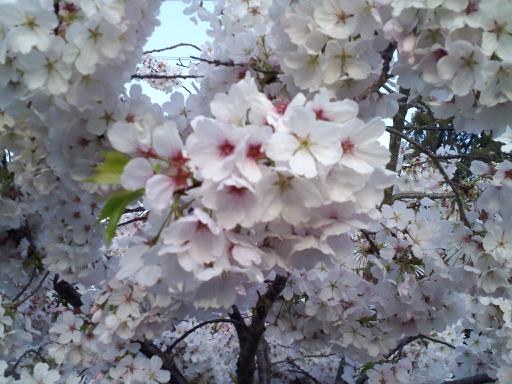
3. Malus X (floribunda?) ‘Prairie Fire’ flowering crabapple bloomed spectacularly. It is a relatively modern cultivar from 1982, but is surprisingly old fashioned. I grew up with a tree that was a decade or so older than I am, but it bloomed with a similar reddish pink.

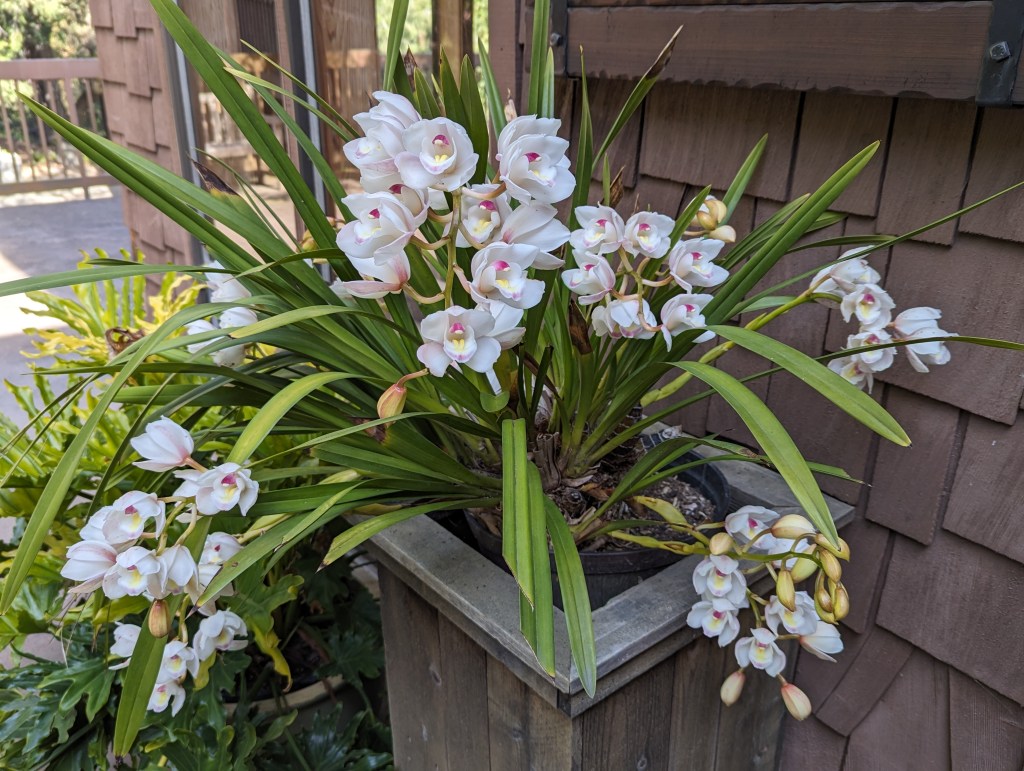
4. Cymbidium orchid of an unidentified cultivar was left by a colleague who only wanted it off his porch. It gets only watering, but blooms annually, and surprisingly abundantly. I should eventually divide it, but I am hesitant to interfere with such a reliable specimen.

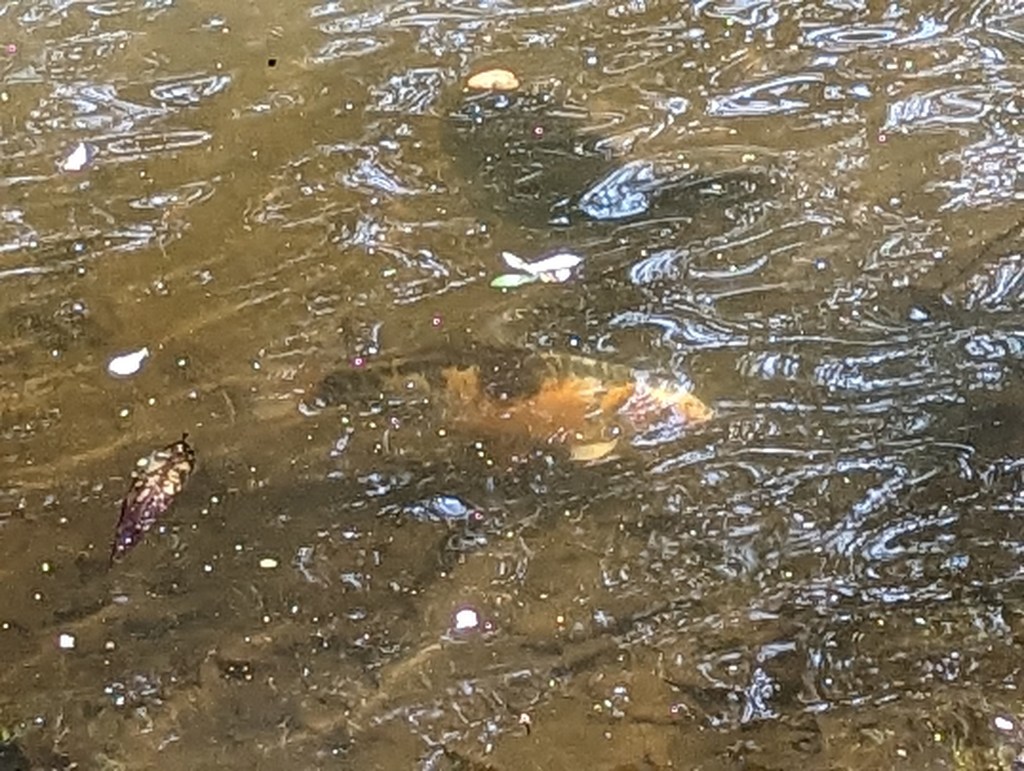
5. Koi met an unfortunate demise two winters ago as someone who was unaware of their presence drained their pond. However, a neighbor inquired about two small fish that he saw in the pond soon afterwards. More recently, the same neighbor inquired about this. It seemed to be about a foot and a half long, with a slightly smaller and darker associate.

6. Koi are supposedly schooling fish. Two do not qualify as a school. So, now they have a few more friends to go to school with. These tiny koi should be able to evade their larger classmates, who might otherwise eat them. Actually, I doubt that the larger koi are large enough to eat them anyway. This is not something that I expected to be contending with.

This is the link for Six on Saturday, for anyone else who would like to participate: https://thepropagatorblog.wordpress.com/2017/09/18/six-on-saturday-a-participant-guide/

Flowering Cherry

Flowering cherry is the fruitless counterpart of fruiting cherry.

Like camellias and chrysanthemums, the many different varieties of flowering cherries, Prunus spp., have been developed by horticulturists in Japan for centuries. There are now almost too many to choose from. Most stay less than about twenty feet tall and broad, so are proportionate to compact gardens. A few stay even smaller. The classic Yoshino flowering cherry can get somewhat larger. Weeping cherries have pendulous branches. Columnar types are noticeably taller than wide, at least while young. Some flowering cherries have remarkable fall color.

Despite my preference for cherry trees that produce cherries, I can not deny that the spring bloom of the innately non-fruiting flowering cherries is spectacular! Most bloom before any foliage develops. Their flowers can be single, semidouble or double, in various shades of white or pink, including rich rosy pink. They can not be very messy without fruit. Unfortunately though, flowering cherry trees are susceptible to rot in the endemically dense soil, so should not be watered too much.

Volunteer Days at the Arizona Garden of Stanford

Green waste from the Arizona Garden is fair game for volunteers.

(This article is from 2010, so contains irrelevantly outdated information.)

Some gardens are native gardens. Some are wildflower gardens. Others are vegetable gardens, white gardens or rose gardens. There are really all sorts of gardens. Mine though is the only garden that I am aware that is described by some as a ‘felony garden’.

This less than appealing distinction originates from my habit of ‘recycling’ green waste from other gardens. From the bits and pieces of debris generated by normal maintenance, I like to propagate copies of plants that I like for my own garden. Sometimes, I get large volumes of material, such as clumps of New Zealand flax or African iris. Sometimes, I just get small bits of pelargonium or English ivy. Sometimes, the small bits are not exactly generated by maintenance.

On March 20, I really scored big! I procured a pick up full of large canes of a somewhat uncommon species of yucca, along with more than a wheelbarrow full of pieces of various cacti, agaves, aloes and succulents! I suppose that I should feel guilty; but I was helping to dispose of the green waste generated by the volunteers at the Arizona Garden at Stanford University.

The historic Arizona Garden could actually use the help of more volunteers during their Volunteer Days every third Saturday of each month. Most of us were pulling weeds last month, and will likely be pulling more this month. Although there is not always booty to be had, (and no one scores like I did!) volunteers are welcome to the debris they generate from any needed grooming and pruning.

The next Volunteer Days will be on April 17, May 15 and June 19. Volunteers can arrive at any time after 9:00 a.m., and should bring heavy gloves since almost everything in the Arizona Garden is equipped with nasty thorns or spines. Some who stay through noon like to bring bag lunches. New volunteers should contact Arizona Garden Coordinator, Christy Smith at 650 – 723 7459 or christy.smith@stanford.edu before attending a Volunteer Day to get any other necessary information and specific directions to access the Garden.

On April 18, the day after the next Volunteer Day at the Arizona Garden, the Going Native Garden Tour will be visiting more than 65 gardens throughout the Santa Clara Valley and the Peninsula from 10:00 a.m. to 4:00 p.m.. The gardens range from newly planted to established, from townhome lots to acre parcels, but all feature native plants. Some gardens feature talks about native plant gardening. A few gardens will have native plants available for purchase.

It is not possible to see all the gardens within this self guided tour, so guests can choose which gardens to visit. Admission is free, but limited; so early registration is recommended. Registration is required prior to noon on the day of the Tour. Registration can be arranged, and more information about the Going Native Garden Tour and about volunteering can be found at www.gngt.org.

Saskatoon

Saskatoon prefers significant chill during winter.

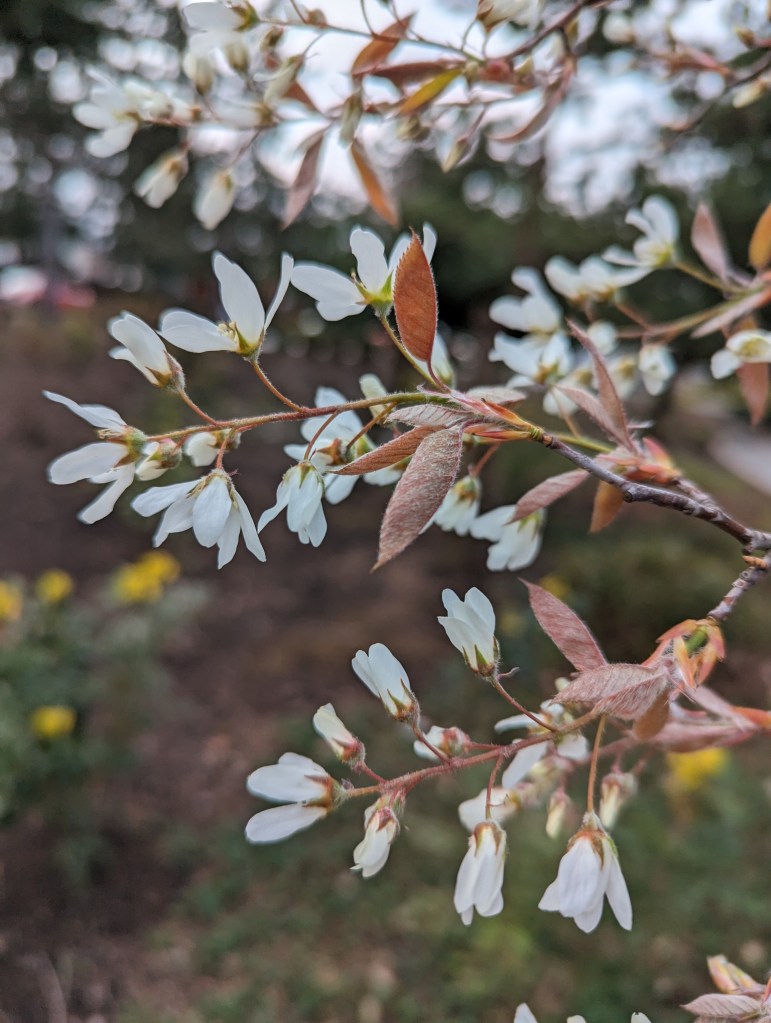
Of eighteen species that are native to North America, only two are native to California. Of these two, only one is native locally. However, some of the few nurseries that sell various saskatoons market them as native. Obviously, most are not. A few are hybrids. All of them are species of Amelanchier, and are still rare here. Their common names are numerous.

Serviceberry, sarvisberry or sarvis may be some of the more common of common names. Shadbush, shadwood or shadblow may be less common. Juneberry, chuckley pear, wild plum and sugarplum are likely regional names. They are more familiar where winters are cooler. Some sorts do not perform well locally because they prefer a bit more winter chill.

Saskatoons are locally popular primarily for their fruit, and only among a few enthusiasts. They are more available online than in nurseries. The fruits are pommes like tiny apples, but are only the size of blueberries. They ripen to blackish purple for summer. Their early spring flowers are like wispy apple flowers. Most Saskatoons grow less than ten feet tall. Some rarer types can grow thirty feet tall in favorable climates.

Irrigation Resumes With Drier Weather

Spring gets progressively drier and warmer.

Spring, in several regards, is like autumn in reverse, or vice versa. Bloom increases for spring but decreases for autumn. Foliage increases for spring but decreases for autumn. The two seasons are in opposition. In this chaparral climate, the rainy season that began last autumn ends now. Irrigation that became redundant then becomes necessary now.

Diminishing rain is not the only reason that irrigation becomes more important for spring. Spring weather also becomes warmer and more arid, or less humid. Warmth and aridity increase evaporation of moisture that rain deposited not long ago. Increasing day length, intensifying sunlight and warmth accelerate plant growth. Such growth consumes water.

This need for moisture is progressive, though. Vegetation certainly requires more water as the weather becomes warmer and drier. However, it does not yet require as much as it will require later during summer. By then, the weather will be even warmer and drier, and the days will be even longer. Irrigation should increase accordingly in regard to weather.

Unfortunately, there are no simple formulas to determine how much irrigation is needed. Some vegetation with shallow roots may require frequent but moderate irrigation. Some vegetation with deep roots may prefer less frequent but more copious irrigation. Rain is possible at any time. It can briefly interfere with the most efficient of irrigation schedules.

Soil also affects irrigation. Sandy soils drain efficiently, but do not retain much moisture. This may not be a problem for some species that tolerate occasionally dry soil. It may be more of a concern for species that prefer more regularly moist soil, though. Dense soils retain more moisture, but do not drain as efficiently. Soil amendments can improve soils.

Manual irrigation is easier to monitor than automated irrigation, but can be tedious. That is why most irrigation is automated nowadays. Automation is more likely to be excessive than insufficient. Desiccation, wilting and other symptoms of insufficiency of irrigation are obvious. Symptoms of saturation may not become obvious until too late for remediation.

Parasite

Mistletoe, Phoradendron leucarpum

Mistletoe, Phoradendron leucarpum, suddenly and inexplicably disappeared from local ecosystems several years ago. Although it was unlikely completely gone, no one could find any. Carcasas of deceased specimens deteriorated and fell slowly in pieces from their host trees. Regeneration has been a very slow process, and in some local ecosystems, does not seem to be happening at all.

If botanists are aware of what happened to the mistletoe, they are not sharing what they know. Arborists are amazed by such sudden death of mistletoe that they had been unable to eliminate from infested trees. Some believe that it was the result of distress of host trees. However, it is unlikely that all host trees, including many within cultivated and irrigated landscapes, could have been so similarly distressed at the same time. Disease could be the primary culprit. There is even a possibility that mistletoe, the most familiar plant parasite, succumbed to another parasite.

Similar die off of various species of mistletoe has been observed within various other ecosystems, at various times, and with various rates of recovery. Perhaps several factors are involved, either individually or in any variety of combination. Because mistletoe is generally considered to be undesirable, investigation of such die off is minimal.

I noticed this particular mistletoe within the same Oregon white oaks in Oregon that I wrote about yesterday. It seems to be adequately healthy and unaffected by whatever killed mistletoe here. I do not remember if it had died off previously, and is now recovering. For all I know, it could be in the process of dying off right now. Mistletoe might be more efficiently controlled or even eliminated from infested trees within cultivated landscapes if someone could identify what kills it naturally. After all, it is a famously persistent and potentially very distressing parasite.

Oakland

Oregon white oak, Quercus garryana

Oakland, fifty miles north of here, was named for the oaks that formerly inhabited it. Imagine that! Although valley oak, Quercus lobata, is native, and assumed to be the origin of the regional name, coast live oak, Quercus agrifolia, was likely more abundant there at the time.

Of the many other towns in California with horticultural names, a few are also named for unspecified oaks, including del Rey Oaks, Oakdale, Oakley and Thousand Oaks. Encinitas, Live Oak and the Encino neighborhood of Los Angeles are named more specifically for coast live oak. Paso Robles is named more specifically for valley oak.

Oakland and Oakridge are the only two towns that I could find in Oregon that are named for Oaks. I suspect that Oakland is named for Oregon white oak, Quercus garryana, only because that is the most prominent species of oak there. It is also native here, although I am not aware if I have ever encountered it locally. It resembles small specimens of valley oak, which, incidentally, is also known as California white oak.

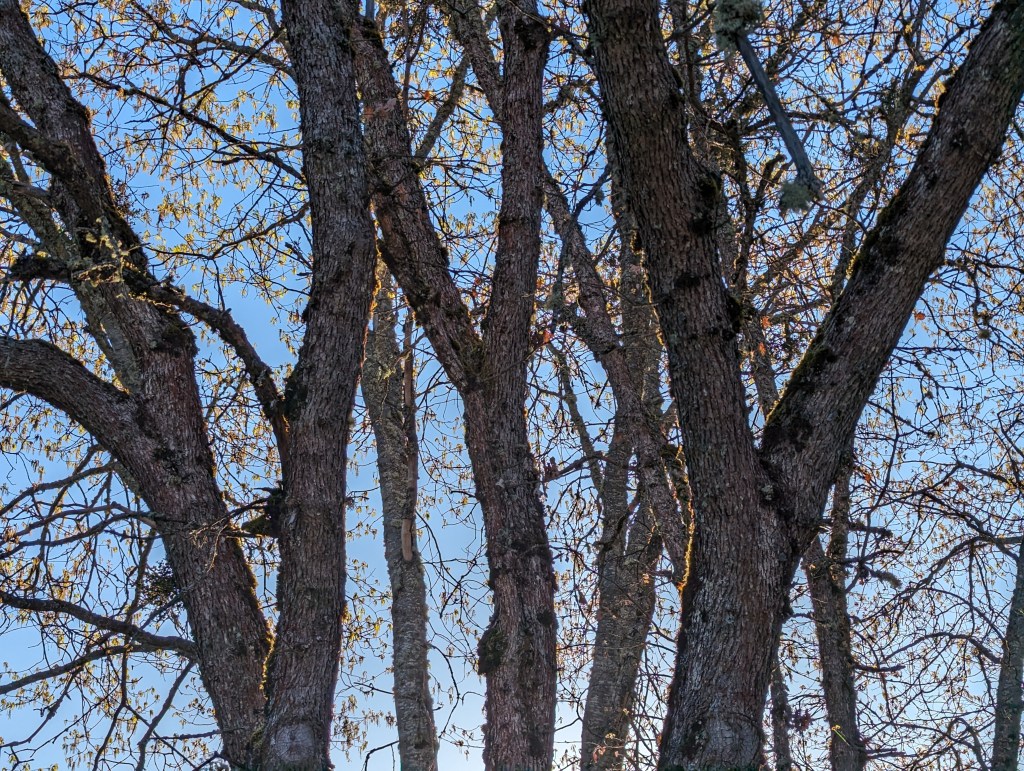
This picture of a few main limbs of an exemplary specimen of Oregon white oak is from Cabin Creek Rest Stop on Southbound Highway 5, just north of Oakland in Oregon. To me, it looks sort of Californian, like something that, a long time ago, was more prominent in Oakland here in California, on ‘the Bright Side of the Bay’.

Six on Saturday: Double Whammy!

Rhody, Carson and I are back from vacation. Now I see that I did not get many pictures

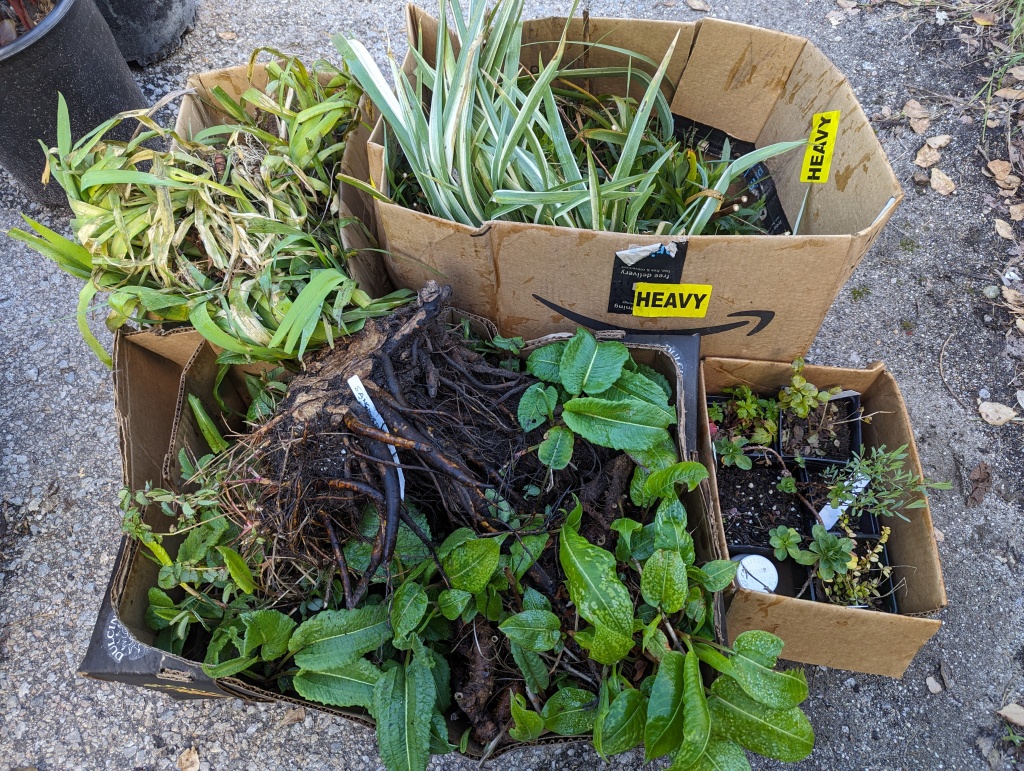
1. If this looks like the same major stockpile of vegetation from Skooter’s Garden (Tangly Cottage Gardening) that I posted a picture of last week, it is because it is. The difference is that it is here at home now. Goodness, it will be a busy week of division and plugging.

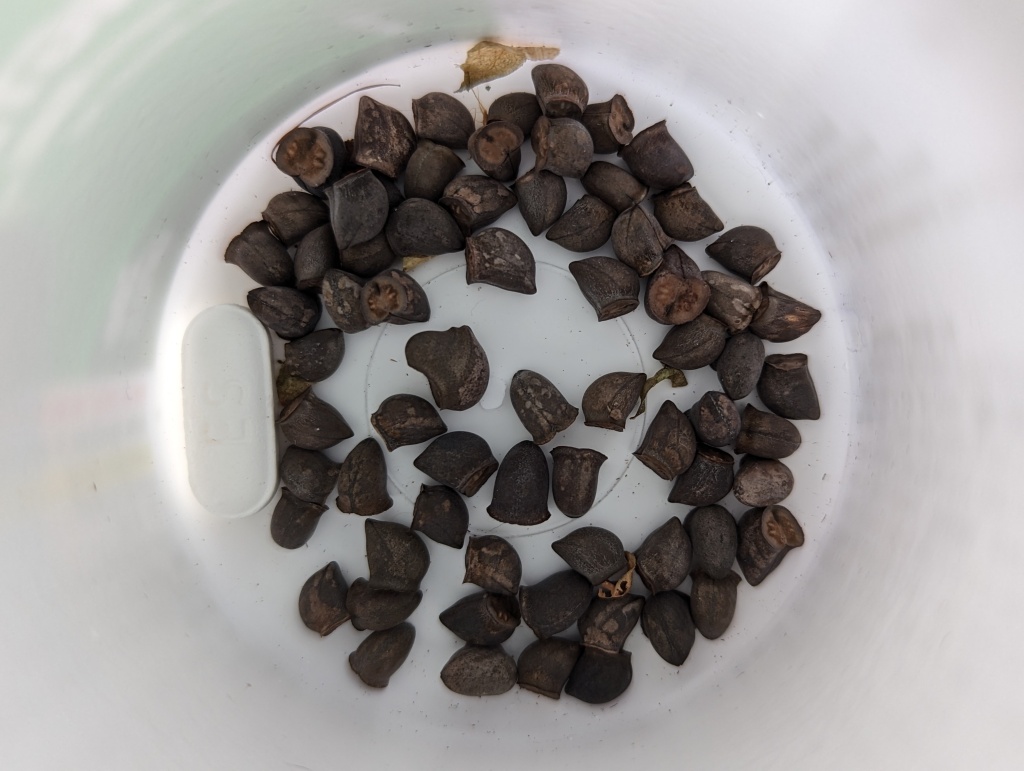
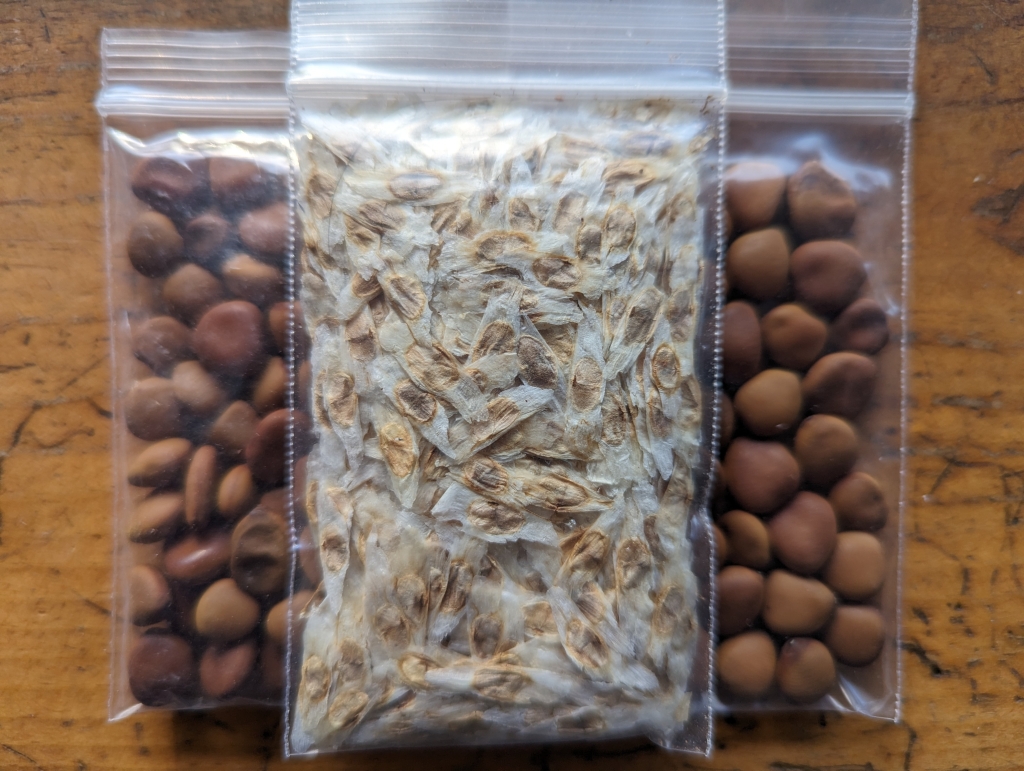
2. Cerinthe seed are in the pill bottle to the lower right of the previous picture. So is that obstinate pill to the left. I should have tried cerinthe by now, and this is my justification.

3. Poinciana and esperanza seed from Crazy Green Thumbs are the second of my double whammy! They were likely in my mail before we left on vacation, but we left town before the Post Office was open. Shamefully, they will be my second attempt for both species. It is a long and embarrassing story. This particular poinciana is more commonly known as dwarf poinciana, Caesalpinia pulcherrima. This particular esperanza is more commonly known as yellow bells, Tecoma stans. ‘Esperanza’ means ‘hope’, which I have enough of.

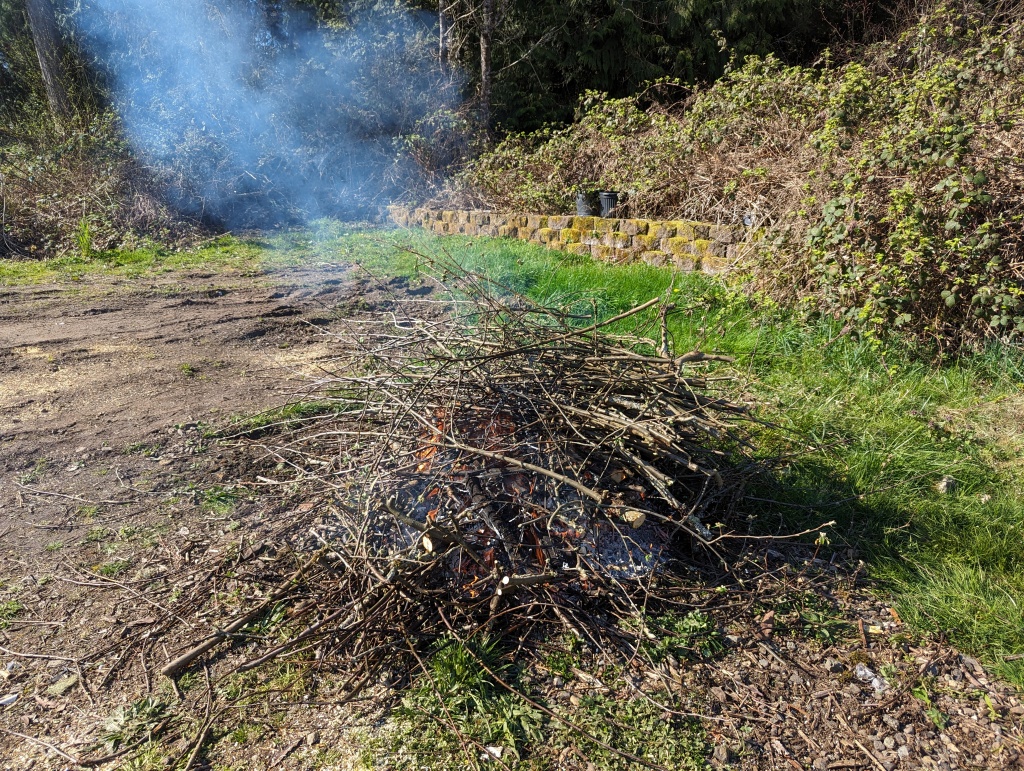
4. My vacation was scheduled to be as late in winter as possible but prior to the bloom of apple trees because I intended to prune eleven apple trees while still dormant. All eleven trees are pruned, and their formerly fresh detritus is gone. Sweet Brown would approve.

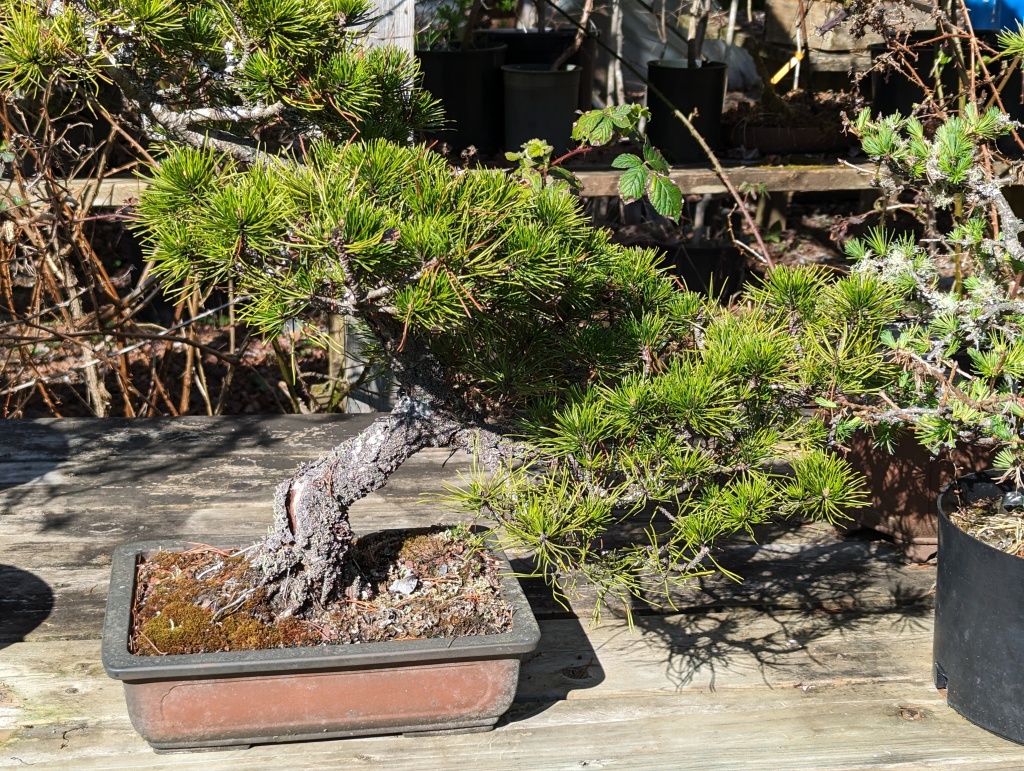
5. Bonsai stock is what my Pa grows on his farm where the pruned apple trees and other old fruit trees live. Goodness, I really should have stayed later, and taken more pictures.

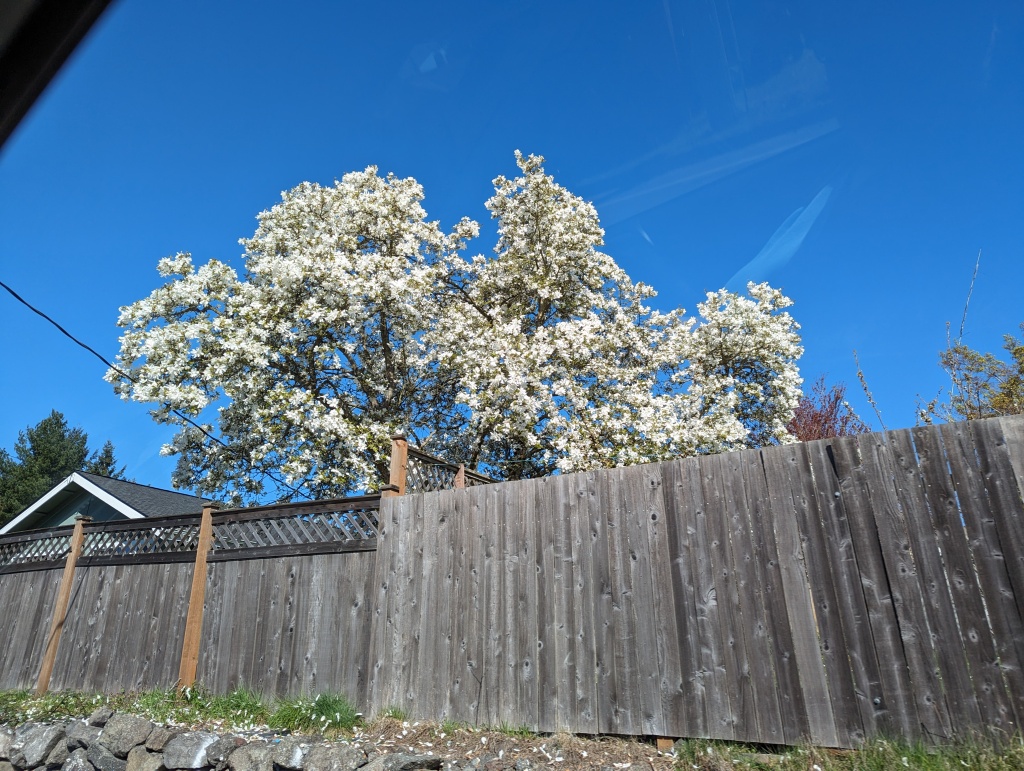
6. Star magnolia performs very well in the Pacific Northwest. I rarely see them any more than five feet tall locally. This is an awkward picture because I took it from a moving car.

This is the link for Six on Saturday, for anyone else who would like to participate: https://thepropagatorblog.wordpress.com/2017/09/18/six-on-saturday-a-participant-guide/