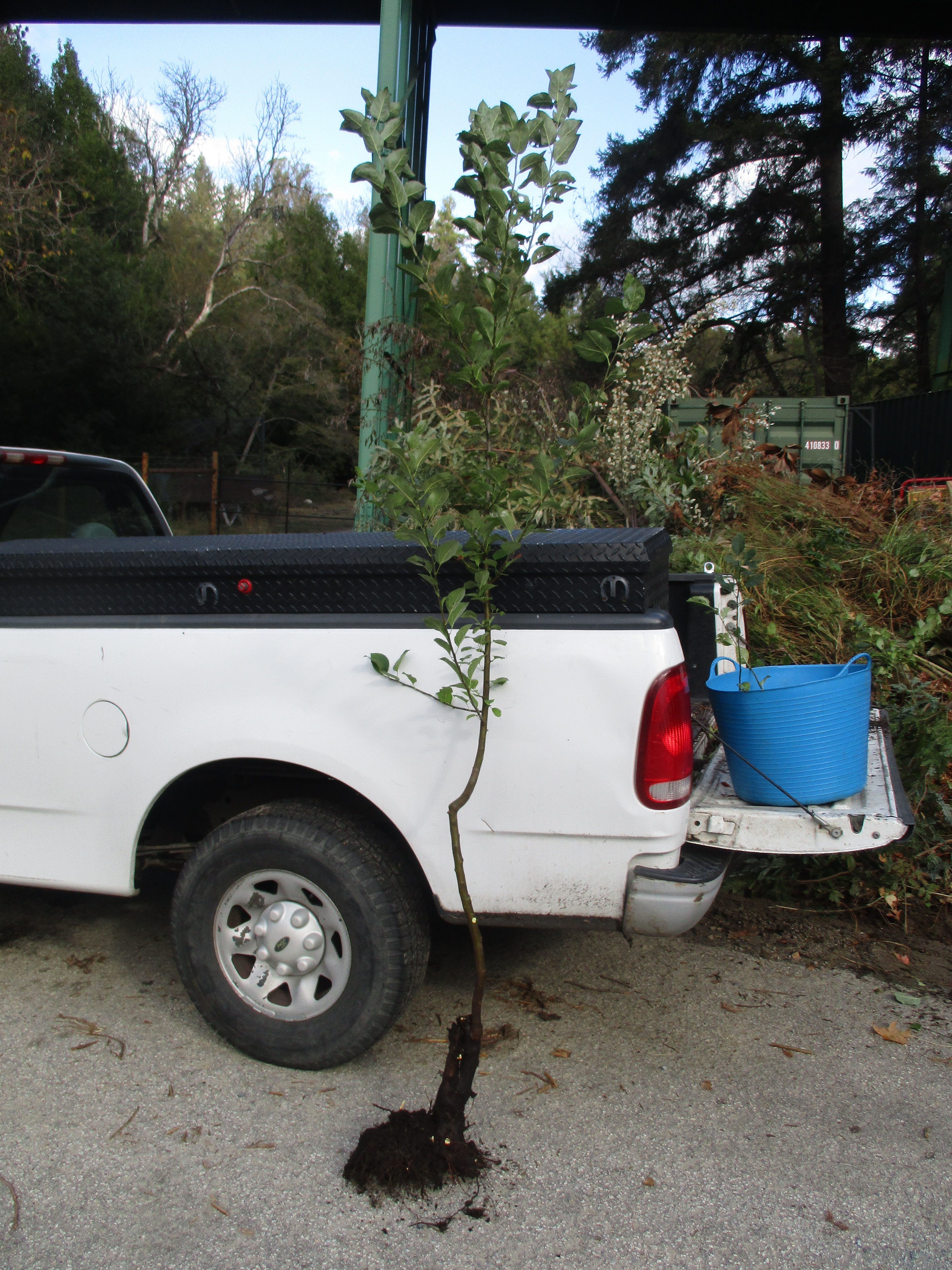
Six on Saturday: Pruning Apple Trees

This is a rather cursory Six for this Saturday, since Rhody and I are on vacation, pruning apple trees in Washington. I should do better next Saturday.

1. Malus domestica, apple trees, even after thorough pruning last winter, are a hot mess now. I prune a small herd of only eleven, but some of them are quite large. Several other assorted fruit trees remain in need of renovation nearby. A tenant maintains a few more.
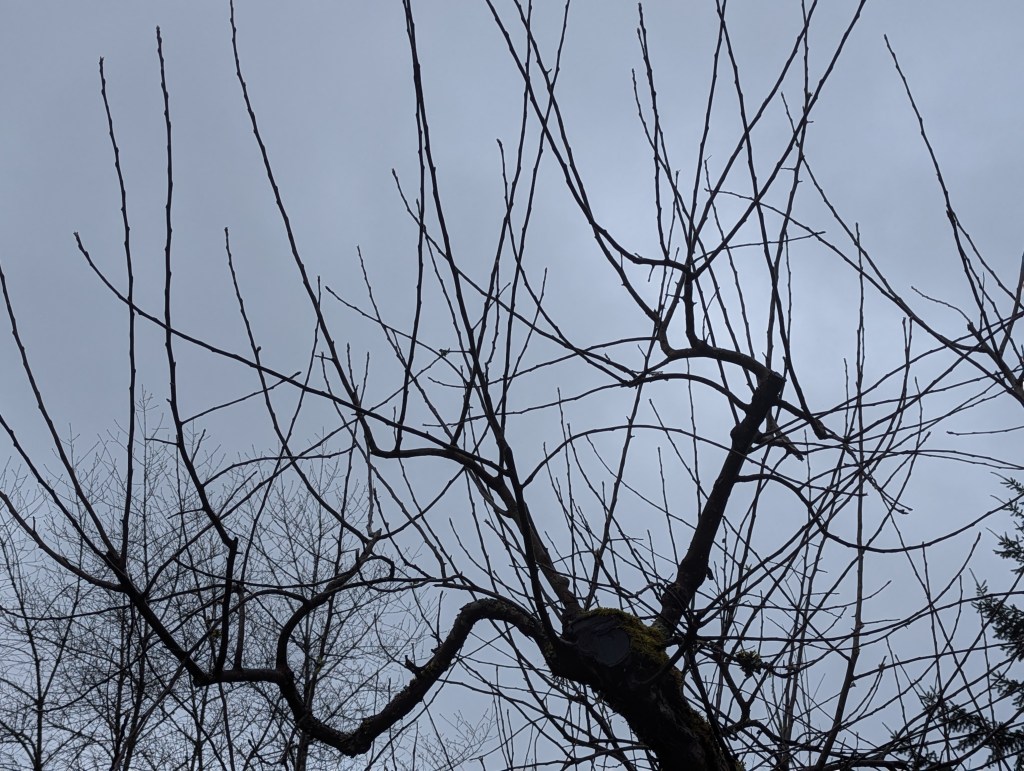
2. Dormant pruning maintains and contains the otherwise rampant growth of the apple trees, and limits their otherwise messily excessive fruit production, but does not actually improve their visual appeal much. The most meticulously pruned trees will look twiggy.

3. Malus sylvestris, crabapple demonstrates why I am in a rush to prune the apple trees before their bloom and foliation. They are about to bloom, and apple trees bloom shortly afterward. I try to get here earlier each year, but always get here at about this same time.

4. Pyrus communis, pear is already beginning to bloom a slight bit more than crabapple. Fortunately, the pear trees are still somewhat small, and do not yet need major dormant pruning or renovation. I might prune back a few minor spires from one of the pear trees.

5. Prunus cerasifera, Myrobalan plum is in full bloom, but needs no pruning anyway. It is merely the understock of an unidentified stone fruit tree that was cut down years ago. It serves no purpose, but is too pretty in bloom to merely cut down without justification.

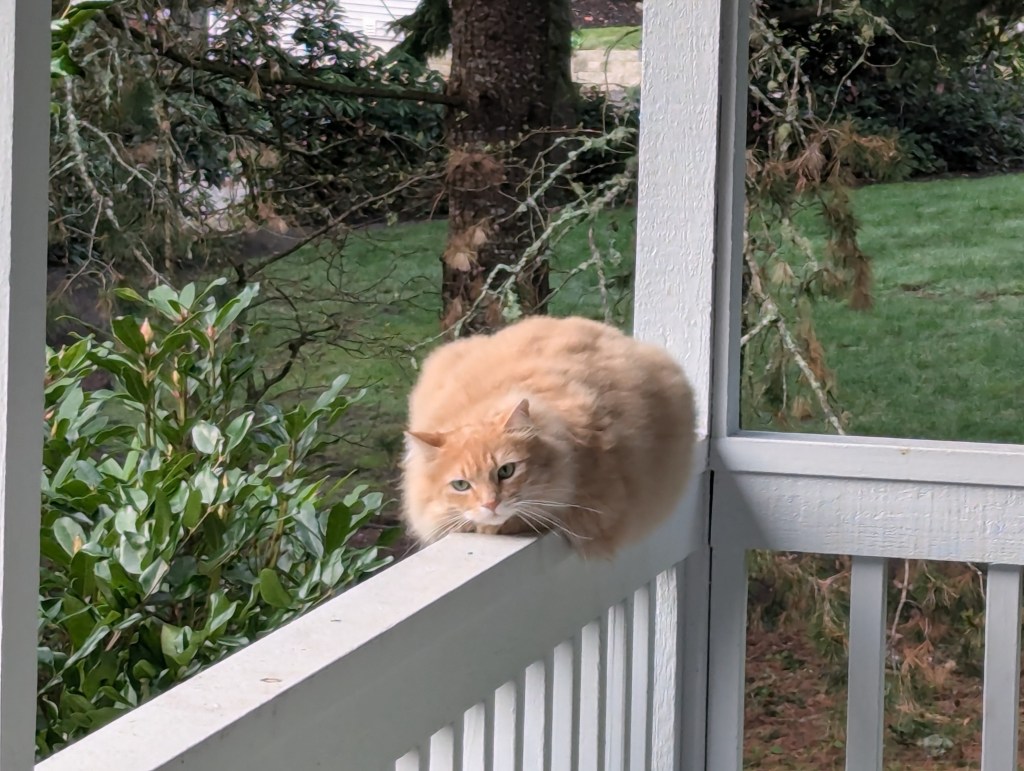
6. Arlo was waiting for us on the porch when we arrived. He lives at another house in the neighborhood, but visits neighbors for food and treats. He was not pleased when Rhody noticed that he was watching us. He did not exactly put much effort into hiding, though.
This is the link for Six on Saturday, for anyone else who would like to participate: https://thepropagatorblog.wordpress.com/2017/09/18/six-on-saturday-a-participant-guide/
Village Harvest Distributes Surplus Fruit (outdated)

Fruit trees are famously productive here.

(This is an old article with outdated information.)

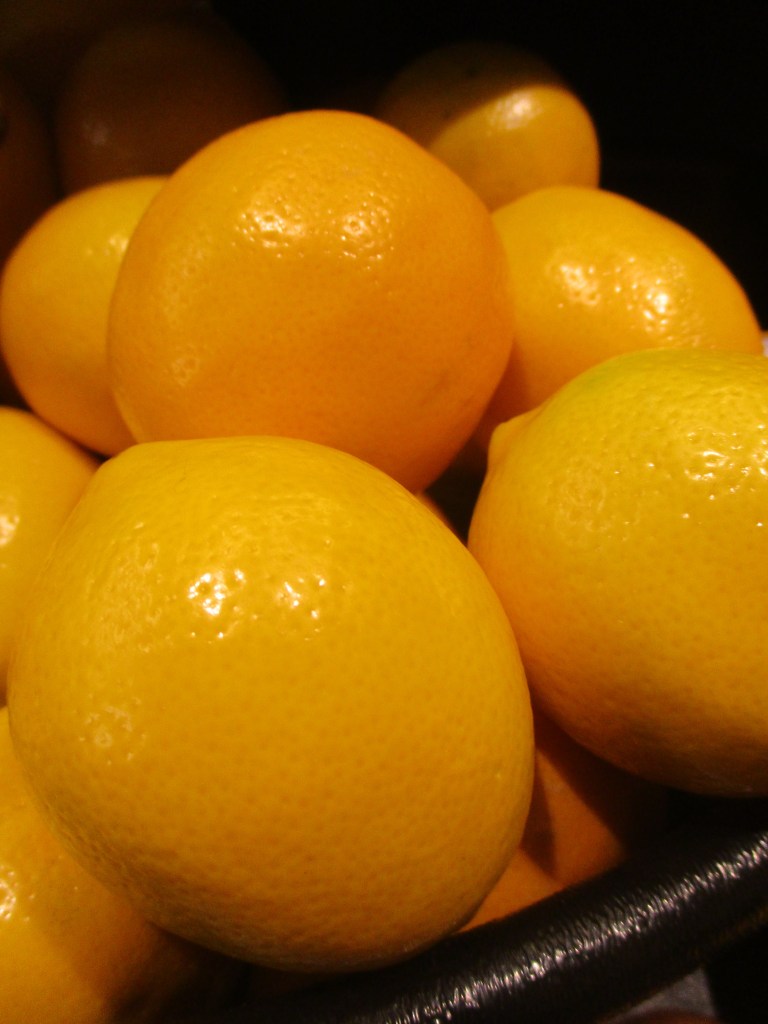
The vast orchards that formerly inhabited the Santa Clara Valley were here because this is among the best places on Earth to grow apricots, cherries, prunes, almonds and walnuts. Actually, there are not many fruit trees that would prefer to be somewhere else. Home gardens continue to produce the many traditional fruits, as well as many other types of fruit that were not so common in the orchards; such as citrus, figs, apples, pears, persimmons, avocados, peaches, nectarines and too many more to fit into a brief list.

Those of us who enjoy growing fruit trees do not need to be reminded of how well they do here. Some trees produce too much and  can become overwhelming. It is not always possible to can, dry, freeze or share with friends and neighbors all the fruit from the more productive trees. Leaving the fruit out in the garden is not only wasteful, but also bad for the garden, attractive to vermin, very messy and smelly.

Besides, there are other people in the community who could use it. During this past year, Village Harvest has harvested from local gardens, and distributed to those who can use the produce, approximately 156,000 pounds of fruit. The record for distribution of produce may be exceeded this year after apples, persimmons and citrus are harvested.

Volunteers make Village Harvest possible, by collecting excessive fruit from home gardens. Some of the people with productive trees like to retain some of the fruit. Volunteers are also welcome to take some of the fruit. The vast majority of fruit gets dispersed to others in the community who can use it.

The next apple harvest event in the Cupertino orchard on October 22 may no longer be able to accommodate additional volunteers; but the next major apple harvest in the Woodside Orchard on October 29 may still be in need of volunteers. Harvests take about three and a half to four hours, between 9:00 a.m. and 12:30 p.m.. Volunteers must be at least sixteen years old.

Volunteers can register for harvest events, or get more information at villageharvest.org. Early registration is recommended since space is limited. Volunteer instructions, including meeting location addresses will be e-mailed to volunteers a few days prior to each event. Those of us with excessively productive fruit trees who happen to be within range of harvest events can possibly make arrangements to get fruit harvested.

The next few neighborhood harvests will be on October 25 in Central San Jose, October 31 in Sunnyvale, November 1 in Central San Jose, November 6 in Mountain View, November 8 in Central San Jose, and November 14 in Sunnyvale. Sunnyvale harvests begin at 8:00 a.m.. Some harvests are repeated. For example, the Central San Jose harvests are weekly on Tuesday.

Volunteer At Filoli

Rose gardens require significant effort.

(This article posted in 2012, so much of its information is now outdated.)

How could so many public gardens throughout the area get all the work that needs to be done in winter? There are roses to prune in both of the Rose Gardens of San Jose. Fruit trees in the Historic Orchard of Guadalupe Gardens need to be pruned. Even Village Harvest of Palo Alto needs to collect citrus fruits that ripen through winter. All this works gets done only because there are so many generous volunteers to help.

The gardens of Filoli are fortunate to get so many volunteers through the year. Nonetheless, the extra pruning that the deciduous fruit trees need in winter reminds us that more volunteers are often welcome. Not only are there big collections of modern and classic apple and pear trees at Filoli, but many are espaliered onto trellis-like supports. (‘Espalier’ trees are pruned onto trellises, fences, walls or other lateral supports, so that they can attain considerable width without much depth from front to rear, conserving space.)

The New Volunteer Recruitment Open House at Filoli is not until January 21. However, those interested in attending must register in only the next few days, before 4:00 p.m. on January 13! Registration can be arranged at volunteer@filoli.org or by telephoning 650 – 364 8300 extension 300, and leaving one’s name and daytime telephone number. The New Volunteer Recruitment Open House will be from 9:30 to 11:30 a.m. on January 21, at the Visitor and Education Center of Filoli, located at 86 Canada Road in Woodside.

Guests will learn about the many different opportunities to volunteer. More than 1,200 volunteers presently help sustain Filoli in areas such as house and garden self guided docents, member services, visitor services, the Ambassador Program, the Cafe and the Garden Shop.

Besides the sixteen acres of English Renaissance gardens that display an expansive horticultural collection, the 654 acre Filoli property includes a 36,000 square foot residence furnished with an extensive collection of 17th and 18th century English antiques, and is recognized as one of the finest remaining country estates of the early 20th century. More information can be found at http://www.filoli.org.

Curb Mongrel

P91208Fruit trees, with few exceptions, have been extensively bred to produce the quality of fruit that we expect from them. Some are consequently genetically unstable, or at least less genetically stable than their wild ancestors were. Even if they never mutate or try to revert to a more stable state, they are very unlikely to produce seed that can develop into genetically similar trees.

In other words, they are not ‘true-to-type’. Their seed might grow into trees that produce fruit that resembles that of one of their ancestors, or of a pollinating parent tree. It is impossible to predict what fruit will be like until it actually develops.

That may take a while. Some seed grown fruit trees start out with juvenile growth, and take a few years to mature enough to bloom and produce fruit. Some types of avocado trees grow tall and lanky for a few years before they bloom. Most citrus are fruitless and wickedly thorny through their juvenile phase.

Grafted fruit trees or those grown from cuttings are true-to-type because they are genetically identical clones of their single parents. Cuttings and scions (for grafting) are made from adult growth, so do not need to mature through a juvenile phase.

The unpredictability of genetic variability is the main reason fruit trees are not often grown intentionally from seed. Juvenility might be the second main reason. However, neither of these two reasons prevents curb mongrels from growing wherever their seed lands, which is often next to sidewalks and curbs where cores and pits get discarded.

Curb mongrels generally get removed and disposed of, just like any other weed. It would be more practical to plant a known cultivar of fruit into a situation where such a tree is actually desired. Every once in a while, a curb mongrel appears where it is allowed to stay, and eventually produces fruit that justifies its preservation.

Well, that was not what happened with this curb mongrel apple tree that appeared adjacent to a patio used for outdoor dining. It was not compatible with the landscape, so got removed before it was able to produce any fruit. It looks like it was grafted, but only because someone tried to cut it down without removing the stump two years ago.

The problem now is that it came up with enough roots to survive relocation. It is not so easy to dispose of a tree with such potential, even though there is no way to know what its potential is until it fruits. It will get planted into a private garden and pruned back accordingly. If we had planned for it to be relocated, the process would have been delayed until it was defoliated.

If the fruit is of inferior quality, the tree can be removed and discarded. At least we tried. Alternatively, a desirable cultivar can be grafted onto it. In a home garden, no one needs to know that it is not a known understock (rootstock) cultivar. The foliage resembles that of ‘Red Delicious’, which makes sense for seed that likely originated from a commonly discarded core.

Apple

90130Some of us who enjoy gardening may not like to admit how useful the internet can be. There is a lot of bad information out there. There is also some degree of good information. It is impossible to fit much information about apples into just a few brief paragraphs. Therefore, the internet is likely the best source of information about the countless cultivars and specie within the genus of Malus.

The most popular apple trees produce the familiar crisp and sweet fruit that ripens anytime between late summer and late autumn, depending on cultivar. The fruit is quite variable. Some cultivars are best for eating fresh. Others are best for cooking or juicing. Some are very sweet, while other are quite tart. Each fruit is about the size of a baseball, but can be much bigger or much smaller. Crabapples are very small. Flowering crabapples make only tiny fruits that are eaten by birds.

The trees are quite variable too. Semi-dwarf trees can be pruned to stay low enough so that all of the fruit is within reach from the ground. Standard trees that grow in orchards can get as big as shade trees. All fruiting apple trees need specialized pruning each winter so that they do not become overgrown and disfigured, and to control disease. All apples bloom sometime in early spring.

My Private Heritage Tree

P81020+++++I really believed that I had something special here. A few fruit trees that are either remnants or descendants of remnants of fruit trees of the old Zayante Rancho have survived on a vacant parcel east of town.
There are two pear trees, a prune tree and an apple tree. The pear and prune trees are too overgrown to make much fruit. Almost all of the fruit that they manage to produce is too high to reach, and of inferior quality. They could be renovated, but the process would require severe winter pruning for several years.
However, the apple tree is still somewhat compact and quite productive. Much of the fruit is within reach for the ground. Much of the rest can be shaken from the tree without damaging it too much. Although abandoned for decades, someone actually put the effort into pruning the apple tree a few years ago. It still needs some major pruning, but would be easier to renovate and restore than the other trees.
I can not identify the cultivar of the apple, or even the type. The fruit looked and tasted like some sort of Pippin apple earlier in the season, but is now slightly more blushed than other familiar Pippin apples in the region. It could of course be another cultivar of Pippin. It is not very juicy, but is quite richly flavored. Winter pruning to concentrate resources would probably improve the quality of the fruit.
Until recently, anyone who wanted to forage for a bit of fruit from these few fruit trees had open access to them. Both prunes and pears needed to be knocked out of their trees, and collected from the ground. Timing was critical for the prunes. They would be unripe if a few days early, or squishy and on the ground if a few days late. Apples were the most popular because they were more abundant and easiest to collect from the tree.
Unfortunately, the vacant parcel needed to be fenced. Only those who are involved with maintenance of the parcel have access to the trees now.
Well, I happen to occasionally work for one of those privileged few, which indirectly gives me access to the distinguished trees.
Of course, I could not resist bragging to my Pa about my privileged access to these now private heritage trees, especially the apple tree. As I said earlier, I really believed that I had something special here.
To my surprise, and perhaps disappointment, my Pa is very familiar with my special apple tree! I had nothing to brag about that he could not also claim! He actually picked apples from it with his mother when he was a little tyke living on Ashley Street in town!

Fireblight Kills Pears And Apples

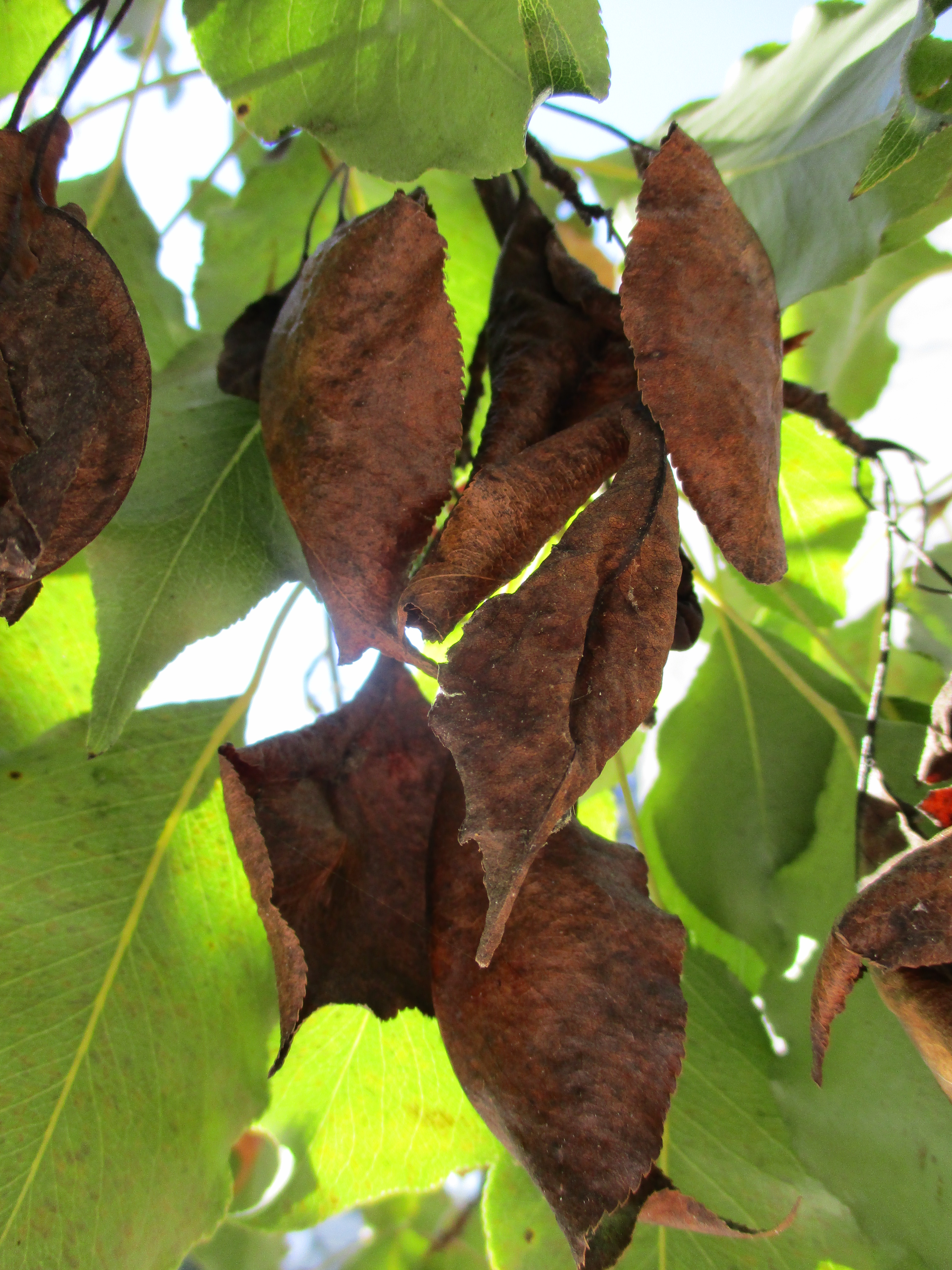
61005thumbBunches of blackened leaves hanging from blackened stems in otherwise healthy pear trees really are as serious as they look. They probably appeared as new growth was developing in spring, and are still as dead now as they were then. As surrounding foliage colors and falls, the blackened foliage will remain until it gets knocked out by rain and wind in winter, or until it gets pruned out.

Because these dead bits seem to have been scorched by fire, the bacterial infection that causes them is known as ‘fireblight’. Pear, flowering pear and evergreen pear are most susceptible to it. Apple, flowering crabapple, quince, flowering quince, hawthorn, loquat, cotoneaster, pyracantha and photinia are also very susceptible. Some cultivars are more resistant to fireblight than others. Few other members of the ‘rose family’ are rarely infected.

At the base of each dead bit (or toward the supporting limb from dead bits that do not stand upright) is a lesion where the bacteria that cause fireblight infected the stem. These infections not only obstruct vascular activity and kill the distal (outward) portion of the infected stems, but they also spread proximally (inward) to more important limbs, branch unions and even main trunks and roots.

Fireblight is transmitted mostly by bees, and also by other insects, birds, rain and wind, while trees are blooming in spring. It most often infects through flowers, and can also infect where infected debris, particularly falling flower parts, get caught in branch unions. If it infects root suckers, it can infect the roots right away, and kill an entire tree. Root suckers should be pruned away anyway.

There is no remedy for fireblight. Because it is very contagious, all infection should be pruned out. Because infection extends inward from obvious lesions, infected stems should be pruned back at least a foot and a half below (inward from) obvious infection. Sadly, this often disfigures infected trees, sometimes severely. Pruning scraps should be removed from around susceptible trees.

Some say that fireblight should be pruned out in summer. Others say that winter is best. Really though, the only bad time is spring, while weather is warm but still damp, and the trees that are so susceptible to fireblight are active and blooming. The reason for pruning it out in winter is that the disease is inactive while cold. However, it does not get cold enough here to slow it down much.